
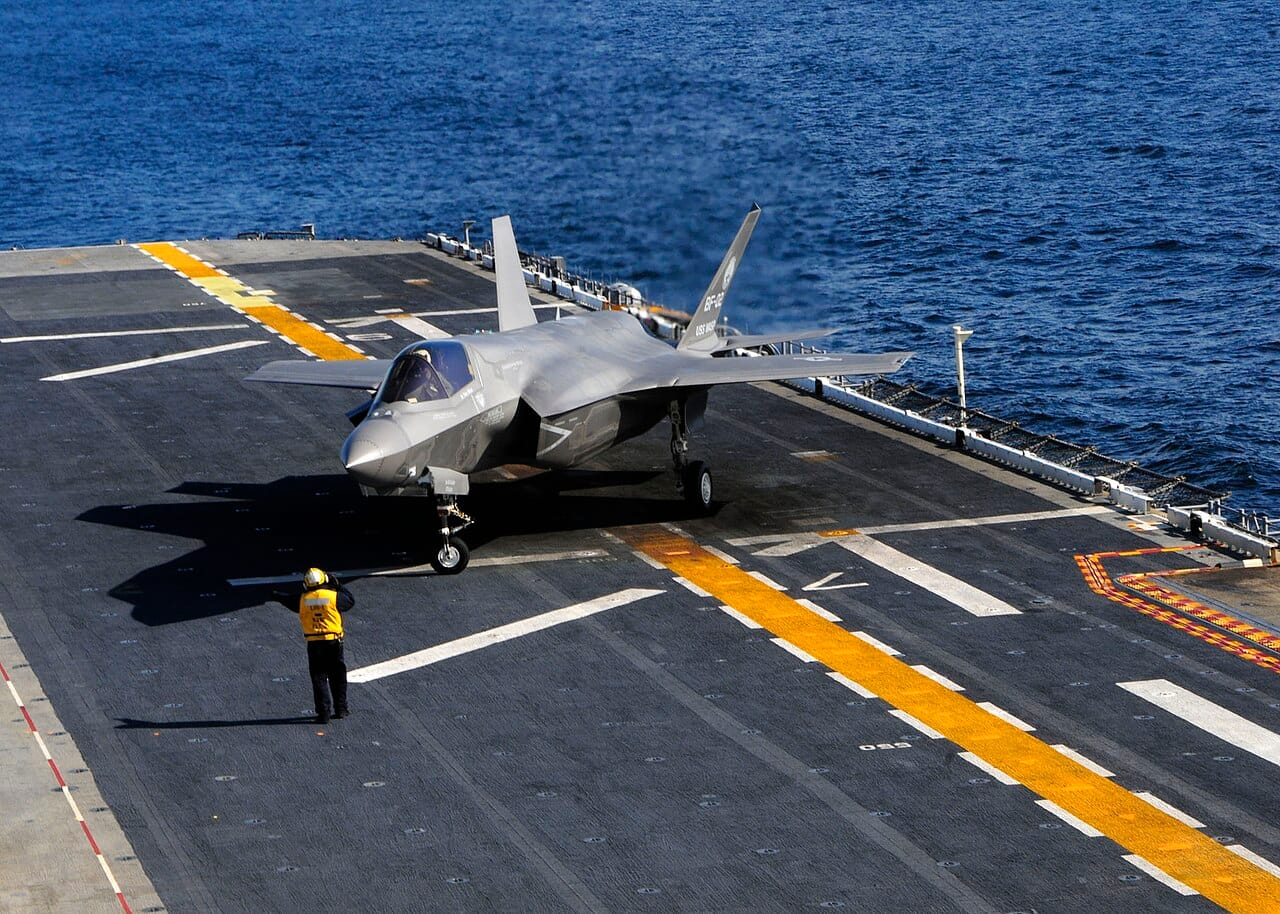
For more than a decade, the UK’s F-35B Lightning II programme has been chasing a single technical milestone that politicians, MPs, and the Royal Air Force itself have all asked about repeatedly: when will the F-35B be able to actually fire a British weapon. The Lightning was sold to the British public on the promise of a flexible, multi-role strike fighter. For most of its first decade in RAF service, the aircraft has gone without a British stand-off missile in its internal stealth bays, its strike punch limited to the short-range Paveway IV guided bomb. That changed earlier this year at NAS Patuxent River, Maryland, where a Royal Navy lieutenant commander took an F-35B into the air with four MBDA SPEAR 3 miniature cruise missiles tucked into a single weapons bay. The announcement, held back until 21 May 2026, marks the first time the British missile has ever flown on board the F-35.
Quick Facts
| Weapon | MBDA SPEAR 3 — 100 kg-class miniature cruise missile |
| Range | > 140 km |
| First flight on F-35B | January 2026, NAS Patuxent River, Maryland |
| Test pilot | Lt Cdr Nick Baker, Royal Navy, UK Air & Space Warfare Centre |
| Loadout | 4 SPEAR 3 in one weapons bay (inert munitions) |
| Full capacity per aircraft | Up to 8 SPEAR 3 internally — all stealth-compatible |
| Operational capability target | Early 2030s |
A British weapon on a British F-35
The British F-35 Lightning fleet — 48 aircraft currently in service with the RAF and Royal Navy, with a further order of 27 placed in 2025 to reach an eventual fleet of around 138 — has, until now, fielded a limited weapons set: American AIM-120 AMRAAMs for air-to-air and British-built Paveway IV laser-guided bombs for ground attack. The lack of a stand-off strike weapon has been a vulnerability for which the programme has been repeatedly criticised, including by the UK’s National Audit Office.
SPEAR 3 changes that. The weapon is the smallest cruise missile of its class — 100 kg in launch weight, 1.8 metres long — and was designed from the outset to fit four-deep in a single F-35 weapons bay. With both bays loaded, the F-35B can carry eight SPEAR 3 missiles internally, with no compromise to its stealth signature. Each missile has a turbojet engine, a range exceeding 140 km, and a multi-mode seeker capable of finding moving targets in poor weather. The data link allows in-flight retargeting and salvo coordination across multiple missiles — a feature MBDA calls Orchestrike.
The unsung British test pilot
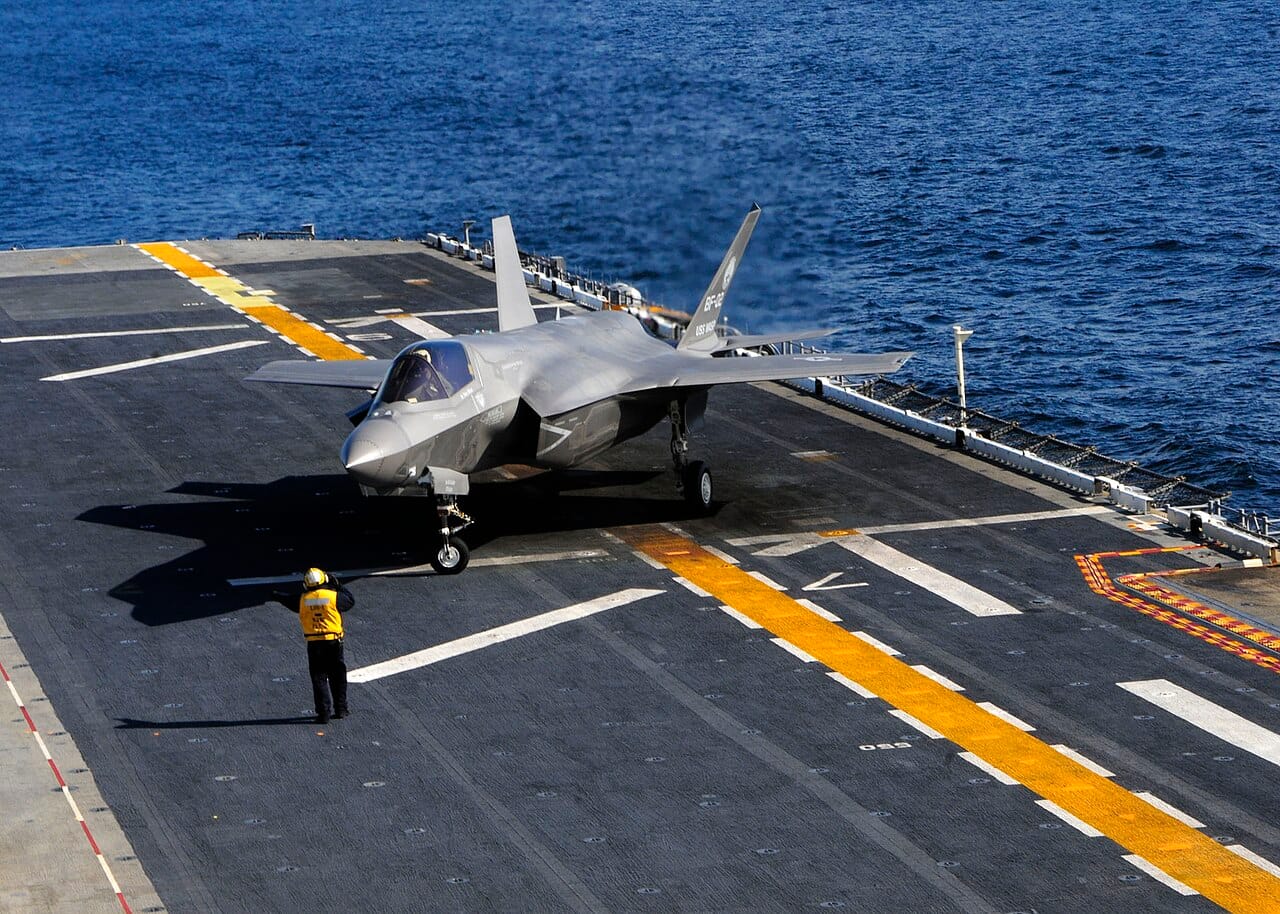
The pilot for the flight was Lieutenant Commander Nick Baker of the Royal Navy, currently serving with the UK Air & Space Warfare Centre. Baker is best known in aviation circles as the first British pilot to land an F-35B on board a Japanese warship — the JS Kaga, in October 2024 — during an integrated Indo-Pacific deployment. The SPEAR 3 sortie was conducted from NAS Patuxent River in Maryland, where the F-35 Integrated Test Force operates the only fully-instrumented F-35B test articles capable of supporting weapons integration.
Why it has taken so long
The SPEAR 3 programme was launched by the UK Ministry of Defence in 2010. Sixteen years later, it has finally completed its first flight on its primary platform. The delay has been the subject of furious internal debate at MoD Main Building: was the slip due to MBDA, due to Lockheed Martin’s F-35 Joint Program Office, due to the UK Treasury’s annual budget cycles, or simply due to the staggering complexity of integrating a new weapon into the F-35’s ALIS / ODIN logistics and maintenance backbone?
The answer is “all of the above.” Every new weapon integration on the F-35 has to be funded and approved separately, has to be coded into the aircraft’s flight control software in close coordination with Lockheed, has to be tested with both inert and live rounds at Edwards and Patuxent River, and has to be certified for safe carriage and release before it can enter operational service. SPEAR 3 remains years away from operational capability — that target of “early 2030s” is not a euphemism. It is, by F-35 weapons integration standards, normal.
What the British F-35 fleet can now do
By the early 2030s, when SPEAR 3 reaches initial operating capability on the RAF and Royal Navy Lightning fleets, each F-35B will be able to launch eight independent precision cruise missiles in a single sortie, each with a 140 km stand-off range and the ability to coordinate target prosecution among themselves. A flight of four F-35Bs, returning from a single sortie, will have 32 cruise missiles at their disposal. The strike geometry against, for example, a Russian missile battery in Kaliningrad or a Chinese surface group in the South China Sea changes fundamentally with that arithmetic. The Royal Navy and RAF can now plausibly say that an F-35B at sea or operating from a forward base can put a credible deep-strike capability on station — without requiring American weapons, American clearances, or American consent.
The same architecture that supports SPEAR 3 can be extended to other British weapons in development: SPEAR-EW (an electronic warfare variant for suppressing enemy air defences), SPEAR Glide (an unpowered variant that trades range for a larger warhead), and the longer-range STRATUS missile programme. The January 2026 SPEAR 3 sortie at Patuxent River is the proof of concept that the F-35 software stack is finally British-weapon-compatible. That alone makes it one of the more strategically significant flights of the year.
RAF F-35B Lightning and HMS Queen Elizabeth on Exercise Atlantic Trident — Royal Navy and Royal Air Force F-35Bs of 617 (Dambusters) Squadron operating from the British carrier strike group.
Sources: The Aviationist; UK Defence Journal; FlightGlobal; Breaking Defense; Janes Defence; Aviation Week; MBDA UK; Royal Air Force public releases.
Related Posts

 English
0 Comments