
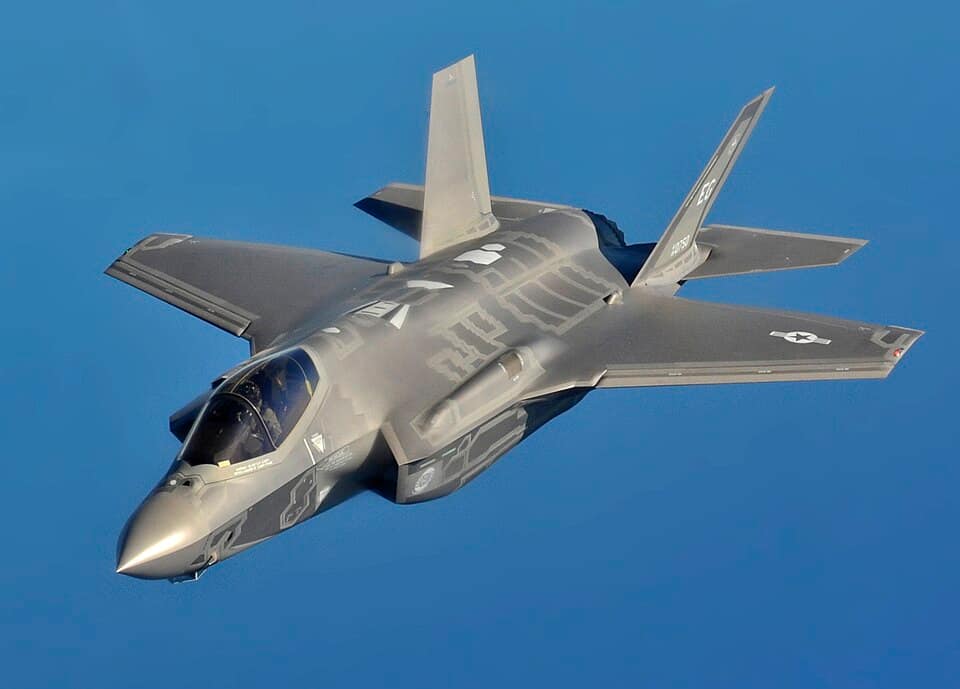
On May 14, Israel’s Ministry of Defense signed a $34 million contract with Cyclone, a subsidiary of Elbit Systems, to develop and integrate external fuel tanks for the F-35I Adir. It is a deal born not of peacetime planning but of hard operational lessons — lessons written in jet fuel and flight hours over the intensive combat sorties of Operation Rising Lion.
The tanks will be based on an existing Cyclone design originally developed for the F-16. Conformal fuel tanks — shaped to hug the airframe closely enough to preserve the Adir’s all-important low-observable signature — have also been studied for the F-35I, although they are not a confirmed part of this contract. The goal is to give the F-35I the range to reach Tehran and return without tanker support — a capability that transforms the strategic calculus of the entire Middle East.
📦 Contract value: $34 million
🇧🇦 Contractor: Cyclone (Elbit Systems subsidiary)
📅 Signed: May 14, 2026
⛽️ Drop tanks: Based on a Cyclone design developed for the F-16
🚀 Conformal tanks: Studied for the F-35I, not confirmed in this deal
🎯 Objective: Tehran-range missions without aerial refueling
📊 Based on: Lessons from intensive Operation Rising Lion sorties
From Operational Necessity to Industrial Reality
The external drop tanks are the more conventional solution. Mounted on underwing pylons, they can be jettisoned before entering contested airspace, allowing the Adir to shed weight and drag before engaging enemy air defenses. Israeli officials have indicated that range-extending fuel tanks were already in service before the latest campaign. The Cyclone contract formalizes the development of a purpose-built, optimized design.
Conformal fuel tanks would be the more ambitious — and more consequential — option. Conformal tanks are not hung from pylons; they are shaped to conform to the aircraft’s fuselage, blending into its contours so seamlessly that they add range without significantly degrading the stealth signature. For a fifth-generation fighter whose survivability depends on remaining invisible to enemy radar, this distinction is not merely academic. It is existential.
The marriage of conformal tanks with the F-35’s low-observable design would give Israel something no external drop tank can: the ability to fly deep into denied airspace with extended range and full stealth protection. It is the difference between a fighter that can reach the target and a fighter that can reach the target unseen.
Strategic Implications: Tehran and Beyond

The strategic mathematics are straightforward. The distance from central Israel to Tehran is approximately 1,600 kilometers. A standard F-35A has a combat radius of roughly 1,100 kilometers — sufficient for regional operations but inadequate for a round trip to the Iranian capital without refueling. The conformal and external tank combination is designed to close that gap definitively.
For Iran, the implications are sobering. The 2025 campaign demonstrated that Israel possesses both the will and the capability to strike deep inside Iranian territory. The fuel tank program ensures that future operations of similar scope can be conducted with greater flexibility, less logistical complexity, and reduced dependence on allied support. It is, in the language of deterrence, a capability that speaks for itself.
For Elbit Systems and its Cyclone subsidiary, the $34 million contract represents more than revenue. It is a validation of Israel’s defense-industrial strategy — the belief that a small nation’s security ultimately depends on its ability to manufacture its own critical military technologies rather than relying solely on foreign suppliers.
Sources: Israeli Ministry of Defense, Elbit Systems press release, Jane’s Defence Weekly, The War Zone, Flight Global.


 English
0 Comments