
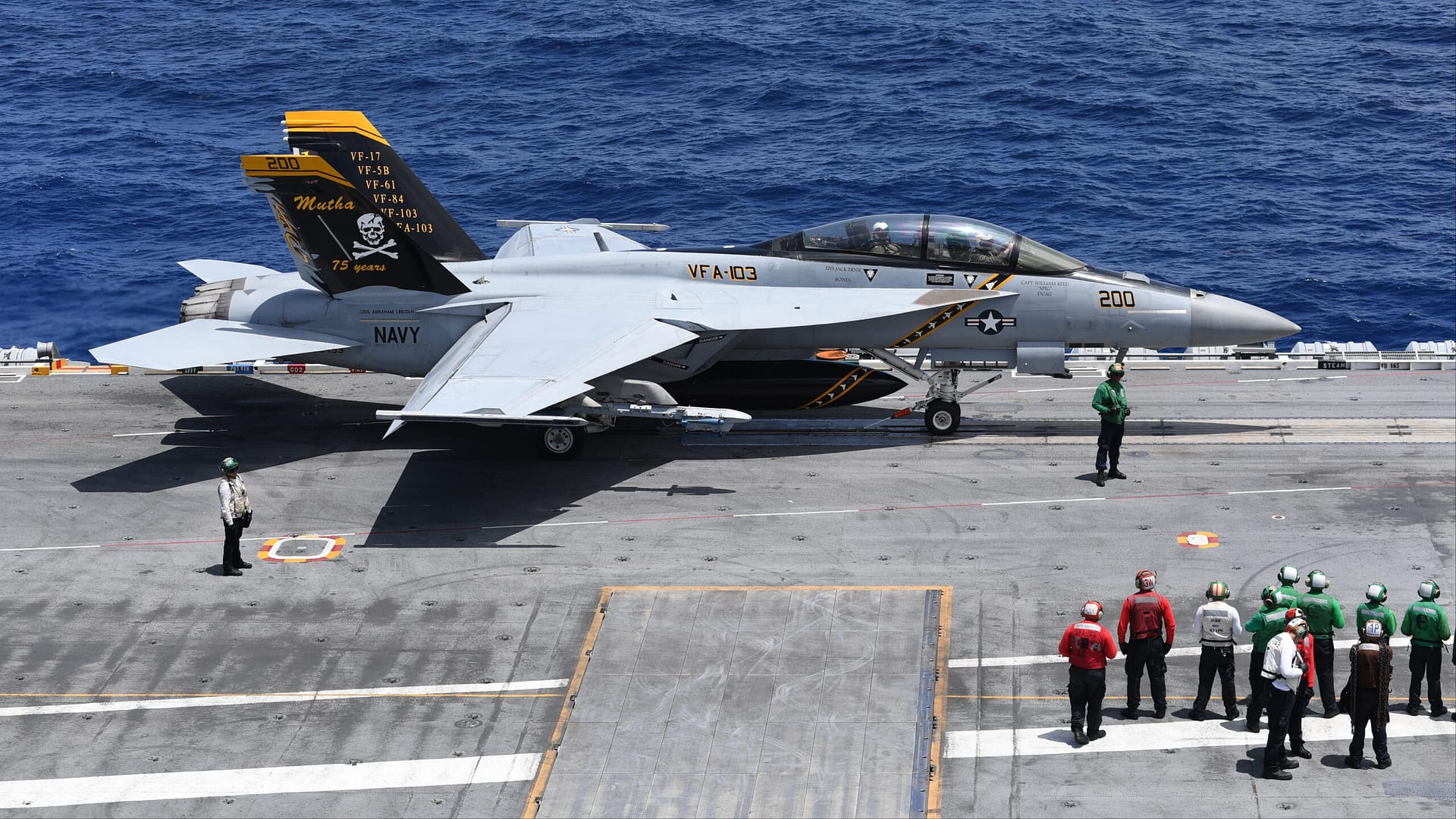
A U.S. Navy F/A-18 Super Hornet just did something that sounds like it belongs in a video game — and the Pentagon released video to prove it. On May 8, 2026, a Super Hornet from USS George H.W. Bush (CVN-77) dropped precision-guided munitions straight down the smokestacks of two Iranian tankers attempting to run the U.S. naval blockade in the Gulf of Oman.
The targets — M/T Sea Star III and M/T Sevda — were heading for an Iranian port in direct violation of the ongoing blockade. CENTCOM released footage of the strike within hours. The munitions entered through the smokestacks and disabled the ships’ propulsion systems. Neither vessel was sunk. Both were surgically neutralized.
This came two days after a separate Super Hornet from USS Abraham Lincoln (CVN-72) blasted the rudder off the M/T Hasna with 20mm cannon fire on May 6. The Navy appears to have found its preferred recipe for tanker interdiction: cannon to the rudder, precision bomb down the stack.
• Smokestack strikes: May 8, 2026 — M/T Sea Star III and M/T Sevda disabled
• Shooter: F/A-18 Super Hornet from USS George H.W. Bush (CVN-77)
• Weapon (assessed): GBU-54 Laser JDAM — 500-lb precision bomb with GPS + laser guidance
• May 6 strike: M/T Hasna rudder disabled by 20mm cannon fire from USS Abraham Lincoln
• Blockade: 20+ warships enforcing; 61+ commercial vessels redirected
• Blockade declared: April 13, 2026
• Result: Both tankers dead in the water; neither reached an Iranian port
Threading the Needle: How You Bomb a Smokestack
The weapon most analysts believe was used is the GBU-54 Laser JDAM — a 500-pound bomb combining GPS and inertial navigation with a laser seeker for terminal precision against moving targets. Hitting a smokestack — a narrow vertical tube maybe six feet across — requires exactly the kind of steep approach angle the GBU-54’s laser seeker provides. From a fighter jet doing several hundred knots. On a moving ship.
The operational logic: disable propulsion without sinking the vessel, keep the crew alive, avoid an environmental disaster in the world’s most-watched oil shipping lane, and send a message to every other tanker captain thinking about running the blockade.

Examining the released footage, Mercogliano noted that the munitions hit the ships in the lower portion or base of their smokestacks — a strike aimed at propulsion, not at destroying the hull.
May 6: The Opening Act With a Cannon
Two days earlier, a Super Hornet from USS Abraham Lincoln caught the M/T Hasna and opened up with its M61A2 Vulcan 20mm cannon, targeting the rudder. Multiple rounds, precise enough to disable steering without destroying the vessel. That first interdiction was historic — the first time U.S. naval aircraft had fired on a vessel in this theatre in living memory.
The May 8 strikes escalated the methodology considerably. Cannon fire on a rudder is intimate. Dropping a precision bomb down a smokestack from altitude is a different statement entirely — it says the Navy can disable your ship from a range you’ll never see coming.
The Strait of Hormuz: Why the World Is Watching
20 Warships, 61 Vessels Redirected
More than 20 U.S. warships are enforcing the blockade, with Abraham Lincoln and George H.W. Bush providing carrier aviation muscle. At least 61 commercial vessels have been redirected without a shot fired. CENTCOM states that U.S. forces have prevented more than 70 tankers from accessing Iranian ports, collectively representing over 166 million barrels of oil — more than $13 billion in export revenue denied to Tehran.
The blockade was declared on April 13, 2026, as part of the Trump administration’s maximum-pressure campaign following the February 28 U.S.-Israel air campaign against Iran. The Strait of Hormuz is where economic pressure and naval airpower intersect.
The Super Hornet’s Moment
In a year when the F-35C has been grabbing headlines, the Super Hornet just reminded everyone why it’s still on the flight deck. The Block III Super Hornet — with conformal fuel tanks, updated AESA radar, and enhanced weapons integration — is a significantly more capable machine than what the Navy flew in the early 2000s.
Two carriers. Multiple Super Hornets. Three tankers disabled. Zero sunk. Zero crew casualties reported. CENTCOM video released within hours. This is the U.S. Navy showing the world exactly what precision naval airpower looks like — and choosing, with restraint, not to do more than the mission requires.
Sources: U.S. Central Command | Stars and Stripes | Navy Times | Military Times | CNN | Task & Purpose
• Experience a Fighter Jet Flight with MiGFlug

 English
0 Comments