

Bill Allen, Boeing’s president, was watching the hydroplane races on Lake Washington from a company yacht on 7 August 1955. The new Boeing 367-80 — the prototype of what would become the 707 — was scheduled to fly overhead in a demonstration for potential airline customers. Allen watched the aircraft appear on the horizon. Then he watched it roll. A complete barrel roll, in a jet aircraft the size of a commercial airliner, at low altitude, in front of 200,000 spectators. He went pale. Then it rolled again.
Full name: Alvin Melvin “Tex” Johnston (1914–1998)
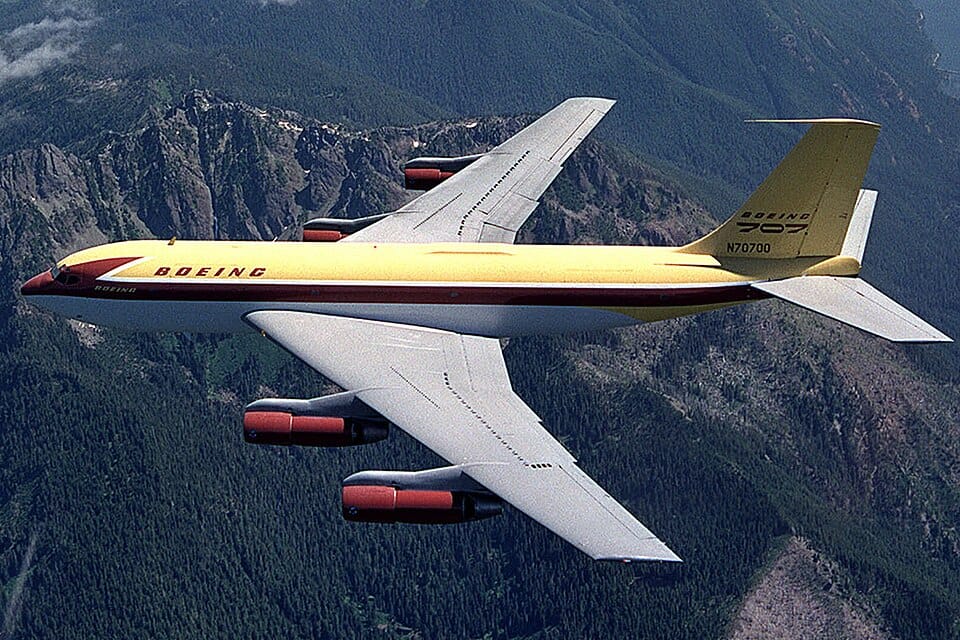
Aircraft: Boeing 367-80 (“Dash 80”) — prototype of the Boeing 707
Date of barrel roll: 7 August 1955
Location: Over Lake Washington, Seattle, during the Gold Cup hydroplane races
Audience: Approximately 200,000 spectators plus airline executives
Number of rolls: Two (one on each pass)
Boeing president’s reaction: Called Johnston into his office the next morning
Johnston’s defence: A barrel roll is a 1-G manoeuvre — the aircraft experiences no stress beyond normal flight

The Dash 80: Boeing’s Gamble on the Jet Age
To understand why Tex Johnston barrel-rolled a prototype airliner, you have to understand what the Boeing 367-80 represented. In 1952, Boeing made the most expensive corporate gamble in aviation history: the company invested $16 million of its own money — roughly $185 million in today’s dollars — to build a jet transport prototype without a single customer order. Douglas, Lockheed, and Convair were all developing propeller-driven airliners. Boeing bet everything on jets.
The Dash 80, as it was known internally, first flew on 15 July 1954. It was a swept-wing, four-engine jet that could carry passengers at 550 mph — nearly twice the speed of existing propeller airliners. Boeing needed to sell it to the airlines, and the August 1955 Gold Cup hydroplane races on Lake Washington provided the perfect venue. Hundreds of thousands of spectators would be watching the sky. Airline executives from around the world were Boeing’s guests on company boats. A flyover by the Dash 80 would demonstrate the aircraft’s grace, power, and reliability.
What Boeing’s president did not authorize was a barrel roll.
The Roll
Johnston had planned the manoeuvre in advance. He later explained that a barrel roll is a 1-G manoeuvre — the aircraft follows a helical path through the air, and at no point does it experience forces beyond those of normal flight. A glass of water on the instrument panel would not spill. The wings are not stressed beyond their design limits. Aerodynamically, a barrel roll in a swept-wing jet is safer than a steep turn.
None of this mattered to Bill Allen. The Boeing president, watching from his yacht with a boatload of airline customers, saw his company’s sole prototype — the aircraft upon which Boeing’s entire commercial future depended — roll upside down at low altitude over a lake. According to multiple accounts, Allen reached for his heart medication. When Johnston came around for a second pass and rolled the aircraft again, Allen’s reaction was not recorded in language suitable for a corporate history.
“Don’t Ever Do That Again”
The next morning, Johnston was called into Allen’s office. The exchange that followed has become one of aviation’s most famous conversations. Allen told Johnston, in no uncertain terms, never to do that again. Johnston’s reported response was characteristic of the man: he said he was just selling airplanes. The barrel roll had, in fact, made exactly the impression Johnston intended — every airline executive on the lake had seen a jet airliner perform a manoeuvre that demonstrated complete confidence in its structural integrity and handling qualities. The Dash 80 was not just fast; it was agile, responsive, and strong enough to be rolled by its test pilot in front of a quarter-million witnesses.
Johnston was not fired. Boeing could not afford to lose its best test pilot over a stunt that had, in retrospect, done more to sell the 707 than any marketing campaign could have. The airlines began placing orders. The 707 entered service with Pan American World Airways in 1958 and transformed commercial aviation. Boeing became the dominant force in commercial aircraft manufacturing — a position it held for decades.

The Man Behind the Roll
Alvin Melvin “Tex” Johnston was born in Admire, Kansas, in 1914. The nickname came from his years of working in Texas oilfields before he learned to fly. He became one of the most accomplished test pilots of the jet age, testing not only the Dash 80 but also the B-52 Stratofortress and the Boeing 727. He won the Thompson Trophy at the 1946 National Air Races, flying a modified P-39 Airacobra. He was, by all accounts, a supremely confident pilot who understood aircraft at an intuitive level that few of his contemporaries could match.
After leaving Boeing in 1968, Johnston worked as an aviation consultant and wrote his autobiography, Tex Johnston: Jet-Age Test Pilot. He died in 1998 at the age of 84. The Dash 80 — the aircraft he rolled — is now preserved in the Smithsonian National Air and Space Museum’s Steven F. Udvar-Hazy Center, where it hangs in permanent testimony to both Boeing’s gamble on the jet age and one test pilot’s very personal definition of a sales demonstration.
Related Questions
Who barrel-rolled the Boeing 707 prototype?
Test pilot Alvin "Tex" Johnston barrel-rolled the Boeing 367-80 — the prototype of the 707 — on 7 August 1955. He did it over Lake Washington in Seattle in front of around 200,000 spectators and airline executives, without telling Boeing's bosses beforehand.
Did Boeing approve the 707 barrel roll?
No. Tex Johnston rolled the prototype on his own initiative during a public display. Boeing president Bill Allen, watching from the ground, was stunned and called Johnston into his office the next morning to explain himself.
Was the 707 barrel roll dangerous?
Johnston argued it wasn't. He explained that a properly flown barrel roll is a "1-G manoeuvre" — the aircraft and everything in it feel normal gravity throughout, so the airframe is never overstressed. He performed two rolls, one on each pass, to demonstrate the jet's confidence.
Why did Tex Johnston roll the Boeing 707?
To show off the new jet's strength and stability to the airline executives watching the Seattle hydroplane races. The dramatic stunt was effectively a sales demonstration, helping convince the industry that Boeing's jetliner was safe and capable.
What aircraft did Tex Johnston barrel-roll?
He rolled the Boeing 367-80, nicknamed the Dash 80 — the prototype that led to the Boeing 707 airliner and the KC-135 tanker. Its famous 1955 roll became one of the most legendary moments in aviation history.
0 Comments