
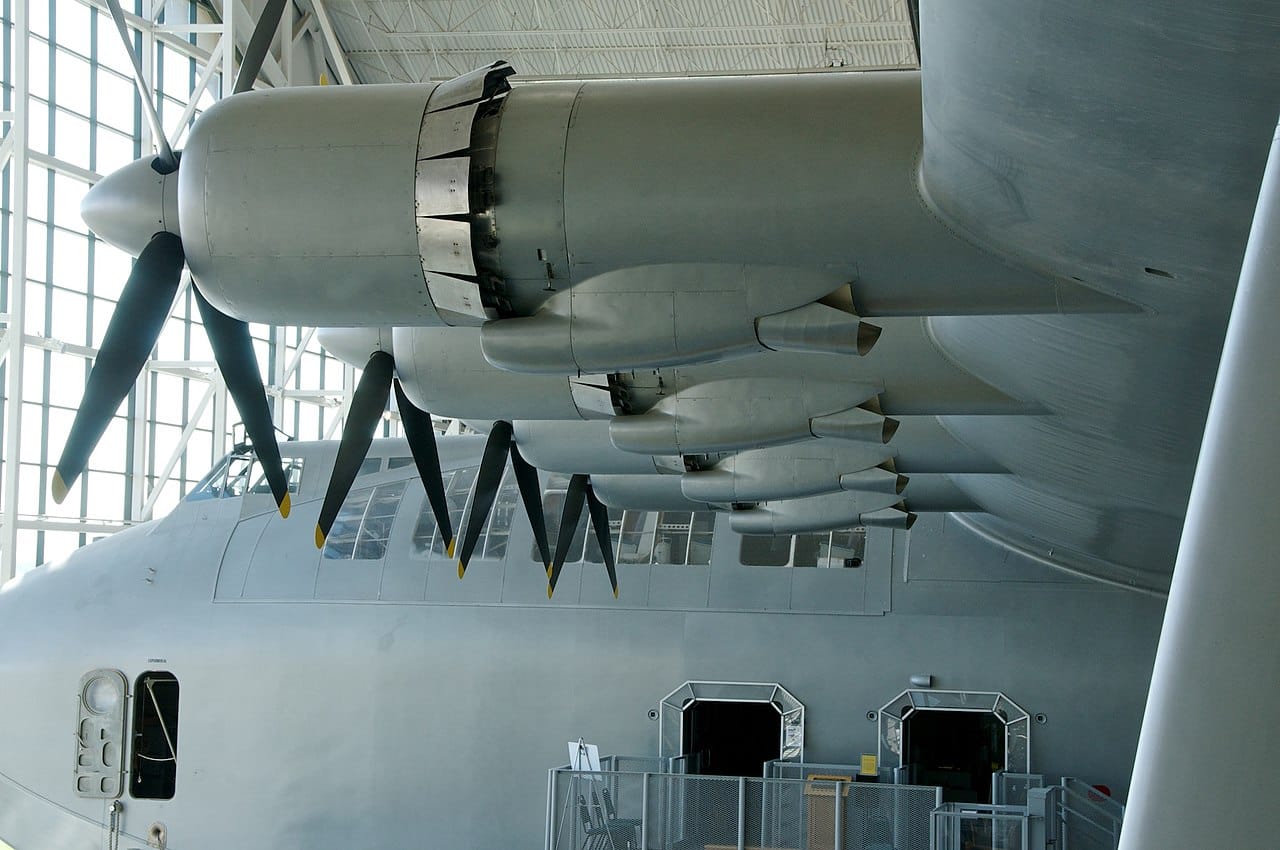
On November 2, 1947, the largest flying boat ever built lifted off the water of Long Beach Harbor, flew for about a mile at seventy feet, and never flew again. In that single minute, Howard Hughes won an argument that had nearly destroyed him.
The Hughes H-4 Hercules — mocked as the "Spruce Goose" — had a wingspan of nearly 98 metres, a record that would stand until the Stratolaunch flew in 2019. Critics in Congress called it a colossal waste of wartime money that would never leave the water. Hughes, at the controls himself, proved them wrong with the whole world watching.
Quick Facts
- Aircraft: Hughes H-4 Hercules ("Spruce Goose")
- Wingspan: ~97.5 m (320 ft) — largest of any aircraft until 2019
- Built from: birch, not spruce (wartime metal was restricted)
- Engines: eight radial piston engines
- Only flight: November 2, 1947, Long Beach — ~1 mile at ~70 ft
- Today: Evergreen Aviation Museum, McMinnville, Oregon
Wood, War, and a Wounded Reputation
The Hercules was conceived during World War II to ferry troops and cargo across an Atlantic infested with U-boats — without using the aluminium the war effort desperately needed. So Hughes built it largely of laminated birch. The war ended long before it was ready, and by 1947 Hughes was hauled before a Senate committee investigating whether he had squandered government millions on an aircraft that would never fly.
One Mile to Make a Point
During what was billed as a taxi test, Hughes pushed the throttles, and the giant lifted clear of the water. He had staked everything on it.
It never flew again, but it never had to. Hughes kept the Hercules in a climate-controlled hangar for the rest of his life, maintained by a full-time crew. The "Spruce Goose" became the ultimate monument to one man's stubbornness — an aircraft that flew exactly once, and is remembered forever.
The original 1947 newsreel footage above shows the moment the giant actually left the water.
Sources: Smithsonian National Air and Space Museum; Evergreen Aviation Museum; U.S. Senate hearing records.
Related Questions
What was the Spruce Goose?
The Spruce Goose was Howard Hughes's H-4 Hercules, a gigantic wooden flying boat built in the 1940s. With a wingspan of about 320 feet (97.5 m), it was the largest aircraft in the world — a record it held until 2019 — yet it flew only once.
Was the Spruce Goose actually made of spruce?
No — despite the nickname, it was built mostly of birch. Wartime restrictions on metals like aluminium forced Hughes to use laminated wood, and Spruce Goose was a catchy but inaccurate name the press gave the giant flying boat.
Did the Spruce Goose ever fly?
Yes, but only once. On 2 November 1947, Howard Hughes himself lifted the Hercules off the water at Long Beach, California, flying about a mile at roughly 70 feet of altitude. It never flew again.
How big was the Spruce Goose?
Its wingspan was about 320 feet (97.5 m) — larger than that of any other aircraft until 2019. Powered by eight radial piston engines, the H-4 Hercules was designed to ferry troops and cargo across a U-boat-infested Atlantic.
Where is the Spruce Goose now?
The H-4 Hercules is preserved at the Evergreen Aviation & Space Museum in McMinnville, Oregon, where the enormous wooden flying boat remains on display as one of aviation's most famous one-flight wonders.
Related Posts
The Horten Ho 229: The Flying Wing That Was 40 Years Ahead of the B-2
The B-58 Hustler: The Mach 2 Bomber That Was Too Fast for Its Own Good


0 Comments