
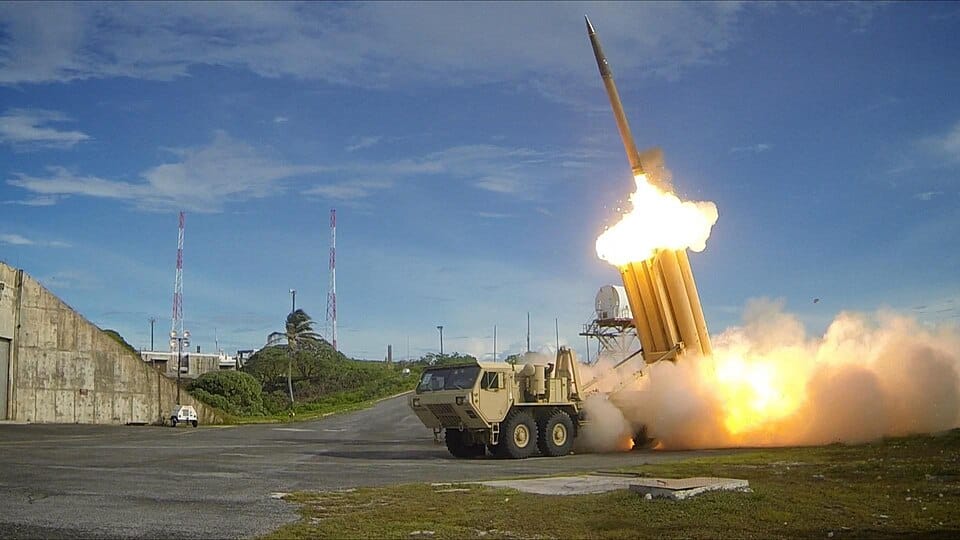
Location Near Suwayda, southwestern Syria
Condition Largely intact — seeker and kill vehicle shroud recovered close together
System Lockheed Martin THAAD — designed to intercept ballistic missiles in the terminal phase
Range 200+ km; intercepts at altitudes up to 150 km
Concern Potential intelligence loss — adversaries could reverse-engineer seeker capabilities
Context THAAD batteries are heavily engaged intercepting Iranian ballistic missiles during Operation Epic Fury

Video surfaced this week from southwestern Syria showing something that should never have been found in one piece: the infrared seeker head of a THAAD interceptor, lying in the dirt near the city of Suwayda with its housing largely intact. Beside it, the shroud that protects the kill vehicle during flight. Both recovered close together. Both in disturbingly good condition.
THAAD — the Terminal High Altitude Area Defense system — is America's premier ballistic missile killer. It is designed to intercept incoming warheads at altitudes up to 150 kilometres, using an infrared seeker to lock onto the target's heat signature in the final seconds of flight. That seeker is one of the most closely guarded pieces of technology in the U.S. defence inventory.
Now a piece of one is sitting in a field in Syria, where anyone — including intelligence services from Russia, China, or Iran — could potentially get to it.
What the Seeker Reveals
The THAAD seeker is built by BAE Systems and uses a cooled infrared focal plane array — essentially a high-resolution thermal camera optimised to pick out the faint heat signature of a ballistic missile warhead against the cold background of space. It is the critical component that allows the kill vehicle to home in during the final intercept, when there is no time for course corrections from ground radar.
Getting access to an intact seeker would give an adversary detailed insight into its detection range, resolution, wavelength sensitivity, and processing algorithms. That is the kind of information that feeds directly into countermeasure design — building warheads that can defeat the seeker through decoys, thermal shielding, or manoeuvring profiles it cannot track.
The Pentagon signed a deal with BAE Systems and Lockheed Martin in March to quadruple THAAD seeker production — a measure of how heavily the system is being used against Iranian ballistic missiles. Every interceptor fired is a seeker that lands somewhere. Most are destroyed on impact. This one was not.

How It Got There
The debris was found near Suwayda in southwestern Syria — not in Iran, where THAAD batteries are actively engaged, but across the border. That geography suggests the seeker came from an intercept of an Iranian missile that passed over or near Syrian airspace, with debris falling across the border.
The fact that the kill vehicle and its shroud were recovered so close together and in relatively intact condition points to a possible failure — an interceptor that did not function as designed, with the kill vehicle separating from its booster but failing to complete the intercept sequence. The exact circumstances remain unknown.
What happened to the debris after the video was shot is also unclear. Syrian territory is a patchwork of government-controlled zones, rebel areas, and regions where Russian and Iranian forces operate. The seeker could already have been picked up by any number of actors — or it could still be sitting in a field.
A Growing Problem
This is not the first time sensitive U.S. missile technology has turned up where it should not be. Interceptor debris has been recovered in conflict zones before. But the THAAD seeker represents a particularly high-value intelligence target — the system is the backbone of American missile defence in the Middle East and the Pacific, and its effectiveness depends on adversaries not knowing exactly how it sees.
As Operation Epic Fury continues and THAAD batteries keep firing, more debris will fall. Some of it will land in places where recovery is impossible. The race to understand what was found near Suwayda — and who got to it first — is almost certainly already underway.
Sources: The War Zone, Defense News, Army Recognition
Related Questions
What is THAAD?
THAAD, or Terminal High Altitude Area Defense, is a US missile-defence system built to shoot down ballistic missiles in their final, "terminal" phase of flight. Built by Lockheed Martin, it uses a hit-to-kill interceptor that destroys incoming warheads by direct impact at high altitude, protecting cities and bases from missile attack.
Who makes the THAAD missile defense system?
THAAD is manufactured by Lockheed Martin, with the system's powerful AN/TPY-2 radar built by Raytheon. It is one of the most advanced layers of US and allied missile defence, deployed to protect against short- and medium-range ballistic missile threats.
How does THAAD intercept ballistic missiles?
THAAD uses "hit-to-kill" technology: its interceptor carries no explosive warhead and instead destroys a target by slamming into it at very high speed. An infrared seeker guides the kill vehicle onto the incoming warhead during the terminal phase, with intercepts possible at altitudes up to around 150 kilometres.
What is the range of the THAAD system?
The THAAD interceptor has a reported range of more than 200 kilometres and can engage targets at altitudes up to about 150 kilometres, placing it between lower-tier systems like Patriot and higher-tier exo-atmospheric defences. During the Iran air campaign, THAAD batteries were heavily engaged against missiles threatening high-value US assets.
Why is a recovered THAAD seeker a security concern?
The infrared seeker is among the most sensitive parts of an interceptor, and finding one largely intact raises the risk that an adversary could reverse-engineer its capabilities. A similar worry surrounded other American missile technology found intact in Syria, where recovered hardware could expose closely guarded design secrets.


0 Comments