

On the night of 16–17 May 1943, nineteen specially modified Avro Lancaster bombers roared across the English Channel at treetop level, carrying a weapon that defied every known principle of aerial bombardment. Their target: the massive hydroelectric dams of Germany’s industrial Ruhr Valley. Their weapon: a cylindrical bomb designed to skip across the water like a stone. The men of 617 Squadron were about to execute one of the most audacious precision strikes in military aviation history—and many of them would not return.

Quick Facts
- Operation: Chastise
- Date: 16–17 May 1943
- Unit: No. 617 Squadron RAF
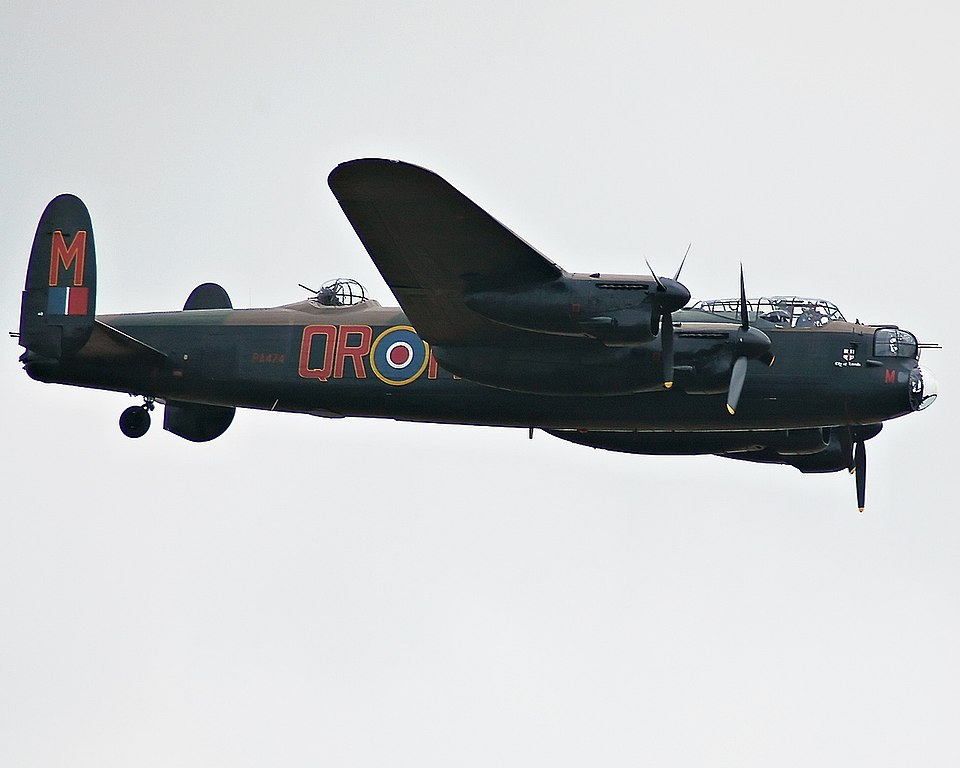
- Aircraft: 19 Avro Lancaster B III (Special)
- Commander: Wing Commander Guy Gibson, DSO & Bar, DFC & Bar
- Weapon: Upkeep bouncing bomb (Barnes Wallis)
- Targets: Möhne, Eder, and Sorpe Dams
- Result: Möhne and Eder dams breached; 8 of 19 aircraft lost
- Casualties: 53 aircrew killed, 3 captured
Barnes Wallis and the Impossible Bomb
The idea of attacking Germany’s dams was not new. British planners had identified the Ruhr dams as critical infrastructure early in the war—the Möhne and Sorpe reservoirs alone supplied 75 percent of the water needed by the steel mills, coking plants, and armaments factories that kept the Wehrmacht fighting. But destroying a dam presented a seemingly unsolvable engineering problem. Conventional bombing from altitude was hopelessly inaccurate, and the dams were far too massive to be damaged by anything short of a direct, concentrated blast against their foundations.
Enter Barnes Wallis, Vickers’ chief designer of structures and a man whose engineering brilliance was matched only by his stubborn persistence. Wallis had already designed the geodetic framework that made the Wellington bomber remarkably resilient. Now, he turned his attention to the problem of dam destruction with the methodical intensity of an obsessive. His calculations showed that to breach the Möhne Dam—a gravity structure 40 metres thick at its base—an explosive charge would need to detonate while pressed against the dam wall, deep underwater, where hydrostatic pressure would amplify the blast.

The solution was breathtaking in its elegance and apparent madness. Wallis designed a cylindrical bomb that would be spun backwards at 500 rpm before release. Dropped from exactly 60 feet at a precise speed of 232 mph, the backspin would cause it to skip across the water surface—bouncing over any torpedo nets—until it struck the dam wall. The backspin would then make it roll down the face of the dam before a hydrostatic fuse detonated 6,600 pounds of Torpex at a depth of 30 feet. The physics were elegant. The practical requirements were terrifying.
Forming 617 Squadron
With the weapon under development, Bomber Command needed crews capable of the extraordinary precision the attack demanded. In March 1943, No. 617 Squadron was formed at RAF Scampton under the command of 24-year-old Wing Commander Guy Gibson, already one of Bomber Command’s most decorated pilots with over 170 operational sorties to his name. Gibson hand-picked his crews from across Bomber Command’s squadrons, selecting men with proven skill in low-level navigation and bombing.
The training that followed was brutal and relentless. Crews practiced low-level flying over the English lakes and reservoirs, learning to hold their Lancasters at exactly 60 feet above the water in total darkness. The altitude problem was solved with elegant simplicity: two Aldis lamps were fitted to each aircraft, angled so their beams converged on the water surface at precisely 60 feet. When the two spots of light merged into one, the navigator called the height. For range, a simple Y-shaped wooden sight was calibrated to the towers of the target dams—when the towers aligned with the nails on the sight, the bomb aimer pressed the release.
The Night of 16 May 1943
At 21:28, the first wave of nine Lancasters took off from Scampton, led by Gibson himself. They flew in three formations of three, skimming the waves of the North Sea at 100 feet to avoid German radar, then threading their way through the flak corridors of occupied Europe at treetop height. A second wave of five aircraft had departed minutes earlier, tasked with attacking the Sorpe Dam via a longer northern route. A mobile reserve of five more Lancasters would follow, to be directed as needed.
The flight in was harrowing. Flying at 100 feet in darkness over enemy territory, the slightest navigational error could mean a hillside or a church steeple. Two aircraft of the second wave struck the sea and were lost. Another hit power lines and had to turn back with its bomb torn away. One more was shot down by flak. Of the five Sorpe-bound Lancasters, only two would reach their target.
Breaching the Möhne
Gibson’s first wave reached the Möhne Dam shortly after midnight. The dam was a colossal wall of masonry stretching over 600 metres, with two flak towers bristling with 20mm guns. Gibson attacked first, running in at 60 feet over the mirror-smooth reservoir while every gun on the dam poured fire at his Lancaster. His bomb bounced three times, struck the dam, and sank—but the resulting geyser of water, while spectacular, did not breach the wall.
Flight Lieutenant Hopgood attacked next. His Lancaster was hit on the approach, catching fire, and his bomb released too late, bouncing over the dam and destroying the powerstation below. Hopgood’s Lancaster crashed in flames moments later—only two of his crew survived. Flight Lieutenant Martin attacked third. His bomb struck the dam but again did not breach it. Then Squadron Leader Young made his run, his Upkeep detonating squarely against the wall. Still the dam held.
On the fifth attack, Flight Lieutenant Maltby released his bomb perfectly. As the vast column of water subsided, Gibson saw it: a breach in the dam, and through it a torrent that would carve a path of destruction down the Möhne Valley for 50 miles. Gibson radioed the codeword back to Bomber Command headquarters, where Barnes Wallis and Air Chief Marshal Arthur Harris waited: “Nigger”—the dam was breached.
The Eder and Sorpe
With three aircraft still carrying their bombs, Gibson led them to the Eder Dam, 60 miles southeast. The Eder was undefended by flak but presented a nightmare approach: a steep hillside above the reservoir forced the Lancasters into a diving, turning approach that left almost no room for the precise, level run the bomb demanded. Flight Lieutenant Shannon made six aborted runs before finally releasing his bomb, which struck the dam but failed to breach it. Flight Lieutenant Knight then made one of the most skilled bombing runs of the war, placing his Upkeep precisely against the dam wall. The Eder collapsed, sending a 30-foot wall of water cascading into the valley below.
At the Sorpe, the lone Lancaster of Pilot Officer Joe McCarthy—an American serving in the RAF—attacked the earthen dam using a different technique, flying along its length rather than approaching head-on. His bomb damaged the crest but could not breach the massive earth and clay structure. Flight Sergeant Brown, the only other aircraft to reach the Sorpe, made a similar attack with similar limited results.

The Cost and the Legacy
Of the nineteen Lancasters that took off from Scampton, eight did not return. Fifty-three aircrew were killed and three were taken prisoner. The youngest was 20 years old. The losses hit 617 Squadron hard—it was a 42 percent casualty rate for a single operation, high even by Bomber Command’s grim standards.
The immediate damage was significant: the Möhne and Eder breaches unleashed over 300 million tons of water into the valleys below, destroying factories, bridges, railways, and power stations. An estimated 1,600 people were killed in the floods, including over 1,000 Allied prisoners of war and forced labourers in camps downstream—a tragic toll that has complicated the operation’s moral legacy. German industrial production in the Ruhr was disrupted for weeks, and thousands of workers were diverted from Atlantic Wall construction to repair the dams.
The strategic debate over Chastise’s long-term impact continues among historians. The Germans repaired both dams by September 1943, and some analysts argue the diversion of resources was modest compared to the cost. Others contend that the raid’s psychological impact and the demonstration of precision attack capability far outweighed the physical damage. What is beyond dispute is the extraordinary courage and skill required to execute it.
Guy Gibson received the Victoria Cross. Thirty-three other members of the squadron were decorated. Gibson was killed in action in September 1944, aged 26, during a Mosquito pathfinder mission over the Netherlands. 617 Squadron went on to become the most famous precision bombing unit in history, later deploying Barnes Wallis’s massive Tallboy and Grand Slam earthquake bombs against U-boat pens, V-weapon sites, and the battleship Tirpitz.
Sources
- Sweetman, John. The Dambusters Raid. London: Cassell, 2002.
- Holland, James. Dam Busters: The True Story of the Inventors and Airmen Who Led the Devastating Raid to Smash the German Dams in 1943. New York: Grove Press, 2013.
- Brickhill, Paul. The Dam Busters. London: Evans Brothers, 1951.
- Imperial War Museum. “Operation Chastise: The Dams Raid.” iwm.org.uk
- RAF Museum. “617 Squadron History.” rafmuseum.org.uk


 English
0 Comments