
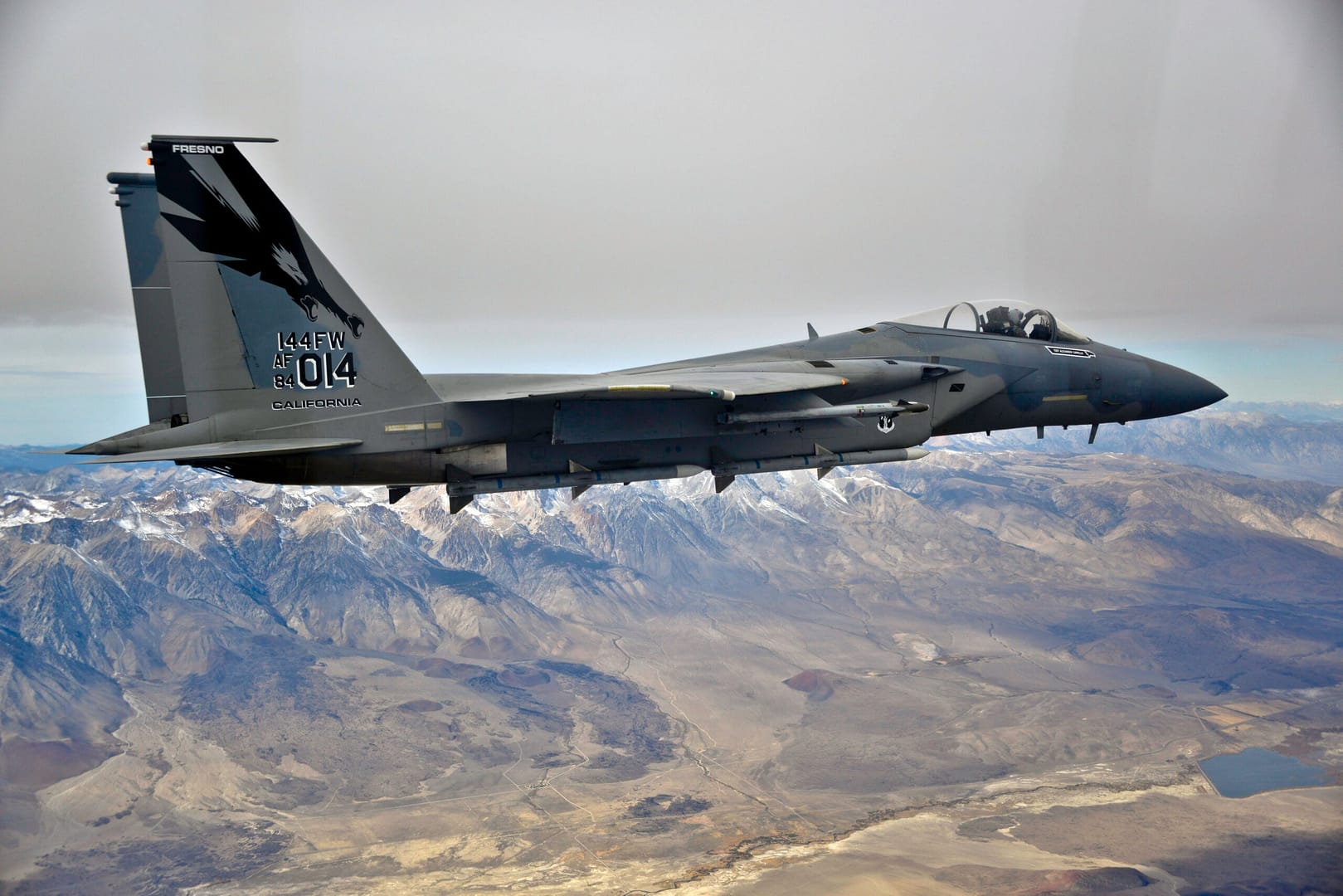
There is no fighter in the history of aerial combat that can match the F-15 Eagle's record. One hundred and four confirmed air-to-air kills. Zero losses to enemy fighters. Not a single combat loss in air-to-air engagements across more than 50 years of operations spanning three continents. No other fighter—not the Spitfire, not the Mustang, not the MiG-29, not the Rafale—comes remotely close to this achievement. The F-15 isn't just a great fighter. It's the greatest fighter ever built.
The story of how one aircraft achieved perfection in the most demanding arena of modern warfare is a tale of bold design philosophy, relentless engineering, and pilots trained to exploit an unforgiving advantage. It's a record that seemed unbreakable. Until April 2026, when the record faced its first real test—and survived.
Quick Facts
| Air-to-Air Record | 104+ kills, 0 losses—unmatched in modern aviation |
| First Kill | 1979—Israeli Air Force ace Moshe Melnik |
| Top Operator | Israel—over half of all F-15 kills |
| Gulf War Score | 36 of 39 US air-to-air victories |
| First Flight | July 27, 1972 |
| Still in Production | F-15EX Eagle II—over 50 years later |
| April 2026 Development | F-15E shot down by ground fire over Iran—air-to-air record intact |
Not a Pound for Air-to-Ground
In the early 1970s, American fighter design was in turmoil. The Vietnam War had exposed brutal truths: the supersonic marvel of the F-4 Phantom, designed for air-to-air combat, was getting shredded by nimble MiGs. Speed alone wasn't enough. Maneuverability mattered. Turn radius mattered. Energy mattered.
Boyd's energy-maneuverability theory—developed by fighter pilot and aeronautical engineer John Boyd—provided the framework. An aircraft that could maintain energy better than its adversary would prevail. The F-15 was designed with ruthless discipline: not a pound for air-to-ground. Every design decision favored air combat. Twin F100 turbofan engines delivering 47,000 pounds of thrust. A thrust-to-weight ratio that still dominates fighters 50 years later. Unmatched instantaneous turn rate. A high lift-to-drag ratio that allowed the pilot to fight in the vertical domain where enemy missiles couldn't follow.
The Israeli Air Force understood this advantage immediately. When they received their first F-15As in 1976, they recognized a game-changer. By 1979, ace Moshe Melnik scored the first F-15 kill—a Syrian MiG-21 over Lebanon. Within three years, Israeli F-15 pilots would prove the design's dominance beyond question.

The Lebanon Wars: Perfect Dominance
The 1982 Lebanon War became the F-15's showcase. During the Bekaa Valley battles, Israeli F-15 pilots encountered Syrian MiG-21s, MiG-23s, and even a MiG-25 interceptor. The results were devastating—and entirely one-sided. F-15 pilots downed over 40 Syrian aircraft in the Valley alone. Not a single Israeli F-15 was lost in air-to-air combat. The pilots weren't just better trained (though they were). The airframe itself was so superior that Syrian pilots never had a chance.
The Syrians threw their best pilots at the F-15s. They threw superior numbers. They threw all three generations of their MiG fleet. Nothing mattered. The F-15's energy performance was simply overwhelming. An Israeli pilot could enter a merge with a MiG-23, and by the time the merge was complete, he'd have regained enough energy to climb away to a safe position. From there, the MiG was helpless.
Forty-plus kills. Zero losses. The verdict was rendered.
Desert Storm: American Dominance
When the Gulf War erupted in January 1991, the F-15C Eagle had never seen American combat. American pilots had trained relentlessly, but they hadn't proven themselves against real adversaries. The Iraqi Air Force fielded MiG-29s—aircraft that looked impressive on paper, with better turn rates and modern avionics. Many observers wondered if the tide might finally turn.
It didn't. USAF F-15C pilots scored 34 of 36 confirmed air-to-air kills in the Gulf War (with an additional two probable kills). They shot down MiG-29s, MiG-25s, MiG-23s, MiG-21s, Su-22s, Su-25s, Mirages, and transport aircraft. Saudi F-15s added additional kills to the tally. The F-15's air-to-air record now stood at nearly 80 confirmed kills, with zero losses.
Again, pilots mattered. American pilots enjoyed superior training, better situational awareness from AWACS, and technological advantage. But the F-15 itself—with its energy management and acceleration—remained the ultimate authority in every engagement. Iraqi pilots in superior-turning MiG-29s couldn't get a gun solution. They were outran, outclimbed, and out-maneuvered by an aircraft whose design was fundamentally superior for air combat.
A Record Tested, Not Broken
For over 50 years, the F-15 maintained a perfect record in air-to-air combat. Not a single F-15A, F-15B, F-15C, or F-15D was ever shot down by another fighter. The achievement seemed almost mythical—the perfect fighter, the undefeated warrior. Then, in April 2026, an F-15E Strike Eagle was shot down over Iran during Operation Epic Fury.
The F-15E was engaged by Iranian air defenses and suffered catastrophic damage from a surface-to-air missile. The crew ejected and was recovered. But the fact of the loss sent shockwaves through aviation communities: the invincible F-15 had finally fallen. Except—and this matters profoundly—the air-to-air record remained unblemished. The F-15E wasn't downed by enemy fighters. It was downed by ground fire. The Eagle's perfect air-to-air dominance over five decades endures.

A Design That Refuses to Fade
The F-15 first flew on July 27, 1972. As of 2026, it remains in production. Boeing is delivering F-15EX Eagle II variants to the US Air Force, with modern avionics, conformal fuel tanks, and a 27,000-pound payload capacity. The latest model can carry hypersonic weapons systems and more sensors than fighters that came a generation after it.
Fifty-four years. Still flying. Still winning. Still undefeated in the arena where it was designed to dominate—the air-to-air fight. No other fighter can claim that legacy. The F-15 isn't just an aircraft. It's a standard against which all modern fighters are measured. And by that measure, every other fighter falls short.
Sources: Israeli Air Force combat records, 1979–1982; USAF Gulf War air-to-air claims documentation; Operation Epic Fury incident reports April 2026; Boeing F-15 production records; John Boyd's energy-maneuverability theory and F-15 design documentation
Related Questions
What is the F-15 Eagle's combat record?
The F-15 Eagle holds the greatest air-to-air record of any fighter: more than 104 confirmed kills and zero losses to enemy fighters across over 50 years of operations. No other fighter comes close to this unmatched record of aerial dominance.
Has an F-15 ever been shot down?
No F-15 has ever been lost in air-to-air combat. In April 2026 an F-15E was shot down by ground fire over Iran, but that was a ground-based loss, leaving the type's perfect air-to-air record intact. Its 104-plus kills against zero air-combat losses remain unmatched.
Who has scored the most F-15 kills?
Israel is the top F-15 operator by victories, accounting for over half of all the type's air-to-air kills. The Israeli Air Force scored the F-15's first kill in 1979 with ace Moshe Melnik, and continues to invest heavily in airpower, recently ordering more stealth fighters after the Iran war.
When did the F-15 first fly?
The F-15 Eagle first flew on July 27, 1972. Designed around John Boyd's energy-maneuverability theory after the Vietnam War exposed the limits of the F-4 Phantom, it followed a not-a-pound-for-air-to-ground philosophy that prioritized pure air-superiority performance.
Is the F-15 still in production?
Yes. More than 50 years after its first flight, the F-15 remains in production as the F-15EX Eagle II, an advanced, heavily upgraded variant. The US Air Force continues to bet on the airframe, as seen in its plan for 267 Eagles to bolster the fighter fleet.
What is the not-a-pound-for-air-to-ground philosophy?
It was the F-15 design mantra demanding that the jet be optimized purely for air-to-air combat, with nothing added that would compromise its dogfighting performance. Drawing on John Boyd's energy-maneuverability theory, designers prioritized thrust, maneuverability and turn performance, qualities that built the Eagle's flawless record.
0 Comments