
Quick Facts
Featured airports: Barra (Scotland), Ice Runway (Antarctica), Tenzing-Hillary (Nepal), Matekane (Lesotho), Courchevel (France), Juancho E. Yrausquin (Saba)
Common challenge: Extreme terrain, weather, and short or unpaved runways
Why they exist: Many are the only link between isolated communities and the outside world
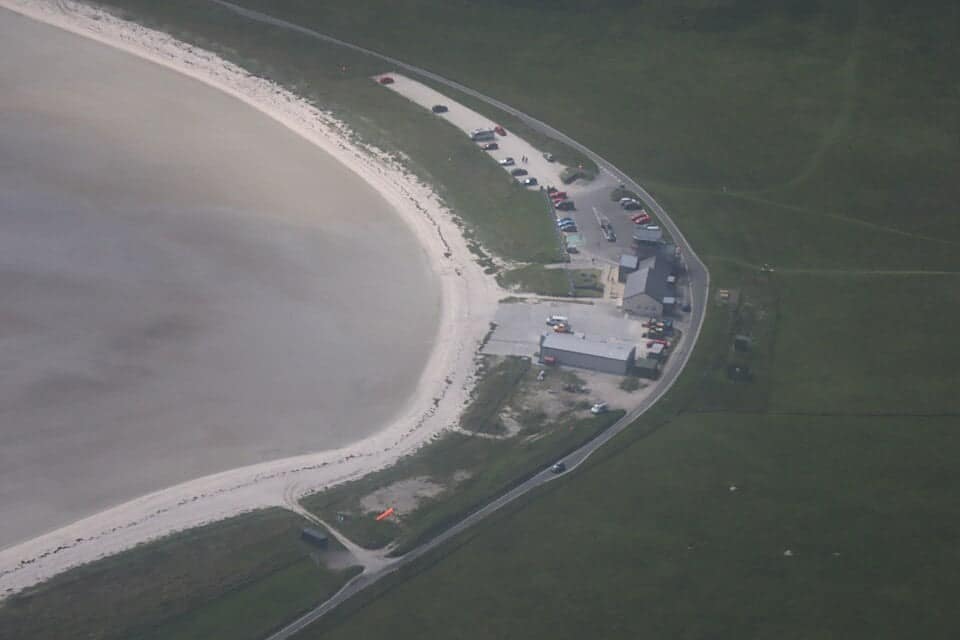
Barra, Scotland — The Beach Runway
Barra Airport in the Outer Hebrides is the only airport in the world where scheduled flights use a beach as a runway. The three runways — marked by wooden poles on the sand — are submerged at high tide. Flight schedules are dictated not by air traffic control but by tide tables. When the water comes in, the airport closes. When it goes out, the de Havilland Twin Otters of Loganair return.
Ice Runway, Antarctica — Landing on a Frozen Sea
McMurdo Station’s Ice Runway is built on the frozen Ross Sea. The runway surface is sea ice — typically 2 to 3 metres thick — and it can support aircraft as large as the Lockheed C-17 Globemaster III, which weighs up to 265 tonnes fully loaded. The runway operates only during the Antarctic summer (October to December) and must be rebuilt every year as the previous season’s ice breaks up. Pilots face unique challenges: whiteout conditions where the horizon disappears, temperatures of minus 40 degrees that can freeze hydraulic fluid, and the unsettling knowledge that the runway is floating.Tenzing-Hillary Airport, Nepal — The Cliff Approach
Lukla’s Tenzing-Hillary Airport serves the gateway to Mount Everest. Its single runway is 527 metres long — roughly one-sixth the length of a standard international runway — and slopes uphill at a 12-percent gradient. One end terminates at a stone wall built into the mountainside. The other drops off a cliff into a 2,000-foot valley. There is no go-around. If a pilot misjudges the approach, the options are the wall or the cliff. Wind shear, fog, and cloud cover can shut the airport for days. Every pilot who lands at Lukla has completed specific mountain flying training, and many consider it the most technically demanding commercial approach in the world.Courchevel, France — The Alpine Ski Slope
Courchevel Altiport sits at 2,008 metres in the French Alps. Its runway is 537 metres long, has an 18.5-percent slope, and is surrounded by mountains on three sides. The approach requires threading between peaks, and the landing involves touching down on what is effectively a ski slope — uphill. Only specially certified pilots are allowed to operate at Courchevel. There are no instrument approaches. Everything is visual, and the margin for error is measured in metres, not miles.Juancho E. Yrausquin, Saba — The World’s Shortest
The Caribbean island of Saba has a runway that is 400 metres long — officially the shortest commercial runway in the world. It is perched on a cliff, with sheer drops into the sea at both ends. Only STOL-capable aircraft like the de Havilland Twin Otter can operate there, and even they use most of the available tarmac. These airports exist because the alternative — no airport at all — is worse. They serve communities where the road does not go, where the sea is too rough for reliable ferries, and where the only flat ground available is a beach, a glacier, or a mountain ledge carved out by dynamite. Every landing is a reminder that aviation, at its core, is the art of making the impossible routine.Sources: Loganair, National Science Foundation, Civil Aviation Authority of Nepal, DGAC France

 English
0 Comments