

In 1961 the Soviet Union flew an aircraft with a working nuclear reactor on board.
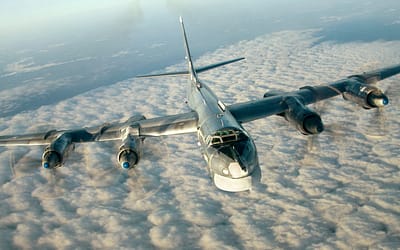
The aircraft was a modified Tupolev Tu-95 Bear, redesignated Tu-95LAL — Letayushchaya Atomnaya Laboratoriya, or “Flying Atomic Laboratory.” The reactor sat in the rear of the bomb bay. Lead-and-polyethylene shielding separated it from the cockpit. The four conventional Kuznetsov turboprop engines remained the only source of propulsion. The reactor itself produced no thrust. Its sole purpose, on this aircraft, was to demonstrate that a fission reactor could be operated safely in the air.
It was the necessary first step in a much more ambitious Soviet programme: a strategic bomber whose engines drew their heat directly from the reactor, a bomber that could in theory remain airborne for weeks, a bomber that could circle the planet without refuelling. The Tu-95LAL was the proof of concept. It flew. It worked. And then, like its American counterpart, it was abandoned.
Quick Facts
Designation: Tu-95LAL (Letayushchaya Atomnaya Laboratoriya)
Base aircraft: Tupolev Tu-95M, modified
Reactor type: VVRL water-moderated, water-cooled reactor
Reactor power: approx. 100 kW thermal
Test flights: 34 (between May and August 1961)
Programme period: 1955-1969 (research), cancelled before any propulsive variant flew
Why anyone built this
The strategic logic of a nuclear-powered bomber, in 1955, was unambiguous. Range was the dominant problem in long-range strategic aviation. A B-52 carried fuel. The fuel ran out. Air-to-air refuelling helped, but every refuelling required a tanker, which itself required fuel, which itself required logistics. A genuinely nuclear-powered bomber would, in principle, fly until the crew could no longer function. Months of patrol. Continuous airborne nuclear deterrent. Unrefuelled global strike. The strategic implications were extraordinary.
The technical implications were equally extraordinary. To build a propulsion-grade nuclear-powered bomber, the Soviet Union would need to design a reactor compact enough to fit inside an aircraft, with shielding light enough that the airframe could carry it, and with thermal coupling to a turbojet or turbofan engine that produced useful thrust. Each of these requirements was, in 1955, beyond the state of the art. The reactor was the most difficult of the three.
The Tu-95LAL was therefore not the bomber. It was the test of whether a reactor could be flown at all. Carrying it in a Tu-95 — the Soviet Union’s largest airworthy bomber — gave the engineers room to mount real shielding, real instrumentation, and real radiation monitoring equipment.
The reactor and the airframe
The reactor installed in the Tu-95LAL was designated VVRL. It was a water-moderated, water-cooled fission reactor with a thermal output of around 100 kilowatts — small by power-plant standards but large for an aircraft. The fuel was uranium-235 enriched to around 90 percent. The cooling water passed through a primary loop entirely contained within the shielded reactor housing. Heat was rejected to the airstream through a secondary radiator system that did not, despite some reports, ever drive a propulsion engine. The reactor’s only direct output was data.
The shielding was a multi-layer structure of lead, polyethylene, and several other materials chosen for their relative effectiveness against gamma radiation and against fast neutrons. The crew compartment received a separate shielded barrier. Dosimeters monitored radiation levels in the cockpit, in the passenger area, and in the reactor housing throughout each flight.
The Tu-95LAL flew 34 test flights between May and August 1961. The reactor was operated only intermittently and never above a fraction of its rated power. Flight crews wore standard flight kit; a portable radiation badge was the only addition. No accidents occurred. The shielding performed within design parameters.

The follow-on that did not fly
The Tu-95LAL was always a stepping stone to a more ambitious aircraft: the proposed Tupolev Tu-119. The Tu-119 was to use two of its four engines as conventional turboprops and the other two as direct-cycle nuclear engines, drawing heat from a larger flight reactor. Detailed studies were completed. A mock-up of the propulsion system was built. The reactor itself was tested on a ground rig.
The Tu-119 never flew. The reasons were prosaic. The reactor’s shielding mass was too large for the available airframe, even after extensive optimisation. The risk of a nuclear-powered aircraft crashing on Soviet territory — given the radiological consequences — was politically unacceptable. By the late 1960s, intercontinental ballistic missiles had reached the level of reliability and yield that made bomber-based strategic deterrence less critical. The strategic case for a months-long flight evaporated.
The programme was cancelled in 1969. The Tu-95LAL itself was decommissioned, its reactor removed, the airframe scrapped. No flight-tested nuclear-powered aircraft survives in any museum.
A measured Soviet legacy
It is tempting, in 2026, to dismiss the Tu-95LAL programme as Cold War excess. The history is more interesting than that. The Soviet engineers who flew the LAL produced a substantial body of data on airborne reactor operation, on shielding effectiveness, and on the radiation environment around a flying reactor. That data, declassified after 1991, has been used in subsequent Russian space-reactor programmes — including the Buk and Topaz reactors used on Soviet RORSAT ocean-surveillance satellites — and in early studies of nuclear thermal rockets for interplanetary missions.
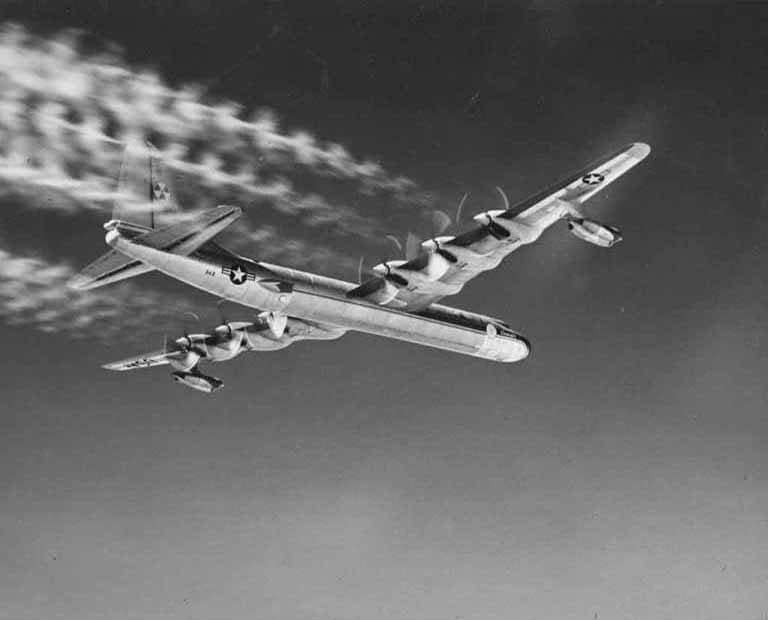
The American NB-36 and the Soviet Tu-95LAL also taught both sides what they had not previously known: that a flying reactor could be built and flown safely if one was sufficiently careful, and that the operational case for doing so collapsed under the weight of intercontinental missiles, in-flight refuelling, and the strategic logic of mutually assured destruction.
The aircraft, in the end, was a question being asked. The answer, it turned out, was no. The asking was not without merit.
Sources: Tupolev Design Bureau historical archives, Soviet Atomic Energy Commission declassified reports, U.S. Air Force Museum reference library.

 English
0 Comments