
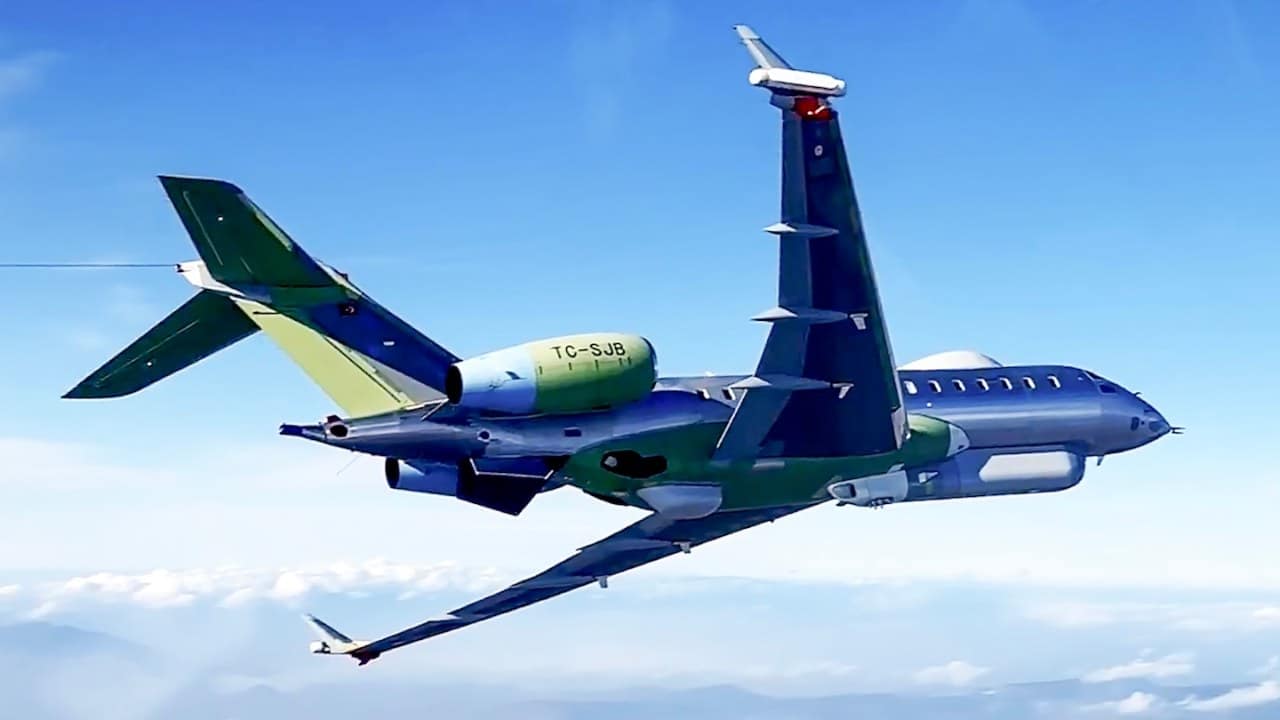
For one second — literally one second of footage — Turkey’s most secretive military aircraft flashed across the screen. The clip, buried in a Ministry of National Defense video marking the 115th anniversary of the Turkish Air Force on June 1, gave analysts their clearest look yet at the Hava SOJ: a Bombardier Global 6000 business jet rebuilt into a standoff electronic-warfare platform.
The aircraft, still unpainted and carrying flight-test fixtures, appeared bristling with fairings, domes and antennas. After years of delay and a first grainy sighting in March, the imagery suggests Turkey’s answer to the U.S. Air Force’s EA-37B Compass Call is finally approaching service — with deliveries of four aircraft expected to begin in 2026.
For the handful of air forces that operate dedicated standoff jammers, the club is about to get a new member — and an ITAR-free competitor on the export market.
Quick Facts
- Aircraft: Hava SOJ (Airborne Standoff Jammer), based on the Bombardier Global 6000
- Integration: Turkish Aerospace Industries (TAI) modifies the airframe; Aselsan supplies the EW mission suite
- Programme: contract awarded 2018; four conversions planned; first airframes delivered to TAI in 2019
- Mission: jam and deceive enemy air-defence radars and communications from outside hostile airspace
- New visuals: Turkish MoD 115th-anniversary video, June 1, 2026 — the clearest official imagery to date
- Western parallels: USAF EA-37B Compass Call, Australia’s MC-55A Peregrine, France’s Archange
What the New Imagery Shows
The June 1 footage rewards a frame-by-frame look. Most prominent is the long canoe-shaped fairing under the fuselage — a feature shared with the U.S. Army’s ME-11B HADES and the RAF’s retired Sentinel R1, where such fairings house radar arrays. A second, smaller ventral fairing sits further aft between the wing roots, alongside rows of slanted blade antennas.
On the spine sit two large dome enclosures, almost certainly beyond-line-of-sight satellite communications — the pipework that lets a jet like this share what it collects in near-real time. Most striking are the wingtip pods, which look remarkably similar to the AN/ALQ-218 receiver pods on the U.S. Navy’s EA-18G Growler, used there to detect and locate hostile emissions.
This is the official Turkish MoD video; the Hava SOJ appears at around the 1:39 mark:
A cable trailing from the fin tip and an air-data probe on the nose mark the jet as still deep in flight test. The aircraft carries the registration TC-SJB; the two Global 6000 airframes known to have been flown to TAI for conversion bore serial numbers 9854 and 9855.
The Mission: Blinding Air Defences From Afar
Standoff jamming is one of modern air war’s least glamorous and most decisive disciplines. Instead of penetrating defended airspace, the jammer orbits outside it, detecting and geolocating enemy radars and command links — then attacking them electronically with focused beams of noise and deception.
The exact designations of Aselsan’s airborne payload remain undisclosed, though the suite is understood to build on the company’s land-based Koral/Kara SOJ electronic-attack system, which uses powerful active electronically scanned arrays. The only confirmed foreign-supplied system aboard is Leonardo’s Miysis directional infrared countermeasures turret for self-protection, per a 2021 Turkish industry report.
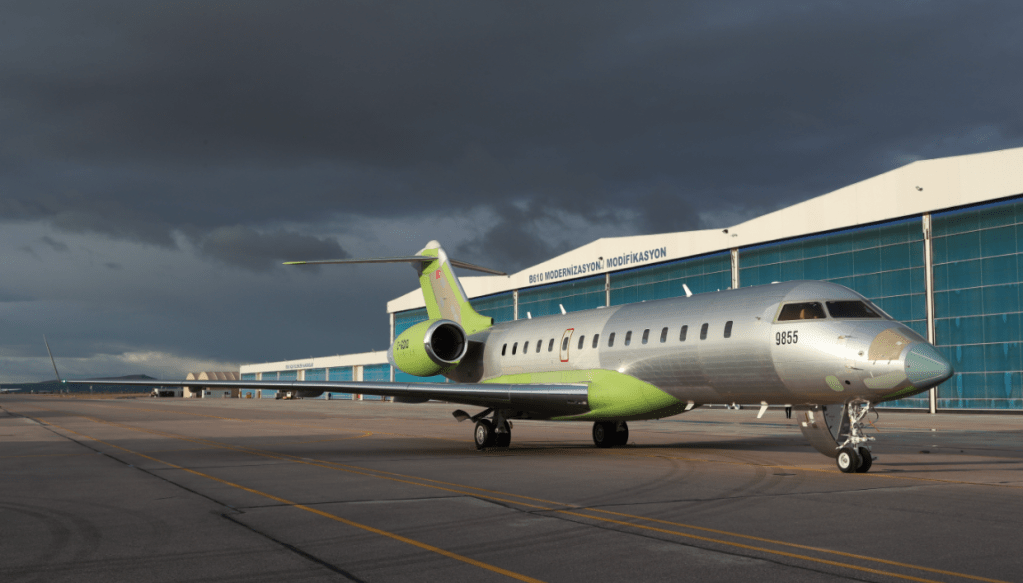
The programme has not been quick. When Aselsan won its contract in 2018, the first delivery was planned for 2023 — a deadline that slipped by years, hardly unusual for a project of this complexity. An interim solution called Gölge, based on two Global Express airframes with mixed foreign and local equipment, was abandoned in 2017. The new jets will replace Turkey’s ageing C-160 Transall-based jamming capability.
A Rare Capability — and an Export Play
Within NATO Europe, dedicated standoff electronic attack is vanishingly rare. Italy has ordered two EA-37B Compass Calls; France fields the Archange SIGINT platform. Turkey developing the capability domestically — airframe integration, jammers, receivers and all — puts Ankara in select company and frees the system from U.S. ITAR export restrictions.

That matters commercially. Pakistan has been identified as a potential customer in the past, and Aselsan’s joint venture with Saudi Arabia’s Taqnia has promoted an export version known as Kasih. With air defences proliferating even among lower-end adversaries, the market for affordable electronic attack is only growing — and Turkish defence exports have a habit of finding buyers.
Questions remain: whether the jet carries a radar with ground-mapping capability in that big canoe, how much power its arrays can put out, and when exactly the Turkish Air Force will declare the type operational. But after years in the shadows, the Hava SOJ is flying, increasingly visible, and clearly close. Turkey’s electromagnetic spectrum war-fighting just grew a long arm.
For context on the Aselsan technology family the airborne suite builds on, this is the land-based Koral system:
Sources: The War Zone, Janes, Aviation Week, SSB (Turkish Defence Industry Agency), Turkish Ministry of National Defense
Related Posts
 English
0 Comments