

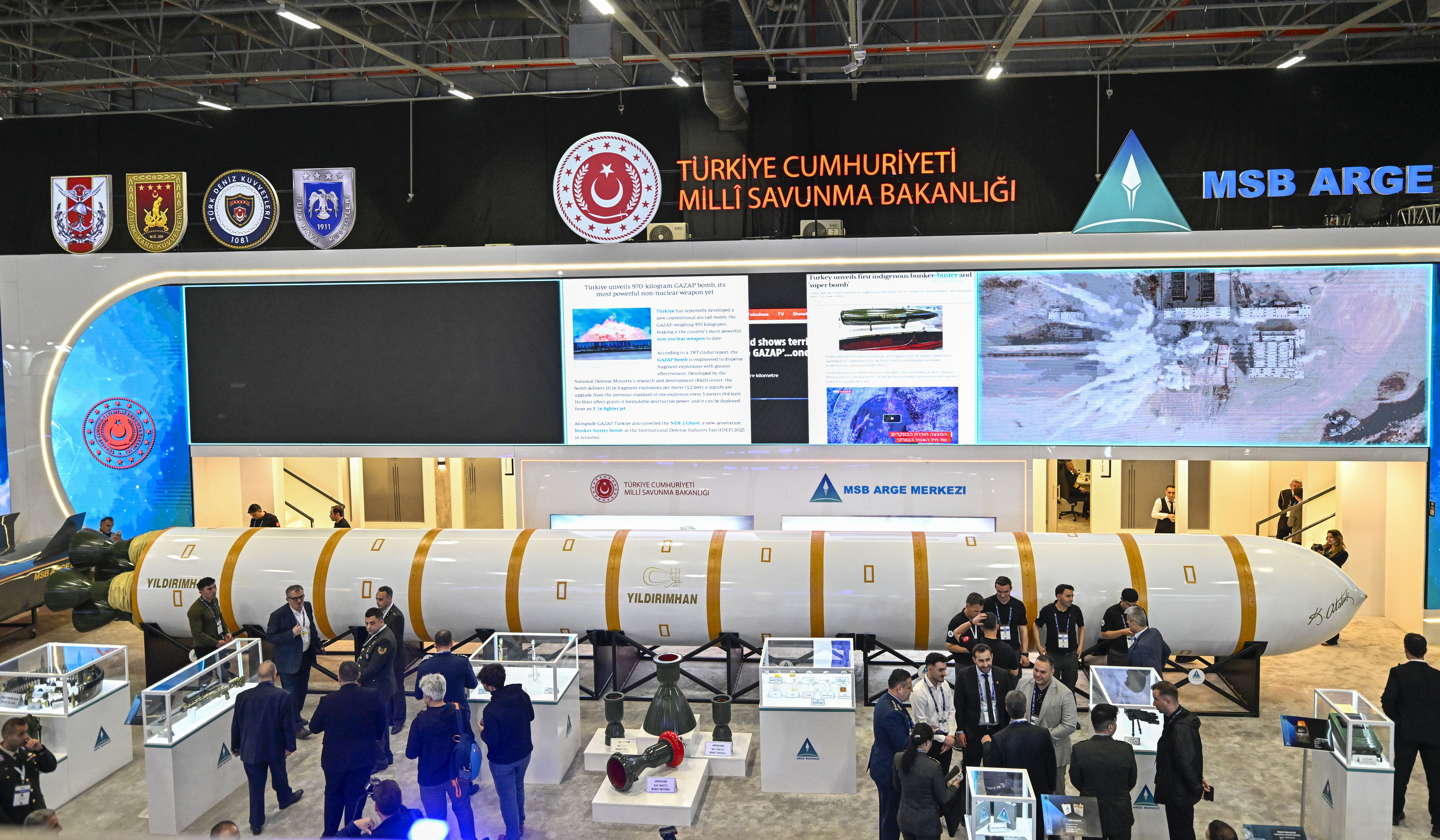
On the morning of 5 May 2026, in a vast exhibition hall on the European shore of Istanbul, something quietly extraordinary happened. Turkey’s Ministry of National Defence unveiled — with little prior warning to the international press — a full-scale mockup of the Yıldırımhan: the country’s first intercontinental ballistic missile, a weapon allegedly capable of reaching Mach 25 and striking targets 6,000 kilometres away. The name, in Turkish, means lightning bolt. The geopolitical implications crackled with appropriate electricity.
The reveal came on the opening day of SAHA 2026 — Turkey’s biennial international defence, aerospace and space industry fair, which drew more than 1,700 companies from over 120 countries to the Istanbul Expo Center. Among the drones, armoured vehicles and electronic warfare systems on display, the Yıldırımhan stood apart: a colossal, road-mobile missile concept developed entirely by the Ministry’s own R&D centre, reportedly a decade in the making. Turkish Defence Minister Yasar Güler presented the programme personally. Ankara was, unmistakably, making a statement.
For observers of strategic affairs — and, one suspects, for several NATO delegations present — the Yıldırımhan was not merely a defence industry exhibit. It was a signal: that Turkey, the Alliance’s second-largest army and a nation long dependent on Western weapons systems, intends to compete in the most exclusive tier of global military power. The exclusive club of states that have demonstrated ICBM-class capability currently numbers the United States, Russia, China, France, India, and North Korea. Ankara has just knocked on that door.
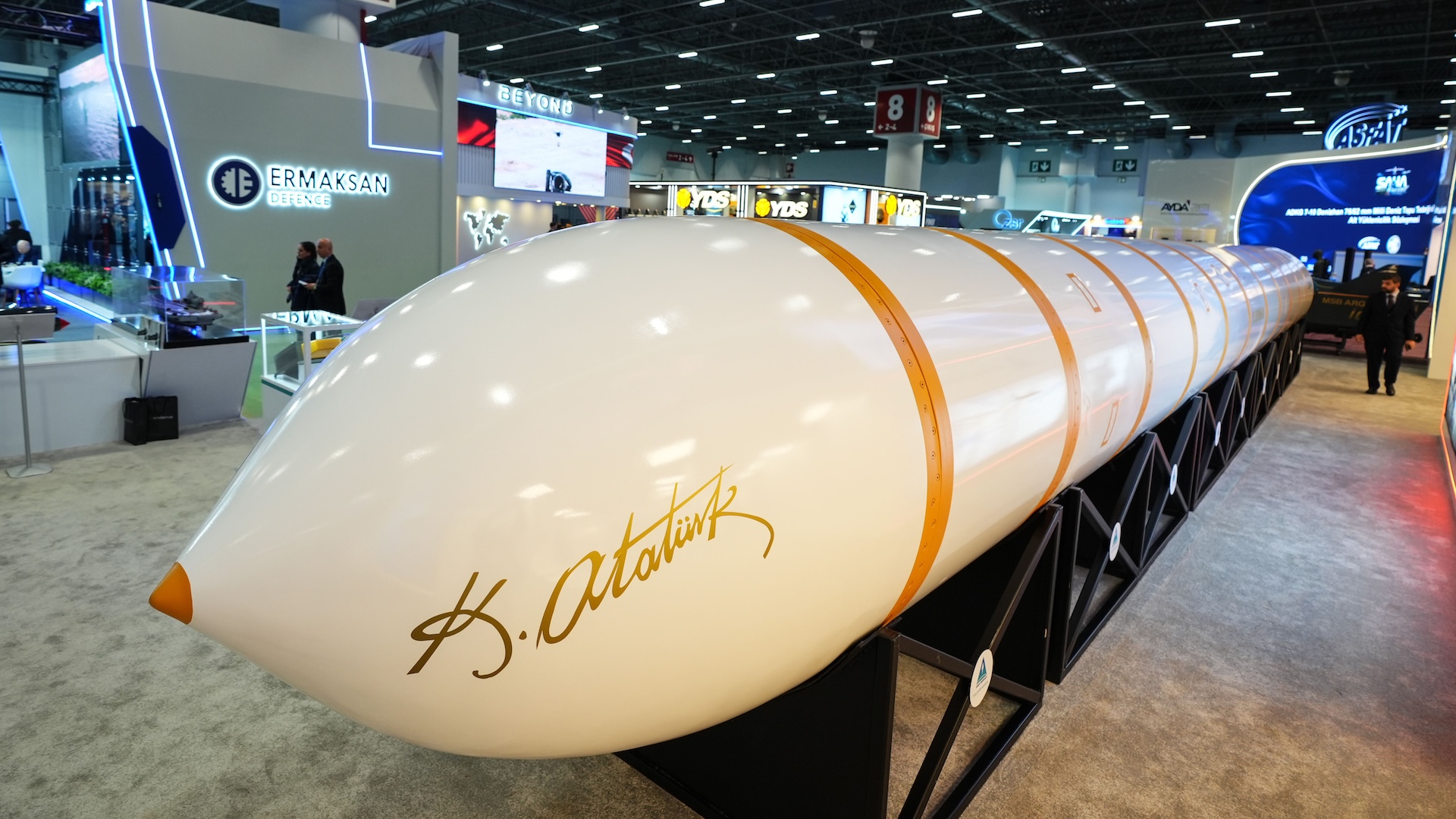
⚡ Quick Facts — Yıldırımhan ICBM
- Revealed: 5 May 2026, SAHA 2026 Expo, Istanbul
- Developed by: Turkish Ministry of National Defence R&D Centre (MSB Ar-Ge)
- Range: 6,000 km — just beyond the 5,500 km ICBM threshold
- Maximum speed: Mach 25 (hypersonic terminal velocity)
- Payload: 3,000 kg conventional warhead
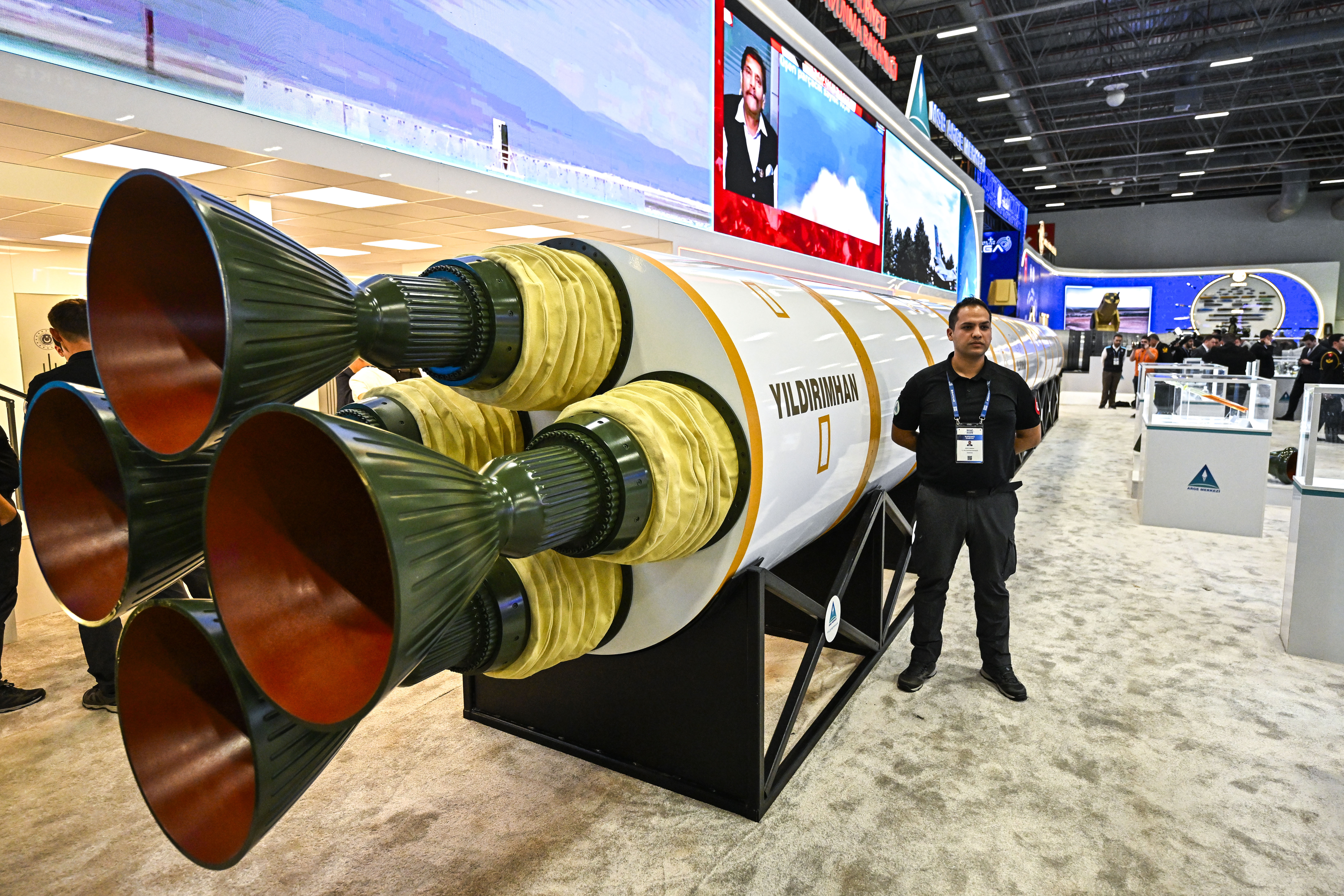
- Propulsion: 4 liquid-fuel rocket engines (single stage)
- Fuel: Nitrogen tetroxide (N₂O₄) + UDMH (hydrazine-based)
- Launch platform: Road-mobile trailer (TEL)
- Status: Concept mockup — no confirmed flight tests
- First potential test: Somalia, end of 2026 (per Turkish security sources)
The Anatomy of a Thunder Bolt
The technical specifications displayed at the SAHA 2026 stand are, on paper, extraordinary. A range of 6,000 kilometres — the minimum qualifying distance for ICBM classification — means that a missile launched from central Anatolia could reach London, Cairo, Mumbai, Nairobi, or Moscow. Propelled by four liquid-fuel rocket engines burning nitrogen tetroxide and UDMH (unsymmetrical dimethylhydrazine), the Yıldırımhan is designed to achieve terminal velocities between Mach 9 and Mach 25. The warhead alone, at 3,000 kilograms of conventional explosive, would deliver a bunker-busting punch of devastating magnitude.
The choice of liquid fuel is both a technical signature and a strategic constraint. Liquid-propellant ICBMs must be fuelled before launch — unlike solid-fuel designs — which increases response time and vulnerability to pre-emptive strikes. It is a measure of technological maturity: most modern arsenals, from the American Minuteman III to China’s DF-41, favour solid propellants for their reliability and rapid deployment. Turkey’s own Tayfun family of shorter-range missiles uses solid propellant. The Yıldırımhan, at this stage, represents the maximum of what Turkey’s R&D centre can achieve at ICBM scale — and it is a remarkable achievement nonetheless.
Equally notable is the single-stage configuration, unusual for a missile of this class. Most operational ICBMs use two or three stages to efficiently shed mass during flight. The single-stage architecture may reflect engineering pragmatism — Turkey has not previously developed anything remotely this large — or it may point to future iterations that will refine the design once testing commences. Defence ministry officials hinted at a propellant breakthrough for the associated Yıldırımhan programme, suggesting active development across the propulsion chain.
A NATO Ally With ICBM Ambitions — Why It Matters
Here lies the question that reverberates through Brussels, Washington, and European capitals: what does it mean when a NATO member state develops an intercontinental ballistic missile?
Good to know: NATO’s nuclear deterrence architecture rests on the United States’ strategic arsenal, supplemented by the independent French and British nuclear forces. No NATO treaty prohibits members from developing conventional long-range missiles — and the Yıldırımhan is, at least officially, conventionally armed. Yet the very existence of an ICBM-class platform within the Alliance raises profound questions. Such a weapon, if it ever flew a nuclear warhead, would shift the strategic calculus of every neighbouring state. It also raises thorny issues around the Missile Technology Control Regime (MTCR), which Turkey has signed and which limits missile exports of this class. And while Turkey has been a steadfast NATO ally, its strategic autonomy — demonstrated by its S-400 purchase from Russia, its independent Syria policy, and its complex relationship with the United States — suggests Ankara pursues its own calculus.
President Erdoğan has long spoken of Turkey’s right to strategic depth: “the first condition for survival in such a geography is deterrence,” he declared when pushing for longer-range missiles years ago. The Yıldırımhan is the logical culmination of that doctrine. Turkey has recently experienced Iranian ballistic missiles intercepted by NATO assets over its own territory. It shares a border with Syria, faces a persistent Kurdish militant threat in Iraq, and navigates a fractious rivalry with Greece in the Eastern Mediterranean. An ICBM offers Ankara the ultimate deterrent insurance — one that no adversary, regional or global, can comfortably ignore.

From Tayfun to Yıldırımhan: A Decade of Escalating Ambition
The Yıldırımhan did not emerge from a vacuum. Turkey’s missile programme has followed a deliberate, decade-long trajectory of escalating range and sophistication. The Bora, Turkey’s first domestically developed short-range ballistic missile, gave way to the Tayfun family, whose Block IV variant — tested in December 2025 — is believed to reach approximately 1,000 kilometres. The Cenk medium-range ballistic missile, with a declared range of 2,000 kilometres, sits in active development. Each iteration has pushed the engineering frontier further, and each has attracted Western scrutiny.
SAHA 2026 also saw a separate announcement of a propellant breakthrough for the wider Yıldırımhan long-range ballistic missile programme — suggesting that the liquid-fuel challenge is being addressed in parallel. Turkey also faces a fundamental testing problem: its primary Black Sea missile range spans less than 1,000 kilometres end-to-end, far too short for a full-range ICBM test. The solution being mooted in Turkish security circles is a spaceport in Somalia, where a launch over the Indian Ocean would provide the required distance. Turkish security sources cited by Bloomberg suggested the first test could come as early as the end of 2026.
Concept or Coming Reality?
Scepticism is warranted. What SAHA 2026 unveiled was a mockup — a concept in steel and paint, not a flight-tested weapon. There are no confirmed propulsion tests at this scale, no re-entry vehicle demonstration, and no publicly verified guidance system for a hypersonic ICBM trajectory. The gap between a full-size model on an exhibition floor and an operational weapon in a military inventory is measured not in months but in years of punishing R&D, testing, and integration work. North Korea’s own ICBM journey — from concept to credible threat — spanned a decade of conspicuous failures before achieving plausible capability.
Yet dismissal would be equally imprudent. Turkey’s defence industry has surprised observers repeatedly. The Bayraktar TB2 drone rewrote the rules of modern warfare in Libya, Nagorno-Karabakh, and Ukraine. The TF Kaan fifth-generation fighter made its maiden flight in 2024. Indigenous frigates, air defence systems, and precision munitions have rolled out of Turkish factories at a pace that was unimaginable two decades ago. When Erdoğan’s Turkey puts its institutional weight behind a programme, the programme tends to advance.
The View From Brussels
NATO, for its part, will be watching carefully and saying little. The Alliance has no formal mechanism to prevent a member state from developing conventional long-range missiles — France and the United Kingdom both maintain independent nuclear deterrents, after all. But the Yıldırımhan raises questions that the Alliance’s legal and strategic frameworks were not designed to address: What is the appropriate response when a member’s conventional deterrent begins to overlap, in range and payload, with strategic nuclear forces? How does NATO’s Article 5 collective defence guarantee interact with a Turkish ICBM? And — most delicately — could such a missile ever serve as a delivery vehicle for nuclear warheads, were Ankara’s relationship with the US nuclear umbrella to deteriorate?
For now, Turkey remains firmly inside the NATO tent, committed to the Hague Summit defence spending targets of 5 percent of GDP. Its Yıldırımhan is conventional, its nuclear posture unchanged. But in the fluid security environment of 2026 — with Iran’s missile programme active, Russia’s war ongoing, and the Eastern Mediterranean in perpetual tension — Ankara has made clear that it is building the infrastructure of strategic independence. The lightning bolt, for the moment, remains on its trailer. Whether and when it flies will be one of the defining questions of the decade.
Sources: The War Zone · TURDEF · Breaking Defense · Al Jazeera · Daily Sabah · Defence Security Asia


 English
0 Comments