
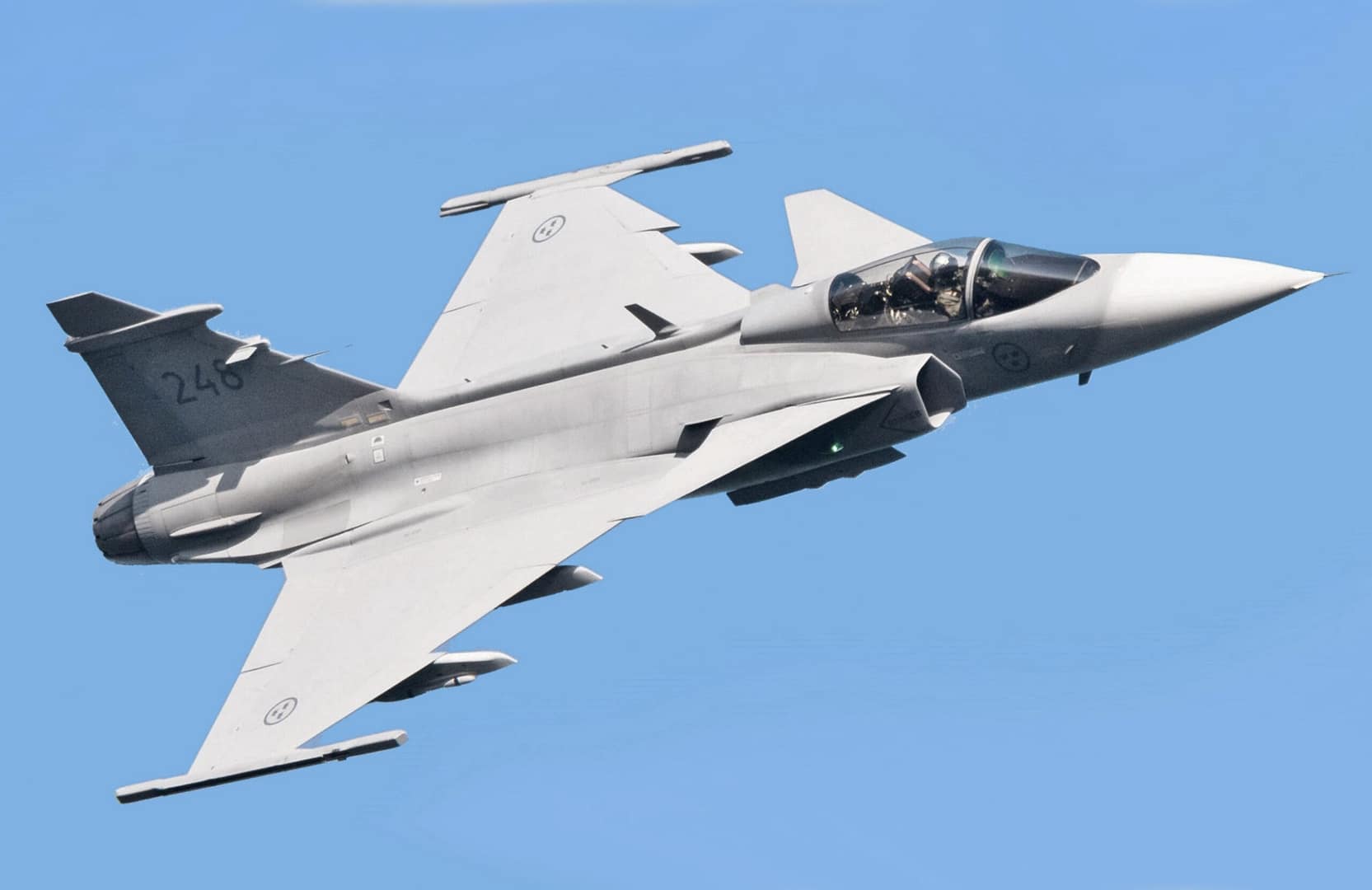
Uppsala, 28 May 2026. Volodymyr Zelensky walked onto the apron at Uppsala air base under a grey Swedish sky, shook hands with Prime Minister Ulf Kristersson, and announced what is — by any measure — the largest Western fighter package Ukraine has ever secured.
The headline number: up to 20 brand-new Saab JAS 39 Gripen E/F multirole fighters, paid for with a €2.5 billion slice of the European Union’s Ukraine Support Loan. Layered on top, Sweden will donate up to 16 of its existing Gripen C/D airframes — pulled directly from the Swedish Air Force’s operational fleet, with advanced air-to-air ordnance bundled in.
For an air force still flying a patchwork of donated F-16s, Mirage 2000-5s and Soviet-era Sukhoi remnants, the implications are seismic.
Quick Facts
Announced: 28 May 2026, Uppsala, Sweden
Purchase: Up to 20 Gripen E/F (latest generation), €2.5 billion EU loan
Donation: Up to 16 Gripen C/D from active Swedish Air Force fleet
First deliveries: Donated C/Ds in early 2027 — new E/Fs from 2030
Letter of intent (2025): Paved the way for up to 150 Gripen E sales to Ukraine
Why the Gripen, and Why Now
The Gripen E was designed for exactly the kind of war Ukraine is fighting. Saab built it to operate from vägbaser — Swedish motorway dispersal strips — using a small ground crew, austere fuel and rearming logistics, and a single-engine architecture that can be turned around in about ten minutes. That doctrine, born in the Cold War, was always going to age better than most Western air forces realised.
Ukraine has spent three years dispersing aircraft across pop-up forward bases to survive Russian cruise-missile strikes. The match is almost too neat.
The Gripen E adds an active-electronically-scanned-array (AESA) Raven ES-05 radar, a powerful electronic warfare suite tailored for the heavily contested Eastern European electromagnetic environment, and integration with the Meteor beyond-visual-range air-to-air missile — arguably the most capable BVR weapon in NATO’s arsenal.
The Two-Tranche Plan
Sweden has structured the package in two tranches so Kyiv does not have to wait until 2030 to get the benefit.
The 16 donated Gripen C/Ds will start arriving in Ukraine in early 2027. These are not export-stripped airframes — they are the same jets Sweden flies on its quick-reaction-alert mission today. They are expected to come with bundled air-to-air weaponry — reportedly including long-range Meteor and IRIS-T missiles — plus the connectivity to plug into NATO data links.
The 20 new-build Gripen E/Fs are a longer process. Saab’s Linköping line is already cranking out Gripens for Brazil, Thailand and the Swedish Air Force; new Ukrainian airframes are penned in for delivery from 2030 onward, with a 2025 letter of intent leaving the door open for as many as 150 over the longer term.
A Coalition Bet on Sweden’s Industrial Base
The deal is also a quiet but enormous vote of confidence in Saab — and by extension in Europe’s ability to scale fighter production without American permission. The €2.5 billion comes from the EU’s Ukraine Support Loan, not from a US foreign military sales credit; it does not depend on US export licences; and the supply chain runs through Sweden, Brazil and a growing list of European subsuppliers.
For Ukrainian pilots transitioning from the F-16, the operational learning curve will be steep but finite. Gripen aviators across Europe consistently describe the jet as the most “pilot-friendly” Western fighter in service — a result of the careful interface design philosophy Saab has refined over four decades. For a country burning through aircrew at the rate Ukraine is, that human-factors edge matters.
Sources: Defense News, Saab press release, Government of Sweden, Euronews, Breaking Defense.
 English
0 Comments