

For most of military history, shooting down an aircraft with artillery was a grim game of chance. Gunners flung up thousands of shells set to burst at a guessed altitude, hoping one happened to explode at the exact instant an enemy plane flew past. Then a small American device, about the size of a pint glass, gave every shell a brain — one that knew the precise moment it was close enough.
It was called the proximity fuze, and it was one of the best-kept secrets of the Second World War.
Quick Facts
- What: the radio proximity fuze (VT fuze) — a tiny Doppler radar built into an artillery shell
- How: it sensed when it passed within about 70 feet of a target and detonated — no direct hit required
- The leap: roughly ten times more lethal against aircraft than older time or contact fuzes
- The engineering: vacuum tubes that survived ~20,000 g at firing; a glass ampoule shattered on launch to power a battery
- Secrecy: its very existence was classified second only to the Manhattan Project
A Radar in a Shell
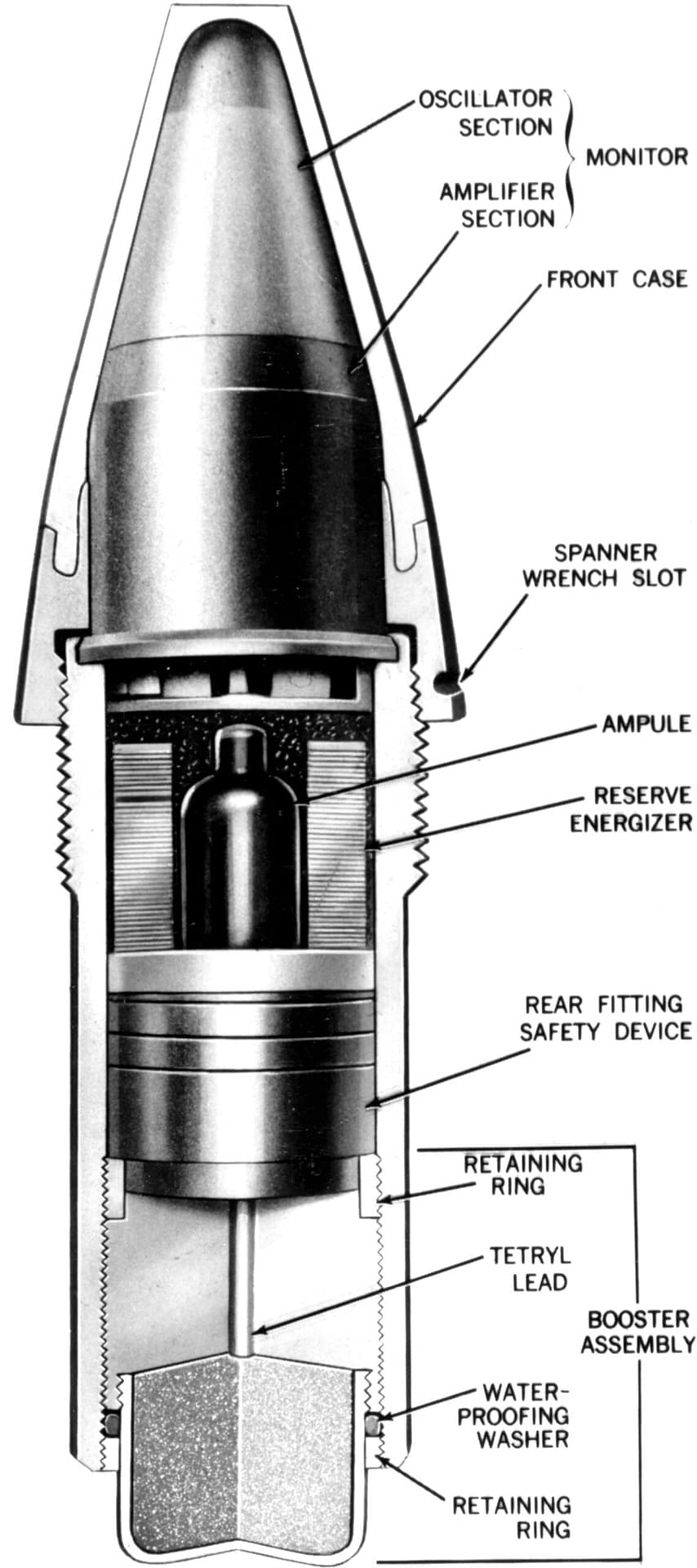
The genius of the VT fuze was to pack a complete miniature radio system into the nose of a spinning artillery shell. As the shell flew, the fuze broadcast a continuous radio signal and listened for the echo bouncing back off a nearby aircraft. When that reflected signal indicated the target was within roughly 70 feet — the lethal radius of the shell’s burst — it triggered detonation. The shell no longer had to hit anything. It just had to get close. Against aircraft, that made it about ten times as effective as the fuzes it replaced.

Surviving 20,000 G
Building it was a nightmare. The fragile vacuum tubes of the day were designed to sit quietly in a warm radio set — not to be fired from a naval gun, where they had to survive a shock of around 20,000 times the force of gravity and then spin at hundreds of revolutions per second. The engineers even had to invent a battery that switched itself on at launch: a glass ampoule of electrolyte that shattered under the firing shock, the liquid flung outward by the spin to activate the cells. Once perfected, the fuzes were mass-produced by the million, eventually for around $18 to $20 apiece.
From Guadalcanal to the Doodlebugs
The fuze drew first blood on January 5, 1943, when the cruiser USS Helena knocked a Japanese dive-bomber out of the sky near Guadalcanal. From there it proved devastating — against Japanese aircraft and kamikazes swarming U.S. ships in the Pacific, and against the V-1 flying bombs — the “doodlebugs” — that Germany rained on England in 1944. Later it was unleashed as air-bursting artillery on massed troops, to terrible effect at the Battle of the Bulge.

It was guarded so jealously that, at first, the fuzes were used only over water, lest a dud fall into enemy hands and reveal the secret. For a humble piece of artillery hardware, the proximity fuze sits in rare company — a wartime invention historians rank among the few that genuinely helped decide the outcome.
Sources: HistoryNet; U.S. Naval Institute; NavWeaps; Smithsonian; Britannica.
 English
0 Comments