
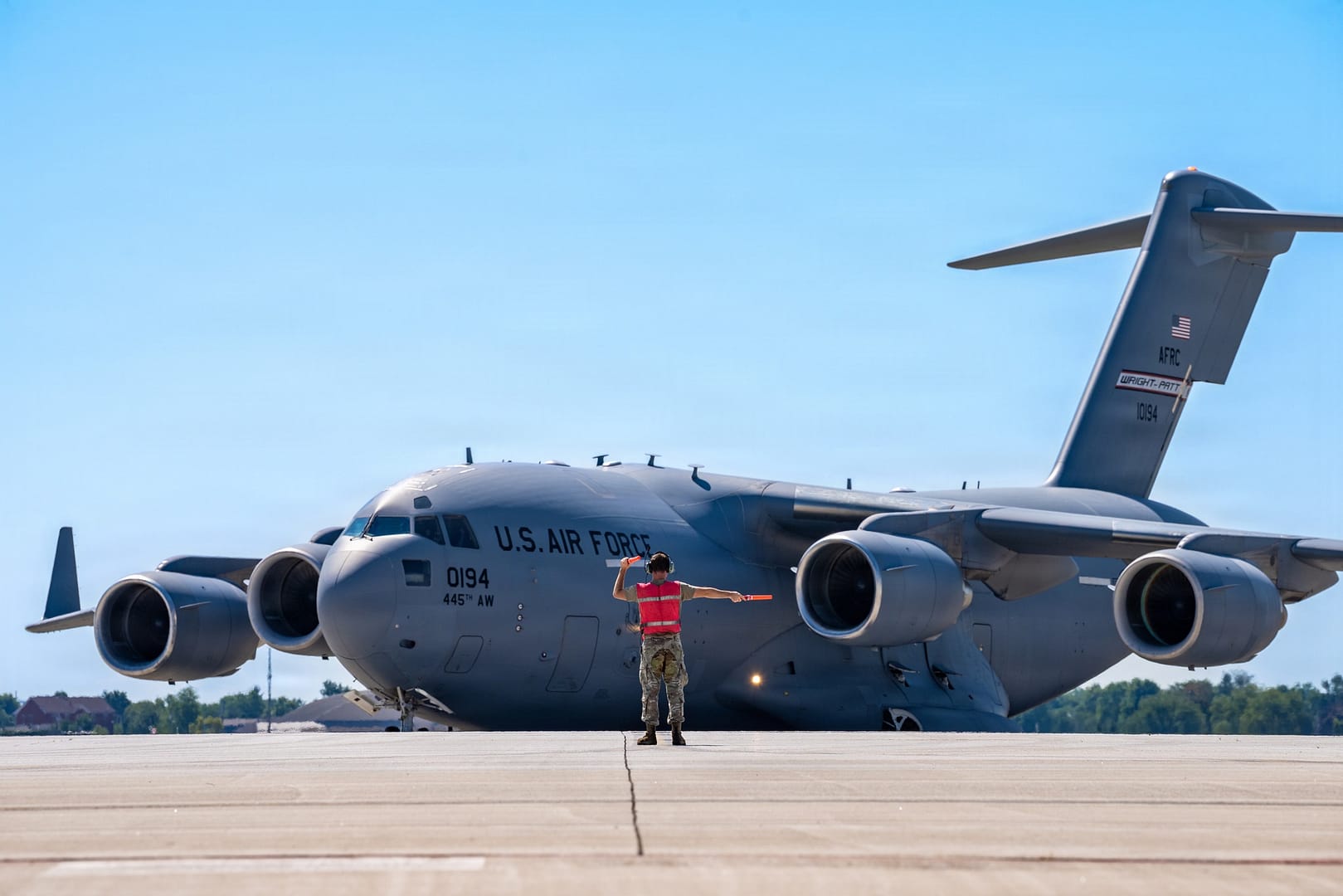
A hailstorm, two runaway business jets, and a nose panel that nobody would build. That is the short version of how a U.S. Air Force C-17 ended up grounded for the better part of a year and a half. The long version ends with a robot, a research lab in Ohio, and the Globemaster hauling itself back into the sky on July 30.
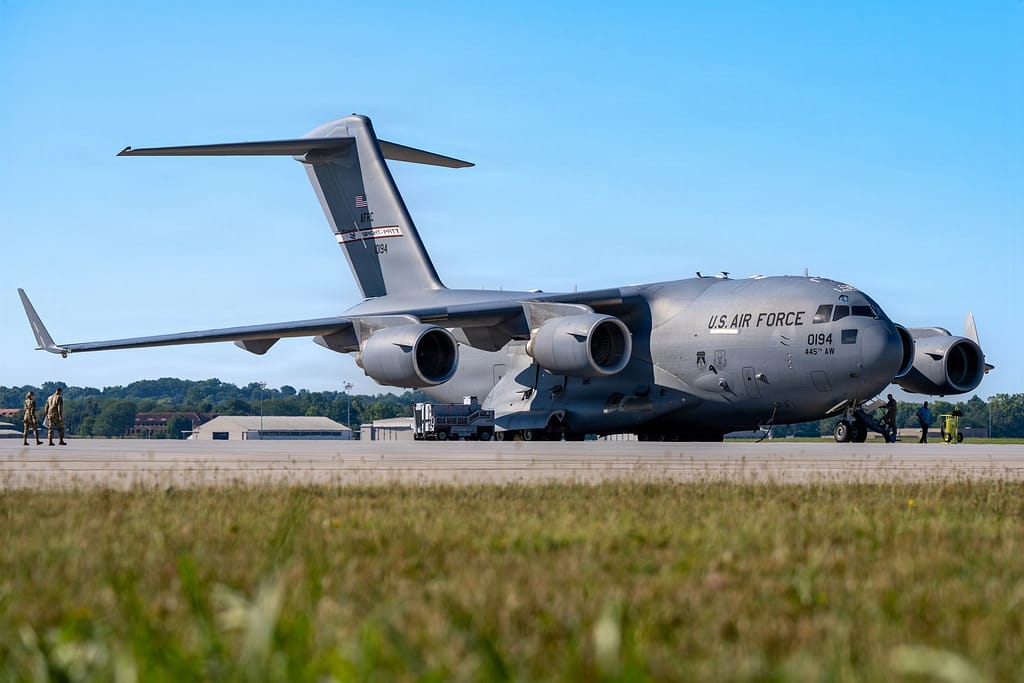
The airlifter — tail 0194 of the 445th Airlift Wing at Wright-Patterson Air Force Base — had been stuck since March 2025. This week the Air Force showed off how it finally got the jet flying again, with a repair it says has never been performed on one of its aircraft before.
Quick Facts
- Aircraft: C-17 Globemaster III, tail 0194, 445th Airlift Wing
- Base: Wright-Patterson AFB, Ohio
- Damaged: March 4, 2025, by a severe storm at Fort Worth Alliance Airport
- Grounded: roughly 16 months
- Fix: nose panel made by robotic Incremental Sheet Forming (ISF)
- First flight after repair: July 30, 2026
A very bad night in Texas
On March 4, 2025, tail 0194 was parked overnight at Perot Field Fort Worth Alliance Airport when severe thunderstorms tore through the Dallas–Fort Worth area. Hail hammered the ramp, microbursts gusted to around 80 mph, and two private Bombardier Challenger jets were picked up and blown into the parked Globemaster, mangling its left-side door, fuselage and nose.
The crew nursed the jet home to Dayton with interim fixes — a Boeing-approved temporary nose patch and the landing gear left down for the entire flight. Then the real problem started.
The part that did not exist
The 445th Maintenance Group patched the door and fuselage, but the left nose panel was beyond repair and had to be replaced. Boeing said the part was not available and would have to be built from scratch — and no vendor was willing to spin up the tooling and machining for a single panel for a single jet. The estimate was grim: a year in storage, then another year of work.
That was a hard pill for a wing that could not spare the aircraft.
Enter the robot
The maintainers called in the Air Force Rapid Sustainment Office. Its Automation and Robotics team, working with the University of Dayton Research Institute, decided the panel was an ideal candidate for Incremental Sheet Forming — a robotic process that slowly presses a flat sheet of metal into a finished, functional shape without any dedicated die or mould.
Production started in January 2026. A fit check followed in April, Boeing and the maintenance group installed the finished panel in July, and on July 30 the Globemaster flew. It is the first ISF-made part ever produced, tested and flown on an Air Force aircraft — and the office is already forming parts for a KC-135 tanker and an F-15.
Why a single panel is a big deal
There are roughly 220 C-17s in U.S. service, plus smaller fleets in the UK, Australia, Canada, India, the UAE, Qatar and Kuwait. But the production line at Long Beach closed in 2015 after the 279th and final Globemaster rolled out, and every year the spares get harder to find. When the factory is gone, the ability to simply make a part in-house stops being a novelty and starts being a lifeline.
It is the same logic behind another recent fix: a lab at Hill AFB in Utah 3D-printing canopy frames for the F-35 Lightning II to dodge supplier delays. The tools are different; the message is the same. If you cannot buy the part, print it, press it, or form it yourself.
For tail 0194, it meant the difference between two years in a hangar and a takeoff roll in July. Not bad for a jet that a hailstorm and two loose business jets very nearly retired.
Sources: Air Force Life-Cycle Management Center; Air Force Materiel Command; DVIDS; The Aviationist.

0 Comments