
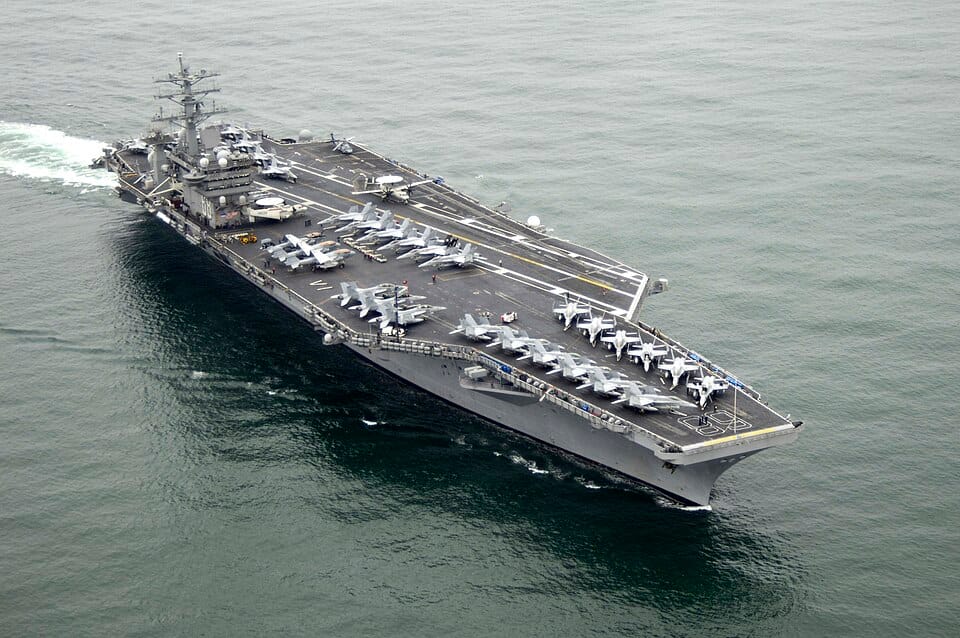
Quick Facts
- Ship: USS Nimitz (CVN-68) — first of her class
- Commissioned: 3 May 1975
- Service: 51 years (longest of any nuclear carrier)
- Final deployment: Southern Seas 2026 — circumnavigating South America
- Exercises with: Argentina, Brazil, Chile, Colombia, Ecuador, Peru, Mexico, El Salvador, Guatemala, Uruguay
- Decommissioning: Extended to March 2027 to maintain 11-carrier mandate
The Long Way Home
Instead of transiting the Panama Canal like most Pacific-to-Atlantic repositioning voyages, Nimitz is taking the scenic route — down the west coast of the Americas, around the tip of South America, and up through the Atlantic. Along the way, she’s conducting exercises with ten Latin American navies as part of Southern Seas 2026, with port visits planned in Brazil, Chile, Panama, and Jamaica. It’s a fitting farewell for a ship that has deployed everywhere. Nimitz has operated in every ocean, participated in every major American military operation since the late 1970s, and launched aircraft in support of operations from the Iranian hostage crisis to Afghanistan to Iraq to counter-ISIS strikes. Now she gets to say goodbye to partners across an entire hemisphere.The Ship That Changed Everything
When Nimitz was commissioned in 1975, she represented a generational leap in carrier design. Her two nuclear reactors meant unlimited range — no more fuel stops, no more vulnerable replenishment at sea for propulsion fuel. Her 4.5 acres of flight deck could handle every aircraft in the Navy’s inventory. She was designed to carry 90 aircraft and sustain combat operations indefinitely. Over 51 years, Nimitz has conducted more flight operations than any other vessel in history. Thousands of pilots made their first carrier landing on her deck. Hundreds of thousands of sailors called her home. She survived the Cold War, the post-Cold War peace, the War on Terror, and the return of great-power competition.One More Extension
Nimitz was supposed to decommission earlier, but the Navy announced a 10-month extension on 14 March 2026. The reason is simple math: the Navy needs 11 carriers by law, and the replacement — USS John F. Kennedy (CVN-79) — isn’t ready yet. So the old ship keeps sailing while the new one finishes construction. This last-minute reprieve means Nimitz will serve until March 2027, making her the longest-serving nuclear carrier in history by the time she finally stands down. It’s a testament both to the ship’s remarkable endurance and to the industrial challenges of building her replacements.What Comes After
Decommissioning a nuclear carrier is a process almost as complex as building one. The reactors must be defueled — a painstaking operation that takes years. The ship is then towed to Puget Sound Naval Shipyard for recycling. The hull that once carried enough aviation fuel to fill a small lake, enough ordnance to level a city, and enough food to feed 5,000 sailors three meals a day will eventually become razor blades and rebar. But that’s still years away. Right now, somewhere off the coast of South America, Nimitz is doing what she’s done for half a century — launching jets, projecting power, and reminding the world what 100,000 tons of sovereign American territory looks like when it shows up uninvited.Sources: USNI News, The Aviationist, Army Recognition, MercoPress


 English
0 Comments