
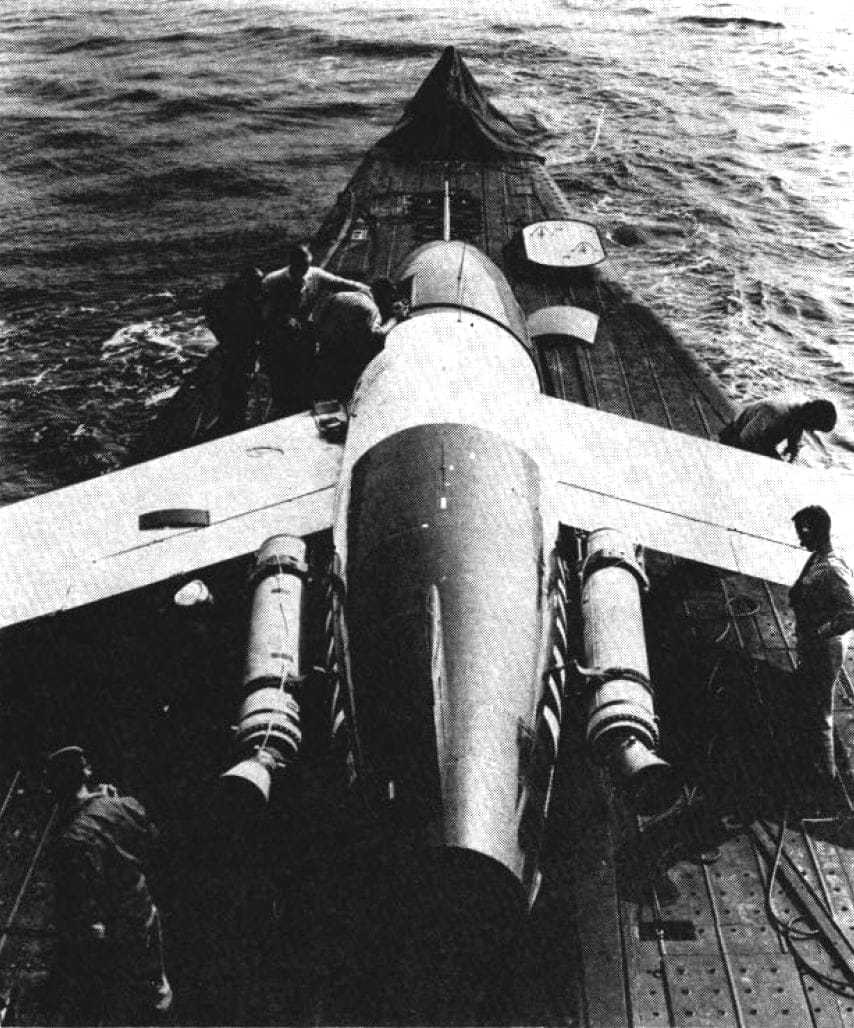
Long before the Tomahawk, and years before Polaris let a submarine fire a nuclear missile from beneath the waves, America’s first seagoing deterrent worked in the most nerve-wracking way imaginable. To shoot, the submarine had to surface in enemy waters, roll a winged, jet-powered missile out of a hangar on its back, point it toward the Soviet Union and light the engine under the open sky.
That missile was the Vought Regulus — part cruise missile, part pilotless aircraft — and for a few tense Cold War years it carried the whole weight of the U.S. Navy’s nuclear strike role on a handful of submarine decks in the North Pacific.
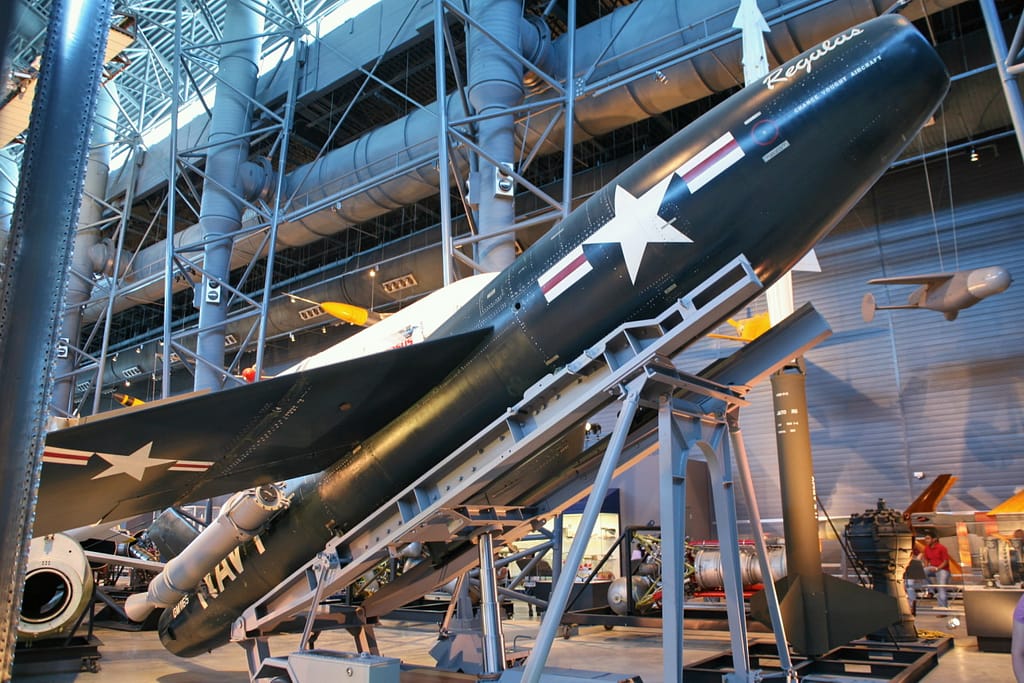
• Missile: Vought SSM-N-8 Regulus I, a turbojet-powered nuclear cruise missile
• Size / reach: ~42 ft long, 21 ft wingspan, ~500-mile range, ~3,000 lb (nuclear) warhead
• First submarine launch: 1953, from USS Tunny
• Catch: the boat had to surface to launch, exposing its position
• Patrols: 40 deterrent patrols from Pearl Harbor, Oct 1959–July 1964 — America’s first sea-based nuclear deterrent
• Replaced by: the submerged-launch Polaris missile
A jet with a warhead
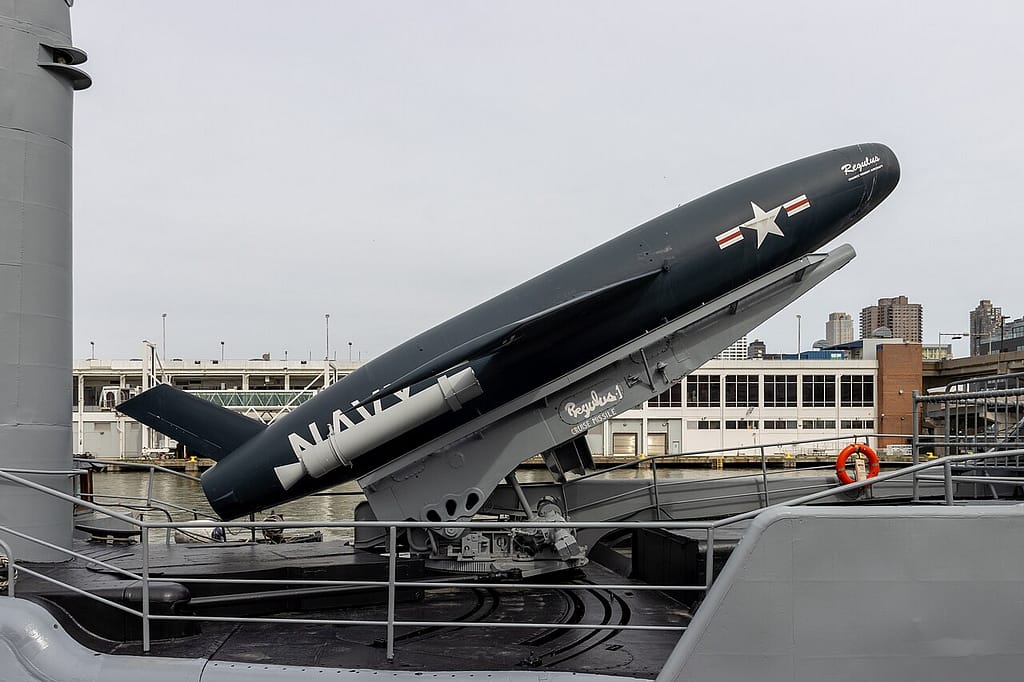
The Regulus was really an unmanned aircraft. It had swept wings, a turbojet in its belly and flew subsonically like a small fighter; it just never came back. Stored in a bulbous, watertight hangar bolted to the submarine’s deck, it could be fuelled and prepared by the crew from inside the pressure hull. But it could not be fired submerged. When the moment came, the boat surfaced, the hangar opened, and the missile was run out on rails and launched with a booster into the sky.
That surfacing requirement was the system’s fatal flaw, and the Navy knew it from the start.
Standing watch in the North Pacific
Flawed or not, it was real, and for five years it was all the Navy had. Five submarines carried the load: the converted war-veterans Tunny and Barbero, the purpose-built Grayback and Growler, and the nuclear-powered Halibut. Sailing from Pearl Harbor, they ran 40 deterrent patrols between October 1959 and July 1964, holding Soviet targets at risk from the far side of the Pacific — including through the tense weeks of the Cuban Missile Crisis.
The day a missile delivered the mail
The Regulus also earned a genuinely bizarre footnote. On June 8, 1959, the submarine Barbero fired a Regulus whose nuclear warhead had been swapped for two mail containers holding 3,000 letters. Twenty-two minutes later it touched down at a naval station in Mayport, Florida. “Missile mail” had arrived — and the Postmaster General could barely contain himself.
British Pathé newsreel of the 1959 “missile mail” delivery by the submarine Barbero.
Overtaken in a single stroke
Summerfield was wrong about the mail but right about the pace of change. Within a year, the nuclear submarine George Washington fired a Polaris missile from beneath the surface, and every disadvantage of the Regulus — the surfacing, the exposed launch, the short range, the tiny magazine — vanished at once. Polaris could shoot while hidden and never had to show itself. The Regulus deterrent patrols ended in 1964, and a planned supersonic successor was cancelled in favour of the new ballistic missiles.
It was a dead end — but a fascinating one. The recoverable training rounds, fitted with landing gear and flown home to be used again, were essentially reusable drones decades ahead of their time, and the whole idea of a submarine hurling a jet-powered cruise missile at a distant target would return, vindicated, in the Tomahawk. The Regulus simply arrived too early, and had to surface to prove it.
Sources: Naval History and Heritage Command; Smithsonian National Postal Museum; GlobalSecurity.org; British Pathé.
0 Comments