

At 9G, your blood weighs nine times what it normally does. Your arms feel like they are filled with wet cement. Your vision collapses from the edges inward until you are looking through a drinking straw. And if you do not fight it — actively, violently, every three seconds — you will be unconscious in about five seconds.
This is what happens inside your body when a fighter jet turns hard.
Quick Facts
- 9G means: Nine times the force of gravity acting on your body
- Weight at 9G: A 80 kg pilot effectively weighs 720 kg
- Blood displacement: Blood pools in lower extremities within seconds
- GLOC onset: G-force induced loss of consciousness can occur in 4–6 seconds without straining
- Anti-G suit: Inflatable bladders squeeze legs and abdomen, adding ~1.5G tolerance
- Training: Fighter pilots train in centrifuges at facilities like Brooks City Base, TX
The Progression: From Color to Black
Under positive G-forces — the kind you feel in a hard pull-up or sustained turn — blood drains from your head to your feet. The sequence that follows is well-documented and mercilessly predictable:
Tunnel vision comes first. Your peripheral vision narrows progressively, as though someone is closing curtains from both sides. Then grey-out: color drains from the world, leaving everything monochromatic and hazy. Next is blackout — complete loss of vision, though you may briefly remain conscious. Finally comes G-LOC (G-force induced Loss of Consciousness): the brain loses blood supply entirely and you pass out.
An untrained person typically blacks out between 4 and 6G. If the G-onset is rapid — more than 1G per second — G-LOC can occur without any visual warning at all. You go from normal to unconscious with no tunnel vision, no grey-out, nothing. Average incapacitation during G-LOC lasts about 12 seconds, followed by several seconds of disorientation.
In a fighter jet traveling at 500 knots, 12 seconds covers about three miles.
How Pilots Fight Back
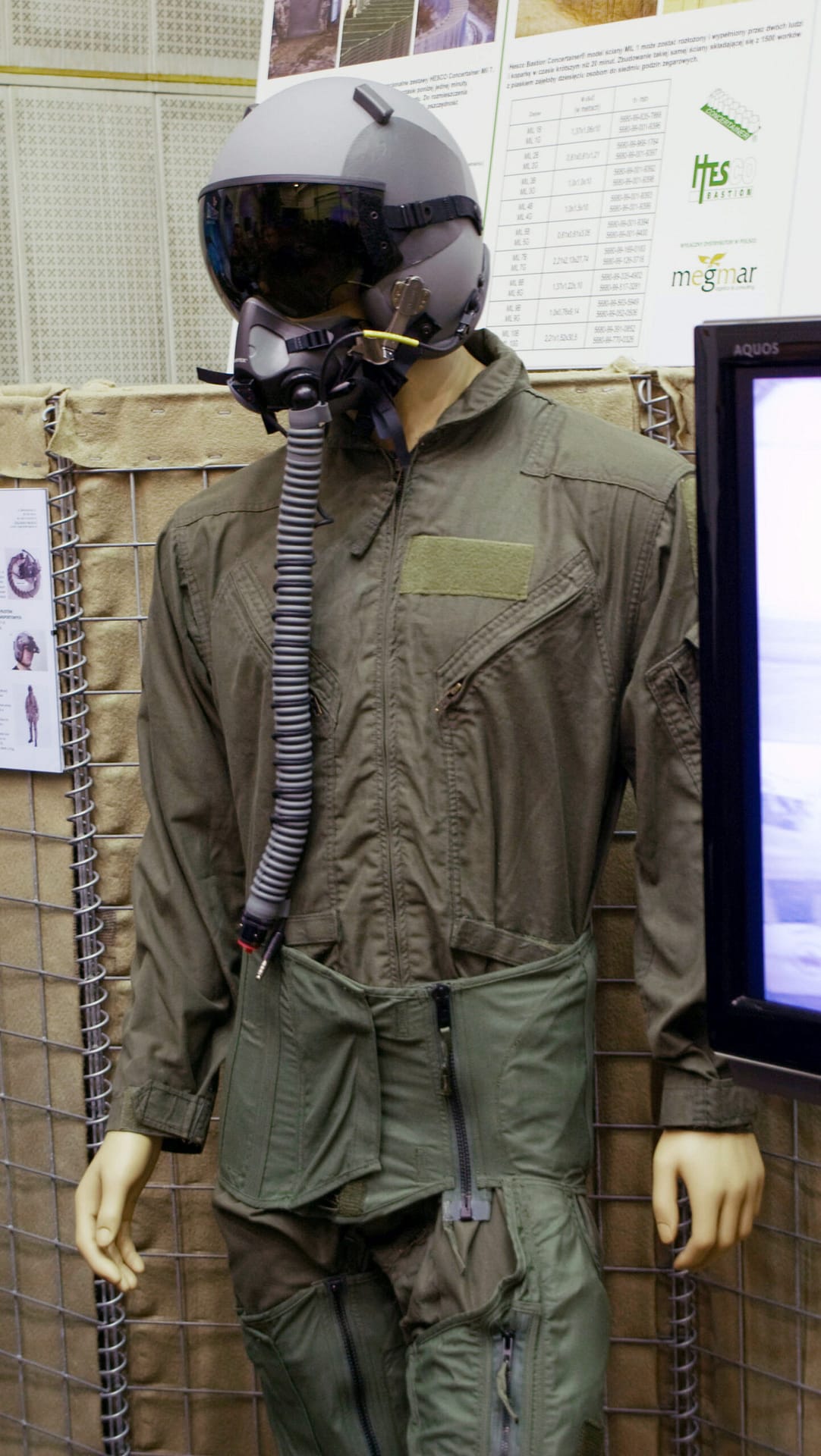
Fighter pilots use two defenses against G-forces: hardware and technique.
The G-suit contains inflatable bladders over the calves, thighs, and abdomen. Under high G-loads, the bladders automatically inflate with compressed air, squeezing blood vessels and forcing blood back toward the heart and brain. A G-suit adds roughly 1G of protection.
The real weapon is the Anti-G Straining Maneuver (AGSM) — a combination of forced breathing against a closed throat every three seconds and intense contraction of leg, abdominal, and back muscles to prevent blood pooling in the lower body. A properly executed AGSM adds approximately 4G of protection. The math works out neatly: baseline tolerance (4.5G) + G-suit (+1G) + AGSM (+4G) = roughly 9G.
Pilots train until the AGSM is automatic, because poor timing actually makes things worse. Strength and core training also improves G tolerance, which is why fighter pilots maintain rigorous fitness regimes.
The Man Who Survived 46G
On December 10, 1954, Dr. John Paul Stapp rode the Sonic Wind I rocket sled at Holloman Air Force Base to 632 mph in 5 seconds, then stopped in just 1.4 seconds. The deceleration hit 46.2G. For the briefest moment, his 168-pound body weighed approximately 7,800 pounds.
He cracked ribs, broke both wrists, and was temporarily blinded when the G-forces burst every blood vessel in his eyes. His research proved that properly restrained pilots could survive crashes at forces previously assumed to be fatal — and led directly to mandatory seatbelts in automobiles.
What the Jets Can Handle
Different fighters have different structural limits. The F-16 and MiG-29 are rated for +9G. The F/A-18 Hornet caps at +7.5G. The L-39 Albatros handles +8G. The F-35A matches the F-16 at 9G, though the B and C carrier/STOVL variants are limited to 7-7.5G.
Then there is the other direction. Negative G — pushing the nose over or flying inverted — sends blood rushing to the head instead of away from it. This causes red-out: vision takes on a reddish tint as blood floods the eye vessels. Red-out can occur at as little as -2 to -3G, and sustained negative G can cause retinal damage and hemorrhagic stroke. G-suits provide zero protection against negative G. The human body tolerates far less of it.
What You Will Feel on a MiGFlug Flight
Passengers on MiGFlug flights typically experience 4G to 7G, depending on the aircraft and the maneuvers. At 4-5G, most passengers feel the edges of their vision going grey. The G-suit inflates around your legs — a sudden, firm squeeze. Breathing becomes work; your chest feels like someone parked a concrete slab on it. The pilot pulls into loops, rolls, Immelmann turns, and split-S maneuvers.
For context: your average rollercoaster hits about 3-5G momentarily. The highest G-force on a currently operating rollercoaster is 5.5G on Shock Wave at Six Flags Over Texas.
A fighter jet sustains those forces for seconds at a time, not fractions of a second. That is the difference between a thrill ride and the real thing.
Sources: Federal Aviation Administration Aeromedical Library, USAF School of Aerospace Medicine, Aerospace Medical Association, Aviation Week
Related Questions
What does pulling 9G do to your body?
At 9G your body feels nine times its normal weight, so an 80 kg pilot effectively weighs about 720 kg. Blood is forced from the head toward the legs within seconds, vision fades, and without protective measures a pilot can lose consciousness. Sustained high-G flight is one of the harshest stresses the human body endures.
What is G-LOC?
G-LOC stands for G-force induced loss of consciousness. It occurs when high positive G drains blood from the brain, and it can strike in just 4 to 6 seconds if the pilot is not actively straining. A pilot may black out completely and only wake seconds later, often with no memory of it.
How quickly can a pilot black out from G-forces?
Without any protective straining, G-LOC can occur within 4 to 6 seconds of sustained high G. Before full blackout, pilots pass through warning stages — greyout, tunnel vision and loss of colour — which serve as cues to fight the effect before consciousness is lost.
How does an anti-G suit work?
An anti-G suit has inflatable bladders that squeeze the legs and abdomen as G-forces rise, slowing the pooling of blood in the lower body and keeping it flowing to the brain. A modern suit adds roughly 1.5G of tolerance, which is then combined with a straining technique.
What is the anti-G straining manoeuvre?
The anti-G straining manoeuvre is a forceful technique pilots use to stay conscious: they tense the legs and core and breathe against a closed throat in short bursts to keep blood pressure up in the brain. Combined with an anti-G suit, it lets pilots tolerate the highest sustained loads.
What is tunnel vision in pilots?
Tunnel vision is an early symptom of G-stress in which the outer field of view darkens and only a narrow central area remains visible. It follows greyout and loss of colour, and signals that blood flow to the eyes and brain is dropping — a final warning before G-LOC.
How do fighter pilots train for high G-forces?
Pilots train in centrifuges that spin them to recreate sustained G, learning the straining manoeuvre and building tolerance under medical supervision. The experience is intense even for the fit — much like the comfort trade-offs explored in flying an F-16 versus an airliner.
Can high G-forces injure a pilot?
Yes. Beyond blackout, repeated high-G flight strains the neck, spine and blood vessels over a career. The forces involved in fast jets are extreme, and related stresses such as ejection-seat spinal compression show how physically demanding military flying really is.


0 Comments