
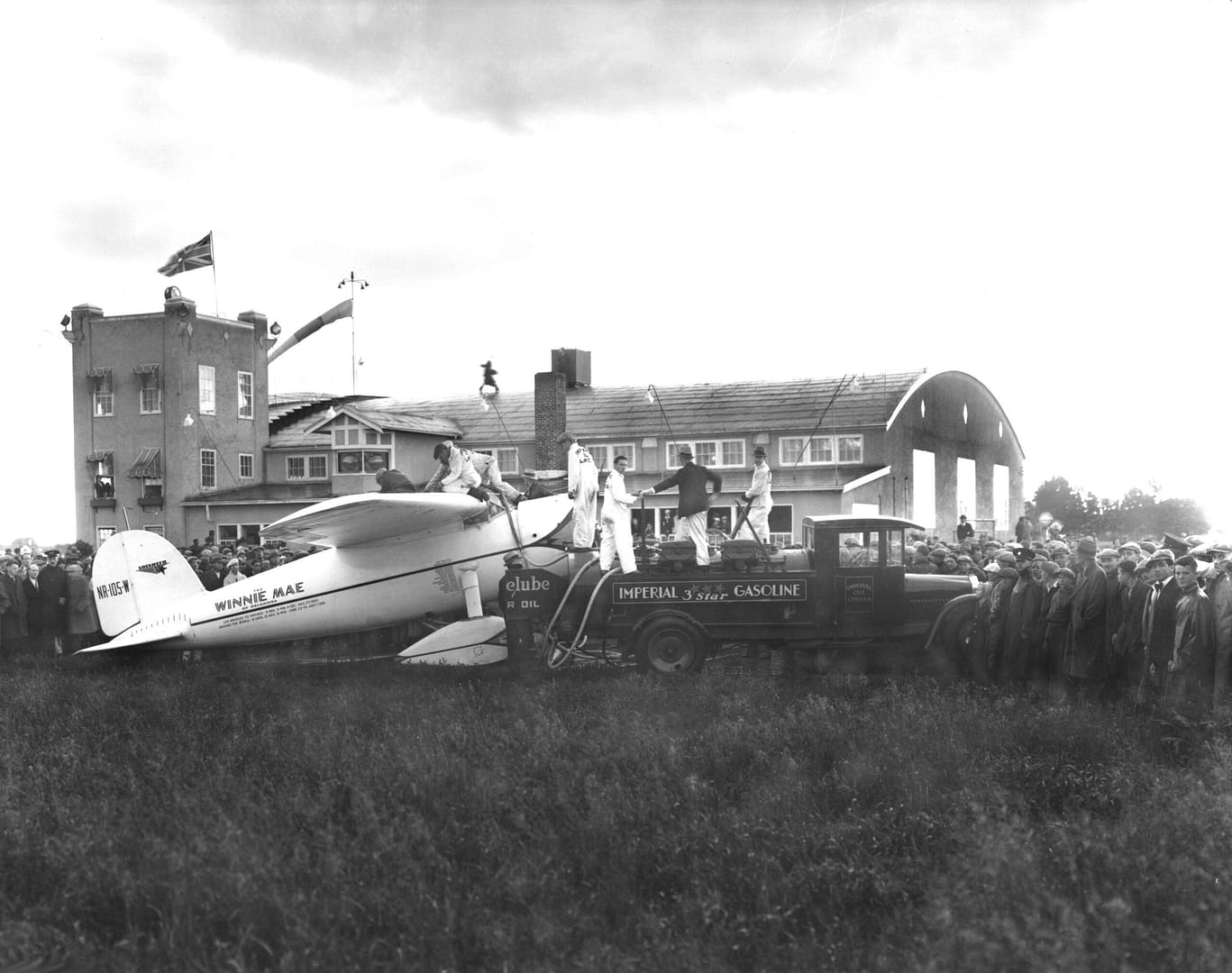
The cockpit of the Winnie Mae, in the summer of 1933, smelled like a hardware store on fire. Hot castor oil, cold steel, the eye-watering tang of leaded fuel sweating through the wooden wing root. There was no autopilot worth the name. There was no second pilot, period. There was a single short man with an eyepatch and a chip on his shoulder the size of Oklahoma, sitting in the only seat, flying alone around the entire world.
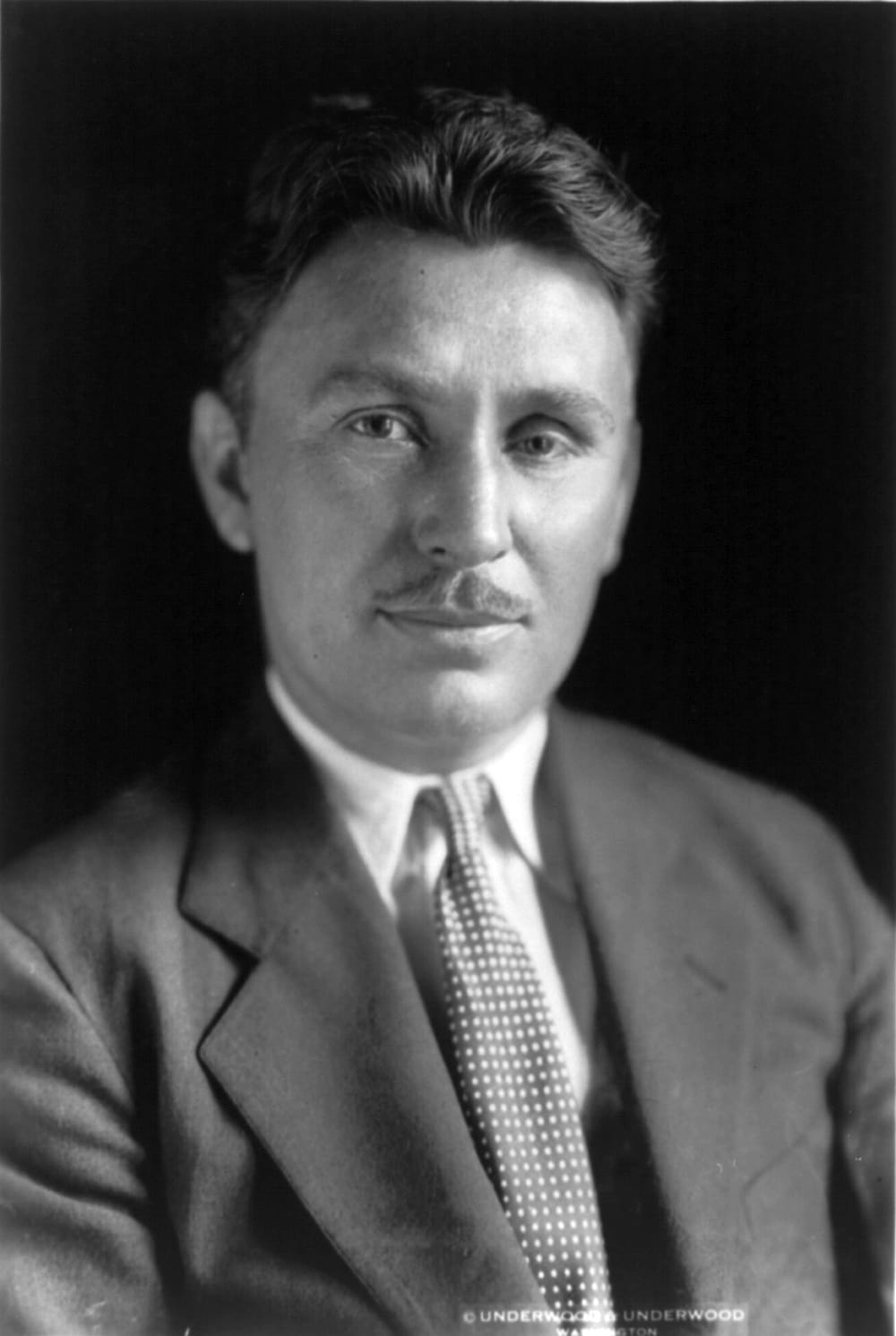
His name was Wiley Hardeman Post. He was thirty-four. He had served time in an Oklahoma reformatory for armed robbery. He had no left eye — that had been taken by a flake of steel on an oil rig — and the settlement money from that lost eye, $1,800, was what he had used to buy his first airplane. On July 15, 1933, he climbed into a purple-and-white Lockheed Vega at Floyd Bennett Field, New York, and pointed the nose at Berlin. Seven days, eighteen hours, and forty-nine minutes later, he came home. First man, solo, around the globe.
And then, because the world is unfair, Lindbergh kept the headlines.

Born: 22 November 1898, Grand Saline, Texas (raised in Oklahoma)
The eye: Lost left eye to an oil-field accident, 1 October 1926
The airplane: Lockheed Model 5C Vega “Winnie Mae”
Solo around the world: 15–22 July 1933 — 7 days, 18 h, 49 min
Distance: ~15,596 miles (25,099 km)
Other firsts: Co-developed the first practical pressure suit; discovered the jet stream
Died: 15 August 1935, plane crash near Point Barrow, Alaska, with Will Rogers
The roughneck who decided to fly
Wiley Post was not the kind of man America likes to celebrate. He quit school in the sixth grade. He was, by his own admission, a hard kid in a hard part of the country. In 1921 he was arrested for armed robbery in Grady County, Oklahoma, and spent fourteen months in the state reformatory at Granite before he was paroled. The story might have ended there — another disposable Oklahoma boy with no future and a record — except that Wiley wanted to fly.
He found work in the oil fields. He found his way to a barnstorming troupe, where he learned to parachute before he learned to pilot. And on a rig near Seminole, in 1926, a chip of metal flew off a drill bit and into his left eye. The eye couldn’t be saved. The infection took it. He was twenty-seven, half-blind, and broke.
He used the $1,800 worker’s comp settlement to buy a Curtiss Canuck. Then he taught himself to estimate distance with one eye. Most pilots said it couldn’t be done. Post simply did it.
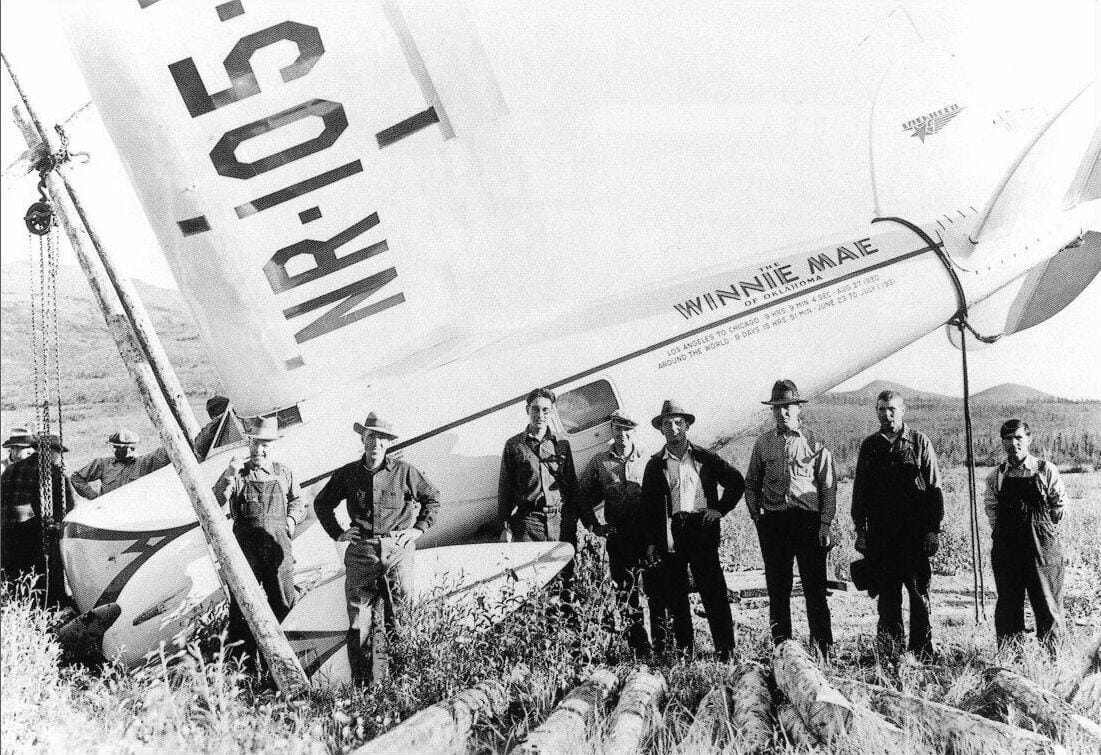
Seven days, eighteen hours, forty-nine minutes
The Winnie Mae was a Lockheed Vega, the same kind of high-wing monoplane Amelia Earhart had flown across the Atlantic. Oklahoma oilman F.C. Hall, whose personal pilot Post was, had bought her in 1930 and named her after his daughter; Post acquired her from Hall after their 1931 flight. He had already flown her around the world once before, in 1931, with navigator Harold Gatty as company. That trip took eight days, fifteen hours, fifty-one minutes. The two men wrote a memoir together — Around the World in Eight Days, with an introduction by Will Rogers — that sold respectably and made Post famous in aviation circles.
But Post wanted the solo record. So in 1933 he equipped the Winnie Mae with a Sperry gyroscopic autopilot — a brand-new device, basically a wooden box of gears that could hold a heading and an altitude if you babied it — and a radio direction-finder. Then he took off from Floyd Bennett Field at 5:10 in the morning on July 15.
He hit Berlin in a single 25-hour hop — a feat in itself. He continued east through Konigsberg, Moscow, Novosibirsk, Irkutsk, Khabarovsk, Flat in Alaska (where the propeller had to be replaced — an echo of the 1931 trip, when a sand takeoff at Solomon, near Nome, had bent both propeller tips, an episode Post described in print with disarming bluntness), then south to Edmonton, then home. He flew on caffeine, cold sandwiches, and the autopilot. He slept in catnaps, with a wrench tied to his finger so that if he dozed too deeply, it would clatter to the cockpit floor and wake him.
He landed at Floyd Bennett Field on the evening of July 22, 1933. Fifty thousand people were waiting. Wiley Post had become the first human being to fly solo around the world.
The pressure suit, the jet stream, and a final flight
The record made him famous, but Post wasn’t finished. He wanted altitude. With the help of the BFGoodrich company, he designed and tested the first practical pressure suit — a rubberized canvas affair with an aluminum diver’s helmet that made him look like a deep-sea diver who had wandered into the wrong century. In it, he climbed the Winnie Mae to 50,000 feet and back, and in the process he became the first man to ride what was, in effect, a high-speed river in the upper air — the jet stream. The technology of every modern airliner traces back to Wiley Post’s rubber suit.
And then, in August 1935, in a hybrid floatplane he had cobbled together himself, with the humorist Will Rogers in the passenger seat, he flew up to Alaska to see what the country looked like from above. They took off from a lagoon near Point Barrow on the evening of August 15. The engine quit at about fifty feet. The plane cartwheeled into the water. Both men were killed instantly.
Wiley Post was thirty-six years old. He was buried in Memorial Park Cemetery in Oklahoma City — the first man to fly solo around the world. Charles Lindbergh, who had merely crossed an ocean six years earlier, would dominate every aviation textbook written for the next ninety years. Post would be a footnote. A one-eyed Oklahoma roughneck who flew alone around the entire planet, invented the spacesuit, and discovered the jet stream — and got, in return, exactly the kind of immortality the country reserves for people it doesn’t quite know what to do with.
Sources: Smithsonian National Air and Space Museum, Smithsonian Magazine, History.com, Oklahoma Historical Society, Internet Archive (Around the World in Eight Days, 1931), Wikipedia.

 English
0 Comments