
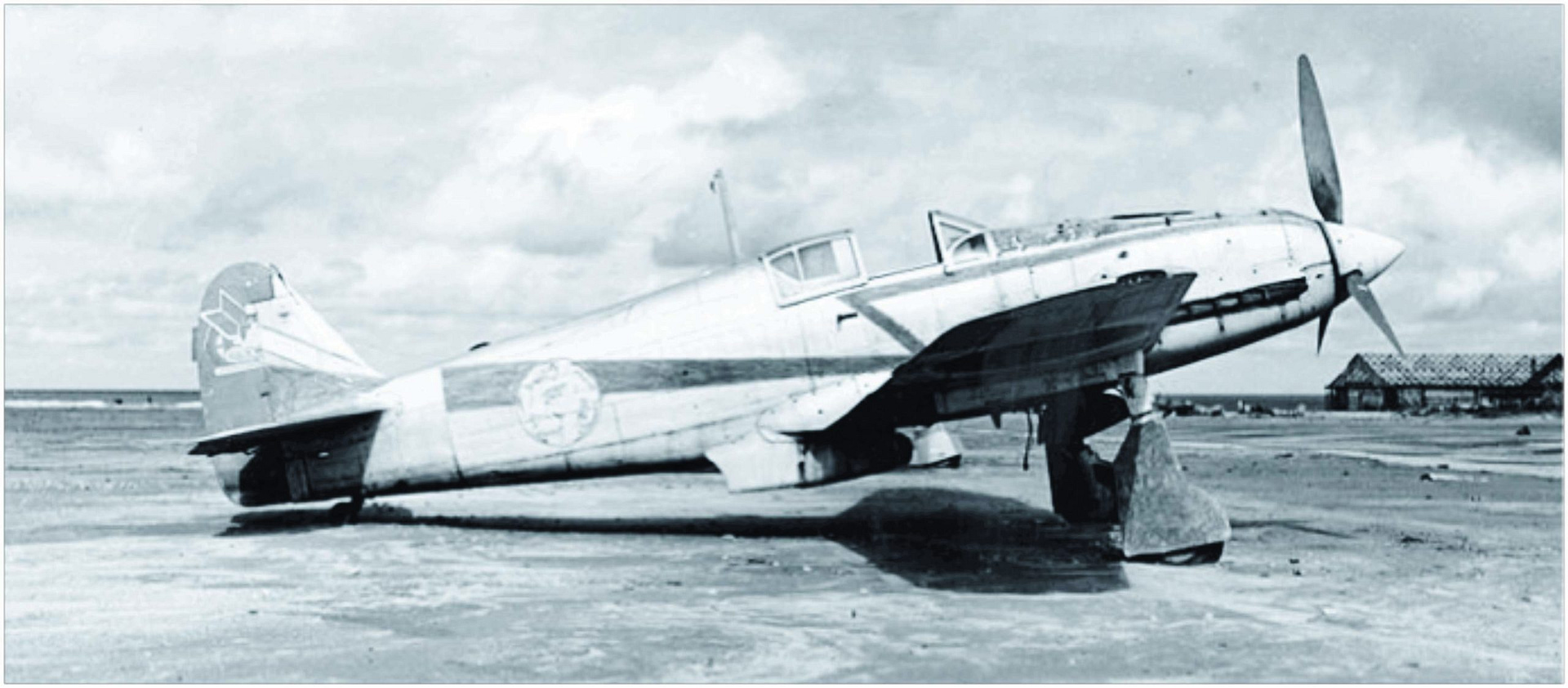
Kawasaki Ki-61 Hien
“Tony”
The Imperial Japanese Army’s one liquid-cooled inline fighter of WWII — so sleek that Allied crews assumed Japan had bought a German or Italian design, and the only Japanese Army fighter to carry armour and self-sealing tanks as standard.
The Japanese fighter the Allies mistook for a European one
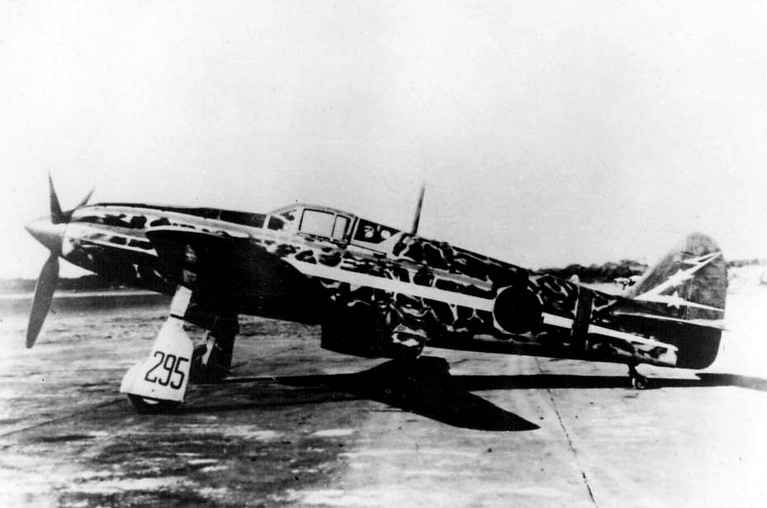
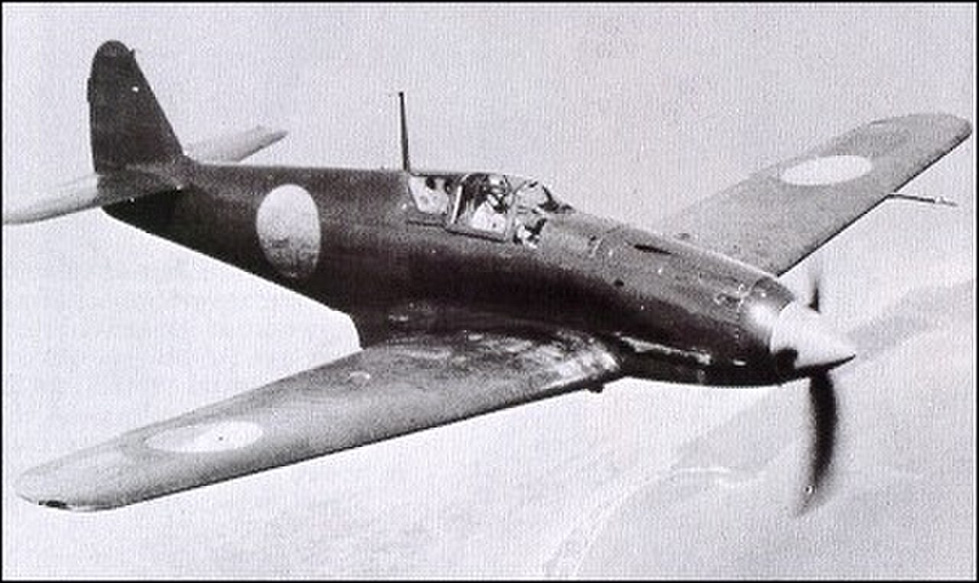
By 1940 almost every Japanese fighter shared a design philosophy: light weight, tight turning, and an air-cooled radial engine, with little armour and no self-sealing fuel tanks. The Kawasaki Ki-61 Hien (“Flying Swallow”) broke that mould. Its designer, Takeo Doi, built the airframe around a liquid-cooled inline V-12 — the Kawasaki Ha-40, a licence-built version of the German Daimler-Benz DB 601 — giving the aircraft a slim, pointed nose quite unlike the blunt radial fighters around it.
That silhouette caused genuine confusion. When Allied crews first met the type over New Guinea in 1943, intelligence officers reportedly assumed it was a licensed German Messerschmitt or an Italian design; the Allied reporting name “Tony” reflects the early belief that it was an Italian fighter. In reality it was wholly Japanese — and unusually well protected. Unlike the famous A6M Zero, the Ki-61 carried armour plate for the pilot and self-sealing fuel tanks, and it could out-dive American fighters such as the P-38, P-39 and P-40 that its rivals struggled to escape.
The Hien’s weakness was under its cowling. The Ha-40 was a demanding, tightly-toleranced engine, and Japanese industry — short of skilled labour, quality alloys and precision tooling as the war turned — never mastered it. Chronic unreliability and a bombing raid that wrecked the engine factory left rows of finished airframes with no engines to fit. The solution was radical and, in the end, brilliant: graft a radial engine onto the Hien airframe. The result, the Kawasaki Ki-100, became one of the best Japanese fighters of the war. Around 2,750 Ki-61s were built; with the Ki-100 the family total nears 3,000.
01The Kawasaki Ki-61 Hien’s German heart: how a Daimler-Benz V-12 ended up in a Japanese fighter
In 1940 Kawasaki obtained a licence for the Daimler-Benz DB 601, the inverted V-12 that powered the Messerschmitt Bf 109 and Bf 110. A design team returned from Germany with drawings and sample engines, and the first Kawasaki Ha-40 was completed in 1941. On paper it was excellent: lighter than the German original and rated around 1,175 hp. In practice the Ha-40 was where Japanese production limits showed most cruelly — it ran hot, its bearings and tolerances were unforgiving, and reliability in the field was poor. The uprated Ha-140 of the Ki-61-II pushed power toward 1,500 hp but made the problems worse. The engine that gave the Hien its distinctive lines was also the reason so many never flew.
What makes it special
A liquid-cooled inline, alone among Japanese fighters
Almost every wartime Japanese fighter used an air-cooled radial. The Ki-61 was the exception, built around the Kawasaki Ha-40 — a licence-built Daimler-Benz DB 601 inverted V-12. The slim nose it allowed gave the Hien clean aerodynamics and a European look that briefly fooled Allied recognition officers into logging it as a German or Italian type.
Armour, self-sealing tanks and a fast dive
Where the Zero traded protection for range and agility, the Hien carried pilot armour and self-sealing fuel tanks from the outset — rare for a Japanese fighter. Sturdily built, it could out-dive the P-38, P-39 and P-40 and held up well at altitude, making it a serious opponent until the P-51 Mustang and F6F Hellcat arrived in numbers.
Engineless airframes — and the radial-engined Ki-100
The Ha-40/Ha-140 was chronically unreliable, and a 1945 raid crippled the Akashi engine works, leaving hundreds of complete Hien airframes with no engines. Engineers fitted a Mitsubishi radial instead, creating the Ki-100 — widely judged one of Japan’s finest late-war fighters, born directly from the Hien’s engine crisis.
02The Kawasaki Ki-61 Hien in home defence: high-altitude fighting and the ramming of the B-29s
By 1944 the Hien had become one of the Imperial Japanese Army’s more capable interceptors against the B-29 Superfortress. The improved Ki-61-II could reach the bombers’ high cruising altitude where lighter, radial fighters ran out of breath, and units such as the 244th Sentai defending the Tokyo area became closely associated with the type. As raids intensified and conventional interceptions proved costly, some Hien pilots resorted to deliberate ramming attacks (taiatari) — stripping their aircraft of guns and armour to gain altitude and colliding with the bombers. It was a measure of desperation, and of how far the defenders were prepared to go.
03The Kawasaki Ki-61 Hien’s variants: from the Ki-61-I to the Ha-140 and the Ki-100
The first production Ki-61-I (from 1942–43) used the roughly 1,175 hp Ha-40 and went through sub-variants with heavier armament, including licensed 20 mm Mauser cannon and later the Japanese Ho-5. The Ki-61-II introduced the more powerful but troublesome Ha-140 and a redesigned wing, aiming at the altitude needed to fight the B-29. Engine supply collapsed: of several hundred Ki-61-II airframes, only a fraction received engines before the Akashi factory was bombed in January 1945. The remaining airframes were completed with a Mitsubishi radial as the Ki-100 — the same basic aircraft, transformed into one of the war’s best-handling Japanese fighters.
Full specifications
Figures below are for the Ki-61-II-KAI, the late-war Ha-140 version; early Ki-61-I aircraft were a little lighter and slower. Wartime Japanese figures vary between sources, so some values are commonly-cited approximations.
Airframe & Performance
- Экипаж
- 1
- Длина
- ~8.94 m
- Размах крыльев
- 12.00 m
- Высота
- ~3.70 m
- Зона крыла
- ~20.0 m²
- Пустой вес
- ~2,840 kg
- Max takeoff weight
- ~3,780 kg
- Max speed
- ~610 km/h (Ki-61-I ~580 km/h)
- Служебный потолок
- ~11,000 m
- Диапазон
- ~1,600 km (with drop tanks)
Powerplant, Armament & Programme
- Двигатель
- 1 × Kawasaki Ha-140 inverted V-12 (liquid-cooled)
- Power
- ~1,500 hp (Ki-61-I Ha-40 ~1,175 hp)
- Engine origin
- Licensed Daimler-Benz DB 601
- Вооружение
- 2 × 20 mm Ho-5 + 2 × 12.7 mm Ho-103
- First flight
- December 1941
- Service entry
- 1943
- Built
- ~2,750 Ki-61 (~3,000 with Ki-100)
- Cost per flight hour
- No reliable public figure
04The Kawasaki Ki-61 Hien’s cost: why no meaningful price figure exists
The Ki-61 was a wartime Japanese state product, built under a command economy and destroyed or scrapped almost in its entirety by 1945. No credible flyaway unit price or cost-per-flight-hour figure survives in open sources, and any modern dollar figure attached to the type is guesswork. What is documented is the human and industrial cost: an engine so hard to build that finished airframes sat waiting, and a programme of roughly 2,750 aircraft whose potential was throttled by supply, not design.
From a German licence to a radial-engined rescue
The DB 601 licence
Kawasaki acquires a licence for the Daimler-Benz DB 601 V-12; a team returns from Germany with drawings and engines to build the Ha-40.
First flight
Takeo Doi’s inline-engined fighter prototype flies in December 1941, standing apart from Japan’s radial-powered fighters.
Combat debut over New Guinea
The Ki-61 enters operational service and meets Allied aircraft over New Guinea; recognition officers code-name it “Tony,” assuming an Italian design.
The Philippines and home defence
Hien units fight over the Philippines and are pulled back for the defence of Japan, where the high-flying type takes on the B-29.
Engineless airframes
A raid cripples the Akashi engine works; hundreds of completed Ki-61-II airframes are left with no engines to fit.
The Ki-100 is born
Fitting a Mitsubishi radial to the stranded airframes creates the Ki-100 — a fast, forgiving fighter regarded as one of Japan’s best.
End of production
Ki-61 production ends after roughly 2,750 aircraft; the war closes months later.
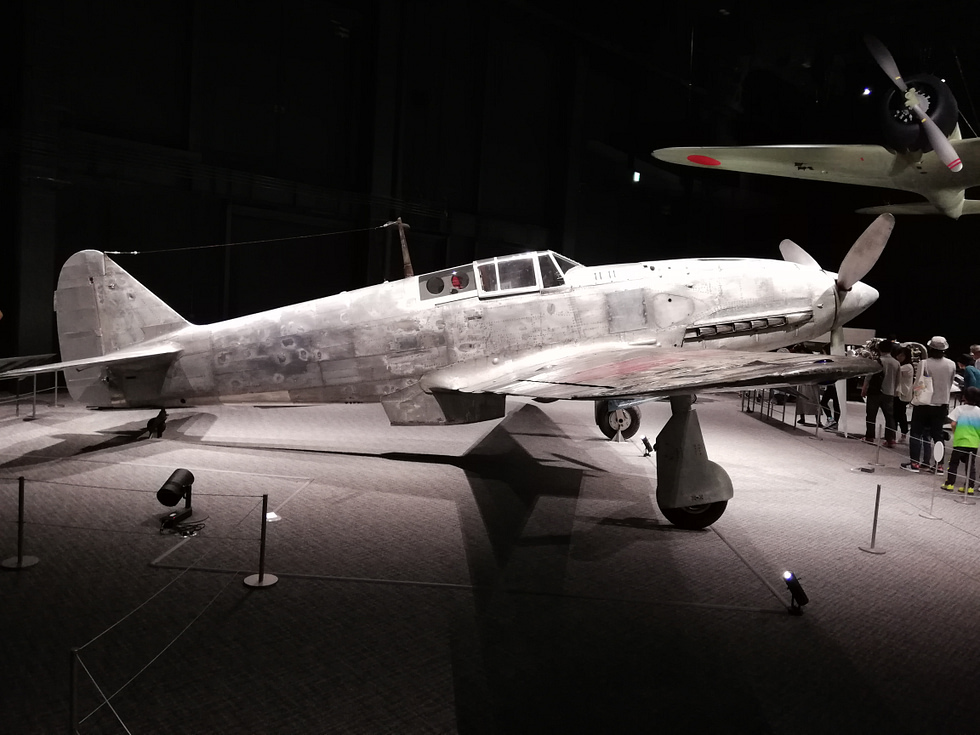
A single survivor
One restored Ki-61 is preserved in Japan — a static museum aircraft, not airworthy, and the only complete Hien left in the world.
From the war: twelve Hien stories
A German engine for a Japanese fighter
Kawasaki licensed the Daimler-Benz DB 601 and built it as the Ha-40.
Read the full story
Why the Allies called it “Tony”
Its slim nose led intelligence to assume a German or Italian design.
Read the full story
The fighter that carried armour
Unlike the Zero, the Hien protected its pilot and fuel.
Read the full story
Diving away from trouble
The Hien could out-dive the P-38, P-39 and P-40.
Read the full story
A hard debut
The Hien fought in the brutal New Guinea campaign from 1943.
Read the full story
The 244th Sentai over Tokyo
A famous home-defence unit flew the Hien against the B-29.
Read the full story
Ramming the Superfortress
Some Hien pilots deliberately collided with B-29s.
Read the full story
Engines that would not come
The Ha-40 was too hard for wartime industry to build well.
Read the full story
Rows of airframes, no power
A 1945 raid on the Akashi engine works stranded the fleet.
Read the full story
A radial where a V-12 had been
Fitting a Mitsubishi radial created the excellent Ki-100.
Read the full story
Potential throttled by supply
Historians see a good design let down by production.
Read the full story
The last Hien
One restored survivor remains, preserved in Japan.
Read the full story
The Hien in pictures
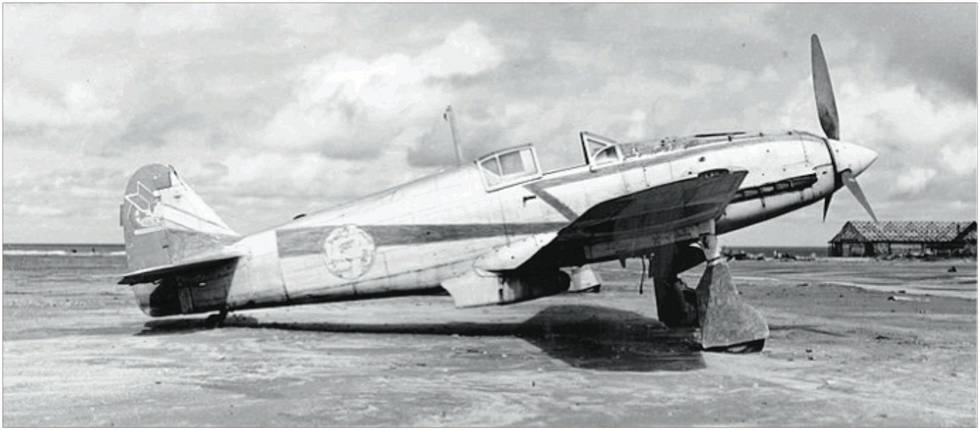
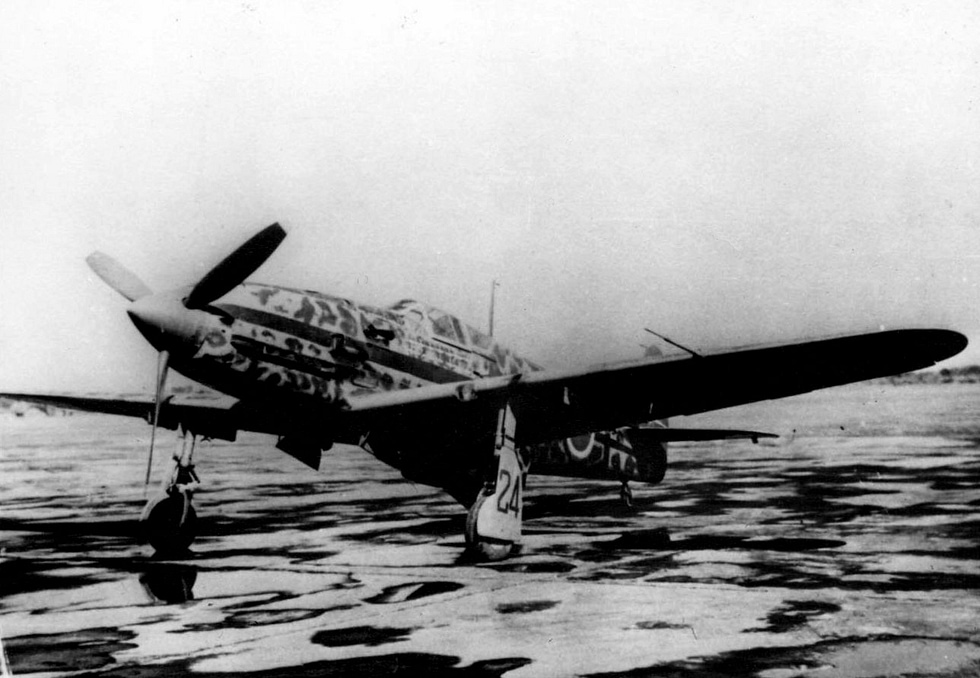
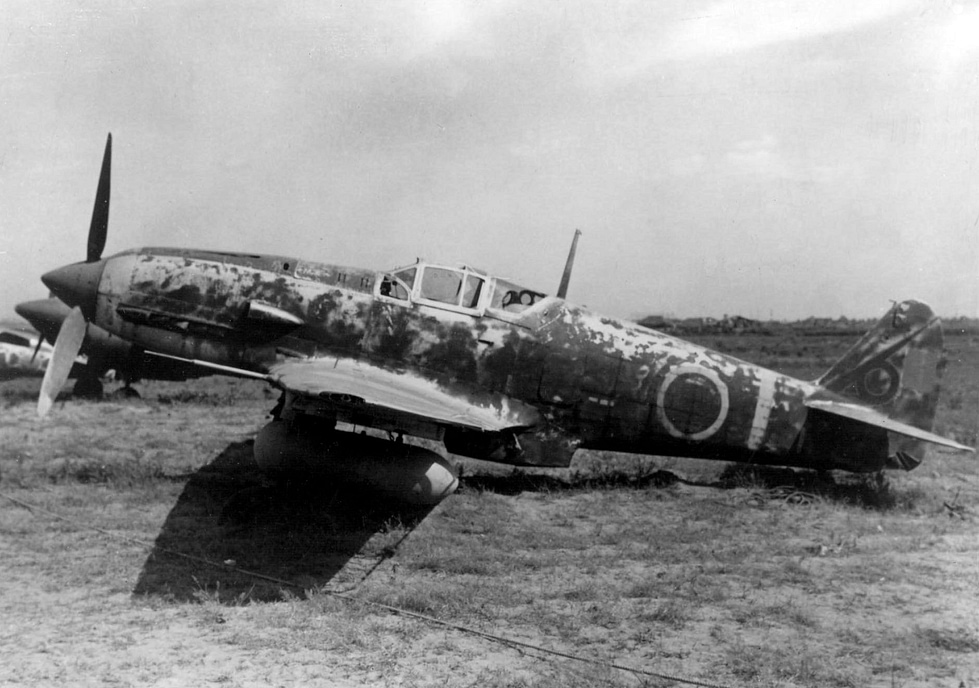
The Hien on film
Verified archival footage of the Kawasaki Ki-61 Hien in flight is scarce, and we would rather show you nothing than something mislabelled. A carefully sourced video is coming soon.
Where the Hien flew
The record that defines it
The Hien was a workmanlike frontline fighter rather than a record-setter, and precise Japanese victory tallies are unreliable. Its significance lies in what it represented: the one Japanese Army fighter with a European inline engine, armour and self-sealing tanks, effective enough at altitude to be trusted with the defence of Japan itself — and hamstrung less by the enemy than by the engine its own industry could not build.
Compare the combat record of every military aircraft. Figures as of July 2026.
Everything people ask about the Ki-61 Hien
Can I fly in a Ki-61?
Why did the Allies call the Ki-61 “Tony”?
What engine did the Ki-61 use?
How was the Ki-61 different from the A6M Zero?
Did the Ki-61 fight the B-29?
What is the Ki-100, and how is it related?
How many Ki-61s were built?
Are any Ki-61s left today?
You can’t fly the Hien.
These, you can.
Some legends only live in museums — others are fuelled and waiting. MiGFlug has put civilians in real military jet cockpits since 2004.
 Fly the L-39 AlbatrosThe world’s most-flown jet trainer — aerobatics included
 Fly the F-104 Starfighter“The missile with a man in it”
 Fly the MiG-21The Cold War’s most-produced jet
 Управляйте самолетом T-33 Shooting Star.America’s first jet trainer
 Fly the DH VampireA piece of early jet history
 Fly the S.211Agile Italian jet trainer
 Fly the MB-326The classic Aermacchi jet
 Fly the MiG-15The Soviet legend of the Korean War
Continue the tour
Every fact, checked
- The History of War — Kawasaki Ki-61 HienJ. Rickard’s detailed development and service history, and the “Tony” naming.
- Air Vectors — The Kawasaki Ki-61 & Ki-100Greg Goebel’s technical overview of the Ha-40 engine and the radial-engined Ki-100.
- Pacific War Online Encyclopedia — Ki-61 “Tony”Kent Budge’s reference specifications and combat summary.
- World War II Database — Ki-61 HienCross-check for dimensions, weights and armament figures.
- Military Factory — Kawasaki Ki-61 Hien (Tony)Variant breakdown and production overview.
- Smithsonian National Air and Space MuseumReference for Japanese wartime aircraft and preservation context.