
Sikorsky Ilya Muromets — the world’s first four-engine airliner that became the world’s first heavy bomber
The Sikorsky Ilya Muromets: the airliner that became the world’s first heavy bomber
In 1913, in the workshops of the Russo-Baltic Wagon Factory (R-BVZ) in St Petersburg, a 24-year-old engineer named Igor Sikorsky did something no one had done before. He built an aircraft with four engines. His Russky Vityaz (“Russian Knight”, also called Le Grand) is generally credited as the world’s first four-engine aeroplane, and it worked — at a time when many serious people still doubted a single-engine machine could be trusted at all. From it grew something larger and far more famous: the Ilya Muromets, named after a mythical Russian folk hero, a giant of a machine that would earn several genuine “firsts” in the short, crowded history of early aviation.
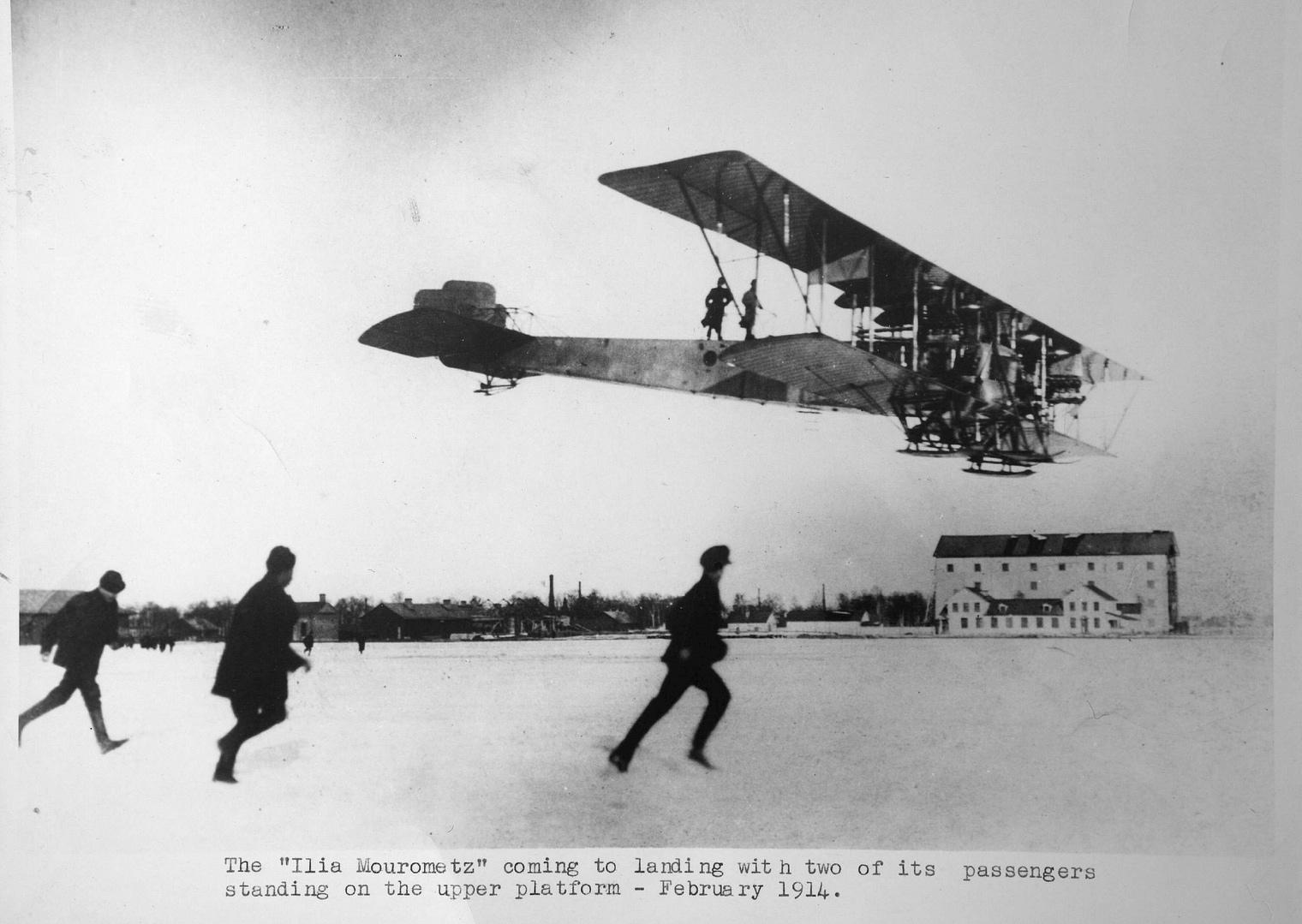
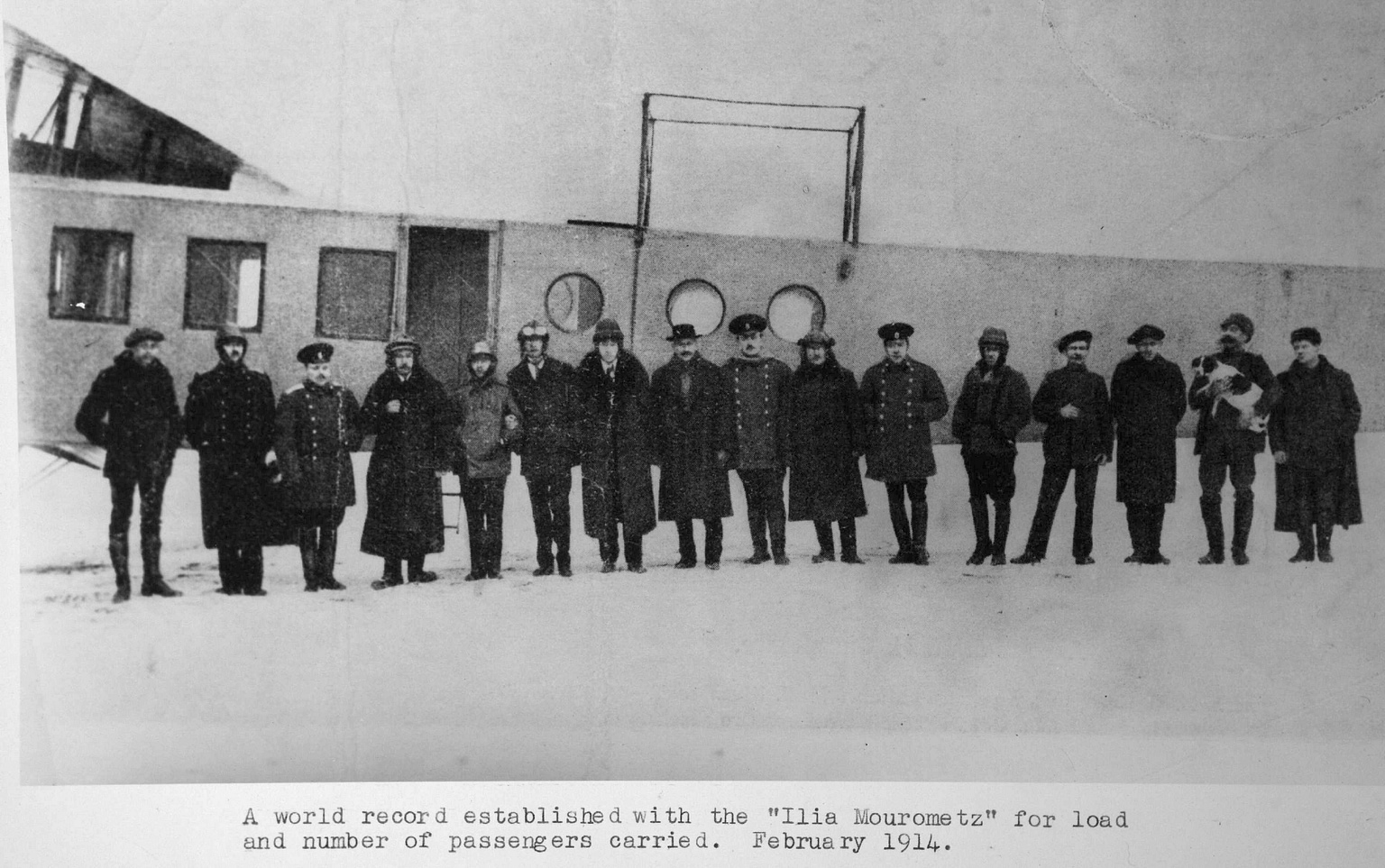
The first Ilya Muromets flew around the winter of 1913–1914, and — this is the part people forget — it was conceived not as a weapon but as a luxury airliner. By the accounts that survive it had an enclosed, heated cabin with electric lighting, comfortable seating, large windows, a small washroom and even a promenade area — genuinely revolutionary comfort at a time when almost every other aircraft in the world was an open, cold, single-seat machine. It set passenger-carrying and altitude records, and in February 1914 reportedly took sixteen people (and, by one popular account, a dog) into the air at once. In the summer of 1914 a Muromets flew from St Petersburg to Kiev and back, a long-distance demonstration of well over a thousand kilometres that made headlines across the empire.
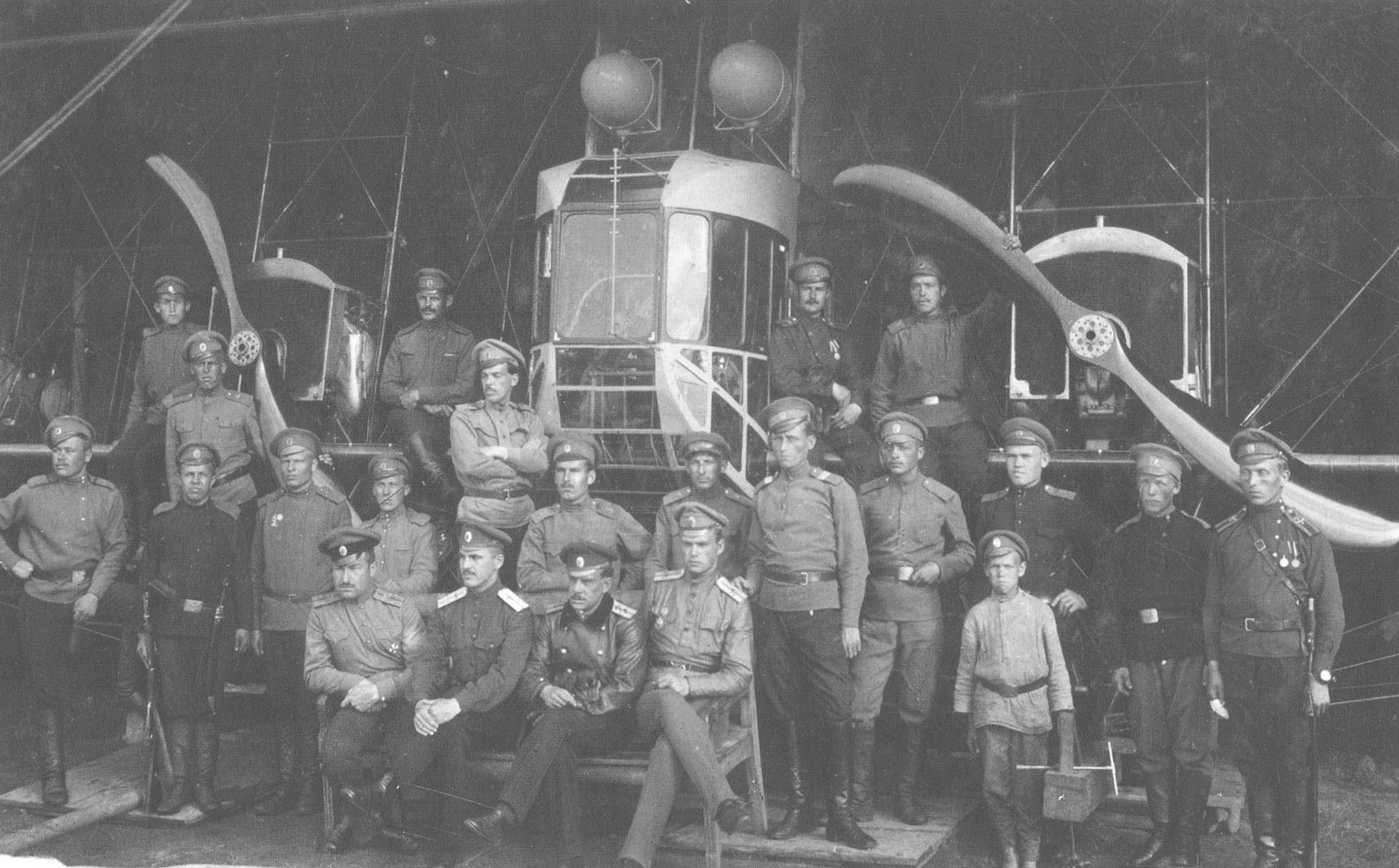
Then the world changed. When the First World War broke out in August 1914, Imperial Russia had a handful of these enormous machines and no clear idea what to do with them. The answer, pushed through by Mikhail Shidlovsky, the head of R-BVZ and a former naval officer, was to turn the flying palace into a flying warship. The comfortable cabins were stripped and repurposed to carry bombs, extra fuel, a multi-man crew and defensive machine guns. In December 1914 Russia formed the Eskadra Vozdushnykh Korablei (EVK) — the “Squadron of Flying Ships” — which is often described as the world’s first dedicated heavy-bomber unit, with each aircraft named, numbered and captained almost like a naval vessel.
From early 1915 the Ilya Muromets went to war in earnest. The bombers flew hundreds of long-range bombing and reconnaissance sorties over the Eastern Front, against German and Austro-Hungarian targets in what are now Poland, Ukraine, Belarus and Lithuania. Crews had to invent the craft of heavy bombing as they went: how to navigate a large aircraft over enemy territory, how to aim bombs with primitive sights, how to photograph the results, and how to fight off interceptors on the long flight home. They carried bomb loads that were huge for the day, bristled with defensive machine guns, and proved remarkably hard to bring down.
That survivability became the type’s legend. According to most accounts, across the entire war only one Ilya Muromets was lost to enemy fighters in air combat — and that aircraft, downed near Krevo on 12 September 1916, is said to have shot down three of the four German fighters attacking it before it fell. For a 1915–16 aircraft, whose contemporaries were being swept from the sky in droves, that is an extraordinary record, and it says a great deal about how big, strong and well-defended the Muromets really was.
None of this should be over-claimed. Russia’s aviation industry was small, engine supply was a constant headache — the war cut the country off from German engines, and good powerplants were scarce throughout — and the numbers built (commonly given as around eighty, though sources vary) were modest next to the war’s clouds of single-seat fighters. The strategic effect of the bombing was limited; this was pioneering work, not a war-winning weapon. But as a proof of concept — that a large, multi-engine aircraft could carry a worthwhile load a long way and come home — the Muromets pointed straight at the future, at every heavy bomber and airliner that followed.
After the 1917 revolution the EVK broke up amid the collapse of the Imperial army, and Shidlovsky was killed. A few Muromets flew briefly with the new Soviet forces, mostly on mail and training duties and in limited numbers during the Civil War, before being retired in the early 1920s — worn out, under-engined and overtaken by newer designs. Sikorsky himself left Russia, emigrated to the United States, and after a hard start rebuilt his career, in time founding Sikorsky Aircraft — later world-famous for its flying boats and then its helicopters.
No original Ilya Muromets survives today. The world’s first heavy bombers simply wore out and were scrapped in the chaos of revolution and civil war, without anyone thinking to preserve one. What remains is a full-scale, non-flying replica at the Central Air Force Museum at Monino, near Moscow, together with a rich archive of photographs and drawings — enough to keep alive the memory of the flying ship that was, for a few remarkable years, unlike anything else in the sky.
Sikorsky’s flying ship, 1913–1920s
The Sikorsky Ilya Muromets in detail: origins, comfort, combat and cost
01The Ilya Muromets’s origins: the Russky Vityaz and the world’s first four-engine aircraft
The Muromets did not appear from nothing. In 1913 Igor Sikorsky, still only in his mid-twenties and working as chief designer at the aviation department of the Russo-Baltic Wagon Factory, built the Russky Vityaz — a biplane so large that it was initially flown with two engines and then rebuilt with four. It is generally credited as the world’s first four-engine aircraft, and its success settled a live and genuinely serious argument of the day.
That argument mattered because the prevailing expert opinion held that multiple engines were a dead end: that an engine failure on one side would produce uncontrollable asymmetric thrust, and that the weight and drag of extra engines and structure would swallow any gain. Sikorsky is said to have answered the doubters partly by demonstration — famously walking out onto the lower wing in flight to show how steady the big machine remained — and partly by simply flying the aircraft, repeatedly and safely, in front of witnesses.
From the Vityaz, Sikorsky quickly developed a refined and enlarged design: the S-22 Ilya Muromets. It kept the four-engine layout but added a fully enclosed fuselage cabin, greater span and much greater load capacity. The prototype flew around the winter of 1913–1914 and immediately began setting records. Where the Vityaz had proved the concept, the Muromets turned it into a practical, capable aircraft.
Why it mattered
Every heavy bomber, airliner and long-range multi-engine aircraft that followed — from the Handley Page and Gotha bombers of the same war to the great flying boats and airliners of the 1920s and 1930s — built on the idea the Vityaz and Muromets proved first: that you could hang several engines on one big airframe, carry a genuinely useful load, and fly a long way safely and repeatably. It is difficult to name a more consequential idea in the first two decades of powered flight.
02The Ilya Muromets as a flying palace: the airliner that became a bomber
What made the early Muromets so startling was not just its size but its comfort. By the surviving accounts it offered an enclosed, heated passenger cabin — warmed using engine exhaust gases — with electric lighting powered by a wind-driven generator, upholstered seating, a table, large windows, and a small private washroom. Some descriptions add a separate sleeping compartment and an external promenade or observation area where passengers could step out in flight. For 1913, when virtually every other aircraft in the world was an open-cockpit, single- or two-seat machine, this was close to science fiction made real.
The comfort was not an indulgence for its own sake; it was an argument. Sikorsky was trying to show that aviation could be a serious, civilised means of transport — safe and comfortable enough for ordinary passengers — rather than a fairground thrill or a soldier’s gamble. He used the aircraft to set records that were as much about publicity as engineering: carrying large numbers of passengers, climbing to notable altitudes, and flying long distances such as the St Petersburg–Kiev round trip of 1914.
When war came in August 1914, all of that comfort was stripped out or repurposed. The spacious cabin that had carried well-dressed passengers now carried bomb racks, extra fuel, a crew of several men and their machine guns. The airliner became a warplane almost overnight. It is an unusually direct example of a civil design being pressed into military service — and, awkwardly for a peaceful vision, the very qualities that made it a fine airliner made it an effective bomber. The dream of comfortable passenger flight would have to wait; the Muromets went to war instead.
03The Squadron of Flying Ships (EVK): arguably the world’s first heavy-bomber unit
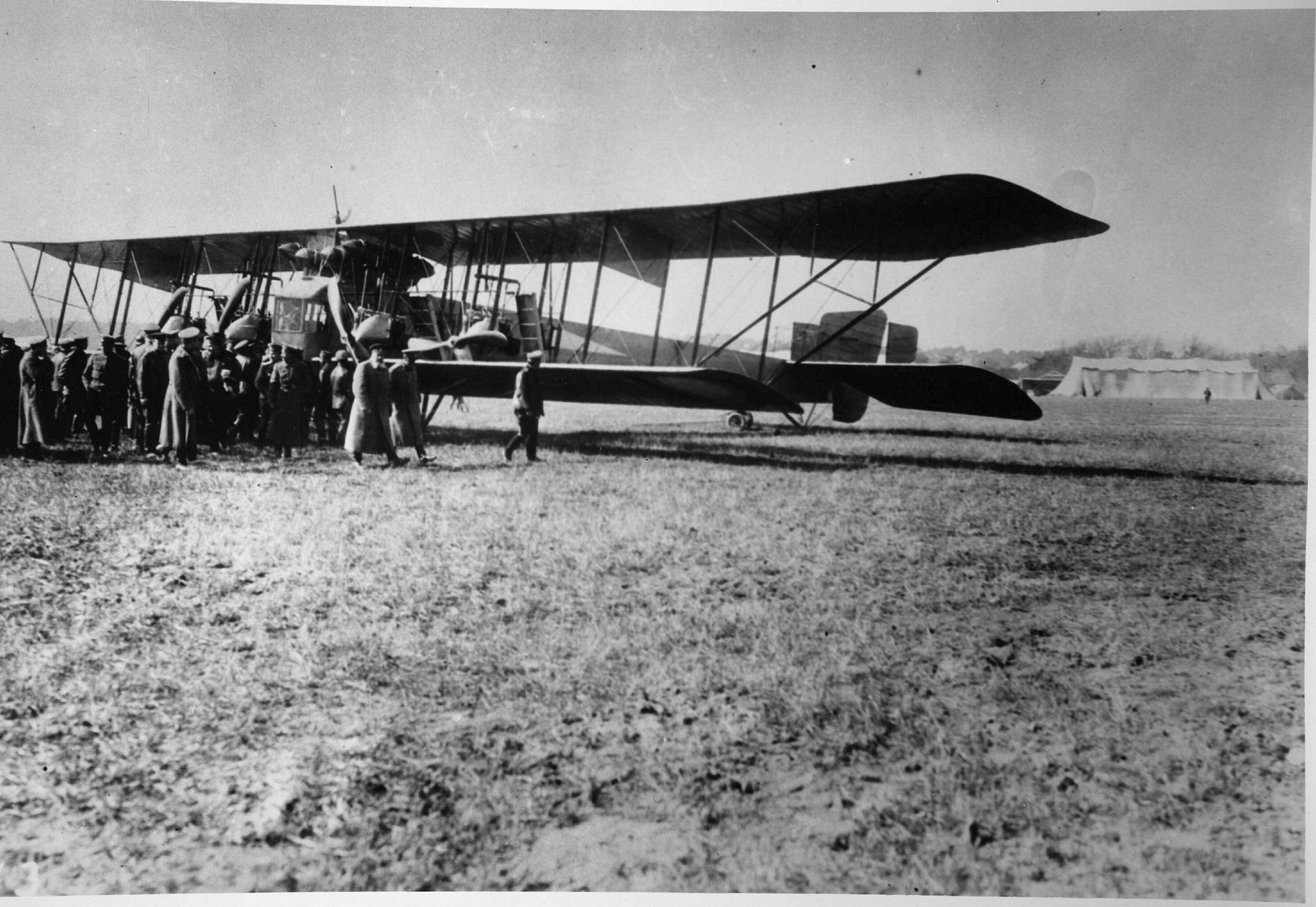
In December 1914, on the initiative of Mikhail Shidlovsky, Russia grouped its Ilya Muromets bombers into a single dedicated formation: the Eskadra Vozdushnykh Korablei, the “Squadron of Flying Ships”. Each aircraft was treated almost like a naval vessel, with its own name and number and a captain in command, and the whole unit had its own bases, workshops, training and command structure. This is why the type is so often described as the world’s first strategic bombing unit.
That claim is reasonable, but — like many aviation “firsts” — it deserves a careful hedge. Other nations were developing bombing aircraft and bombing forces in the same period, and definitions of what counts as a “strategic” or “heavy” bomber unit differ. What is not seriously disputed is that the EVK was among the earliest formations built specifically around large, multi-engine bombers, and that it worked out much of the practical doctrine of heavy bombing before anyone else had a comparable force in the field.
From 1915 the EVK flew long-range bombing and reconnaissance missions against German and Austro-Hungarian rail junctions, supply dumps, bridges and troop concentrations across the Eastern Front. Over the war the squadron is commonly credited with more than 400 sorties and roughly 65 tonnes of bombs dropped. Those numbers are modest by the standards of the next war, but as pioneering work — in navigation, bomb-aiming, aerial photography and defensive gunnery — they were anything but trivial.
Why it mattered
The EVK was the laboratory in which the practical craft of heavy bombing was invented: crew roles, defensive gun positions, formation flying, target navigation and reconnaissance photography. The strategic results on the Eastern Front were limited, but the organisational template — a dedicated heavy-bomber unit, run like a fleet — is one every later air force would recognise.
04The Ilya Muromets’s operating costs: what a WWI flying ship actually cost
Honest answer first: reliable unit-cost and cost-per-flight-hour figures for the Ilya Muromets simply are not recorded in any way that compares to a modern aircraft. It was built in small numbers, under wartime conditions, in a currency and economy — the Imperial Russian rouble on the eve of revolution and then hyperinflation — that make any single price figure essentially meaningless. So in the specification tables below, the cost rows read “not reliably recorded (WWI)” rather than a made-up number dressed up as fact. That is the honest position, and we would rather state it plainly than invent false precision.
What can be said is qualitative. The Muromets was expensive by the standards of its time and place — a large, complex, four-engine machine built by a country whose industry struggled to produce reliable aero-engines at all. The real recurring “cost” of the programme was often measured not in roubles but in engines: good powerplants were scarce, frequently imported, and the single most important limiting factor on how many aircraft could fly and how well they performed.
That scarcity, as much as enemy action, shaped the type’s entire career. When you read that “around eighty” were built over four years, it is worth remembering that keeping even a fraction of them simultaneously serviceable, engined, armed and crewed was a continual struggle — and that the true cost of a strategic bomber in 1915 was as much organisational and industrial as it was financial.
For readers who care about the economics of flight, this is exactly why comparing a WWI pioneer to a modern jet on a “cost per hour” basis breaks down: the categories that make such comparisons meaningful — a stable currency, a functioning market, standardised production, recorded fleet flight hours — largely did not exist for the Muromets. The comparison tool that accompanies this museum will always show this aircraft’s cost fields as unrecorded, and that is the correct answer.
05Defending the flying ship: guns, gunners and why the Muromets was so hard to kill
The single most surprising fact about the Ilya Muromets — that across the whole war only one is generally recorded as lost to enemy fighters in air combat — is not luck. It follows directly from how the aircraft was built and armed. Understanding it is the key to understanding why a slow, enormous 1915 biplane was not the easy target it looks.
Start with the structure. The Muromets was large and strongly built, with multiple spars and a great deal of redundant wooden structure. It could absorb a lot of damage — holes in the fabric, hits to the structure, even the loss of an engine — and keep flying. A single-seat fighter’s rifle-calibre machine guns, firing at a fast-moving deflection angle, often simply could not do enough damage quickly enough to bring it down.
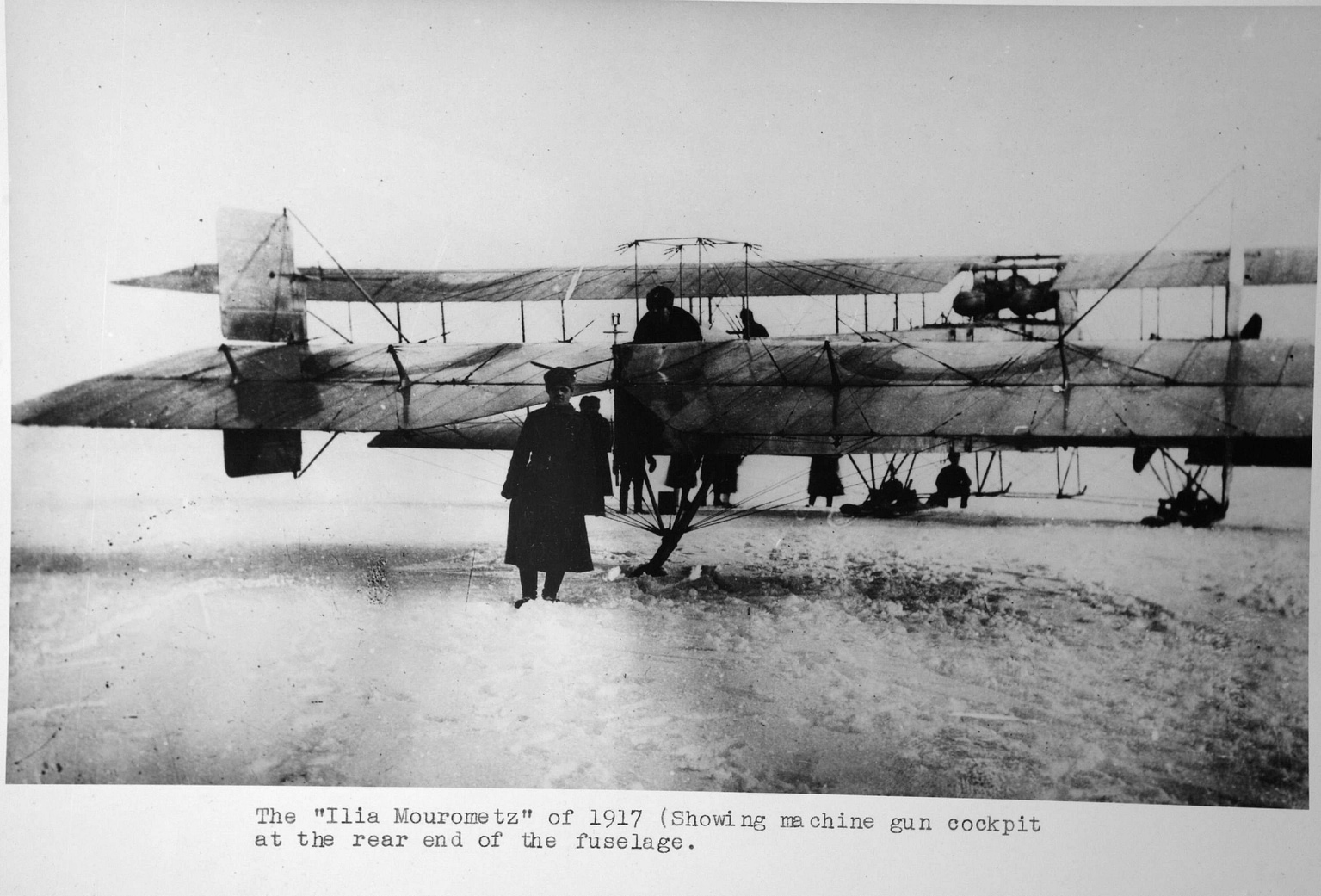
Then add the guns. The Muromets could carry several machine guns covering a wide arc, including dorsal and rearward positions that were genuinely dangerous for an attacking fighter to approach. A fighter trying to close on the tail of a Muromets was flying into the muzzles of defensive guns manned by crew who had room to move, aim and reload — a very different proposition from attacking a lone two-seater. On 12 September 1916, the one Muromets caught and downed by fighters is commonly credited with shooting down three of its four attackers first, which tells you how costly it was to engage.
Why it mattered
This is, in embryo, the whole logic of the heavy bomber that would dominate the next thirty years: a large, robust, self-defending aircraft that flies into hostile skies and relies on structure and massed defensive fire to survive. The Muromets got there first, and its survival record was the proof of concept.
06The Ilya Muromets in context: what it did and did not achieve
It is easy, with an aircraft this pioneering, to slide from admiration into exaggeration. So it is worth setting out plainly what the Muromets did and did not do. What it did: it was generally the first four-engine aircraft to enter series production; it began as a genuinely revolutionary passenger aircraft; it became the core of what is often called the first heavy-bomber unit; and it flew hundreds of combat sorties with a survivability that was extraordinary for its day.
What it did not do: it did not win the war, or come close. The bombing effort was small in scale and limited in strategic effect. It did not exist in large numbers — only a fraction of the roughly eighty built were operational at any time. And it did not have a long career; obsolete within a decade, worn out and under-engined, it was quietly retired in the early 1920s.
None of that diminishes it. Firsts are, almost by definition, modest in raw achievement and enormous in influence, because their real product is a proven idea rather than a decisive result. The Muromets proved that a large multi-engine aircraft could carry a serious load a long way, defend itself and come home — and that idea, once proven, never went away. It runs straight through the bombers and airliners of the century that followed, which is why a slow Russian biplane from 1913 still matters.
How the Ilya Muromets was built: four engines, a cabin and a flying gun platform
Four engines on one biplane
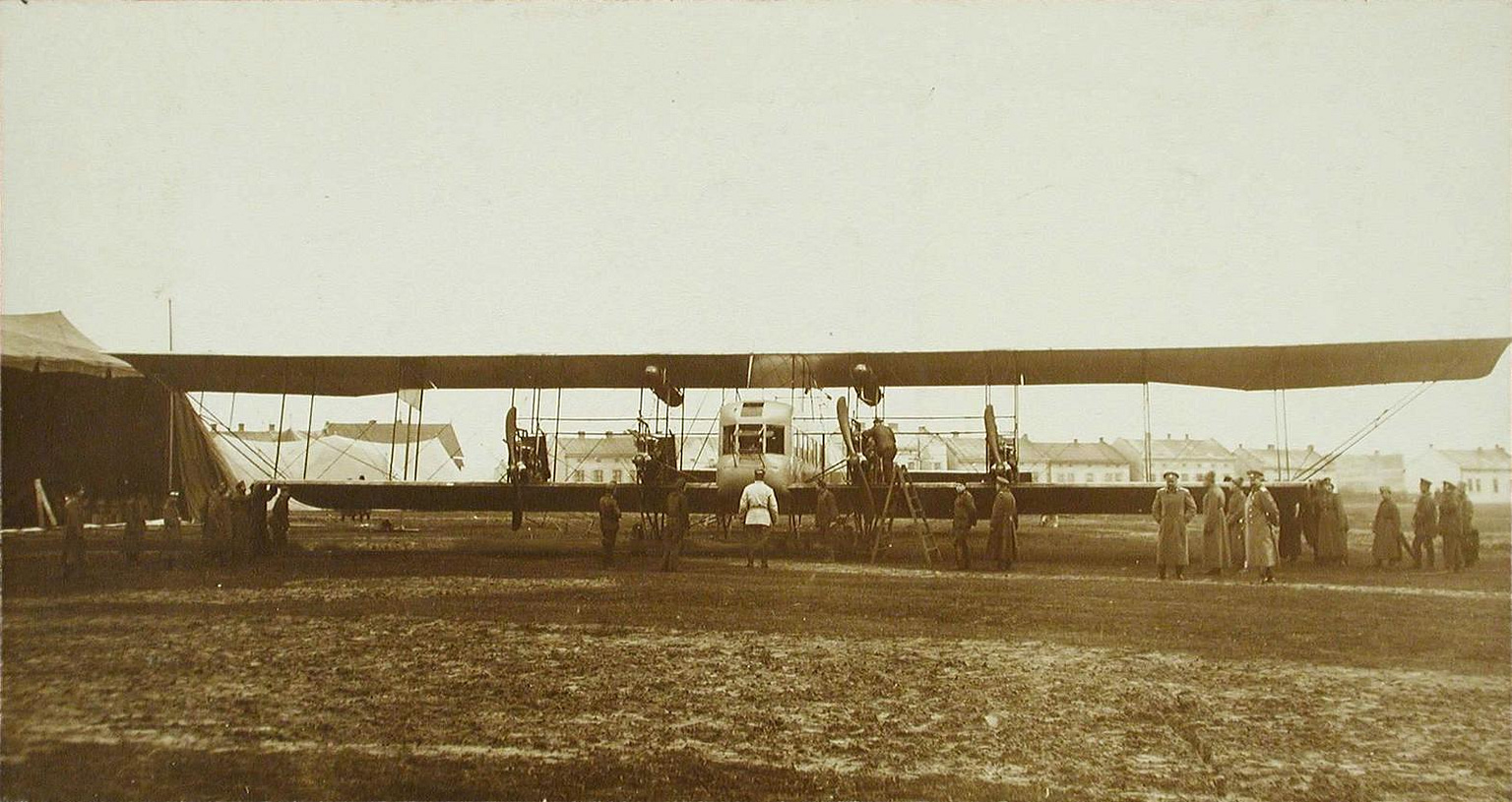
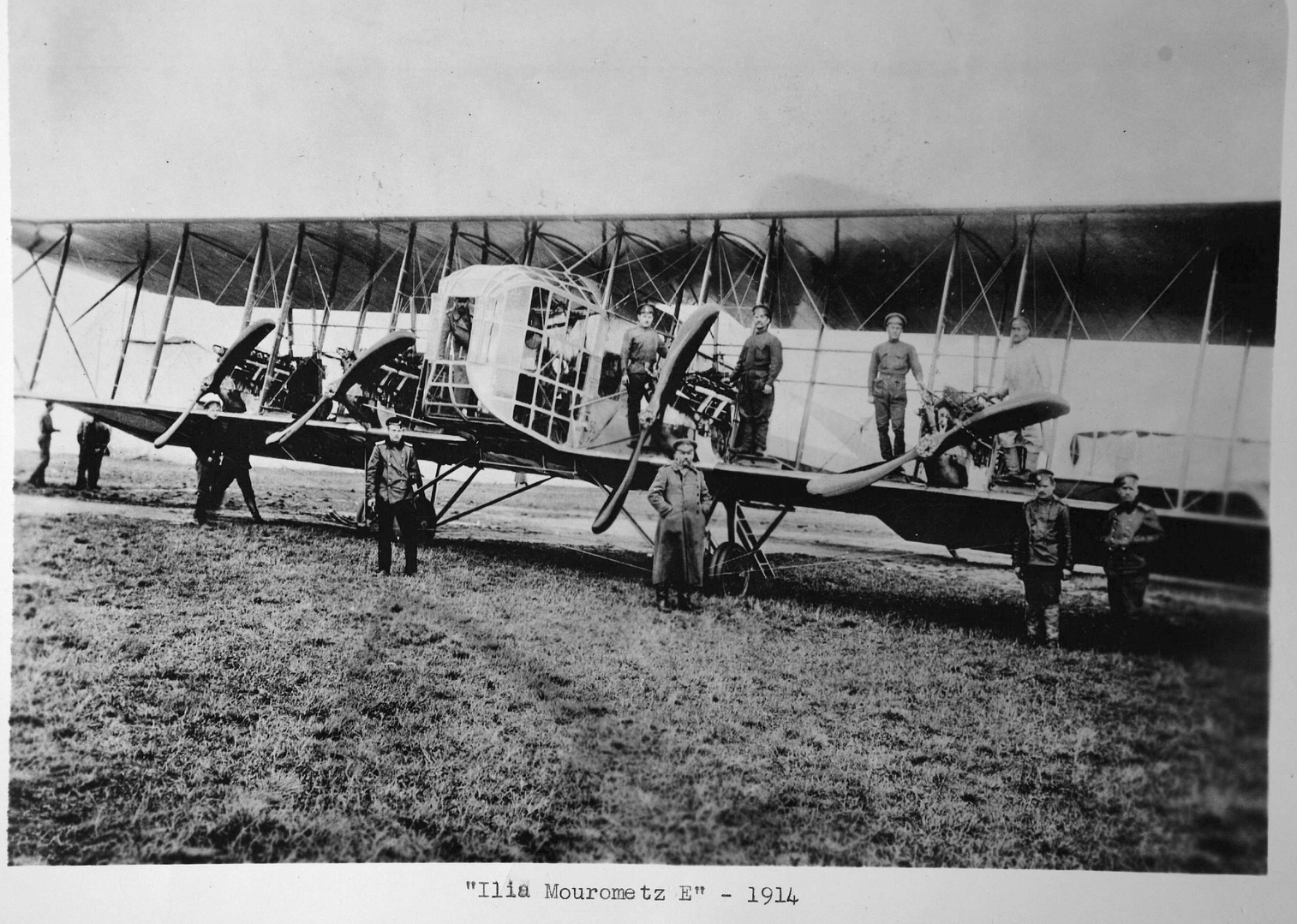
Two pairs of engines were mounted along the lower wing, driving tractor propellers, at a time when almost every other aircraft made do with one. Four engines gave the lift needed to carry crew, fuel, bombs and defensive guns over long distances — and, just as importantly, redundancy: the aircraft could keep flying with an engine shut down or shot out, a safety margin no single-engine machine could offer. The specific engines varied constantly (Argus, Mercedes, Sunbeam, Renault, RBVZ-6 and others), because reliable powerplants were always in short supply and wartime blockade made a bad situation worse. The four-engine layout, first proven on the Russky Vityaz, is the Muromets’ single most influential feature.
An enclosed cabin and a walkway in the sky
Unlike almost every contemporary, the Muromets had a fully enclosed fuselage rather than an open cockpit. In airliner form it held a heated, electrically lit cabin with seats, a table and a washroom; in bomber form that same sheltered interior housed the crew, bomb racks, fuel and guns out of the wind and weather, letting several men work through a long mission in relative protection. Crew could move around inside the fuselage — and even step out onto the lower wing in flight, a feature Sikorsky famously used to reassure doubters that four engines were safe. An enclosed, walk-around, multi-crew cabin was close to unheard of in 1913, and pointed directly at the airliners and bombers to come.
A gun platform that was hard to kill
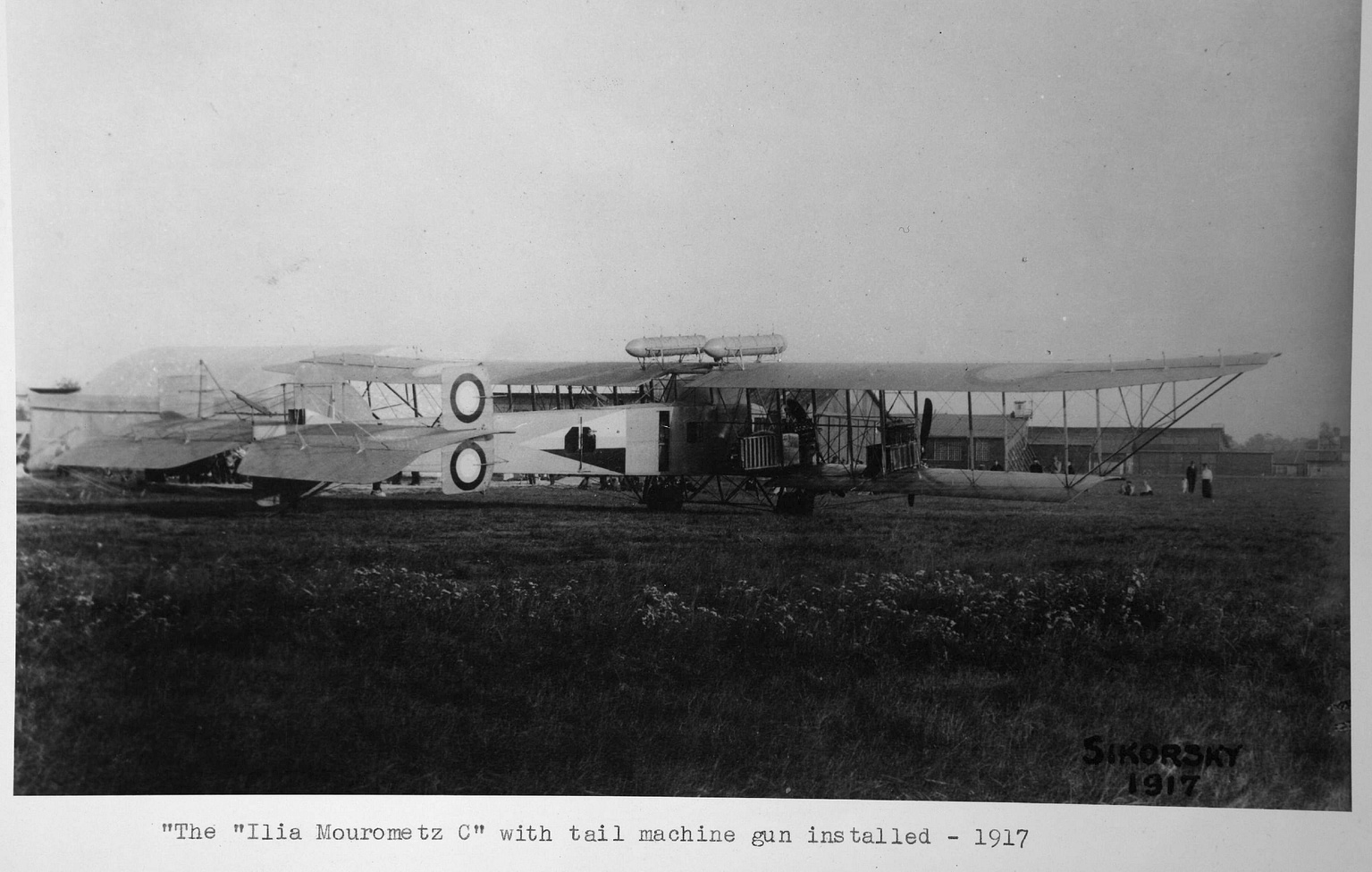
Big, strong and stable, the Muromets made an excellent defensive platform. It could carry several machine guns covering a wide arc, including dorsal and tail positions that the fighters of 1915–16 found dangerous to attack, so that closing on a Muromets often meant flying into its guns. Combined with a robust wooden structure that could soak up considerable battle damage, this made the type exceptionally survivable for its era: famously, only one is generally recorded as lost to enemy fighters in air combat across the whole war — and that aircraft reportedly took three of its four attackers down with it. In miniature, this is the entire logic of the heavy bomber that would follow.
Sikorsky Ilya Muromets specifications, performance and cost
Figures below are representative of the wartime bomber variants (chiefly the S-22, S-23 “Veh” and S-25 types). The Muromets was built in many sub-types over 1913–1918 with different engines and dimensions, so treat these as typical ranges rather than exact constants. Values marked with a tilde (~) are estimates; where the record is genuinely poor, the row says so.
- Производитель
- Russo-Baltic Wagon Factory (R-BVZ), St Petersburg
- Designer
- Igor I. Sikorsky
- Экипаж
- ~4–8 (varied by role and variant)
- Длина
- ~17.5–19 m (~57–62 ft), varied by type
- Wingspan (upper)
- ~29.8–34.5 m (~98–113 ft), varied by type
- Высота
- ~4.0 m (~13 ft), approx.
- Зона крыла
- ~125–160 m² (~1,350–1,720 sq ft)
- Пустой вес
- ~3,500–5,000 kg (est., varied)
- Max takeoff weight
- ~5,000–7,500 kg (est., varied)
- Электростанция
- 4 × inline engines (types varied — see note)
- Engine power
- ~140–220 hp each (varied by engine type)
- First flight
- Winter 1913–1914 (prototype)
- Number built
- ~80 (sources vary, roughly 76–83)
Dimensions & powerplant
- Максимальная скорость
- ~110–130 km/h (~68–81 mph), estimate
- Cruising speed
- ~95–110 km/h (~59–68 mph), approx.
- Служебный потолок
- ~3,000–3,200 m (~9,800–10,500 ft), est.
- Endurance
- ~4–5 hours (varied with load)
- Диапазон
- ~500 km+ typical (varied)
- Bomb load
- ~400–800 kg typical (heavier on some sorties)
- Defensive armament
- Multiple machine guns — up to ~9 on some aircraft, in nose, dorsal, beam and tail positions
- EVK combat record
- 400+ sorties; ~65 tonnes of bombs dropped (commonly cited)
- Losses to enemy fighters
- 1 (commonly cited across the whole war)
- Unit cost
- Not reliably recorded (WWI)
- Cost per flight hour
- Not reliably recorded (WWI)
Performance, armament & cost
The Ilya Muromets’s variants, engines and place in history
01From S-22 to S-25: the Muromets family
The Ilya Muromets was not one aeroplane but a family, developed continuously from 1913 to 1918. The earliest passenger and reconnaissance machines (the S-22 series) gave way to progressively larger, stronger and better-armed bombers as wartime experience accumulated. Later types — commonly labelled with Cyrillic-derived letters such as the “Veh” (V) and “Yeh” (E) series, and running through designations up to the S-25 — introduced revised noses, more powerful or more numerous defensive guns, strengthened structures and different engine fits.
The general trend across the family is easy to summarise even if the details are messy: from comfortable pre-war airliner toward purpose-built wartime bomber, with each iteration a little more warlike than the last. Noses were reshaped for better fields of fire and bombing; gun positions multiplied; loads crept upward where engines allowed.
Because the changes were incremental, overlapping and often applied to existing airframes, and because the records are incomplete and sometimes contradictory, sources genuinely disagree on exactly how to divide the type into distinct variants and how many of each were built. The sensible approach — and the one taken here — is to treat the variant boundaries as approximate rather than to pretend a false precision the evidence does not support.
02Engines: the constant problem
No single engine defines the Muromets, and that is central to understanding it. Over its life the type flew behind German Argus and Mercedes engines, British Sunbeam and other imported units, French Renaults, and Russian-built RBVZ-6 engines — sometimes in mixed installations, with different engines on the inner and outer positions of the same aircraft.
The outbreak of war in 1914 made a difficult situation acute. It cut Russia off from German engines overnight — the very engines several Muromets had been designed around — and strained the supply of everything else, from imported units held up by blockade and shipping shortages to domestically built engines that Russia’s industry struggled to produce in quantity or to a consistent standard.
This is the honest heart of the Muromets story: the airframe was ahead of the engines available to power it. The performance figures quoted for the type vary so widely between examples largely because the engines varied so widely, and the number of aircraft operational at any one time was often set not by how many airframes existed but by how many could be given four reliable, running engines. It is not an exciting fact, but it explains more about the type’s real-world career than any tale of combat.
03The floatplane Muromets
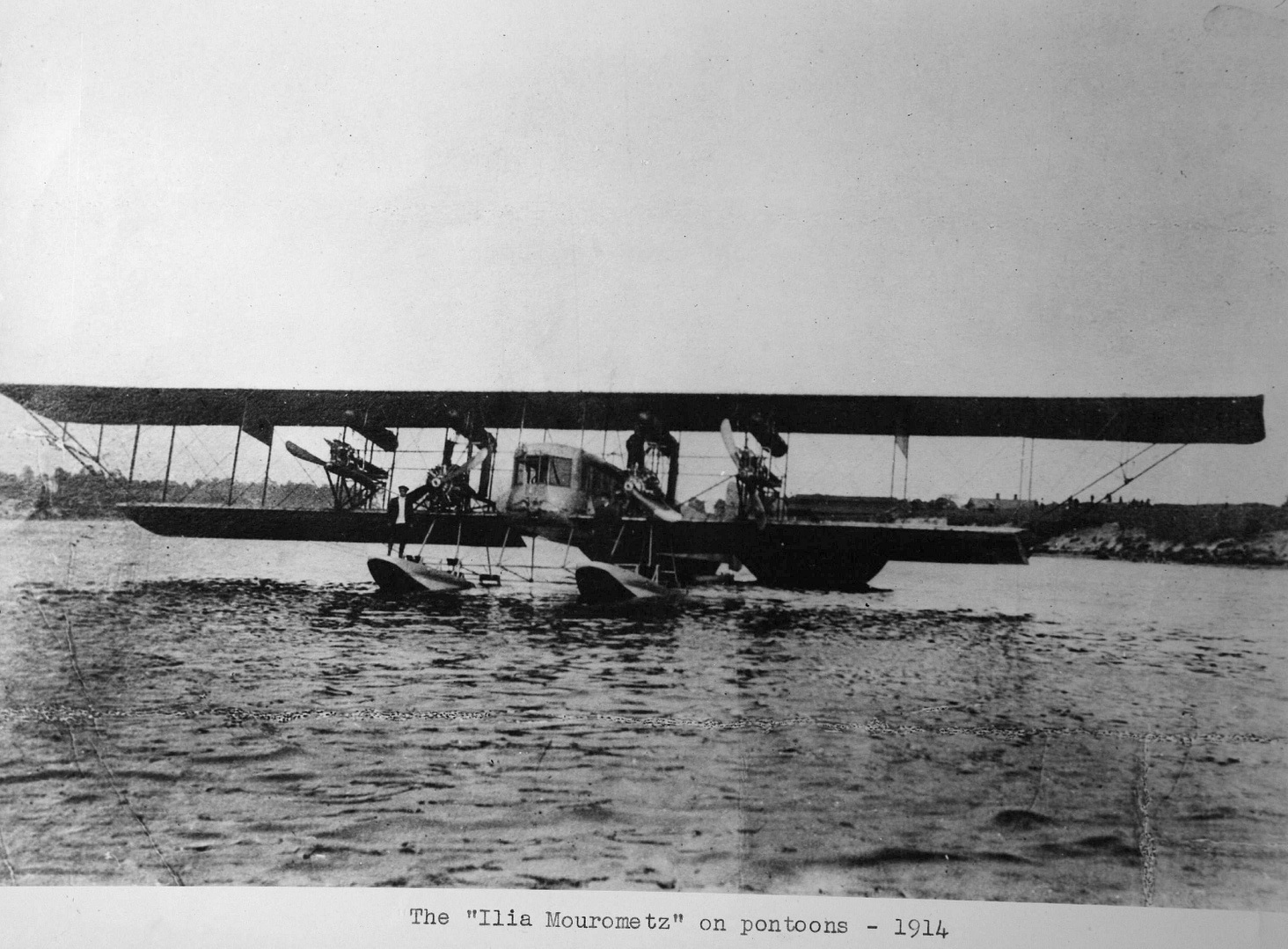
At least one Ilya Muromets was built or converted as a floatplane, trading its wheeled undercarriage for large floats so that it could operate from water. In that configuration it was, for a time, among the largest seaplanes anywhere in the world — a striking sight, and a logical experiment for a nation with long coastlines and rivers and a serious naval-aviation interest.
Operating so heavy an aircraft from water brought its own problems, from the drag and weight of the floats to the difficulty of getting a fully loaded machine unstuck from the surface, and the floatplane remained a small side-branch of the Muromets story rather than a mass-produced type.
But it is worth mentioning, because it shows how far Sikorsky and the R-BVZ team were willing to push the basic design, and how versatile the underlying concept was. The same big, strong, multi-engine airframe that made a good bomber could be adapted toward passenger transport, reconnaissance and maritime work — a flexibility that would become a hallmark of large aircraft in the decades that followed.
04Numbers built and losses: what the records say
The total number of Ilya Muromets built is usually given as around eighty, with individual sources ranging from roughly 76 to 83. As always with the type, the honest figure is a range rather than a single confident number, and only a fraction of those built were ever serviceable at any one moment, given the chronic engine shortage.
Combat losses to enemy fighters are commonly recorded as a single aircraft across the entire war — a figure so striking that it needs to be stated carefully to avoid being misunderstood. It refers specifically to Muromets lost in air combat to enemy aircraft. It does not mean only one Muromets was ever lost; the type also suffered losses to accidents, to anti-aircraft fire, to engine failures and forced landings, and to the general wear, disorganisation and destruction of the revolutionary period.
Read correctly, though, that single air-combat loss is still remarkable. It says that in the specific, dangerous business of being hunted and attacked by enemy fighters — the fate that destroyed so many aircraft of the period — the Muromets was, for its era, almost uniquely survivable. That is the fact worth carrying away from the numbers, provided it is not stretched into the claim that the aircraft was somehow invulnerable, which it plainly was not.
The Ilya Muromets through its years: 1913 to Monino
The Russky Vityaz flies
Sikorsky’s four-engine Russky Vityaz takes to the air — generally credited as the world’s first four-engine aircraft and the direct ancestor of the Muromets.
The first Ilya Muromets
The enlarged S-22 Ilya Muromets flies as a luxury airliner, with a heated, lit, enclosed cabin and even a washroom — and begins setting passenger and altitude records.
A record load aloft
A Muromets reportedly carries sixteen people (and, by one account, a dog) into the air at once — a passenger-carrying record for its day.
War, and a new job
The First World War breaks out. With no airliner market left, Russia begins converting the Muromets into a heavy bomber.
The Squadron of Flying Ships
Russia forms the Eskadra Vozdushnykh Korablei (EVK), grouping its Muromets bombers into what is often called the world’s first heavy-bomber unit.
Into combat
The EVK begins long-range bombing and reconnaissance sorties over the Eastern Front against German and Austro-Hungarian targets, inventing the craft of heavy bombing as it goes.
The one that was shot down
In the only air-combat loss of the war for the type, a Muromets is downed near Krevo by German fighters — but not before reportedly taking three of the four attackers with it.
Revolution and the end of the squadron
The revolution shatters the Imperial army; the EVK breaks up and Shidlovsky, who founded it, is killed in 1918. The world’s first heavy-bomber unit ceases to exist.
Sikorsky emigrates
Igor Sikorsky leaves Russia for the United States, where he will rebuild his career and later found Sikorsky Aircraft, famous for flying boats and helicopters.
Retirement
A handful of surviving Muromets serve briefly with Soviet forces on mail and training duties before the worn-out, under-engined type is quietly retired. No original is preserved.
A replica at Monino
Decades later a full-scale, non-flying replica is built for the Central Air Force Museum at Monino, near Moscow — today the only complete Ilya Muromets on public display.
The Sikorsky Ilya Muromets in twelve stories: from flying palace to flying ship
Le Grand leaves the ground, 1913
Before the Muromets, Sikorsky had to prove four engines could work at all.
Read the full story
In 1913 the very idea of a four-engine aeroplane was contentious. Many respected engineers believed that if one engine failed, the asymmetric thrust would roll the machine out of control, and that the extra weight and complexity of four powerplants simply cancelled out any benefit. The conventional wisdom was that the future belonged to small, light, single-engine machines. Sikorsky disagreed — and rather than argue, he built.
His Russky Vityaz answered the sceptics in the most direct way possible: it flew, steadily and controllably, and is generally credited as the world’s first four-engine aircraft. Originally laid out with two engines and then rebuilt with four, it demonstrated that multiple engines could be managed, that an engine failure need not be fatal, and that a genuinely large airframe could get airborne and stay there.
The story most often retold is that Sikorsky walked out onto the lower wing during flight to show observers how stable the aircraft remained with its engines running — a piece of showmanship as much as engineering. Whether or not every detail is exact, the point stands: the Vityaz turned a theoretical argument into a settled fact, and cleared the path for the Ilya Muromets that followed within months.
The washroom in the sky
A heated cabin, electric light and a private washroom — in 1913.
Read the full story
It is hard to overstate how strange the early Ilya Muromets would have looked to anyone who knew aviation in 1913. Aircraft of the day were open to the wind, freezing, deafening and built for one or two people who wore goggles and leather and hoped for the best. The Muromets was something else entirely: a flying room.
By the accounts that survive, it offered an enclosed cabin heated using engine exhaust, electric lighting powered by a small wind-driven generator, upholstered chairs, a table, and big windows through which passengers could watch the landscape unroll beneath them. There was a small private washroom — a detail that delights people a century later — and some descriptions add a separate sleeping compartment and an external promenade deck where the brave could, in principle, step out and take the air in flight.
This was an airliner before the airline age, and it was no accident. Sikorsky was making a deliberate argument that flight could be civilised, comfortable and safe — a means of transport for ordinary well-dressed passengers, not just a daredevil’s stunt. The war would cut that vision short, but the idea did not die; it simply had to wait a decade for the world to catch up.
Sixteen aloft — and a dog
The February 1914 flight that set a passenger-carrying record.
Read the full story
To advertise what his giant could do, Sikorsky flew it full. In February 1914 an Ilya Muromets reportedly carried sixteen people into the air at once — a passenger-carrying record for the era — and popular retellings add that a dog, sometimes named, went along for the ride too.
The exact figures are told slightly differently in different sources, which is a caution worth keeping in mind for many Muromets “firsts”: early-aviation record-keeping was informal, and numbers were sometimes rounded up in the retelling. But the substance was real and widely reported at the time.
Loading more than a dozen people into an aeroplane in early 1914 was not merely a record for its own sake. It was a statement that this machine belonged to a wholly different category from everything else in the sky — that here was an aircraft measured not in how long it could stagger aloft, but in how much it could carry and how far. That capacity was exactly what would make it, within the year, a bomber.
St Petersburg to Kiev and back
A 1914 long-distance demonstration that made headlines across Russia.
Read the full story
In the summer of 1914, before the war redirected everything, a Muromets made a celebrated long-distance flight from St Petersburg to Kiev and back — a round trip of well over a thousand kilometres, flown in stages with intermediate stops for fuel.
For an age when most flights were measured in minutes and a few dozen kilometres, and when a cross-country hop could make a pilot famous, this was a demonstration of range and reliability that captured the public imagination and cemented the Muromets’ reputation as a national achievement.
It also, in hindsight, foreshadowed the aircraft’s wartime role precisely. The ability to fly a long way with a useful load, navigate to a distant point and return safely was exactly the capability a strategic bomber needed — even though, in 1914, no one was yet using that word. The Kiev flight was a peacetime triumph that turned out to be a rehearsal for war.
From airliner to bomber
How a luxury flying machine became a weapon in weeks.
Read the full story
When war broke out in August 1914, the Muromets was a solution looking for a problem. There was no passenger market in wartime, and no one in the Russian high command was quite sure what these enormous, expensive aircraft were actually for. Some senior officers doubted they were worth the trouble at all.
The answer, driven hard by R-BVZ boss Mikhail Shidlovsky, was to arm them. The comfortable cabins that had carried well-dressed passengers were stripped and repurposed to carry bombs, extra fuel tanks, a multi-man crew and defensive machine guns. Bomb racks and sighting gear were fitted; gunners’ positions were cut into the fuselage and added to nose, sides and tail.
Within months the flying palace had become a flying warship — one of the most direct civil-to-military conversions in aviation history. The same qualities that had made it a good airliner — size, load-carrying, range, an enclosed structure that sheltered its crew — turned out to make it a formidable bomber. It is a rare case of an aircraft being almost accidentally perfect for a role it was never designed to fill.
Shidlovsky and the birth of the EVK
The manager who turned a handful of aircraft into a squadron.
Read the full story
The Ilya Muromets might have remained a curiosity, argued over by sceptical generals, if not for Mikhail Shidlovsky — the head of the Russo-Baltic Wagon Factory, a former naval officer and a member of the State Council. He had the industrial authority to build the aircraft and the political weight to defend them.
It was Shidlovsky who pushed to group the scattered Muromets into a single dedicated formation, the Eskadra Vozdushnykh Korablei (Squadron of Flying Ships), formed in December 1914, and who was placed in charge of it, reportedly with the rank of major-general. Treating each bomber like a ship — named, numbered and captained, with its own crew and identity — was more than romance; it created the command structure, training pipeline and logistics that heavy bombing required and that no one had built before.
His later fate was tragic and tells its own story about the era: caught up in the upheavals of the revolution, Shidlovsky was killed in 1918. The organisation he built did not long outlive him, but for a few years it was the most advanced bombing force in the world.
First blood over the Eastern Front
The 1915 sorties that opened strategic bombing on the Eastern Front.
Read the full story
From early 1915 the EVK began flying combat missions against German and Austro-Hungarian targets: rail junctions, depots, bridges, airfields and troop positions behind the front. Each mission was a problem no one had solved before, tackled with improvised tools and hard-won experience.
Crews had to navigate a heavy aircraft across enemy territory using map, compass and eye; aim bombs with primitive sights while holding a steady run; photograph the results for the intelligence staff; and fight off interceptors on the long, slow flight home. Bombing accuracy was rough and the tonnage dropped was modest by the standards of later wars.
But the strategic effect, though limited, was never really the point in these first years. The missions built the practical craft of heavy bombing from scratch — crew coordination, bomb-aiming, defensive gunnery, reconnaissance photography — and proved that a large aircraft could reach distant targets and come back. Each sortie was, in a real sense, an experiment carried out under fire, and the lessons fed straight into how every later air force would think about bombing.
The Kievsky — the most famous ship
One named Muromets became the celebrity of the squadron.
Read the full story
Among the individually named aircraft of the EVK, the one usually remembered as the Kievsky became the most celebrated of all the flying ships. It flew repeated long-range bombing and reconnaissance sorties, ranged deep behind the lines, and survived battle damage that would have destroyed a lesser machine, returning home riddled and patched more than once.
Naming aircraft after cities and heroes was part of how the squadron built morale and identity around its “ships”. A named, storied aircraft with a known captain and crew was something the public and the press could follow, and the exploits of the famous ships were reported at home as proof that Russia possessed a weapon the enemy could not match.
In a grinding, costly war on the Eastern Front, that mattered. The Muromets was not just a bomber; it was a symbol — a rare piece of unambiguous good news, and a source of national pride at a time when there was little enough of either.
12 September 1916: the one that fell
The single air-combat loss of the war — and how dearly it was sold.
Read the full story
For all its size and apparent vulnerability, the Ilya Muromets was famously hard to shoot down. It was big, structurally robust, and could bring several machine guns to bear across a wide arc, including rearward angles that the fighters of 1915–16 found genuinely dangerous to attack. Across the entire war, most accounts record just one Muromets lost to enemy fighters in air combat.
That loss came on 12 September 1916, near Krevo, when a single Muromets was set upon by a group of German fighters and finally brought down. But it was not a one-sided kill. The bomber’s gunners are commonly credited with shooting down three of the four attacking aircraft before their own machine fell — a defence so fierce that the episode is remembered less as a defeat than as a demonstration of just how dangerous the type was to engage.
Whether the exact tally was three of four or thereabouts — and such figures always deserve a little caution — the story became emblematic of the whole type: a bomber that, even in the one instance when fighters finally caught and killed it, made its attackers pay a price most of them did not survive.
Engines from everywhere
The supply nightmare that shaped the whole programme.
Read the full story
The Muromets’ greatest enemy may not have been German fighters but its own engines. Building a reliable, powerful aero-engine was one of the hardest industrial problems of the age, and Russia’s industry was not well placed to solve it at scale.
So the aircraft flew behind a bewildering variety of powerplants over its life — German Argus and Mercedes units, British Sunbeams, French Renaults and Russian-built RBVZ-6 engines, sometimes even mixed on the same airframe. The outbreak of war made things dramatically worse by cutting Russia off from German engines overnight and straining every other source of supply.
The consequences ran through everything. Performance varied enormously between individual examples, which is why any single set of “specifications” for the type has to be given as a range. And the number of aircraft that could actually fly at any given moment was often limited less by how many airframes existed than by whether four working engines could be found and kept running for each one. It is the quiet, unglamorous fact behind almost every Muromets statistic — and behind the modest number that were ever operational at once.
Revolution and the last flights
How the flying ships faded away after 1917.
Read the full story
The 1917 revolution effectively ended the Ilya Muromets as a fighting force. The EVK broke up amid the collapse of the Imperial army, discipline and supply evaporated, and Shidlovsky — the man who had willed the squadron into being — was killed in 1918.
A number of surviving aircraft passed to the new Soviet forces. A handful were used briefly, reportedly on mail and training duties, and in the Russian Civil War in very limited numbers, before the type was quietly retired in the early 1920s. By then it was worn out, chronically under-engined, and thoroughly overtaken by newer designs; the aircraft that had been revolutionary in 1913 was obsolete a decade later, as early aircraft tended to be.
There was no grand finale, no preserved example rolled into a museum with ceremony. The world’s first heavy bombers simply wore out and were scrapped in the turmoil of the times — which is the main reason why, today, not a single original Ilya Muromets survives anywhere in the world.
Sikorsky’s second life in America
The designer who lost a country and built an aviation empire.
Read the full story
Igor Sikorsky left Russia after the revolution, his factory and his country gone, and eventually made his way to the United States. The start there was hard — he arrived with little, and rebuilding an aviation business from nothing took years and the support of a Russian émigré community that included, famously, the composer Sergei Rachmaninoff, who helped fund the venture.
From that difficult beginning grew what became Sikorsky Aircraft. It was first famous for large flying boats — the “Clippers” that helped open transoceanic air travel in the 1930s — and then, most enduringly, for practical helicopters, a field in which Sikorsky became a pioneer and in which the name remains world-renowned to this day.
The Ilya Muromets was, in a sense, only his first act, and it is easy to forget it behind the helicopters. But it was a remarkable one. Before he ever built an American airliner or a working helicopter, the young Sikorsky had already given the world its first four-engine aircraft and its first heavy bomber — an achievement that would have secured his place in aviation history even if he had never designed another thing.
The Sikorsky Ilya Muromets in photographs
The Sikorsky Ilya Muromets on film: the first heavy bomber explained
Video: “Ilya Muromets: The Sikorsky Bomber” (Dukes, YouTube) — a focused history of the type and its place as the first heavy bomber. A niche subject with a modest audience (roughly 18,600 views at the time of writing); chosen for being dedicated and on-topic rather than for view count.
Where the Ilya Muromets flew, fought and survives
The Ilya Muromets was a machine of the Russian Empire and the Eastern Front. This map shows its world: its origin and manufacture in Russia, the Eastern-Front theatres where the EVK “Squadron of Flying Ships” bombed German and Austro-Hungarian targets, its brief post-war use and the influence that travelled with Sikorsky to America, and where the sole surviving replica stands today. Hover (or tap) a country for detail.
The Ilya Muromets’s war record
A few numbers capture why the Ilya Muromets is remembered. The bombing effort was modest in scale but genuinely pioneering; the survivability was, for its era, almost without parallel. Treat the figures as commonly-cited approximations rather than audited totals — wartime record-keeping on the Eastern Front was imperfect — but the shape of the story is not in doubt.
Sikorsky Ilya Muromets: your questions answered
Can I fly in a Sikorsky Ilya Muromets?
No — and it is worth being completely clear about why. No original Ilya Muromets survives anywhere in the world. Every one was scrapped or lost in the chaos of the revolution and the years that followed, and the only complete example in existence is a non-flying, full-scale replica in a museum (at Monino, near Moscow). There is no airworthy, bookable Muromets anywhere, and MiGFlug does not and cannot offer flights in one.
However, you can still fly in a real, genuine military aircraft today — and actually take the controls. MiGFlug arranges flights in aircraft such as the L-39 Albatros jet trainer, the Hawker Hunter and other classic warbirds and fighters, in various countries around the world. You sit up front, feel the g-forces, and with the pilot’s guidance you fly the aircraft yourself. It is not a passenger joyride; it is as close as a civilian can get to being a military pilot for a day.
If the story of the Ilya Muromets — the first heavy bomber, the flying ship that was almost impossible to shoot down — has sparked your interest in real military aviation, that is the closest you can get to the real thing: see all MiGFlug flights and prices.
Was the Ilya Muromets really the world’s first heavy bomber?
It is generally credited as the first purpose-operated heavy/strategic bomber to enter service, and its unit — the Squadron of Flying Ships (EVK), formed in December 1914 — is often called the world’s first dedicated heavy-bomber formation. It is also generally credited as the first four-engine aircraft to enter series production, having grown from Sikorsky’s Russky Vityaz, itself generally credited as the world’s first four-engine aircraft of any kind.
Like most aviation “firsts”, these claims deserve a small hedge, because several nations were developing bombing aircraft and bombing units in the same period and definitions differ about what exactly counts as “heavy” or “strategic”. But the Muromets’ claim is a strong, well-documented and widely accepted one — not marketing, but a genuine place near the very start of heavy aviation.
Why is it called “Ilya Muromets”?
The aircraft is named after Ilya Muromets, a legendary hero — a bogatyr — of Russian folklore, celebrated for his great strength and courage. It was a fitting name for a giant, powerful flying machine that dwarfed everything else in the sky, and it fit a pattern: Sikorsky’s earlier four-engine aircraft was similarly named Russky Vityaz, the “Russian Knight”, and later EVK aircraft carried their own heroic and civic names. Giving each “flying ship” a name was part of how the squadron built pride and identity around its machines.
How many engines did the Ilya Muromets have, and what type?
Four — that was the whole point of the design. It grew directly from Sikorsky’s Russky Vityaz of 1913, generally credited as the world’s first four-engine aircraft, and the Muromets became generally the first four-engine type to enter series production.
The specific engines, however, varied a great deal over the type’s life and even between individual aircraft: German Argus and Mercedes units, British Sunbeams, French Renaults and Russian-built RBVZ-6 engines were all used, sometimes mixed on a single airframe. Reliable engines were chronically in short supply, especially after the war cut Russia off from German powerplants, and this engine problem — more than any enemy — limited how many Muromets could fly and how well they performed.
Is it true the Ilya Muromets had a heated cabin and a washroom?
Yes — in its original airliner form, and it is one of the most delightful facts in early aviation. By the accounts that survive, the early Ilya Muromets had a fully enclosed passenger cabin that was heated (using engine exhaust) and electrically lit (from a wind-driven generator), with comfortable upholstered seating, a table and large windows. There was a small private washroom, and some descriptions add a separate sleeping compartment and an external promenade area where passengers could step out in flight.
In 1913, when almost every other aircraft in the world was an open, freezing, single- or two-seat machine, this was extraordinary — an airliner built before the airline age, meant to prove that flight could be civilised and comfortable. When the type was converted into a bomber in 1914, that same sheltered interior was stripped and repurposed to carry crew, bombs, fuel and machine guns. The washroom in the sky became a gun platform, almost overnight.
How effective was the Ilya Muromets in combat?
Capable, but within limits, and it is important to be honest about both sides of that. The EVK is commonly credited with more than 400 sorties and about 65 tonnes of bombs over the course of the war. That was genuinely pioneering work — it established, in practice, how a heavy bomber navigates to a distant target, aims its bombs, photographs the results and defends itself — but the tonnage was modest by the standards of later conflicts and the strategic effect on the Eastern Front was limited.
Its most remarkable quality was defensive rather than offensive. The Muromets was big, structurally robust and heavily armed, able to bring several machine guns to bear across a wide arc, and it proved extremely hard to shoot down: most accounts record only one lost to enemy fighters in air combat across the whole war. As a weapon it was a promising beginning rather than a decisive tool — which is exactly what you would expect of the first of its kind.
Was the Ilya Muromets really only shot down once?
According to most accounts, only one Ilya Muromets was lost to enemy fighters in air combat during the entire war — near Krevo on 12 September 1916 — and even then the bomber’s gunners reportedly shot down three of the four German fighters attacking it before their own machine fell. For a large, slow aircraft in an era when fighters were slaughtering the opposition, that is a remarkable record, and it is genuinely well attested.
Two caveats keep it honest. First, it refers specifically to losses in air combat to enemy aircraft; other Muromets were certainly lost — to accidents, anti-aircraft fire, engine failures and forced landings, and the general destruction of the revolutionary years — so “only one lost” does not mean “only one ever destroyed”. Second, exact combat tallies from 1916 always deserve a little caution. But the core fact holds up: the Muromets was, for its time, astonishingly hard to shoot down, and that survivability is one of the main reasons it is remembered.
How many Ilya Muromets were built?
The total is usually given as around eighty, with individual sources ranging from roughly 76 to 83 — so a range is more honest than a single figure. Only a fraction were serviceable at any one time, largely because of the persistent shortage of reliable engines. For a type so historically significant, that is a small production run, and it is a useful reminder that the Muromets’ importance lies in what it proved rather than in the numbers built or the tonnage it dropped.
What happened to the Ilya Muromets after the war?
After the 1917 revolution the EVK broke up amid the collapse of the Imperial army, and Mikhail Shidlovsky, who had created the squadron, was killed in 1918. A number of surviving aircraft passed to the new Soviet forces, which used a handful briefly — reportedly on mail and training duties, and in the Russian Civil War in limited numbers — before retiring the type, worn out and obsolete, in the early 1920s.
Igor Sikorsky himself emigrated to the United States, where after a difficult start he rebuilt his career and founded Sikorsky Aircraft, later world-famous for its flying boats and helicopters. The world’s first heavy bombers, meanwhile, were simply scrapped as they wore out — which is why no original survives today.
Where can I see an Ilya Muromets today?
No original survives anywhere. The one complete example you can go and see is a full-scale, non-flying replica displayed at the Central Air Force Museum at Monino, near Moscow. Beyond that, the aircraft lives on in a rich archive of period photographs, technical drawings and museum material — including the public-domain images used throughout this page.
So while you can look at a Muromets, you cannot fly in one. If you want to actually get airborne in a piece of living military-aviation history rather than a static replica, MiGFlug can put you in a real, flying military jet and let you take the controls: explore the flights and prices here.
You can’t fly an Ilya Muromets. These, you can.
No original Ilya Muromets survives, and the only replica lives in a museum — so no one on Earth can sell you a flight in Sikorsky’s flying ship. But you can still strap into a real military jet, feel the g-forces and take the controls yourself. Here is what MiGFlug can actually put you in.
 Fly the L-39 AlbatrosThe world’s most-flown jet trainer — aerobatics included
 Fly the F-104 Starfighter“The missile with a man in it”
 Fly the MiG-21The Cold War’s most-produced jet
 Управляйте самолетом T-33 Shooting Star.America’s first jet trainer
 Fly the DH VampireA piece of early jet history
 Fly the S.211Agile Italian jet trainer
 Fly the MB-326The classic Aermacchi jet
 Fly the MiG-15The Soviet legend of the Korean War
Explore more of the Book of Beasts
Where these Ilya Muromets facts come from
- Smithsonian National Air and Space Museum — Reference material on early multi-engine aircraft and Igor Sikorsky’s Russian designs, and on the wider birth of the heavy bomber — useful for placing the Muromets in its international context.
- Encyclopaedia Britannica — “Ilya Muromets” — Concise, edited overview of the type as an early bomber, its passenger origins and its place in aviation history; a good sanity-check for headline facts.
- San Diego Air & Space Museum Archives — Source of the public-domain historical photographs of the Ilya Muromets and its variants used on this page (via Wikimedia Commons); an outstanding archive of early aviation imagery.
- Igor I. Sikorsky Historical Archives — Biographical material on Sikorsky himself, the Russky Vityaz and the Ilya Muromets, and on his later flying-boat and helicopter work in the United States.
- Central Air Force Museum, Monino — Home of the full-scale Ilya Muromets replica — the only complete representation of the type on public display, and the reference point for what a Muromets physically looked like.
- Royal Air Force Museum — Context on the development of strategic bombing in the First World War, useful for comparing the Muromets with its Western-Front contemporaries such as the Handley Page bombers.
- Imperial War Museums — First World War history and aviation context, including the often-overlooked air war on the Eastern Front where the EVK operated.
- Flight and historic aviation press archives — Contemporary and retrospective technical reporting on the Muromets, its many engine fits and its performance — valuable precisely because it captures how the aircraft was seen at the time.
- MiGFlug Afterburner — “Sikorsky Ilya Muromets: The First Heavy Bomber” — MiGFlug’s own feature article on the aircraft and its significance, and a companion to this museum exhibit.
- Standard reference works on WWI aircraft — Cross-checked for specifications, variants, production totals and combat figures — all of which vary between sources for this type, which is why ranges and hedges are used throughout this page.
Figures for early aircraft like the Ilya Muromets vary between sources; where accounts differ (production totals, exact dimensions, engine types, combat tallies) we have given ranges or flagged the figure as approximate rather than pick a single false-precise number. Photographs are public domain via Wikimedia Commons, credited individually above.