
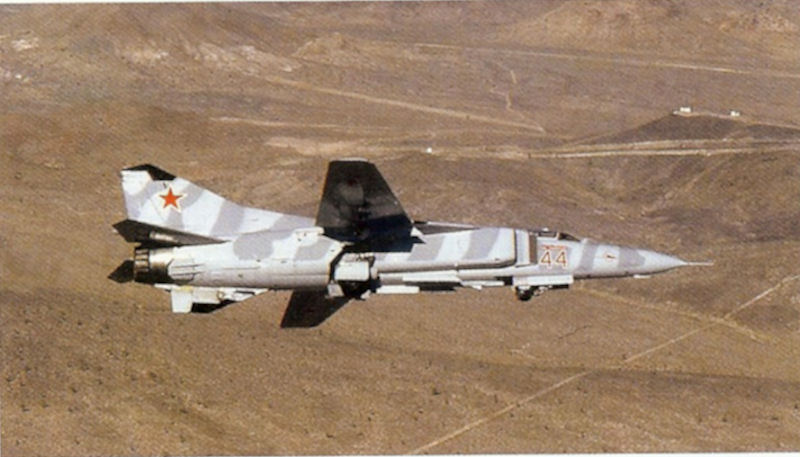
Mikoyan-Gurevich MiG-23
“Flogger”
The Soviet Union’s swing-wing workhorse — a fast, missile-armed interceptor built by the thousand, flown into combat from the Bekaa Valley to the Persian Gulf, and forever remembered for the 1989 “ghost flight” that crossed a continent with no pilot aboard.
The swing-wing that armed the Soviet front line
The MiG-23 was conceived in the early 1960s to fix everything the brilliant but short-legged МиГ-21 could not do. Soviet planners wanted three things at once: longer range and endurance, a powerful radar, and a genuine beyond-visual-range (BVR) missile shot — all without giving up the short-field performance Soviet doctrine demanded. The Mikoyan bureau’s answer was a variable-geometry “swing” wing, the same idea then being explored in the West on the F-111 and later the F-14.
The swing-wing prototype, the “23-11,” first flew on 10 April 1967 with test pilot Aleksandr Fedotov. The type entered service around 1970–1971 and, with roughly 5,000+ built (commonly cited as ~5,047) between 1967 and the mid-1980s, became for a decade the single most numerous fighter in Soviet Frontal Aviation — a Mach-2 interceptor deployed in bulk from East Germany to the Far East.
Variants evolved fast: the early MiG-23M with its Sapfir-23 radar, the downgraded MiG-23MS/MF export models, and the definitive lightened MiG-23ML / MLA / MLD family with better handling and avionics. A dedicated ground-attack sibling, the MiG-27, shared the wing and fuselage but adopted a sloped “ducknose,” fixed intakes and a heavier cannon. The Flogger fought almost everywhere — and struggled, repeatedly, against well-flown Western fourth-generation fighters.
01Why the MiG-23 replaced the MiG-21: range, radar and a real BVR missile
The MiG-21 was cheap, fast and beloved, but it was a clear-weather knife-fighter with tiny fuel tanks, a short-range radar and little beyond-visual-range capability. As NATO fielded heavier, radar-and-missile fighters, the Soviet Union needed something that could see and shoot first. The MiG-23 was that aircraft: a bigger fuselage for fuel and a large Sapfir-23 radar, the semi-active R-23/R-24 (AA-7 Apex) BVR missile, and the swing wing to keep short-field performance despite the extra weight.
It was a genuine capability leap for Soviet fighter aviation — the first practical Soviet BVR shot and a rudimentary look-down ability — but it arrived roughly a decade behind the West’s AIM-7 Sparrow, and its radar reliability, look-down/shoot-down and ECM performance lagged its Western contemporaries. The Flogger was a big step forward that was still, in air combat, a step behind.
What makes the MiG-23 special
The three-position swing wing
The Flogger’s signature is a manually swept variable-geometry wing with three settings: 16° fully spread for short takeoff, low-speed handling and landing; 45° for cruise and maneuver; and 72° fully swept for a high-speed, low-level dash. It gave one airframe a dual personality the fixed-wing MiG-21 could never match — at the price of weight, complexity and a wing box that demanded careful maintenance.
The big Tumansky R-29 turbojet
A single afterburning R-29-300 (later R-35-300 in the ML/MLD) delivered roughly 83–84 kN dry and ~120–127 kN in afterburner — enough to drive the Flogger past Mach 2 and to haul a heavier radar and BVR missiles than any earlier MiG. That brute straight-line thrust, more than agility, defined how the jet was meant to fight.
The first real Soviet BVR shot
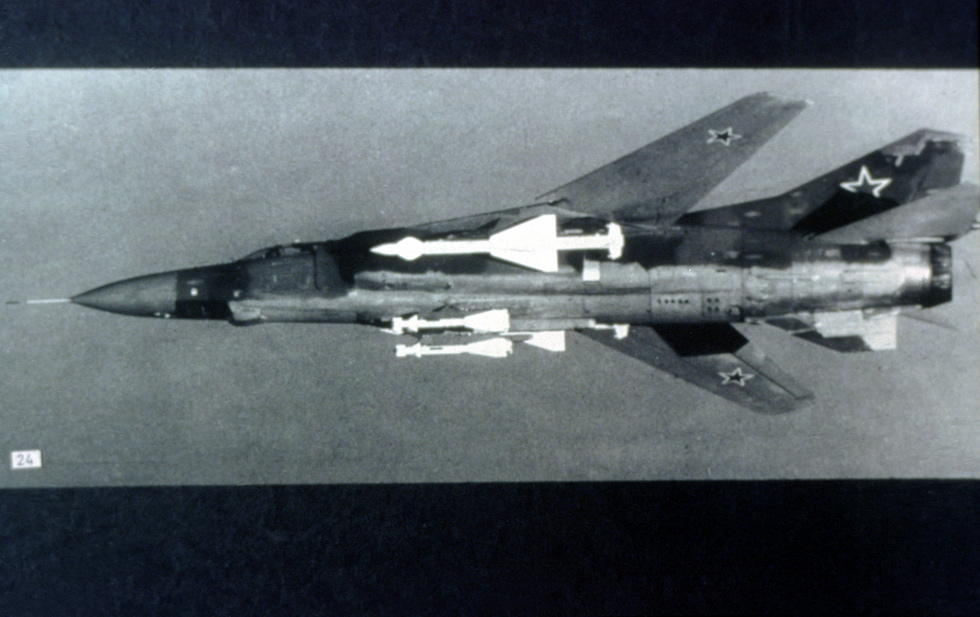
The Sapfir-23 (“High Lark”) radar paired with the semi-active R-23/R-24 (AA-7 Apex) missile gave Soviet pilots their first practical beyond-visual-range capability, backed by a short-range R-60 (AA-8) dogfight missile and a twin-barrel GSh-23L cannon. The capability was real but limited — early reliability, look-down and ECM performance repeatedly showed their age in combat.
02The MiG-23’s swing wing: one jet, three personalities
Variable geometry solves an old aerodynamic conflict: a straight, spread wing is efficient at low speed and short fields, while a sharply swept wing is efficient at supersonic speed. Rather than compromise, the MiG-23 let the pilot pick. At 16° the wing is spread for a short, docile takeoff and landing; at 45° it is a balanced cruise and combat setting; at 72° it is swept hard back for a fast, stable low-level penetration. The cost was mechanical: pivots, actuators and a heavy wing carry-through structure that added weight and maintenance the simple MiG-21 never carried. It made the Flogger genuinely versatile — and genuinely demanding to keep flying.
03Fast, but not forgiving: what pilots said about flying the MiG-23
Test and adversary pilots — including the Americans who secretly flew smuggled Floggers under CONSTANT PEG — consistently praised the MiG-23’s acceleration and top speed while warning about its handling. They described vicious high angle-of-attack behavior, poor cockpit visibility and a heavy control feel. The jet rewarded energy fighting and straight-line speed but punished the low-and-slow turning duel, exactly the fight NATO’s newer, more agile fighters wanted. It was a fighter to be respected and, in the wrong regime, feared by its own pilot.
Full MiG-23 specifications
Airframe & Performance
- Экипаж
- 1 (two-seat UB trainers exist)
- Длина
- ~16.7 m (54 ft 10 in)
- Wingspan, spread (16°)
- ~14.0 m
- Wingspan, swept (72°)
- ~7.8 m
- Высота
- ~4.82 m
- Пустой вес
- ~10,900 kg
- Max takeoff weight
- ~18,000–18,400 kg
- Max speed
- ~Mach 2.35 · ~2,500 km/h at altitude
- Служебный потолок
- ~18,000–18,600 m
- Боевой радиус
- ~1,150 km (varies with load)
Propulsion & Systems
- Двигатель
- 1 × Tumansky/Soyuz R-29-300 (R-35-300 on ML/MLD)
- Толкать
- ~83 kN dry / ~120–127 kN afterburner
- Cannon
- 1 × 23 mm GSh-23L twin-barrel
- Missiles
- R-23/R-24 (AA-7 Apex) BVR; R-60 (AA-8) IR
- Radar
- Sapfir-23 (“High Lark”)
- First flight
- 10 April 1967
- Built
- ~5,047 (1967–1985)
- Unit cost
- Not publicly documented
- Cost per flight hour
- No reliable public figure
04How fast is the MiG-23, really? Mach 2.35 versus the “Mach 2.0” label
The MiG-23’s top speed is usually given as around 2,500 km/h at altitude, which works out to roughly Mach 2.35. Some reference pages confusingly label the same aircraft “Mach 2.0,” a figure that is inconsistent with their own quoted 2,500 km/h and appears to reflect a low-altitude or clean-configuration limit. The widely accepted high-altitude figure for the lightened ML is ~Mach 2.35, and that is what we quote here. As with many Soviet-era specifications, published numbers blend the MiG-23M and MiG-23ML across sources, and no credible public unit-cost figure exists for the type at all.
The MiG-23 Flogger through the years
The requirement
Soviet planners issue a requirement for a longer-ranged, radar- and BVR-capable successor to the MiG-21.
First flight
The swing-wing “23-11” prototype flies for the first time, piloted by Aleksandr Fedotov.
Enters service
The MiG-23 is introduced and enters Soviet Frontal Aviation as a swing-wing interceptor.
The definitive MiG-23M
The MiG-23M (Flogger-B) with the Sapfir-23 radar enters mass production.
The MiG-27 is born
A dedicated ground-attack derivative, the MiG-27, is developed from the same swing wing and fuselage.
The ultimate Floggers
The lightened MiG-23ML/MLA/MLD family is produced; production winds down around 1985.
The Iran–Iraq War
Iraqi Floggers fly the type’s busiest combat, downing Iranian F-4s, F-5s and at least one F-14.
Bekaa Valley
Israel devastates Syria’s air arm; roughly ten Syrian MiG-23s are lost in the fighting.
The “ghost flight”
A pilotless MiG-23M crosses ~900 km of Europe on autopilot and crashes fatally into a Belgian farmhouse.
From the flight line: twelve Flogger stories
The three-position wing
One jet, three personalities — hand-selected in the cockpit.
Read the full story
The ghost flight of 1989
A fighter with no pilot crosses a continent and kills a stranger.
Read the full story
Bekaa Valley reckoning
The Flogger meets the F-15 and F-16 — and comes off worst.
Read the full story
Top guns of the Persian Gulf
Iraq’s busiest fighter, through eight years of war.
Read the full story
Warbird survivors
A few Floggers still fly — privately, not for hire.
Read the full story
The MiG-27 sibling
Same wing, different mission — the Flogger turned mud-mover.
Read the full story
The first real Soviet BVR shot
Beyond visual range, at last — a decade behind the West.
Read the full story
Red star over Nevada
America’s clandestine Floggers flew out of Tonopah.
Read the full story
Fast, but not forgiving
A pilot’s-hands-full fighter that punished mistakes.
Read the full story
The Cold War’s everywhere fighter
From Havana to Pyongyang, the Flogger flew for two dozen air forces.
Read the full story
Libya’s Floggers versus the US Navy
Confrontation over the Mediterranean in the 1980s.
Read the full story
Backbone of Frontal Aviation
For a decade, the single most numerous fighter in Soviet service.
Read the full story
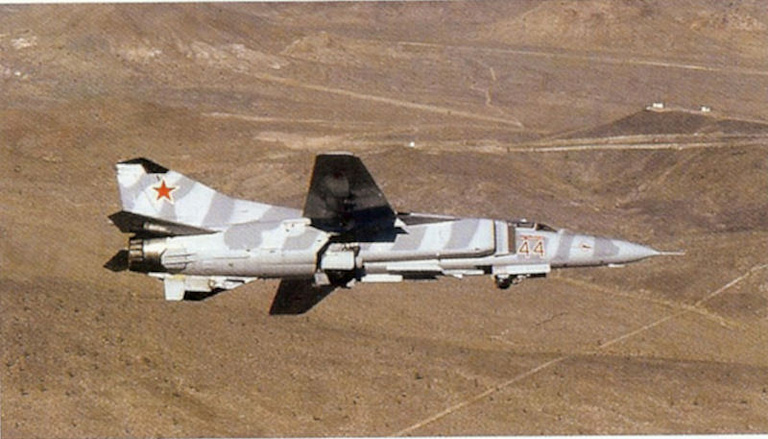
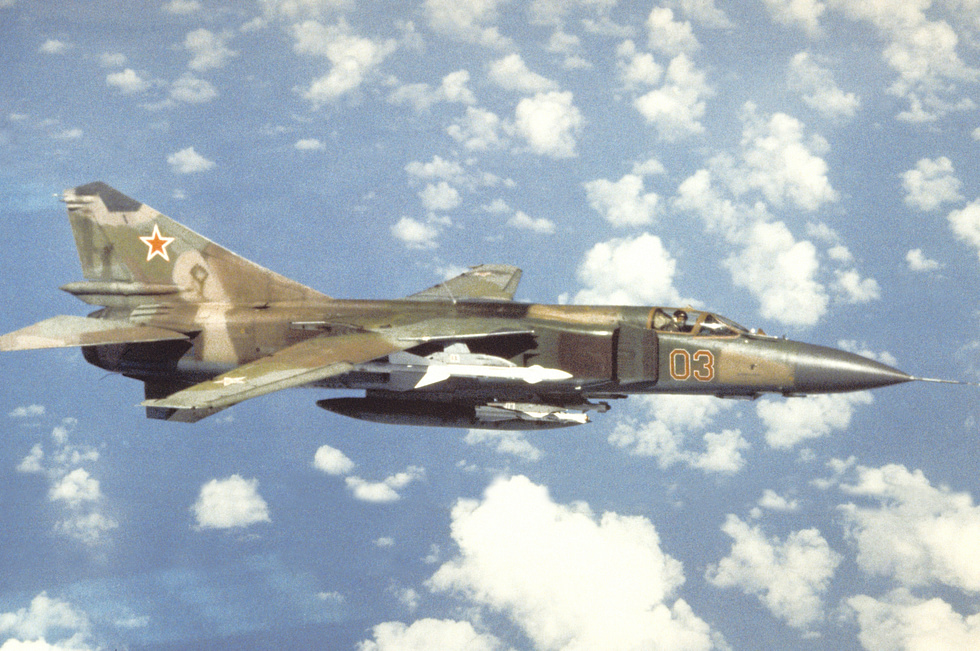
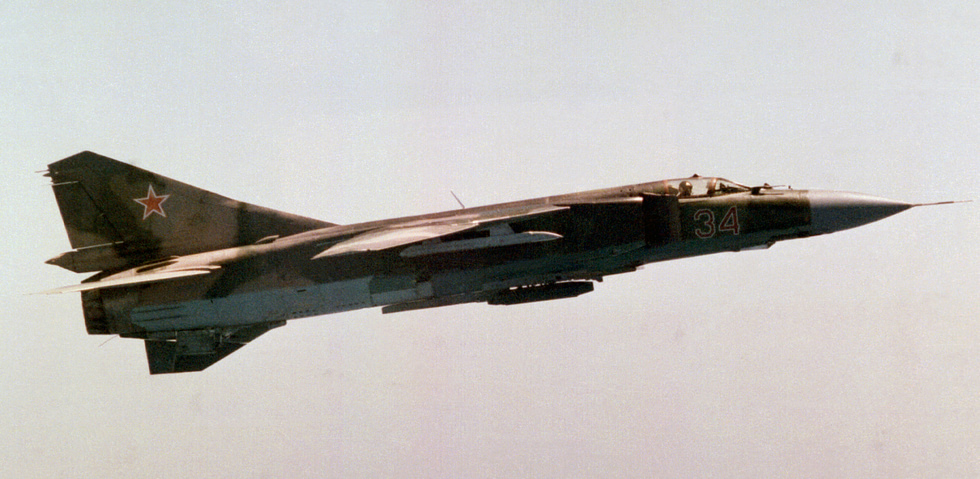
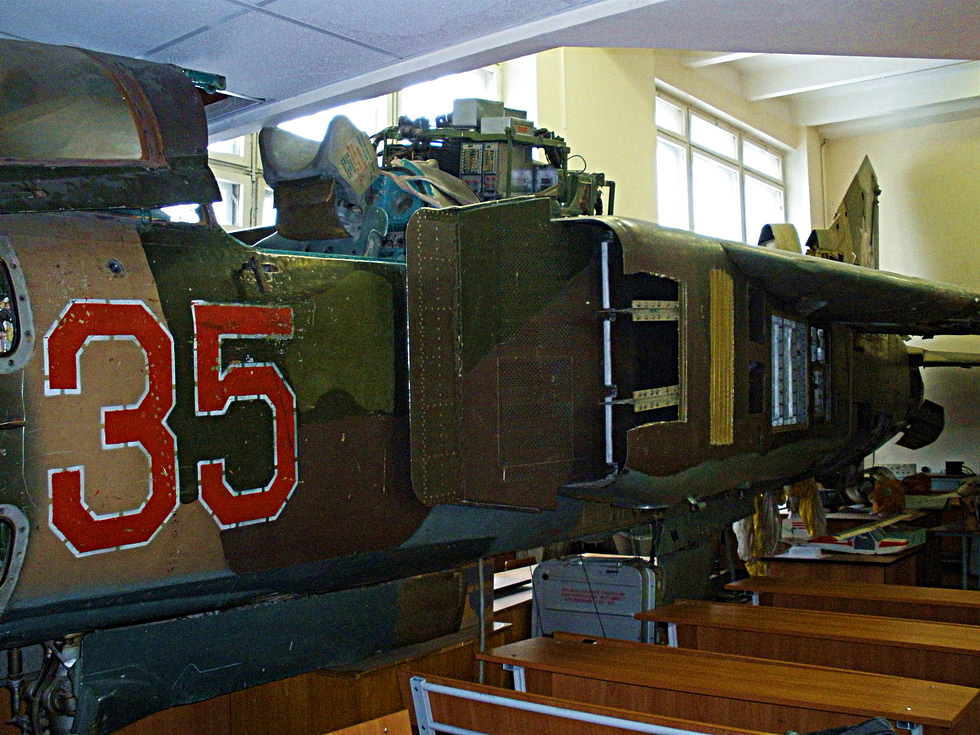
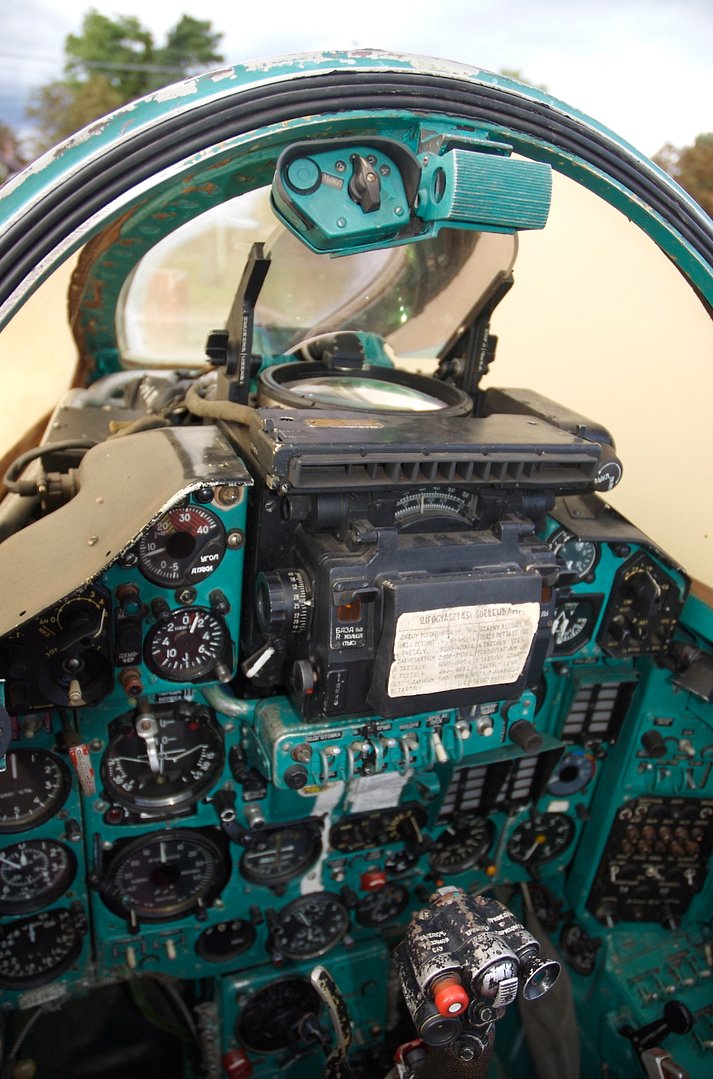
The MiG-23 Flogger in pictures
The MiG-23 Flogger in motion
A verified MiG-23 video is coming soon.
The MiG-23 Flogger in motion
Wings Over the Rockies Air & Space Museum — one of the most-watched MiG-23 Flogger films on YouTube.
Where the Flogger flew
One of the most combat-tested Soviet jets
The MiG-23 saw more combat than almost any other Soviet-era fighter — but its air-to-air record is fiercely contested, and every kill and loss total below should be read as a claim, not a settled score. What is beyond dispute is the sheer breadth of its fighting career, from the Bekaa Valley to the Persian Gulf, Angola, Libya and Syria.
Compare the combat record of every military aircraft. Figures as of July 2026 and widely contested.
Everything people ask about the MiG-23
Can I fly in a MiG-23?
How fast is the MiG-23?
What is the swing wing for?
Is the MiG-23 still in service?
How does the MiG-23 compare to the F-16 or F-15?
How many MiG-23s were built?
How is the MiG-23 related to the MiG-27?
You can’t fly the MiG-23.
These, you can.
Some legends only live in museums — others are fuelled and waiting. MiGFlug has put civilians in real military jet cockpits since 2004.
 Fly the L-39 AlbatrosThe world’s most-flown jet trainer — aerobatics included
 Fly the F-104 Starfighter“The missile with a man in it”
 Fly the MiG-21The Cold War’s most-produced jet
 Управляйте самолетом T-33 Shooting Star.America’s first jet trainer
 Fly the DH VampireA piece of early jet history
 Fly the S.211Agile Italian jet trainer
 Fly the MB-326The classic Aermacchi jet
 Fly the MiG-15The Soviet legend of the Korean War
Continue the tour
Every fact, checked
- Military Factory — Mikoyan-Gurevich MiG-23Specifications, variants and production overview for the Flogger family.
- GlobalMilitary.net — MiG-23 FloggerCombat aircraft specs and current-operator estimates (2026).
- flugzeuginfo.net — MiG-23 technical dataIndependent specification and performance cross-check.
- War History Online — The 1989 unmanned MiG-23MThe pilotless Flogger that flew across Europe and crashed in Belgium.
- Russia Beyond — The Belgian ghost-flight crashRussian-side account of the 1989 accident and its aftermath.
- MiG-23 Flogger site — Combat over the Persian GulfDedicated enthusiast history of Iraqi and Syrian Flogger combat.
- The Aviation Geek Club — Bekaa Valley 1982The Israeli air battles that inflicted heavy Syrian MiG-23 losses.
- MiGFlug — Fighter jet flights & pricesThe jets you actually can fly today (no MiG-23 offered).