
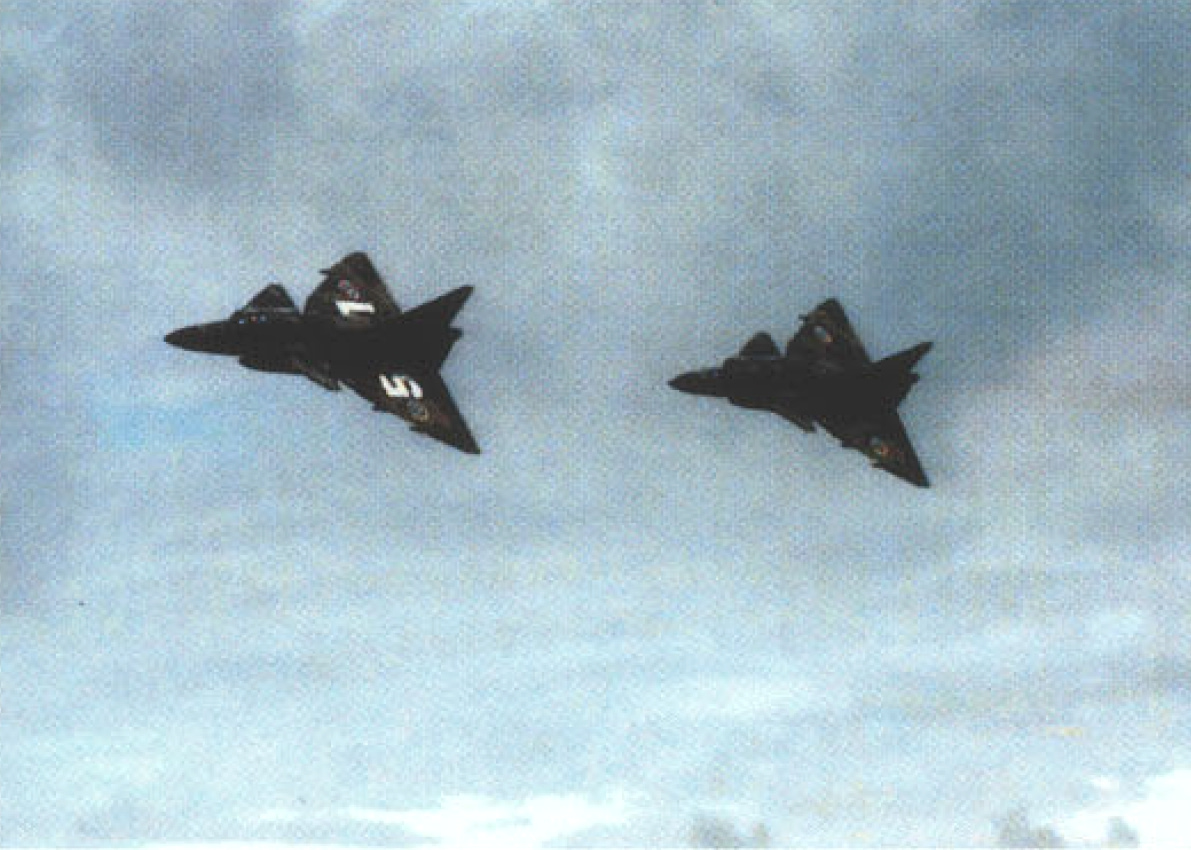
Saab 37 Viggen
“The Thunderbolt”
Sweden’s canard-delta Cold War fighter — the first production canard jet, built to scramble from ordinary highways, brake to a stop with a thrust reverser, and the only aircraft ever to get an acknowledged radar lock on the Mach-3 SR-71 Blackbird.
The fighter built to fly from the roads
In the 1960s, neutral Sweden faced a stark strategic problem: a handful of large air bases would be destroyed in the opening minutes of any war with the Soviet Union. Its answer was one of the boldest air-power doctrines of the Cold War — disperse the entire air force onto ordinary public roads. The aircraft built to make that idea work was the Saab 37 Viggen, the centrepiece of “System 37.”
To operate from short, rough highway strips, Saab gave the Viggen a radical shape: a close-coupled canard-delta, with a small foreplane ahead of the main delta wing that generated extra lift for steep, slow, precise approaches. On touchdown a thrust reverser — pre-selected in the air — slammed the engine into reverse, hauling the jet to a stop in a few hundred metres. No drag chute, no long runway. The Viggen first flew on 8 February 1967 and entered service on 21 June 1971.
Over the next three decades it evolved into a whole family — the AJ 37 attack aircraft, the JA 37 interceptor, the SF 37 and SH 37 reconnaissance variants, and the SK 37 two-seat trainer. It never fired a shot in anger, yet it earned a place in aviation legend over the Baltic, where its powerful radar and clever tactics let Swedish pilots do what no one else managed: lock onto the untouchable SR-71 Blackbird. The last front-line Viggens stood down in 2005, replaced by the smaller Saab Gripen.
01The Saab 37 Viggen and Sweden’s dispersed-basing doctrine
Swedish air-defence planning assumed that fixed air bases could not survive a first strike. Under the Bas 60 system and its refined successor Bas 90, combat aircraft were dispersed across dozens of road bases — straight sections of public highway widened and reinforced, with taxiways leading into the forest for concealment, and pre-positioned fuel and munitions. A Viggen could land on an 800-metre strip, be turned around by a small team of conscript ground crew in a handful of minutes, and be back in the air before an attacker could find it.
Almost every feature of the Viggen — the canard for short, steep landings, the thrust reverser, the rugged low-pressure tyres, the automated systems that let one pilot manage the whole mission — existed to serve that doctrine. The aircraft is inseparable from the strategy; it is arguably the purest expression of Cold War Swedish defence thinking ever built.
What makes the Viggen special
Canard-delta & a thrust reverser
The Viggen was the first canard-configured aircraft built in quantity. Its close-coupled foreplane created strong vortex lift for slow, steep, carrier-style approaches onto short road strips, and a target-type thrust reverser — selectable in the air and triggered on nose-wheel compression — stopped it in a few hundred metres. No other supersonic fighter of its era could land this short without a hook or a chute.
The Volvo RM8: a reheated turbofan that could reverse
Power came from the Volvo RM8, a heavily reworked, licence-built Pratt & Whitney JT8D airliner engine fitted with a Swedish-designed afterburner and reverser. It was the second operational afterburning turbofan in the world — and the first ever combined with a thrust reverser. The definitive RM8B produced about 125 kN in reheat, enough to push the Viggen past Mach 2.
A digital computer years ahead of its time
The Viggen’s CK 37 central computer was among the first airborne computers to use integrated circuits, tying navigation, weapons and the head-up display into a single system. It let one pilot fly, fight and navigate a low-level strike alone — a level of cockpit integration most contemporaries needed a two-man crew to achieve.
02The Viggen’s thrust reverser: how a fighter stops on a highway
Landing a fast jet on an 800-metre road strip demanded a way to shed speed instantly. Saab’s solution was a target-type thrust reverser integrated into the RM8’s exhaust. The pilot pre-selected reverse thrust on final approach; the moment the nose-wheel oleo compressed on touchdown, deflector buckets swung into the jet efflux and redirected it forward. Combined with the steep, no-flare canard approach, this let the Viggen make a genuine short landing without a drag chute or arrester gear — and even taxi backwards under its own power, useful in a cramped forest dispersal.
03The Volvo RM8 — an airliner engine turned Mach-2 fighter powerplant
Sweden needed a big, fuel-efficient engine for the Viggen’s long-range strike role, and turbofans were far more economical at cruise than the turbojets rivals used. Volvo Flygmotor took the civil Pratt & Whitney JT8D — the engine of the Boeing 727 and DC-9 — and rebuilt it for supersonic combat: strengthened for high speeds, fitted with a Swedish afterburner and the world’s first turbofan thrust reverser. The result was unusual and complex, and the reheat-plus-reverser combination gave engineers real trouble, but it delivered exactly the mix of cruise economy and short-field braking the road-base doctrine demanded.
Full specifications
Airframe & Performance
- Экипаж
- 1 (SK 37 trainer seats 2)
- Длина
- ~16.4 m
- Размах крыльев
- ~10.6 m
- Высота
- ~5.9 m
- Пустой вес
- ~9,500 kg
- Max takeoff weight
- ~20,000 kg
- Max speed
- ~Mach 2.0 (about 2,200 km/h at altitude)
- Служебный потолок
- ~18,000 m
- Боевой радиус
- ~1,000 km (hi-lo-hi strike)
- Landing roll
- A few hundred metres with reverser
Propulsion & Systems
- Двигатель
- 1 × Volvo RM8B afterburning turbofan
- Толкать
- ~72 kN dry · ~125 kN reheat
- Cannon
- 1 × 30 mm Oerlikon KCA (JA 37 only)
- Air-to-air
- Rb 71 Skyflash, Rb 24/74 Sidewinder
- Air-to-surface
- Rb 04 / RBS-15 anti-ship, Rb 75 Maverick, rockets, bombs
- Avionics
- CK 37 digital central computer
- First flight
- 8 February 1967
- Built
- ~329 (all variants, 1970–1990)
- Unit cost
- No reliable public figure (state programme)
04The Viggen’s cost: why no clean price exists
The Viggen was a Swedish state defence programme, funded through the national budget and never sold on an open export market despite several sales campaigns. No firm flyaway unit price or cost-per-flight-hour figure exists in reliable open sources. What is documented is the scale of the effort: roughly 329 aircraft across all versions, backed by the entire Swedish aviation industry — Saab for the airframe, Volvo Flygmotor for the engine, Ericsson for the radar. Any precise dollar figure attached to a Viggen should be treated as an estimate, not a sourced number.
From System 37 to the last Thunderbolt
System 37 approved
After years of concept studies, the Swedish government green-lights Aircraft System 37 to replace the Lansen and Draken.
First flight
The prototype flies on 8 February, piloted by Erik Dahlström — the first canard-delta jet headed for mass production.
Enters service
The AJ 37 attack version joins the Swedish Air Force on 21 June, built around the road-base doctrine.
The JA 37 interceptor
The dedicated air-defence Viggen enters service with a new pulse-Doppler radar and a 30 mm Oerlikon KCA cannon.
Hunting the Blackbird
JA 37 pilots repeatedly achieve radar — and reportedly missile — lock on SR-71s crossing the Baltic.
Escorting a crippled SR-71
Viggens shepherd a stricken Blackbird to safety over the Baltic; the Swedish pilots are decorated by the US decades later.
The final upgrades
Surviving airframes are rebuilt as AJS 37 and JA 37D with new avionics and missiles, extending their careers.
Retirement
The last front-line Viggen stands down on 25 November 2005; a handful of SK 37E trainers soldier on to 2007.
From the cockpit: twelve Viggen stories
A jet designed around a highway
Almost every feature of the Viggen exists to let it fight from dispersed road bases.
Read the full story
The only jet to lock the SR-71
Swedish JA 37 pilots are the only ones credited with an acknowledged radar lock on the SR-71 Blackbird.
Read the full story
Escorting a crippled Blackbird
When an SR-71 lost an engine over the Baltic, Viggens closed in — not to attack, but to protect it.
Read the full story
Stopping on a road
A pre-armed thrust reverser let the Viggen brake to a halt in a few hundred metres.
Read the full story
An airliner engine at Mach 2
The Volvo RM8 began life as the Pratt & Whitney JT8D that powered the Boeing 727 and DC-9.
Read the full story
A computer ahead of its time
The CK 37 was among the first airborne computers built with integrated circuits.
Read the full story
Why the Viggen looks like that
The distinctive foreplane wasn’t for dogfighting agility — it was for landing slowly and safely.
Read the full story
Rearmed in minutes by conscripts
A small team of national-service teenagers could turn a Viggen around on a forest road.
Read the full story
The JA 37 and its 30 mm gun
The dedicated fighter Viggen carried one of the hardest-hitting cannon of its generation.
Read the full story
Eyes over the Baltic
Dedicated SF 37 and SH 37 Viggens gave Sweden its own strategic and maritime reconnaissance.
Read the full story
The two-seat SK 37
A handful of twin-seat Viggens checked out new pilots — and later flew as jammers.
Read the full story
From Viggen to Gripen
The Viggen’s road-base philosophy lives on in the smaller, cheaper Saab Gripen.
Read the full story
The Viggen in pictures


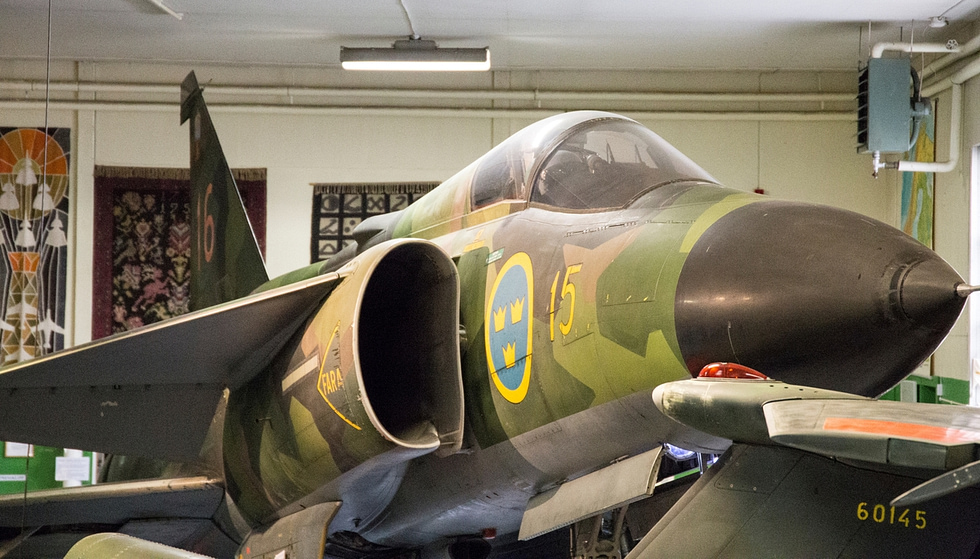


The Viggen in motion
A dedicated Saab 37 Viggen video feature is coming soon. In the meantime, explore the stories, specifications and photo gallery above — and see where the Viggen served on the operations map below.
The Viggen in motion
DroneScapes — one of the most-watched Viggen films on YouTube.
Where the Viggen served
The record that defines it
The Viggen never fired a weapon in anger. In three decades of service, neutral Sweden never went to war, and no Viggen ever scored — or suffered — an air-to-air kill. Its reputation rests instead on deterrence, dispersal and one extraordinary Cold War achievement: intercepting the fastest aircraft in the world.
Compare the combat record of every military aircraft. Figures as of July 2026.
Everything people ask about the Saab 37 Viggen
Can I fly in a Viggen?
Why was the Viggen designed to land on roads?
Did a Viggen really lock onto an SR-71 Blackbird?
How fast is the Saab 37 Viggen?
What is the thrust reverser for?
Why did only Sweden operate the Viggen?
Did the Viggen ever see combat?
What replaced the Viggen?
You can’t fly the Viggen.
These, you can.
Some legends only live in museums — others are fuelled and waiting. MiGFlug has put civilians in real military jet cockpits since 2004.
 Fly the L-39 AlbatrosThe world’s most-flown jet trainer — aerobatics included
 Fly the F-104 Starfighter“The missile with a man in it”
 Fly the MiG-21The Cold War’s most-produced jet
 Управляйте самолетом T-33 Shooting Star.America’s first jet trainer
 Fly the DH VampireA piece of early jet history
 Fly the S.211Agile Italian jet trainer
 Fly the MB-326The classic Aermacchi jet
 Fly the MiG-15The Soviet legend of the Korean War
Continue the tour
Every fact, checked
- The Aviation Geek Club — Viggen vs BlackbirdHow JA 37 pilots achieved radar lock on the SR-71, with pilot accounts and intercept tactics.
- 19FortyFive — The Only Jet To Catch the SR-71Overview of the Viggen’s SR-71 intercepts and the 1987 escort of a crippled Blackbird.
- The National Interest — Viggen and the BlackbirdThe reported missile lock on the SR-71 and the Viggen’s interceptor development.
- National Security Journal — JA-37 ViggenAnalysis of the JA 37 interceptor and its Baltic radar-lock achievement.
- Saab — company historyManufacturer background on the System 37 programme and the Viggen family.
- Swedish Air Force Museum (Flygvapenmuseum)Reference for preserved Viggen airframes, variants and Swedish air-power history.
- Hush-KitPilot interviews and analysis of flying and fighting the Viggen.
- The AviationistCoverage of the SR-71 Baltic intercepts and the 2018 US Air Medals for the Swedish pilots.