
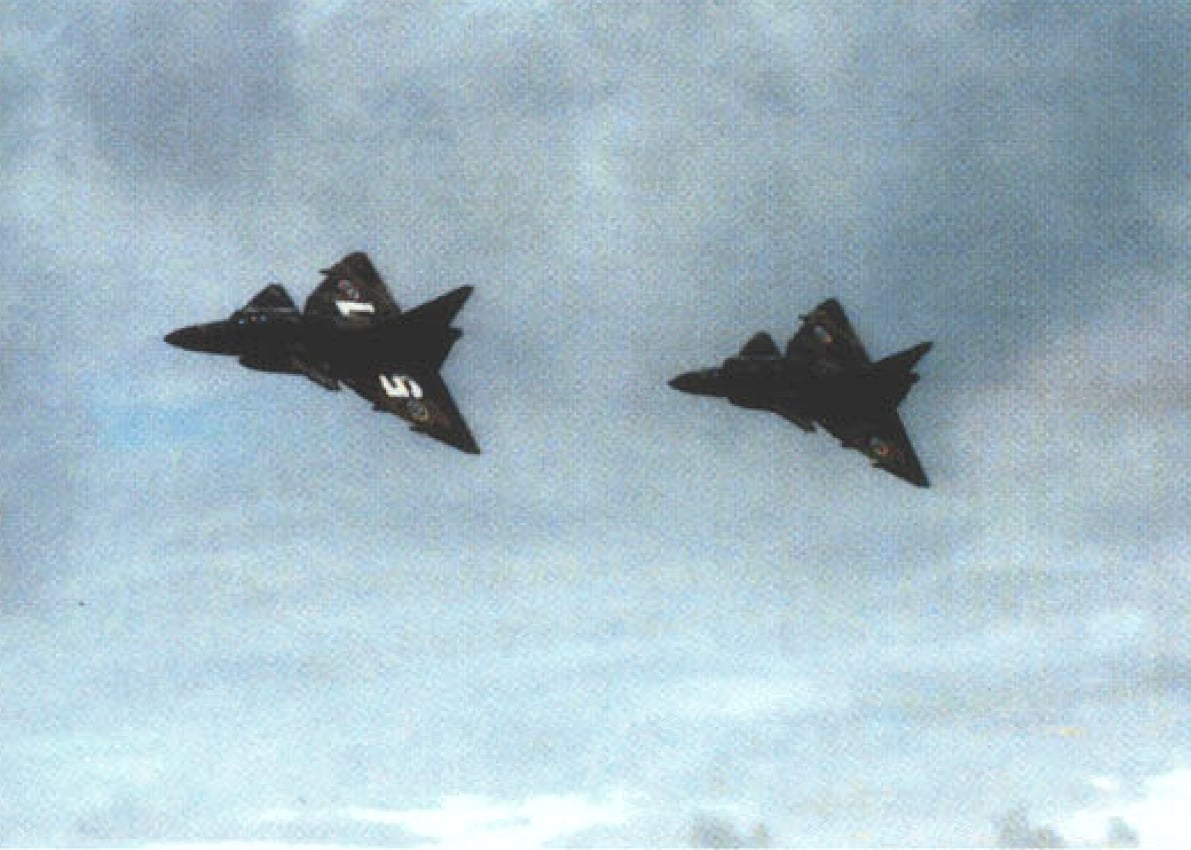
Saab 37 Viggen
“The Thunderbolt”
Sweden’s canard-delta Cold War fighter — the first production canard jet, built to scramble from ordinary highways, brake to a stop with a thrust reverser, and the only aircraft ever to get an acknowledged radar lock on the Mach-3 SR-71 Blackbird.
The fighter built to fly from the roads
In the 1960s, neutral Sweden faced a stark strategic problem: a handful of large air bases would be destroyed in the opening minutes of any war with the Soviet Union. Its answer was one of the boldest air-power doctrines of the Cold War — disperse the entire air force onto ordinary public roads. The aircraft built to make that idea work was the Saab 37 Viggen, the centrepiece of “System 37.”
To operate from short, rough highway strips, Saab gave the Viggen a radical shape: a close-coupled canard-delta, with a small foreplane ahead of the main delta wing that generated extra lift for steep, slow, precise approaches. On touchdown a thrust reverser — pre-selected in the air — slammed the engine into reverse, hauling the jet to a stop in a few hundred metres. No drag chute, no long runway. The Viggen first flew on 8 February 1967 and entered service on 21 June 1971.
Over the next three decades it evolved into a whole family — the AJ 37 attack aircraft, the JA 37 interceptor, the SF 37 and SH 37 reconnaissance variants, and the SK 37 two-seat trainer. It never fired a shot in anger, yet it earned a place in aviation legend over the Baltic, where its powerful radar and clever tactics let Swedish pilots do what no one else managed: lock onto the untouchable SR-71 Blackbird. The last front-line Viggens stood down in 2005, replaced by the smaller Saab Gripen.
01The Saab 37 Viggen and Sweden’s dispersed-basing doctrine
Swedish air-defence planning assumed that fixed air bases could not survive a first strike. Under the Bas 60 system and its refined successor Bas 90, combat aircraft were dispersed across dozens of road bases — straight sections of public highway widened and reinforced, with taxiways leading into the forest for concealment, and pre-positioned fuel and munitions. A Viggen could land on an 800-metre strip, be turned around by a small team of conscript ground crew in a handful of minutes, and be back in the air before an attacker could find it.
Almost every feature of the Viggen — the canard for short, steep landings, the thrust reverser, the rugged low-pressure tyres, the automated systems that let one pilot manage the whole mission — existed to serve that doctrine. The aircraft is inseparable from the strategy; it is arguably the purest expression of Cold War Swedish defence thinking ever built.
What makes the Viggen special
Canard-delta & a thrust reverser
The Viggen was the first canard-configured aircraft built in quantity. Its close-coupled foreplane created strong vortex lift for slow, steep, carrier-style approaches onto short road strips, and a target-type thrust reverser — selectable in the air and triggered on nose-wheel compression — stopped it in a few hundred metres. No other supersonic fighter of its era could land this short without a hook or a chute.
The Volvo RM8: a reheated turbofan that could reverse
Power came from the Volvo RM8, a heavily reworked, licence-built Pratt & Whitney JT8D airliner engine fitted with a Swedish-designed afterburner and reverser. It was the second operational afterburning turbofan in the world — and the first ever combined with a thrust reverser. The definitive RM8B produced about 125 kN in reheat, enough to push the Viggen past Mach 2.
A digital computer years ahead of its time
The Viggen’s CK 37 central computer was among the first airborne computers to use integrated circuits, tying navigation, weapons and the head-up display into a single system. It let one pilot fly, fight and navigate a low-level strike alone — a level of cockpit integration most contemporaries needed a two-man crew to achieve.
02The Viggen’s thrust reverser: how a fighter stops on a highway
Landing a fast jet on an 800-metre road strip demanded a way to shed speed instantly. Saab’s solution was a target-type thrust reverser integrated into the RM8’s exhaust. The pilot pre-selected reverse thrust on final approach; the moment the nose-wheel oleo compressed on touchdown, deflector buckets swung into the jet efflux and redirected it forward. Combined with the steep, no-flare canard approach, this let the Viggen make a genuine short landing without a drag chute or arrester gear — and even taxi backwards under its own power, useful in a cramped forest dispersal.
03The Volvo RM8 — an airliner engine turned Mach-2 fighter powerplant
Sweden needed a big, fuel-efficient engine for the Viggen’s long-range strike role, and turbofans were far more economical at cruise than the turbojets rivals used. Volvo Flygmotor took the civil Pratt & Whitney JT8D — the engine of the Boeing 727 and DC-9 — and rebuilt it for supersonic combat: strengthened for high speeds, fitted with a Swedish afterburner and the world’s first turbofan thrust reverser. The result was unusual and complex, and the reheat-plus-reverser combination gave engineers real trouble, but it delivered exactly the mix of cruise economy and short-field braking the road-base doctrine demanded.
Full specifications
Baseline note: the figures below describe the JA 37, the all-weather interceptor version powered by the Volvo Flygmotor RM8B — 149 aircraft, more than any other mark, delivered between 1979 and 1990 and the last Viggen variant in front-line service. Deltas for the AJ 37 attack aircraft and its RM8A engine, the SF 37 photographic and SH 37 maritime reconnaissance versions, the SK 37 two-seat trainer, the SK 37E electronic-warfare aircraft and the JA 37D / JA 37Di upgrades are given in grey. Three warnings before the numbers. First, Swedish reference works tabulate engine thrust in kiloponds and give the RM8A as 6,455 kp dry and 10,405 kp in reheat, which converts to 63.3 and 102.0 kN, while English-language sources quote 65.6 and 115.6 kN for the same engine; the gap is far too large to be a rounding error and almost certainly reflects different rating conditions, so both sets are stated below rather than one being quietly preferred. Second, maximum take-off weight is variously given as 19,274 kg and as a round 20,000 kg, and neither camp shows its working. Third, the Viggen’s famous 500-metre field length is an aircraft requirement, not a description of the bases: the wartime Bas 90 short strips were 800 m long and 17 m wide, and the 500 m figure is what the aeroplane was designed to need so that it would still have margin on a strip that had been cratered at one end.
Dimensions & weights
- Crew
- 1 — two in tandem in the SK 37 trainer and the SK 37E, whose rear cockpit was rebuilt for an electronic-warfare officer. Every operational Viggen was flown single-crew, and on the JA 37 that one man ran the radar, the interception, the gun and the missiles
- Length
- 16.40 m (53 ft 10 in) for the JA 37, whose rear fuselage was stretched to take the longer RM8B. The AJ 37, SH 37, SK 37 and their AJS-standard rebuilds are 16.30 m (53 ft 6 in). The SF 37 is longer again because its camera nose replaced the radar entirely; figures around 16.5 m are quoted for it and no authoritative single number exists
- Wingspan
- 10.60 m (34 ft 9 in) — identical on every mark. That is a very short span for a 16-tonne aeroplane, and it is deliberate: the wing had to fit inside the 17-metre width of a Bas 90 short strip with the aircraft off the centreline
- Canard span
- 5.45 m (17 ft 11 in), area about 6.2 m² (67 sq ft). Jane’s-derived tables agree on these; several general reference works omit the foreplane from the wing-area figure entirely, which is why published wing loadings for the Viggen vary by a fifth
- Height
- 5.90 m (19 ft 4 in) for the JA 37, which has a taller fin than the attack marks. The AJ 37 and SH 37 are usually given as 5.60 m (18 ft 4 in). The SK 37 fin is taller again, and folds to the right to get the aeroplane into a hardened shelter
- Wing area
- 46.0 m² (495 sq ft) for the main delta alone; about 52.2 m² (562 sq ft) counting the canard, which on a close-coupled layout is a genuine lifting surface and not a trimming device. Use whichever you like, but say which
- Configuration
- Close-coupled canard delta — a cropped double-delta main wing with a leading-edge dogtooth, and a small high-set foreplane mounted behind the intakes and slightly above the wing plane, fitted with its own powered trailing-edge flaps. The canard is not there for trim. It sheds a strong vortex that runs back over the inner wing and keeps the flow attached at angles of attack where a plain delta would already have separated, which is what lets the Viggen fly a very steep, very slow approach without the enormous nose-up attitude that made the Draken and the Mirage such awkward things to land short. It also gave a useful pitch-up moment for rotation. Saab was building close-coupled canards for a road-strip requirement a decade before the configuration became fashionable
- Empty weight
- 9,500 kg (20,940 lb) for the JA 37. The AJ 37 is lighter, usually given between 9,300 and 9,500 kg, and the reconnaissance marks sit within a couple of hundred kilogrammes of the attack aircraft. The Viggen is a heavy aeroplane for its size, and much of that is structure: a bonded metal honeycomb fuselage, a titanium rear section and an undercarriage stressed for arriving without a flare
- Normal take-off weight
- 15,000 kg (33,070 lb) in the JA 37 interception fit — gun pack, two Rb 71, two Rb 74 and internal fuel. The AJ 37 is normally tabulated at 17,000 kg (37,480 lb) gross with a strike load
- Maximum take-off weight
- 19,274 kg (42,490 lb) as given in the current specification tables; a round 20,000 kg (44,090 lb) appears in older works and in Saab publicity. The disagreement is unresolved and both figures are in wide circulation
- Internal fuel
- ~5,000 litres (1,100 imp gal, 1,320 US gal) in six tanks in the fuselage and wings, roughly 4,000 kg. The SK 37 lost one tank to the second cockpit and is correspondingly shorter-legged, which mattered in the ferry role and not much anywhere else
- External tank
- 1,500 litres (330 imp gal, 396 US gal) on the centreline — one only. The Viggen never carried multiple drop tanks the way a Draken did, because the centreline was the only station shaped for it and the wing pylons were wanted for weapons
- Undercarriage
- Tricycle, twin wheels in tandem on each main leg — an unusual arrangement chosen to spread the load over a thin, temporary strip while still folding into a very shallow bay. The legs shorten as they retract. Anti-skid brakes throughout, and the main oleos are stressed for a deliberate no-flare arrival at about 5 m/s (roughly 1,000 ft/min) of sink. A conventional fighter undercarriage would have been driven through the wing
Performance
- Maximum speed, altitude
- 2,231 km/h at 11,000 m (1,386 mph, 1,205 kn at 36,100 ft), Mach 2.1. Achieved on fixed-geometry intakes, which is remarkable: Saab decided that variable ramps were not worth the weight, complexity and maintenance burden on an aeroplane that would spend its war at low level over the Baltic. The price is that the last tenth of Mach comes hard
- Maximum speed, sea level
- 1,400 km/h (870 mph, 756 kn), about Mach 1.1 — and this is the number that mattered. The AJ 37 was designed to run in at low level under a radar horizon and the RM8 was thickened and re-bladed specifically to survive supersonic flight in dense air
- Rate of climb
- 203 m/s (40,000 ft/min) initial for the JA 37 on the RM8B. The AJ 37 on the RM8A is appreciably less; Swedish squadron practice quoted roughly 175 m/s
- Time to 10,000 m
- 100 seconds (33,000 ft) from brake release for the JA 37 — the figure Swedish air defence planned around, because a Viggen sitting on a road base had to be at bomber altitude before the bombers reached the coast
- Service ceiling
- 18,000 m (59,000 ft); some sources give 18,500 m (60,700 ft) for the AJ 37. Zoom climbs well above this were routine on Baltic intercepts
- Take-off run
- 400 m (1,310 ft) at normal weight, with the canard flaps drooped in sympathy with the undercarriage. The aircraft rotates early and steeply because the foreplane provides the pitching moment rather than a tailplane pushing down
- Landing run
- 500 m (1,640 ft) with the thrust reverser deployed — the number the whole aeroplane was designed around. Without the reverser it is roughly double, which is why the reverser was not an optional refinement but part of the flight envelope
- Approach speed
- 215 km/h (134 mph, 116 kn) on a 3.5 to 4 degree glide path flown to touchdown without flaring, at about 5 m/s of sink. Pilots described it as controlled flying into the ground; the technique removes the float that eats runway and puts the wheels on a known spot within about 30 m of the threshold when flown on the TILS microwave landing aid
- Combat radius
- ~1,000 km (620 miles, 540 nm) hi-lo-hi with external stores; ~500 km (310 miles, 270 nm) lo-lo-lo. For an interceptor working a 400-km-wide sea this was ample, and the Viggen was never asked to fly the long-range strike missions its contemporaries were
- Ferry range
- 1,820 km (1,130 miles, 983 nm) on internal fuel; about 2,000 km (1,240 miles, 1,080 nm) with the centreline tank. There was no in-flight refuelling probe on any Swedish Viggen, because Sweden had no tankers and no intention of flying anywhere
- Wing loading
- 326 kg/m² (66.8 lb/sq ft) at 15,000 kg counting the main delta only; 287 kg/m² (58.8 lb/sq ft) if the canard is included. High by delta standards and low by strike-fighter standards, which is a fair description of what the Viggen was
- Thrust-to-weight
- 0.85 at 15,000 kg on RM8B reheat — better than a Phantom, not as good as an F-16, and with a much larger installed thrust reserve at sea level than the numbers suggest because the fixed intake is optimised low rather than high
Propulsion & systems
- Engine
- One Volvo Flygmotor RM8B afterburning turbofan in the JA 37 — the RM8A in the AJ 37, SF 37, SH 37 and SK 37. Both are the Pratt & Whitney JT8D airliner engine built under licence and then very substantially rebuilt: thickened parts for supersonic flight in dense air, and a Swedish-designed afterburner that the civil engine never had. Nobody else turned a Boeing 727 engine into a Mach 2 fighter powerplant
- Thrust, dry
- 72.1 kN (16,200 lbf) RM8B; 65.6 kN (14,750 lbf) RM8A. Swedish tables in kiloponds give 6,795 kp and 6,455 kp, which convert to 66.6 and 63.3 kN — a real and unexplained discrepancy with the English-language figures
- Thrust, reheat
- 125 kN (28,100 lbf) RM8B; 115.6 kN (25,990 lbf) RM8A. The Swedish kilopond figures of 11,250 kp and 10,405 kp convert to 110.3 and 102.0 kN. Treat any single quoted Viggen thrust figure with suspicion unless the source says at what condition
- Engine detail
- Bypass ratio 0.97:1, overall pressure ratio 16.5:1, 2,350 kg (5,180 lb) dry, 6.23 m long — a genuine turbofan in a supersonic fighter years before the F-16’s F100 made that normal. The RM8B differs from the RM8A in a redesigned fan and low-pressure compressor and a combustion chamber with four injectors per can, both for thrust and for stall margin at interception altitudes
- Thrust reverser
- Three-slot, airframe-mounted, pre-selectable in flight — the single most important system on the aeroplane. The reverser cascade is built into the rear fuselage around the nozzle rather than into the engine, and deflects the efflux partly forwards through three slots for a braking force of roughly 60 per cent of maximum dry take-off thrust. The pilot arms it on the approach; a pneumatic trigger fires it the instant the nose-leg strut compresses on touchdown, so full reverse is developing before the aeroplane has finished settling. That is why the no-flare technique works: arrive hard, on a known point, with the brakes and the reverser already committed. It could also be used to back an aircraft out of a dispersal off a forest road
- Intakes
- Fixed-geometry, side-mounted, standing clear of the fuselage — larger versions of the Draken’s. No ramps, no bleed doors, nothing to jam and nothing for a conscript ground crew to rig on a roadside. The cost is pressure recovery at the top of the envelope, and it is the main reason the Viggen is a Mach 2.1 aeroplane rather than a Mach 2.4 one
- Radar
- Ericsson PS-46/A X-band pulse-Doppler in the JA 37 — multi-mode, with genuine look-down and shoot-down against targets in ground and sea clutter at ranges reported in excess of 48 km, track-while-scan on two targets, and a level of jamming resistance that surprised NATO exercise opponents. It was one of the first pulse-Doppler sets in European service and, in 1979, put a small neutral air force in a club that otherwise contained only the F-14, F-15 and Tornado F3. The attack marks carry the earlier PS-37/A monopulse set for terrain avoidance, ranging and mapping; the SH 37 has the maritime PS-371/A; the SF 37 and SK 37 have no radar at all
- Mission computer
- CK 37 in the attack marks, CD 107 and later Ericsson processors in the JA 37 — the CK 37 (centralkalkylator 37) is usually credited as the first airborne digital computer built with integrated circuits to enter service anywhere. The JA 37D upgrade added an Ericsson CD 207 mission computer and an ANP-37 stores management computer on dual MIL-STD-1553B databuses
- Displays
- Head-up display plus three cathode-ray-tube head-down displays in the JA 37 AP-12 suite — an early glass cockpit by any standard. The JA 37D added a TI 327 colour moving-map display originally developed for the Gripen. The attack marks make do with a HUD and conventional instruments
- Navigation and landing aids
- Inertial and Doppler navigation, radar altimeter with its aerials buried in the canards, and TILS — a microwave tactical instrument landing system that could be trucked to a road base and set up in hours, guiding a Viggen to a touchdown within about 30 m of the threshold in weather that would have closed the strip to anything else. Bas 90 dispersal is worthless if the aeroplanes cannot find the road in cloud, and TILS is the answer to that problem
- Datalink
- Integrated with the Swedish STRIL 60 ground environment — the JA 37 could be flown to an intercept by uplinked commands displayed to the pilot, with target data fed straight into the fire-control computer. The autopilot was also slaved to the radar to steady the aeroplane for gun firing. Sweden was doing networked, ground-directed interception on a national scale in the 1960s and 1970s, and this is why Viggens repeatedly got radar contact on targets they could never have found alone
- Numbers built
- 329 production aircraft — 108 AJ 37, 17 SK 37, 27 SH 37, 28 SF 37 and 149 JA 37, delivered between 1971 and 1990, preceded by a small batch of prototypes and pre-series machines. First flight 8 February 1967; entry into service 21 June 1971. Not one was exported
04The Viggen’s cost: why no clean price exists
The Viggen was a Swedish state defence programme, funded through the national budget and never sold on an open export market despite several sales campaigns. No firm flyaway unit price or cost-per-flight-hour figure exists in reliable open sources. What is documented is the scale of the effort: roughly 329 aircraft across all versions, backed by the entire Swedish aviation industry — Saab for the airframe, Volvo Flygmotor for the engine, Ericsson for the radar. Any precise dollar figure attached to a Viggen should be treated as an estimate, not a sourced number.
Armament & payload
The Viggen carried two entirely different arsenals, and the interceptor version was the only one that could shoot at what it could not see
There is no single Viggen weapons fit, because the AJ 37 and the JA 37 were built for opposite jobs and share almost nothing below the pylons. The attack aircraft was a low-level anti-shipping and interdiction machine carrying the largest Swedish-designed missiles of the period; the interceptor was a radar-missile platform with a very good gun. Both hang their stores from seven pylons — three under the fuselage and four under the wings — although some reference works count nine by including the outer rails, and the discrepancy is never explained.
The JA 37 is the more interesting aeroplane to arm. Its 30 mm Oerlikon KCA, the Swedish akan m/75, is one of the hardest-hitting fighter guns ever fitted: a 360-gramme projectile at 1,030 m/s, half again the mass of the NATO 30×113 mm round, from a revolver cannon firing 1,350 rounds a minute. It sits in a conformal pack under the fuselage rather than inside the airframe, which Swedish sources describe as a kapsel and English ones frequently and misleadingly call internal. With the autopilot slaved to the radar for tracking, JA 37 gunnery was exceptionally accurate. Above that, the Rb 71 gave Sweden a beyond-visual-range weapon in 1980 that most European air forces would not field for another decade.
What the Viggen never had was a laser designator, a targeting pod or a precision-guided bomb in the Western sense. Sweden bought the Maverick and built the BK90 glide dispenser, and stopped there. Fits varied sharply between marks and across three decades: the AJ 37 as delivered in 1971 and the AJS 37 as retired in 2005 have almost no weapons in common, the SF 37 and SK 37 were essentially unarmed, and the Rb 99 AMRAAM reached only the small number of JA 37D and JA 37Di aircraft modified in the late 1990s.
Gun
- 30 mm Oerlikon KCA, Swedish designation akan m/75, on the JA 37 only — a gas-operated four-chamber revolver cannon, 1,350 rounds a minute, 1,030 m/s muzzle velocity, 136 kg, firing the heavy 30×173 mm round. 126 rounds carried
- The gun is in a conformal ventral pack, permanently fitted, not a true internal installation. Sources disagree on the round count, with 125 and 126 both published; 126 is the figure given in the Oerlikon literature
- The AJ 37 and its AJS 37 rebuilds had no built-in gun. When one was wanted, a pod carrying the licence-built 30 mm ADEN akan m/55 with 150 rounds went on an inboard wing pylon — usually two of them
- The SF 37, SH 37, SK 37 and SK 37E carried no gun in normal service, though the reconnaissance marks retained the wing pylons and could in principle have taken the ADEN pods
- Fire control on the JA 37 tied the gunsight to the PS-46/A and the autopilot to the radar track, which is a level of gun integration that puts it closer to an F-15 than to its own generation of European fighters
Air-to-air
- Rb 71 — the British Skyflash, a Sparrow airframe with a Marconi semi-active inverse-monopulse seeker, bought by Sweden and assembled under licence. Semi-active homing off the PS-46/A, effective to roughly 30 km and, crucially, able to kill down into clutter. The JA 37 normally carried two on the fuselage stations; a maximum of four is quoted but was not a squadron fit
- Rb 74 — the AIM-9L Sidewinder, adopted from 1987, all-aspect and by a wide margin the best short-range weapon the Viggen ever had. Two or four on the wing pylons. It replaced the Rb 24J (AIM-9J/P) and the original Rb 24 (AIM-9B)
- Rb 99 — the AIM-120B AMRAAM, integrated only on the JA 37D and JA 37Di from 1997 and carried up to four at a time on the fuselage and inner wing stations. Active radar homing turned the Viggen from a missile platform that had to keep pointing at the target into one that could shoot and turn away
- Rb 28 — the infrared Hughes Falcon (AIM-4), the AJ 37’s original self-defence missile and a poor one, superseded by the Sidewinder families as quickly as budgets allowed
- The upgraded reconnaissance marks were given a limited fighter fit: the AJSF 37 could carry Rb 24J or Rb 74 but had no radar, so any engagement was visual only. That is an honest description of a last resort, not a capability
Air-to-surface guided
- Rb 04E — the Saab anti-ship missile that the AJ 37 was largely designed to deliver. Active radar homing, sea-skimming, roughly 32 km, and in service from 1975 a genuinely modern weapon; three could be carried. Sweden had a working fire-and-forget anti-ship missile before Exocet was operational
- Rb 05A — a rocket-powered radio-command missile flown to the target by the pilot with a thumb controller, usable against ships and hard land targets and also, in theory, against a large aircraft. Effective in trained hands and hopeless in poor visibility
- Rb 75 — the AGM-65 Maverick, both the television-guided A and the heavyweight Swedish-specific variants, replacing the Rb 05 in the precision role from 1978
- Rb 15F — the turbojet-powered Saab anti-ship missile, over 70 km of range, integrated as part of the AJS 37 upgrade from 1989 and carried by the AJS 37 and AJSH 37. This is the weapon that kept the attack Viggen relevant into the 2000s
- The JA 37 retained wiring for Rb 05 and Rb 75 and could be used as a secondary attack aircraft, but Swedish practice was to keep the interceptors on air defence and let the AJS fleet do the shooting at ships
Bombs
- 120 kg fragmentation bombs, bomb m/71, carried in fours on a single pylon — the standard Swedish light bomb, retarded for low-level release, and the weapon a Viggen was most likely to drop in anger against a landing force
- 250 kg and 600 kg bombs in Swedish patterns for harder targets, again fitted for very low release with retarding devices, since a Viggen attack profile assumed running in below the radar horizon
- BK90 Mjölner, the Swedish designation DWS 39, a glide dispenser of submunitions integrated with the AJS 37 upgrade in the 1990s — a stand-off runway and armour weapon and the closest thing the Viggen ever had to a precision-guided bomb
- Naval mines, laid from the wing pylons. Mining the Baltic approaches was one of the AJ 37’s written wartime tasks and gets far less attention than it deserves
- No laser-guided bomb was ever integrated on any Viggen mark, and no Swedish Viggen carried a targeting pod. Precision, in Swedish doctrine, meant a missile with its own seeker
Rockets
- 135 mm srak m/70 in the six-tube raketkapsel m/70 pod — a heavy Bofors rocket with real anti-ship and anti-armour effect, and the AJ 37’s bread-and-butter unguided weapon. Up to four pods
- Up to twenty-four 135 mm rockets could be ripple-fired in a single low pass, which against a landing craft or a column on a road was a devastating and very cheap attack
- 75 mm srak m/57 pods, inherited from the Lansen and Draken era, were carried early in the AJ 37’s life and dropped from the inventory as the heavier rocket took over
- Rocket attack demanded the accuracy that the CK 37 computer and the head-up display existed to provide: the Viggen was one of the first aircraft where the sight was computed rather than fixed, and it showed in the scores
- The JA 37 did not carry rockets. Unlike the Draken, it had no unguided air-to-air rocket capability at all — by 1979 that idea was finished
Pods & other stores
- Reconnaissance: the SF 37 carried six cameras and a VKa 702 infrared linescanner in a purpose-built nose in place of the radar; the SH 37 carried a long-range camera plus its maritime radar, with a night-photography flare pod on a wing pylon
- Jamming: the U22/A noise jammer pod, the later Ericsson U95, and the G24 jammer inherited from the withdrawn J 32E Lansen and fitted to the SK 37E
- Countermeasures dispensers: KB chaff and flare pods on the pylons, and on the JA 37D a BOY-401 dispenser mounted away from the weapon stations so that a full missile load did not cost the aircraft its chaff
- Fuel: a single 1,500-litre centreline tank. There was never a wing tank and never a refuelling probe
- Training: practice bomb carriers, towed targets and, on the SK 37E, the full electronic-warfare fit that let ten converted trainers spend their last decade jamming their own air force for practice — a quietly sensible use for an obsolete airframe
Three typical loadouts
- JA 37 quick-reaction alert, 1985
- Gun pack with 126 rounds, two Rb 71 Skyflash on the fuselage stations, two Rb 74 Sidewinder on the wings, 1,500-litre centreline tank. Scrambled from a Bas 90 road strip or a hardened dispersal, flown to the target by STRIL 60 uplink, and expected to be at 10,000 m within a hundred seconds of brake release.
- AJS 37 anti-shipping strike, 1995
- Two Rb 15F anti-ship missiles on the inner wing pylons, two Rb 74 for self-defence, a KB countermeasures pod and the centreline tank. Run in at 100 m and 900 km/h, launch outside the escort screen’s engagement envelope, turn away. This is the mission the Viggen was conceived for and the one it was still credible at on the day it retired.
- SH 37 maritime reconnaissance, 1980
- PS-371/A maritime search radar, long-range oblique camera, night-photography flare pod, two Rb 24 for self-defence and the centreline tank. Sweep the Baltic shipping lanes at medium level, photograph what the radar finds, and be back inside the coast before anyone decides to do anything about it.
Sourcing caveat: Swedish weapon designations changed as marks were upgraded and the same airframe number can appear under two or three designations in a decade, so published loadouts often mix eras. Missile ranges quoted here are open-literature figures and Swedish operational figures remain unpublished; where a maximum fit is quoted — four Rb 71, four Rb 99 — it is a cleared configuration rather than evidence of a routine squadron load.
Variants
Sweden built one airframe five ways, then rebuilt most of them again in the 1990s
The Viggen programme was conceived as a system: one airframe, one engine and one basing concept covering attack, reconnaissance, training and, eventually, interception. That was ambitious in 1962 and it very nearly worked. The attack, reconnaissance and training marks are effectively the same aeroplane with different noses and different boxes; the JA 37 interceptor, which arrived eight years later, is a different machine sharing an outline — new engine, longer fuselage, taller fin, a fourth elevon, a new radar, a new computer and a new cockpit.
What follows the production run is almost as important. Between 1993 and 1998 Sweden rebuilt most of the surviving fleet rather than replace it, because the Gripen was late and expensive. The AJS programme collapsed the attack and reconnaissance marks into a single multi-role standard on a modern databus; the JA 37D programme gave the interceptor an AMRAAM and a colour moving map borrowed from the Gripen. Neither was cosmetic, and both bought Sweden the decade it needed.
Not one Viggen was exported. Denmark, Norway, Belgium and the Netherlands were all offered the type for their 1975 fighter competition and all chose the F-16; India wanted it and could not have it, because the RM8 was a licence-built American engine and Washington held the veto. That single dependency is the reason the Gripen was designed around an engine Sweden could sell.
- Saab 37 prototypes (1967–1969, 7 aircraft)
- First flight 8 February 1967. Seven development airframes explored the canard delta, the fixed intakes and the reverser; the configuration was frozen with remarkably little change from the first machine.
- AJ 37 (1971–1976, 108 built)
- The original attack version and the reason the programme existed. RM8A, PS-37/A radar, CK 37 computer, Rb 04E and Rb 05 missiles, no built-in gun. Entered service 21 June 1971 with F 7 at Såtenäs.
- SK 37 (1972–1973, 17 built)
- Two-seat trainer with a raised rear cockpit, a taller fin to restore directional stability and a periscope for the instructor. No radar and one fuel tank deleted. Withdrawn from the training role in 2003.
- SH 37 (1975–1977, 27 built)
- Maritime reconnaissance and strike, with the PS-371/A sea-search radar and a long-range camera, replacing the S 32C Lansen. Retained a full attack capability, which is why it was worth upgrading later.
- SF 37 (1977–1979, 28 built)
- Photographic reconnaissance with the radar removed entirely and a lengthened nose carrying six cameras and a VKa 702 infrared linescanner. Usually flown in pairs with an SH 37, the radar aircraft finding and the camera aircraft recording.
- JA 37 (1979–1990, 149 built)
- The interceptor, and the definitive Viggen. RM8B, stretched rear fuselage, taller fin, a fourth elevon, the Ericsson PS-46/A pulse-Doppler radar, three CRT displays, the KCA gun pack and the Rb 71. It replaced the J 35 Draken and was Sweden’s primary fighter until the Gripen.
- JA 37C (late 1980s, fleet-wide)
- A software and avionics standard applied to earlier JA 37s rather than a new build. Sources are inconsistent about where JA 37C ends and JA 37D begins, and Swedish and English references do not agree.
- JA 37D / JA 37Di (1993–1998, 35 modified, of which about 20 to Di)
- The interceptor mid-life update: Ericsson CD 207 mission computer, ANP-37 stores management, dual MIL-STD-1553B databuses, the TI 327 colour moving-map display from the Gripen programme, new radar warning receivers, the U95 jammer pod and — the point of the exercise — four Rb 99 AMRAAM. The Di was the final operational standard and the last Viggen configuration to fly on a squadron.
- AJS 37 / AJSF 37 / AJSH 37 (1993–1998, 48 / 13 / 25 modified)
- The attack and reconnaissance marks rebuilt to a common multi-role standard with a new Ericsson processor, a MIL-STD-1553B databus and a MIL-STD-1760 stores interface, adding the Rb 15F, the BK90 dispenser and the Rb 74. An AJS 37 could do its own reconnaissance; an AJSH 37 could sink a ship. The distinction that had justified four separate marks quietly disappeared.
- SK 37E (1998–2000, 10 converted)
- Ten SK 37 trainers rebuilt as electronic-warfare aircraft, the rear cockpit given displays and controls for an EW officer, carrying the G24 jammer taken from the retired J 32E Lansen plus U22/A and KB pods. Nicknamed Erik. Their job was to jam the Swedish Air Force in training, and the conversion was reversible. They were the last Viggens in uniform.
- Export proposals (1968–1979, none sold)
- Offered to Denmark, Norway, Belgium and the Netherlands as an F-104 replacement and beaten by the F-16 on price and industrial offset; offered to India, Austria, Finland and others and blocked or declined. The United States held export approval over the JT8D-derived RM8, and the lesson was learned: the Gripen’s engine was chosen with export licences in mind.
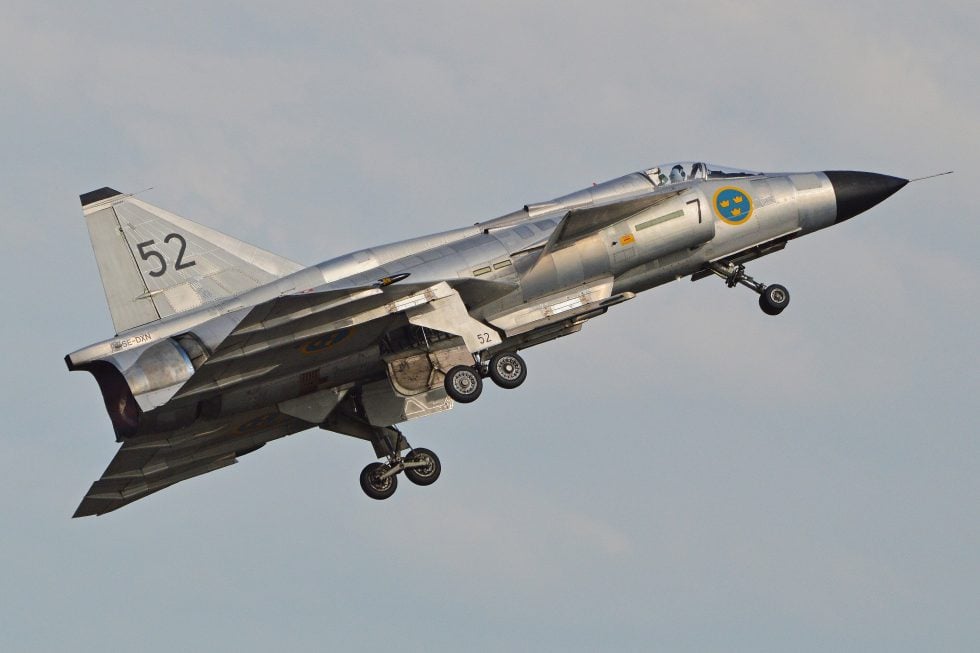
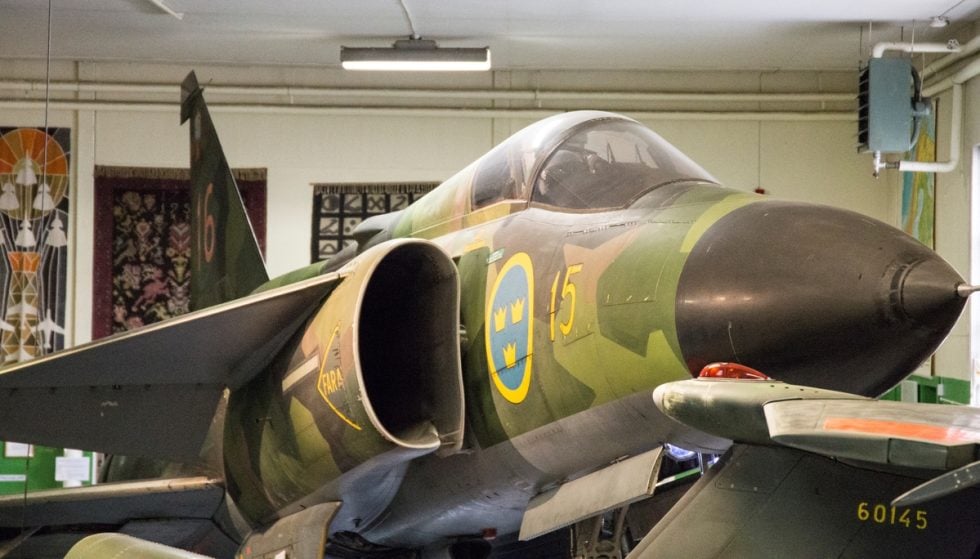
Disposition: the Viggen was withdrawn in stages. The AJ, SF and SH marks were largely retired from 1998 as the AJS-standard rebuilds concentrated the survivors, the SK 37 left the training role in 2003, the last front-line Viggen — a JA 37Di of F 21 at Luleå — was formally retired on 25 November 2005, and the SK 37E electronic-warfare aircraft soldiered on until 2007, the final Viggen flight being a test sortie on 26 June 2007. No Viggen was ever sold abroad, so every survivor is a Swedish airframe and there are no reproductions of any kind: the type is too recent and too complicated to fake. Something over forty complete airframes survive, the great majority in Sweden — the Flygvapenmuseum at Linköping holds examples of most marks, and others stand at former wing bases, at Aeroseum outside Gothenburg and at technical schools — with a scattering in museums elsewhere in Europe and a handful in North America. Two are kept in flying condition, both civil-registered and operated by the Swedish Air Force Historic Flight from Såtenäs: the AJS 37 SE-DXN (airframe 37098, coded F 7–52), returned to the air on 27 March 2012, and the SK 37E SE-DXO (37809, F 15–61), flown again on 15 May 2018. SE-DXN remains the world’s only airworthy single-seat Viggen and is still flying the European display circuit — it is billed for shows in 2026 — which makes the Viggen one of the very few Cold War supersonic fighters a member of the public can still watch reverse its own thrust onto a runway. Survivor counts for recently retired jets move as airframes are scrapped, gate-guarded or traded, so the figure above is an order of magnitude rather than a census.
From System 37 to the last Thunderbolt
System 37 approved
After years of concept studies, the Swedish government green-lights Aircraft System 37 to replace the Lansen and Draken.
First flight
The prototype flies on 8 February, piloted by Erik Dahlström — the first canard-delta jet headed for mass production.
Enters service
The AJ 37 attack version joins the Swedish Air Force on 21 June, built around the road-base doctrine.
The JA 37 interceptor
The dedicated air-defence Viggen enters service with a new pulse-Doppler radar and a 30 mm Oerlikon KCA cannon.
Hunting the Blackbird
JA 37 pilots repeatedly achieve radar — and reportedly missile — lock on SR-71s crossing the Baltic.
Escorting a crippled SR-71
Viggens shepherd a stricken Blackbird to safety over the Baltic; the Swedish pilots are decorated by the US decades later.
The final upgrades
Surviving airframes are rebuilt as AJS 37 and JA 37D with new avionics and missiles, extending their careers.
Retirement
The last front-line Viggen stands down on 25 November 2005; a handful of SK 37E trainers soldier on to 2007.
From the cockpit: twelve Viggen stories
A jet designed around a highway
Almost every feature of the Viggen exists to let it fight from dispersed road bases.
Read the full story
The only jet to lock the SR-71
Swedish JA 37 pilots are the only ones credited with an acknowledged radar lock on the SR-71 Blackbird.
Read the full story
Escorting a crippled Blackbird
When an SR-71 lost an engine over the Baltic, Viggens closed in — not to attack, but to protect it.
Read the full story
Stopping on a road
A pre-armed thrust reverser let the Viggen brake to a halt in a few hundred metres.
Read the full story
An airliner engine at Mach 2
The Volvo RM8 began life as the Pratt & Whitney JT8D that powered the Boeing 727 and DC-9.
Read the full story
A computer ahead of its time
The CK 37 was among the first airborne computers built with integrated circuits.
Read the full story
Why the Viggen looks like that
The distinctive foreplane wasn’t for dogfighting agility — it was for landing slowly and safely.
Read the full story
Rearmed in minutes by conscripts
A small team of national-service teenagers could turn a Viggen around on a forest road.
Read the full story
The JA 37 and its 30 mm gun
The dedicated fighter Viggen carried one of the hardest-hitting cannon of its generation.
Read the full story
Eyes over the Baltic
Dedicated SF 37 and SH 37 Viggens gave Sweden its own strategic and maritime reconnaissance.
Read the full story
The two-seat SK 37
A handful of twin-seat Viggens checked out new pilots — and later flew as jammers.
Read the full story
From Viggen to Gripen
The Viggen’s road-base philosophy lives on in the smaller, cheaper Saab Gripen.
Read the full story
The Viggen in pictures
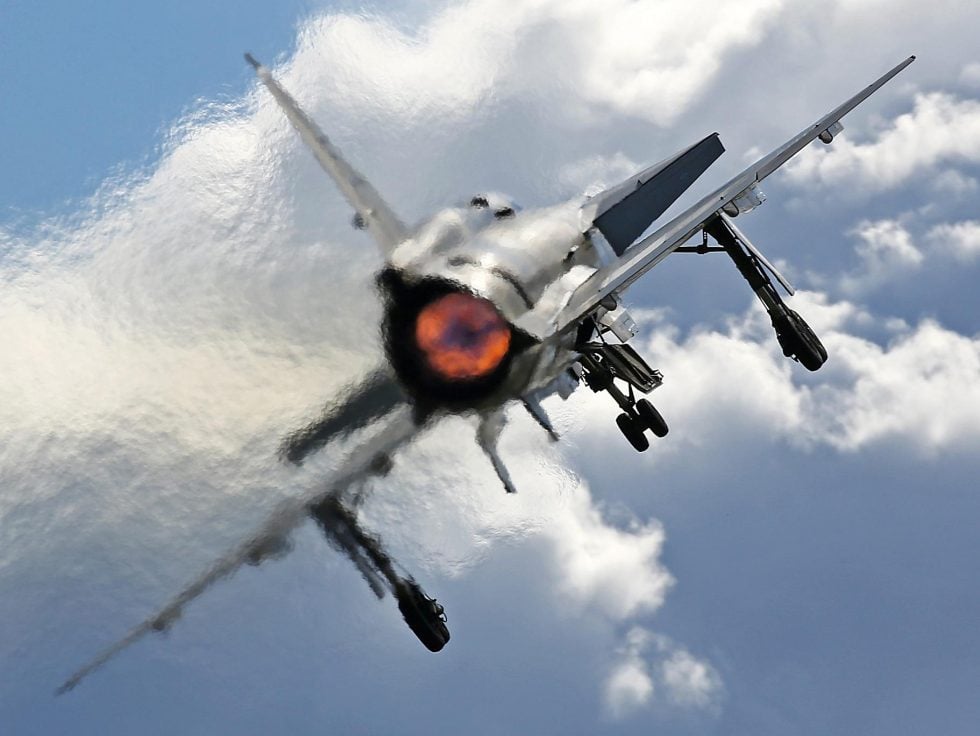
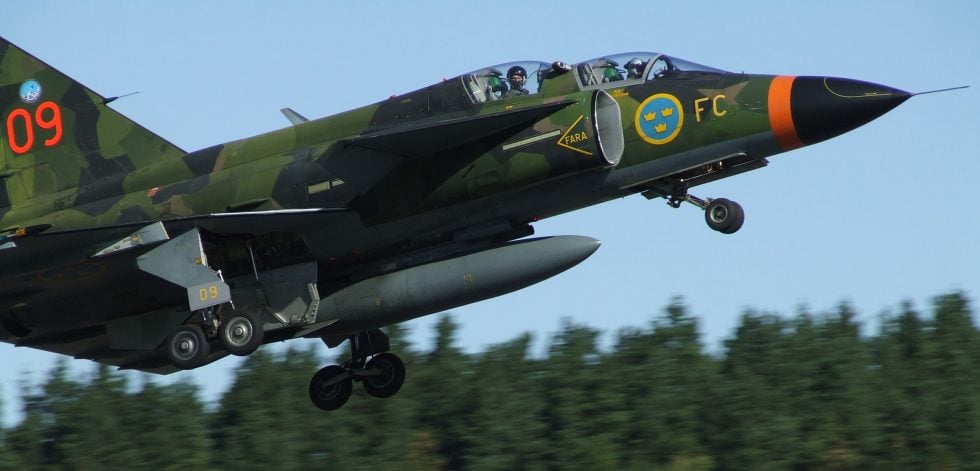
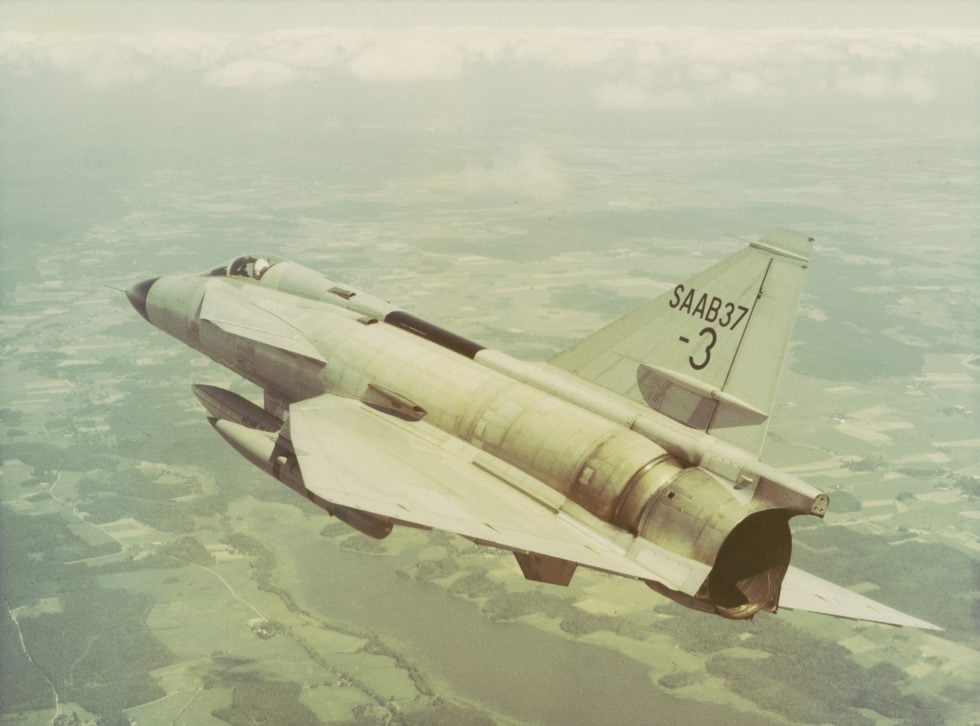
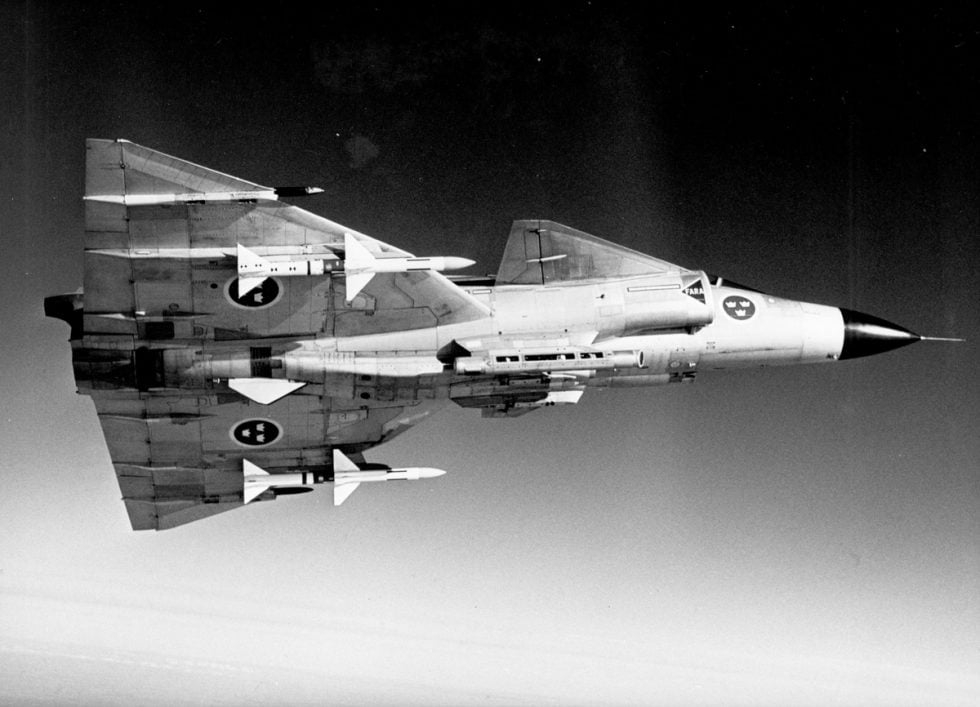
The Viggen in motion
A dedicated Saab 37 Viggen video feature is coming soon. In the meantime, explore the stories, specifications and photo gallery above — and see where the Viggen served on the operations map below.
The Viggen in motion
DroneScapes — one of the most-watched Viggen films on YouTube.
Where the Viggen served
The record that defines it
The Viggen never fired a weapon in anger. In three decades of service, neutral Sweden never went to war, and no Viggen ever scored — or suffered — an air-to-air kill. Its reputation rests instead on deterrence, dispersal and one extraordinary Cold War achievement: intercepting the fastest aircraft in the world.
Compare the combat record of every military aircraft. Figures as of July 2026.
Everything people ask about the Saab 37 Viggen
Can I fly in a Viggen?
Why was the Viggen designed to land on roads?
Did a Viggen really lock onto an SR-71 Blackbird?
How fast is the Saab 37 Viggen?
What is the thrust reverser for?
Why did only Sweden operate the Viggen?
Did the Viggen ever see combat?
What replaced the Viggen?
You can’t fly the Viggen.
These, you can.
Some legends only live in museums — others are fuelled and waiting. MiGFlug has put civilians in real military jet cockpits since 2004.
 Fly the L-39 AlbatrosThe world’s most-flown jet trainer — aerobatics included
 Fly the F-104 Starfighter“The missile with a man in it”
 Fly the MiG-21The Cold War’s most-produced jet
 Fly the T-33 Shooting StarAmerica’s first jet trainer
 Fly the DH VampireA piece of early jet history
 Fly the S.211Agile Italian jet trainer
 Fly the MB-326The classic Aermacchi jet
 Fly the MiG-15The Soviet legend of the Korean War
Continue the tour
Every fact, checked
- The Aviation Geek Club — Viggen vs BlackbirdHow JA 37 pilots achieved radar lock on the SR-71, with pilot accounts and intercept tactics.
- 19FortyFive — The Only Jet To Catch the SR-71Overview of the Viggen’s SR-71 intercepts and the 1987 escort of a crippled Blackbird.
- The National Interest — Viggen and the BlackbirdThe reported missile lock on the SR-71 and the Viggen’s interceptor development.
- National Security Journal — JA-37 ViggenAnalysis of the JA 37 interceptor and its Baltic radar-lock achievement.
- Saab — company historyManufacturer background on the System 37 programme and the Viggen family.
- Swedish Air Force Museum (Flygvapenmuseum)Reference for preserved Viggen airframes, variants and Swedish air-power history.
- Hush-KitPilot interviews and analysis of flying and fighting the Viggen.
- The AviationistCoverage of the SR-71 Baltic intercepts and the 2018 US Air Medals for the Swedish pilots.