
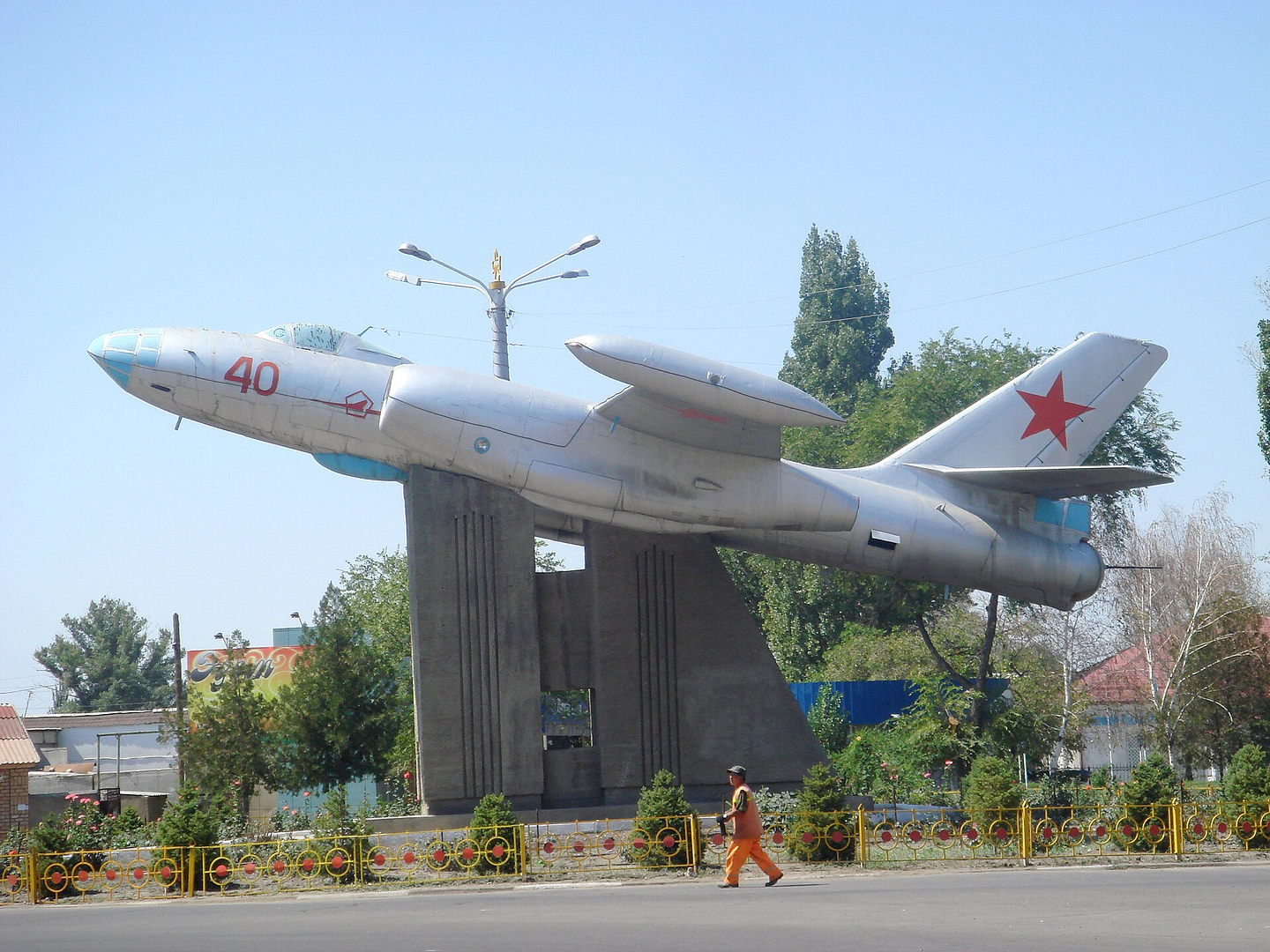
Ilyushin Il-28
“Beagle”
The Soviet Union’s first mass-produced jet bomber — a simple, rugged straight-winged aircraft built in thousands, licence-rebuilt in China as the Harbin H-5, and exported to air forces across three continents.
The Soviet Union’s first mass-produced jet bomber
In the years after 1945 the Soviet Air Force needed to replace its piston-engine tactical bombers, above all the wartime Tupolev Tu-2, with something built around the new jet engine. The task fell to the Ilyushin design bureau (OKB-240) under Sergei Ilyushin. Its answer was deliberately conservative: a clean, straight-winged aircraft with two engines slung in underwing nacelles, a glazed nose for the navigator and a defended tail. The prototype first flew on 8 July 1948, and the type entered Soviet service around 1950 as the Il-28 — the first jet bomber to reach the Soviet bomber regiments in quantity.
The engines mattered as much as the airframe. The Il-28 was powered by two Klimov VK-1 centrifugal turbojets, a Soviet development of the British Rolls-Royce Nene, samples of which Britain had sold to the USSR in 1946–47. Reliable and well understood, the VK-1 gave the bomber a top speed of roughly 900 km/h without the risks of unproven swept-wing research. Combined with a robust, bolt-together airframe that was easy to build and to repair in the field, this made the Il-28 cheap to mass-produce — commonly cited figures put Soviet output at more than 6,000 aircraft, with several thousand more of the Chinese version.
That simplicity turned the Beagle, as NATO named it, into one of the most widely exported bombers of the early Cold War. It served across the Warsaw Pact — from Poland and Czechoslovakia to Romania and Bulgaria — and was supplied to the Middle East, Asia and Africa. Egypt used it in the 1956 Suez Crisis and again in 1967, when many were destroyed on the ground; a handful fought in the Nigerian civil war over Biafra; and in China the design was reverse-engineered and re-produced as the Harbin H-5, keeping the basic aircraft in service and in export markets for decades. Nuclear-capable Il-28s shipped to Cuba even became a sticking point in the 1962 Cuban Missile Crisis, when the United States insisted they be withdrawn alongside the ballistic missiles.
01The Ilyushin Il-28’s British heart: how a Rolls-Royce Nene ended up in a Soviet bomber
In 1946–47 the British government approved the export of a small number of Rolls-Royce Nene and Derwent centrifugal-flow jet engines to the Soviet Union — a decision later regarded in Britain as a serious strategic misjudgement. Soviet engineers under Vladimir Klimov reverse-engineered the Nene as the RD-45 and then developed it into the improved VK-1. That engine powered both the MiG-15 fighter and the Il-28 bomber, giving the early Soviet jet fleet a proven, reliable powerplant far sooner than domestic development alone would have allowed.
For the Il-28 the choice was pragmatic. A centrifugal engine was bulkier than the axial designs that would follow, but it was rugged, well understood and easy to build in numbers — exactly the qualities Ilyushin wanted in a bomber meant for mass production and hard field service. The Chinese H-5 later used a locally built VK-1 derivative, the WP-5.
What makes it special
A straight wing and two Nene-derived engines
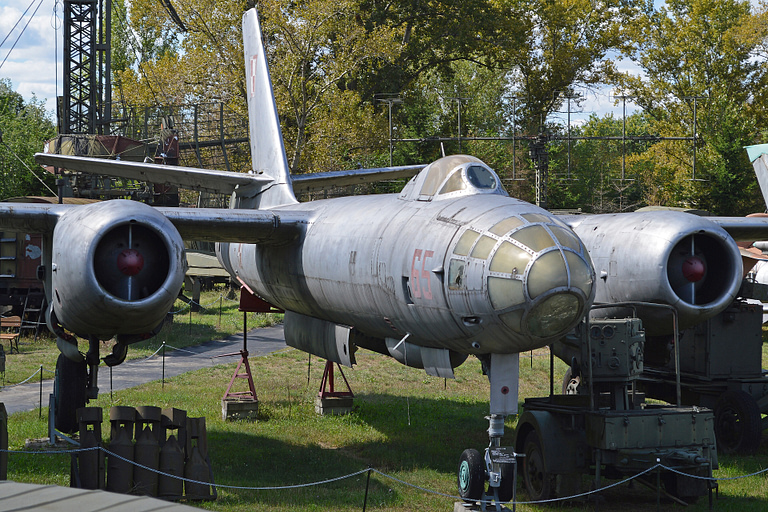
Rather than gamble on the swept wings then being explored, Ilyushin gave the Il-28 a simple unswept high-mounted wing and two Klimov VK-1 centrifugal turbojets — each about 26.5 kN (5,950 lbf) — in large underwing nacelles. The layout was conservative but dependable, delivering near-transonic speed with engines that were easy to build, maintain and overhaul in the field.
A glazed nose and pressurised crew stations
The three-man crew sat in pressurised compartments: the pilot under a fighter-style canopy, the navigator/bombardier in a fully glazed nose with an optical bombsight, and the radio operator/gunner in the tail. Pilot and navigator had ejection seats — an advanced survivability feature for a design of the late 1940s.
A powered tail turret for self-defence
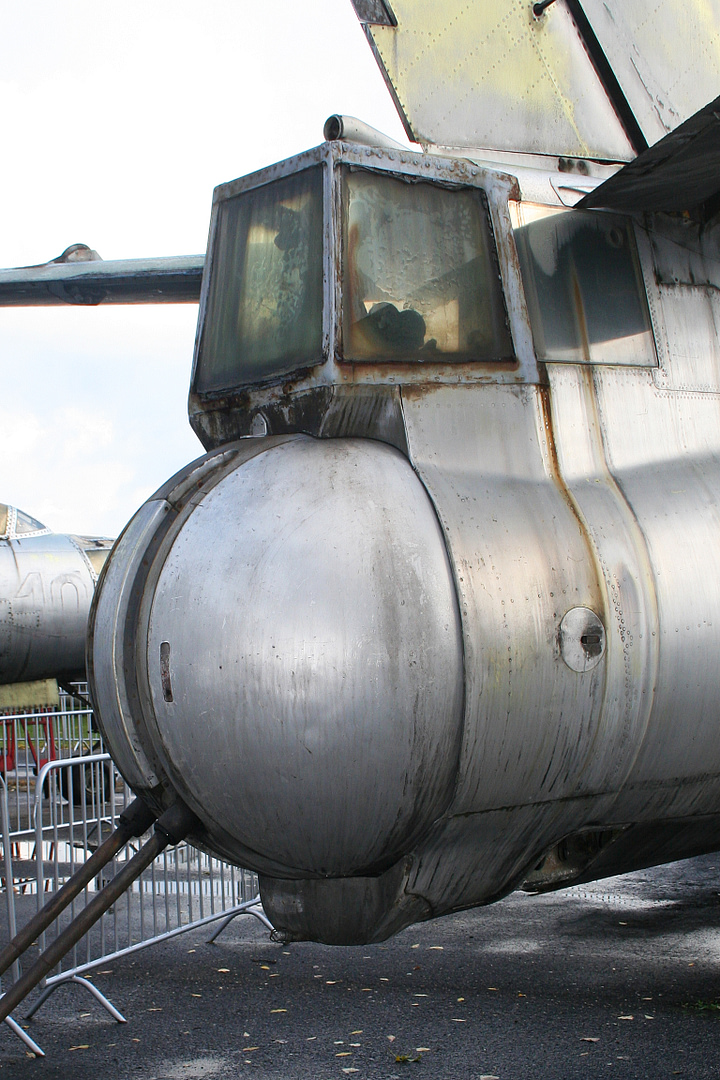
Unusually for a tactical bomber, the Il-28 carried a powered tail turret — commonly designated Il-K6 — with two 23 mm cannon giving all-aspect rearward defensive fire, plus two fixed forward-firing 23 mm guns. Combined with a modular, bolt-together airframe built for mass production, it made the Beagle both defensible and exportable.
02The Il-28 Beagle’s crew layout: the glazed nose, the ejection seats and the lone tail gunner
The Il-28 was flown by a crew of three, split between separate pressurised sections. Up front the pilot sat beneath a bubble canopy with an armoured windscreen. Ahead and below him, in the fully glazed nose, the navigator doubled as bombardier, aiming through an optical sight. Both men had ejection seats. The third crewman, in the tail, operated the radio and the defensive gun turret — but had no ejection seat, relying instead on an escape hatch. The arrangement reflected the aircraft’s late-1940s origins: modern enough to protect the two forward crew with ejection seats, yet leaving the gunner in the older position of the wartime bomber.
03The Il-28 Beagle’s bolt-together airframe: why simplicity made it a global bomber
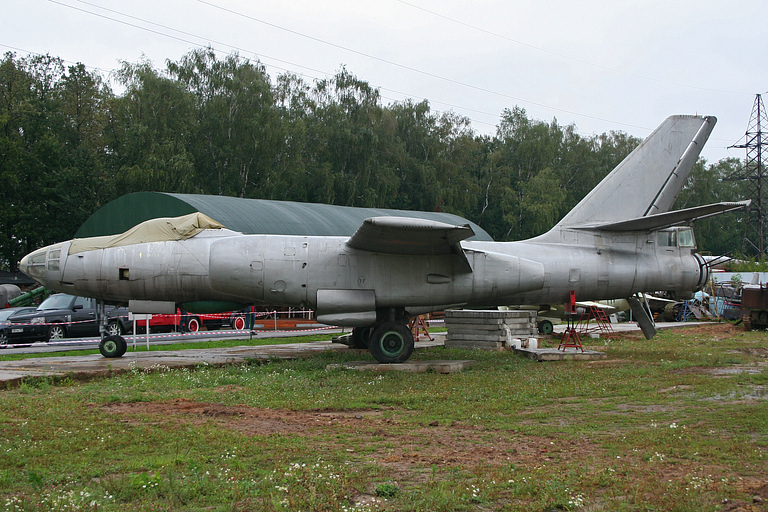
Much of the Il-28’s long career comes down to how it was built. The airframe was designed for straightforward mass production, assembled from sections that bolted together, with systems that were simple to service. That made it cheap to build in Soviet factories and, just as importantly, easy to keep flying in less-industrialised air forces with limited maintenance infrastructure. The same qualities let China re-derive the design as the Harbin H-5 and keep it in production and service long after Soviet output ended. It is a clear example of an aircraft whose ruggedness and simplicity, rather than raw performance, defined its place in history.
Full specifications
Figures are for the standard Soviet-built Il-28 bomber. Sources vary on weights and production totals; contested values are hedged below. The Chinese Harbin H-5 differed in detail (revised structure, WP-5 engines, a different tail turret).
Airframe & Performance
- Экипаж
- 3 (pilot, navigator/bombardier, tail gunner)
- Длина
- 17.65 m (57 ft 11 in)
- Размах крыльев
- 21.45 m (70 ft 4 in)
- Высота
- 6.7 m (22 ft)
- Зона крыла
- ~60.8 m² (654 sq ft)
- Max takeoff weight
- ~21,200 kg; some sources up to ~23,200 kg
- Max speed
- ~900 km/h (~560 mph) at altitude
- Служебный потолок
- ~12,300 m (~40,400 ft)
- Диапазон
- ~2,180 km (~1,350 mi)
Propulsion, Armament & Cost
- Engines
- 2 × Klimov VK-1 centrifugal turbojets
- Thrust (each)
- ~26.5 kN (~5,950 lbf)
- Bomb load
- ~1,000 kg typical, ~3,000 kg maximum
- Defensive guns
- Tail turret (Il-K6) with 2 × 23 mm; 2 fixed forward 23 mm
- First flight
- 8 July 1948
- Built
- ~6,000+ in the USSR (6,600+ incl. Chinese H-5)
- Chinese version
- Harbin H-5 (from ~1967)
- Cost per flight hour
- Not publicly documented (Soviet-era programme)
04The Ilyushin Il-28’s cost and production: why a simple bomber was built in the thousands
Unlike Western aircraft, the Il-28 has no reliable published unit price or cost-per-flight-hour — Soviet programme economics were not disclosed and any dollar figure would be a guess. What is clear is that the design was optimised for cheap mass production. Commonly cited figures put Soviet output at more than 6,000 aircraft, with the Chinese Harbin H-5 adding several hundred to well over a thousand more depending on the source. That scale, rather than any single flyaway cost, is the meaningful economic fact: the Il-28 was affordable enough to equip the Soviet Air Force and a long list of client states, and simple enough to keep flying for decades. Treat all production totals as approximate; sources differ.
From Tu-2 replacement to Cold War export
Requirement issued
The Soviet Air Force calls for a jet bomber to replace the piston-engine Tupolev Tu-2; Ilyushin’s OKB-240 begins design work.
First flight
The prototype makes its maiden flight on 8 July 1948, initially powered by imported Rolls-Royce Nene engines.
Enters service
The Il-28 reaches Soviet bomber regiments — the first jet bomber in widespread Soviet service — alongside trainer (Il-28U) and reconnaissance (Il-28R) variants.
Suez Crisis
Egyptian Il-28s are among the targets struck on the ground during the 1956 Suez Crisis.
Cuban Missile Crisis
Nuclear-capable Il-28s shipped to Cuba become a sticking point; the US demands their removal alongside the missiles, and they are withdrawn by late 1962.
Six-Day War & Biafra
Many Egyptian and Syrian Il-28s are destroyed on the ground in the opening Israeli strikes; the same year, a few Il-28s enter the Nigerian civil war over Biafra.
Harbin H-5 in production
China begins series production of its re-derived version, the Harbin H-5, keeping the design in service and export long after Soviet output ends.
Retired from Soviet first line
The Il-28 is withdrawn from front-line Soviet units, though many serve on in export air forces and in secondary roles.
Long afterlife
Romania retires its fleet around 2001; North Korea is still commonly listed as an operator decades later, making the Beagle one of the longest-serving early jet bombers.
Twelve Il-28 Beagle stories
The bomber that jetted the Soviet Air Force
Built to replace the piston Tu-2, the Il-28 became the USSR’s first mass jet bomber.
Read the full story
A British engine at its core
The Il-28’s Klimov VK-1 engines descended from the Rolls-Royce Nene sold to the USSR in 1946–47.
Read the full story
The navigator’s greenhouse
The Il-28’s fully glazed nose gave the navigator/bombardier a panoramic aiming position.
Read the full story
The lone crewman facing backwards
The Il-28 kept a manned tail turret with twin 23 mm cannon for self-defence.
Read the full story
A flashpoint in the missile crisis
Nuclear-capable Il-28s in Cuba became a sticking point the US demanded be resolved.
Read the full story
China rebuilds the Beagle
After the Sino-Soviet split, China re-derived the Il-28 as the Harbin H-5.
Read the full story
A handful over a civil war
A small number of Il-28s flew in the Nigerian civil war over Biafra, 1967–70.
Read the full story
Caught on the ground
Many Egyptian Il-28s were destroyed on the ground in the first hours of the Six-Day War.
Read the full story
The living fossil
North Korea is still commonly listed as an Il-28/H-5 operator in the 21st century.
Read the full story
Recon, trainer and torpedo Beagles
The Il-28 spawned reconnaissance, training and naval torpedo versions.
Read the full story
The Beagle that sampled the air
Finland flew a handful of Il-28s on survey and air-sampling duties into the 1980s.
Read the full story
Simplicity as a superpower
The Il-28’s ruggedness, not its speed, made it one of the most widely exported bombers.
Read the full story
The Beagle in pictures
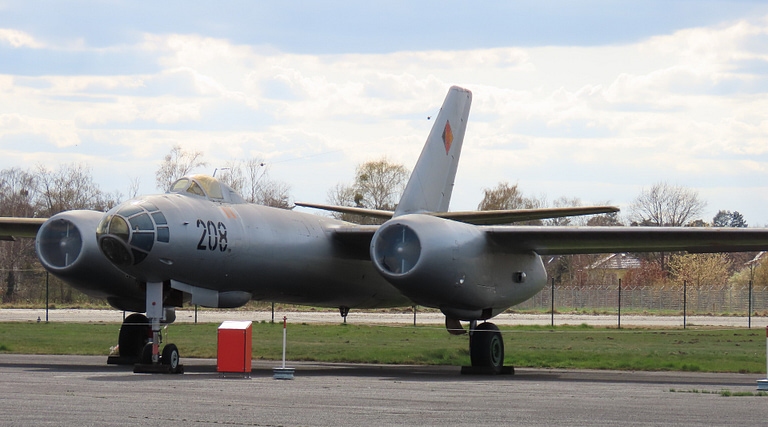
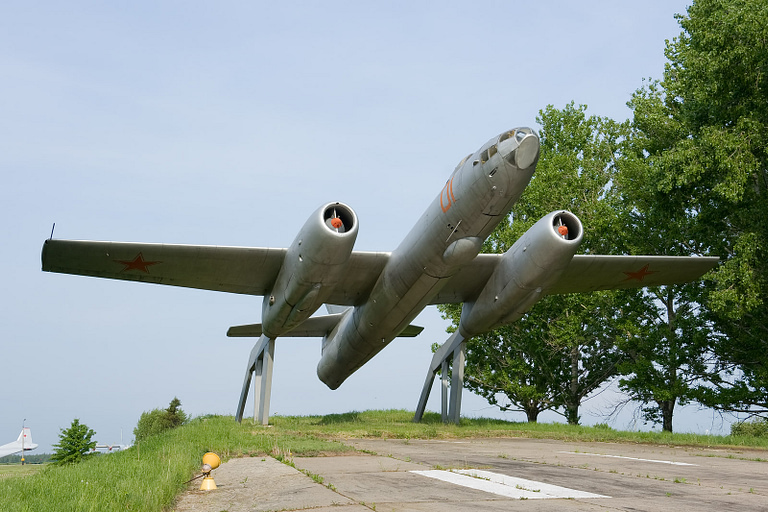
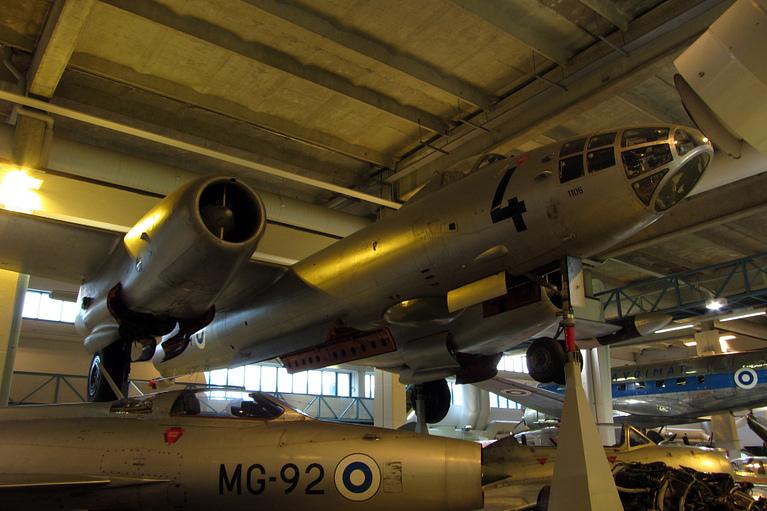
The Il-28 Beagle in motion
A curated video feature for the Il-28 Beagle is coming soon. In the meantime, explore the photo gallery above and the operations map below.
Where the Il-28 flew
The record that defines it
The Il-28 is a bomber, not a fighter, and its record is measured in service and export rather than aerial victories. It saw combat with several operators: Египет used it in the 1956 Suez Crisis, the North Yemen civil war and the 1967 Six-Day War — in which many Egyptian and Syrian Il-28s were destroyed on the ground; a small number flew for the Federal side in the Nigerian civil war over Biafra; and it served with North Korea, Afghanistan and others. Its most famous moment was political rather than tactical: nuclear-capable Il-28s in Куба became a sticking point in the 1962 missile crisis. Figures for losses and sorties are contested and should be treated as approximate.
Compare the combat record of every military aircraft. Figures as of July 2026.
Everything people ask about the Il-28 Beagle
Can I fly in an Il-28?
What was the Ilyushin Il-28?
What is the difference between the Il-28 and the Harbin H-5?
Why were Il-28s part of the Cuban Missile Crisis?
How many Il-28s were built?
Who used the Il-28 in combat?
Is the Il-28 still in service?
You can’t fly the Il-28.
These, you can.
Some legends only live in museums — others are fuelled and waiting. MiGFlug has put civilians in real military jet cockpits since 2004.
 Fly the L-39 AlbatrosThe world’s most-flown jet trainer — aerobatics included
 Fly the F-104 Starfighter“The missile with a man in it”
 Fly the MiG-21The Cold War’s most-produced jet
 Управляйте самолетом T-33 Shooting Star.America’s first jet trainer
 Fly the DH VampireA piece of early jet history
 Fly the S.211Agile Italian jet trainer
 Fly the MB-326The classic Aermacchi jet
 Fly the MiG-15The Soviet legend of the Korean War
Continue the tour
Every fact, checked
- The Aviationist — Ilyushin Il-28 BeagleOverview of the first Soviet jet bomber, its VK-1/Nene engines and construction.
- Federation of American Scientists — Il-28First jet bomber in Soviet service; production scale and Cuba/Middle East notes.
- MilitaryFactory — Ilyushin Il-28Dimensions, weights, performance and armament figures.
- GlobalSecurity.org — Harbin H-5Chinese H-5 production timeline and how it differed from the Il-28.
- Skytamer — Harbin H-5H-5 variants, export operators and design differences.
- Finnish Air Force Museum — Ilyushin Il-28RFinland’s four Il-28s, 1960–1981, and their reconnaissance/survey role.
- Arms Control Association — The Cuban Missile CrisisThe US demand to remove the Il-28s as offensive weapons in 1962.
- National Security Archive — Cuban Missile CrisisDocumentary record of the Il-28 withdrawal negotiations, late 1962.