
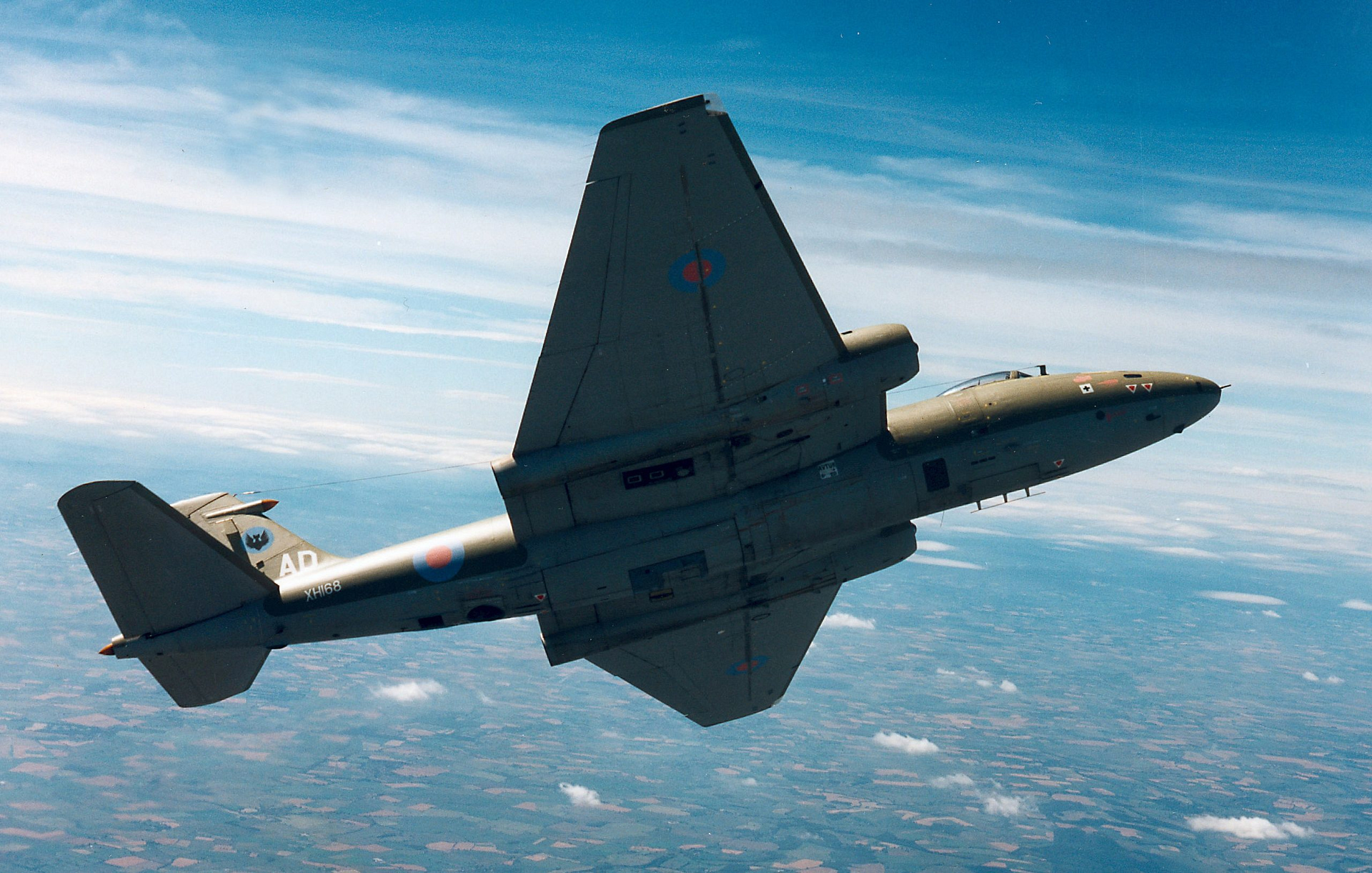
English Electric Canberra
The bomber that refused to retire
Britain’s first jet bomber — a simple, broad-winged machine built to fly higher than any fighter could reach. It set world altitude records, was licence-built in America as the Martin B-57, and in NASA’s hands is still flying today, more than 75 years after its first flight.
Simple, high, and impossible to kill off
In 1944 the Air Ministry wanted a jet successor to the wooden de Havilland Mosquito — a fast, unarmed bomber that would survive by flying too high and too fast to be caught. The job went to a young English Electric team led by W. E. W. “Teddy” Petter, and the aircraft that emerged, first flown on 13 May 1949, was almost shocking in its simplicity: a broad, low-loaded straight wing, a fat fuselage, and two Rolls-Royce Avon turbojets. No swept wing, no gun turrets, no complexity for its own sake.
That plain recipe worked brilliantly. The Canberra could cruise above 48,000 ft — higher than the fighters sent to intercept it — and it climbed and turned better up there than almost anything of its era. It entered RAF service in 1951 as Britain’s first jet bomber, set a string of world altitude records through the 1950s, and became one of the great export successes in British aviation history: licence-built in the United States as the Martin B-57 and in Australia, and flown by well over a dozen air forces.
Its real trick, though, was longevity. The airframe was so adaptable — bomber, photo-reconnaissance, interdictor, trainer, target-tug, high-altitude testbed — that operators simply refused to give it up. The RAF flew its last Canberras in 2006; India retired hers in 2007. And NASA’s WB-57s are still flying scientific missions in the 2020s, making the Canberra one of the longest-serving jet designs ever built.
01Why the Canberra could fly higher than the fighters chasing it
The Canberra’s secret was its wing. Petter’s team gave it an unusually large, thick, low-aspect straight wing — a big lifting surface carrying a relatively light aircraft. That low wing-loading meant the Canberra kept generating lift in the thin air of the high stratosphere, where sharper-winged jet fighters ran out of performance and mushed into a stall. Combined with two efficient Avon engines, it could operate above 48,000 ft and, in specialised forms, far higher.
For most of the early 1950s that put it out of practical reach: interceptors that could match its altitude couldn’t manoeuvre once they got there. The trade-off was speed — the straight wing capped the Canberra at around Mach 0.88, firmly subsonic — but for a bomber meant to slip over a target and leave, altitude mattered more than raw speed. It is the same logic that later produced the Canberra-derived, and even higher-flying, reconnaissance aircraft.
What makes the Canberra special
A big straight wing built for the stratosphere
The Canberra’s defining feature is its broad, low-loaded straight wing paired with two Rolls-Royce Avon turbojets. Where fighters used thin swept wings for speed, the Canberra used a large wing area to keep flying in thin air — giving it a service ceiling around 48,000 ft and, in record-setting forms with uprated engines, well over 60,000 ft. For years it simply flew above the threat.
One airframe, endless jobs
Unarmed and aerodynamically honest, the Canberra proved extraordinarily adaptable. It served as a level bomber, low-level interdictor, photo-reconnaissance platform with up to seven cameras, dual-control trainer, target-tug, radar calibrator and high-altitude testbed. Some 27 variants were built, which is a large part of why so many air forces bought it and kept it.
Longevity — and a second life in research
The Canberra’s clean high-altitude airframe made it perfect for science. NASA operates a small fleet of WB-57 high-altitude research aircraft — direct descendants of the Martin-built Canberra — still flying atmospheric sampling, sensor testing and spacecraft re-entry tracking in the 2020s, more than seven decades after the type first flew.
02The Canberra and the Martin B-57: an American Canberra
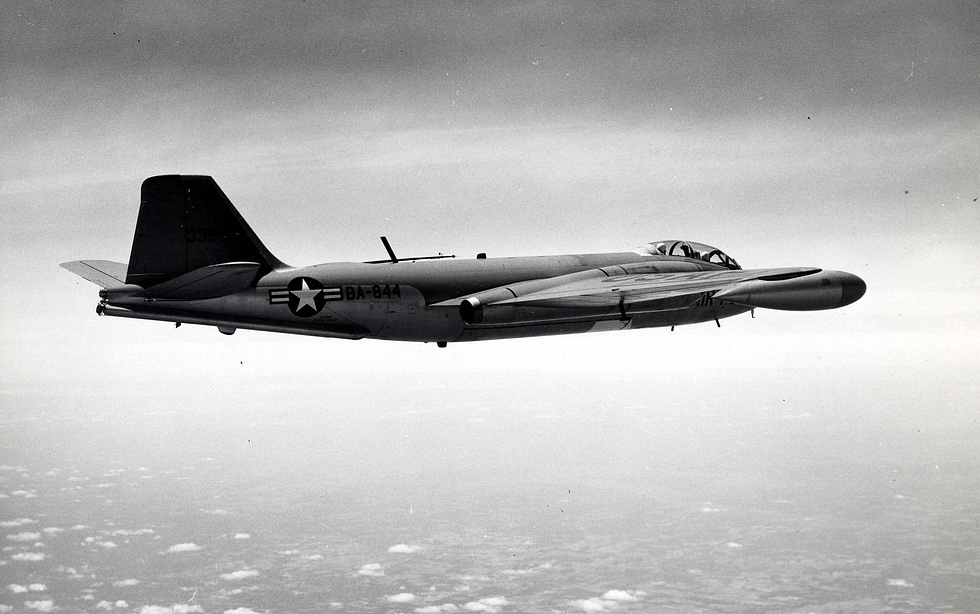
When the US Air Force needed a fast tactical bomber in the early 1950s and its own designs disappointed, it did something almost unheard of: it licensed a British aircraft. The Glenn L. Martin Company built the Canberra as the B-57, and though early examples were near-identical, later versions diverged sharply — a redesigned cockpit, rotary bomb door, and eventually the enormous long-span RB-57F/WB-57 high-altitude variants. Around 403 B-57s were built in the United States. They fought over Vietnam, and it is the WB-57 line that keeps the Canberra family airborne with NASA today.
03Record after record: how the Canberra kept climbing
Through the 1950s the Canberra rewrote the altitude tables. On 4 May 1953 a Canberra fitted with Bristol Olympus engines reached about 63,668 ft; on 29 August 1955 another set a record near 65,889 ft. The peak came on 28 August 1957, when a Canberra using a Napier Double Scorpion rocket motor in addition to its jets zoom-climbed to 70,310 ft (21,430 m) — a world altitude record at the time. These flights showed just how much altitude the basic airframe had in reserve.
Full specifications
Airframe & Performance
- Экипаж
- 2–3 (pilot, navigator, bomb-aimer)
- Длина
- 19.96 m (B.2)
- Размах крыльев
- 19.51 m
- Высота
- 4,77 м
- Max takeoff weight
- ~24,900 kg
- Max speed
- ~870 km/h · ~Mach 0.88
- Служебный потолок
- ~14,600 m (48,000 ft)
- Record altitude
- 21,430 m (70,310 ft, 1957)
- Диапазон
- ~4,300 km (ferry)
Propulsion & Systems
- Engines
- 2 × Rolls-Royce Avon turbojets
- Thrust (each)
- ~29 kN (~6,500 lbf), early marks
- Вооружение
- Up to ~2,700 kg bombs; cannon/rockets on interdictor marks
- Sensors (recon)
- Up to 7 cameras (PR variants)
- First flight
- 13 May 1949
- Built
- ~1,350 (UK, US B-57, Australia)
- Unit cost
- No reliable open figure
- Cost per flight hour
- No reliable public figure
04What did a Canberra cost — and why the numbers are fuzzy
The Canberra was a 1950s state-era product sold across many countries in wildly different deals, so no single trustworthy flyaway price exists in open sources, and cost-per-flight-hour figures for the type are not reliably published either. What is well documented is the production spread: roughly 900 built in Britain, about 403 as the Martin B-57 in the United States, and 48 licence-built in Australia — on the order of 1,350 aircraft in total. Any precise dollar figure attached to a Canberra should be treated as an estimate.
From Mosquito replacement to museum — and still flying
First flight
Prototype VN799, flown by Roland Beamont, takes to the air on 13 May — Britain’s first jet bomber design.
Enters RAF service
No. 101 Squadron receives the Canberra B.2 in May, replacing piston bombers with a jet that outclimbs its own escorts.
Altitude records
A run of world altitude records culminates in a rocket-boosted climb to 70,310 ft on 28 August 1957.
Suez & the Malayan jungle
RAF Canberras bomb Egyptian airfields during the Suez crisis; the type had already flown its first combat in the Malayan Emergency.
First SAM kill
A Soviet-supplied SA-2 downs a Taiwanese RB-57D over China on 7 October — the first aircraft ever shot down by a surface-to-air missile.
India’s wars
Indian Air Force Canberras fly bombing and reconnaissance in both Indo-Pakistani wars, including the 1971 raids toward Karachi.
Falklands
Argentine Canberras bomb British positions; one B.62 is shot down by a Sea Dart from HMS Exeter on 13 June, its navigator killed.
Retirement — except NASA
The RAF retires its last PR.9s in 2006 and India in 2007, but NASA’s WB-57s keep flying research missions into the 2020s.
Twelve stories from a 75-year career
The Mosquito’s jet-age heir
The Air Ministry wanted a fast, unarmed bomber that would survive on speed and height alone.
Read the full story
The wing that reached the stratosphere
A big low-loaded straight wing let the Canberra keep flying where fighters stalled.
Read the full story
Rocket-boosted to 70,310 ft
A Canberra with a rocket motor bolted on climbed higher than any aircraft had before.
Read the full story
An American Canberra
The US Air Force did the almost unthinkable and licence-built a British bomber as the Martin B-57.
Read the full story
Bombing from Malta and Cyprus
Around 100 RAF Canberras flew the opening strikes of the 1956 Suez operation.
Read the full story
The first missile kill in history
A Canberra was the first aircraft ever shot down by a surface-to-air missile.
Read the full story
B-57s over the jungle
The American Canberra went to war in Vietnam, joined by Australia’s RAF-built bombers.
Read the full story
India’s long-serving bomber
Indian Canberras fought in 1965 and 1971 and served for fifty years.
Read the full story
Argentina’s Canberras
Argentine Canberras bombed British forces in 1982 — and one fell to a Sea Dart.
Read the full story
Eyes at the edge of the sky
Stripped of bombs and filled with cameras, the PR Canberras flew some of the Cold War’s quietest missions.
Read the full story
The jet that would not retire
From 1951 front-line service to 2020s science flights, the Canberra keeps going.
Read the full story
Britain’s great export bomber
Well over a dozen air forces flew the Canberra; it shaped a generation of jet bombing.
Read the full story
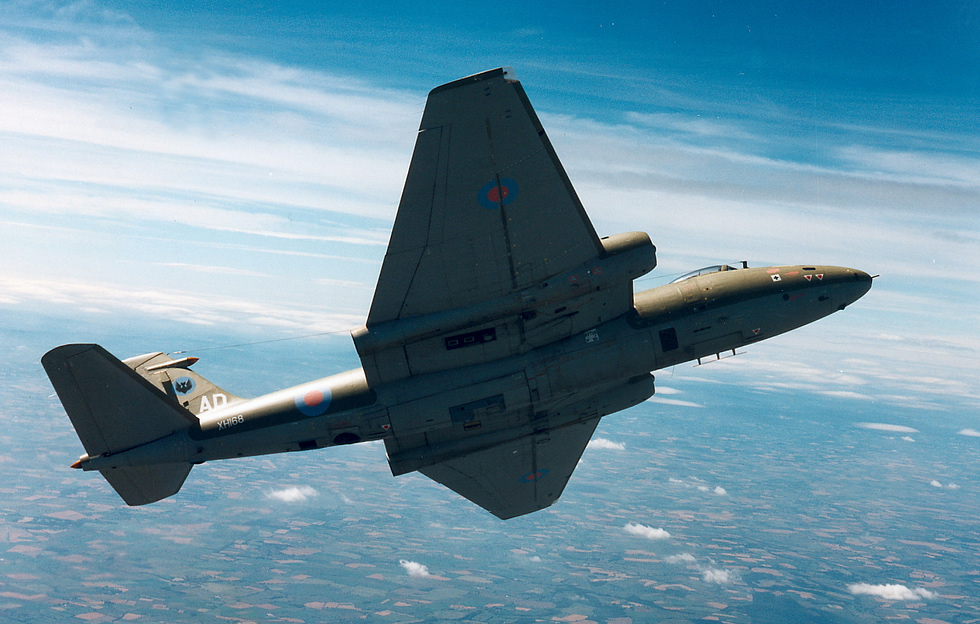
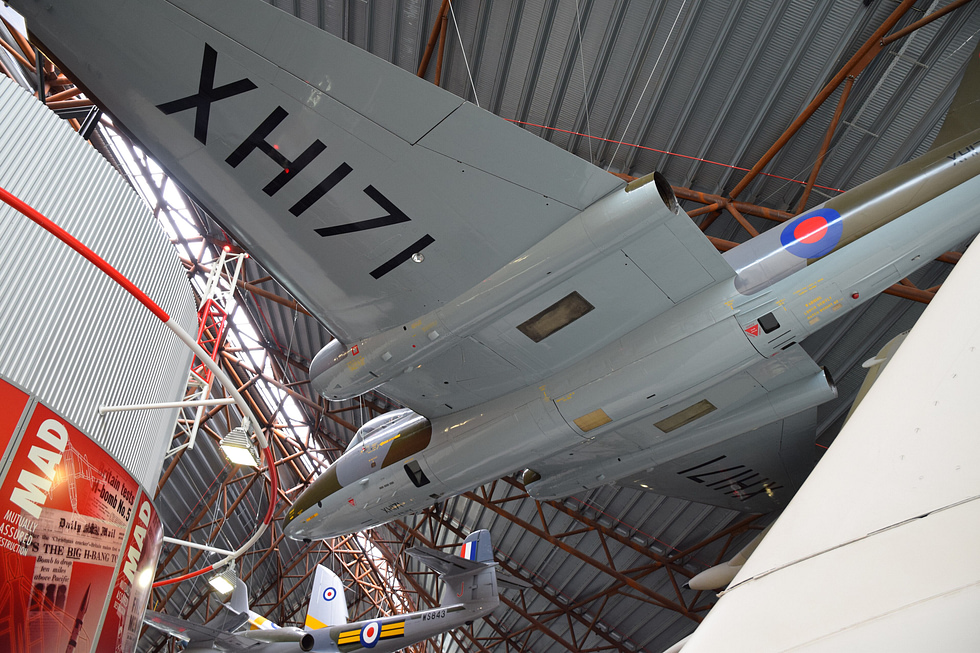
The Canberra in pictures
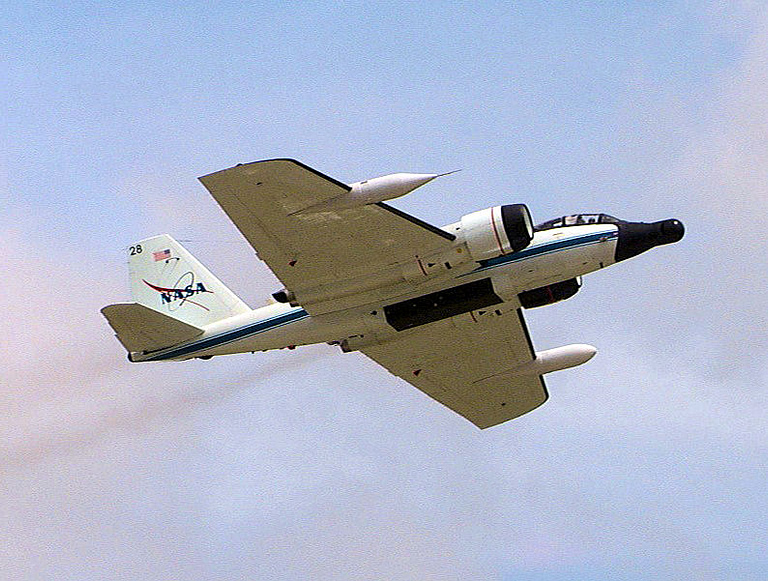
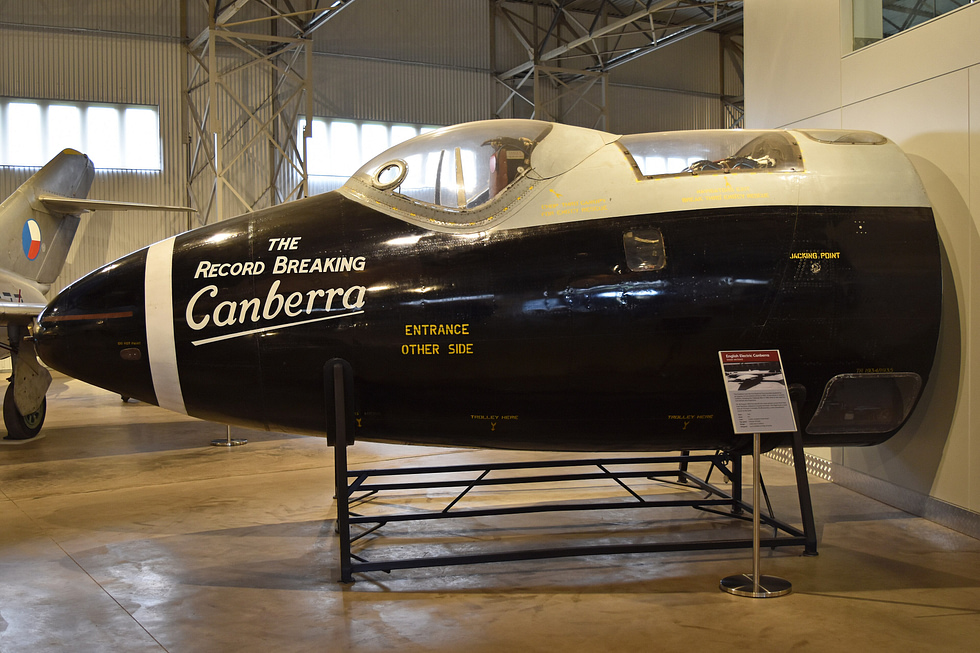
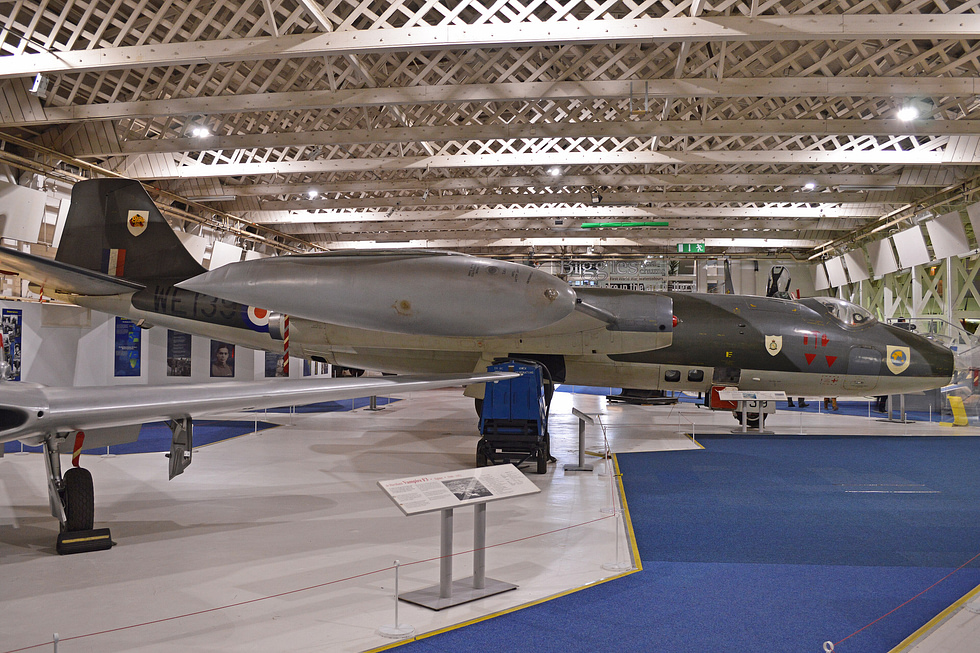
The Canberra in motion
Video coming soon. We’re still choosing the right film to do the Canberra justice — a documentary that captures the altitude records, the global service and the improbable NASA afterlife. Check back shortly.
The Canberra in motion
DroneScapes — one of the most-watched Canberra films on YouTube.
Where the Canberra flew
A bomber that fought on every side of the Cold War
The Canberra almost never fought as a dogfighter — it had no guns for that. Its combat record is written in bombs dropped and photographs taken, over Malaya and Suez, Vietnam, the India–Pakistan wars and the Falklands. It was also, grimly, the first aircraft in history shot down by a guided missile. Figures below are best-available estimates and are contested in places.
Compare the combat record of every military aircraft. Figures as of July 2026.
Everything people ask about the Canberra
Can I fly in a Canberra?
Why was the Canberra so special?
What is the Martin B-57?
Is any Canberra still flying?
How high could a Canberra fly?
Did the Canberra ever get shot down?
Who else flew the Canberra?
You can’t fly the Canberra.
These, you can.
Some legends only live in museums — others are fuelled and waiting. MiGFlug has put civilians in real military jet cockpits since 2004.
 Fly the L-39 AlbatrosThe world’s most-flown jet trainer — aerobatics included
 Fly the F-104 Starfighter“The missile with a man in it”
 Fly the MiG-21The Cold War’s most-produced jet
 Управляйте самолетом T-33 Shooting Star.America’s first jet trainer
 Fly the DH VampireA piece of early jet history
 Fly the S.211Agile Italian jet trainer
 Fly the MB-326The classic Aermacchi jet
 Fly the MiG-15The Soviet legend of the Korean War
Continue the tour
Every fact, checked
- BAE Systems Heritage — English Electric CanberraManufacturer heritage overview: origins, roles and service history.
- Royal Air Force MuseumCanberra variants, RAF service and the 2006 retirement.
- National Museum of the US Air ForceMartin B-57 Canberra history and Vietnam service.
- NASA WB-57 High Altitude Research ProgramThe still-flying WB-57 fleet and its research missions.
- The Aviation Geek Club — first SAM killThe 1959 RB-57D shootdown over China.
- Thunder & Lightnings — Canberra historyDetailed British service history and variant reference.
- FAI records databaseOfficial altitude-record classifications from the 1950s.
- AvBuyer — Britain’s first jet bomberDevelopment background and design analysis.