
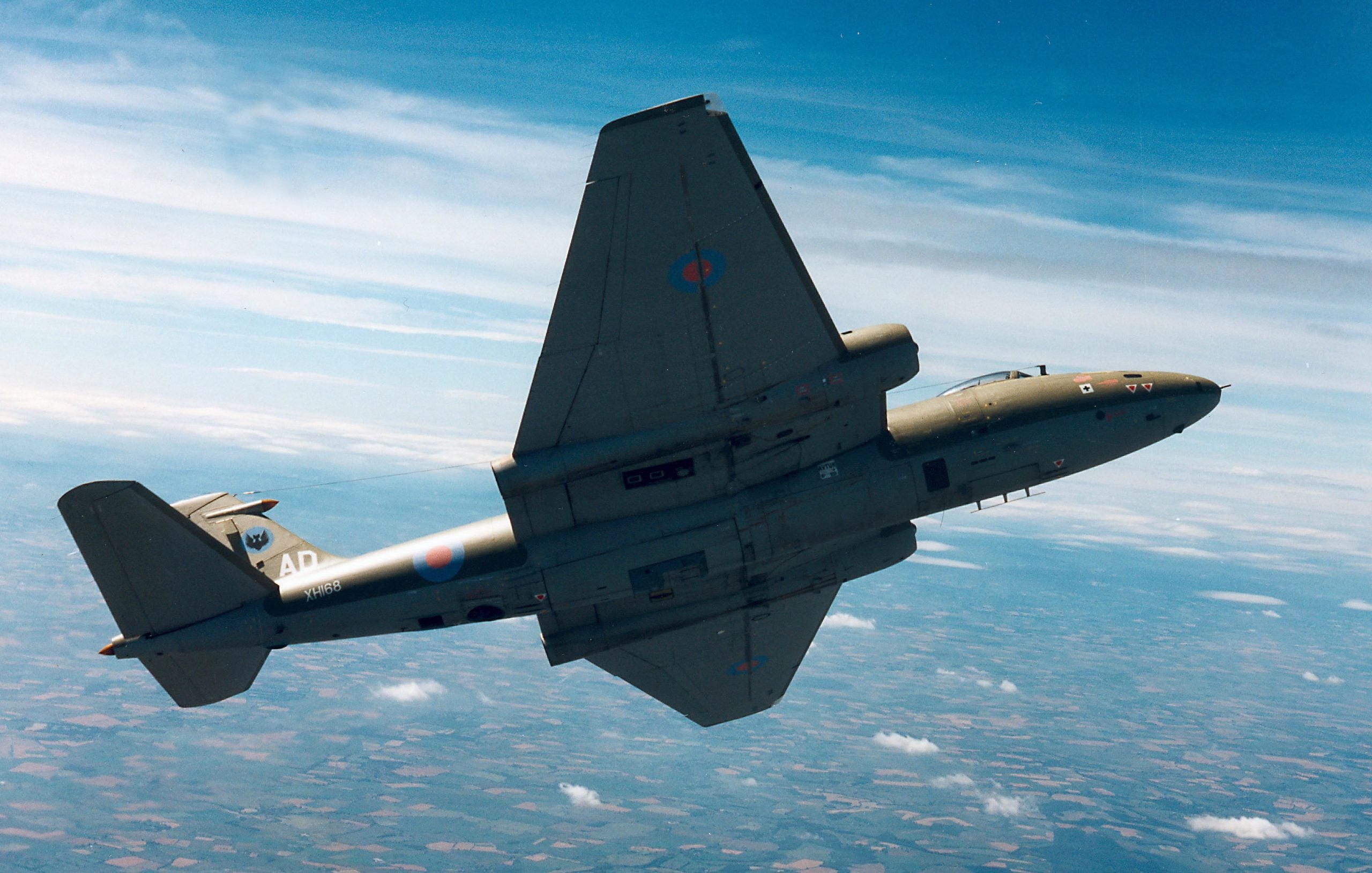
English Electric Canberra
The bomber that refused to retire
Britain’s first jet bomber — a simple, broad-winged machine built to fly higher than any fighter could reach. It set world altitude records, was licence-built in America as the Martin B-57, and in NASA’s hands is still flying today, more than 75 years after its first flight.
Simple, high, and impossible to kill off
In 1944 the Air Ministry wanted a jet successor to the wooden de Havilland Mosquito — a fast, unarmed bomber that would survive by flying too high and too fast to be caught. The job went to a young English Electric team led by W. E. W. “Teddy” Petter, and the aircraft that emerged, first flown on 13 May 1949, was almost shocking in its simplicity: a broad, low-loaded straight wing, a fat fuselage, and two Rolls-Royce Avon turbojets. No swept wing, no gun turrets, no complexity for its own sake.
That plain recipe worked brilliantly. The Canberra could cruise above 48,000 ft — higher than the fighters sent to intercept it — and it climbed and turned better up there than almost anything of its era. It entered RAF service in 1951 as Britain’s first jet bomber, set a string of world altitude records through the 1950s, and became one of the great export successes in British aviation history: licence-built in the United States as the Martin B-57 and in Australia, and flown by well over a dozen air forces.
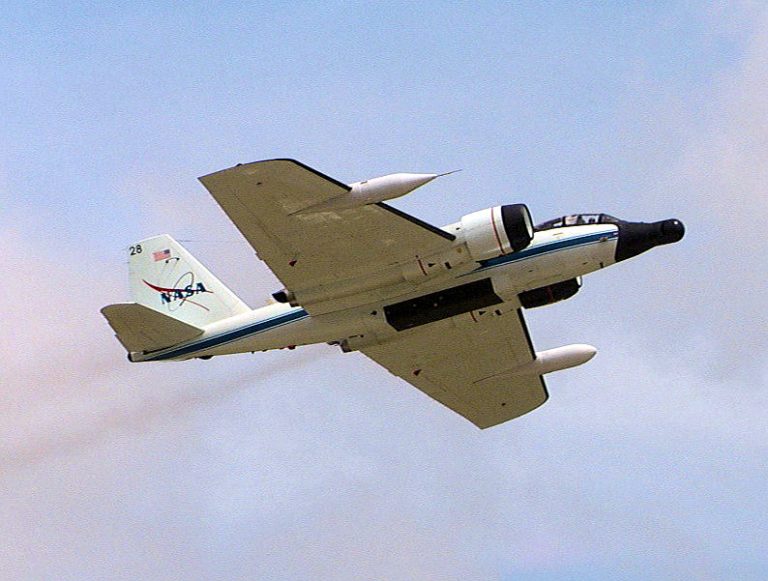
Its real trick, though, was longevity. The airframe was so adaptable — bomber, photo-reconnaissance, interdictor, trainer, target-tug, high-altitude testbed — that operators simply refused to give it up. The RAF flew its last Canberras in 2006; India retired hers in 2007. And NASA’s WB-57s are still flying scientific missions in the 2020s, making the Canberra one of the longest-serving jet designs ever built.
01Why the Canberra could fly higher than the fighters chasing it
The Canberra’s secret was its wing. Petter’s team gave it an unusually large, thick, low-aspect straight wing — a big lifting surface carrying a relatively light aircraft. That low wing-loading meant the Canberra kept generating lift in the thin air of the high stratosphere, where sharper-winged jet fighters ran out of performance and mushed into a stall. Combined with two efficient Avon engines, it could operate above 48,000 ft and, in specialised forms, far higher.
For most of the early 1950s that put it out of practical reach: interceptors that could match its altitude couldn’t manoeuvre once they got there. The trade-off was speed — the straight wing capped the Canberra at around Mach 0.88, firmly subsonic — but for a bomber meant to slip over a target and leave, altitude mattered more than raw speed. It is the same logic that later produced the Canberra-derived, and even higher-flying, reconnaissance aircraft.
What makes the Canberra special
A big straight wing built for the stratosphere
The Canberra’s defining feature is its broad, low-loaded straight wing paired with two Rolls-Royce Avon turbojets. Where fighters used thin swept wings for speed, the Canberra used a large wing area to keep flying in thin air — giving it a service ceiling around 48,000 ft and, in record-setting forms with uprated engines, well over 60,000 ft. For years it simply flew above the threat.
One airframe, endless jobs
Unarmed and aerodynamically honest, the Canberra proved extraordinarily adaptable. It served as a level bomber, low-level interdictor, photo-reconnaissance platform with up to seven cameras, dual-control trainer, target-tug, radar calibrator and high-altitude testbed. Some 27 variants were built, which is a large part of why so many air forces bought it and kept it.
Longevity — and a second life in research
The Canberra’s clean high-altitude airframe made it perfect for science. NASA operates a small fleet of WB-57 high-altitude research aircraft — direct descendants of the Martin-built Canberra — still flying atmospheric sampling, sensor testing and spacecraft re-entry tracking in the 2020s, more than seven decades after the type first flew.
02The Canberra and the Martin B-57: an American Canberra
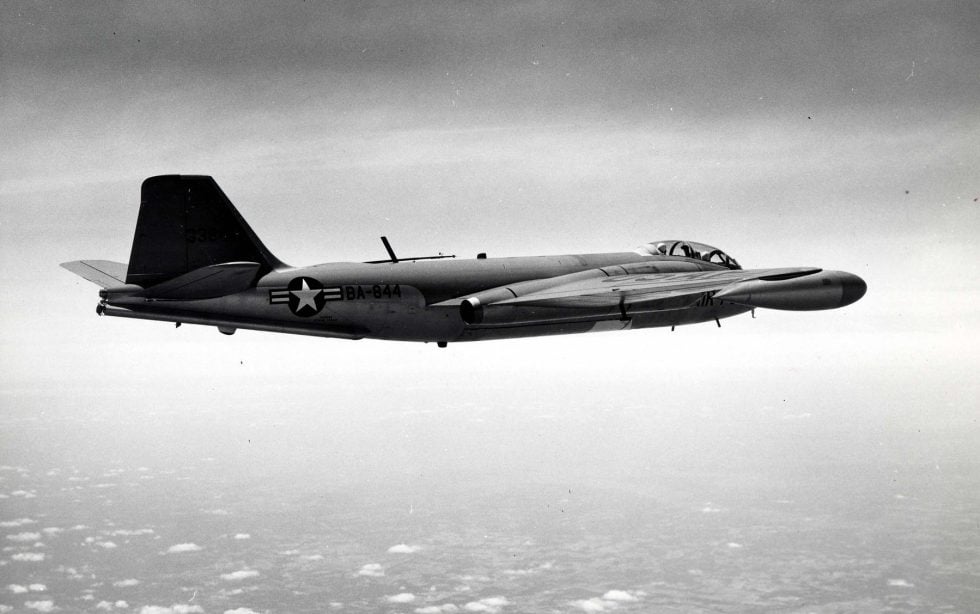
When the US Air Force needed a fast tactical bomber in the early 1950s and its own designs disappointed, it did something almost unheard of: it licensed a British aircraft. The Glenn L. Martin Company built the Canberra as the B-57, and though early examples were near-identical, later versions diverged sharply — a redesigned cockpit, rotary bomb door, and eventually the enormous long-span RB-57F/WB-57 high-altitude variants. Around 403 B-57s were built in the United States. They fought over Vietnam, and it is the WB-57 line that keeps the Canberra family airborne with NASA today.
03Record after record: how the Canberra kept climbing
Through the 1950s the Canberra rewrote the altitude tables. On 4 May 1953 a Canberra fitted with Bristol Olympus engines reached about 63,668 ft; on 29 August 1955 another set a record near 65,889 ft. The peak came on 28 August 1957, when a Canberra using a Napier Double Scorpion rocket motor in addition to its jets zoom-climbed to 70,310 ft (21,430 m) — a world altitude record at the time. These flights showed just how much altitude the basic airframe had in reserve.
Full specifications
Baseline note: the figures below describe the Canberra B(I).8 of 1956–59 — the definitive interdictor version, 72 built including 17 for export, with two Rolls-Royce Avon Mk 109 turbojets, an offset fighter canopy on the port side, a detachable four-cannon pack in the rear half of the bomb bay and the Low Altitude Bombing System for throwing a tactical nuclear weapon from 250 ft. It is the mark that did most of the Canberra’s front-line RAF strike work after Bomber Command gave the type up in 1961, and it is the aeroplane furthest from what W. E. W. "Teddy" Petter had drawn: a high, fast, unarmed bomber meant to use altitude as its only defence. Deltas for the B.2, the B.6, the PR.3, PR.7 and PR.9 photo-reconnaissance marks, the T.4 trainer, the Australian GAF B.20 and the Indian B(I).58 and PR.57 are given in grey. Two cautions. Most published B(I).8 tables are in fact B(I).6 or B.6 tables, because those marks share the wing, the engines and the weights and differ only in the forward fuselage. And the Martin-built American Canberra is a substantially different aeroplane, with a rotary bomb door, tandem seating and its own wing loading; it has a separate page here as the B-57 and its figures should never be mixed with these.
Dimensions & weights
- Crew
- 2 — pilot under the offset blown canopy, navigator/bomb-aimer in the nose compartment ahead of and below him. The B.2, B.6, B.15 and B.16 carried three, the pilot plus two navigators in the rear cabin; the B.16 lost one of its ejection seats when Blue Shadow radar was fitted. The PR.3, PR.7, PR.9 and T.4 carried two, three and two respectively
- Length
- 19.96 m (65 ft 6 in) — the same as the B.2, because the B(I).8 nose is a reshaping rather than a stretch. PR.3 and PR.7 20.32 m (66 ft 8 in) with the 14 in camera bay inserted forward of the wing; PR.9 20.32 m (66 ft 8 in), though a commonly reproduced variant list says 68 ft and then converts it to 27.72 m, which is arithmetically impossible and should be ignored
- Wingspan
- 19.51 m (64 ft 0 in), quoted by some authorities as 63 ft 11½ in; 19.96 m (65 ft 6 in) over the wingtip fuel tanks when carried. PR.9 20.68 m (67 ft 10 in), the only Canberra with a genuinely new wing
- Height
- 4.78 m (15 ft 8 in); airvectors gives 4.75 m (15 ft 7 in), which is tail-down attitude rather than a different aeroplane
- Wing area
- 89.19 m² (960 sq ft) — unchanged from the first prototype to the last B(I).8. The PR.9 inner wing was extended in chord and span for about 102 m² (1,100 sq ft)
- Wing planform
- Unswept mid wing of aspect ratio 4.27, single-spar, with 4° of sweep on the leading edge and 14° of forward sweep on the trailing edge outboard of the nacelles. Aerofoil RAE/D, 12 per cent symmetrical at the root and 9 per cent at the tip. The leading edge is a single alloy sheet wrapped to 40 per cent chord over Redux-bonded stiffeners, so the profile carries no external joint or fastener between the leading edge and the main spar — the reason a straight-winged 1949 bomber was still flying reconnaissance in 2006
- Engine position
- Buried in nacelles at roughly one-third span, mounted on tubular trusses off the wing leading edge. Petter’s 1945 design had a single centrally mounted engine; moving to two mid-wing units cut structural weight by about 13 per cent and fixed the centre-of-gravity problem, at the cost of thrust lost in longer jet pipes and severe yaw on one engine
- Empty weight
- 9,820 kg (21,650 lb); the B.2 is usually given as 10,070 kg (22,200 lb), heavier than the interdictor because of its third crew station and glazed nose
- Gross weight
- 20,865 kg (46,000 lb) — the weight at which the performance figures opposite were measured
- Maximum take-off weight
- 24,948 kg (55,000 lb). The Australian GAF B.20 was cleared marginally higher on the strength of its extra wing tankage
- Wing loading
- 234 kg/m² (48 lb/sq ft) at gross weight — a jet bomber flying on a wing loading closer to a trainer’s. That single number explains the climb, the ceiling, the loiter and the fact that the aeroplane could be rolled and looped by squadron pilots
- Internal fuel
- ~8,050 litres (~1,770 imp gal) in the B.2, in two self-sealing fuselage tanks and a lace-supported bag, plus two 1,110-litre (244 imp gal) tanks under the wingtips. The B.5 introduced integral leading-edge wing tanks and the B.6, B(I).6, B(I).8, PR.7 and PR.9 inherited them, taking usable internal fuel to roughly 10,000 litres (~2,200 imp gal). Published figures differ by tank fit and are best treated as approximate
- Weapons load
- 3,630 kg (8,000 lb) total on the B(I).8, internal and external combined. The unarmed bomber marks could take up to ~4,540 kg (10,000 lb) in the bay, and up to 910 kg (2,000 lb) sits on the two underwing pylons on marks that have them
Performance
- Maximum speed
- 933 km/h (580 mph, 504 kn) at 12,190 m (40,000 ft), Mach 0.88
- Maximum speed, low level
- 917 km/h (570 mph, 495 kn) — the B.2 figure, and the speed at which the interdictor marks actually worked in RAF Germany
- Rate of climb
- 17.3 m/s (3,400 ft/min) initial at gross weight. Light, with the tip tanks off, the aeroplane climbed far harder than that, which is what made the record attempts possible
- Service ceiling
- 14,630 m (48,000 ft) — the standard quoted figure across the B.2, B.6 and B(I).8, and in 1951 it put the Canberra above every interceptor in the world. By the mid-1950s the Hawker Hunter could reach it, and after 1960 the S-75 Dvina made it irrelevant
- Ceiling, PR.9
- Above 15,240 m (50,000 ft) officially; a Boscombe Down PR.9 was flown to 19,800 m (65,000 ft) by Ian Strachan, and the mark was still being used for high-altitude oblique photography along the inner German border in the 1980s
- Handling at extreme altitude
- At 19,200 m (63,000 ft), the height an Avon test-bed Canberra worked at routinely, the gap between the stall and the Mach limit — the coffin corner — was 25 knots. Everything the type is famous for at altitude was flown inside that band
- Combat range
- ~1,300 km (810 miles) with a war load. This is the Canberra’s central weakness: it is a tactical bomber that could not reach strategic targets, which is why the RAF bought the B-29 on loan and then the V-bombers
- Ferry range
- 5,440 km (3,380 miles)
- Range, internal fuel
- 4,275 km (2,656 miles, 2,310 nm) for the B.2 clean; the PR.3, with an extra tank in the forward bomb bay, is credited with 5,770 km (3,585 miles)
- Thrust-to-weight
- 0.32 at gross weight, 0.37 by some published tables at lighter loading. Modest by fighter standards and entirely adequate on a wing this large
- Records set
- First non-stop unrefuelled jet crossing of the Atlantic, 21 February 1951, B.2 WD932 flown by Roland Beamont, 4 hr 37 min to Gander. First double Atlantic crossing in a day, 26 August 1952, the sole B.5, 10 hr 3 min. World altitude record 19,406 m (63,668 ft) on 4 May 1953, B.2 WD952 with Bristol Olympus engines; 20,083 m (65,889 ft) on 29 August 1955; and 21,430 m (70,310 ft) on 28 August 1957, B.2 WK163 with a Napier Double Scorpion rocket motor in the bomb bay. The 1953 London to Christchurch race was won by a PR.3 in 23 hr 51 min for 19,750 km (12,270 miles), and that record has never been beaten
Propulsion & systems
- Engines
- Two Rolls-Royce Avon Mk 109 (RA.7) axial-flow single-spool turbojets. B.2 and Australian B.20: Avon Mk 101 (RA.3). B.5 prototype: RA.7. PR.9: Avon Mk 206 (RA.24). The second prototype, VN828, flew on Rolls-Royce Nenes because Avon development was late, and Sapphire, Olympus and Gyron Junior test-bed Canberras all flew as well — the type was Britain’s standard engine trials airframe for twenty years
- Rated thrust
- 32.9 kN (7,400 lbf) each; some tables give 33.4 kN (7,500 lbf) for the same mark. B.2: 28.9 kN (6,500 lbf). PR.9: 50.0 kN (11,250 lbf) each, which is the figure Shorts and the RAF used; a commonly reproduced variant list quotes 44.6 kN (10,030 lbf) for the same engine and is the outlier
- Starting
- Coffman cartridge starters, specified by the manufacturer. Australian aircraft carried a triple cartridge breech which had an unhelpful habit of firing all three at once, so the RAAF loaded them singly. Rhodesia and others started on compressed air instead, against Rolls-Royce advice, and saved a great deal of money doing it
- Flight controls
- Fully manual throughout the bomber and early reconnaissance marks — push rods rather than cables, shrouded-nose ailerons, four-section split flaps, no artificial feel and no hydraulic boost. Powered ailerons arrived only with the PR.9. That a 24-tonne aeroplane was flown on muscle at 500 mph is the single most-quoted fact about Canberra handling, and the reason its pilots liked it
- Airbrakes
- Forty hydraulically raised fingers set into the upper and lower wing surfaces — an unusual arrangement that let the aeroplane come down steeply without pitch change, and useful on a type with no thrust reverser and a great deal of excess wing
- Bomb bay
- A single long bay taking up the whole lower fuselage, closed by two hydraulic clamshell doors. On the B(I).6 and B(I).8 the rear half is occupied by the detachable gun pack, leaving three 1,000 lb stations forward. The Martin B-57 replaced the clamshells with a rotary door; the British aeroplane never did
- Escape
- Martin-Baker ejection seats for the pilot and the rear crew on the B.2 and B.6. The B(I).8’s navigator sits in the nose with no seat at all and must leave through the crew door — a decision taken to buy the pilot a fighter canopy, and one that killed navigators. The PR.9 fixed it with a side-hinged nose that swings open to admit an ejection seat
- Electrical & pressurisation
- Each engine drives a 6 kW generator for a 28 V DC system, a hydraulic pump and a bleed-air feed for the pressurised nose compartment. There is no auxiliary power unit
- Navigation & bombing
- Gee-H, Rebecca distance-measuring equipment, VHF, radio compass, radar altimeter, IFF and Orange Putter tail-warning radar. The H2S Mk 9 blind-bombing radar was late, so early aircraft flew with a T.2 optical sight and a bomb-aimer lying in a glazed nose — markedly worse than radar from high altitude, and the reason the Suez bombing was so inaccurate. Blue Shadow sideways-looking radar went into the B.6(RC) and B.16
- Reconnaissance fit
- PR.3 and PR.7: one vertical and six oblique cameras in a 14 in fuselage bay, with an extra fuel tank forward in the bomb bay. PR.9: long-focal-length optical cameras reportedly derived from U-2 practice, plus infrared linescan taken from the RAF Phantom reconnaissance pods for night work at low level
- Undercarriage
- Single outboard mainwheel on each leg, twin nosewheel. The legs were forged in DTD683 alloy, which suffered stress-corrosion cracking within a few years; the RAF instituted repeat radiographic and later ultrasonic inspections for the rest of the type’s life rather than redesign it. Maxaret anti-skid braking arrived with the B.6 generation
04What did a Canberra cost — and why the numbers are fuzzy
The Canberra was a 1950s state-era product sold across many countries in wildly different deals, so no single trustworthy flyaway price exists in open sources, and cost-per-flight-hour figures for the type are not reliably published either. What is well documented is the production spread: roughly 900 built in Britain, about 403 as the Martin B-57 in the United States, and 48 licence-built in Australia — on the order of 1,350 aircraft in total. Any precise dollar figure attached to a Canberra should be treated as an estimate.
Armament & payload
The Canberra was specified with no guns at all, and then spent most of its front-line career carrying four cannon at two hundred and fifty feet
Specification B.3/45 asked for a Mosquito replacement that would carry no defensive armament, on the Mosquito’s own reasoning: guns cost weight and drag, they had never saved bombers from fighters, and speed and height were a better answer. For about five years that was exactly right, and Canberras were effectively uninterceptable in RAF air-defence exercises until the Hunter arrived. Then the surface-to-air missile ended high-altitude bombing as a survivable activity, and the same airframe was sent down to the weeds, where it was given a bolt-in pack of four 20 mm Hispano cannon in the back of its own bomb bay, two wing pylons, and a system for tossing an American nuclear bomb over its shoulder. The interdictor Canberra is therefore an aeroplane doing the opposite of what it was designed to do, and doing it for longer. Fits varied enormously by mark and by operator: the B.2, B.6 and every PR mark were unarmed, the RAAF sent its B.20s to Vietnam with no guns at all, Rhodesia and India built their own weapons for it, and a published armament table describes one squadron in one year rather than the type.
Gun
- Four 20 mm Hispano Mk.V cannon with 500 rounds per gun, in a detachable ventral pack occupying the rear half of the bomb bay. Introduced on the interim B(I).6 in 1955 and standard on the B(I).8 from January 1956
- The pack could be removed in a few hours to restore the full bay, and squadrons did remove it. Being ventral rather than in the wing, it left the leading edge and its integral fuel tanks alone — the opposite of Martin’s solution on the B-57, which put four M39 revolver cannon or eight 0.50 in Brownings in the outer wing panels
- An alternative pack of two 0.30 in (7.62 mm) machine guns is listed in the official tables and was very rarely seen
- Nothing was fired backwards, ever. No Canberra of any mark carried a tail turret, a tail gun or a defensive position of any kind, and the type went to war eight times without one
- The B.2, B.5, B.6, B.15, B.16, all four PR marks, the T.4 and the Australian B.20 were unarmed. So were the Canberras of No. 2 Squadron RAAF over Vietnam, which is why they were restricted to bombing and never strafed
Air-to-air
- None, on any operational mark, ever. The Canberra was never fitted with an air-to-air missile in service and is credited with no air-to-air victory anywhere
- The single exception was a laboratory one: Shorts converted a PR.9 into the SC.9, with AI.23 radar and an infrared head in the nose, to fly Red Top missile trials. It carried the missile as a test bed and nothing more, and was broken up some time between 1986 and 1998
- As a target the type has a long and unhappy record. A PR.7 was shot down by a Syrian Gloster Meteor over the Mediterranean on 6 November 1956, the last day of the Suez fighting. An Indian Canberra fell to a Pakistani F-86F over Rawalpindi on 10 April 1959, giving the Pakistan Air Force its first aerial victory
- On 1 May 1982 an Argentine Canberra was shot down by an AIM-9L fired from a Sea Harrier of 801 Naval Air Squadron. On 13 June, B.62 serial B-108 was destroyed at 11,900 m (39,000 ft) by a Sea Dart from HMS Exeter — the last Argentine aircraft lost in the Falklands, on the night before the surrender. The pilot ejected; the navigator did not
- The defence was always the aeroplane itself. Egyptian MiG-15s intercepted RAF Canberras before the Suez landings without scoring, and Soviet MiG-15s failed to reach the Canberras that overflew the Kapustin Yar rocket range in 1953
Air-to-surface guided
- Nord AS.30 radio-command missiles on the B.15 and B.16 conversions of No. 32 and No. 73 Squadrons in Cyprus — the only guided air-to-surface weapon carried operationally by any British Canberra
- That is the whole list. The RAF Canberra never carried a laser designator, never dropped a laser-guided bomb and never had a self-designation capability. The sixteen Martin B-57Gs of Tropic Moon III did all three from Ubon in 1970–72, on the American page
- The Low Altitude Bombing System fitted to the B(I).6 and B(I).8 is a delivery method rather than a weapon: the aircraft runs in below radar cover, pulls up into a half loop, releases the bomb on the way up and rolls off the top to escape the blast
- The Canberra’s guided-weapon poverty is a fair measure of British tactical procurement in the 1960s. The aeroplane was structurally capable of carrying far more than it was ever given
- Indian and Peruvian aircraft were offered various later fits over the decades; none of the guided options is well attested in service and none should be quoted as standard
Bombs
- Internally on the B(I).8 with the gun pack fitted: three 1,000 lb (454 kg) bombs in the forward bay. With the pack out, or on the unarmed bomber marks, six 1,000 lb, nine 500 lb (227 kg) or a single 4,000 lb (1,814 kg) weapon, up to about 4,540 kg (10,000 lb)
- Externally, two underwing hardpoints of 454 kg (1,000 lb) each, which will also take four 500 lb bombs between them. Total war load 3,630 kg (8,000 lb)
- Nuclear. RAF Germany’s four B(I).6 and B(I).8 squadrons carried American-owned Mark 7 bombs from 1960 under Project E dual-key arrangements, replaced by B43s from 1965 and held until 1972. Three squadrons in Cyprus and one at Tengah carried the British Red Beard instead; the later WE.177A was cleared on other marks. All nuclear weapons went inside
- At Suez in 1956 about a hundred RAF Canberras flew 278 sorties from Malta and Cyprus and dropped 1,439 bombs of 1,000 lb each — and largely missed, because the T.2 optical sight was a poor instrument from height at night. The campaign is the strongest single argument that the high-level Canberra was already obsolete when it went to war
- Operators improvised. Rhodesia’s No. 5 Squadron developed the Alpha bomb, a rubber-cased bouncing anti-personnel bomblet carried three hundred at a time in the bay and used at Chimoio in November 1977 and against Zambian camps in October 1978; flechette weapons were tested but not used. No. 2 Squadron RAAF dropped 76,389 bombs in about 12,000 sorties from Phan Rang between 1967 and 1971 and was credited with 16 per cent of its American wing’s assessed bomb damage for 5 per cent of its missions
Rockets
- Two underwing pods each holding 37 unguided 2-inch (51 mm) rocket projectiles — the standard British interdictor fit of the late 1950s
- Or two Matra pods with 18 SNEB 68 mm rockets each, which superseded the 2-inch on most fits from the 1960s
- Rockets and the gun pack together made the B(I).8 a genuine strafing aircraft, which the specification had never asked for. In practice they were fired far less often than the guns
- The rocket pods compete directly with bombs for the same two pylons, so a Canberra is either a rocket aircraft or a bomb aircraft on any given sortie, not both
- No Canberra mark carried a rocket rail or launcher on the fuselage; the bay was reserved for bombs, the gun pack or, in one celebrated case, a Napier Double Scorpion rocket motor for record flying
Pods & other stores
- Two 1,110-litre (244 imp gal) teardrop tanks under the wingtips on the B.2 and its descendants — the type’s visual signature and worth several hundred miles of range
- Camera fits in place of weapons: seven cameras in the PR.3 and PR.7, long-focal-length optics and infrared linescan in the PR.9. A reconnaissance Canberra carries nothing offensive at all, and the PR.9 flew over Iraq in 2003 and Afghanistan in 2006 unarmed and alone
- Target-towing gear on the TT.18, with Rushton winch pods under the wings for the RAF and Royal Navy, and on RAAF B.20s in their last decade supporting Mirage gunnery
- Electronic warfare stores on the T.17 and T.17A: jammers, chaff dispensers and a spectrum analyser in an extended nose, used to train British radar and fighter crews against jamming. Sweden’s two Tp 52s carried a T.17 nose for eavesdropping on Soviet, Polish and East German transmissions and were publicly described as "testing aircraft" for a decade
- Air-sampling pods on the B.6s of No. 76 Squadron, which flew through British mushroom clouds at Maralinga and Christmas Island to collect particulates — with radiation instrumentation that was not always accurate
Three typical loadouts
- Tactical nuclear strike, RAF Germany, 1965
- One American-owned B43 bomb in the bomb bay, gun pack removed, wingtip tanks fitted, no external stores. Low-level ingress under the radar to a Warsaw Pact airfield, LABS pull-up, release on the way up, roll off the top and run for home. Two crew, one of whom had no ejection seat.
- Night bombing, Operation Musketeer, Cyprus, November 1956
- Six 1,000 lb bombs in the bay, no external stores, target-marking by other Canberras and Valiants, release from around 12,000 m (40,000 ft) on a T.2 optical sight. Three crew. A total of 278 such sorties were flown against Egyptian airfields and the results were poor enough to help end high-level bombing in RAF practice.
- Counter-insurgency strike, No. 5 Squadron Rhodesian Air Force, 1977–79
- Three hundred Alpha bouncing bomblets in the bay, no guns, no pylon stores, run in at low level ahead of Hunters and helicopter-borne troops. Used at Chimoio in Operation Dingo and against the Zambian camps in Operation Gatling, where the Canberra formation leader — "Green Leader" — informed Lusaka tower by radio that Rhodesia was taking temporary control of Zambian airspace.
Sourcing caveat. The armament table above follows the RAF release-to-service figures for the B(I).6 and B(I).8, which are the best-attested British numbers; export and licence aircraft differ. Several popular accounts of Operation Gatling list only Hunters and helicopters and omit the Canberras entirely, although the "Green Leader" transmission was made by the Canberra formation leader of No. 5 Squadron. Rhodesian and Indian locally developed munitions are documented mainly in participant memoirs and should be read as such.
Variants
Twenty-seven marks from five factories on three continents, and the type was rebuilt far more often than it was replaced
English Electric, Avro, Handley Page and Short Brothers built 901 Canberras in Britain. The Government Aircraft Factories assembled 48 in Australia, and the Glenn L. Martin Company built 403 in Maryland as the B-57 — the only British aircraft design ever licence-produced in quantity by the United States, chosen over Martin’s own XB-51 in a 1951 fly-off. The global total is 1,352.
What follows is the British family. The American aircraft diverged so far — rotary bomb door, tandem cockpit, wing guns, and in the RB-57D and RB-57F a wing of 106 and 122 ft — that it is treated separately here as the B-57 Canberra, and its figures should not be blended with these. The export mark numbers below follow the British convention in which the second digit encodes the customer.
- Canberra B.1 / English Electric A.1 (1949–50, 4 prototypes)
- VN799 first flew on 13 May 1949 with Roland Beamont; VN828 flew on 9 November 1949 on Nenes because the Avon was late. The glazed nose and bomb-aimer’s position were added when the H2S Mk 9 radar bombsight failed to appear.
- Canberra B.2 (1950–56, 418 built)
- The definitive first-generation bomber and the most numerous mark: crew of three, Avon 101s of 6,500 lbf, wingtip tanks. English Electric 208, Avro 75, Handley Page 75, Short 60. Entered service with No. 101 Squadron in May 1951 and became the basis for the B-57, the Australian B.20 and most export machines.
- Canberra PR.3 (1950–55, 35 production plus prototype)
- A 14 in plug forward of the wing for seven cameras, an extra tank in the forward bay, two crew. The first aircraft ever designed for the RAF purely for photo-reconnaissance. Into service December 1952 with No. 540 Squadron; won the 1953 London–Christchurch race outright.
- Canberra T.4 (1951–58, about 75 built)
- Solid nose, dual controls, pilot and instructor side by side under the canopy with the navigator still in the "coal hole" behind. Prototype flew 12 June 1951, production from 20 September 1953, service with No. 231 OCU in early 1954. Every B.2 squadron held at least one. Exported as the T.13, T.64, T.74 and T.84.
- Canberra B.6 and B.6(RC) (1954–56, 106 built)
- Second generation: Avon 109s of 7,400 lbf and integral leading-edge fuel tanks from the one-off B.5. Into Bomber Command from June 1954. The four B.6(RC) aircraft carried Blue Shadow sideways-looking radar in a lengthened nose for electronic intelligence; No. 76 Squadron’s B.6s sampled British nuclear tests.
- Canberra PR.7 and PR.9 (1953–61, 74 and 23 built)
- PR.7: the PR.3 camera bay on the B.6 airframe, with the wet wing and Maxaret brakes; some authorities say 82 rather than 74 were built. PR.9: Short Brothers of Belfast, new inner wing of greater span and chord, Avon 206s of 11,250 lbf, powered ailerons, offset canopy and a side-hinged nose giving the navigator an ejection seat at last. Service February 1960 to July 2006.
- Canberra B(I).6 and B(I).8 (1955–59, 22 and 72 built)
- The interdictors. B(I).6 was a B.6 with the ventral four-cannon pack, two pylons and LABS. B(I).8 added an entirely new forward fuselage with an offset teardrop canopy and the navigator moved into the nose without a seat. The prototype was the converted B.5, flown 23 July 1954; 17 of the 72 went for export and two were converted from B.2s.
- Second-life conversions (1961–90s, roughly 140 airframes)
- B.15 and B.16 tropical strike conversions of the B.6 with wing pylons and, on 32 and 73 Squadrons, AS.30 missiles; T.11, T.17 and T.17A electronic warfare and radar trainers; TT.18 target tugs with Rushton winches; T.19 silent targets; T.22 for Buccaneer navigators; U.10 and U.14 pilotless target drones. The RAF kept finding new work for an airframe it could not afford to replace.
- GAF Canberra B.20 and T.21 (1953–58, 48 built in Australia)
- Government Aircraft Factories at Fishermans Bend and Avalon. A B.2 with a modified leading edge, integral wing tanks and triple starter cartridges, with a higher proportion of Australian and American components. First flight 29 May 1953, service December 1953, Malayan Emergency, then eight aircraft to Phan Rang for the Vietnam War from April 1967 to June 1971. Retired June 1982 after 29 years.
- Export marks (1957–75, more than 200 aircraft to 15 nations)
- India took the largest share: 54 B(I).58 interdictors, 8 PR.57 reconnaissance aircraft and 6 T.4s from 1957, then B(I).66s, PR.67s and eight ex-New Zealand B(I).12s, upwards of a hundred aircraft in all. Others: B(I).12 to New Zealand and South Africa; B.52 to Ethiopia; B.62 and T.64 to Argentina; B.82, B(I).82, PR.83, T.84 and B(I).88 to Venezuela; B(I).56, B(I).68, B(I).72, T.74 and B(I).78 to Peru; refurbished B.2s to Rhodesia; two Tp 52 electronic-intelligence aircraft to Sweden. The B.92 and T.94 built for Argentina were embargoed in 1982 and never delivered.
Survivors and disposition. Something over sixty complete airframes are preserved worldwide, all of them original aircraft — no Canberra reproduction has ever been built, and the type is recent enough that none is likely to be. They are concentrated in Britain, Australia, India, South Africa and Zimbabwe, with smaller groups in Argentina, New Zealand, Sweden, Germany, Malta, Norway and the United States. Exactly one is airworthy: TT.18 WJ680, a converted B.2 operated by the RAAF’s Air Force Heritage Squadron at Temora, New South Wales, which flew again on 27 June 2021 after eleven years grounded. WK163, the B.2 that took a Napier Double Scorpion to 70,310 ft in 1957, is under long-term restoration to flight by the Vulcan to the Sky Trust at Doncaster, with WT327 bought as a donor; no return-to-flight date has been announced. Two ex-RAF machines, N30UP and N40UP, remain registered in the United States to High Altitude Mapping Missions but are not flying, and the widely repeated claim that about ten Canberras are airworthy in private hands is stale and unsupported by any current register. The only Canberras still earning a living are American: NASA holds three Martin and General Dynamics WB-57Fs at Ellington Field in Houston, of which two are currently flying — N927NA has been grounded since a gear-up landing on 27 January 2026 — and those are B-57s, covered on their own page, not English Electric aircraft.
From Mosquito replacement to museum — and still flying
First flight
Prototype VN799, flown by Roland Beamont, takes to the air on 13 May — Britain’s first jet bomber design.
Enters RAF service
No. 101 Squadron receives the Canberra B.2 in May, replacing piston bombers with a jet that outclimbs its own escorts.
Altitude records
A run of world altitude records culminates in a rocket-boosted climb to 70,310 ft on 28 August 1957.
Suez & the Malayan jungle
RAF Canberras bomb Egyptian airfields during the Suez crisis; the type had already flown its first combat in the Malayan Emergency.
First SAM kill
A Soviet-supplied SA-2 downs a Taiwanese RB-57D over China on 7 October — the first aircraft ever shot down by a surface-to-air missile.
India’s wars
Indian Air Force Canberras fly bombing and reconnaissance in both Indo-Pakistani wars, including the 1971 raids toward Karachi.
Falklands
Argentine Canberras bomb British positions; one B.62 is shot down by a Sea Dart from HMS Exeter on 13 June, its navigator killed.
Retirement — except NASA
The RAF retires its last PR.9s in 2006 and India in 2007, but NASA’s WB-57s keep flying research missions into the 2020s.
Twelve stories from a 75-year career
The Mosquito’s jet-age heir
The Air Ministry wanted a fast, unarmed bomber that would survive on speed and height alone.
Read the full story
The wing that reached the stratosphere
A big low-loaded straight wing let the Canberra keep flying where fighters stalled.
Read the full story
Rocket-boosted to 70,310 ft
A Canberra with a rocket motor bolted on climbed higher than any aircraft had before.
Read the full story
An American Canberra
The US Air Force did the almost unthinkable and licence-built a British bomber as the Martin B-57.
Read the full story
Bombing from Malta and Cyprus
Around 100 RAF Canberras flew the opening strikes of the 1956 Suez operation.
Read the full story
The first missile kill in history
A Canberra was the first aircraft ever shot down by a surface-to-air missile.
Read the full story
B-57s over the jungle
The American Canberra went to war in Vietnam, joined by Australia’s RAF-built bombers.
Read the full story
India’s long-serving bomber
Indian Canberras fought in 1965 and 1971 and served for fifty years.
Read the full story
Argentina’s Canberras
Argentine Canberras bombed British forces in 1982 — and one fell to a Sea Dart.
Read the full story
Eyes at the edge of the sky
Stripped of bombs and filled with cameras, the PR Canberras flew some of the Cold War’s quietest missions.
Read the full story
The jet that would not retire
From 1951 front-line service to 2020s science flights, the Canberra keeps going.
Read the full story
Britain’s great export bomber
Well over a dozen air forces flew the Canberra; it shaped a generation of jet bombing.
Read the full story
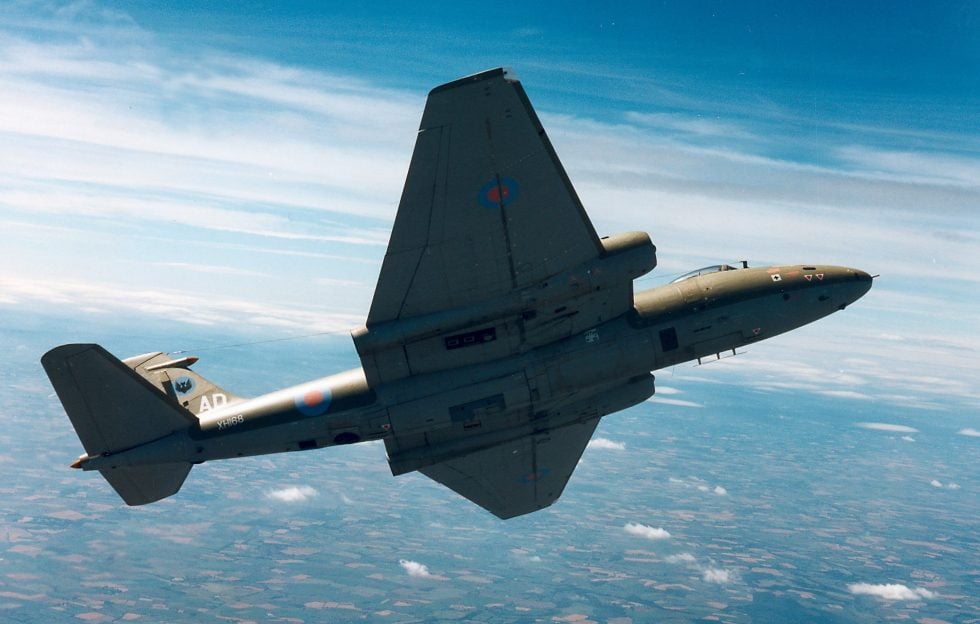
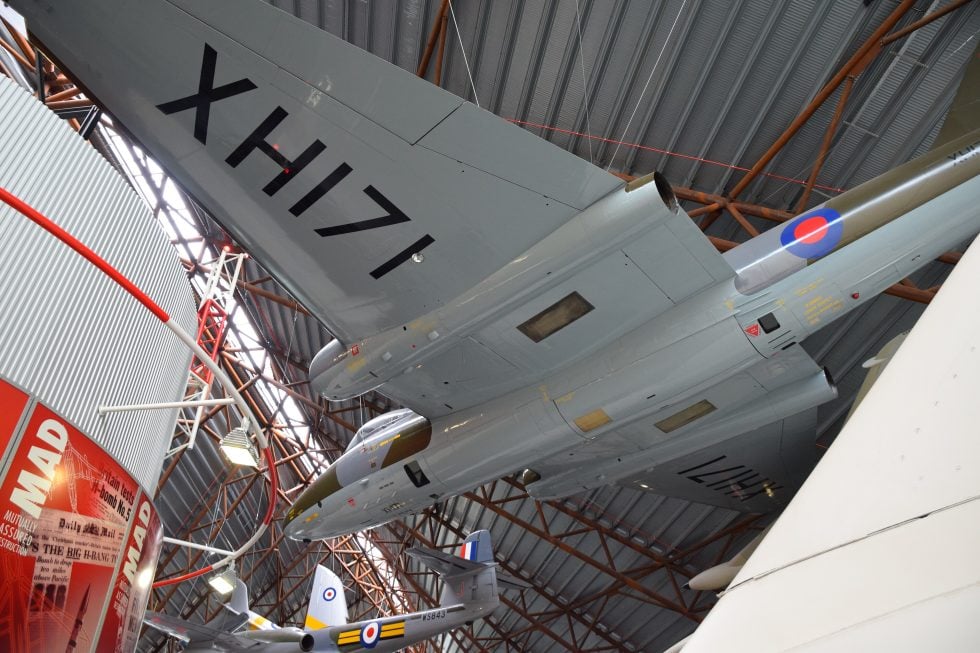
The Canberra in pictures
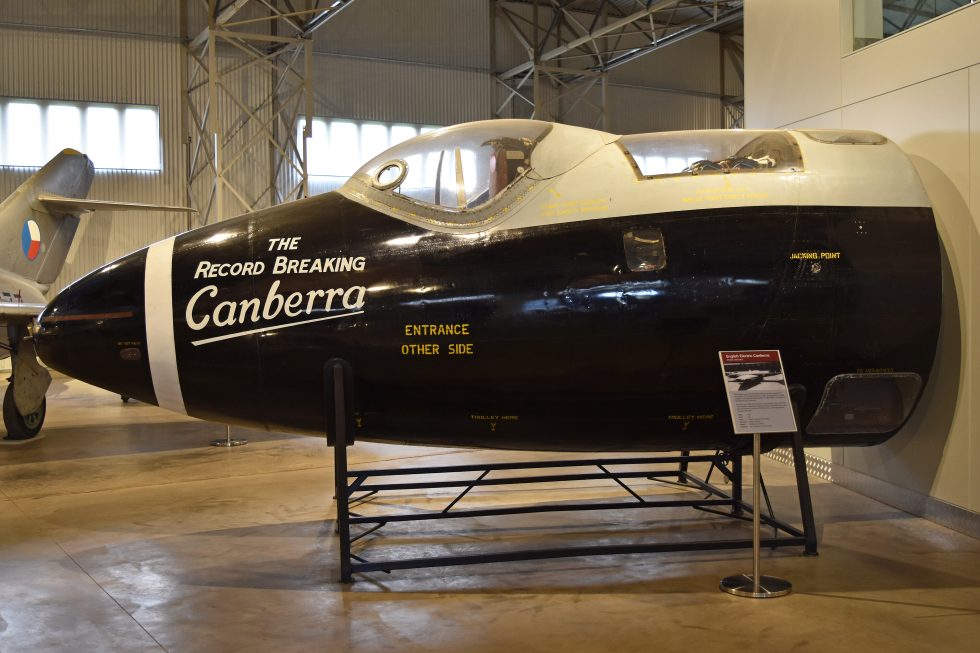
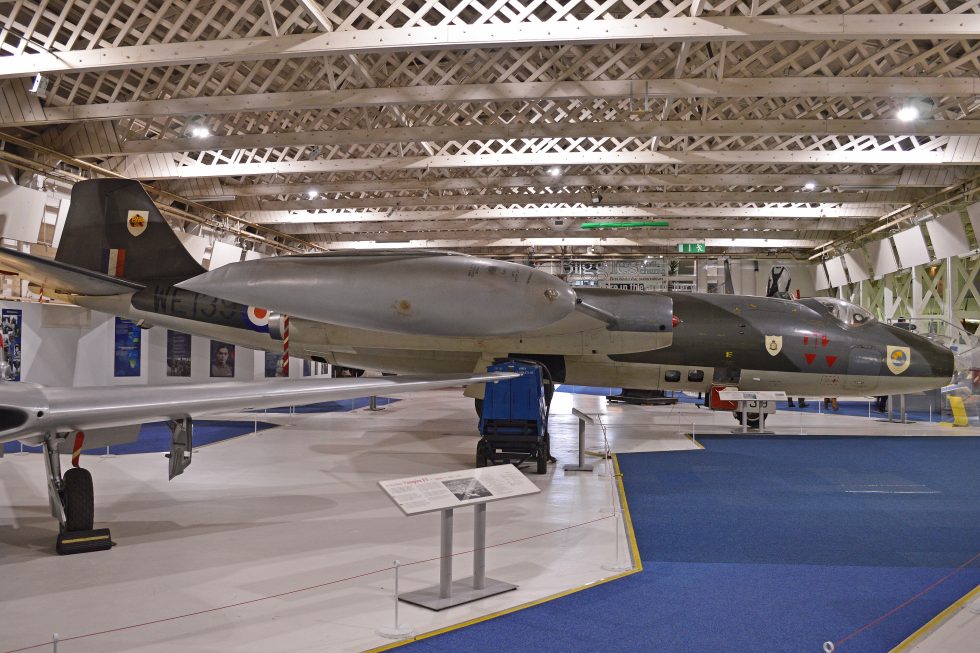
The Canberra in motion
Video coming soon. We’re still choosing the right film to do the Canberra justice — a documentary that captures the altitude records, the global service and the improbable NASA afterlife. Check back shortly.
The Canberra in motion
DroneScapes — one of the most-watched Canberra films on YouTube.
Where the Canberra flew
A bomber that fought on every side of the Cold War
The Canberra almost never fought as a dogfighter — it had no guns for that. Its combat record is written in bombs dropped and photographs taken, over Malaya and Suez, Vietnam, the India–Pakistan wars and the Falklands. It was also, grimly, the first aircraft in history shot down by a guided missile. Figures below are best-available estimates and are contested in places.
Compare the combat record of every military aircraft. Figures as of July 2026.
Everything people ask about the Canberra
Can I fly in a Canberra?
Why was the Canberra so special?
What is the Martin B-57?
Is any Canberra still flying?
How high could a Canberra fly?
Did the Canberra ever get shot down?
Who else flew the Canberra?
You can’t fly the Canberra.
These, you can.
Some legends only live in museums — others are fuelled and waiting. MiGFlug has put civilians in real military jet cockpits since 2004.
 Fly the L-39 AlbatrosThe world’s most-flown jet trainer — aerobatics included
 Fly the F-104 Starfighter“The missile with a man in it”
 Fly the MiG-21The Cold War’s most-produced jet
 Fly the T-33 Shooting StarAmerica’s first jet trainer
 Fly the DH VampireA piece of early jet history
 Fly the S.211Agile Italian jet trainer
 Fly the MB-326The classic Aermacchi jet
 Fly the MiG-15The Soviet legend of the Korean War
Continue the tour
Every fact, checked
- BAE Systems Heritage — English Electric CanberraManufacturer heritage overview: origins, roles and service history.
- Royal Air Force MuseumCanberra variants, RAF service and the 2006 retirement.
- National Museum of the US Air ForceMartin B-57 Canberra history and Vietnam service.
- NASA WB-57 High Altitude Research ProgramThe still-flying WB-57 fleet and its research missions.
- The Aviation Geek Club — first SAM killThe 1959 RB-57D shootdown over China.
- Thunder & Lightnings — Canberra historyDetailed British service history and variant reference.
- FAI records databaseOfficial altitude-record classifications from the 1950s.
- AvBuyer — Britain’s first jet bomberDevelopment background and design analysis.