
Grumman X-29
“The jet with backwards wings”
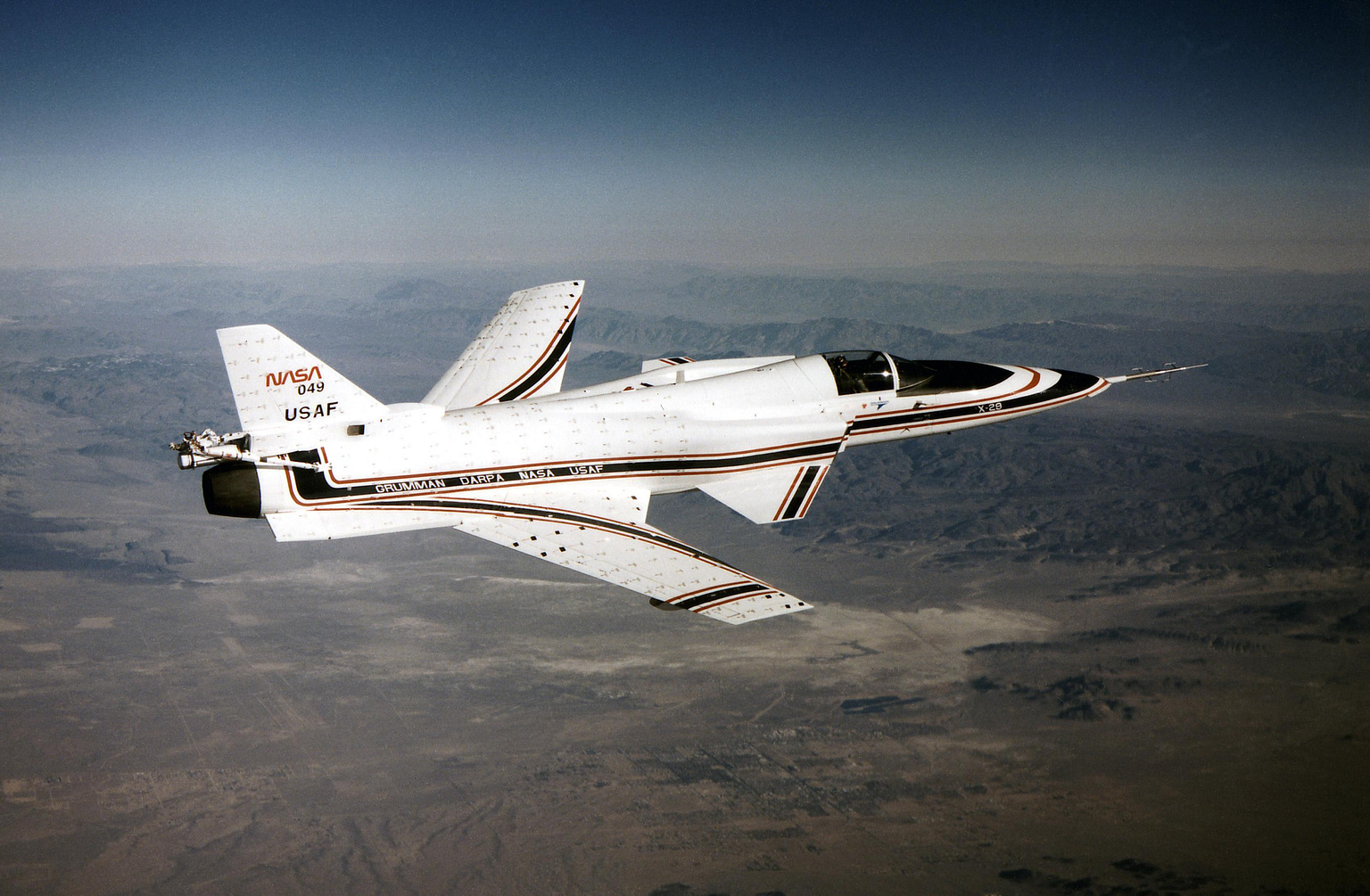
A forward-swept-wing, canard research jet that was deliberately built to be unflyable by a human alone — only a triple digital fly-by-wire computer, correcting up to 40 times a second, kept it in the air. Two were built from F-5 and F-16 parts; both survive.
The jet built to fly its wings backwards
Look at almost any jet fighter and the wings sweep back, trailing away from the nose. The Grumman X-29 did the opposite: its wings swept sharply forward, more than 33 degrees, jutting ahead like a paper dart flown in reverse. It was one of the strangest-looking aircraft of the Cold War — and every bit of that oddity was on purpose.
Engineers had long known that a forward-swept wing offered real aerodynamic prizes: better low-speed handling, sharper manoeuvrability, resistance to the vicious wingtip stalls that plague swept-back designs, and cleaner airflow at high angles of attack. There was just one catch, and it was a killer. A forward-swept wing wants to twist itself apart. As speed rises, aerodynamic loads bend the wingtips up and forward, which increases their angle of attack, which increases the load again — a runaway feedback called aeroelastic divergence that, with 1940s metal, simply tore the wings off. The idea sat on the shelf for decades.
Two technologies finally made it flyable. The first was aeroelastic tailoring: skinning the wing in graphite-epoxy composite laid up so that as the wing bends, it also twists in the opposite direction, cancelling the divergence. The second was the computer. To get the aerodynamic payoff, the X-29 was also built to be aggressively unstable in pitch — reportedly up to about 35 percent unstable, its lift acting well ahead of its centre of gravity — so that, left alone, it would tumble out of control in well under a second. A human pilot could not react fast enough. Instead, a triple-redundant digital fly-by-wire system (with a triple analog backup) sensed the aircraft’s attitude and nudged the controls up to 40 times every second, flying the jet the pilot could only aim.
Funded by DARPA, o U.S. Air Force Ve NASA, and built quickly and cheaply by Grumman from a parts bin — the forward fuselage and nose gear of a Northrop F-5A, the main landing gear and control actuators of an F-16 — two X-29s first flew from Edwards in December 1984. Over 422 research missions to 1992 they proved the forward-swept concept worked, flew controllably to extreme high angles of attack, and never carried a weapon. Both survive: one in a museum, one at NASA.
01The Grumman X-29’s forward-swept wing: the prize, the problem and the fix
A wing swept forward instead of back reverses the way air flows across it. On a swept-back wing, airflow drifts outward toward the tips, so the tips tend to stall first — costing aileron control exactly when a pilot needs it most, at high angles of attack. A forward-swept wing pushes the airflow inward, toward the roots, so the tips keep flying and the ailerons stay effective deep into a high-alpha manoeuvre. That promised superb agility and docile stall behaviour.
The obstacle was structural, not aerodynamic. Under load, a forward-swept wing twists nose-up at the tips, raising the load further in a divergent loop that historically ripped wings from aircraft. The X-29 beat it with aeroelastic tailoring — carbon-fibre composite skins whose fibres are oriented so that bending automatically induces a counter-twist. The wing was allowed to flex, but it flexed in a way that cancelled the runaway rather than feeding it. Without composites, the X-29 could not have existed.
What makes it special
Wings swept the wrong way
The X-29’s defining feature is a wing swept forward by more than 33 degrees. It is not a styling gimmick: forward sweep drives airflow toward the wing roots, so the tips keep flying and the ailerons stay effective at high angles of attack, giving outstanding agility and gentle stall behaviour. The price is aeroelastic divergence — a tendency for the wing to twist itself apart — which is why the concept waited decades for the right materials.
Deliberately unstable, flown by computer
To harvest the aerodynamic payoff, the X-29 was designed to be aggressively unstable in pitch — reportedly up to about 35 percent unstable. Unattended, it would depart controlled flight in a fraction of a second. A triple-redundant digital fly-by-wire system, backed by three analog computers, reads the jet’s motion and adjusts the canards, flaperons and strake flaps up to 40 times a second. The pilot commands where to go; the computer does the flying.
A three-surface parts-bin jet
To keep cost and risk down, Grumman built the two X-29s largely from existing hardware: the forward fuselage and nose gear of a Northrop F-5A ve main landing gear and control actuators of an F-16, married to a new composite wing and a close-coupled canard. The result is a rare three-surface layout — canard, forward-swept wing and aft strake flaps — all worked together by the flight-control computer.
02The Grumman X-29’s fly-by-wire: why a computer flew it 40 times a second
A stable aircraft, disturbed by a gust, tends to return to steady flight on its own. The X-29 was built to do the reverse: any disturbance would grow, fast. That instability was wanted, because a naturally unstable airframe can be smaller, lighter and far more agile than a docile one — if something can react quickly enough to hold it steady. Nothing human can. A pilot’s reaction time is measured in tenths of a second; the X-29 could diverge in less.
The answer was a triple-redundant digital flight-control system with a further triple analog backup, sampling the aircraft’s attitude and rates and issuing corrections up to 40 times per second. Three channels let the system vote out any single faulty computer and keep flying. It is one of the clearest demonstrations ever flown that fly-by-wire does not merely assist a pilot — it can make an otherwise impossible aircraft controllable.
03The Grumman X-29’s high-alpha tests: control where other jets depart
Because forward sweep keeps the wingtips flying, the X-29 was expected to shine at extreme angles of attack — the nose-high, low-speed regime where conventional fighters lose control and “depart.” In a dedicated high-alpha programme, largely flown by the second aircraft, the X-29 demonstrated excellent, stable control response to around 45 degrees angle of attack and remained controllable, if limited, at up to about 67 degrees — attitudes at which most aircraft are simply falling.
The data fed directly into the agility and high-alpha research that shaped later fighters’ flight-control laws. The X-29 never fought anything; its contribution was knowledge — proof of how a well-controlled airframe behaves at the ragged edge of the envelope.
Full specifications
Figures are for the Grumman X-29A. As an experimental type only two were built, and published values vary slightly between NASA documents; figures are given as commonly cited.
Airframe & Performance
- Mürettebat
- 1 (pilot)
- Uzunluk
- ~14.7 m (48.1 ft)
- Kanat açıklığı
- ~8.3 m (27.2 ft)
- Yükseklik
- ~4.5 m (14 ft 9.5 in)
- Wing sweep
- >33° forward (anhedral, forward-swept)
- Boş ağırlık
- ~6,170 kg (~13,600 lb)
- Max takeoff weight
- ~8,070 kg (~17,800 lb); NASA lists ~17,600 lb
- Max speed
- ~Mach 1.6
- Servis tavanı
- ~15,240 m (50,000 ft)
Propulsion, Systems & Programme
- Motor
- 1 × General Electric F404-GE-400 turbofan
- Thrust
- ~71 kN (~16,000 lbf)
- Flight control
- Triple digital fly-by-wire + triple analog backup; ~40 updates/sec
- Layout
- Three-surface: canard, forward-swept wing, aft strake flaps
- Silahlanma
- None — research aircraft
- First flight
- 14 December 1984
- Built
- 2 aircraft (422 research missions, 1984–1992)
- Programme cost
- ~$87 million contract (1981) for both aircraft
- Cost per flight hour
- No reliable public figure
04The Grumman X-29’s cost: a deliberately cheap way to test a wild idea
The X-29 was conceived as a low-cost demonstrator, which is exactly why Grumman raided the parts bin — using the forward fuselage of an F-5A and the landing gear and actuators of an F-16 rather than designing everything new. The 1981 contract to build the two aircraft was reported at about $87 million; total programme figures including years of NASA and Air Force flight research are variously cited higher, but no single audited lifetime number is published in a way comparable to a production fighter.
There is likewise no reliable public cost-per-flight-hour figure for the X-29. As a one-off research aircraft flown by NASA and the Air Force, its operating economics were never reported in the terms used for an operational type, so any precise dollar-per-hour claim should be treated as guesswork.
From a shelved idea to a computer-flown jet
The call goes out
DARPA and the U.S. Air Force Flight Dynamics Laboratory invite proposals for a forward-swept-wing technology demonstrator, an idea made newly practical by composites.
Grumman is chosen
Grumman wins a contract reported at about $87 million to build two X-29A aircraft, using an F-5A forward fuselage and F-16 landing gear and actuators.
First flight
On 14 December, X-29 No. 1 makes its maiden flight from Edwards AFB, flown by Grumman test pilot Chuck Sewell — a jet no human could hold steady without its computers.
Through the sound barrier
The X-29 goes supersonic, confirming the forward-swept composite wing behaves as predicted at transonic and supersonic speed.
The second aircraft flies
X-29 No. 2 makes its first flight on 23 May, dedicated to the high-angle-of-attack research phase.
High-alpha campaign
Flying to around 45° angle of attack under full control — and briefly to about 67° — the X-29 explores flight regimes where conventional fighters depart.
Programme ends
After 422 research missions across both aircraft, the joint DARPA/NASA/USAF X-29 programme concludes, the forward-swept concept proven.
Both preserved
X-29 No. 1 is displayed at the National Museum of the U.S. Air Force, Dayton; No. 2 is preserved at NASA’s Armstrong Flight Research Center in California.
Twelve Grumman X-29 stories
The plane that looks wrong
Forward-swept wings make the X-29 look like it is flying in reverse — on purpose.
Read the full story
The wing that wanted to tear off
Forward-swept wings twist themselves apart — which is why the idea waited 40 years.
Read the full story
Built to be uncontrollable
The X-29 was designed to fall out of the sky — then handed to a computer.
Read the full story
The invisible pilot
A triple fly-by-wire system flew the X-29 by correcting it 40 times every second.
Read the full story
An F-5 nose and F-16 legs
To save money, Grumman built the X-29 out of other jets’ pieces.
Read the full story
Canard, wing and strake
The X-29 steered with three sets of surfaces working together.
Read the full story
14 December 1984
Grumman test pilot Chuck Sewell took the impossible jet up for the first time.
Read the full story
Flying where others fall
The X-29 stayed controllable at angles of attack that make normal fighters depart.
Read the full story
The Ju 287 connection
A forward-swept jet flew in Nazi Germany — and pointed the way to the X-29.
Read the full story
A fighter that never fought
The X-29 looks like a warplane but never carried a single weapon.
Read the full story
Only a pair, both survive
Just two X-29s were ever built — and both are still with us.
Read the full story
Why forward sweep vanished
The X-29 proved forward sweep worked — and then no one built another.
Read the full story
The X-29 in pictures
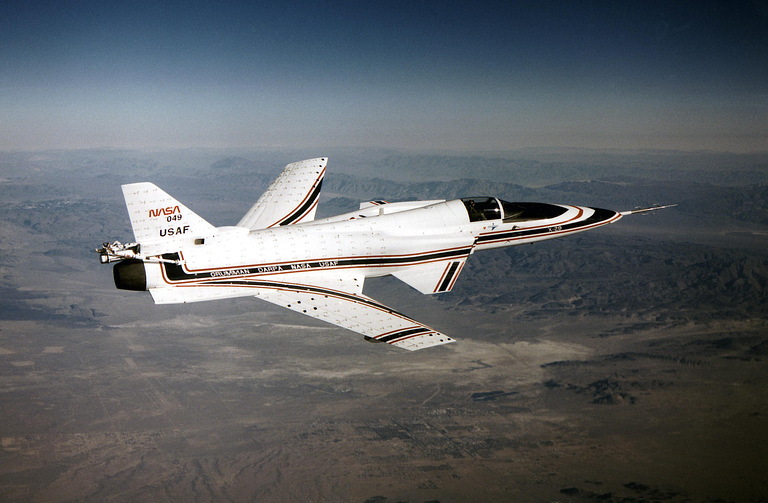
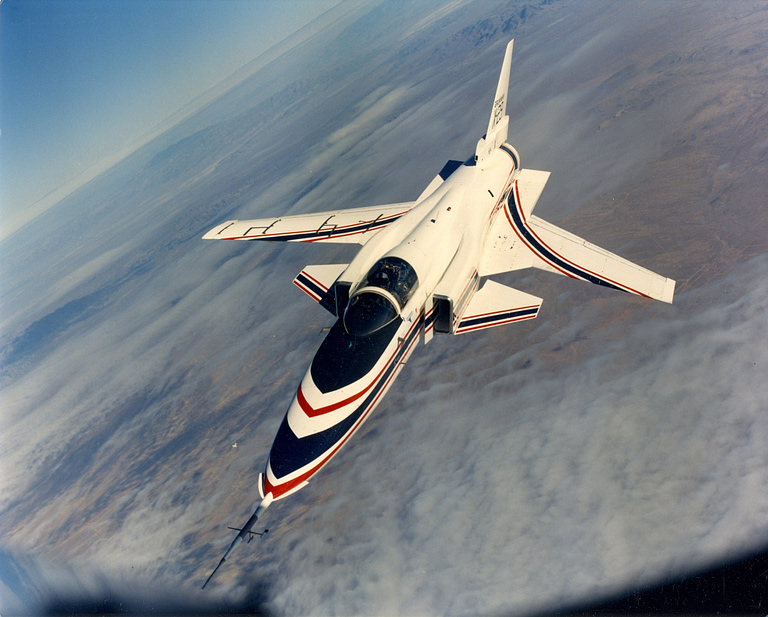
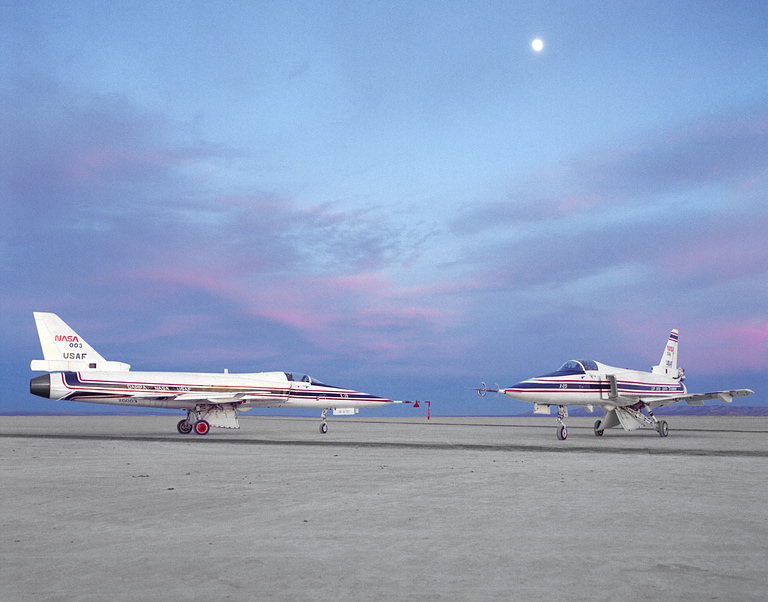
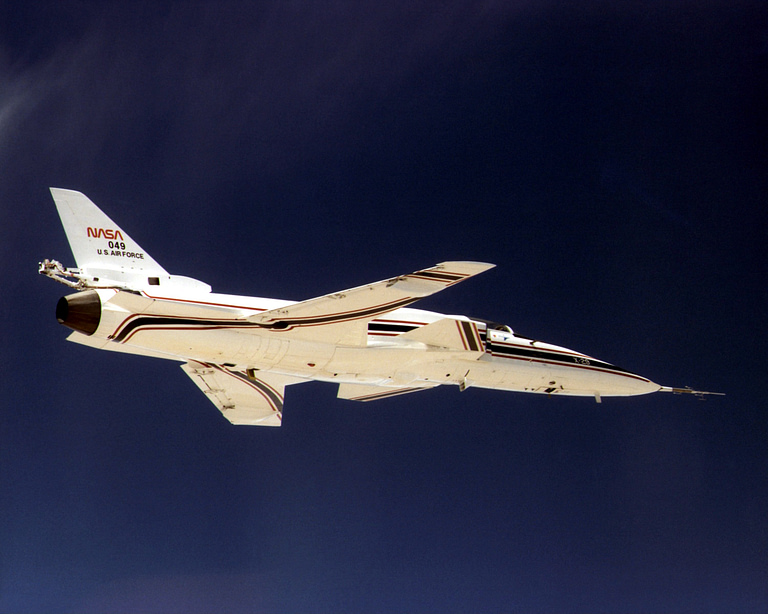
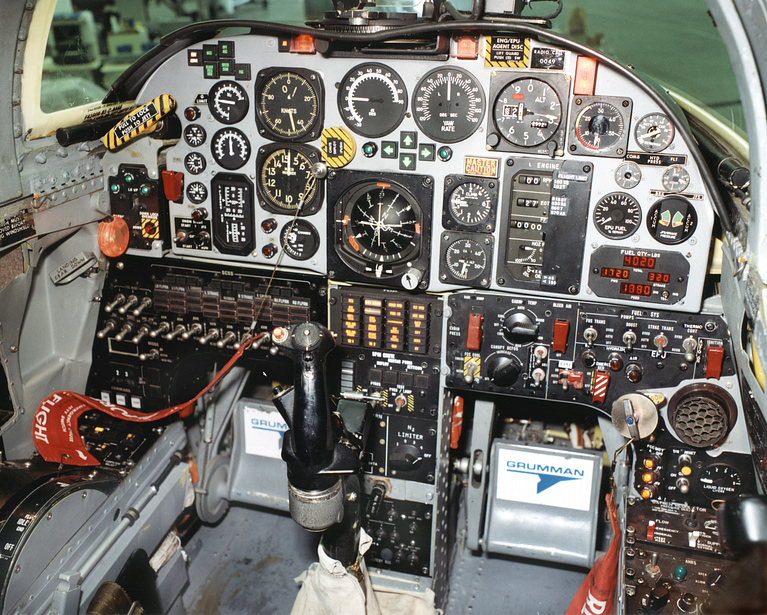
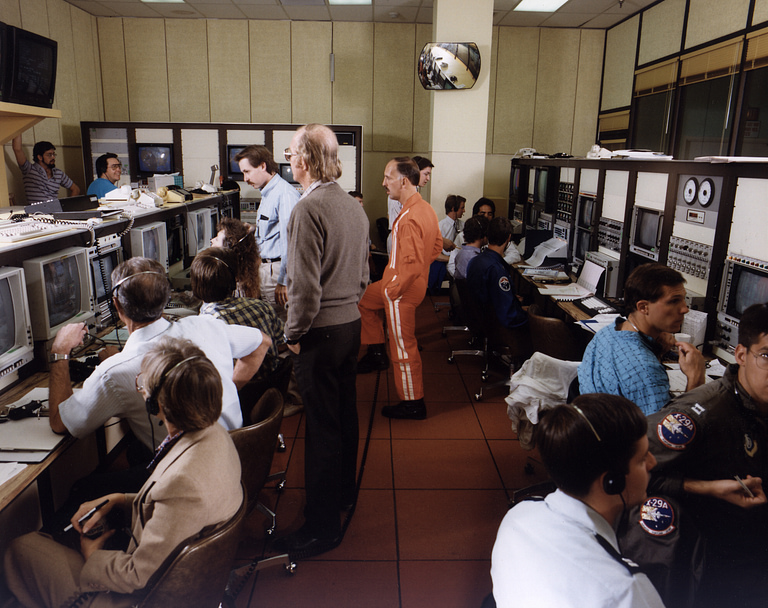
The X-29 in motion
A curated video feature for the Grumman X-29 is coming soon. In the meantime, explore the photo gallery above and the operations map below.
Where the X-29 flew
What it proved, not what it fought
The X-29 has no combat record — it was a research aircraft that never carried a weapon or left the United States. Its “score” is written in data. Across two aircraft and 422 research missions from 1984 to 1992, it demonstrated that a forward-swept composite wing could be flown safely, that an aggressively unstable airframe could be tamed by a fast enough computer, and that such a jet could stay under control at extreme angles of attack where conventional fighters lose it.
Compare the combat record of every military aircraft. Figures as of July 2026.
Everything people ask about the X-29
Can I fly in an X-29?
Why were the X-29’s wings swept forwards?
Was the X-29 really unstable?
How many X-29s were built, and do they still exist?
Is it true the X-29 was built from F-5 and F-16 parts?
Did the X-29 ever see combat?
You can’t fly the X-29.
These, you can.
Some legends only live in museums — others are fuelled and waiting. MiGFlug has put civilians in real military jet cockpits since 2004.
 Fly the L-39 AlbatrosThe world’s most-flown jet trainer — aerobatics included
 Fly the F-104 Starfighter“The missile with a man in it”
 Fly the MiG-21The Cold War’s most-produced jet
 T-33 Shooting Star'ı uçurunAmerica’s first jet trainer
 Fly the DH VampireA piece of early jet history
 Fly the S.211Agile Italian jet trainer
 Fly the MB-326The classic Aermacchi jet
 Fly the MiG-15The Soviet legend of the Korean War
Continue the tour
Every fact, checked
- NASA — X-29 Advanced Technology DemonstratorPrimary source for dimensions, engine, first-flight dates, 422 missions and preservation.
- NASA Armstrong Fact Sheet FS-008The triple fly-by-wire, 40-updates-per-second control system and high-alpha figures.
- National Museum of the U.S. Air Force — Grumman X-29AMuseum airframe (aircraft No. 1), programme background and instability.
- Smithsonian National Air and Space MuseumReference on forward-swept-wing aerodynamics and the aeroelastic-tailoring problem.
- NASA Technical Reports Server — X-29 flight researchTechnical reports on the forward-swept wing and high-angle-of-attack programme.
- MiGFlug Afterburner — The X-29 that flew with its wings on backwardsMiGFlug’s own feature on the forward-swept demonstrator.
- Fight’s On! — X-29 forward-swept-wing aircraftComponent origins (F-5A / F-16), composite wing and flight-test summary.
- Vintage Aviation News — Flight Test Files: X-29Aeroelastic tailoring, three-surface layout and programme narrative.