
Grumman X-29
“The jet with backwards wings”
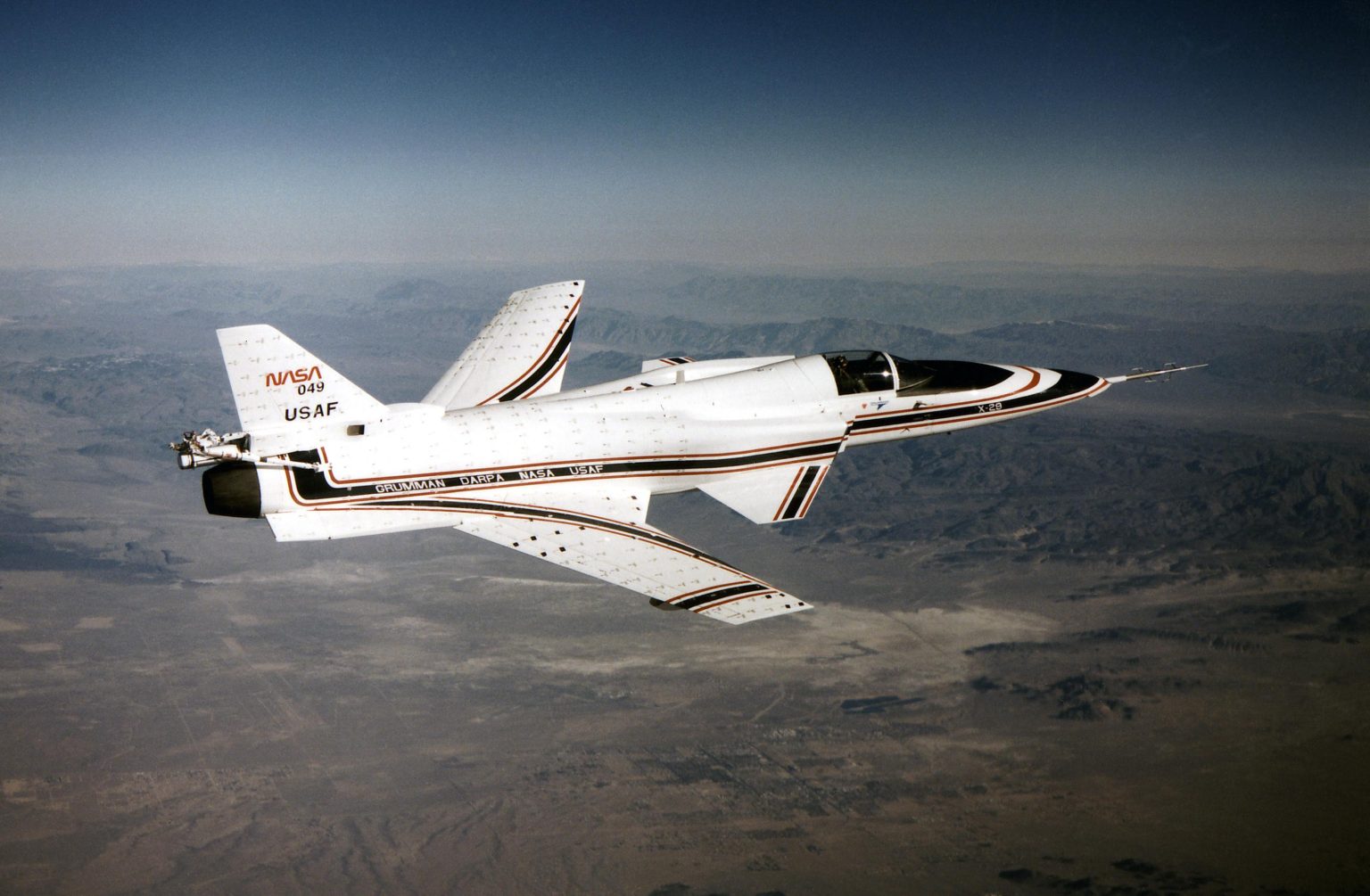
A forward-swept-wing, canard research jet that was deliberately built to be unflyable by a human alone — only a triple digital fly-by-wire computer, correcting up to 40 times a second, kept it in the air. Two were built from F-5 and F-16 parts; both survive.
The jet built to fly its wings backwards
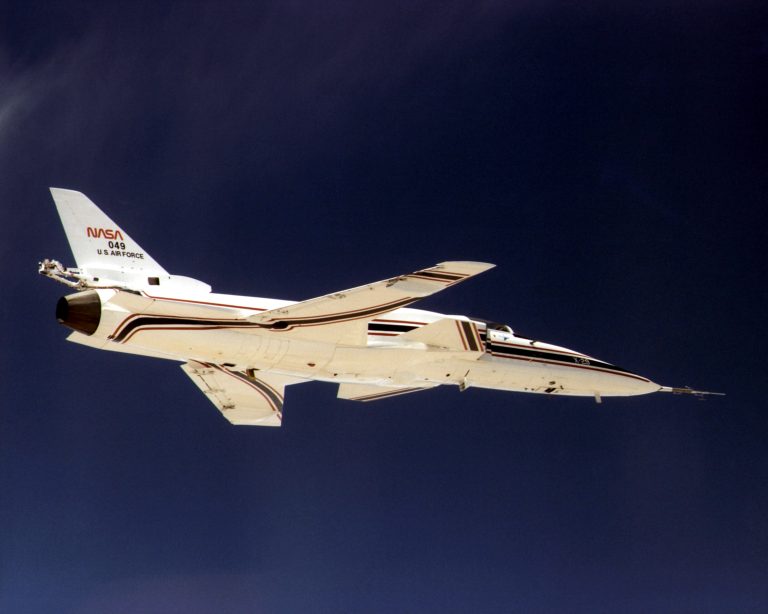
Look at almost any jet fighter and the wings sweep back, trailing away from the nose. The Grumman X-29 did the opposite: its wings swept sharply forward, more than 33 degrees, jutting ahead like a paper dart flown in reverse. It was one of the strangest-looking aircraft of the Cold War — and every bit of that oddity was on purpose.
Engineers had long known that a forward-swept wing offered real aerodynamic prizes: better low-speed handling, sharper manoeuvrability, resistance to the vicious wingtip stalls that plague swept-back designs, and cleaner airflow at high angles of attack. There was just one catch, and it was a killer. A forward-swept wing wants to twist itself apart. As speed rises, aerodynamic loads bend the wingtips up and forward, which increases their angle of attack, which increases the load again — a runaway feedback called aeroelastic divergence that, with 1940s metal, simply tore the wings off. The idea sat on the shelf for decades.
Two technologies finally made it flyable. The first was aeroelastic tailoring: skinning the wing in graphite-epoxy composite laid up so that as the wing bends, it also twists in the opposite direction, cancelling the divergence. The second was the computer. To get the aerodynamic payoff, the X-29 was also built to be aggressively unstable in pitch — reportedly up to about 35 percent unstable, its lift acting well ahead of its centre of gravity — so that, left alone, it would tumble out of control in well under a second. A human pilot could not react fast enough. Instead, a triple-redundant digital fly-by-wire system (with a triple analog backup) sensed the aircraft’s attitude and nudged the controls up to 40 times every second, flying the jet the pilot could only aim.
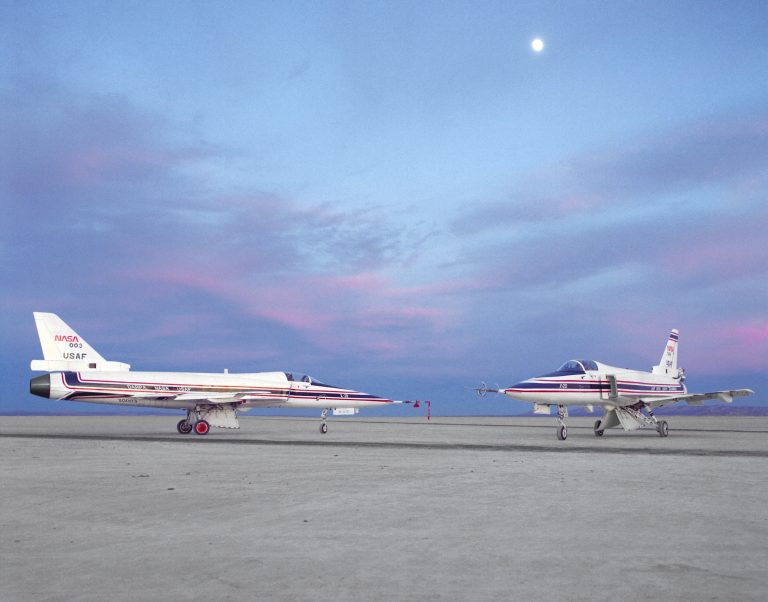
Funded by DARPA, the U.S. Air Force and NASA, and built quickly and cheaply by Grumman from a parts bin — the forward fuselage and nose gear of a Northrop F-5A, the main landing gear and control actuators of an F-16 — two X-29s first flew from Edwards in December 1984. Over 422 research missions to 1992 they proved the forward-swept concept worked, flew controllably to extreme high angles of attack, and never carried a weapon. Both survive: one in a museum, one at NASA.
01The Grumman X-29’s forward-swept wing: the prize, the problem and the fix
A wing swept forward instead of back reverses the way air flows across it. On a swept-back wing, airflow drifts outward toward the tips, so the tips tend to stall first — costing aileron control exactly when a pilot needs it most, at high angles of attack. A forward-swept wing pushes the airflow inward, toward the roots, so the tips keep flying and the ailerons stay effective deep into a high-alpha manoeuvre. That promised superb agility and docile stall behaviour.
The obstacle was structural, not aerodynamic. Under load, a forward-swept wing twists nose-up at the tips, raising the load further in a divergent loop that historically ripped wings from aircraft. The X-29 beat it with aeroelastic tailoring — carbon-fibre composite skins whose fibres are oriented so that bending automatically induces a counter-twist. The wing was allowed to flex, but it flexed in a way that cancelled the runaway rather than feeding it. Without composites, the X-29 could not have existed.
What makes it special
Wings swept the wrong way
The X-29’s defining feature is a wing swept forward by more than 33 degrees. It is not a styling gimmick: forward sweep drives airflow toward the wing roots, so the tips keep flying and the ailerons stay effective at high angles of attack, giving outstanding agility and gentle stall behaviour. The price is aeroelastic divergence — a tendency for the wing to twist itself apart — which is why the concept waited decades for the right materials.
Deliberately unstable, flown by computer
To harvest the aerodynamic payoff, the X-29 was designed to be aggressively unstable in pitch — reportedly up to about 35 percent unstable. Unattended, it would depart controlled flight in a fraction of a second. A triple-redundant digital fly-by-wire system, backed by three analog computers, reads the jet’s motion and adjusts the canards, flaperons and strake flaps up to 40 times a second. The pilot commands where to go; the computer does the flying.
A three-surface parts-bin jet
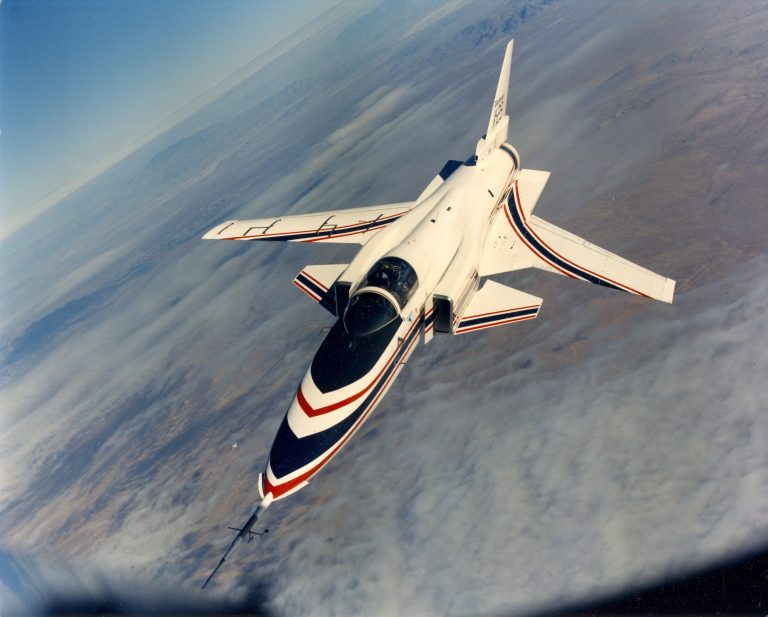
To keep cost and risk down, Grumman built the two X-29s largely from existing hardware: the forward fuselage and nose gear of a Northrop F-5A and the main landing gear and control actuators of an F-16, married to a new composite wing and a close-coupled canard. The result is a rare three-surface layout — canard, forward-swept wing and aft strake flaps — all worked together by the flight-control computer.
02The Grumman X-29’s fly-by-wire: why a computer flew it 40 times a second
A stable aircraft, disturbed by a gust, tends to return to steady flight on its own. The X-29 was built to do the reverse: any disturbance would grow, fast. That instability was wanted, because a naturally unstable airframe can be smaller, lighter and far more agile than a docile one — if something can react quickly enough to hold it steady. Nothing human can. A pilot’s reaction time is measured in tenths of a second; the X-29 could diverge in less.
The answer was a triple-redundant digital flight-control system with a further triple analog backup, sampling the aircraft’s attitude and rates and issuing corrections up to 40 times per second. Three channels let the system vote out any single faulty computer and keep flying. It is one of the clearest demonstrations ever flown that fly-by-wire does not merely assist a pilot — it can make an otherwise impossible aircraft controllable.
03The Grumman X-29’s high-alpha tests: control where other jets depart
Because forward sweep keeps the wingtips flying, the X-29 was expected to shine at extreme angles of attack — the nose-high, low-speed regime where conventional fighters lose control and “depart.” In a dedicated high-alpha programme, largely flown by the second aircraft, the X-29 demonstrated excellent, stable control response to around 45 degrees angle of attack and remained controllable, if limited, at up to about 67 degrees — attitudes at which most aircraft are simply falling.
The data fed directly into the agility and high-alpha research that shaped later fighters’ flight-control laws. The X-29 never fought anything; its contribution was knowledge — proof of how a well-controlled airframe behaves at the ragged edge of the envelope.
Full specifications
Figures are for the Grumman X-29A. As an experimental type only two were built, and published values vary slightly between NASA documents; figures are given as commonly cited.
Baseline note: the figures below describe the Grumman X-29A as flown — two airframes, 82-0003 and 82-0049, ordered from Grumman in December 1981 on a contract of about 87 million dollars for the pair, and flown from Edwards Air Force Base between 14 December 1984 and 1992 by a joint DARPA, US Air Force and NASA programme. The two aeroplanes were near-identical; deltas for aircraft No. 2, which carried the emergency spin recovery chute, the forebody pressure belt and later the vortex flow control nozzles, are in grey. Five published disagreements should be settled before the tables start. First, length: 48 ft 1 in is the fuselage and 53 ft 11 in is over the flight-test nose probe, and the widely copied metric conversion of 15 m for the former is arithmetic that nobody checked — 48 ft 1 in is 14.66 m. Second, weights: empty weight is given as 13,600 lb by NASA and 13,800 lb by most reference works, and maximum take-off weight as 17,600 lb by NASA and 17,800 lb in the Grumman and Air Force flight-test papers. Third, wing sweep, quoted variously at 29.3°, 33.7° and 35° because the sources are measuring different reference lines: 29.3° forward is the leading edge, the low-thirties figure is the quarter chord. Fourth, flight totals: NASA counts 242 research missions by aircraft No. 1, 120 by No. 2 in the high angle of attack phase and about 60 more in vortex flow control, giving 422 research flights inside 436 total, while older reference works say 374 and several online summaries give 242 for both aeroplanes together — which is in fact the figure for the first aeroplane alone. Fifth, the end date: 1991 if the programme stops at the high-alpha phase, 1992 if the vortex flow control flights are counted, and they should be.
Dimensions & weights
- Crew
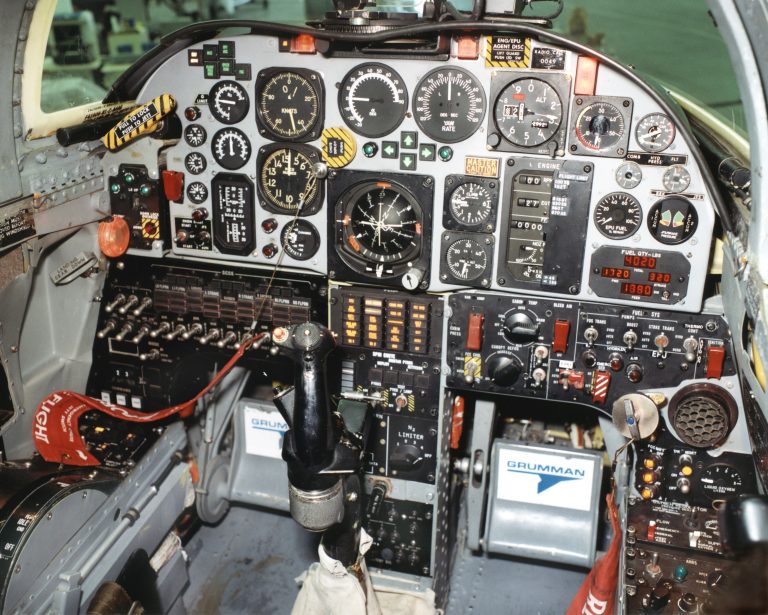
- 1 — in an F-5A forward fuselage and cockpit lifted whole from a Freedom Fighter, complete with its ejection seat and its canopy. The pilot sat ahead of a canard he could see moving in his peripheral vision, flying an aeroplane that would have tumbled out of control in well under a second without its computers. There was no second seat and no simulator time that could fully rehearse the failure case.
- Length
- 14.66 m (48 ft 1 in) fuselage. 16.44 m (53 ft 11 in) measured over the flight-test nose probe, which is the figure most photographs suggest and most spec tables quote without saying which they mean.
- Wingspan
- 8.29 m (27 ft 2.5 in) — short, because a forward-swept wing carries its structural problem at the root and lengthening the span makes the twisting worse, not better
- Height
- 4.36 m (14 ft 3.5 in) to the top of the fin
- Wing area
- 17.54 m² (188.8 sq ft). NASA and the 1986 Grumman programme-overview paper give 17.2 m² (185 sq ft); the difference is whether the strake carry-through is counted.
- Wing sweep
- 29.3° forward at the leading edge — about 33.7° forward at the quarter chord, which is the number most often quoted. Sweeping the wing forward rather than aft moves the spanwise pressure gradient inboard: the boundary layer drifts towards the root instead of the tip, so the root stalls first and the tips, with the ailerons on them, keep flying.
- Aerofoil
- Grumman K MOD 2 thin supercritical, 6.2 per cent at the root and 4.9 per cent at the tip — flight-test papers round this to a "5 per cent thin supercritical section". Thinness is the point and also the trap: a thin wing has little torsional stiffness, which is exactly what a forward-swept wing needs most.
- Aspect ratio and taper
- 4.0 (some tables give 3.9), taper ratio 0.4. A stubby, highly loaded planform — the X-29 was never meant to be efficient in cruise, only to prove that the shape could be flown at all.
- Canard
- All-moving, close-coupled, mounted high on the fuselage ahead of the wing; area equal to 20 per cent of the wing, about 3.5 m² (38 sq ft). Deflection range 30° leading edge up to 60° leading edge down, at rates to 100°/sec. Enormous for a canard, and it had to be: it was the primary pitch effector on an airframe with no tailplane and no natural stability to lean on.
- Strakes and strake flaps
- Long fuselage strakes running aft to the tailpipe, each carrying a strake flap either side of the rudder — travel 30° trailing edge up to 30° trailing edge down. The strakes also held integral fuel tanks. These were the third pitch surface and the one that gave nose-down authority when the canard was working in the wing’s wake at high alpha.
- Empty weight
- 6,169 kg (13,600 lb) per NASA. Grumman and most reference works give 6,260 kg (13,800 lb). Neither figure is unreasonable; the aeroplane gained weight through the programme as instrumentation was added.
- Maximum take-off weight
- 8,074 kg (17,800 lb) in the Air Force flight-test papers; NASA quotes 7,983 kg (17,600 lb). Roughly the mass of a lightly loaded F-5, on the engine of an F-18.
- Internal fuel
- 1,804 kg (3,978 lb) in two fuselage bladder tanks and two integral strake tanks. Several reference tables list this as a 4,000 lb "payload capacity", which is a misreading — the X-29 had no payload. That number is its fuel.
Performance
- Maximum speed (design)
- Mach 1.6 — about 1,771 km/h (1,100 mph, 956 kn) at 10,000 m (33,000 ft)
- Maximum Mach flown
- About Mach 1.5 — sources give Mach 1.48 to Mach 1.52 for the fastest flights. Mach 1.6 is the design limit, not a demonstrated figure, and the distinction is routinely lost in spec tables.
- First supersonic flight
- 13 December 1985 — the first forward-swept-wing aeroplane to exceed Mach 1 in level flight, almost exactly a year after the first flight
- Service ceiling
- 15,240 m (50,000 ft) per NASA, and the altitude to which the envelope was actually cleared. Some widely reproduced tables give 16,760 m (55,000 ft), which is a design figure.
- Endurance
- About one hour — a research sortie was typically 45 minutes to an hour, of which the useful test points occupied a few minutes. On afterburner the fuel went in minutes.
- Range
- About 650 km (350 nautical miles, 400 miles). Academic: the aeroplane never operated away from Edwards and its lakebed.
- Load factor limits
- 6.4 g subsonic, 5.2 g supersonic — the airframe was proof-tested to an 8 to 9 g design case, and 5.7 g was the maximum demonstrated in flight, on the 84th flight of the envelope expansion phase
- Longitudinal static margin
- Approximately −35 per cent subsonically — the centre of gravity sat about a third of a mean aerodynamic chord behind the aerodynamic centre. For comparison, an F-16A is around −5 per cent. This was, by a wide margin, the most statically unstable manned aeroplane flown up to that point, and it is the single number that explains the whole flight control system.
- Usable angle of attack
- 45° with excellent control response — flight test rated the aeroplane "good" to 40°, where roll control was still excellent and departure resistance high, against wind-tunnel predictions that it would be unflyable there
- Maximum angle of attack reached
- 67° in a momentary pitch-up on aircraft No. 2, with limited but real controllability; the envelope was formally cleared to 67° at 1 g and Mach 0.75
- Roll performance
- Excellent to 40° angle of attack — the central aerodynamic claim for the forward-swept wing, and the one the programme actually confirmed. Specific roll rates were not published in the open literature.
- Transonic drag
- Predicted saving of up to 13 per cent; not delivered — the measured basic drag polar shapes met or exceeded wind-tunnel predictions, but NASA’s own summary is blunt that the aeroplane "did not demonstrate the overall reduction in aerodynamic drag that earlier studies had suggested". This is the most consequential negative result of the programme.
Propulsion & systems
- Engine
- 1 × General Electric F404-GE-400 afterburning turbofan — the F-18A engine, chosen because it was mature, available and did not need developing. Almost nothing about the X-29 was novel except the parts that had to be.
- Thrust
- 71.2 kN with afterburner (16,000 lbf); about 47.2 kN (10,600 lbf) military dry
- Thrust to weight
- About 0.9 at maximum take-off weight — better than 1.0 at typical test weights with fuel burnt down
- Air intakes
- Fixed-geometry side inlets — no variable ramps or spikes. Another deliberate simplification: the aeroplane only had to reach Mach 1.6, and a variable inlet would have added cost and risk to a programme whose risk budget was entirely spent on the wing.
- Flight control system
- Triplex digital fly-by-wire with a triplex analogue backup — three digital channels voting against each other, with three independent analogue channels behind them, any one of which could fly the aeroplane home. On an airframe 35 per cent unstable this is not redundancy for comfort; a total control failure would have been unsurvivable within about half a second.
- Computation rate
- 80 Hz minor cycle, with most control law computation at 40 Hz — the source of the often-repeated line that the computers made "40 corrections per second". The rate is also the reason for the programme’s most instructive systems failure, described in the section below.
- Control modes
- Normal digital, digital reversion and analogue reversion — each with an "up and away" cruise submode and a power approach submode. A NORMHI mode was added for the high-alpha programme to stop the system automatically downmoding out of digital control in the middle of a test point, which would have been an alarming place to lose the good control laws.
- Automatic camber control
- Continuous trimming of the flaperons to hold optimum wing camber — automatic (ACC) and manual (MCC) modes. The double-hinged trailing-edge flaperons reshaped the aerofoil in flight for the flight condition. Non-optimum ACC settings during manoeuvres cost measurable performance, one of the quieter findings of the test programme.
- Pitch control
- Three surfaces — canard, symmetric flaperon, strake flap — blended by the control laws. Flaperon travel 10° up to 24.75° down at up to 68°/sec. The three-surface arrangement was itself one of the experiments, and its weakness was found in flight: minimum nose-down pitching moment was predicted to be nearly twice what a Class IV fighter specification recommends, which is the polite way of saying the aeroplane was short of authority to lower its own nose at very high alpha.
- Actuation and undercarriage
- F-16 control surface actuators, F-16 main landing gear, F-5A nose gear — together with an F-16 emergency power unit and jet fuel starter. The X-29 is a case study in spending money only where the research is: about half the airframe was other people’s hardware.
- Structure and materials
- Aluminium and titanium substructure with graphite-epoxy composite wing covers — the covers are the entire reason the aeroplane exists. Their plies are laid off-axis so that bending and twisting are elastically coupled: when lift bends the tips up, the layup twists the leading edge down, cancelling the divergent feedback that had made forward-swept wings unbuildable in metal.
- Emergency equipment
- Spin recovery chute on aircraft No. 2 only — a 5.8 m (19 ft) canopy on 23 m (75 ft) risers mounted at the base of the rudder, sized to recover the aeroplane from an upright or inverted spin or a deep stall. It was the only significant physical difference between the two airframes, and it is a fair measure of how little anyone trusted the predictions for 67° angle of attack.
04The Grumman X-29’s cost: a deliberately cheap way to test a wild idea
The X-29 was conceived as a low-cost demonstrator, which is exactly why Grumman raided the parts bin — using the forward fuselage of an F-5A and the landing gear and actuators of an F-16 rather than designing everything new. The 1981 contract to build the two aircraft was reported at about $87 million; total programme figures including years of NASA and Air Force flight research are variously cited higher, but no single audited lifetime number is published in a way comparable to a production fighter.
There is likewise no reliable public cost-per-flight-hour figure for the X-29. As a one-off research aircraft flown by NASA and the Air Force, its operating economics were never reported in the terms used for an operational type, so any precise dollar-per-hour claim should be treated as guesswork.
Armament & payload
The X-29 carried no weapons at all, and the instruments it carried instead are the only payload worth listing
The X-29 was never armed and was never meant to be. It carried no gun, no missile rails, no pylons and no wiring for any of them; the "4,000 lb payload" that appears in several reference tables is its fuel load, misfiled. What it carried instead was measurement: pressure orifices, strain gauges, accelerometers, angle-of-attack vanes, smoke generators, cameras and, in the last phase, bottled nitrogen to blow on its own nose. The aeroplane existed to answer one question — whether a forward-swept wing could be built stiff enough to fly and useful enough to justify itself — and everything bolted into it served that question. The six cards below therefore describe instrumentation, systems under test and the things deliberately left out, labelled honestly rather than padded with six empty weapons headings. Instrumentation fits changed repeatedly across eight years and differed between the two airframes and between the Phase 1, high-alpha and vortex flow control programmes; what follows is representative of each phase, not a single configuration either aeroplane held for long.
No gun, no pylons, and no wiring for either
- No armament of any kind was fitted, mounted, wired for or provisioned on either X-29A. There were no hardpoints and no ammunition bay.
- The 4,000 lb figure that appears as "payload capacity" in several published tables is the internal fuel capacity — 1,804 kg (3,978 lb) in two fuselage bladder tanks and two integral strake tanks. The X-29 had no payload in any military sense.
- The gun bay space in the inherited F-5A forward fuselage went to flight-test instrumentation and avionics, which is a neat summary of the whole aeroplane: a fighter’s nose repurposed as a laboratory.
- Nor did the programme ever propose arming it. Unlike the Bell X-1C, which was to have been an armament testbed, no X-29 variant with weapons was ever laid out. The military utility argument was to be settled by handling qualities, not by shooting.
- The nearest thing to an offensive system it ever carried was the vortex flow control blowing rig of 1992, which used compressed nitrogen to steer the aeroplane at angles of attack where the rudder had stopped working.
Air data: the noseboom and the wingtip probe
- A long flight-test noseboom carried three independent angle-of-attack vanes, one feeding each channel of the triplex flight control system, plus a single sideslip vane. On an aeroplane this unstable, angle of attack is not a comfort readout; it is a load-bearing input to the control laws.
- Airspeed and altitude were taken from a separate probe on the left wingtip, deliberately away from the forebody, because at high angle of attack the forebody flow field is precisely what corrupts nose-mounted static pressure.
- The noseboom adds 1.78 m (5 ft 10 in) to the aeroplane and is the reason the length is quoted two ways. It is also the reason the X-29 looks longer in photographs than its 48 ft fuselage suggests.
- Air data calibration through the transonic range was itself a test objective, as it had been on every research aeroplane since the X-1: the instruments measuring the experiment were part of the experiment.
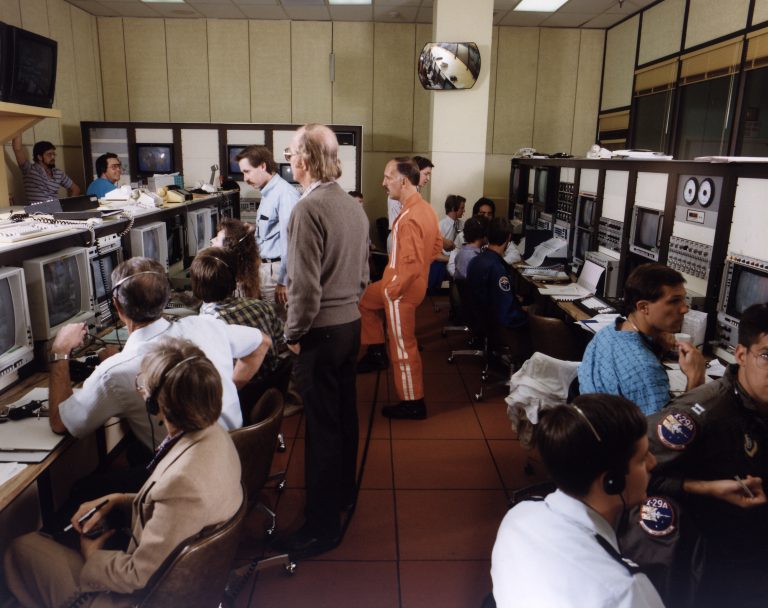
- Data went to the ground by real-time telemetry into Dryden’s control room, where engineers watched test points as they happened — a genuine advance over the film-and-oscillograph era, and the reason a 35 per cent unstable aeroplane could be flown safely at all.
Structures, aeroelasticity and the hunt for divergence
- Strain gauges through the wing box and carry-through structure measured the real loads arriving at the composite covers, against a design case proof-tested to 8 to 9 g while the flight envelope was limited to 6.4 g subsonic and 5.2 g supersonic.
- Divergence margin — the whole point — was tracked in flight by the Southwell technique, extrapolating structural response as dynamic pressure increased to estimate the speed at which the wing would run away. The margins proved sensitive to measurement scatter and preliminary results indicated lower divergence speeds than predicted, though still outside the flight envelope.
- That is the honest verdict on aeroelastic tailoring: it worked, it was not as comfortably conservative as the analysis claimed, and nobody ever saw the wing diverge.
- Flutter and loads envelope expansion consumed the first 84 flights, ending on 14 November 1986, clearing the aeroplane to 50,000 ft, Mach 1.5, 20° angle of attack and 5.7 g.
- NASA’s summary of the structural result is the sentence the programme should be remembered for: flight confirmed the feasibility of designing a forward-swept-wing aircraft that inhibits its natural tendency to static divergence by using strong, light graphite-epoxy layups for the wing covers.
The flight control system as the experiment
- Three digital computers voting against each other, backed by three analogue channels, running an 80 Hz minor cycle with most control law computation at 40 Hz. Three flight modes — normal digital, digital reversion, analogue reversion — each with cruise and power-approach submodes.
- Automatic camber control continuously trimmed the double-hinged flaperons to hold the best wing camber for the flight condition, with a manual mode for test work. Non-optimum settings during dynamic manoeuvres cost measurable performance, a finding that only flight could produce.
- The most instructive failure of the whole programme was a systems one. After control law gains were raised to improve pitch and roll response, a 26.5 Hz canard structural mode was aliased by the digital sampling in the canard position feedback loop and re-emerged as a 13.5 Hz command to the longitudinal surfaces, worst at Mach 0.80 and 15,000 ft.
- The cause was three things stacked: an anti-aliasing filter break frequency of 32 Hz set above the 20 Hz Nyquist frequency, a canard structural mode at 26.5 Hz, and worn canard seals that let the structure ring more freely. Fresh seals measurably reduced the response.
- It is the classic digital fly-by-wire trap, found the expensive way on an aeroplane that could not be flown without its computers, and it went straight into the lessons-learned literature that every fly-by-wire programme since has drawn on.
High angle of attack: pressures, smoke and tufts
- Aircraft No. 2 carried 202 static pressure orifices in four circumferential rows around the forebody at fuselage stations x/l = 0.026, 0.056, 0.136 and 0.201, plumbed with 1.8 m of 1.6 mm tubing to temperature-controlled electronic scanning modules read 25 times a second.
- The point was the asymmetric forebody vortices that form at high alpha and generate yawing moments a rudder can no longer counter — correlating nose pressures with aircraft yawing moment was one of the programme’s genuinely new contributions.
- An onboard smoke system with four cartridges in a forebody housing fed exhaust ports either side of the aeroplane, giving up to 30 seconds of dense white smoke, usable below 30,000 ft, to make the vortices visible.
- Tufts and flow cones on the wing upper surface and fin, spaced 16 in spanwise and 9 to 12 in chordwise, were filmed by two camera sets — an 8 mm camcorder and a 35 mm stills camera at the base of the fin, a second pair at the right wingtip. Off-surface data run from 25.5° to 50.5° alpha, surface data from 5° to 30°.
- The high-alpha aeroplane also carried the spin chute, and a NORMHI control mode that prevented the system dropping out of digital control mid-manoeuvre. Around 120 flights were flown in this phase.
Vortex flow control: nitrogen instead of rudder
- The last phase, run by the Air Force from 1991 into 1992, added a pneumatic forebody vortex control system to aircraft No. 2: paired nozzles set symmetrically on the upper nose, their axes angled 60° inboard, blowing to manipulate the forebody vortices directly.
- Air came from two Kevlar-wrapped, aluminium-lined bottles carrying up to 5.9 kg (13 lb) of gaseous nitrogen at 414 bar (6,000 psi). Three nozzle sizes were flown — 5.1, 7.3 and 8.9 mm (0.202, 0.286 and 0.350 in) — at blowing coefficients from 0.003 to 0.012.
- Tunnel work showed the technique effective from 15° to 55° angle of attack; flight demonstrations were made at 35° and 40°, and recovered a large part of the yaw control power lost above 30° where the rudder is blanketed.
- About 60 flights were flown in this phase, and the conclusion was that vortex flow control was mature enough to be integrated into an operational flight control system.
- Nothing has flown operationally with it. Thrust vectoring, demonstrated on the X-31 and the F-15 ACTIVE and put into service on the F-22, solved the same problem with hardware that also improves the aeroplane at every other angle of attack.
Three typical loadouts
- Envelope expansion sortie, 1985–86
- Aircraft No. 1, full internal fuel, noseboom and wingtip air data probe, wing and carry-through strain gauge harness, structural accelerometers, full telemetry downlink. A climb to a test altitude, a series of stabilised points and gentle wind-up turns at increasing dynamic pressure, structural response watched live on the ground for any hint of divergence, then home. Forty-five minutes for perhaps six usable minutes of data.
- High angle of attack sortie, 1990–91
- Aircraft No. 2, spin recovery chute armed, 202 forebody pressure orifices scanning at 25 samples a second, tufts and flow cones on the wing and fin, fin-base and wingtip cameras running, smoke cartridges loaded, NORMHI control mode selected so the system could not downmode mid-point. Decelerating 1 g stalls and rolls taken progressively deeper into the alpha envelope, with a chase aeroplane filming from outside.
- Vortex flow control sortie, 1992
- Aircraft No. 2 with the pneumatic blowing rig: two nitrogen bottles at 414 bar feeding paired upper-nose nozzles, one nozzle size per flight block. Post-stall points at 35° and 40° angle of attack, blowing commanded left and right in turn to measure how much of the lost rudder power could be bought back with 5.9 kg of gas.
Sourcing: the instrumentation detail above comes from NASA and Air Force flight-test papers in the NASA Technical Reports Server — the 1986 X-29A programme overview, the 1987 preliminary flight assessment, the operational view of the digital flight control system, the 1990 paper on the canard and flight control system interaction, the high-alpha flight dynamics summary, the forebody pressure and flow visualisation papers, and Walchli’s account of pneumatic forebody vortex control. Where those papers and the popular reference works disagree, the flight-test papers have been preferred. Fits described here are representative of a phase, not of a particular flight; instrumentation was added, removed and re-plumbed constantly across 436 flights.
Variants
Two airframes, three flight programmes, and a lineage of four forward-swept jets that never became a production aeroplane
There are no variants of the X-29 in the ordinary sense. Two aeroplanes were built to one standard and they stayed that way; what changed was the instrumentation, the control laws and the question being asked. The list below therefore treats the design study, the two airframes and the three flight programmes as the real divisions, and then places the aeroplane in the only lineage that makes sense of it — the short, strange line of forward-swept jets, of which the X-29 was the fourth to fly.
The engineering verdict is worth stating plainly, because the X-29 is usually remembered as a triumph and it was not quite that. The forward-swept wing did what its advocates promised aerodynamically: the spanwise flow ran inboard, the root stalled before the tip, the ailerons stayed effective, and the aeroplane was controllable to 45° angle of attack and momentarily to 67° on an airframe the wind tunnel said would depart long before. Aeroelastic tailoring worked; the wing never diverged. But the predicted transonic drag saving of up to 13 per cent did not appear, the composite covers that solved divergence were heavy and expensive, the three-surface arrangement was short of nose-down pitching moment at extreme alpha, and Air Force testing did not support the claims of exceptional manoeuvrability — the control laws had to damp the pitch response to keep the aeroplane from departing, which ate the agility the configuration was supposed to deliver.
Then the requirement moved. By the time the X-29 finished flying, the fighter argument had become an argument about low observability and supercruise, and a wing whose leading edges sweep forward on both sides is close to the worst planform anyone could choose for radar cross-section. Whatever agility the shape offered could also be had from thrust vectoring, which was demonstrated on the X-31 and the F-15 ACTIVE and went into service on the F-22 without demanding a novel structure. Sukhoi reached the same conclusion in Russia a decade later with the Su-47, and built exactly one. The X-29 answered its question honestly. The answer was that you can do it, and that on balance you should not.
- Grumman Model 712 (G-712) (design study, 1977–1981)
- Grumman’s in-house designation for the forward-swept-wing demonstrator, developed out of DARPA and Air Force Flight Dynamics Laboratory studies in the late 1970s that showed composite aeroelastic tailoring could finally beat the divergence problem. Grumman won the contract in December 1981, worth about 87 million dollars for two aircraft.
- X-29A No. 1 (82-0003, from F-5A 63-8372, 242 flights, 1984–1988)
- The first airframe, first flown from Edwards on 14 December 1984 by Grumman chief test pilot Chuck Sewell; NASA joined the programme four months later. First supersonic on 13 December 1985. Completed the 84-flight envelope expansion phase on 14 November 1986 and went on to performance, handling qualities and flight control work. No spin chute, because at this stage nobody intended to go near a departure.
- X-29A No. 2 (82-0049, from F-5A 65-10573, about 180 flights, 1989–1992)
- The second airframe, first flown 23 May 1989, built to the same standard but fitted with the emergency spin recovery chute at the base of the rudder — the only significant physical difference between the two aeroplanes. It flew the high angle of attack programme and then the vortex flow control programme, and it is the aeroplane that reached 67°.
- Phase 1 configuration (No. 1, 1984–1988)
- Envelope expansion, flutter and divergence clearance, drag polars, automatic camber control evaluation and flight control system assessment. Cleared to 50,000 ft, about Mach 1.5, 20° angle of attack and 5.7 g. This is the phase that proved the structure and produced the disappointing drag result.
- High angle of attack configuration (No. 2, 1989–1991, about 120 flights)
- Spin chute, 202 forebody pressure orifices, tufts, flow cones, smoke generators, wingtip and fin cameras, and a NORMHI control mode added to stop the system downmoding out of digital control during a test point. Cleared the aeroplane to 67° angle of attack at 1 g and Mach 0.75 and found it good to 40° with excellent roll control.
- Vortex flow control configuration (No. 2, 1991–1992, about 60 flights)
- An Air Force programme adding paired upper-nose nozzles fed by two Kevlar-wrapped nitrogen bottles at 414 bar, blowing on the forebody vortices to recover yaw control above 30° angle of attack where the rudder is blanketed. Demonstrated at 35° and 40°. These were the last X-29 flights.
- Proposed derivatives (studied 1984–1990, none built)
- Grumman and the Air Force sketched forward-swept-wing fighters, thrust-vectoring X-29 follow-ons and a third demonstrator at various points. None was funded. There was never an X-29B, and no production aeroplane of any nation has used a forward-swept wing.
- Junkers Ju 287 (Germany, first flight 16 August 1944, 1 flown)
- Not an X-29 variant, but its ancestor: the first jet aeroplane with a forward-swept wing, flown by Siegfried Holzbauer with fixed undercarriage in spats and four engines hung on the nose and wings. Hans Wocke’s team understood the divergence problem perfectly well and simply had no material that could beat it.
- OKB-1 EF 131 and HFB 320 Hansa Jet (1947 and 1964)
- The EF 131 was the Ju 287 line continued in the Soviet Union by the captured German team, six engines, first flown 23 May 1947 and abandoned. The Hansa Jet, also Wocke’s, first flew on 21 April 1964 and is the only forward-swept jet ever series-produced — 47 built — where the sweep was chosen to move the wing spar behind the cabin rather than for any aerodynamic reason.
- Sukhoi S-37 / Su-47 Berkut (Russia, first flight 25 September 1997, 1 built)
- The only other modern forward-swept-wing jet, and a close parallel: composite aeroelastically tailored wing, three-surface layout with canards, one aeroplane, no production. It is bigger and faster than the X-29 and it changed nothing either. Two national programmes, twenty years apart, reached the same verdict independently.
Survivors, precisely: both airframes exist, and both are original. X-29A No. 1, 82-0003, stands in the Research and Development Gallery of the National Museum of the United States Air Force at Wright-Patterson Air Force Base near Dayton, Ohio, alongside the X-1B and the other research types. X-29A No. 2, 82-0049, carried on the NASA register as NASA 849, is at the NASA Armstrong Flight Research Center on Edwards Air Force Base, California, on the centre’s own grounds rather than in a public museum — older reference works describing both aeroplanes as "stored at Ames-Dryden" are simply out of date. The full-scale X-29 at the Cradle of Aviation Museum in Garden City, New York, on Long Island where Grumman built the aeroplane, is a replica: it was moved there in 2011 from the National Air and Space Museum and should not be counted as a third airframe. Nothing else exists; only two were ever built. One further correction to the usual account: the X-29 is often called the first forward-swept-wing jet, and it was the fourth to fly, after the Ju 287 of 1944, the EF 131 of 1947 and the Hansa Jet of 1964. What was new in 1984 was not the sweep but the wing covers — and the computers without which an airframe 35 per cent statically unstable could not have left the ground.
From a shelved idea to a computer-flown jet
The call goes out
DARPA and the U.S. Air Force Flight Dynamics Laboratory invite proposals for a forward-swept-wing technology demonstrator, an idea made newly practical by composites.
Grumman is chosen
Grumman wins a contract reported at about $87 million to build two X-29A aircraft, using an F-5A forward fuselage and F-16 landing gear and actuators.
First flight
On 14 December, X-29 No. 1 makes its maiden flight from Edwards AFB, flown by Grumman test pilot Chuck Sewell — a jet no human could hold steady without its computers.
Through the sound barrier
The X-29 goes supersonic, confirming the forward-swept composite wing behaves as predicted at transonic and supersonic speed.
The second aircraft flies
X-29 No. 2 makes its first flight on 23 May, dedicated to the high-angle-of-attack research phase.
High-alpha campaign
Flying to around 45° angle of attack under full control — and briefly to about 67° — the X-29 explores flight regimes where conventional fighters depart.
Programme ends
After 422 research missions across both aircraft, the joint DARPA/NASA/USAF X-29 programme concludes, the forward-swept concept proven.
Both preserved
X-29 No. 1 is displayed at the National Museum of the U.S. Air Force, Dayton; No. 2 is preserved at NASA’s Armstrong Flight Research Center in California.
Twelve Grumman X-29 stories
The plane that looks wrong
Forward-swept wings make the X-29 look like it is flying in reverse — on purpose.
Read the full story
The wing that wanted to tear off
Forward-swept wings twist themselves apart — which is why the idea waited 40 years.
Read the full story
Built to be uncontrollable
The X-29 was designed to fall out of the sky — then handed to a computer.
Read the full story
The invisible pilot
A triple fly-by-wire system flew the X-29 by correcting it 40 times every second.
Read the full story
An F-5 nose and F-16 legs
To save money, Grumman built the X-29 out of other jets’ pieces.
Read the full story
Canard, wing and strake
The X-29 steered with three sets of surfaces working together.
Read the full story
14 December 1984
Grumman test pilot Chuck Sewell took the impossible jet up for the first time.
Read the full story
Flying where others fall
The X-29 stayed controllable at angles of attack that make normal fighters depart.
Read the full story
The Ju 287 connection
A forward-swept jet flew in Nazi Germany — and pointed the way to the X-29.
Read the full story
A fighter that never fought
The X-29 looks like a warplane but never carried a single weapon.
Read the full story
Only a pair, both survive
Just two X-29s were ever built — and both are still with us.
Read the full story
Why forward sweep vanished
The X-29 proved forward sweep worked — and then no one built another.
Read the full story
The X-29 in pictures
The X-29 in motion
A curated video feature for the Grumman X-29 is coming soon. In the meantime, explore the photo gallery above and the operations map below.
Where the X-29 flew
What it proved, not what it fought
The X-29 has no combat record — it was a research aircraft that never carried a weapon or left the United States. Its “score” is written in data. Across two aircraft and 422 research missions from 1984 to 1992, it demonstrated that a forward-swept composite wing could be flown safely, that an aggressively unstable airframe could be tamed by a fast enough computer, and that such a jet could stay under control at extreme angles of attack where conventional fighters lose it.
Compare the combat record of every military aircraft. Figures as of July 2026.
Everything people ask about the X-29
Can I fly in an X-29?
Why were the X-29’s wings swept forwards?
Was the X-29 really unstable?
How many X-29s were built, and do they still exist?
Is it true the X-29 was built from F-5 and F-16 parts?
Did the X-29 ever see combat?
You can’t fly the X-29.
These, you can.
Some legends only live in museums — others are fuelled and waiting. MiGFlug has put civilians in real military jet cockpits since 2004.
 Fly the L-39 AlbatrosThe world’s most-flown jet trainer — aerobatics included
 Fly the F-104 Starfighter“The missile with a man in it”
 Fly the MiG-21The Cold War’s most-produced jet
 Fly the T-33 Shooting StarAmerica’s first jet trainer
 Fly the DH VampireA piece of early jet history
 Fly the S.211Agile Italian jet trainer
 Fly the MB-326The classic Aermacchi jet
 Fly the MiG-15The Soviet legend of the Korean War
Continue the tour
Every fact, checked
- NASA — X-29 Advanced Technology DemonstratorPrimary source for dimensions, engine, first-flight dates, 422 missions and preservation.
- NASA Armstrong Fact Sheet FS-008The triple fly-by-wire, 40-updates-per-second control system and high-alpha figures.
- National Museum of the U.S. Air Force — Grumman X-29AMuseum airframe (aircraft No. 1), programme background and instability.
- Smithsonian National Air and Space MuseumReference on forward-swept-wing aerodynamics and the aeroelastic-tailoring problem.
- NASA Technical Reports Server — X-29 flight researchTechnical reports on the forward-swept wing and high-angle-of-attack programme.
- MiGFlug Afterburner — The X-29 that flew with its wings on backwardsMiGFlug’s own feature on the forward-swept demonstrator.
- Fight’s On! — X-29 forward-swept-wing aircraftComponent origins (F-5A / F-16), composite wing and flight-test summary.
- Vintage Aviation News — Flight Test Files: X-29Aeroelastic tailoring, three-surface layout and programme narrative.