
North American X-15
the fastest crewed aeroplane ever flown
A black, rocket-powered dart dropped from beneath a B-52 to probe the edge of space — the machine that flew a pilot to Mach 6.7 and past the Kármán line, and taught America how to come home from space.
The rocket plane that flew to the edge of space
In the mid-1950s, with the sound barrier already behind it and the space race not yet begun, the United States set itself a staggering new question: could a piloted aircraft fly at hypersonic speed — above Mach 5 — and out of the atmosphere altogether, and could its crew survive the heat and the return? To find out, the National Advisory Committee for Aeronautics (NACA), o US Air Force ve US Navy jointly commissioned a single, uncompromising machine from North American Aviation: the X-15.
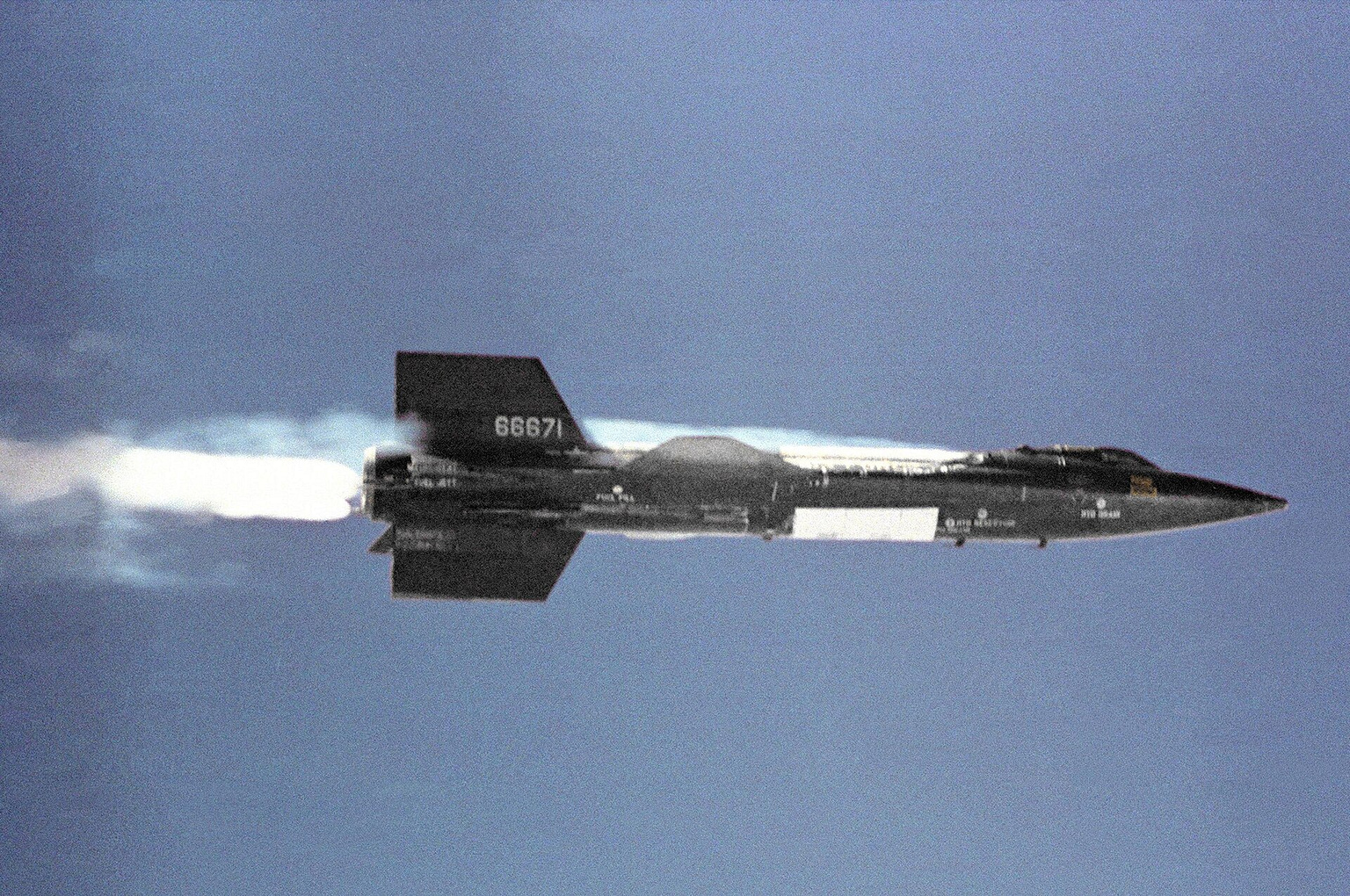
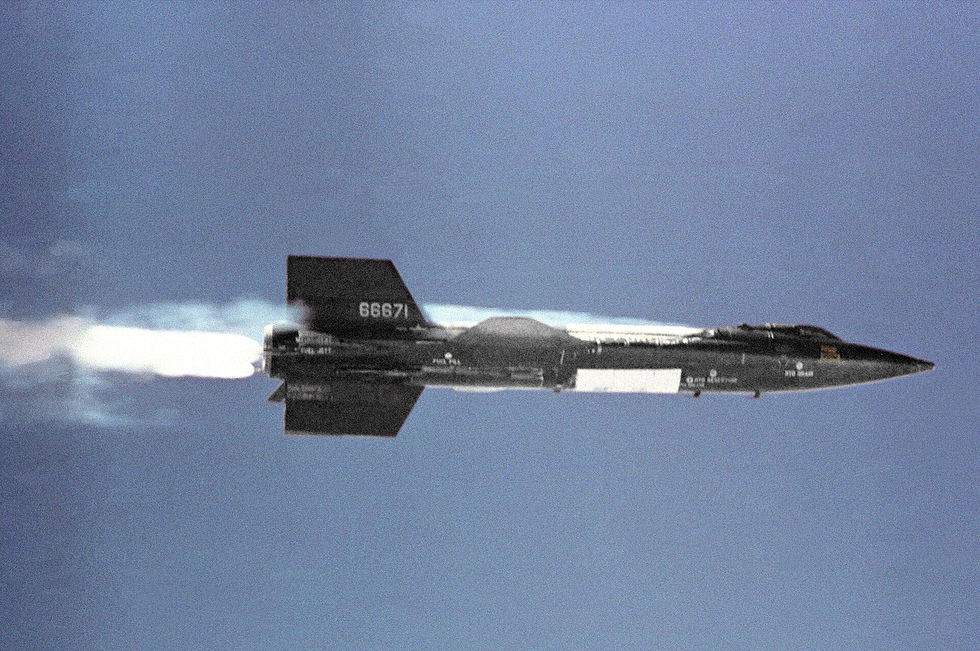
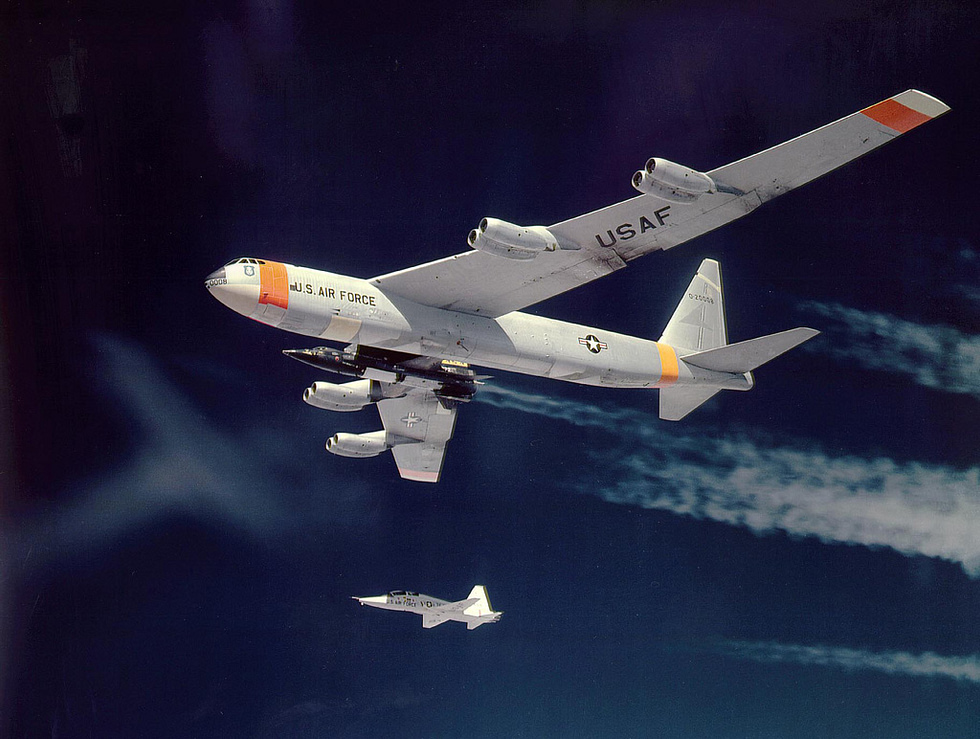
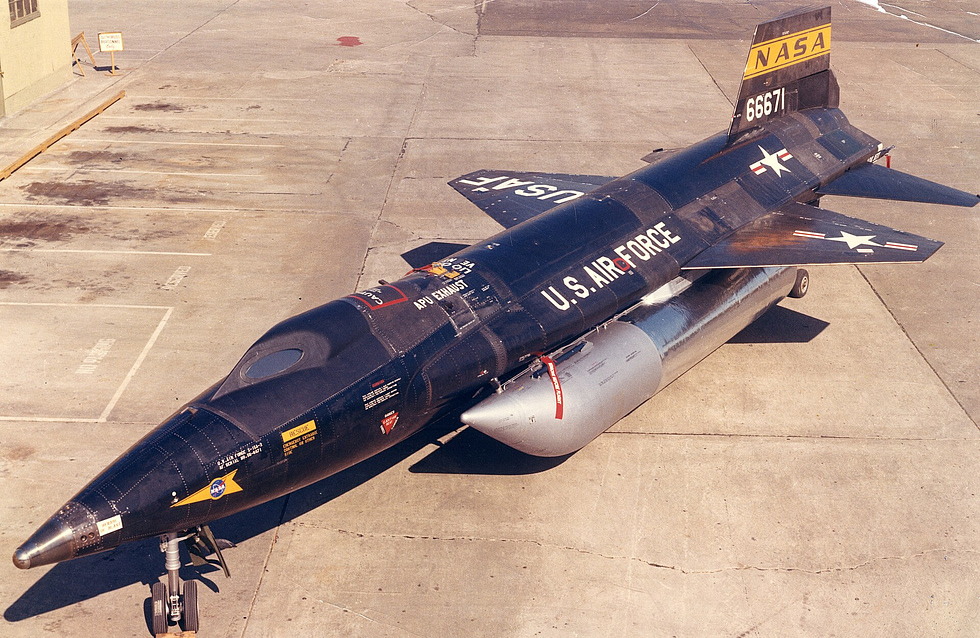
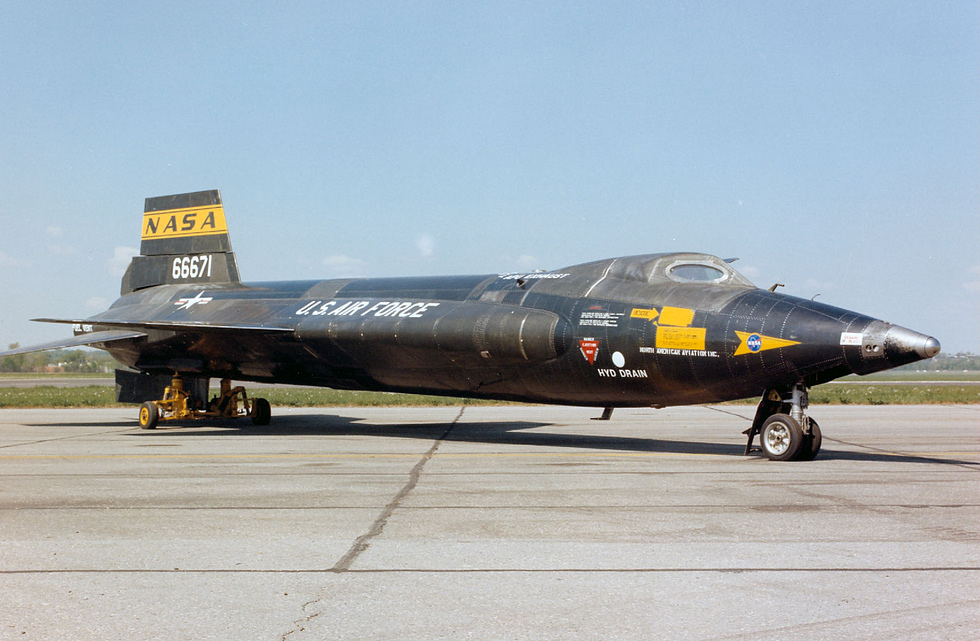
It looked like nothing else — a stubby-winged black projectile with a wedge tail, built not of aluminium but of Inconel X, a nickel-chrome superalloy chosen to soak up aerodynamic heating that could reach roughly 650 °C. Because its rocket drank propellant in minutes, the X-15 could not take off; it was carried aloft under the wing of a modified B-52 and dropped at about 45,000 feet, lighting its Reaction Motors XLR99 only once it fell clear. That single throttleable rocket produced around 57,000 pounds of thrust — enough to fling the aircraft upward on a ballistic arc where the air grew too thin for wings, and where the pilot steered instead with hydrogen-peroxide reaction thrusters in the nose and wings, exactly as a spacecraft would.
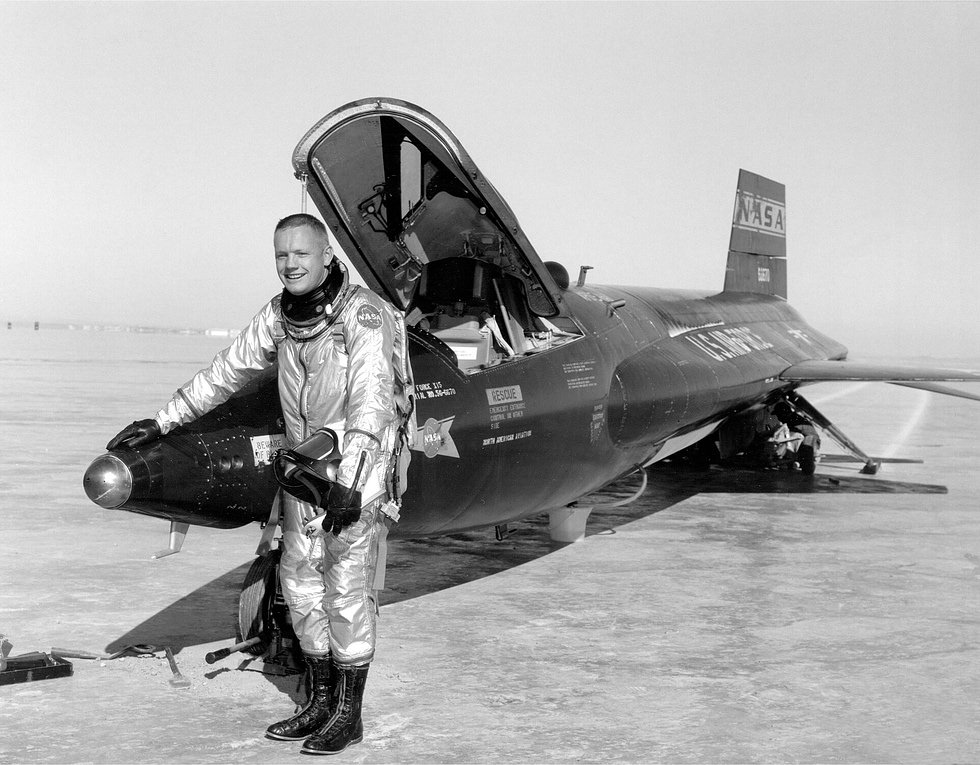
Between 1959 and 1968 three X-15s flew 199 times, and the numbers they set still stand as milestones. On 3 October 1967 Major William “Pete” Knight took the modified X-15A-2 to Mach 6.7 (7,274 km/h) — a speed no crewed aircraft has matched to this day. On 22 August 1963 NASA pilot Joe Walker climbed to about 107 km, above the internationally recognised Kármán line, becoming an astronaut in an aeroplane. Thirteen pilots flew the programme, among them a young NASA civilian named Neil Armstrong.
It was not without cost. On 15 November 1967 Major Michael Adams was killed when his X-15 entered a hypersonic spin and broke up during re-entry — the programme’s only fatality. But the data the X-15 brought back — on hypersonic aerodynamics, heat, reaction controls and dead-stick returns from the edge of space — fed directly into Mercury, Gemini, Apollo and the Space Shuttle. When the Shuttle glided silently onto a desert lakebed years later, it was flying a path the X-15 had scouted first.
01The X-15’s astronaut-wings controversy: the 50-mile line that split a flight crew
Eight X-15 pilots flew above the 50-mile altitude the United States used to define the edge of space, but their reward depended on the flag on their flight suit. The five US Air Force pilots — Robert White, Robert Rushworth, Joe Engle, Pete Knight and Michael Adams — were awarded military astronaut wings. The three NASA civilians who flew just as high — Joe Walker, Jack McKay and William Dana — received nothing at the time. NASA finally corrected the injustice in 2005, awarding civilian astronaut wings to all three — two of them, Walker and McKay, posthumously. To muddy it further, the world air-sports body (the FAI) drew the line higher, at 100 km; only two X-15 flights, both by Walker in 1963, crossed that mark.
What makes it special
A throttleable rocket, air-launched from a B-52
The X-15 was driven by a single Reaction Motors XLR99 — the first large, human-rated, throttleable rocket engine — burning anhydrous ammonia and liquid oxygen for about 57,000 lbf (~254 kN). It drained its tanks in roughly 80–120 seconds, far too fast to take off and climb, so the aircraft was carried aloft under the wing of a modified B-52 and dropped at about 45,000 feet before lighting the rocket.
An airframe of Inconel X, built to take the heat
At hypersonic speed friction turns the air to fire. Aluminium would have melted, so North American skinned the X-15 in Inconel X, a nickel-chrome superalloy, and used the structure itself as a heat sink to soak up aerodynamic heating of roughly 650 °C (1,200 °F). The crew cabin was thermally isolated inside the hot outer shell — the aircraft was, in effect, a reusable, pilot-carrying meteor.
Reaction-control thrusters for flight in space
Above about 30 km the air is too thin for rudders and ailerons to bite. So the X-15 carried a second control system borrowed from spacecraft: hydrogen-peroxide reaction thrusters in the nose (pitch and yaw) and wingtips (roll). Pilots flew the ballistic arc over the top on these jets alone, learning the reaction-control techniques that Mercury, Gemini and Apollo would soon depend on.
02The X-15’s XLR99 rocket and B-52 drop: why the fastest aeroplane could not take off
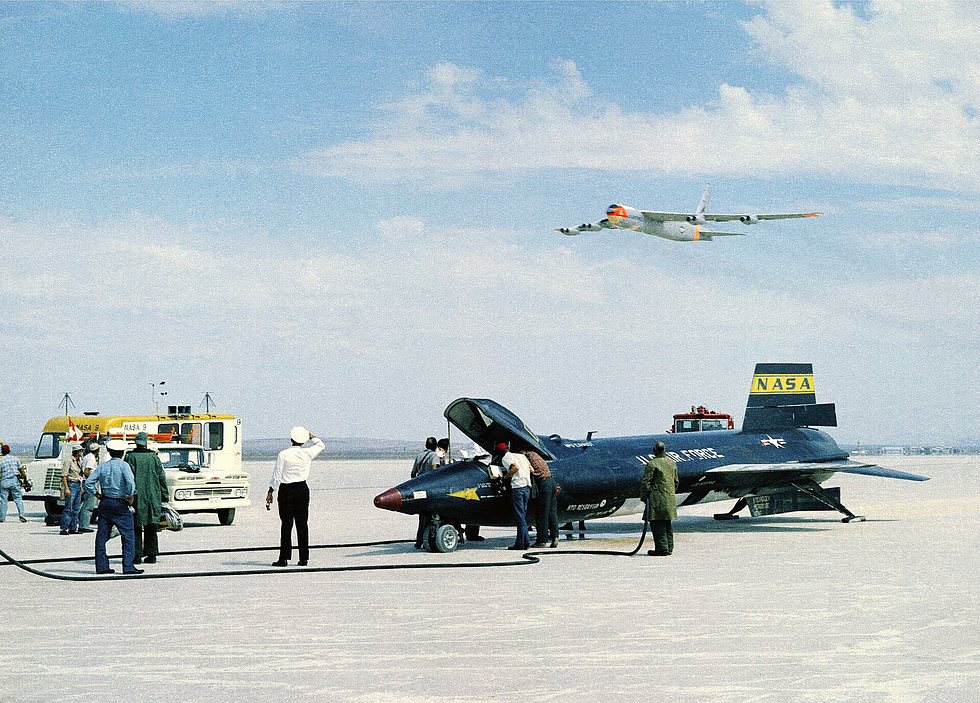
A rocket engine is monstrously powerful and monstrously thirsty. The XLR99 could deliver about 57,000 pounds of thrust, but it emptied the X-15’s propellant tanks in only a minute or two — an aircraft carrying enough ammonia and liquid oxygen to climb to test altitude Ve accelerate past Mach 6 could never have lifted off a runway under its own power. The answer, inherited from the Bell X-1, was to make the X-15 a parasite: two modified B-52s (an NB-52A and an NB-52B) carried it to about 45,000 feet and released it at roughly 500 mph. Only after it fell clear did the pilot light the rocket — and the clock, measured in seconds of burn time, began to run.
03The X-15’s return from space: dead-stick landings on a desert lakebed
Once the rocket burned out, the X-15 became the world’s fastest glider. Every flight ended the same way: a long, unpowered, high-speed descent to a dead-stick landing on the vast hard clay of Rogers Dry Lake at Edwards Air Force Base, the pilot dropping a pair of rear skids and a nose wheel and sliding to a halt. There was no engine to wave off with and no second chance. Learning to bring a hypersonic vehicle home unpowered, and to hit a precise point after a ballistic arc, was one of the X-15’s most direct gifts to the Space Shuttle, which landed exactly the same way twenty years later.
Full specifications
Airframe & Performance
- Mürettebat
- 1
- Uzunluk
- 15.45 m (50 ft 9 in) · X-15A-2 15.98 m
- Kanat açıklığı
- 6.8 m (22 ft 4 in)
- Yükseklik
- 4.12 m (13 ft 6 in)
- Boş ağırlık
- ~6,620 kg (14,600 lb)
- Launch weight
- ~14,200 kg (31,275 lb) · up to ~25,500 kg as X-15A-2
- Max speed
- Mach 6.7 · 7,274 km/h (Knight, 1967)
- Peak altitude
- 107,960 m · 354,200 ft (Walker, 1963)
- Skin temperature (design)
- ~650 °C (1,200 °F)
- Powered flights
- 199 total · 1959–1968
Propulsion & Systems
- Motor
- 1 × Reaction Motors XLR99 (early: 2 × XLR11)
- Thrust
- ~254 kN (~57,000 lbf), throttleable
- Propellant
- Anhydrous ammonia + liquid oxygen
- Powered endurance
- ~80–120 seconds
- Attitude control
- Hydrogen-peroxide reaction thrusters
- Launch method
- Air-dropped from a B-52 at ~45,000 ft
- First flight (glide)
- 8 June 1959
- Built
- 3 airframes (56-6670/6671/6672)
- Unit cost
- No fixed price (research prototypes)
- Cost per flight hour
- Not applicable · one-off research program
04The X-15’s cost: a national research program, not a production aircraft
The X-15 was never priced like a service aircraft. It was a government research program of three hand-built airframes, funded jointly by NACA (later NASA), the US Air Force and the US Navy, flown a few dozen times each purely to gather data. There is no meaningful flyaway unit price or cost-per-flight-hour for a machine that existed only to probe hypersonic flight and the edge of space, that was launched from a converted bomber, and that landed as a glider. The whole program is usually reckoned in the low hundreds of millions of 1960s dollars — but any single-aircraft dollar figure is an accounting estimate, not a market price.
From a hypersonic question to the edge of space
The program is approved
NACA, the US Air Force and the US Navy agree to build a piloted hypersonic research aircraft; North American Aviation wins the contract in 1955.
First flights
On 8 June, North American test pilot Scott Crossfield makes the first unpowered glide flight; the first rocket-powered flight follows on 17 September.
Mach 4, 5 and 6
With the definitive XLR99 engine, Robert White pushes the X-15 past Mach 4, Mach 5 and, in November, Mach 6 — the first crewed flights at those speeds.
Wings and a wild ride
Robert White climbs above 50 miles to earn the first X-15 astronaut wings; weeks earlier Neil Armstrong ballooned off the atmosphere and overshot Edwards toward Pasadena.
Above the Kármán line
On 22 August, Joe Walker reaches 354,200 ft (about 107 km), above the internationally recognised edge of space — the program’s highest flight.
The X-15A-2 returns
Rebuilt and stretched after a 1962 landing accident, aircraft #2 re-enters testing as the X-15A-2, fitted to carry two external propellant tanks.
Mach 6.7 — and tragedy
On 3 October Pete Knight sets the crewed airspeed record of Mach 6.7. Six weeks later, on 15 November, Michael Adams is killed when his X-15 breaks up in a hypersonic spin.
The program ends
On 24 October, William Dana flies the 199th and final X-15 mission. A planned 200th flight is repeatedly scrubbed and never made.
Legacy in orbit
X-15 data on hypersonic heating, reaction controls and dead-stick returns feeds directly into Mercury, Gemini, Apollo and the Space Shuttle.
From the flight line: twelve X-15 stories
The speed mark that will not die
A 1967 airspeed record no crewed aircraft has beaten in nearly 60 years.
Read the full story
The coating that charred
To reach Mach 6.7 they sprayed the aircraft with armour designed to burn away.
Read the full story
Above the Kármán line
A test pilot flew an aeroplane into space — twice.
Read the full story
The spin at Mach 5
The X-15’s only fatal flight began with a slow drift into disaster.
Read the full story
Neil Armstrong bounces off the sky
The first man on the Moon once accidentally flew halfway to Los Angeles.
Read the full story
Crossfield and the engine that blew up
The X-15’s own test pilot survived his rocket exploding behind him.
Read the full story
Astronaut, or not?
Whether you had been to space depended on which service you flew for.
Read the full story
Landing on a dry lake
A plane with no engine and skids for wheels, aimed at a lakebed.
Read the full story
Grandfather of the spaceplane
Before the Shuttle glided home, the X-15 proved it could be done.
Read the full story
A skin of superalloy
Ordinary aluminium would have turned to soup, so they built it from jet-engine metal.
Read the full story
Dropped from the wing of a bomber
The X-15 could not take off — it had to be carried up and let go.
Read the full story
Pete Knight, fastest man in an aeroplane
One pilot holds aviation’s ultimate speed mark — and few know his name.
Read the full story
The X-15 in pictures
The X-15 in motion
A hand-picked, high-authority film of the X-15 dropping from its B-52 and rocketing to the edge of space is on the way — video coming soon.
Where the X-15 flew
The records that define it
The X-15 never fired a shot — it was a research aircraft, and its victories were milestones rather than kills. Each one pushed the frontier of what a piloted machine could do, and two of them have stood unbeaten for well over half a century.
Explore the whole collection in the MiGFlug Aircraft Museum.
Everything people ask about the North American X-15
Can I fly in an X-15?
How fast could the X-15 go?
How high did the X-15 fly?
Did X-15 pilots become astronauts?
Did Neil Armstrong fly the X-15?
What engine did the X-15 use and how was it launched?
Where can I see an X-15 today?
You can’t fly the X-15.
These, you can.
Some legends only live in museums — others are fuelled and waiting. MiGFlug has put civilians in real military jet cockpits since 2004.
 Fly the L-39 AlbatrosThe world’s most-flown jet trainer — aerobatics included
 Fly the F-104 Starfighter“The missile with a man in it”
 Fly the MiG-21The Cold War’s most-produced jet
 T-33 Shooting Star'ı uçurunAmerica’s first jet trainer
 Fly the DH VampireA piece of early jet history
 Fly the S.211Agile Italian jet trainer
 Fly the MB-326The classic Aermacchi jet
 Fly the MiG-15The Soviet legend of the Korean War
Continue the tour
Every fact, checked
- NASA — X-15 Hypersonic Research ProgramCore fact sheet: 199 flights, serials, XLR99, Inconel-X, records and the pilot roster.
- NASA — X-15 Hypersonic Research AircraftSpecifications, structure and materials, program dates and engine thrust.
- National Museum of the U.S. Air Force — North American X-15A-2Museum record for the actual Mach 6.7 record-setter and its external tanks.
- Air Force Test Center — October 3, 1967: X-15 Human Speed RecordPete Knight’s Mach 6.7 flight, the ablative coating and the dummy ramjet.
- Smithsonian NASM — The X-15 Still Holds the World Speed RecordContext for the standing crewed airspeed record and the aircraft’s legacy.
- NASA — X-15 Space Pioneers Now Honored as AstronautsThe 2005 civilian astronaut-wings award to Walker, McKay and Dana and the 50-mile line.
- NASA History — Michael J. AdamsThe fatal Flight 191 spin and breakup and Adams’ posthumous astronaut wings.
- Smithsonian Magazine — Neil Armstrong’s X-15 Flight Over PasadenaThe ballooning re-entry that carried Armstrong far past Edwards.