
North American X-15
the fastest crewed aeroplane ever flown
A black, rocket-powered dart dropped from beneath a B-52 to probe the edge of space — the machine that flew a pilot to Mach 6.7 and past the Kármán line, and taught America how to come home from space.
The rocket plane that flew to the edge of space
In the mid-1950s, with the sound barrier already behind it and the space race not yet begun, the United States set itself a staggering new question: could a piloted aircraft fly at hypersonic speed — above Mach 5 — and out of the atmosphere altogether, and could its crew survive the heat and the return? To find out, the National Advisory Committee for Aeronautics (NACA), the US Air Force and the US Navy jointly commissioned a single, uncompromising machine from North American Aviation: the X-15.
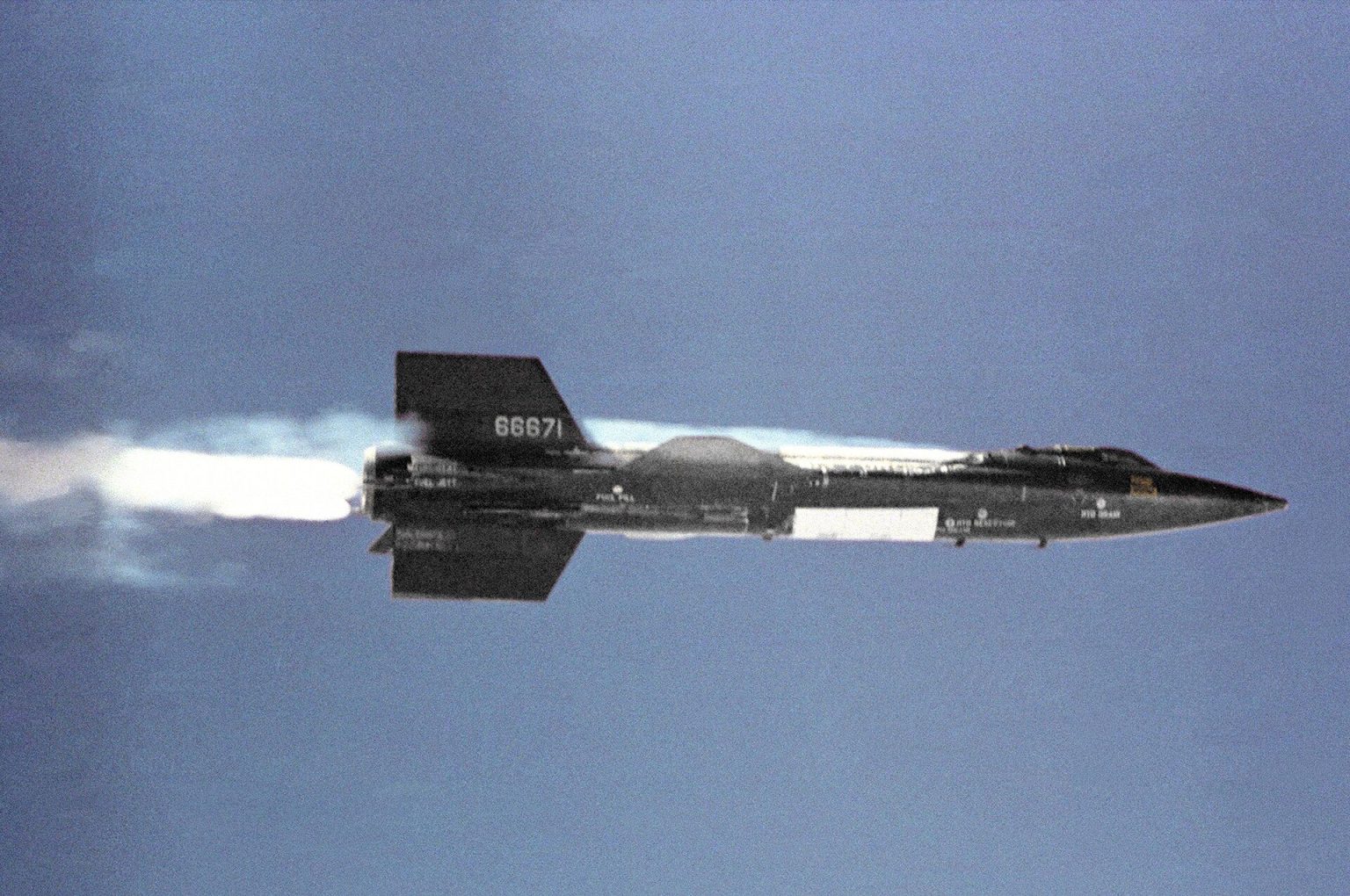
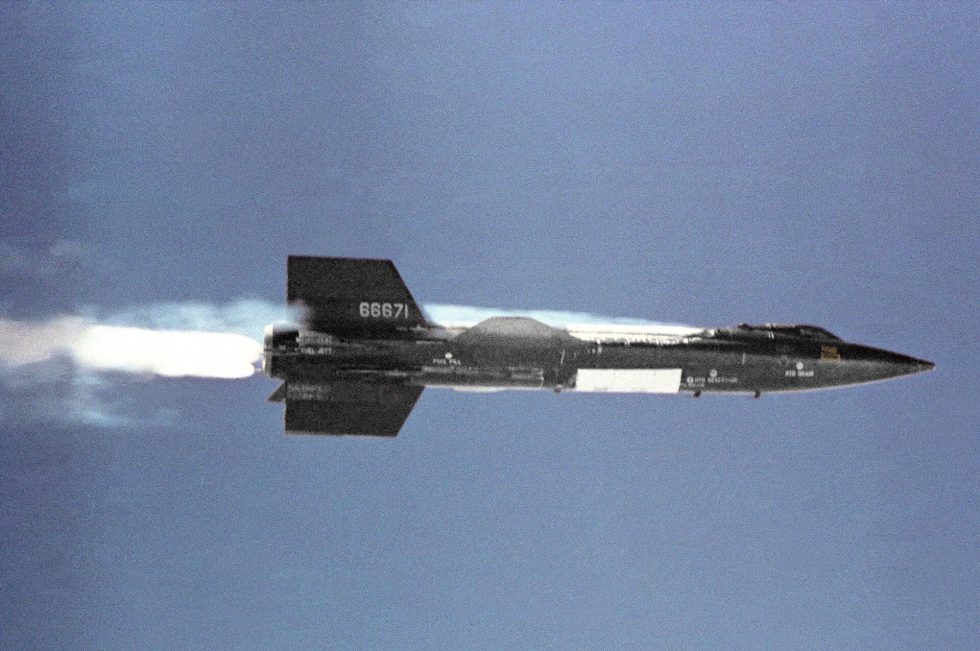
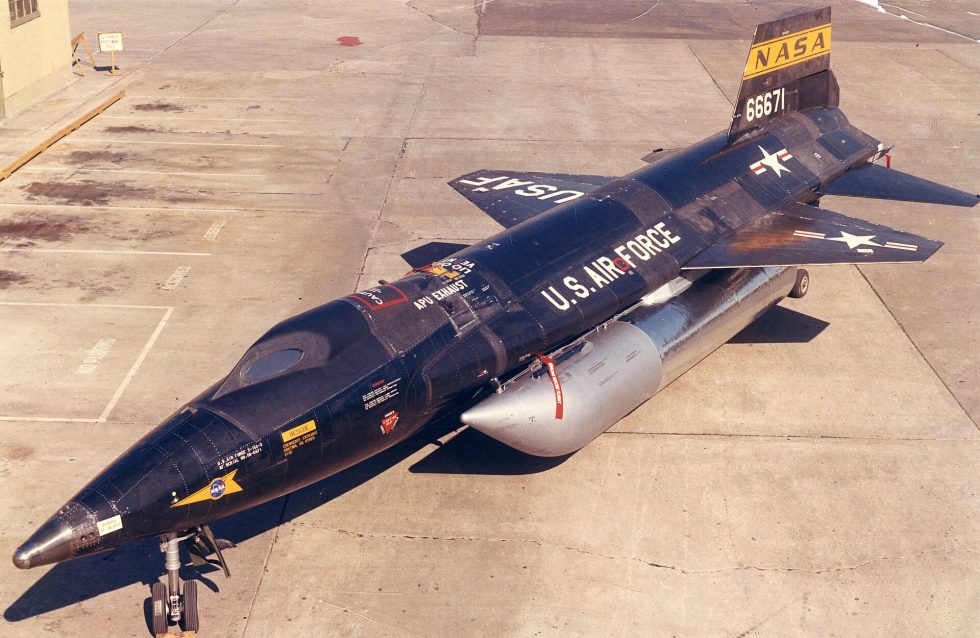
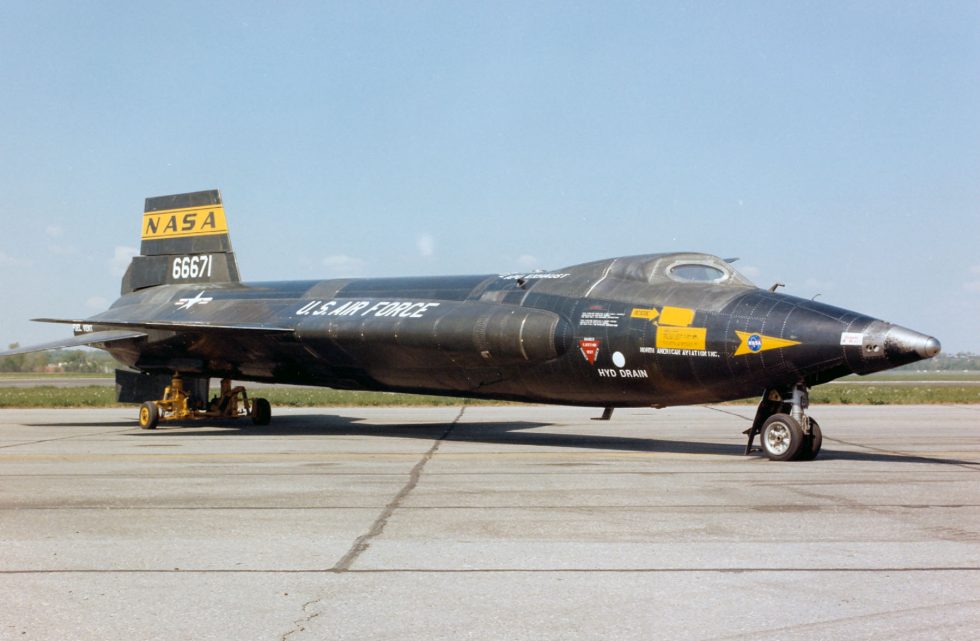
It looked like nothing else — a stubby-winged black projectile with a wedge tail, built not of aluminium but of Inconel X, a nickel-chrome superalloy chosen to soak up aerodynamic heating that could reach roughly 650 °C. Because its rocket drank propellant in minutes, the X-15 could not take off; it was carried aloft under the wing of a modified B-52 and dropped at about 45,000 feet, lighting its Reaction Motors XLR99 only once it fell clear. That single throttleable rocket produced around 57,000 pounds of thrust — enough to fling the aircraft upward on a ballistic arc where the air grew too thin for wings, and where the pilot steered instead with hydrogen-peroxide reaction thrusters in the nose and wings, exactly as a spacecraft would.
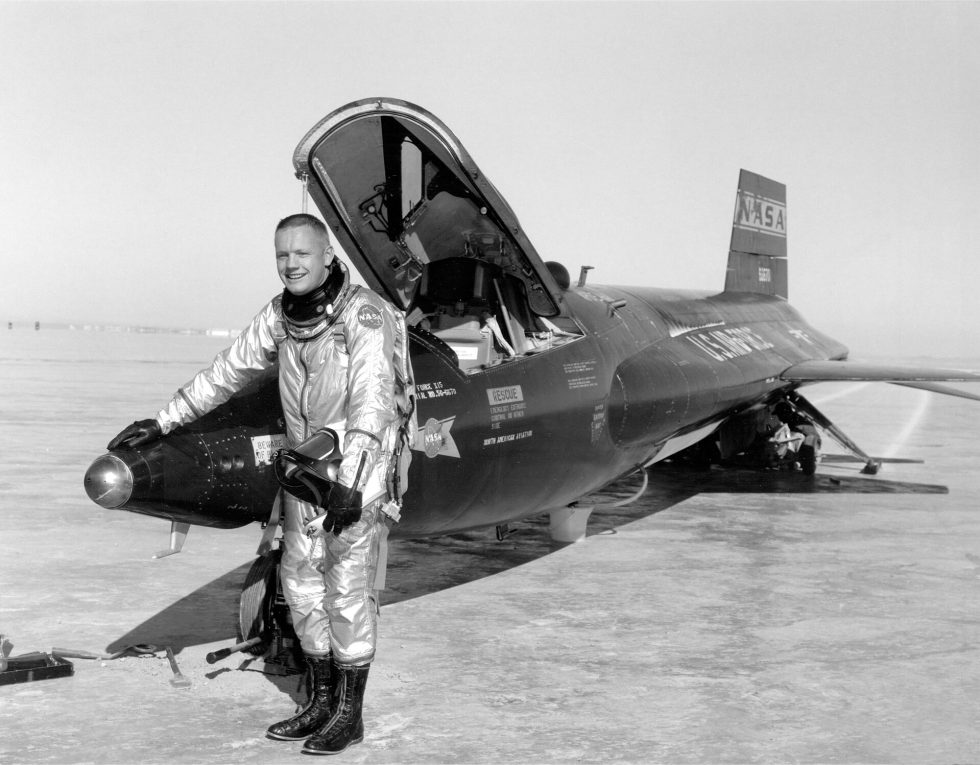
Between 1959 and 1968 three X-15s flew 199 times, and the numbers they set still stand as milestones. On 3 October 1967 Major William “Pete” Knight took the modified X-15A-2 to Mach 6.7 (7,274 km/h) — a speed no crewed aircraft has matched to this day. On 22 August 1963 NASA pilot Joe Walker climbed to about 107 km, above the internationally recognised Kármán line, becoming an astronaut in an aeroplane. Thirteen pilots flew the programme, among them a young NASA civilian named Neil Armstrong.
It was not without cost. On 15 November 1967 Major Michael Adams was killed when his X-15 entered a hypersonic spin and broke up during re-entry — the programme’s only fatality. But the data the X-15 brought back — on hypersonic aerodynamics, heat, reaction controls and dead-stick returns from the edge of space — fed directly into Mercury, Gemini, Apollo and the Space Shuttle. When the Shuttle glided silently onto a desert lakebed years later, it was flying a path the X-15 had scouted first.
01The X-15’s astronaut-wings controversy: the 50-mile line that split a flight crew
Eight X-15 pilots flew above the 50-mile altitude the United States used to define the edge of space, but their reward depended on the flag on their flight suit. The five US Air Force pilots — Robert White, Robert Rushworth, Joe Engle, Pete Knight and Michael Adams — were awarded military astronaut wings. The three NASA civilians who flew just as high — Joe Walker, Jack McKay and William Dana — received nothing at the time. NASA finally corrected the injustice in 2005, awarding civilian astronaut wings to all three — two of them, Walker and McKay, posthumously. To muddy it further, the world air-sports body (the FAI) drew the line higher, at 100 km; only two X-15 flights, both by Walker in 1963, crossed that mark.
What makes it special
A throttleable rocket, air-launched from a B-52
The X-15 was driven by a single Reaction Motors XLR99 — the first large, human-rated, throttleable rocket engine — burning anhydrous ammonia and liquid oxygen for about 57,000 lbf (~254 kN). It drained its tanks in roughly 80–120 seconds, far too fast to take off and climb, so the aircraft was carried aloft under the wing of a modified B-52 and dropped at about 45,000 feet before lighting the rocket.
An airframe of Inconel X, built to take the heat
At hypersonic speed friction turns the air to fire. Aluminium would have melted, so North American skinned the X-15 in Inconel X, a nickel-chrome superalloy, and used the structure itself as a heat sink to soak up aerodynamic heating of roughly 650 °C (1,200 °F). The crew cabin was thermally isolated inside the hot outer shell — the aircraft was, in effect, a reusable, pilot-carrying meteor.
Reaction-control thrusters for flight in space
Above about 30 km the air is too thin for rudders and ailerons to bite. So the X-15 carried a second control system borrowed from spacecraft: hydrogen-peroxide reaction thrusters in the nose (pitch and yaw) and wingtips (roll). Pilots flew the ballistic arc over the top on these jets alone, learning the reaction-control techniques that Mercury, Gemini and Apollo would soon depend on.
02The X-15’s XLR99 rocket and B-52 drop: why the fastest aeroplane could not take off
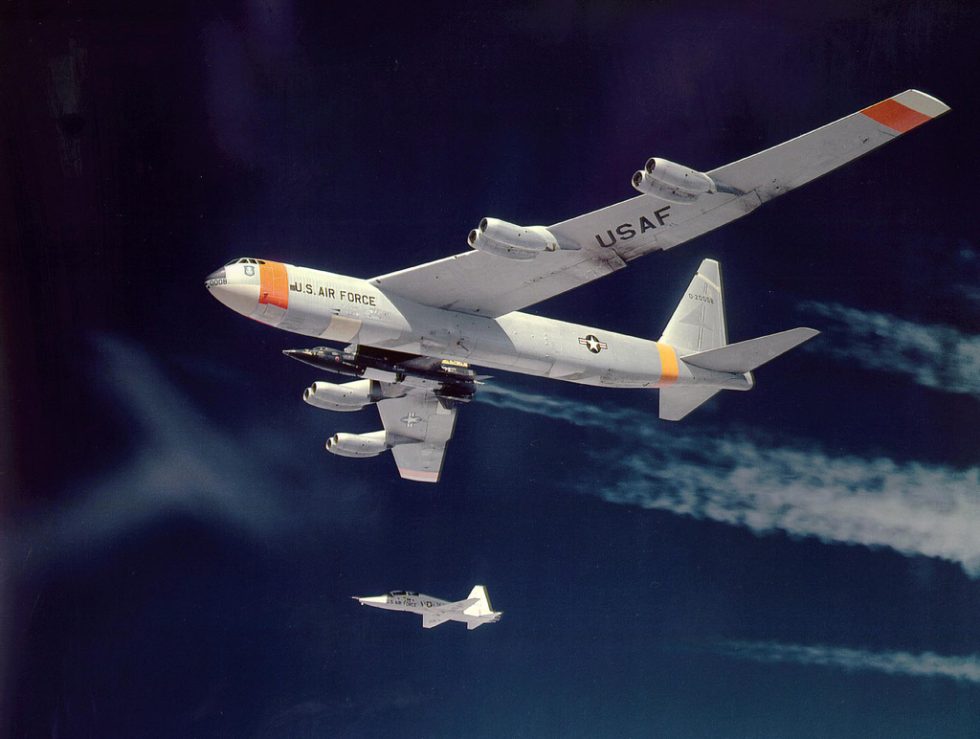
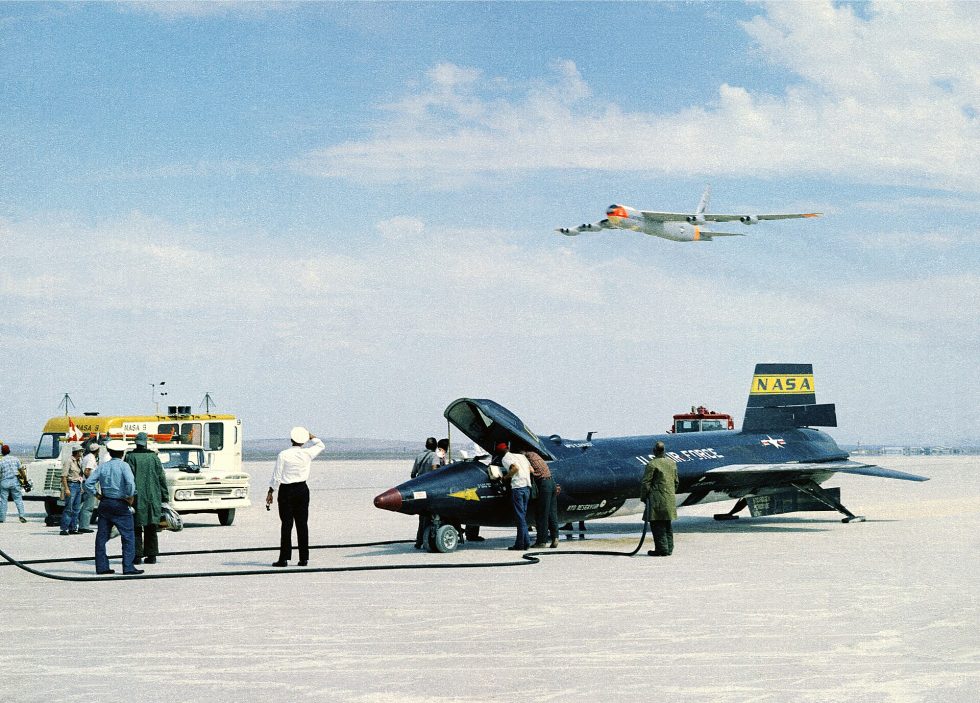
A rocket engine is monstrously powerful and monstrously thirsty. The XLR99 could deliver about 57,000 pounds of thrust, but it emptied the X-15’s propellant tanks in only a minute or two — an aircraft carrying enough ammonia and liquid oxygen to climb to test altitude and accelerate past Mach 6 could never have lifted off a runway under its own power. The answer, inherited from the Bell X-1, was to make the X-15 a parasite: two modified B-52s (an NB-52A and an NB-52B) carried it to about 45,000 feet and released it at roughly 500 mph. Only after it fell clear did the pilot light the rocket — and the clock, measured in seconds of burn time, began to run.
03The X-15’s return from space: dead-stick landings on a desert lakebed
Once the rocket burned out, the X-15 became the world’s fastest glider. Every flight ended the same way: a long, unpowered, high-speed descent to a dead-stick landing on the vast hard clay of Rogers Dry Lake at Edwards Air Force Base, the pilot dropping a pair of rear skids and a nose wheel and sliding to a halt. There was no engine to wave off with and no second chance. Learning to bring a hypersonic vehicle home unpowered, and to hit a precise point after a ballistic arc, was one of the X-15’s most direct gifts to the Space Shuttle, which landed exactly the same way twenty years later.
Full specifications
Baseline note: the figures below describe the X-15 as it flew from November 1960 onward — a basic airframe (X-15-1 or X-15-3) with the Reaction Motors XLR99 engine and internal propellant only. Deltas for the two interim XLR11-powered aeroplanes of 1959–1960 and for the rebuilt X-15A-2 of 1964–1967 are in grey. Four published disagreements need settling before the tables start. Length: reference works give anything between 49 ft 2 in and 51 ft, because some measure to the tip of the ball nose and some do not, and because the lower ventral fin was jettisoned before every landing; 50 ft 9 in is the figure Dennis Jenkins’ NASA monograph uses and the one adopted here. Launch weight: NASA’s own fact sheet quotes 31,275 lb, most tables 33,500 lb, and both are right for different propellant loads and instrument fits. Peak altitude: Joe Walker’s 22 August 1963 flight is recorded by NASA as 354,200 ft, which converts to 107.96 km — the frequently cited 107.8 km is a rounding artefact and is not what the flight record says. Top speed: the flight card reads 6,630 ft/s at 102,100 ft, which NASA renders as Mach 6.70 and 4,520 mph and North American as Mach 6.72; the difference is the atmospheric model, not the aeroplane.
Dimensions & weights
- Crew
- 1 — twelve men flew the three aeroplanes across 199 free flights. Five were NASA, five US Air Force, one US Navy and one, Scott Crossfield, a North American company pilot who flew the contractor demonstration programme and never flew a research mission
- Length
- 15.45 m (50 ft 9 in). X-15A-2 with its 28-inch fuselage plug: 15.98 m (52 ft 5 in). The plug and the quoted overall lengths do not reconcile cleanly in any published source, which is a fair warning about how loosely these numbers are handled
- Wingspan
- 6.81 m (22 ft 4 in) — shorter than the fuselage by a factor of more than two. At Mach 6 the wing is nearly incidental; the fuselage and the tail do the work
- Height
- 3.99 m (13 ft 1 in) over the upper vertical fin, with the lower ventral fitted
- Wing area
- 18.6 m² (200 sq ft), aspect ratio 2.5, leading edge swept 25°, a symmetrical section only about 5 per cent thick with a wedge-shaped leading edge. There are trailing-edge flaps and no ailerons
- Vertical tail
- Upper and lower wedge fins of roughly 4.0 m² (43 sq ft) each, the section a 10° included-angle wedge with a blunt base. The lower fin was jettisoned on a parachute before every landing because it hung below the skids
- Horizontal tail
- All-moving slab surfaces of about 4.9 m² (53 sq ft) each, with 15° of anhedral, working together for pitch and differentially for roll. The X-15 is where the "rolling tail" became routine practice
- Empty weight
- 6,620 kg (14,600 lb)
- Launch weight
- 15,195 kg (33,500 lb) at drop from the NB-52; NASA’s fact sheet gives 14,186 kg (31,275 lb) for a lighter fit. X-15A-2 with both external tanks: about 25,460 kg (56,130 lb)
- Landing weight
- 5,580 kg (12,295 lb) at burnout — the aeroplane sheds well over half its mass in eighty seconds, which is why the trim and handling change continuously through the boost
- Internal propellant
- 6,800 kg (15,000 lb) of anhydrous ammonia and liquid oxygen. The X-15A-2 added two jettisonable external tanks carrying roughly 5,900 kg (13,000 lb) more, dropped about sixty seconds after ignition
- Structure
- Inconel X-750 hot structure — a nickel-chromium alloy skin and primary structure that carries load while glowing, with titanium and stainless steel inboard and a separate aluminium cockpit tub insulated from the outer shell. Nothing about it was cheap, light or quick to build, and that verdict shaped every reusable hypersonic design that followed
Performance
- Maximum speed
- 7,274 km/h (4,520 mph, 2,021 m/s), Mach 6.70, set by Major William "Pete" Knight in the X-15A-2 on 3 October 1967 at 102,100 ft. Still the fastest a crewed, powered aeroplane has ever flown. North American quoted the same flight as Mach 6.72
- Maximum speed, unmodified airframe
- About 6,400 km/h (4,000 mph), Mach 6.06 — the practical ceiling of a basic X-15 on internal propellant. Everything above that required the A-2’s external tanks and its ablative coating
- Maximum altitude
- 107,960 m (354,200 ft, 67.1 miles), Joe Walker, 22 August 1963 — the highest a winged aeroplane flew until SpaceShipOne in 2004. Walker’s 19 July 1963 flight reached 106,010 m (347,800 ft); these two are the only X-15 flights above the 100 km Kármán line
- Design goals
- Mach 6 and 76,200 m (250,000 ft) — both comfortably exceeded. The programme beat its speed target by 12 per cent and its altitude target by 42 per cent, which is unusual enough in flight research to be worth stating plainly
- Rate of climb
- Over 18,000 m/min (60,000 ft/min) on an altitude profile, climbing at up to 40° nose-up. This is an average over the boost, not a steady-state figure; the aeroplane is accelerating hard the whole time
- Powered endurance
- 80–85 seconds on internal propellant. The X-15A-2 with external tanks burned for 140.7 seconds on the record flight. Every X-15 mission is a glider flight with a rocket-powered first minute and a half
- Typical flight duration
- 8–12 minutes from drop to touchdown. Knight’s record flight lasted 8 minutes 17 seconds; Mike Adams’s fatal flight broke up 10 minutes 35 seconds after launch
- Launch conditions
- Released at 13,700 m (45,000 ft) and about 800 km/h (500 mph, Mach 0.8) from the pylon of an NB-52. The X-15 never took off under its own power and never landed anywhere but a dry lakebed
- Ground track
- Around 450 km (280 miles) on a typical sortie, flown down a chain of instrumented dry lakes from Wendover or Mud Lake to Rogers Dry Lake at Edwards. The "High Range" radar and telemetry chain built for the X-15 was itself a significant piece of infrastructure
- Re-entry loads
- About 5 g sustained in the pull-out from a maximum-altitude flight, against a design limit of 7.33 g. Adams’s aeroplane saw more than 15 g vertically and 8 g laterally before it came apart
- Skin temperature
- Up to 650 °C (1,200 °F) in the design case. On the Mach 6.7 flight, shock impingement from the dummy ramjet drove local temperatures to about 1,480 °C (2,700 °F) and burned through the Inconel
- Landing speed
- About 320 km/h (200 mph) touchdown on the lakebed, at a glide ratio of roughly 4:1 with the speed brakes in. There is one approach and no go-around
Propulsion & systems
- Powerplant
- 1 × Reaction Motors XLR99-RM-1 — the first large throttleable, restartable, man-rated liquid rocket engine built in the United States, and arguably the X-15’s single most consequential piece of hardware
- Thrust
- 254 kN (57,000 lbf) at altitude, throttleable from roughly half power to full and restartable in flight. Thrust-to-weight at launch is about 1.7, which is why the boost is flown as a controlled climb rather than a straight acceleration
- Propellants
- Anhydrous ammonia and liquid oxygen, with 90 per cent hydrogen peroxide decomposed over a catalyst to spin the turbopump. Ammonia was chosen over kerosene for cooling: it is a far better regenerative coolant, and the engine ran hot enough to need it
- Interim engines
- 2 × Reaction Motors XLR11-RM-13 — eight chambers between them for 72.9 kN (16,380 lbf) on ethyl alcohol and liquid oxygen, the same engine family that took the X-1 through Mach 1. Flown on the first 24 powered flights because the XLR99 was two years late
- Reaction control system
- Monopropellant hydrogen peroxide thrusters — pitch and yaw jets in the nose, roll jets at the wing tips, specific impulse about 140 s. Above roughly 30 km the aerodynamic controls do nothing and the pilot flies on the jets alone; below that the two systems overlap and have to be blended
- Flow-direction sensor
- The "ball nose" — a hollow sphere, built by Nortronics to a NASA design, cooled with liquid nitrogen and driven by servos to null the pressure difference across two pairs of ports. It measured angle of attack and sideslip directly, plus stagnation pressure. A conventional pitot boom would simply have melted, and no X-15 flew above Mach 3 without this instrument working
- Flight controls
- All-moving horizontal tail, wedge verticals, flaps — commanded through a conventional centre stick plus a right-hand side-stick for high-g work and a left-hand controller for the reaction jets. Learning to fly three control systems at once was a genuine workload problem and is a large part of what the programme measured
- Adaptive control system
- Honeywell MH-96, X-15-3 only — a self-adaptive system that continuously adjusted its own gains and blended aerodynamic and reaction controls automatically, reducing three controllers to one. It was a genuine advance and a direct ancestor of practical fly-by-wire; it also contributed to killing Mike Adams
- Auxiliary power
- Two hydrogen-peroxide auxiliary power units driving hydraulic pumps and alternators. There is no engine-driven accessory gearbox because the rocket only runs for eighty seconds; lose both APUs and the aeroplane goes dark, as Knight found at Mach 4.17 on 29 June 1967 before gliding to an unpowered dead-stick landing at Mud Lake
- Crew systems
- David Clark full-pressure suit, ejection seat — the MC-2 and later the A/P22S-2, the latter becoming the standard USAF full-pressure suit and a direct ancestor of the Gemini garments. The cockpit was pressurised to 3.5 psi with nitrogen and the pilot breathed oxygen separately. The seat was rated to Mach 4 and 120,000 ft and was never used
- Undercarriage
- Nose wheel and two rear steel skids — skids because tyres could not survive the soak temperatures. The geometry produced a violent nose slap-down at touchdown, and it was a hard landing of this kind on 9 November 1962 that wrecked X-15-2 and injured Jack McKay
04The X-15’s cost: a national research program, not a production aircraft
The X-15 was never priced like a service aircraft. It was a government research program of three hand-built airframes, funded jointly by NACA (later NASA), the US Air Force and the US Navy, flown a few dozen times each purely to gather data. There is no meaningful flyaway unit price or cost-per-flight-hour for a machine that existed only to probe hypersonic flight and the edge of space, that was launched from a converted bomber, and that landed as a glider. The whole program is usually reckoned in the low hundreds of millions of 1960s dollars — but any single-aircraft dollar figure is an accounting estimate, not a market price.
Armament & payload
The X-15 never carried a weapon, and its payload bays are the entire reason it existed
There is nothing to say about the X-15’s armament, because it had none and was never intended to have any. It was a research aeroplane, procured jointly by the Air Force, the Navy and the NACA, and what it carried instead of guns was instrumentation: several hundred kilograms of thermocouples, strain gauges, pressure orifices, accelerometers and telemetry transmitters wired into an airframe that was, in effect, one large test specimen with a pilot inside it. The primary questions were narrow and specific. What actually happens to a lifting airframe at Mach 6 — how much heat arrives, where, and how fast? How do you control an aeroplane when the air is too thin for the tail to bite? And can a pilot, in a pressure suit, under 5 g, having just spent two minutes weightless, still fly the machine? The answers came back as more than 765 technical reports, and a substantial fraction of them were negative results that saved somebody else a great deal of money.
From about 1962 the aeroplane also became a truck. With the basic aerodynamic and heating questions largely answered, NASA and the Air Force began hanging separately funded follow-on experiments on it — astronomy, upper-atmosphere physics, materials panels, sensor calibration — carried in wing-tip pods, in a box faired onto the tail cone, in the space where the ventral fin’s lower section had been, and in the vacant instrument bays. This second career is less famous than the records and was arguably the more useful half of the programme. The six cards below therefore describe instruments, experiments and research payloads, honestly relabelled, rather than pretending an unarmed aeroplane had an ordnance list. Fits varied enormously between the three airframes and across nine years: X-15-3 alone carried the MH-96 adaptive control system, X-15A-2 was configured around the dummy ramjet and the external tanks, and X-15-1 ended its life as the dedicated experiments carrier with wing-tip pods and a tail-cone box.
Primary research instrumentation
- The airframe itself was the instrument: hundreds of thermocouples spot-welded to the Inconel skin and internal structure, strain gauges on spars and frames, and static pressure orifices distributed over the fuselage, wing and tail.
- Roughly 600 kg (1,300 lb) of instrumentation and recording equipment in a typical fit, feeding an onboard oscillograph recorder and a telemetry transmitter working to the High Range ground stations at Beatty, Ely and Edwards.
- Inertial platform and three-axis attitude reference, essential once the aeroplane left useful air and the pilot had no visual or aerodynamic cue to work from.
- The data were the deliverable. More than 765 technical reports came out of the programme, and the flight-test techniques developed to gather them — pre-flight simulation of every mission, real-time telemetry monitoring, a chase aircraft on every sortie — became the standard NASA method.
The ball nose and air-data system
- Nortronics flow-direction sensor to a NASA design: a servo-driven, liquid-nitrogen-cooled sphere that hunted until the pressures across two orthogonal pairs of ports balanced, reading out angle of attack and sideslip directly.
- It replaced the conventional nose boom, which at Mach 6 would have been destroyed, and it displaced the pitot-static system to the fuselage sides.
- Neil Armstrong flew the first flight with the production ball nose, in December 1960 — one of eight X-15 flights he made before joining the astronaut corps.
- Without it the pilot could not fly the correct angle of attack through re-entry, where being a few degrees wrong means either an overshoot or a structural overload. It is the least glamorous and most indispensable item on the aeroplane.
- The same null-seeking principle went on to serve on the XB-70, the SR-71 family and later hypersonic vehicles.
Reaction control and flight-control research
- Hydrogen-peroxide thrusters — pitch and yaw at the nose, roll at the wing tips — giving the first sustained experience of flying a winged vehicle on jets outside the sensible atmosphere, and of handing control back to aerodynamic surfaces on the way down.
- Honeywell MH-96 adaptive flight control system on X-15-3 from December 1961: it measured the airframe’s own response and retuned its gains in real time, and it blended aerodynamic and reaction controls automatically so the pilot flew one stick throughout.
- A companion Air Force programme flew a simulator-based study of pilot performance under boost and re-entry loads, and the X-15 validated it in flight. The finding that a suited pilot could work usefully at 5 g after weightlessness was not obvious in 1960.
- The wedge tail was itself an experiment: a blunt-based 10° wedge section is a far more effective directional stabiliser at hypersonic speed than a conventional aerofoil, because the shock stands off and the base pressure does the work. The penalty is enormous subsonic drag — the blunt base alone was reckoned to produce roughly as much drag as an entire F-104.
- The X-15 also proved the case for large fixed vertical area plus an all-moving rolling tail, a layout that turns up again on the Shuttle orbiter.
Follow-on science experiments
- Ultraviolet stellar photography, flown above almost all the absorbing atmosphere, in a period when there were no orbiting ultraviolet observatories at all.
- Micrometeorite collection, with a deployable collector exposed at altitude and closed for recovery — the classic difficulty being to prove that what came back was collected up there rather than picked up on the way home.
- Horizon definition: measurement of the infrared radiance profile of the Earth’s limb, run for the Apollo navigation problem, since Apollo’s sextant sightings depended on knowing exactly where the horizon appears to a sensor.
- Sky-brightness and solar-spectrum measurements, high-altitude Earth photography, and atmospheric-density work using the aeroplane’s own trajectory as the probe.
- These payloads rode in wing-tip pods, a tail-cone box and vacated instrument bays. Several failed or returned marginal data; the honest summary is that the X-15 was a mediocre science platform that happened to be the only one available above 60 km.
Materials and structures test articles
- Ablative coating samples and full-airframe ablator: the X-15A-2 carried Martin MA-25S, a pink ablative sprayed over the whole aeroplane and sealed with a white overcoat to cut solar heating of the cryogenic tanks.
- The verdict on ablators was damning and valuable. The coating worked thermally, but it outgassed onto the canopy — one windscreen pane had to be fitted with a mechanical eyelid so the pilot had something to land through — and stripping and respraying it between flights took weeks. Reusable hypersonic vehicles went to tiles instead, and the X-15A-2 is a large part of the reason.
- Saturn launch-vehicle insulation panels were flown to check cryogenic tank insulation against real aerodynamic heating and dynamic pressure rather than tunnel conditions.
- Sharp and blunt leading-edge specimens, boundary-layer probes and calorimeter panels measured heat transfer where theory and wind tunnels disagreed — and they frequently did, with turbulent heating rates often lower in flight than predicted.
- The dummy scramjet on the A-2’s ventral fin was a shape, not an engine. Its shock impingement on 3 October 1967 burned through the Inconel pylon, the model tore away in flight, and the aeroplane never flew again — an accident that taught the hypersonic community more about shock-interference heating than any planned test.
What the X-15 never carried
- No guns, no bombs, no rockets, no pylons for stores of any kind. The airframe had no combat role and no weapons-carriage provision was ever designed into it.
- No working scramjet. The Hypersonic Research Engine was built and ground-tested but never flew powered; a genuine flight-weight scramjet had to wait until NASA’s X-43A in 2004.
- No liquid-hydrogen tank in use. The 28-inch plug in the X-15A-2 was put there to hold hydrogen for the ramjet, and it flew empty for the whole of the aeroplane’s career.
- No orbital capability. The X-15B proposal of 1957–58, which would have used the airframe atop a Navaho-derived booster, was dropped in favour of the ballistic Mercury capsule; the delta-wing X-15 of the mid-1960s died with the programme’s budget.
- No ejection above Mach 4 or 120,000 ft. The seat was simply not rated for the conditions in which the aeroplane spent most of its interesting minutes, and every pilot flew knowing it.
Three typical loadouts
- Maximum-speed profile
- Drop at 45,000 ft, immediate light-up, shallow climb to a level acceleration run at roughly 100,000 ft with the engine at full throttle until propellant exhaustion. On the X-15A-2 the two external tanks went at about 60 seconds, the burn ran on to 140.7 seconds, and skin temperatures held near the structural limit for minutes rather than seconds. This is the profile that produced Mach 6.70 and the profile that destroyed the ramjet pylon.
- Maximum-altitude profile
- Drop, light-up and a climb at up to 40° nose-up, engine shutdown at around 170,000 ft, then a ballistic coast to apogee with the aerodynamic controls dead and the reaction jets doing everything. Two to four minutes above 200,000 ft, most of it weightless, then a precise 5 g pull-out on a re-entry angle of attack the pilot had to hold within a couple of degrees. Both 100 km flights were flown this way, and so was the flight that killed Mike Adams.
- Experiment and stability sortie
- The bread-and-butter mission and by far the most common: a moderate profile holding Mach 4 to 5 at 80,000–120,000 ft long enough to stabilise conditions for a heat-transfer measurement, a control-system evaluation or a follow-on experiment. Unspectacular, badly reported at the time, and the source of most of the data the programme is actually remembered for.
Sourcing caveat: the experiment fits above are drawn from NASA Dryden and Armstrong programme histories and from Dennis Jenkins’ NASA monograph on the X-15. Published lists of follow-on experiments differ, because a good many were manifested, deferred and cancelled without ever flying, and because several flew in more than one configuration. Where a specific experiment’s results could not be corroborated it has been described in general terms rather than credited with a finding.
Variants
Three airframes, one of them rebuilt twice, and a shelf of proposals that never left paper
North American built three X-15s under a contract placed in November 1955, and the programme flew them for nine years. There were no production variants, no export customers and no licence-built copies; what there were instead were configurations, and the same tail number could be a substantially different aeroplane from one year to the next. The three airframes diverged early and stayed divergent: X-15-1 became the experiments carrier, X-15-2 was wrecked in a landing accident and came back as the record-breaking A-2, and X-15-3 was the avionics testbed and the only one with the adaptive control system.
The proposals matter too, because they show what the aeroplane was nearly asked to do. An orbital X-15B was studied seriously in 1957–58 and lost to Mercury. A delta-wing rebuild was studied in the mid-1960s as a hypersonic-cruise and scramjet testbed and lost to the budget. The Hypersonic Research Engine was built and never flown. Each of these was a road not taken toward an operational hypersonic aeroplane, and the fact that none of them was taken is the largest single reason the X-15’s speed record has stood since 1967.
- X-15-1, 56-6670 (1958–1968, 81 flights)
- The first airframe, first flown as a glider by Scott Crossfield on 8 June 1959. Spent its later years as the dedicated follow-on experiments aircraft with wing-tip pods and a tail-cone instrument box. Flew the last X-15 mission of all, with Bill Dana at the controls, on 24 October 1968.
- X-15 with XLR11 engines (1959–1961, 24 powered flights)
- Not a variant so much as an embarrassment: the XLR99 ran two years late, so the first two aeroplanes flew with a pair of eight-chamber XLR11s of 16,380 lbf total — less than a third of the design thrust, and the same engine family that had powered the X-1. First powered flight 17 September 1959; the interim fit still reached Mach 3.5.
- X-15-2, 56-6671 (1959–1962, 31 flights)
- The second airframe in original configuration. Crossfield made the first XLR99 flight in it on 15 November 1960. Badly damaged in a hard landing at Mud Lake on 9 November 1962 when the flaps failed and the landing weight was too high; the aeroplane broke its back and Jack McKay was seriously injured, though he returned to flying.
- X-15A-2, 56-6671 rebuilt (1964–1967, 22 flights)
- The rebuild that chased the speed record: a 28-inch fuselage plug for a liquid-hydrogen tank that never held hydrogen, two jettisonable external propellant tanks nearly doubling burn time, a rebuilt cockpit with an eyelid over one windscreen pane, and from 1967 a full MA-25S ablative coating. It reached Mach 6.70 on 3 October 1967 and never flew again.
- X-15-3, 56-6672 (1961–1967, 65 flights)
- The systems aeroplane, rebuilt after an engine explosion during a ground run in June 1960 and fitted with the Honeywell MH-96 adaptive flight control system and an all-new instrument display. Flew both of Joe Walker’s 100 km flights. Destroyed with Mike Adams aboard on 15 November 1967.
- Hypersonic Research Engine fit (1966–1968, never flown powered)
- A Garrett AiResearch hydrogen-burning ramjet-scramjet intended for the A-2’s ventral pylon. Only the aerodynamic dummy ever flew, and it destroyed its own mounting on the record flight. The real engine was ground-tested at Langley and Plum Brook and never left the ground.
- X-15B (proposed 1957–1958, none built)
- An orbital derivative to be launched by a cluster of Navaho-derived boosters, offered as the United States’ first crewed spaceflight. It was rejected in favour of the quicker ballistic Mercury capsule, a decision that was almost certainly correct in 1958 and that closed off the winged route to orbit for two decades.
- X-15 Delta Wing (proposed 1962–1964, none built)
- A rebuild with a delta planform and a hot structure sized for sustained hypersonic cruise, intended to carry the scramjet properly and to explore Mach 8. Studied in detail, costed, and killed as the follow-on hypersonic research budget was redirected toward the Shuttle.
- NB-52A 52-003 and NB-52B 52-008 (1959–1968, carriers for every flight)
- Two modified B-52 Stratofortresses with a pylon under the starboard wing between fuselage and inboard nacelle, a notch cut in the flap for the X-15’s vertical fin, and an observer’s station in the fuselage. "The High and Mighty One" and "Balls 8" were as much part of the system as the rocket aeroplane, and without them there were no flights at all.
Survivors, precisely. Two of the three airframes exist and both are original. X-15-1 (56-6670) was transferred to the Smithsonian in 1969 and hangs in the Boeing Milestones of Flight Hall at the National Air and Space Museum in Washington, DC. X-15A-2 (56-6671) was returned to North American for repairs after the Mach 6.70 flight, never flew again, and went to the National Museum of the United States Air Force at Wright-Patterson AFB, Ohio, in October 1969; it is displayed in the Space Gallery. X-15-3 (56-6672) does not exist: it broke up over the Mojave on 15 November 1967 and the wreckage was scattered across roughly 130 km² (50 sq miles) of desert north of Cuddeback; a memorial to Mike Adams was placed near the impact site in 2004. Everything else labelled X-15 in a museum is a reproduction or a mock-up, including the full-scale mock-ups at NASA Armstrong at Edwards, the Pima Air & Space Museum in Tucson and the Evergreen Aviation & Space Museum at McMinnville, Oregon; several of these descend from the fibreglass shells built for the 1961 film. Of the carriers, NB-52B 52-008 stands at the north gate of Edwards AFB and NB-52A 52-003 is at Pima. Programme totals for the record: 199 free flights out of 336 attempts, the remainder captive-carry or aborted; thirteen flights by eight pilots exceeded the US Air Force’s 50-mile boundary, of which two, both Joe Walker’s, exceeded 100 km. The five Air Force pilots — Robert White, Robert Rushworth, Joe Engle, Pete Knight and, posthumously, Mike Adams — were given military astronaut wings at the time. The three NASA civilians waited: Bill Dana, Jack McKay and Joe Walker were awarded NASA astronaut wings on 23 August 2005, thirty-five years after the programme closed and by then only Dana was alive to collect his. Total programme cost is usually put at about 300 million US dollars of 1960s money.
From a hypersonic question to the edge of space
The program is approved
NACA, the US Air Force and the US Navy agree to build a piloted hypersonic research aircraft; North American Aviation wins the contract in 1955.
First flights
On 8 June, North American test pilot Scott Crossfield makes the first unpowered glide flight; the first rocket-powered flight follows on 17 September.
Mach 4, 5 and 6
With the definitive XLR99 engine, Robert White pushes the X-15 past Mach 4, Mach 5 and, in November, Mach 6 — the first crewed flights at those speeds.
Wings and a wild ride
Robert White climbs above 50 miles to earn the first X-15 astronaut wings; weeks earlier Neil Armstrong ballooned off the atmosphere and overshot Edwards toward Pasadena.
Above the Kármán line
On 22 August, Joe Walker reaches 354,200 ft (about 107 km), above the internationally recognised edge of space — the program’s highest flight.
The X-15A-2 returns
Rebuilt and stretched after a 1962 landing accident, aircraft #2 re-enters testing as the X-15A-2, fitted to carry two external propellant tanks.
Mach 6.7 — and tragedy
On 3 October Pete Knight sets the crewed airspeed record of Mach 6.7. Six weeks later, on 15 November, Michael Adams is killed when his X-15 breaks up in a hypersonic spin.
The program ends
On 24 October, William Dana flies the 199th and final X-15 mission. A planned 200th flight is repeatedly scrubbed and never made.
Legacy in orbit
X-15 data on hypersonic heating, reaction controls and dead-stick returns feeds directly into Mercury, Gemini, Apollo and the Space Shuttle.
From the flight line: twelve X-15 stories
The speed mark that will not die
A 1967 airspeed record no crewed aircraft has beaten in nearly 60 years.
Read the full story
The coating that charred
To reach Mach 6.7 they sprayed the aircraft with armour designed to burn away.
Read the full story
Above the Kármán line
A test pilot flew an aeroplane into space — twice.
Read the full story
The spin at Mach 5
The X-15’s only fatal flight began with a slow drift into disaster.
Read the full story
Neil Armstrong bounces off the sky
The first man on the Moon once accidentally flew halfway to Los Angeles.
Read the full story
Crossfield and the engine that blew up
The X-15’s own test pilot survived his rocket exploding behind him.
Read the full story
Astronaut, or not?
Whether you had been to space depended on which service you flew for.
Read the full story
Landing on a dry lake
A plane with no engine and skids for wheels, aimed at a lakebed.
Read the full story
Grandfather of the spaceplane
Before the Shuttle glided home, the X-15 proved it could be done.
Read the full story
A skin of superalloy
Ordinary aluminium would have turned to soup, so they built it from jet-engine metal.
Read the full story
Dropped from the wing of a bomber
The X-15 could not take off — it had to be carried up and let go.
Read the full story
Pete Knight, fastest man in an aeroplane
One pilot holds aviation’s ultimate speed mark — and few know his name.
Read the full story
The X-15 in pictures
The X-15 in motion
A hand-picked, high-authority film of the X-15 dropping from its B-52 and rocketing to the edge of space is on the way — video coming soon.
Where the X-15 flew
The records that define it
The X-15 never fired a shot — it was a research aircraft, and its victories were milestones rather than kills. Each one pushed the frontier of what a piloted machine could do, and two of them have stood unbeaten for well over half a century.
Explore the whole collection in the MiGFlug Aircraft Museum.
Everything people ask about the North American X-15
Can I fly in an X-15?
How fast could the X-15 go?
How high did the X-15 fly?
Did X-15 pilots become astronauts?
Did Neil Armstrong fly the X-15?
What engine did the X-15 use and how was it launched?
Where can I see an X-15 today?
You can’t fly the X-15.
These, you can.
Some legends only live in museums — others are fuelled and waiting. MiGFlug has put civilians in real military jet cockpits since 2004.
 Fly the L-39 AlbatrosThe world’s most-flown jet trainer — aerobatics included
 Fly the F-104 Starfighter“The missile with a man in it”
 Fly the MiG-21The Cold War’s most-produced jet
 Fly the T-33 Shooting StarAmerica’s first jet trainer
 Fly the DH VampireA piece of early jet history
 Fly the S.211Agile Italian jet trainer
 Fly the MB-326The classic Aermacchi jet
 Fly the MiG-15The Soviet legend of the Korean War
Continue the tour
Every fact, checked
- NASA — X-15 Hypersonic Research ProgramCore fact sheet: 199 flights, serials, XLR99, Inconel-X, records and the pilot roster.
- NASA — X-15 Hypersonic Research AircraftSpecifications, structure and materials, program dates and engine thrust.
- National Museum of the U.S. Air Force — North American X-15A-2Museum record for the actual Mach 6.7 record-setter and its external tanks.
- Air Force Test Center — October 3, 1967: X-15 Human Speed RecordPete Knight’s Mach 6.7 flight, the ablative coating and the dummy ramjet.
- Smithsonian NASM — The X-15 Still Holds the World Speed RecordContext for the standing crewed airspeed record and the aircraft’s legacy.
- NASA — X-15 Space Pioneers Now Honored as AstronautsThe 2005 civilian astronaut-wings award to Walker, McKay and Dana and the 50-mile line.
- NASA History — Michael J. AdamsThe fatal Flight 191 spin and breakup and Adams’ posthumous astronaut wings.
- Smithsonian Magazine — Neil Armstrong’s X-15 Flight Over PasadenaThe ballooning re-entry that carried Armstrong far past Edwards.