
Bell X-1
“Glamorous Glennis”
The bullet-shaped rocket plane that broke the sound barrier — the first aircraft to carry a human past Mach 1, and the machine that launched the American X-plane era.
The rocket plane that punched through the sound barrier
In the last months of the Second World War, one question haunted aeronautics: what happens at the speed of sound? Pilots diving high-performance fighters had run into a wall of violent buffeting and vanishing control — the so-called sound barrier — and some had died trying to push through it. In 1944 the US Army Air Forces, the National Advisory Committee for Aeronautics (NACA) and the Bell Aircraft Corporation of Buffalo agreed to build an aircraft to find out. The contract for three aircraft was signed on 16 March 1945. It answered to no military or commercial mission; it existed only to fly into the unknown transonic region and come back with data — effectively inventing the dedicated research aircraft.
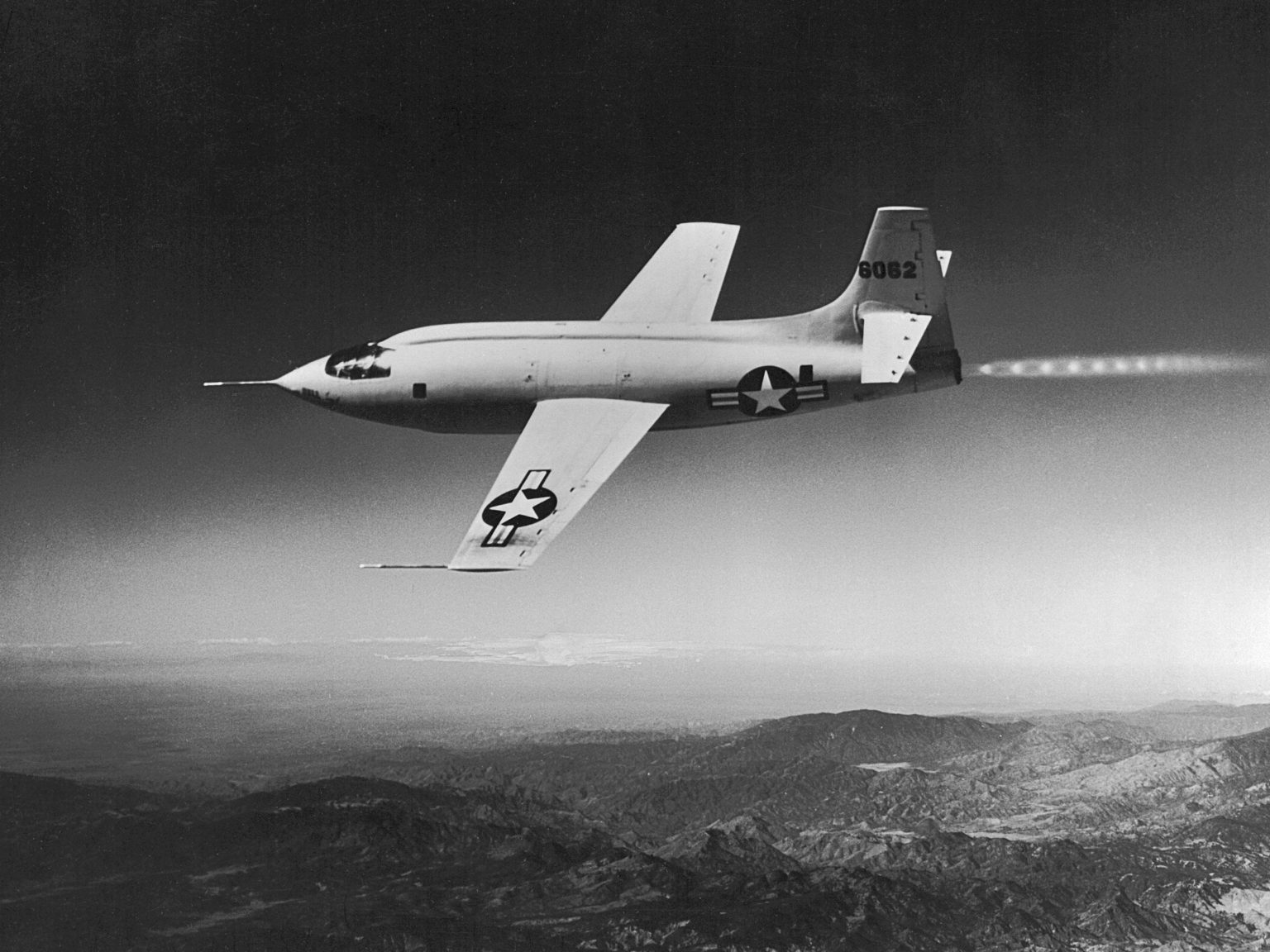
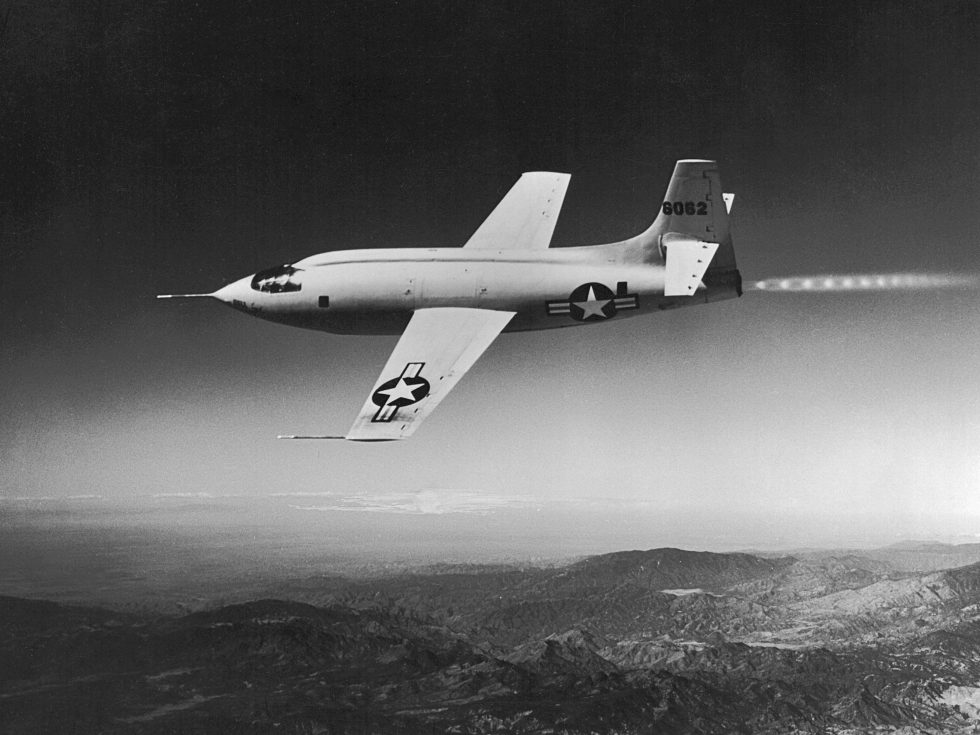
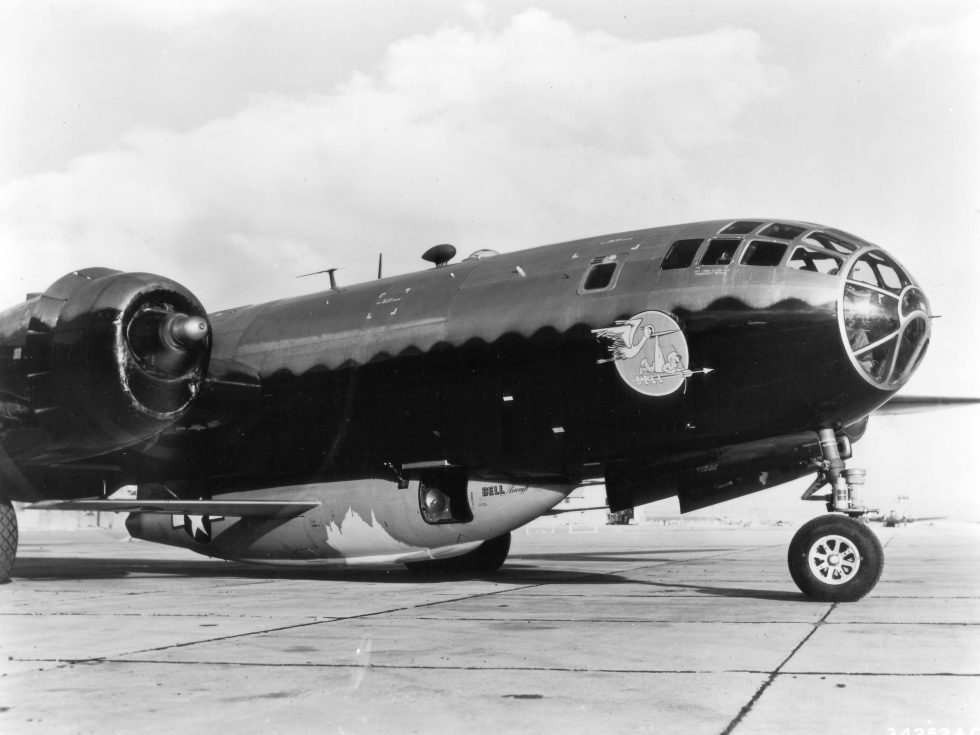
Bell’s answer was a small, straight-winged rocket plane painted international orange, its fuselage shaped like a .50-caliber machine-gun bullet — a form already known to stay stable faster than sound. Because a rocket burns its propellant in minutes, the X-1 could not take off with enough fuel to climb and still make a supersonic run, so it was carried aloft in the bomb bay of a modified B-29 Superfortress and dropped at around 25,000 feet, lighting its Reaction Motors rocket only once clear of the mother ship.
On 14 October 1947, US Army Air Forces Captain Chuck Yeager was dropped over the Mojave at Muroc Army Air Field — later Edwards Air Force Base — fired the rocket, and pushed the aircraft he had named “Glamorous Glennis,” after his wife, to about Mach 1.06 at roughly 43,000 feet. For the first time a piloted aircraft had flown faster than sound and returned. On the desert floor, observers heard what sounded like distant thunder — one of the first sonic booms ever made by an aircraft.
The achievement was classified. It leaked to the press in December 1947 and was only officially confirmed in 1948 — the same year the team behind it (Bell, Yeager and NACA’s John Stack) shared the Collier Trophy. What made the flight possible mattered as much as the flight itself: as shock waves rendered the conventional elevator useless near Mach 0.92, Yeager kept pitch control using the X-1’s all-moving horizontal stabilizer, a trimming tailplane that soon became standard on every supersonic fighter that followed.
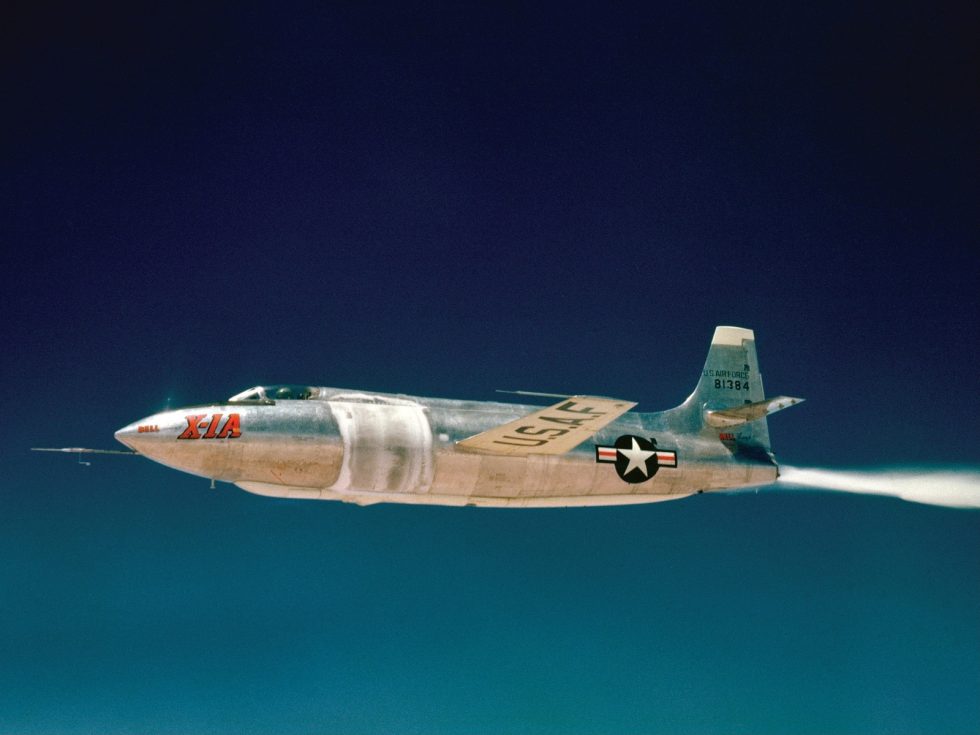
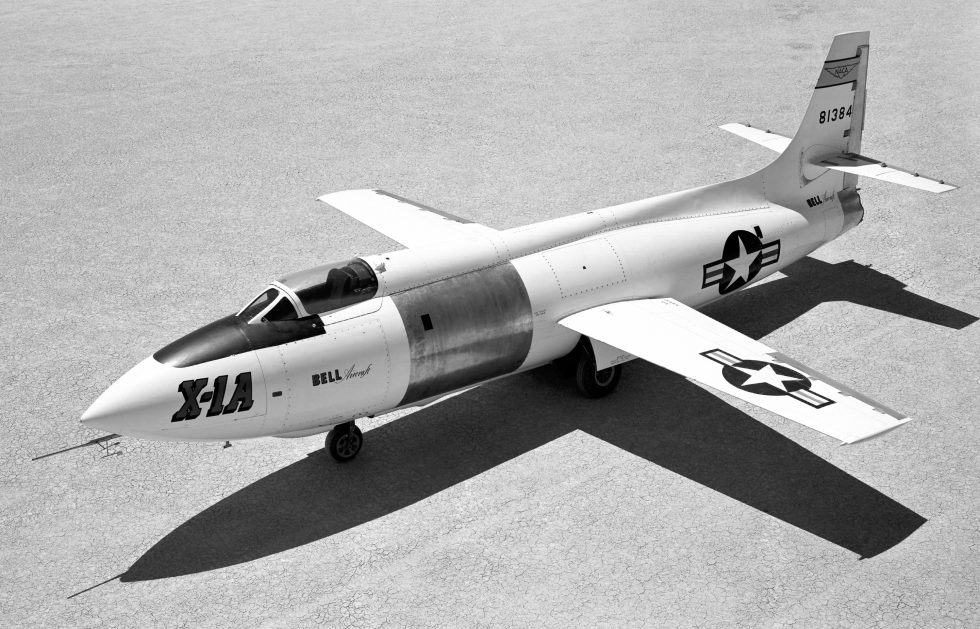
The X-1 was only the beginning. Later versions pushed further and faster: on 12 December 1953 Yeager took the boosted X-1A to about Mach 2.44 before it tumbled out of control in a then-unknown phenomenon called inertia coupling, falling tens of thousands of feet before he recovered. Other X-1s set altitude records; several were lost to violent liquid-oxygen explosions later traced to a leather-gasket problem. The type retired in 1958 — but it had already launched the entire American X-plane dynasty that led, through the X-15, to the edge of space. Two of the original aircraft survive: “Glamorous Glennis” hangs in the Smithsonian, and the rebuilt X-1E stands at NASA Armstrong.
01The Bell X-1’s secret first supersonic flight: why the world did not hear for months
The most important flight since Kitty Hawk was a military secret. When Yeager took the X-1 past Mach 1 on 14 October 1947, the result was classified — the United States did not want the Soviet Union to know it had cracked the transonic problem. The story broke only when it leaked to Aviation Week in December 1947, and the US Air Force did not officially confirm it until 1948. By the time the public learned that a human had outrun sound, it had already been true for months.
What makes it special
Rocket power and a mid-air launch
The X-1 was driven by a single Reaction Motors XLR-11 rocket with four combustion chambers, each fired independently for roughly 1,500 lbf — about 6,000 lbf (~26 kN) combined. It burned ethyl alcohol diluted with water and liquid oxygen, and drained its tanks in only a few minutes. Because it could never take off with enough propellant to climb and run supersonic, it was carried aloft in a B-29’s bomb bay and dropped at altitude.
The all-moving tail that beat Mach 1
Near Mach 0.92, shock waves over the tail made the conventional hinged elevator almost useless — the classic transonic loss of pitch control that had killed pilots. Bell built the X-1 with a horizontal stabilizer whose whole angle could be trimmed in flight. Using that all-moving tailplane, Yeager kept control through and past Mach 1. The idea was quickly adopted on the F-86 Sabre and every supersonic fighter since.
A fuselage shaped like a .50-caliber bullet
Nobody knew what shape stayed stable beyond the speed of sound, so Bell copied one that did: the fuselage was modeled on a .50-caliber Browning bullet, already proven supersonic. It was fitted with very thin, straight (unswept) wings — the first two aircraft used 8% and 10% thickness ratios so engineers could compare transonic behavior.
02The Bell X-1’s stabilator: the control breakthrough that made Mach 1 survivable
The single most important piece of engineering on the X-1 was not its rocket but its tail. As the aircraft approached the speed of sound, a shock wave formed on the horizontal tail and blanked the hinged elevator, so pulling the stick did almost nothing — the phenomenon that had destroyed aircraft in high-speed dives. Bell had given the X-1 a fully trimmable stabilizer driven by an electric screw-jack, and NACA engineer Jack Ridley worked out that moving the entire tailplane a fraction of a degree at a time restored pitch authority. That “flying tail” carried Yeager through Mach 1 and became a defining feature of supersonic aircraft design.
03The Bell X-1’s rocket and B-29 air-launch: why it was dropped, not flown, off the ground
A rocket engine is enormously powerful but ferociously thirsty — the XLR-11 emptied the X-1’s propellant tanks in a matter of minutes. An aircraft loaded with enough alcohol and liquid oxygen to reach test altitude and accelerate past Mach 1 simply could not have taken off from a runway under its own power. The solution was to make the X-1 a parasite: a modified B-29 (and later a B-50) carried it up to about 25,000 feet, slowed, and released it. Only once it had fallen clear did the pilot light the rocket — a launch technique that would define the whole X-plane program right through to the X-15.
Full specifications
Baseline note: the figures below describe the first two aeroplanes — XS-1 #1 (46-062, Glamorous Glennis) and XS-1 #2 (46-063), the Bell Model 44 airframes of 1946–47, nitrogen-pressure-fed and air-launched from a B-29. Deltas for the longer Model 58 second generation (X-1A, X-1B, X-1D) and for the rebuilt X-1E are in grey. Four published disagreements should be settled before the tables start. First, the speed on 14 October 1947: the reduced NACA data give Mach 1.06 at about 43,000 ft, Yeager’s own account and several official histories say Mach 1.05 at 45,000 ft, and some reference works quote as little as Mach 1.015 — the spread is not sloppiness but the whole problem, because the Machmeter itself was of doubtful calibration in exactly the regime the aeroplane was built to survey. Second, the number built: six airframes were completed (46-062, 46-063, 46-064, 48-1384, 48-1385, 48-1386), the X-1C 48-1387 was cancelled at mock-up, and the X-1E was 46-063 rebuilt — the commonly quoted total of seven counts one airframe twice. Third, the first flight: 19 January 1946 is the usual date for Jack Woolams’s first glide over Pinecastle, while NASA’s own X-vehicle inventory says 25 January. Fourth, the X-1E’s best speed is given as Mach 2.21 in some sources and Mach 2.24 in others, both at about 1,450 mph.
Dimensions & weights
- Crew
- 1 — seated behind a sloped, framed window set flush into the nose, entering through a hatch in the fuselage side that was bolted shut from outside by the B-29 crew. No ejection seat, and no way out at speed: to leave the aeroplane the pilot had to release the hatch into the slipstream and climb over the wing. The X-1E was the only one of the family to get a canopy and a seat.
- Length
- 9.42 m (30 ft 11 in). X-1A, X-1B, X-1D: 10.87 m (35 ft 8 in), the extra length almost entirely propellant tankage. X-1E: unchanged fuselage from 46-063, re-nosed and re-canopied.
- Wingspan
- 8.53 m (28 ft 0 in). X-1E: 6.96 m (22 ft 10 in) — the X-1E wing was not merely thinner but shorter, a different aerofoil on a shorter span
- Height
- 3.30 m (10 ft 10 in) to the top of the fin
- Wing area
- 12.08 m² (130 sq ft). X-1E: 10.68 m² (115 sq ft)
- Aerofoil
- NACA 65-110, 10 per cent thickness on #2 (46-063). #1 was flown initially with the 10 per cent wing and re-winged to NACA 65-108 at 8 per cent for the powered programme — a deliberate hedge, because nobody knew which thickness would give useful data before the shock stall arrived. X-1A, X-1B, X-1D: 65-108. X-1E: NACA 64A004 at 4 per cent, derived from the Douglas X-3 wing.
- Wing thickness
- 8 per cent of chord on 46-062 and the Model 58 aeroplanes, 10 per cent on 46-063. X-1E: 4 per cent, measuring 86 mm (3.375 in) at the root — a wing you could nearly cut bread with, and the reason the X-1E needed 343 strain gauges to prove it would hold together. Bell did not publish a root thickness in inches for the original wings.
- Aspect ratio
- 6.03 — unswept, and deliberately so. Bell knew about German sweep research; the programme judged that too little was understood about swept wings to risk a research aeroplane on one, and that a straight wing would give cleaner data. X-1E: 4.53.
- Tailplane
- Horizontal stabiliser with incidence adjustable in flight, elevator hinged to it — the single most consequential detail on the aeroplane, and often loosely described as an all-moving slab. It was not quite that: the whole tailplane could be trimmed, or the elevator worked alone at a fixed stabiliser setting. The tail was mounted high, clear of the wing wake, and cut thinner than the wing so its drag rise would arrive later.
- Empty weight
- 3,175 kg (7,000 lb). X-1A, X-1B, X-1C, X-1D: 3,120 kg (6,880 lb). X-1E: 3,107 kg (6,850 lb).
- Launch weight
- 5,557 kg (12,250 lb) at drop. X-1A, X-1B, X-1D: 7,478 kg (16,487 lb); the National Museum of the USAF quotes 7,525 kg (16,590 lb) loaded for the X-1B. X-1E: 6,690 kg (14,750 lb).
- Propellant load
- ~2,290 kg (~5,050 lb) of liquid oxygen and diluted ethyl alcohol, derived from the difference between empty and launch weight less pilot and pressurant — Bell did not publish tank capacities consistently, and the figure should be treated as an order of magnitude rather than a datum
- Wing loading
- 460 kg/m² (94 lb/sq ft) at launch, falling to about 265 kg/m² (54 lb/sq ft) at burnout. A 1947 fighter sat near 200 kg/m². This is why the X-1 came down like a brick and landed at speeds its pilots described as arriving very quickly indeed.
- Design load factor
- 18 g — specified because nobody could predict transonic buffet or trim change, so the airframe was built to survive whatever arrived. The result is a very heavy structure for its size: thick-skinned high-strength aluminium over steel propellant tanks, with two-thirds of the airframe weight in the tankage and its pressurisation.
Performance
- Speed on 14 October 1947
- Mach 1.06, about 1,127 km/h (700 mph) at roughly 13,100 m (43,000 ft), XS-1 #1, Yeager, flight 50 of the aeroplane’s life and his ninth powered sortie. Level flight, not a dive — the distinction that separates this from every earlier claim.
- Maximum speed, first generation
- Mach 1.45, 1,540 km/h (957 mph), Yeager in 46-062 on 26 March 1948 — the fastest the original nitrogen-fed aeroplanes ever went
- Maximum speed, X-1A
- Mach 2.44, 2,594 km/h (1,612 mph) at 22,770 m (74,700 ft), Yeager, 12 December 1953. Figures of 1,650 mph also circulate for the type and appear on the X-1B museum fact sheet; 1,612 mph is the number tied to the recorded flight.
- Maximum speed, X-1E
- Mach 2.21, about 2,333 km/h (1,450 mph), Joe Walker — quoted as Mach 2.24 in NASA’s own X-vehicle inventory. John McKay was chasing Mach 3 when the aeroplane was grounded.
- Service ceiling
- 21,340 m (70,000 ft). X-1A, X-1B, X-1D: 27,430 m (90,000 ft). X-1E: 22,860 m (75,000 ft).
- Highest altitude flown
- 27,566 m (90,440 ft), Major Arthur W. Murray in the X-1A, 28 May 1954. The first-generation best was about 21,030 m (69,000 ft).
- Powered endurance
- 5 minutes on the original aeroplanes; 4 min 40 s on X-1A, X-1B and X-1D; 4 min 45 s on the X-1E. All three figures assume the pilot cycling chambers on and off. With all four chambers lit the propellant lasts closer to two and a half minutes, which is the number that governs a record attempt.
- Thrust-to-weight at launch
- 0.49 rising past 0.85 at burnout as the tanks emptied — the X-1 accelerated hardest at the end of the run, which is precisely what made the last few tenths of Mach number reachable and the recovery afterwards so unforgiving
- Launch altitude
- 6,100–9,150 m (20,000–30,000 ft) from the bomb bay of the B-29 — the 14 October 1947 drop was made at 20,000 ft, later an EB-50 or RB-50. The early Pinecastle glide tests were dropped from 8,840 m (29,000 ft).
- Landing speed
- 177 km/h (110 mph) on the original aeroplanes at the end of a twelve-minute glide; 274 km/h (170 mph) for the heavier X-1B. Every flight ended dead-stick on the Rogers dry lake — there was no second attempt at the runway.
- Ground take-off, 5 January 1949
- 7,010 m in 90 seconds (23,000 ft) — Yeager flew 46-062 off the lakebed under its own power, the only runway launch of the entire programme, with a partial propellant load. The X-1 was originally specified to take off conventionally; what it could not do was leave the ground at full launch weight, and once the war ended and a B-29 became available nobody had any reason to make it.
Propulsion & systems
- Engine
- 1 × Reaction Motors XLR11-RM-3 four-chamber liquid-propellant rocket motor — X-1B: XLR11-RM-6. X-1E: Reaction Motors LR8-RM-5, the naval designation for the same engine family. Reaction Motors was one of the first American firms to build liquid rockets at all, and the XLR11 went on to power the Skyrocket, the X-15 in its interim fit and most of the lifting bodies.
- Thrust
- 26.7 kN (6,000 lbf) total, from four chambers of 6.7 kN (1,500 lbf) each. The engine could not be throttled at all; the pilot managed thrust by lighting and shutting individual chambers, so power came in four discrete steps and nothing in between. On 14 October 1947 Yeager ran up through the steps, shut down, coasted, and relit — a technique dictated entirely by the absence of a throttle valve.
- Propellants
- Ethyl alcohol diluted with water, with liquid oxygen as oxidiser — chosen after Bell examined and rejected hydrogen peroxide as a monopropellant, aniline and nitric acid as a hypergolic pair, and nitromethane. The choice was made for handling safety as much as performance, and by the standards of the Walter motor in the Me 163 it was almost civilised.
- Propellant feed
- High-pressure nitrogen on 46-062 and 46-063; gas-driven turbopumps on 46-064 and everything after — the single worst design compromise in the aeroplane. Pressure-feeding cost roughly a minute and a half of burn time and put about 900 kg (2,000 lb) of nitrogen bottles and tank structure into the landing weight. The turbopump raised chamber pressure and thrust while making the whole installation lighter. Fatigue worries about the nitrogen system grounded 46-063 after its 54th flight and were a direct cause of the X-1E rebuild.
- Pressurisation
- Twelve spherical nitrogen bottles serving both propellant tanks and the cockpit — the same gas that pushed alcohol into the engine kept the pilot breathing. There was no cabin air system in any conventional sense; the X-1 is a pressure vessel with a man inside it and wings bolted on.
- Structure
- High-strength aluminium fuselage over steel propellant tanks, conventional aluminium wing and tail — the skin is unusually thick for the size of the aeroplane because the fuselage is doing three jobs at once: carrying an 18 g design case, containing pressurised cryogenic tankage, and providing the bullet profile. Materials recorded on the surviving airframe include aluminium, steel, magnesium, asbestos, leather and radium-painted instrument dials.
- Aerodynamic form
- Fuselage modelled on the Browning .50-calibre (12.7 mm) machine gun bullet — not a metaphor but a genuine engineering shortcut. Ballistics data proved that shape stable and well behaved above Mach 1, which was more than could be said for any aerofoil-derived body in 1945. The cockpit was pushed inside the nose contour rather than the contour being opened up for the cockpit, which is why the pilot flies the aeroplane looking out of a letterbox.
- Flight controls
- Conventional ailerons, rudder and elevator, plus electrically driven stabiliser incidence — John Stack and Robert Gilruth at NACA recommended mounting the elevator on an adjustable stabiliser in 1945, and Bell built it in. A contractor flight by Tex Johnston found unacceptable lost motion between the pilot’s trim input and the actuator, which was fixed before the Air Force took the aeroplane over. Trim setting mattered on the ground too: Scott Crossfield recorded a one-degree error flipping an X-1 onto its back at the moment of drop.
- Undercarriage
- Retractable tricycle gear — short-legged and fragile, which is what wrecked the X-1D on its only successful flight when the nose leg collapsed on the lakebed
- Instrumentation
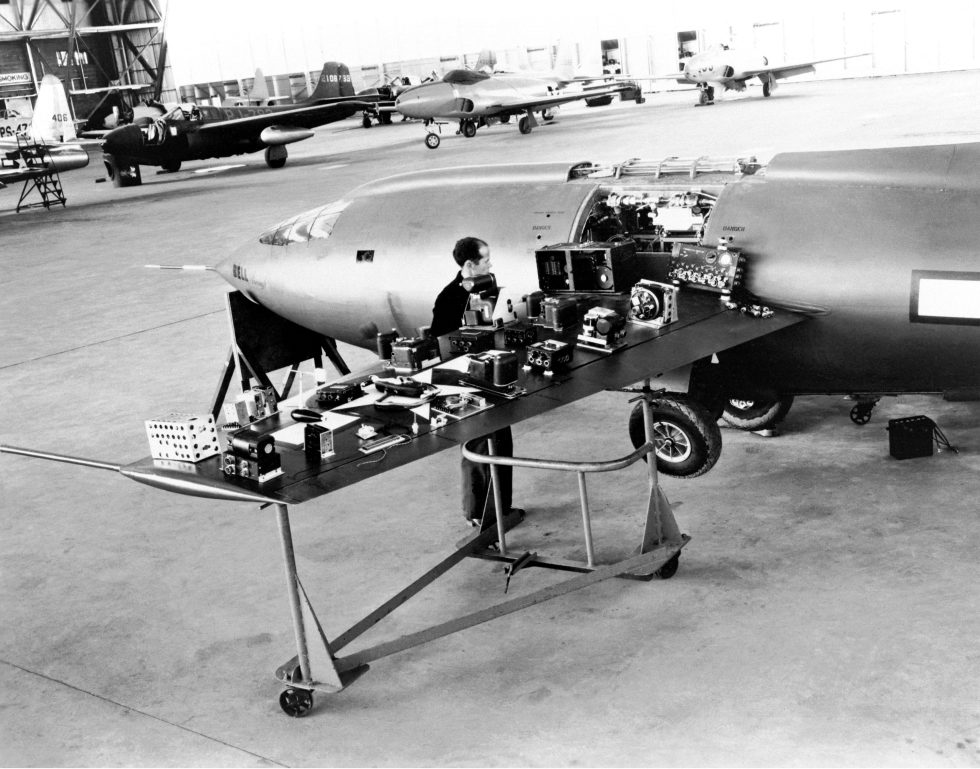
- More than 227 kg (500 lb) of NACA flight-test recording equipment on the first aeroplanes — roughly a twentieth of the empty weight, and the reason the aeroplane existed. The X-1B added more than 300 thermal probes; the X-1E carried 200 pressure ports and 343 strain gauges.
- Carrier aircraft
- Boeing B-29 Superfortress, later EB-50A and RB-50 Superfortress — the X-1 was carried semi-recessed in the bomb bay, the pilot climbing down a ladder in flight to a cockpit he then had to be sealed into. The mothership was also the single point of failure: the X-1D and the X-1A were both lost while still attached to one, and the explosion of 46-064 destroyed its EB-50A as well.
- Known failure mode
- Ulmer leather gaskets impregnated with tricresyl phosphate in the liquid oxygen plumbing — TCP becomes unstable and explosive in contact with pure oxygen under mechanical shock. It took three destroyed aeroplanes, two lives across the wider rocket-research programme and severe burns to Bell engineer Joe Cannon before the cause was identified. It is the plainest illustration available that in 1951 nobody yet knew how to handle cryogenics.
04The Bell X-1’s cost: a research program, not a production aircraft
The X-1 was never priced like a service aircraft. It was a government research program of a handful of hand-built prototypes — three first-generation X-1s plus the later X-1A, X-1B, X-1D and the rebuilt X-1E — funded jointly by the Army Air Forces (later the Air Force) and the NACA. There is no meaningful flyaway unit price or cost-per-flight-hour for an aircraft that existed only to gather data, flew a few dozen times each, and was launched from a converted bomber. Any dollar figure attached to a single X-1 is, in practice, an accounting estimate rather than a market price.
Armament & payload
The X-1 never carried a weapon, and the half-tonne of recording instruments it carried instead is the only payload that mattered
This was a measuring instrument with a pilot in it. The Bell X-1 was contracted in March 1945 for one purpose — to fly a man through the transonic range and bring back numbers — and every design decision follows from that, including the ones that look reckless now. It had no ejection seat because the bullet contour had no room for one. It had no guns because it was never intended to fight, and the one X-1 that was to have tested armament, the X-1C, was cancelled at mock-up when the F-86 and F-100 made a dedicated supersonic gun platform unnecessary. What it carried instead was more than 227 kg (500 lb) of NACA recording instrumentation on the first two aeroplanes, growing to some 300 thermal probes on the X-1B and 200 pressure ports with 343 strain gauges on the X-1E. The six cards below therefore describe sensors, structures and the things deliberately left out, honestly labelled rather than padded with empty weapons headings. Instrumentation fits changed constantly and differed between aeroplanes and between the Air Force and NACA phases of the same aeroplane; the fits described here are representative, not a single configuration any one airframe held for long.
The gun that shaped the aeroplane
- No armament of any kind was fitted, mounted, or wired for, on any X-1 that flew.
- A gun nevertheless designed the airframe: the fuselage is a scaled Browning .50-calibre (12.7 mm) machine gun bullet, chosen because ballistic ranges had already proved that body stable and predictable above Mach 1.
- The logic was sound and slightly desperate. In 1945 there was no wind tunnel that gave trustworthy transonic data — the tunnels choked in exactly the band of interest — so the only reliable supersonic body anyone had measured was a bullet.
- The shape was followed to the point of discomfort: sloped framed window inside the nose contour, no ejection seat, entry through a bolted side hatch.
- The X-1C (48-1387) was to have been the armament testbed of the family, carrying guns and munitions into the supersonic regime. It never left the mock-up stage.
Recording instrumentation and telemetry
- Over 227 kg (500 lb) of NACA flight-test instrumentation on 46-062 and 46-063 — oscillographs, film-recording galvanometers, accelerometers and control-position transmitters, with radium-painted dials for the pilot.
- Data came home on photographic film and paper trace, developed after the flight; real-time telemetry existed but was thin, and most of what the programme learnt it learnt hours or days later on the ground.
- Instrument weight was a live design constraint, not an afterthought. On a 3,175 kg empty airframe, 227 kg of recorders is one pound in fourteen, and it competed directly with propellant.
- The Air Force flew 46-062 for envelope expansion and records; NACA flew 46-063 to a slower, duller and ultimately more valuable programme of systematic data-gathering across the transonic band.
- By mid-1950 the two first-generation aeroplanes had flown 19 contractor demonstration flights and 59 Air Force test flights between them, within a first-generation total of 157 flights across all three airframes.
Air data and the Machmeter problem
- The X-1 carried a nose-boom pitot-static system feeding an airspeed indicator, altimeter and Machmeter — and the central difficulty of the whole programme was that nobody knew what those instruments read through a shock wave.
- On 14 October 1947 the Machmeter needle jumped and went off the scale as the shock passed the static ports. That jump, and the sonic boom heard on the ground, are the evidence that the aeroplane went supersonic; the exact number was reconstructed afterwards.
- Which is why the reduced figure sits at Mach 1.06 at 43,000 ft while Yeager and several official accounts say Mach 1.05 at 45,000 ft, and some reference works quote Mach 1.015. All of them are honest readings of an instrument that was itself under test.
- Calibrating transonic air data was arguably the most useful single output of the programme, because every supersonic aeroplane since has depended on knowing what its pitot head is lying about.
- The X-1E added 200 flush pressure ports so that the pressure distribution over the wing and fuselage could be mapped directly rather than inferred.
Structural loads and pressure distribution
- Strain gauges on wing and tail spars measured the real air loads arriving at the structure — the numbers that told designers whether the 18 g design case was cautious or optimistic.
- The wing-thickness experiment was itself instrumentation: 46-063 flew the 10 per cent NACA 65-110 wing while 46-062 was re-winged to 8 per cent, so the drag rise and buffet onset of two thicknesses could be compared on the same fuselage.
- The X-1E carried 343 strain gauges together with its 200 pressure ports, the densest structural instrumentation the family ever flew, on the thinnest wing.
- The programme’s most consequential structural finding was negative: cracks in the fuel tank walls. They grounded the X-1B in January 1958 and the X-1E in November 1958, ending the family.
- Metal fatigue in the high-pressure nitrogen system had already grounded 46-063 after its 54th flight, which is what created the X-1E in the first place.
Aerodynamic heating — the X-1B
- The X-1B (48-1385) was fitted with more than 300 thermal probes distributed over its surface, the first American aeroplane instrumented specifically to measure kinetic heating in flight.
- The question was practical and urgent: at Mach 2 and above, skin temperature rather than air load becomes the limit on how long an aeroplane can stay fast, and nobody had measured it on a real airframe.
- The X-1B flew for the Air Force from October 1954 and for NACA from January 1955 to January 1958, 27 flights in all.
- The heating data fed directly into the X-15, which was designed from the outset around a hot structure rather than an aluminium one.
- The X-1D (48-1386) was to have done the same heat-transfer work and never got the chance, being destroyed before its first powered flight.
Reaction controls — and what was never carried
- The X-1B was fitted with small reaction rockets for attitude control, the first aeroplane in the world to fly such a system — the answer to the problem that above about 90,000 ft there is not enough air for aerodynamic surfaces to bite on.
- That system is the direct ancestor of the X-15’s ballistic control system, and through it of every crewed spacecraft attitude control since.
- Never carried: guns, bombs, rockets, sights, radar, self-defence equipment of any kind, and until the X-1E no ejection seat — the first-generation pilots had a bolted side hatch and a slim theoretical chance.
- Also never carried in service: the fuel for a self-ferry. Designed to take off conventionally, the X-1 did so exactly once, on 5 January 1949, with a partial load; every other flight of every airframe began under a bomber.
- Nor did it carry a pressure suit worth the name in 1947. Yeager flew the sound barrier in a standard flying suit, oxygen mask and leather helmet, in an aeroplane pressurised by the same nitrogen that fed the engine.
Three typical loadouts
- Envelope expansion, 14 October 1947
- XS-1 #1, 8 per cent wing, full nitrogen-pressurised propellant load, standard NACA recorder pack. Dropped from the B-29 at about 20,000 ft, chambers lit in sequence to a level Mach 1.06 at roughly 43,000 ft, shut down with propellant deliberately in hand, glide to Rogers dry lake. Pilot flying with two ribs broken two nights earlier in a fall from a horse, taped by a doctor in Rosamond, unable to reach across to lock the hatch and using a ten-inch length of broom handle sawn off by Jack Ridley as a lever to do it.
- Speed record, 12 December 1953
- X-1A, full propellant, minimum instrumentation consistent with a record claim, all four chambers to burnout. Zoom-and-accelerate profile to Mach 2.44 at 74,700 ft — then complete loss of control to inertia coupling, a fall of 51,000 ft in under a minute at up to 8 g with the pilot’s helmet breaking the canopy, recovered into a spin and then out of it at around 25,000 ft. The flight that proved the record and the flight that nearly ended the programme were the same flight.
- Heating and reaction-control research, 1955–58
- X-1B with 300-plus thermal probes and the reaction control thrusters, or X-1E with turbopump feed, 4 per cent wing, 200 pressure ports and 343 strain gauges. Launch at 30,000 ft, four-and-three-quarter-minute burn, data recorded on film, glide home. No records attempted, no publicity, and by a distance the most useful flying any X-1 ever did.
Sourcing caveat: instrumentation fits are drawn from NASA and Smithsonian descriptions of specific airframes at specific dates and were changed repeatedly; probe, port and gauge counts should be read as the published figure for one configuration rather than a constant. The 14 October 1947 narrative detail — the horse, the taped ribs, the broom handle — rests principally on Yeager’s own account and Jack Ridley’s, is not documented in the contemporary flight record, and even the profession of the man in Rosamond who taped the ribs is disputed in the literature.
Variants
Six airframes were built, three were destroyed by the same chemical mistake, and the seventh designation is one of the survivors rebuilt
The X-1 family divides cleanly into two generations and one rebuild. The first generation — Bell Model 44, three aeroplanes ordered in March 1945 as the XS-1 and redesignated X-1 in 1948 — was pressure-fed, short-legged and good for a little over Mach 1.4. The second generation, Bell Model 58, stretched the fuselage by nearly five feet for more propellant, added a stepped canopy and went after Mach 2 and 90,000 ft. The X-1E was 46-063 rebuilt around a turbopump and a knife-thin wing to recover the research programme after the second generation started exploding.
Three of the six were lost to the same cause, and it took until 1951 to find it: Ulmer leather gaskets treated with tricresyl phosphate, used in liquid oxygen plumbing, which detonate under mechanical shock in pure oxygen. It is a sobering entry in the ledger of a programme usually remembered as a triumph. So is the fact that the aeroplane which broke the sound barrier did so with a straight wing, no ejection seat and a hatch that had to be levered shut with a piece of broom.
- XS-1 / X-1-1 (46-062, 1946–1951)
- The first aeroplane, named Glamorous Glennis for Yeager’s wife, re-winged to the 8 per cent NACA 65-108 section for powered testing. First glide 19 January 1946 at Pinecastle with Jack Woolams; first supersonic flight 14 October 1947; fastest at Mach 1.45 on 26 March 1948; the only X-1 ever to take off from a runway, on 5 January 1949. Retired to the Smithsonian in 1950.
- X-1-2 (46-063, 1946–1951)
- The NACA aeroplane, kept on the 10 per cent NACA 65-110 wing so the two thicknesses could be compared directly, and flown to a systematic research programme rather than for records. Grounded after 54 flights over fatigue concerns in its high-pressure nitrogen system, then rebuilt as the X-1E rather than scrapped.
- X-1-3 (46-064, 1951, one flight)
- The first aeroplane with turbopump propellant feed instead of nitrogen pressurisation. Made a single glide flight on 20 July 1951 and was destroyed on 9 November 1951 while being defuelled after a captive flight, taking its EB-50A mothership with it and severely burning Bell engineer Joe Cannon.
- X-1A (48-1384, Bell Model 58A, 1953–1955)
- Ordered 2 April 1948 for work above Mach 2 and 90,000 ft. Longer, heavier, stepped canopy, same XLR11. First flown by Skip Ziegler on 14 February 1953. Yeager’s Mach 2.44 and the inertia-coupling departure of 12 December 1953; Arthur Murray’s 90,440 ft on 28 May 1954. Destroyed on 8 August 1955 by a liquid oxygen tank explosion while hung under the RB-50, with Joe Walker extricated by the mothership crew before the aeroplane was jettisoned.
- X-1B (48-1385, Bell Model 58B, 1954–1958, 27 flights)
- The heating aeroplane: more than 300 thermal probes, a slightly different wing, and, late in its NACA career, the world’s first flight-tested reaction control thrusters. Air Force from October 1954, NACA from January 1955, grounded January 1958 with cracked fuel tanks.
- X-1C (48-1387, cancelled at mock-up)
- Intended to test guns and munitions in the high transonic and supersonic range. Cancelled without being built once the F-86 Sabre and F-100 Super Sabre made a dedicated armament testbed pointless — the clearest possible sign of how fast the technology the X-1 unlocked moved into service aeroplanes.
- X-1D (48-1386, Bell Model 58D, 1951, one flight)
- First of the second generation to fly, intended for heat-transfer research, with a new low-pressure fuel system and slightly greater capacity. One glide flight on 24 July 1951 that ended with the nose gear collapsing on Rogers Dry Lake; destroyed on 22 August 1951 in a fuel explosion during preparation for its first powered flight and jettisoned from its EB-50A.
- X-1E (46-063 rebuilt, 1955–1958, 26 flights)
- The most modified of all and the only one you would call comfortable: turbopump feed in place of the nitrogen system, a 4 per cent NACA 64A004 wing just 86 mm thick at the root derived from the X-3, a knife-edge windscreen, an upward-opening canopy and an ejection seat, plus 200 pressure ports and 343 strain gauges. First glide 15 December 1955 with Joe Walker — NASA’s own inventory says 12 December — Mach 2.21 on Walker’s 21 flights, five more by John McKay chasing Mach 3, grounded November 1958 with cracks in the fuel tank wall.
- Bell Model 58 second generation, as a group (48-1384 to 48-1387, 54 flights flown)
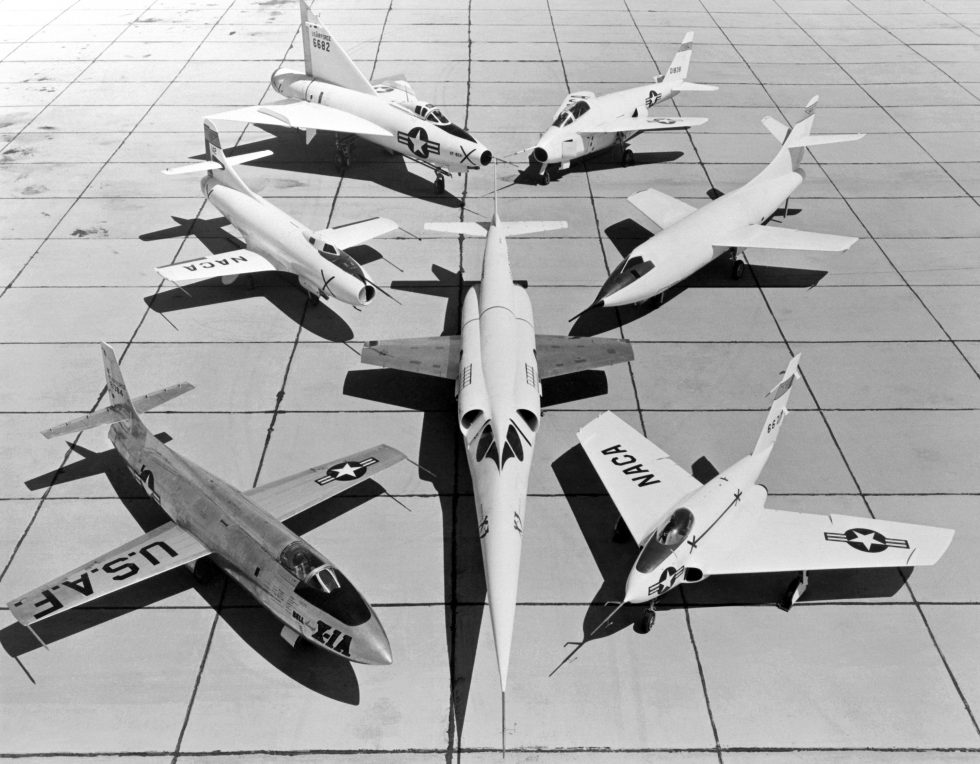
- Taken together the second generation flew 54 times, reached Mach 2.44 and 90,440 ft, killed nobody, destroyed two of its three completed aeroplanes and handed the high-speed research programme to the X-2 and then the X-15. Its real legacy is negative knowledge: inertia coupling, cryogenic gasket chemistry, and the limits of an aluminium airframe at Mach 2.
Survivors, precisely: three airframes exist and all three are original, though one is unrecognisable. X-1-1 (46-062) Glamorous Glennis hangs in the Boeing Milestones of Flight Hall at the National Air and Space Museum in Washington, D.C., in international orange, transferred from the Air Force on 26 August 1950 after being flown to Washington slung beneath a B-29. X-1B (48-1385) stands in the Research and Development Gallery at the National Museum of the United States Air Force, Wright-Patterson AFB, Ohio, transferred in 1959. X-1E, which is 46-063 rebuilt and therefore the second aeroplane ever built, is displayed outdoors in front of the NASA Armstrong Flight Research Center headquarters at Edwards AFB, California. The other three airframes — 46-064, the X-1A and the X-1D — were destroyed by explosion and nothing meaningful of them survives; 48-1387 was never built. Any other X-1 on display anywhere is a replica or a mock-up, and several exist; none should be confused with the three above. A related correction worth making: the X-1’s adjustable-incidence stabiliser was recommended by John Stack and Robert Gilruth of NACA and built into Bell’s 1945 design, before the cancelled Miles M.52 papers reached Bell in early 1946. Miles had independently reached the same conclusion, its chief aerodynamicist Dennis Bancroft stating plainly that an ordinary elevator would not function at all above Mach 1, and the British data corroborated and reinforced what Bell was already building rather than originating it — a distinction the popular accounts on both sides of the Atlantic tend to lose. What is not in dispute is that the transfer was one-way: Britain sent everything and received nothing back, and the M.52 itself was cancelled in February 1946 with three prototypes under construction, its aerodynamics finally vindicated by an unmanned three-tenths-scale rocket model that reached Mach 1.38 in level flight on 10 October 1948.
From a wartime question to the edge of space
The idea takes shape
The Army Air Forces and NACA begin the design study (MX-524, then MX-653) for an aircraft to probe the transonic region no fighter could safely enter.
Bell is contracted
On 16 March, Bell Aircraft is awarded the contract to build three XS-1 research aircraft in Buffalo, New York.
First flights
Jack Woolams makes the first unpowered glide flight in January; in December, Bell pilot Chalmers “Slick” Goodlin makes the first powered flight.
The sound barrier falls
On 14 October, Capt. Chuck Yeager flies “Glamorous Glennis” to about Mach 1.06 — the first crewed supersonic flight. The result is kept secret.
The Collier Trophy
The achievement is confirmed publicly and the year’s Collier Trophy is shared by Bell, Yeager and NACA’s John Stack.
An altitude record
Maj. Frank Everest takes an X-1 to 71,902 ft (21,900 m), stretching the type’s envelope higher still.
The wild ride of the X-1A
On 12 December, Yeager reaches about Mach 2.44 in the X-1A, then tumbles in an inertia-coupling spin, falling tens of thousands of feet before recovering.
Ninety thousand feet
Maj. Arthur “Kit” Murray zoom-climbs the X-1A to about 90,440 ft (27,566 m), an altitude record for the type.
The program ends
The rebuilt X-1E makes the last flight of the X-1 family, closing a program that launched the entire American X-plane era.
From the flight line: twelve X-1 stories
Two broken ribs and a broomstick
Yeager broke the sound barrier hurt — and rigged a broomstick to close the hatch.
Read the full story
Glamorous Glennis
Every X-1 Yeager flew carried his wife’s name.
Read the full story
The barrier broke in silence
The most important flight since Kitty Hawk was classified for months.
Read the full story
A bullet with wings
Not knowing what shape stayed stable past Mach 1, Bell copied a gun.
Read the full story
The tail that saved the flight
As the elevator went dead near Mach 0.92, the whole tail took over.
Read the full story
The wild ride of the X-1A
Going too fast in 1953 nearly killed Yeager.
Read the full story
The Mach jump
The needle itself told the story of breaking through.
Read the full story
The bonus that opened the door
A pay dispute helped hand the flight to a military pilot.
Read the full story
The drop
The X-1 was launched, not flown, off the ground.
Read the full story
The Collier Trophy
Breaking the barrier earned aviation’s top prize.
Read the full story
The first boom
People on the desert floor heard the barrier break.
Read the full story
From X-1 to X-15
The orange bullet started a dynasty.
Read the full story
The X-1 in pictures
The X-1 in motion
A hand-picked, high-authority film of the Bell X-1 breaking the sound barrier is on the way — video coming soon.
Where the X-1 flew
The records that define it
The X-1 never fired a shot in anger — it was a research aircraft, and its victories were milestones rather than kills. Every one of them expanded what a piloted aircraft was known to be able to do, and each was won in the thin air over the California desert.
Explore the whole collection in the MiGFlug Aircraft Museum.
Everything people ask about the Bell X-1
Can I fly in a Bell X-1?
Who broke the sound barrier in the X-1?
How fast could the Bell X-1 go?
What engine did the X-1 use?
How did the X-1 take off?
What made the X-1 able to fly supersonic?
Where can I see a Bell X-1 today?
You can’t fly the X-1.
These, you can.
Some legends only live in museums — others are fuelled and waiting. MiGFlug has put civilians in real military jet cockpits since 2004.
 Fly the L-39 AlbatrosThe world’s most-flown jet trainer — aerobatics included
 Fly the F-104 Starfighter“The missile with a man in it”
 Fly the MiG-21The Cold War’s most-produced jet
 Fly the T-33 Shooting StarAmerica’s first jet trainer
 Fly the DH VampireA piece of early jet history
 Fly the S.211Agile Italian jet trainer
 Fly the MB-326The classic Aermacchi jet
 Fly the MiG-15The Soviet legend of the Korean War
Continue the tour
Every fact, checked
- Smithsonian National Air and Space Museum — Bell X-1 “Glamorous Glennis”Primary museum record for dimensions, engine, flight totals and current display.
- NASA — First Generation X-1Authoritative on serials, wing thicknesses, air-launch, pilots and the X-1-3 explosion.
- NASA Armstrong — X-1E Research AircraftThe rebuilt X-1E’s specifications, flights and its display at NASA Armstrong.
- Aerotech News & Review — The Bell X-1 programThe most complete variant-by-variant rundown, losses and the TCP/Ulmer-leather cause.
- Smithsonian Magazine — How the Bell X-1 Ushered in the Supersonic AgeCollier Trophy recipients, the secrecy and leak, and the flight’s significance.
- The Chuck Yeager FoundationDetailed first-person account of the X-1A’s Mach 2.44 flight and inertia-coupling spin.
- HistoryNet — Bell X-1: Dropping the Orange BeastThe broken ribs, the broomstick, the drop procedure and the stabilizer fix.
- National Museum of the US Air Force — Bell X-1BOfficial record for the surviving X-1B and its reaction-control research.