
North American XB-70
“Valkyrie”
A six-engine, 250-tonne stainless-steel delta built to cruise at Mach 3 on its own shock wave — the ultimate Cold-War bomber, rendered obsolete before it ever carried a weapon, and remembered for one of aviation’s most tragic accidents.
The bomber that flew too late
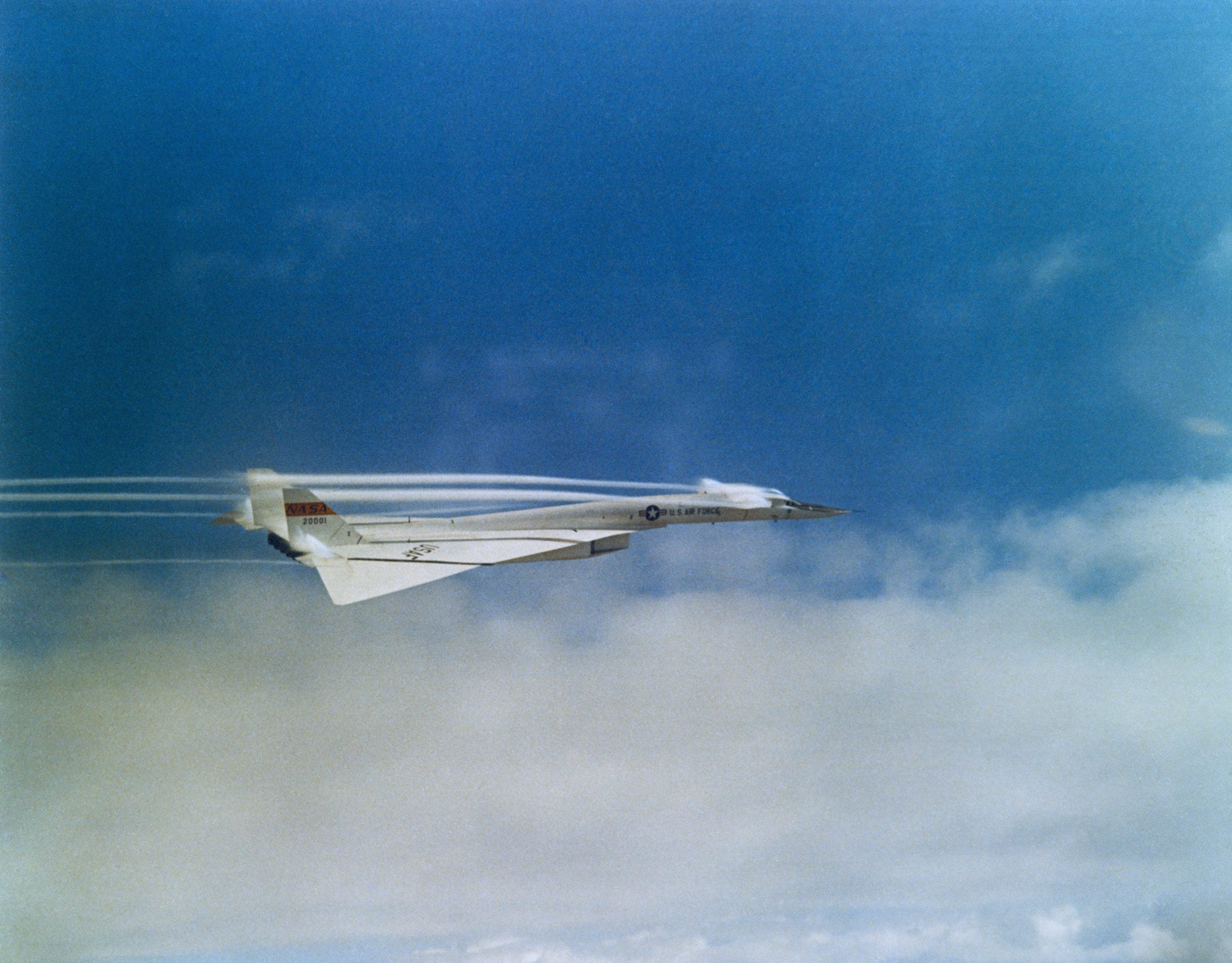
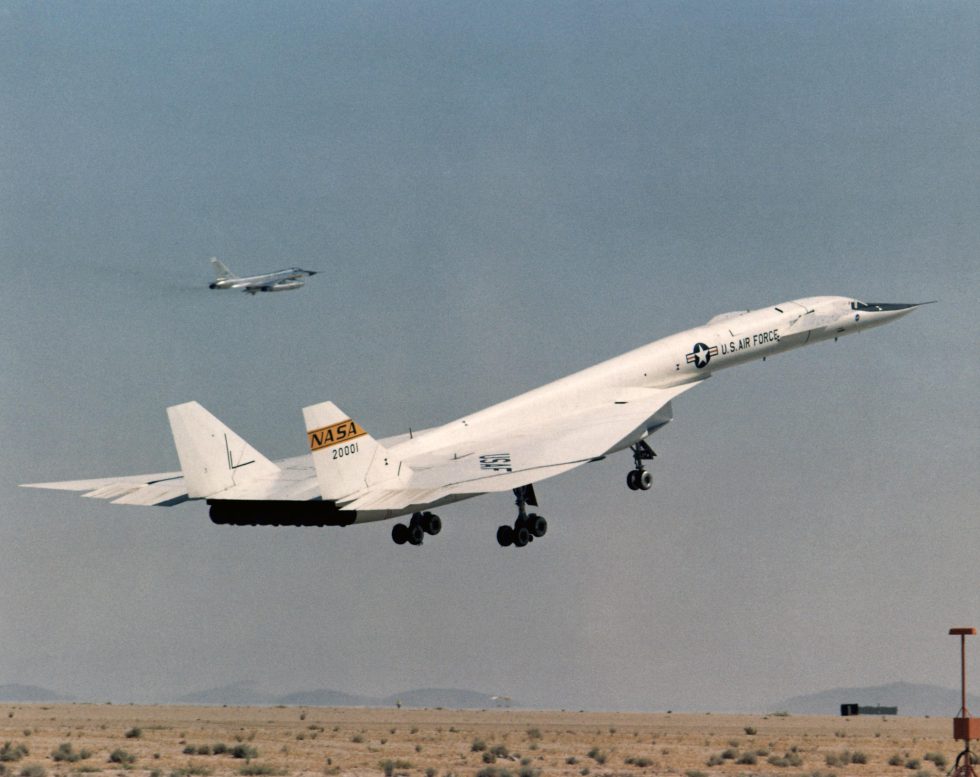
In the mid-1950s the US Air Force wanted a bomber that could do what no interceptor could stop: cruise at Mach 3 and 70,000 feet, drive deep into the Soviet Union and deliver nuclear weapons faster than anything could climb to meet it. North American Aviation — makers of the P-51 Mustang and the X-15 — won the development contract in 1957. The result, the XB-70 Valkyrie, was one of the most extraordinary machines ever built: a 57-metre, six-engine stainless-steel delta finished in gleaming white, designed to ride its own shock wave across a continent.
Its central trick was compression lift. At Mach 3 the wedge-shaped forward fuselage threw a powerful shock wave, and the wing was shaped to trap that high-pressure air beneath it — so the aircraft was held up, in part, by its own sonic boom. To make it work the outer wing panels, each the size of a fighter’s entire wing, folded down as much as 65 degrees in flight, sealing the shock under the wing and restoring the directional stability a slender delta loses at high Mach.
But the world shifted underneath the programme. On 1 May 1960 an SA-2 surface-to-air missile knocked Gary Powers’ U-2 out of the sky over Sverdlovsk. If a missile could reach 70,000 feet, then flying high and fast was no longer a defence — it was a target. At the same time the intercontinental ballistic missile arrived: cheaper, faster and unstoppable, with no crew to lose. In 1961 the Kennedy administration and Defence Secretary Robert McNamara cancelled the B-70 as a bomber. Only two airframes were completed, and they flew on as pure research aircraft.
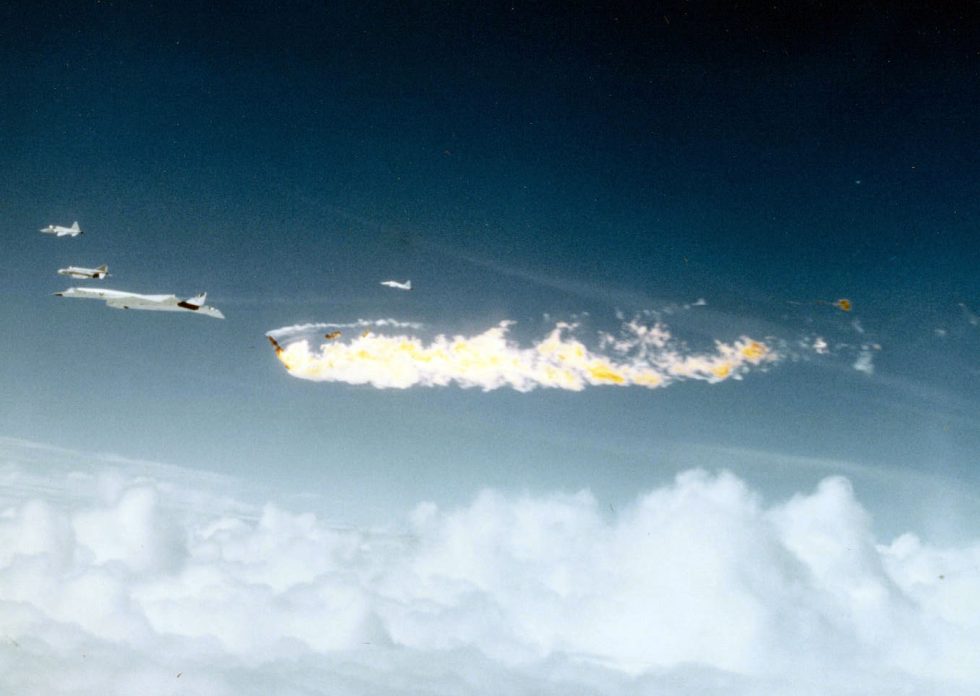
The Valkyrie’s public story is inseparable from tragedy. On 8 June 1966 the second aircraft flew a tight formation of General Electric-powered jets for a company publicity photograph near Edwards Air Force Base. An F-104 chase plane, caught in the bomber’s powerful wingtip vortex, rolled into the Valkyrie, sheared off both of its vertical tails and sent it into an unrecoverable spin. NASA test pilot Joe Walker in the F-104 and Air Force co-pilot Carl Cross in the Valkyrie were killed; pilot Al White escaped in the aircraft’s encapsulated ejection seat. It is remembered as a needless loss on a flight that existed only for a photograph.
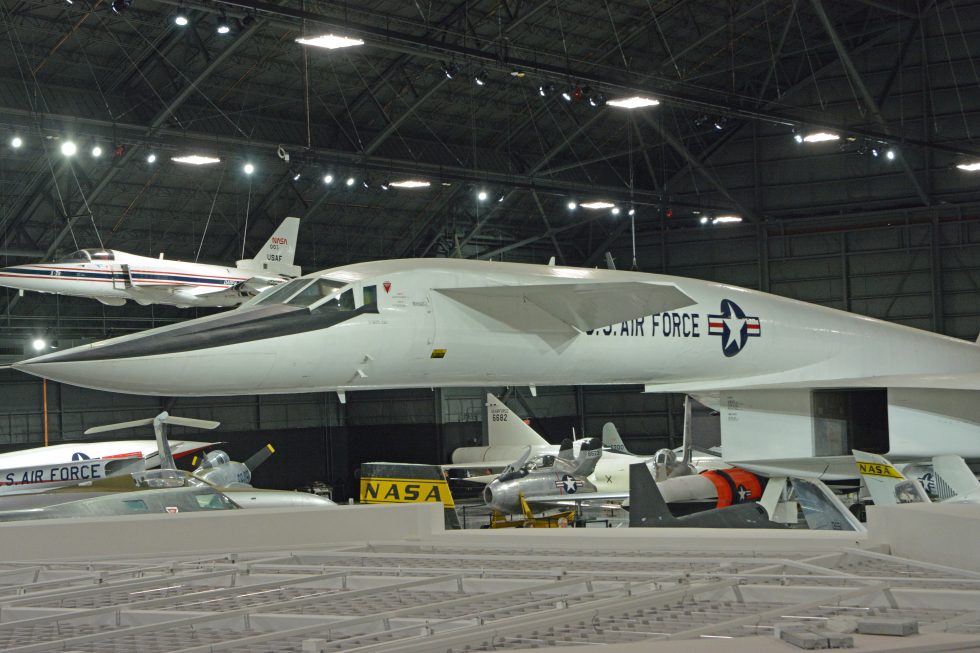
The surviving aircraft flew on for NASA, gathering the high-speed data that fed America’s supersonic-transport research, before making its final flight to the National Museum of the US Air Force on 4 February 1969. It has stood indoors at Dayton, Ohio ever since — the only XB-70 in the world, a monument to an idea that was brilliant, beautiful and obsolete almost before it left the ground.
01The XB-70 Valkyrie’s cancellation: why America built only two Mach 3 bombers
The Valkyrie grew out of the 1950s Weapon System 110A requirement for a Mach 3 intercontinental bomber to replace the B-52. It was a triumph of ambition — and it was overtaken by two technologies at once. High-altitude surface-to-air missiles, proven when an SA-2 downed a U-2 in 1960, erased the safety of flying high and fast. And the intercontinental ballistic missile offered the same nuclear reach without risking a crew. Facing a bomber that was expensive, vulnerable and arguably redundant, Robert McNamara cut the B-70 to a two-aircraft research programme in 1961. The Valkyrie never carried a weapon or entered squadron service; its value, in the end, was the flight-test data it produced.
What makes it special
It rode its own shock wave
The Valkyrie was designed around compression lift: at Mach 3 its wedge-shaped forebody generated a shock wave whose high pressure pushed up on the underside of the wing, supplying a large share of cruise lift almost for free. Its folding wingtips — drooping to 25° subsonic and a full 65° at high Mach — sealed that pressure under the wing and clawed back the directional stability a slim delta loses near Mach 3.
Six engines and a skin of steel
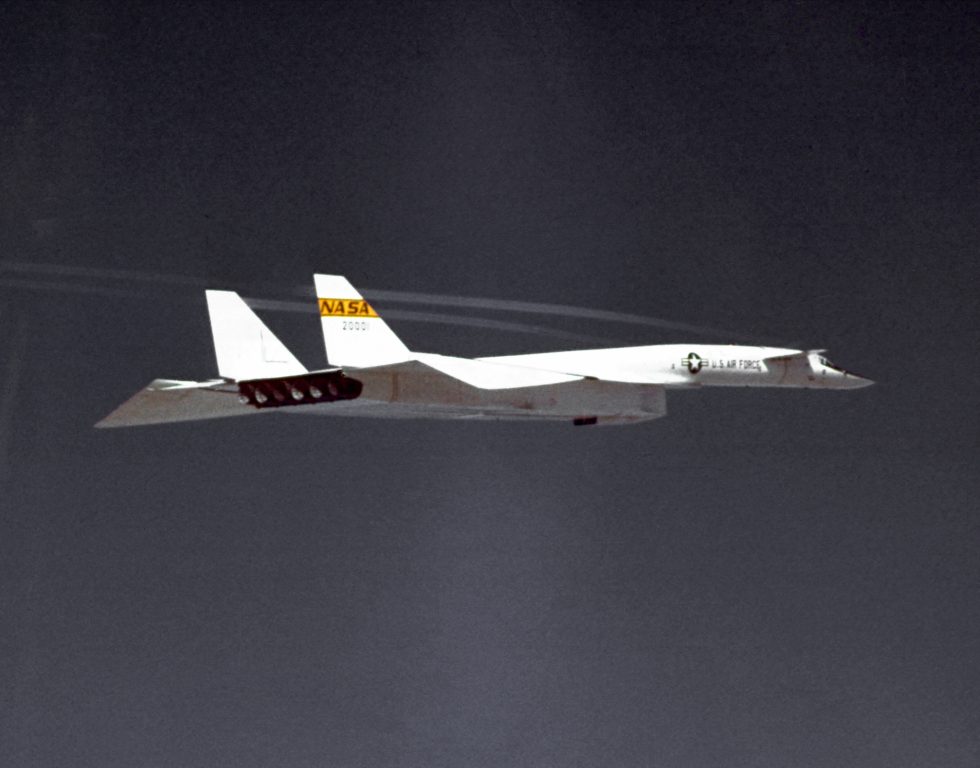
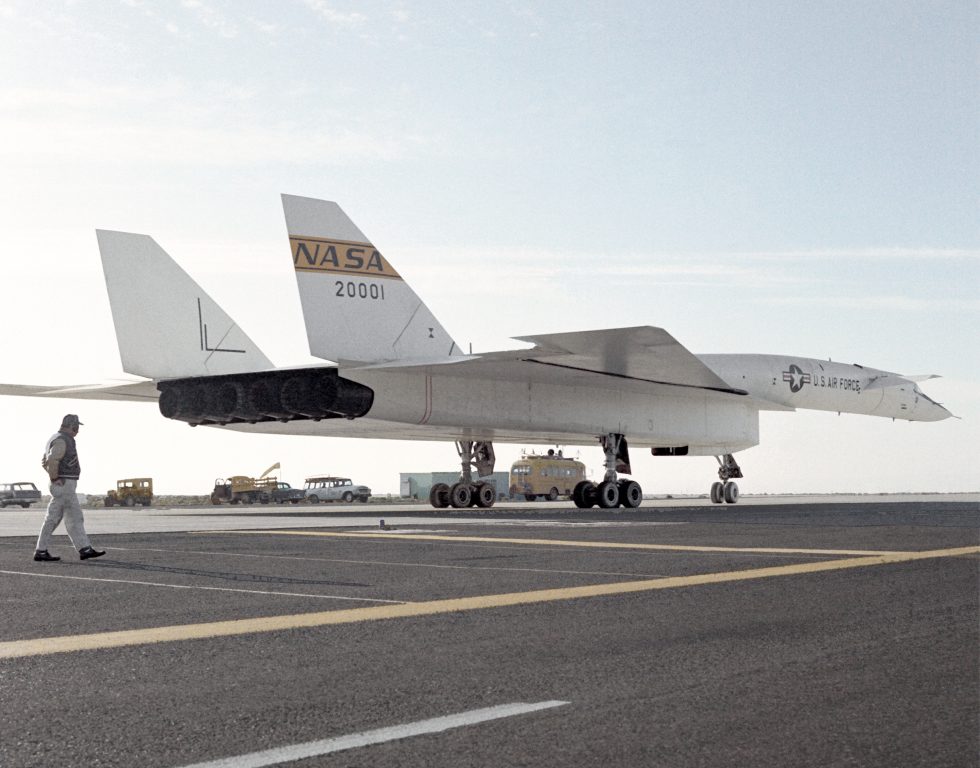
Thrust came from six General Electric YJ93 afterburning turbojets clustered in the rear fuselage — roughly 28,000–30,000 lbf each, and one of the loudest aircraft ever flown. To survive Mach 3 heat the airframe was built largely of brazed stainless-steel honeycomb sandwich panels, with titanium — only about 9% of the structure — reserved for the hottest areas.
Fighting the heat of Mach 3
At Mach 3.1 the nose and leading edges reached around 330 °C and the whole airframe grew measurably longer from thermal expansion. The fuel doubled as a heat sink, soaking up heat before it was burned; a special high-stability fuel, JP-6, resisted cooking, and empty tank space was filled with inert nitrogen so the hot fuel vapours could not ignite.
02The XB-70 Valkyrie’s folding wingtips: the largest movable surfaces ever flown
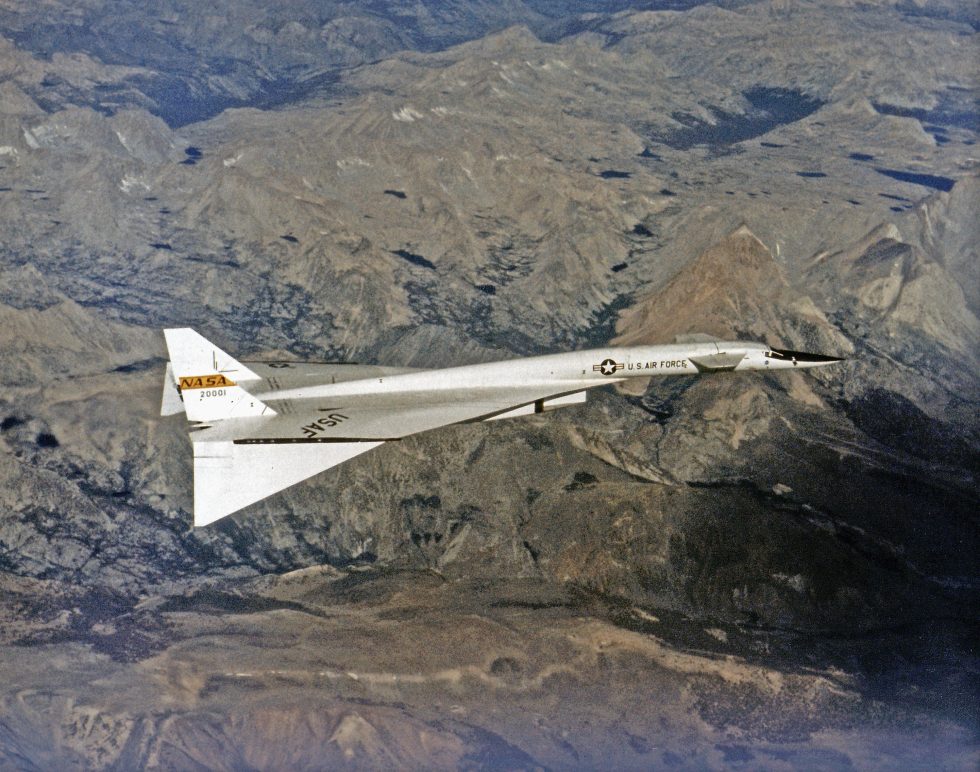
Each of the Valkyrie’s outer wing panels was, on its own, about the size of a fighter’s entire wing — and they were hydraulically hinged to fold downward in flight. Subsonic they hung at roughly 25°; above about Mach 1.4 they drooped to the full 65°. This did three jobs at once: it trapped the high-pressure air of the aircraft’s own shock wave under the wing to boost compression lift, it reduced drag, and it added side-area aft to restore directional stability at Mach 3. No aircraft before or since has flown movable surfaces on this scale.
03The XB-70 Valkyrie’s honeycomb skin: the manufacturing nightmare behind Mach 3
Building an aircraft that could survive sustained Mach 3 meant inventing a structure to match. North American turned to brazed stainless-steel honeycomb sandwich panels — two thin steel skins bonded to a honeycomb core — light, stiff and heat-tolerant in theory. In practice it was punishing to build: panels could delaminate and shed under heat and stress, and at least one Mach 3 flight ended with skin peeling away from the airframe. The technique was as much art as engineering, and its difficulties were among the reasons the Valkyrie stayed a two-aircraft experiment.
Full specifications
Baseline note: the figures below describe an XB-70A air vehicle as flown from Edwards between 1964 and 1969 — two crew, no weapons fitted, six YJ93-GE-3 engines, internal fuel only. Where the two airframes differed, AV-2 is noted in grey, as are the numbers intended for the production B-70A that was never built. Four disagreements need settling before the tables start. Length: most reference works give 185 ft 0 in, but the USAF Standard Aircraft Characteristics sheet of January 1972 records 196 ft; 56.39 m (185 ft 0 in) is adopted here and the discrepancy is flagged again in the table. Empty weight: the same split runs through the weights, 253,600 lb in the popular sources against 231,215 lb on the SAC sheet, a difference of over ten tonnes that nobody has ever reconciled in print. Thrust: General Electric described the YJ93 as being in the "30,000-pound class" and the National Museum of the USAF still quotes 180,000 lb of combined thrust, but North American’s own B-70 Aircraft Study records 28,000 lbf with afterburner and 19,900 lbf dry, which is what is used here. Ceiling: 77,350 ft is the published service ceiling and 74,000 ft is the highest altitude any Valkyrie is recorded as reaching, on 19 March 1966 — the aeroplane never flew as high as its brochure.
Dimensions & weights
- Crew
- 2 — pilot and co-pilot only. The production B-70A was to have carried four, the extra two being a navigator and a bombardier; with no weapons to aim and no target to find, the research aircraft did not need them. The cancelled AV-3 would have had the four-man cockpit
- Length
- 56.39 m (185 ft 0 in) — the figure in almost every reference work. The USAF Standard Aircraft Characteristics sheet for AV-1, dated January 1972, gives 59.74 m (196 ft), and German and Russian sources follow it. The gap is roughly the length of the nose air-data probe, but no published source states plainly what is and is not being measured
- Wingspan
- 32.00 m (105 ft 0 in) with the tips level. With both tips folded to 65° the span across the top of the wing falls to about 24 m, which is why the aeroplane looks like a different machine in cruise photographs
- Height
- 9.14 m (30 ft 0 in) to the top of the twin fins. The Russian SAC-derived table says 9.36 m (30 ft 8 in); the difference is trivial and probably a question of undercarriage extension
- Wing area
- 585.0 m² (6,297 sq ft) — a delta of 65.57° leading-edge sweep, 58° at quarter chord, aspect ratio 1.75, mean aerodynamic chord 23.94 m (78 ft 6 in). The inboard leading edge was cambered to make the aeroplane tolerable below Mach 1
- Canard
- 38.6 m² (415.6 sq ft), all-moving, set immediately behind the cockpit and fitted with its own trailing-edge flap — the only foreplane of its era with flaps of its own. See the Propulsion & systems table for what it was for
- Folding wingtips
- hinged at roughly two-thirds semi-span, three positions: level, 25° down and 65° down — the largest movable aerodynamic surfaces ever flown on any aircraft. AV-1 folded to a measured 64.5°, AV-2 to 69.5°. Each panel is bigger than the whole wing of a fighter of the period
- Wing dihedral
- 0° on AV-1 — AV-2 was built with 5° of dihedral on the advice of NASA Ames wind-tunnel work, to cure the directional wandering that had confined the first aircraft to Mach 2.5. It worked: AV-2 handled far better above Mach 2.5 than AV-1 ever did
- Empty weight
- 115,031 kg (253,600 lb) in the usual references; the SAC sheet says 104,877 kg (231,215 lb). Either way the aeroplane weighed empty about what a fully loaded Boeing 707 weighed
- Gross weight
- 242,536 kg (534,700 lb) — the working take-off weight for a full-fuel research sortie
- Maximum take-off weight
- 245,847 kg (542,000 lb). Maximum landing weight was 134,396 kg (296,300 lb), a little over half, so a sortie that ended early meant dumping fuel for a long time
- Internal fuel
- ~136,000 kg (300,000 lb), about 176,900 litres (46,745 US gal) in eleven tanks, three in each wing and five in the fuselage. Fuel was more than half the take-off weight and was pumped aft in flight to chase the centre of lift as it moved back with Mach number. No in-flight refuelling was fitted to either aircraft
- Undercarriage track
- 7.07 m (23 ft 2 in). Four-wheel main bogies with aluminium-coated tyres to keep the rubber from cooking, an anti-skid computer fed by a small unbraked reference wheel, and a retraction sequence that swung each leg through two 90° rotations to fit it into a bay alongside the intake duct
Performance
- Maximum speed (design)
- Mach 3.1, 3,310 km/h (2,056 mph, 1,787 kt) at altitude — a design figure, not one that was demonstrated
- Fastest flown
- Mach 3.08 by AV-2 on 12 April 1966, held for 20 minutes. The highest recorded true airspeed was 3,251 km/h (2,020 mph) on 12 January 1966
- Cruise speed
- Mach 3.0, 3,219 km/h (2,000 mph) — the design cruise was the design maximum, which is the whole point of the aeroplane. Below the tropopause it was a different machine: at low level it was limited to about Mach 0.95
- Longest Mach 3 cruise
- 32 minutes by AV-2 on 19 May 1966, covering 3,860 km (2,400 miles) in a 91-minute sortie. Across the whole programme the two aircraft accumulated 1 hour 48 minutes above Mach 3 — an SR-71 could do that in a single flight
- Service ceiling
- 23,580 m (77,350 ft) published. The highest altitude actually recorded was 22,555 m (74,000 ft) on 19 March 1966
- Rate of climb
- 139 m/s (27,400 ft/min) initial, with time to 6,096 m (20,000 ft) quoted as 3 minutes 34 seconds. Getting to cruise altitude and speed took far longer than that: the climb and acceleration to Mach 3 consumed a large fraction of the fuel
- Combat range
- ~6,900 km (3,725 nautical miles) combat radius as quoted for the type; the SAC sheet gives a typical mission range of 5,499 km and a design mission of 6,901 km. The 1955 requirement had asked for a 4,000-nautical-mile unrefuelled radius, which the aeroplane never met
- Lift-to-drag ratio
- about 6 at Mach 2 — poor by subsonic standards and remarkable by supersonic ones. Compression lift and the folded tips are the reason it is not worse
- Take-off run
- 2,255 m (7,400 ft), unstick at 377 km/h (234 mph). A thrust-to-weight ratio of 0.314 at maximum weight meant the Valkyrie needed a long runway and a patient pilot
- Landing speed
- 296 km/h (184 mph) on the approach, stall 219 km/h (136 mph). Approaches were flown at a deliberately shallow 1.2–1.5° to spare the tyres, and three 8.5 m (28 ft) brake chutes stopped the aeroplane. Delta ground effect made the touchdown itself unusually soft
- Wing loading
- 414.7 kg/m² (84.93 lb/sq ft) at gross weight — low for the weight, because the wing is enormous
- Sorties flown
- 129 across the programme: 83 by AV-1 in 160 hours 16 minutes, 46 by AV-2 in 92 hours 22 minutes. That is the entire operational record of the type
Propulsion & systems
- Engines
- 6 × General Electric YJ93-GE-3 afterburning turbojets — developed from the J79 as the J79-X275 and shared with the cancelled XF-108 Rapier interceptor, which is why the two programmes died within a few years of each other
- Thrust
- 124.6 kN (28,000 lbf) with afterburner and 88.5 kN (19,900 lbf) dry, each; 747 kN (168,000 lbf) total. General Electric marketed the engine as being in the "30,000-pound class" and the National Museum of the USAF still quotes 180,000 lb of combined thrust, but the B-70 Aircraft Study figures are the ones the aeroplane actually flew on
- Engine detail
- single-shaft axial turbojet, 11-stage variable-stator compressor, annular combustor with 36 dual nozzles, two-stage turbine, turbine inlet temperature 1,149°C (2,100°F), air mass flow about 125 kg/s (275 lb/s), dry weight 2,368 kg, 6.0 m long by 1.375 m in diameter. The installation was designed so a dead engine could be changed on the ramp in 25 minutes
- Fuel
- JP-6 — a high-flash-point kerosene formulated specifically for this aeroplane, because ordinary JP-4 would have boiled and coked in tanks running at soak temperatures a conventional jet never sees. The original plan had been to burn boron-based high-energy "zip" fuel in the afterburners to make the range figures work; that programme was cancelled in 1959 after the caustic residue proved to eat turbines, and the range requirement was quietly relaxed instead
- Air induction
- two rectangular mixed-compression inlets, each feeding three engines through a duct roughly 27 m (90 ft) long that a man could walk down upright. Variable ramps scheduled the throat against Mach number; at cruise about 81 per cent of captured air reached the engines, 16 per cent was bled off as boundary layer and 3 per cent went to engine-bay cooling. An inlet unstart — the internal shock being violently expelled forward — produced a bang, a yaw and, in a double unstart, up to 30° of corrective nose-down elevon. It was the single most disliked feature of flying the aeroplane
- Compression lift
- the reason the whole configuration exists — the shock generated by the splitter plate at the leading edge of the intake, below the apex of the wing, lies about 65° back at Mach 3, and the wing sits on top of it. The air trapped under the wing behind that shock is roughly 1.9 kPa (40 lb/sq ft) higher in pressure than the air ahead of it, and that pressure pushes upward for nothing. It supplied about five per cent of total lift. The idea came from a 1956 NACA report by Alfred Eggers and Clarence Syvertson, "Aircraft Configurations Developing High Lift-Drag Ratios at High Supersonic Speeds", which North American found while hunting for anything that would close the range shortfall
- Folding wingtips
- hydraulically driven, level below about Mach 0.5, 25° down for transonic and low supersonic flight and 65° down above roughly Mach 1.4 — they do four things at once. They add vertical surface, restoring directional stability the long forebody destroys. They box in the compression-lift shock so the high pressure cannot spill sideways, and reflect it off the inner faces of the folded panels for a little more. They delete lifting area behind the centre of gravity, which cancels most of the nose-down trim change as the centre of pressure marches aft with Mach number, so the elevons do not have to fight it and the trim drag is saved. And they do it without a wing pivot, a carry-through box or the weight that variable sweep costs
- Canard
- all-moving foreplane with a trailing-edge flap — the flap is the clever part. Lowering it makes the canard lift harder, which pitches the nose up, which is then trimmed out by deflecting the elevons down. The elevons therefore act as landing flaps instead of as an up-deflected trim penalty, and the aeroplane gains lift where a tailless delta normally loses it. This is why the Valkyrie’s low-speed handling was described as gentle and better than predicted, in an aircraft with a landing weight of 134 tonnes
- Structure
- brazed stainless-steel honeycomb sandwich — PH15-7Mo stainless, 68 per cent of structural weight, about 1,900 m² of panel per aircraft, face sheets down as thin as 0.50 mm brazed to a foil core. The rest: H-11 tool steel 17 per cent (undercarriage, wingtip fold mechanisms, main spars), titanium alloys 8–9 per cent (the 18 m forward-fuselage skin in Ti-6Al-4V, plus forgings), AM-355 stainless 4 per cent and René 41 nickel alloy 2 per cent in the engine bay. Vacuum electron-beam welding had to be developed to build assemblies this size. Early panels were badly made — two tore off AV-1 in supersonic flight, one taking 0.6 m of the left wing leading edge with it on 14 October 1965, after which that aircraft was restricted to Mach 2.5 for the rest of its life
- Thermal management
- about 330°C at the nose and wing leading edges at Mach 3 and roughly 246°C over the rest of the airframe — fuel was circulated through heat exchangers as a heat sink before being burned, the skin was finished in a white heat-reflective enamel chosen partly for the flash of a nuclear detonation, and windscreen de-icing and rain removal used 316°C (600°F) engine bleed air
- Fuel inerting
- nitrogen injected into the JP-6 during refuelling, plus a system that vaporised a 318 kg (700 lb) supply of liquid nitrogen to pressurise the tanks and fill the vent space, so that no explosive fuel-air mixture could form in tanks that expanded, contracted and leaked as the airframe grew and shrank with heat. Sealing those tanks was one of the hardest problems on the aeroplane
- Escape system
- two individual encapsulated ejection seats of the type developed for the B-58 and shared with the XF-108 — the seat slid aft, straps pulled the occupant’s limbs in, and clamshell doors closed to form a pressure capsule before the whole assembly was fired through the roof. It saved Al White on 8 June 1966 and crushed his right elbow doing it. Carl Cross either could not reach the initiation handle under the spin loads or the system failed
04The XB-70 Valkyrie’s cost: what a cancelled Mach 3 bomber was worth
Because the Valkyrie was a government research programme and never sold, no clean flyaway unit price exists. The research effort is commonly cited at around $1.5 billion in 1960s dollars, while the original full-scale bomber programme — development plus a planned operational fleet — was estimated near $2.5 billion before cancellation; per-aircraft figures around $700 million are also quoted. All of these should be read as estimates, not audited costs. No credible cost-per-flight-hour figure for the type exists in open sources.
Armament & payload
The Valkyrie was built to deliver nuclear weapons and never carried one
Neither Valkyrie ever carried a weapon, and neither was wired to. The production B-70A was to have been a pure nuclear bomber, dropping free-fall weapons from an internal bay behind the undercarriage bays, and the design carried that bay through to the two prototypes as empty volume. What went into that volume instead was instrumentation: the recorders, transducers and telemetry sets of 1964 were heavy and bulky, and the bomb bay was the obvious place to put them. Everything published about the intended armament comes from planning documents for an aircraft that was cancelled before its bay was ever fitted out, and some of it is thin: the AIM-47 Falcon and the Mk 80 series that circulate in online specification tables are uncited in the sources that carry them, and should be read as proposals or errors rather than as fit.
The honest answer to "what did the XB-70 carry?" is: two men, a great deal of fuel, and about a tonne of test equipment. The six cards below therefore describe the weapons bay as designed, the guided weapons that were studied, the defensive fit that was never resolved, the research instrumentation that actually flew, the sonic-boom and structural-dynamics sensors added from 1966, and the escape capsules — which are the only pieces of equipment on this aircraft that were ever used in anger. Fits differed between the two airframes and changed repeatedly: AV-2 was instrumented for the National Sonic Boom Program in 1966 and flew exactly one such sortie before it was destroyed, while AV-1 carried the boom instrumentation from November 1966 and the ILAF vanes from mid-1968.
Weapons bay as designed
- A single internal bay in the lower fuselage between the intake ducts and the engine bay, with large doors, sized for free-fall nuclear weapons. Carrying stores internally was not a preference but a requirement: external pylons at Mach 3 would have wrecked the range and enlarged an already enormous radar signature.
- German and Russian sources give a planned load of up to fourteen nuclear free-fall bombs; American sources are vaguer and quote a maximum of around 24,000 kg (53,000 lb) of stores, a figure that appears without citation and should be treated with suspicion.
- Neither AV-1 nor AV-2 had the bay fitted out for weapons. AV-3, the cancelled third airframe, might have been the first that could have carried them; it was stopped in early manufacture in July 1964.
- The B-70's bomb load was smaller than the B-52's, its range shorter, and its low-level dash speed barely better — three facts that did more to kill the programme than any missile did.
Guided weapons studied
- At the March 1959 mock-up review the Air Force asked North American to add provision for air-to-surface missiles and external tanks. Nothing came of either request before the bomber was cancelled.
- The RS-70 reconnaissance-strike proposal of 1961–62 would have turned the aircraft into a post-attack reconnaissance and re-strike platform, spotting surviving Soviet targets after an ICBM exchange and hitting them. It was the last serious attempt to find the airframe a job.
- Widely circulated tables list the AIM-47 Falcon, the long-range missile of the cancelled XF-108 Rapier. The two aircraft shared engines, escape capsules and subsystems, so the association is understandable, but there is no sourced evidence the B-70 was to carry it.
- No stand-off missile was ever integrated. By the time the aeroplane flew, the answer to defended airspace was the ballistic missile, and the money had gone there.
Defensive armament: none
- No gun, no tail turret, no defensive missile. The B-70's defence was to be its altitude and speed — 70,000 ft and Mach 3, above and beyond anything an interceptor of the mid-1950s could reach.
- Electronic countermeasures were to have been the production aircraft's real defence, in the pattern of the B-58 and later the B-1. They were among the subsystems shelved when the December 1959 decision cut the programme to a bare research effort.
- The airframe was a radar reflector: two enormous flat-sided rectangular intakes, six engine faces at the back of straight ducts, and two vertical fins meeting the fuselage at right angles. Russian accounts identify the radar cross-section as a decisive factor in the decision to build only prototypes.
- This was the whole strategic argument in miniature. An aeroplane that cannot hide and cannot shoot back has to outrun the threat, and after 1 May 1960 it could not.
Research instrumentation carried
- Roughly a tonne of recorders, thermocouples, strain gauges, pressure transducers, accelerometers and telemetry, installed in the unused weapons bay and throughout the airframe. The airframe was the specimen.
- Skin and structural thermocouples were central: nobody had operated a large aeroplane at 330°C leading-edge temperature for half an hour at a time, and the difference between wind-tunnel prediction and flight measurement was one of the programme's most valuable products.
- Air-induction instrumentation recorded pressure recovery, distortion and unstart dynamics — the single most troublesome system on the aircraft and the one whose data went most directly into later designs.
- Structural measurements included fuselage bending and twist and the loads on the canard, correlated against a ground-based SST simulator at NASA Ames and an airborne simulator at the Flight Research Center.
Sonic-boom and structural-dynamics sensors
- For the National Sonic Boom Program, run jointly by NASA, the USAF and the FAA from 3 November 1966 to 31 January 1967, the aircraft flew a matrix of speeds, altitudes and weights over an instrumented range at Edwards to map the overpressure footprint on the ground.
- AV-2 was fitted with the boom sensors first and flew a single such sortie on 6 June 1966, reaching Mach 3.05 at 72,000 ft. Two days later it was destroyed. AV-1 carried the programme through, at speeds up to Mach 2.57.
- The results were unwelcome: an aircraft this size laid down overpressures capable of damaging property, and in a turn the shocks converged to roughly double the level. That finding fed straight into the political defeat of the American SST and the cancellation of the Boeing 2707 in 1971.
- From mid-1968 AV-1 carried two small vanes on the nose for the ILAF experiment — Identically Located Acceleration and Force. They oscillated through 12° at up to eight cycles per second to excite the airframe at a known frequency and amplitude, so that accelerometers and the stability augmentation system could be shown to damp it. It worked, and gust-load alleviation of this kind is now standard on large flexible aircraft.
Crew escape capsules
- Two encapsulated seats of the B-58 pattern, shared with the XF-108. Above about Mach 2 an open ejection seat is not survivable: the blast would strip the pressure suit and the crew member would decompress instantly in air too thin to breathe.
- The sequence: seat slides aft on rails, retraction straps haul in arms and legs, clamshell doors close to form a sealed pressurised capsule, then the whole capsule is fired through the roof. After deceleration the capsule separates and a parachute deploys.
- On 8 June 1966 the system saved Al White, at the cost of his right elbow, crushed by the closing clamshell. His parachute was spotted 20 km from the wreckage; he landed hard, was unconscious for three days, and never flew again.
- Carl Cross, on his first XB-70 flight, did not get out. Under the spin loads he was either unable to reach the initiation handle or the system failed. The nose section broke up before impact.
- The capsules are the only equipment on this aircraft that was ever used for its intended purpose in an emergency, which is a fair summary of the Valkyrie's operational record.
Three typical loadouts
- Planned B-70A strike profile, never flown
- Free-fall thermonuclear weapons in the internal bay, take-off at about 245,000 kg, climb and accelerate to Mach 3 at 70,000 ft, cruise at maximum speed all the way in because at Mach 3 the engines burn twice the fuel per hour but cover four times the ground — the discovery that abolished the subsonic-cruise-plus-dash concept and produced this aeroplane. Release, then out at the same speed and height. Combat radius about 3,725 nautical miles, against a 1955 requirement for 4,000.
- National Sonic Boom Program sortie, winter 1966–67
- Bomb bay full of recorders and telemetry, boom-measurement fit, take-off from Edwards, climb and run at a scheduled Mach number, altitude and weight across an instrumented ground array, then a second run at a different condition. Speeds to Mach 2.57 on AV-1. Eleven joint NASA/USAF sorties between November 1966 and the end of January 1967.
- NASA structural-dynamics sortie, 1968
- ILAF vanes on the nose, accelerometers through the airframe, cruise at high altitude while the vanes shake the aeroplane at a known frequency and the stability augmentation system is measured damping it out. Objective: understand why the crew felt trim changes and buffet in the high-altitude cruise, and prove that the ride of a large, flexible supersonic transport could be made acceptable to fare-paying passengers.
Sourcing caveat: nothing in the first two cards was ever fitted to a flying aircraft, and the payload figures for the production B-70A come from planning documents and secondary works that do not agree with one another. Where a weapon is named here it is because a source names it; the AIM-47 and Mk 80 entries that appear in online tables are flagged above precisely because they are uncited. The instrumentation cards describe fits that changed from sortie to sortie across five years.
Variants
The B-70 was cancelled twice, resurrected once by an election, and survives as two designations that flew
The B-70 has more cancelled designations than built ones, and the list below is really a record of a strategic argument being lost in instalments. Weapon System 110A began in 1955 as a request for a chemically fuelled successor to the B-52 with a 4,000-nautical-mile unrefuelled radius; the first designs were so vast that Curtis LeMay said of one, "this is not an airplane, it’s a three-ship formation." The Mach 3 configuration that emerged in 1957 was brilliant and, by the time it flew, pointless.
The dates matter, because the popular account — that Kennedy cancelled the B-70 in 1961 — is true but incomplete. Eisenhower had already gutted it. At secret meetings on 16 and 18 November 1959 the Air Force Chief of Staff, General Thomas White, conceded that the Soviets would "be able to hit the B-70 with rockets" and asked for the programme to be cut to a bare research effort; Eisenhower, who thought the whole idea "bows and arrows at a time of gunpowder", agreed, and in December 1959 the Air Force announced a single prototype. The 1960 presidential campaign then resurrected it: Kennedy told a San Diego audience "I endorse wholeheartedly the B-70 manned aircraft", Nixon matched him, Eisenhower pledged another $155 million, and in August 1960 the Air Force restored full weapon development with one XB-70 and eleven YB-70s.
In office, told that the missile gap was a fiction, Kennedy reversed himself. On 28 March 1961, with about $800 million already spent, he cancelled the bomber as "unnecessary and economically unjustifiable" because it "stood little chance of penetrating enemy defenses successfully", and directed that the programme continue only to explore flight at three times the speed of sound. The argument did not stop there. LeMay, made Chief of Staff in July 1961, lobbied Congress hard for the RS-70; by March 1962 the House Armed Services Committee — twenty-one of whose members had B-70 work in their districts — had written a bill to order the Executive by law to spend nearly $500 million on it. A Rose Garden deal between Kennedy and Carl Vinson on 19 March 1962 pulled the language out, and that was the end of it. The technical case had died earlier and more cleanly: on 1 May 1960 an S-75 Dvina battery near Sverdlovsk brought down Francis Gary Powers’ U-2 at around 70,000 ft, which is exactly the altitude and exactly the sanctuary the Valkyrie had been designed to occupy.
- Weapon System 110A (1955–1957, study contracts)
- Boeing and North American received Phase 1 contracts on 8 November 1955 — $2.6 million and $1.8 million respectively — for a subsonic-cruise, supersonic-dash bomber. The 1956 designs were monstrous and were rejected. The Mach 3 all-the-way configuration, and North American’s win on 23 December 1957, followed from the discovery that continuous Mach 3 cruise was more fuel-efficient per mile than a dash.
- XB-70A AV-1 (62-0001, first flight 21 September 1964, 83 flights)
- The first air vehicle: no wing dihedral, poor directional behaviour above Mach 2.5, and honeycomb panels that failed twice in supersonic flight. It exceeded Mach 3 exactly once, at Mach 3.02 and 70,000 ft on 14 October 1965, damaged itself doing so, and was restricted to Mach 2.5 thereafter. It flew 160 hours 16 minutes and carried the whole research programme after June 1966.
- XB-70A AV-2 (62-0207, first flight 17 July 1965, 46 flights)
- The good one. Built with 5° of wing dihedral on NASA Ames’ advice, it handled properly at high Mach, reached Mach 3.08, held Mach 3 for 32 minutes on 19 May 1966, and was the airframe selected for the sonic-boom programme. Destroyed on 8 June 1966 after 92 hours 22 minutes. Losing it ended any serious prospect of sustained Mach 3 research with the type.
- XB-70B AV-3 (62-0208, cancelled July 1964, incomplete)
- Model NA-274, the improved third airframe: four-man cockpit, in-flight refuelling including a supersonic capability, and the first that might have been fitted for weapons. Cancelled in early manufacture before assembly.
- YB-70A (11 planned, ordered August 1960, cancelled 1961)
- Pre-production aircraft embodying prototype lessons, to be converted to B-70A standard after test. Ordered in the 1960 campaign upswing and deleted when the production order collapsed to three prototypes in March 1961.
- B-70A (up to 65 planned, never built)
- The operational bomber: four crew, internal nuclear load, in-flight refuelling receptacle on the upper forward fuselage, complete ECM fit, and a longer fuselage in some published figures. Strategic Air Command was to have received a wing of them.
- RS-70 (proposed 1961–1962, never built)
- Reconnaissance-strike variant, intended to enter service with SAC as a wing in the mid-1960s, finding and re-attacking Soviet targets that survived an ICBM exchange. The vehicle for LeMay’s last stand and for the 1962 congressional revolt against McNamara.
- B-70 tanker concept (proposed, never built)
- A study in which one B-70 fitted with a refuelling boom would accompany one to three bombers and extend their radius, including refuelling at supersonic speed. AV-2 was at one point considered for temporary conversion. The same idea reappeared, realised, as the buddy-tanker Tornado fifteen years later.
- North American XF-108 Rapier (related, cancelled September 1959)
- Not a Valkyrie variant but the same family: a Mach 3 interceptor sharing the YJ93 engines, the escape capsules and lesser systems, whose cancellation removed the cost-sharing that the B-70 depended on. Its death is part of the B-70’s.
Survivors: one, and it is an original airframe, not a reproduction. XB-70A AV-1, USAF serial 62-0001, flew itself to Wright-Patterson Air Force Base on 4 February 1969 and is on public display at the National Museum of the United States Air Force near Dayton, Ohio; it stood in the Research & Development Gallery until late October 2015 and was then moved into the museum’s fourth building, where it remains. It became the museum’s signature exhibit, on the letterhead and lending its name to the Valkyrie Cafe. AV-2 (62-0207) was destroyed on 8 June 1966 and its wreckage lies scattered north of Barstow, California; AV-3 (62-0208) was scrapped incomplete and no third airframe, replica or flying reproduction of any kind exists. The Valkyrie’s real descendants are not aircraft but findings: the inlet and structural data that went into the B-1, the boom-carpet measurements that helped kill the American SST, the gust-alleviation work that survives in every large flexible airliner — and, by way of Soviet intelligence, a good deal of the Tu-144. The MiG-25 was built to shoot this aeroplane down and outlived it by forty years.
From Mach 3 dream to museum piece
The requirement
The USAF frames Weapon System 110A: a Mach 3, high-altitude intercontinental bomber to replace the B-52.
North American wins
North American Aviation is selected to build the B-70, beating Boeing for the most ambitious bomber contract of the era.
Cancelled as a bomber
SAMs and ICBMs make a high-fast bomber vulnerable and redundant; McNamara cuts the B-70 to a two-aircraft research effort.
Rollout and first flight
AV-1 (62-0001) is rolled out on 11 May and makes its first flight on 21 September.
First Mach 3
On 14 October AV-1 reaches Mach 3.02; the refined AV-2 would go on to nine Mach 3 flights and the programme’s top speed of Mach 3.08.
The mid-air collision
On 8 June a chase F-104 strikes AV-2 during a formation photo shoot; the second Valkyrie is destroyed and two airmen die.
Research for the SST
The surviving AV-1 flies sonic-boom, turbulence and high-speed handling research that feeds the US supersonic-transport programme.
Final flight to the museum
On 4 February AV-1 makes its last flight, straight to the National Museum of the US Air Force, where it remains today.
From the programme: twelve Valkyrie stories
The bomber that outran everything
WS-110A demanded a Mach 3 bomber that no interceptor could catch at 70,000 ft.
Read the full story
Riding its own shock wave
Compression lift let the Valkyrie be held up, in part, by its own sonic boom.
Read the full story
The 65-degree folding wingtips
Outer panels the size of a fighter’s wing folded down in flight.
Read the full story
Six engines, one wall of noise
A cluster of six GE YJ93 turbojets made it one of the loudest aircraft ever.
Read the full story
The honeycomb-skin nightmare
Brazed stainless-steel honeycomb was cutting-edge — and hard to build.
Read the full story
Fuel as coolant, nitrogen as fireguard
At Mach 3 the airframe cooked, so the fuel absorbed the heat.
Read the full story
Obsolete before it entered service
SAMs and ICBMs erased the case for a high-fast bomber.
Read the full story
The collision that shocked the programme
A publicity photo shoot ended with a chase plane in the Valkyrie’s tails.
Read the full story
The pilot in the chase plane
NASA’s chief research pilot and a spaceflight veteran died in the F-104.
Read the full story
The capsule that saved Al White
The Valkyrie’s encapsulated ejection seat sealed a pilot into a survivable pod.
Read the full story
Grandfather of the supersonic transport
The survivor’s research fed America’s SST programme.
Read the full story
The last Valkyrie in the world
AV-1 flew its final flight straight into the museum in 1969.
Read the full story
The Valkyrie in pictures
Where the Valkyrie flew
A prototype that never went to war
The Valkyrie has no combat record — it never carried a weapon, never flew a mission and never entered squadron service. Its story is written instead in flight-test numbers: the speed it demonstrated, the altitude it held, and the research data it left behind. Two were built; one survives.
See how aircraft that did reach the front line compare in the combat record of every military aircraft.
Everything people ask about the XB-70
Can I fly in an XB-70?
How fast was the XB-70?
Why were only two XB-70s built?
What happened on 8 June 1966?
Where is the XB-70 now?
Was the XB-70 ever operational?
How much did the XB-70 cost?
You can’t fly the XB-70.
These, you can.
Some legends only live in museums — others are fuelled and waiting. MiGFlug has put civilians in real military jet cockpits since 2004.
 Fly the L-39 AlbatrosThe world’s most-flown jet trainer — aerobatics included
 Fly the F-104 Starfighter“The missile with a man in it”
 Fly the MiG-21The Cold War’s most-produced jet
 Fly the T-33 Shooting StarAmerica’s first jet trainer
 Fly the DH VampireA piece of early jet history
 Fly the S.211Agile Italian jet trainer
 Fly the MB-326The classic Aermacchi jet
 Fly the MiG-15The Soviet legend of the Korean War
Continue the tour
Every fact, checked
- National Museum of the US Air Force — XB-70 Valkyrie fact sheetOfficial record for the surviving aircraft: specifications, history and the 1966 accident.
- NASA — XB-70 ValkyrieNASA’s account of the research programme, the SST work and the mid-air collision.
- Air & Space Forces Magazine — “The Ride of the Valkyrie”In-depth program history, politics and specifications.
- This Day in Aviation — 8 June 1966Detailed, well-sourced reconstruction of the collision, the aircraft and the crew.
- The Aviation Geek Club — Al White’s accountThe surviving pilot’s first-person recollection of the escape-capsule ejection.
- The Aviation Geek Club — the General Electric YJ93Engine thrust, JP-6 fuel and the thermal design of the powerplant.
- GlobalSecurity.org — B-70 ValkyrieWS-110A requirement, contract history and programme-cost estimates.
- Smithsonian National Air and Space MuseumReference material on the YJ93 engine and Mach 3 flight research.