
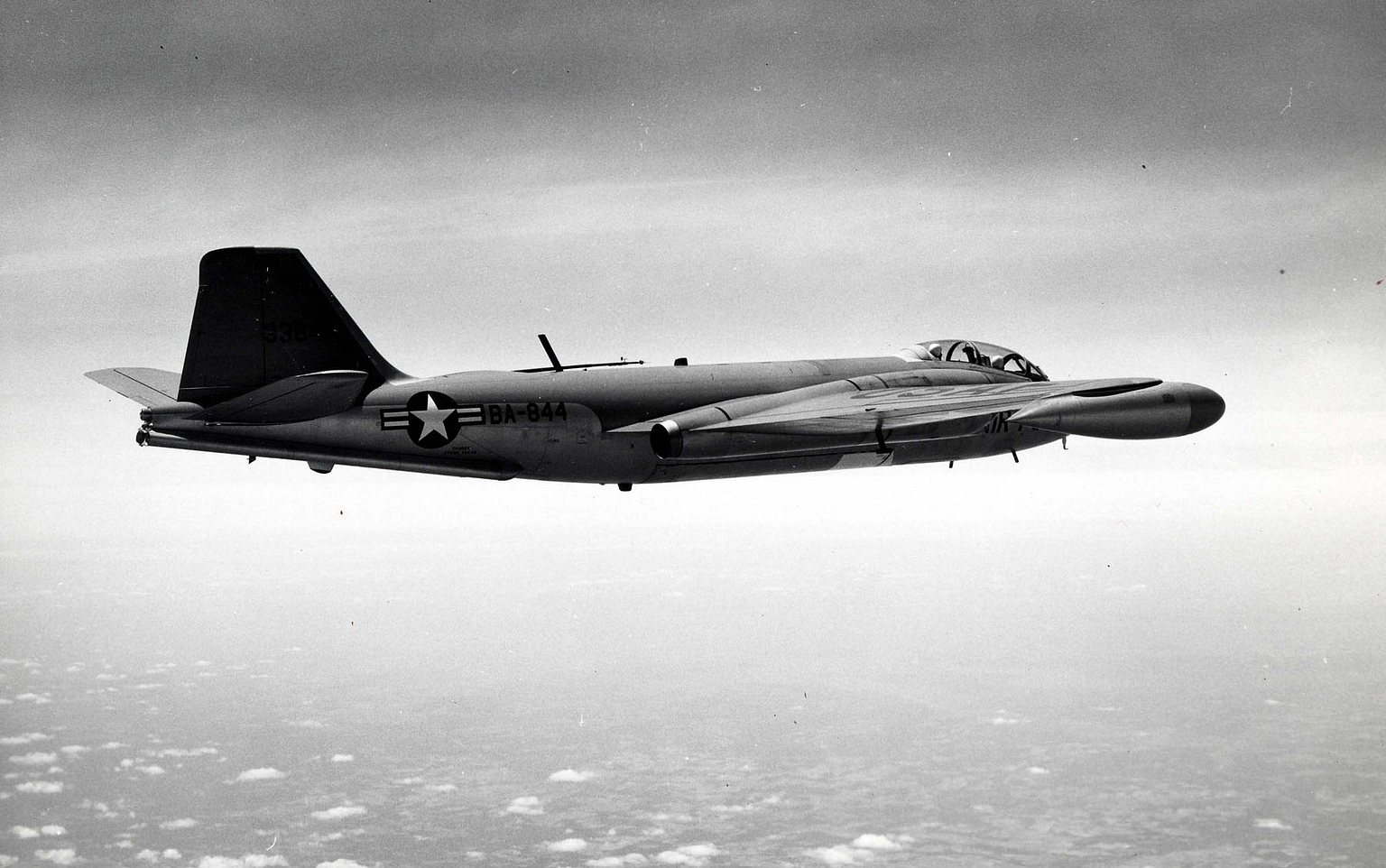
Martin B-57
“Canberra”
The British bomber America rebuilt as its own — a Vietnam night-interdiction jet, a Cold War spyplane that stretched its wings to reach the edge of space, and, as NASA’s WB-57, still flying research missions today.
The Martin B-57 Canberra: the British bomber America made its own
In the early 1950s the United States needed a modern jet tactical bomber in a hurry, and for once the best answer was not American. Britain’s English Electric Canberra was already flying and doing everything the U.S. Air Force wanted. So in March 1951 the USAF contracted the Glenn L. Martin Company of Baltimore to build the Canberra under licence — the only foreign combat aircraft design adopted as a standard American bomber in the jet age. The first US-built example flew in July 1953.
Martin did not simply copy it. The company reworked the design for American production and doctrine: a new tandem cockpit in place of the British side-by-side layout, a distinctive rotary bomb door that swung the bomb load into the slipstream on a rotating panel, integral wing hardpoints, and licence-built Wright J65 engines — themselves an American version of Britain’s Armstrong Siddeley Sapphire. Roughly 403 were built by Martin before production ended in 1959, in bomber, trainer, target-tug and reconnaissance forms.
Its long career ran on two very different tracks. As a tactical bomber the B-57B flew some of the first U.S. Air Force strikes of the Vietnam War and hunted trucks by night over the Ho Chi Minh Trail, including the sensor-laden B-57G. On a separate path, Martin’s airframe was stretched into two of the highest-flying aircraft of the Cold War — the long-winged RB-57D and the enormous RB-57F, spy aircraft built to cruise above 60,000 feet. That reconnaissance line never fully retired: NASA still flies three WB-57 descendants today, making the Canberra one of the longest-serving jet designs in history.
01The Martin B-57 Canberra: how a British bomber became an American one
When the USAF went shopping for a jet night-intruder and tactical bomber around 1950, the competition included home-grown designs, but the English Electric Canberra beat them in a fly-off — it climbed higher, flew farther and handled better than the American entrants. Rather than wait for a domestic aircraft, the Air Force chose to build the Canberra in the United States, a politically remarkable decision that made it the only foreign design adopted as a frontline U.S. bomber in that era.
Glenn L. Martin licence-built the type and adapted it. The most visible change was the cockpit: the British Canberra seated its crew side-by-side under a fighter-style canopy, while Martin moved to a tandem pilot-and-navigator arrangement. Less visible but more clever was the rotary bomb door — instead of conventional bomb-bay doors, the weapons were mounted on a rotating door that flipped over to expose them, cutting drag and buffet at high speed. The result was a genuinely American aircraft grown from a British seed, and it served the USAF for three decades.
What makes the Martin B-57 Canberra special
An American redesign of a British classic
Martin kept the Canberra’s superb wing and light, agile handling but rebuilt the front end for U.S. service: a tandem cockpit, American systems, and the licence-built Wright J65 turbojets of about 7,220 lbf each. Its signature feature was the rotary bomb door — a rotating panel carrying the bomb load that flipped open into the airstream, reducing the drag and buffeting of a conventional open bomb bay.
The stretched-wing spyplanes
The reconnaissance Canberras were almost different aircraft. The RB-57D grew a honeycomb-construction wing spanning about 106 ft — a first for a piloted aircraft — to loiter near 65,000 ft. The later RB-57F, rebuilt by General Dynamics, went further still: a wing of roughly 122 ft (nearly double the bomber’s 64 ft), big Pratt & Whitney TF33 turbofans plus two auxiliary J60 jet pods, and altitudes above 60,000 ft.
The B-57G night hunter
Over the Ho Chi Minh Trail the USAF needed to find and hit trucks in total darkness. The B-57G “Tropic Moon III” answered with a chin turret packing forward-looking infrared, a laser rangefinder/designator and low-light-level television — an early precision night-attack sensor suite that let a 1950s-designed bomber deliver guided weapons on targets it could not see with the naked eye.
02The RB-57D and RB-57F: how the Canberra grew wings to reach the edge of space
As the U-2 was rushed into service, the Air Force also stretched the B-57 into a high-altitude platform. The RB-57D (first flight November 1955) roughly doubled the wing to about 106 ft using bonded honeycomb panels, trading the bomber’s toughness for the thin-air lift needed above 60,000 ft. Only about 20 were built, and the delicate wings suffered fatigue and had to be strengthened. The RB-57F (first flight June 1963) was a far more radical General Dynamics rebuild — a three-spar wing near 122 ft, TF33 turbofans and two removable J60 jet pods — that could operate above 65,000 ft. These aircraft flew sensitive reconnaissance around the edges of the Soviet bloc and China, and several were lost. Most survivors were redesignated WB-57F for weather and research work, the line NASA still flies today.
03The B-57G Tropic Moon III: turning a night bomber into a precision truck-hunter
By 1970 the war over the Ho Chi Minh Trail had become a nightly hunt for trucks moving under jungle cover. The B-57G, a small batch of B-57Bs rebuilt under the “Tropic Moon III” programme, carried a nose sensor package — forward-looking infrared, low-light television and a laser designator — that let the crew detect, track and hit vehicles in darkness with laser-guided bombs. Operating from Ubon, Thailand, from October 1970, the B-57G was one of the earliest fixed-wing aircraft to combine night sensors and precision-guided weapons in combat, a direct ancestor of the way air forces attack at night today. Claims of very high per-aircraft truck tallies are widely repeated but hard to verify, and should be treated with caution.
Martin B-57 Canberra: full specifications
Airframe & Performance (B-57B)
- Mürettebat
- 2 (pilot & navigator, tandem)
- Uzunluk
- 19.96 m (65 ft 6 in)
- Kanat açıklığı
- 19.5 m (64 ft)
- Yükseklik
- 4.75 m (15 ft 7 in)
- Max takeoff weight
- ~26,800 kg (58,800 lb)
- Max speed
- ~917 km/h (570 mph, ~Mach 0.79)
- Servis tavanı
- ~14,600 m (48,000 ft)
- Combat range
- ~3,200 km (~2,000 mi)
- First flight (US)
- July 1953 (B-57A)
- Built
- ~403 by Martin (to 1959)
Propulsion, Armament & Cost
- Engines (B-57B)
- 2 × Wright J65-W-5, ~7,220 lbf each
- Engines (RB-57F)
- 2 × P&W TF33 + 2 × J60 pods
- RB-57F wingspan
- ~37 m (~122 ft)
- Silahlanma
- 8 × .50-cal or 4 × 20 mm + rotary bomb door
- Bomb load
- ~3,200 kg (~7,000 lb)
- B-57G sensors
- FLIR, laser, low-light TV (Tropic Moon III)
- Unit cost (period)
- No reliable public figure
- Cost per flight hour
- No reliable public figure
04The B-57 Canberra’s costs: why no reliable operating figure exists
The B-57 was a 1950s military programme built under licence, and no dependable, widely-cited flyaway unit price or cost-per-flight-hour figure survives in the open authoritative record. Any precise dollar amount attached to the type online should be read as an estimate rather than a sourced number.
The one B-57 line still flying, NASA’s WB-57 fleet, is offered to government, academic and commercial customers on a cost-reimbursable basis, but NASA does not publish a standard hourly rate. For a very-high-altitude, low-production research aircraft, real operating costs are driven by specialised maintenance and the small size of the surviving fleet — so we list the cost rows as unquantified rather than guess.
The Martin B-57 Canberra: from licence deal to NASA research jet
America buys a British bomber
The USAF contracts Glenn L. Martin to licence-build the English Electric Canberra — the only foreign design adopted as a standard U.S. bomber in the jet age.
First US-built flight
The Martin B-57A flies in July 1953, with a tandem cockpit, rotary bomb door and licence-built Wright J65 engines.
The stretched-wing spyplane
The high-altitude RB-57D first flies in November, its ~106 ft honeycomb wing built to loiter near 65,000 ft.
First SAM kill in history
A Taiwanese RB-57D is shot down over mainland China by a Chinese SA-2 — widely credited as the first aircraft ever destroyed by a surface-to-air missile.
The 122-foot Canberra
The General Dynamics RB-57F first flies, its enormous wing and turbofan engines reaching above 60,000 ft.
Into the Vietnam War
B-57Bs deploy to South Vietnam; a Viet Cong mortar attack destroys several at Bien Hoa on 1 November 1964, and the type flies early USAF bombing raids of the war.
The B-57G night hunters
Sensor-equipped B-57G “Tropic Moon III” jets deploy to Ubon, Thailand, to hunt trucks by night over the Ho Chi Minh Trail.
Still flying for NASA
NASA returns a third WB-57 to flight; three remain the only Canberras of any kind still flying, doing high-altitude research from Houston.
From the flight line: twelve B-57 Canberra stories
The British design America bought
In a 1950 fly-off the English Electric Canberra beat the American entrants — so the USAF built it.
Read the full story
The Martin makeover
Martin gave the Canberra a tandem cockpit and a rotary bomb door.
Read the full story
Destroyed on the ground at Bien Hoa
A Viet Cong mortar attack wrecked B-57s before they had fired a shot in anger.
Read the full story
First bombs of the air war
B-57Bs flew some of the first USAF bombing raids of the Vietnam War.
Read the full story
“Patricia Lynn”
A secret RB-57E program flew infrared night reconnaissance over Vietnam from 1963.
Read the full story
The night truck-hunters
The B-57G carried infrared, laser and low-light TV to hit trucks it could not see.
Read the full story
The first SAM kill in history
A Taiwanese RB-57D fell to a Chinese missile — the first aircraft ever downed by a SAM.
Read the full story
The 122-foot spyplane
The RB-57F’s wing was nearly double the bomber’s — built to fly above 60,000 ft.
Read the full story
Lost over the Black Sea
An RB-57F vanished off Odessa in December 1965; the cause is still disputed.
Read the full story
Pakistan’s night raiders
Pakistani B-57s bombed Indian airfields by night in the 1965 and 1971 wars.
Read the full story
NASA’s Canberras
Three WB-57s are the only B-57s of any kind still flying — and one made a dramatic landing in 2026.
Read the full story
Not the Cuban Missile Crisis aircraft
The famous 1962 overflights were U-2s, not RB-57s — a detail often confused.
Read the full story
The B-57 Canberra in pictures
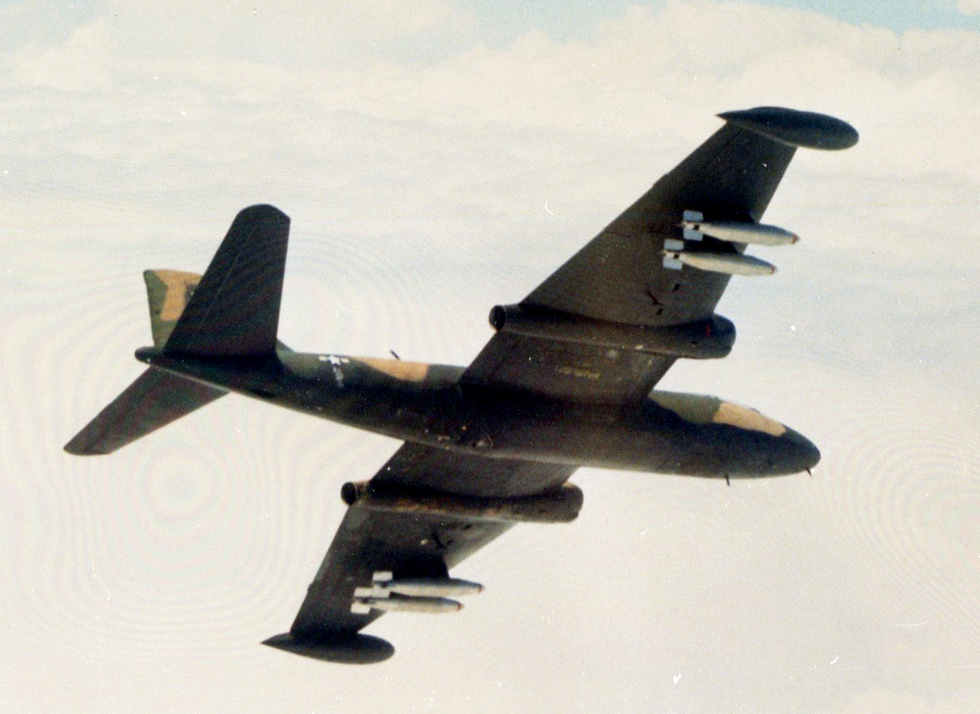
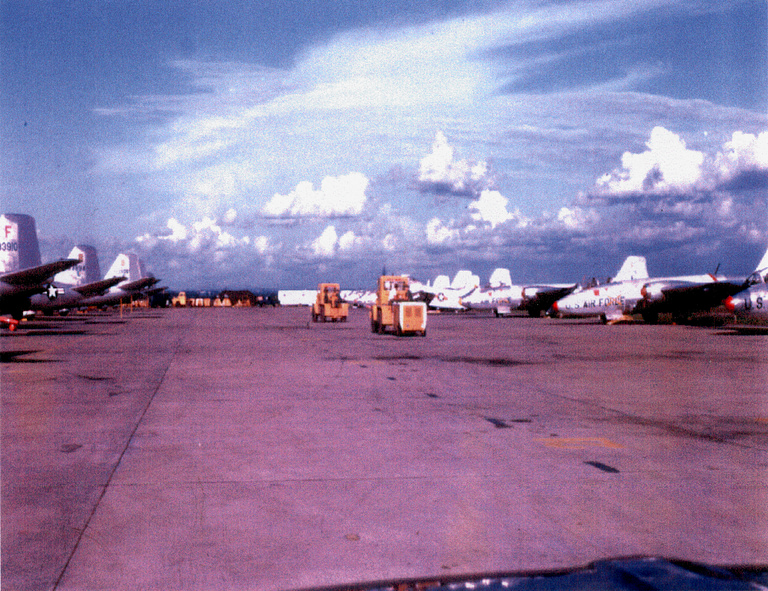
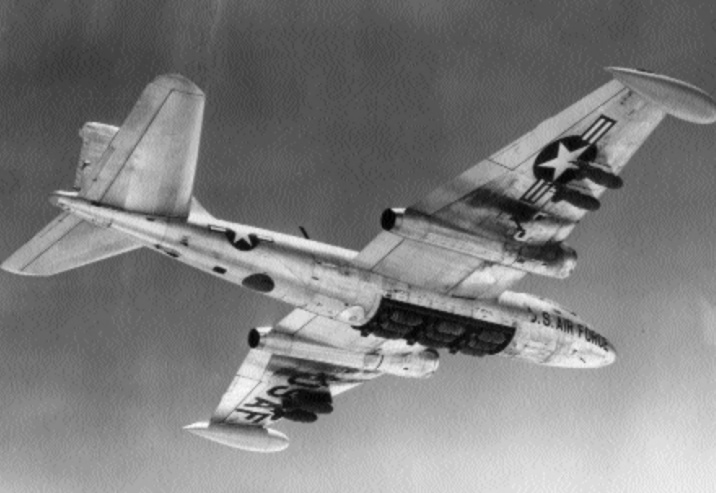
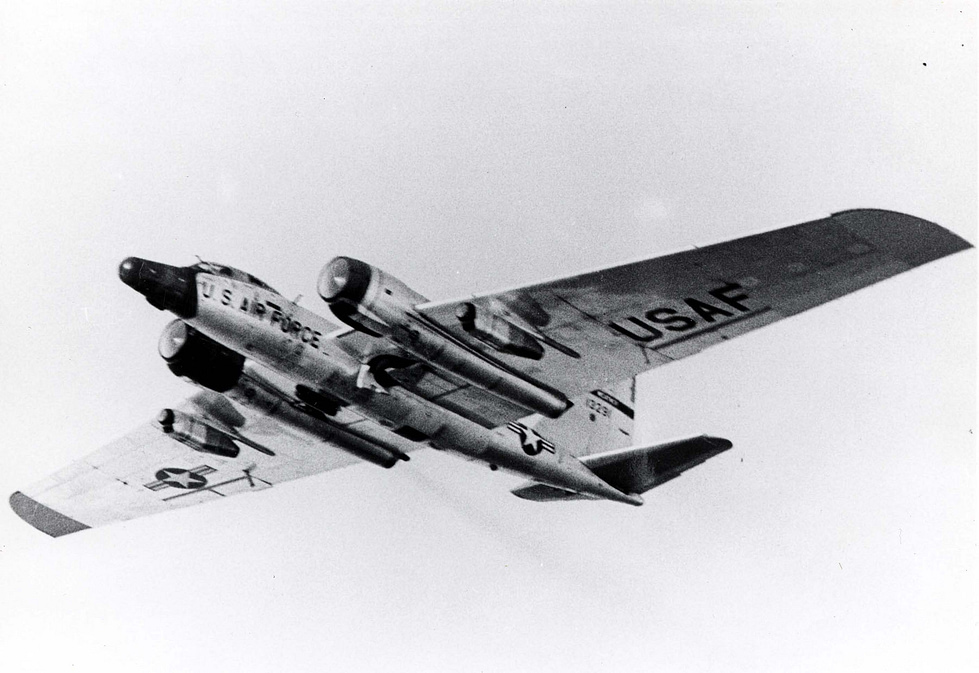
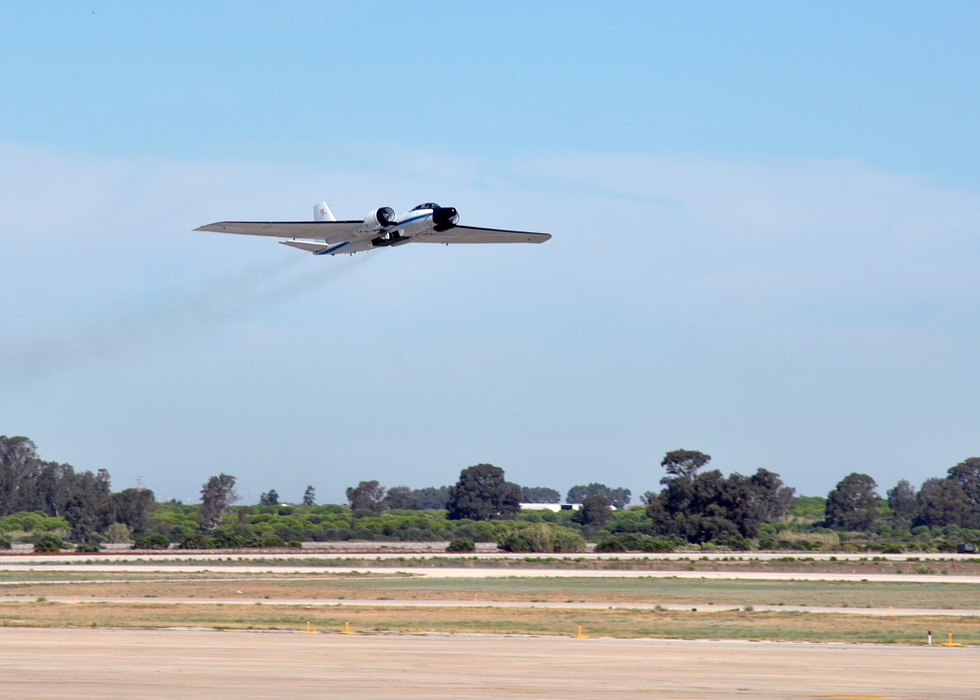
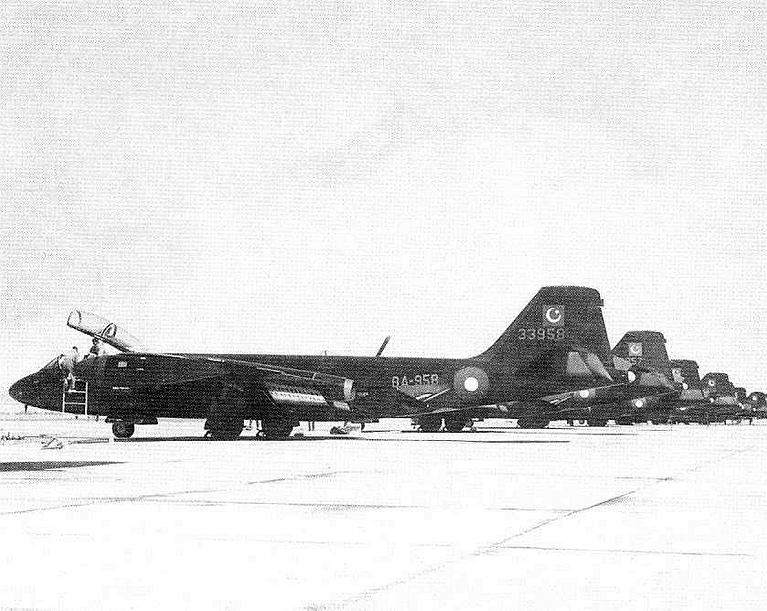
The B-57 Canberra in motion
Great Planes: Martin B-57 Canberra — the classic aviation-documentary-series profile of the type, covering the Martin redesign, its Vietnam service and the high-altitude RB-57 reconnaissance variants.
Where the B-57 Canberra flew
The B-57 Canberra’s war record
The Martin B-57 was a bomber and a spyplane, not a dogfighter, and its record is written in strike sorties and reconnaissance rather than air-to-air kills. It flew early USAF raids of the Vietnam War, pioneered night truck-hunting with the sensor-laden B-57G, served as Pakistan’s main night bomber against India, and — as the RB-57 — helped mark a grim milestone: the first aircraft ever downed by a surface-to-air missile.
Compare the combat record of every military aircraft. Figures as of 2026.
Everything people ask about the B-57 Canberra
Can I fly in a Martin B-57 Canberra?
Is the Martin B-57 the same as the English Electric Canberra?
What was the B-57 used for in Vietnam?
How high could the RB-57 reconnaissance versions fly?
Are any B-57 Canberras still flying?
Did a B-57 ever get shot down by a missile?
How many B-57 Canberras were built?
You can’t fly the B-57 Canberra.
These, you can.
Some legends only live in museums — others are fuelled and waiting. MiGFlug has put civilians in real military jet cockpits since 2004.
 Fly the L-39 AlbatrosThe world’s most-flown jet trainer — aerobatics included
 Fly the F-104 Starfighter“The missile with a man in it”
 Fly the MiG-21The Cold War’s most-produced jet
 T-33 Shooting Star'ı uçurunAmerica’s first jet trainer
 Fly the DH VampireA piece of early jet history
 Fly the S.211Agile Italian jet trainer
 Fly the MB-326The classic Aermacchi jet
 Fly the MiG-15The Soviet legend of the Korean War
Continue the tour
Every fact, checked
- National Museum of the U.S. Air Force — Martin B-57B CanberraOfficial history, first flight, ~403 built, B-57B specifications and Vietnam service.
- NMUSAF — “Patricia Lynn: Taking Away the Night”The secret RB-57E infrared night-reconnaissance program in Vietnam.
- NASA Johnson Space Center — WB-57 ProgramThe three flying WB-57s, Ellington Field basing and high-altitude research missions.
- Smithsonian National Air and Space MuseumReference for the B-57’s design, licence origins and variants.
- Federation of American Scientists — RB-57RB-57D/F wingspans, the China shoot-downs and the Black Sea RB-57F loss.
- GlobalSecurity.org — RB-57RB-57D first flight, the honeycomb wing and its structural strengthening.
- HistoryNet — Aviation HistoryThe Bien Hoa attack of 1 November 1964 and B-57 losses in Vietnam.
- Air & Space Forces MagazineCuban Missile Crisis clarification — the 1962 overflights were U-2s, not RB-57s.