
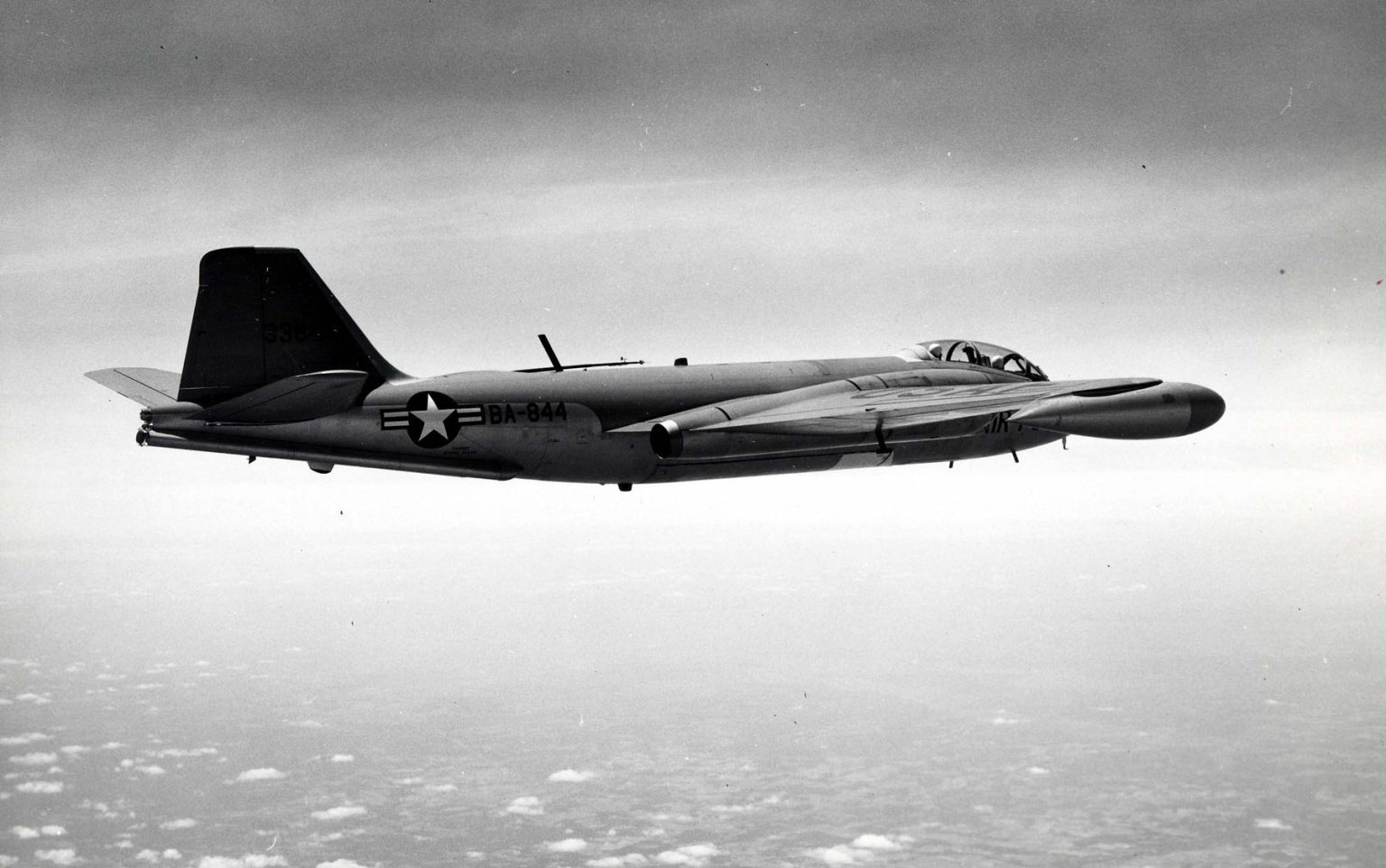
Martin B-57
“Canberra”
The British bomber America rebuilt as its own — a Vietnam night-interdiction jet, a Cold War spyplane that stretched its wings to reach the edge of space, and, as NASA’s WB-57, still flying research missions today.
The Martin B-57 Canberra: the British bomber America made its own
In the early 1950s the United States needed a modern jet tactical bomber in a hurry, and for once the best answer was not American. Britain’s English Electric Canberra was already flying and doing everything the U.S. Air Force wanted. So in March 1951 the USAF contracted the Glenn L. Martin Company of Baltimore to build the Canberra under licence — the only foreign combat aircraft design adopted as a standard American bomber in the jet age. The first US-built example flew in July 1953.
Martin did not simply copy it. The company reworked the design for American production and doctrine: a new tandem cockpit in place of the British side-by-side layout, a distinctive rotary bomb door that swung the bomb load into the slipstream on a rotating panel, integral wing hardpoints, and licence-built Wright J65 engines — themselves an American version of Britain’s Armstrong Siddeley Sapphire. Roughly 403 were built by Martin before production ended in 1959, in bomber, trainer, target-tug and reconnaissance forms.
Its long career ran on two very different tracks. As a tactical bomber the B-57B flew some of the first U.S. Air Force strikes of the Vietnam War and hunted trucks by night over the Ho Chi Minh Trail, including the sensor-laden B-57G. On a separate path, Martin’s airframe was stretched into two of the highest-flying aircraft of the Cold War — the long-winged RB-57D and the enormous RB-57F, spy aircraft built to cruise above 60,000 feet. That reconnaissance line never fully retired: NASA still flies three WB-57 descendants today, making the Canberra one of the longest-serving jet designs in history.
01The Martin B-57 Canberra: how a British bomber became an American one
When the USAF went shopping for a jet night-intruder and tactical bomber around 1950, the competition included home-grown designs, but the English Electric Canberra beat them in a fly-off — it climbed higher, flew farther and handled better than the American entrants. Rather than wait for a domestic aircraft, the Air Force chose to build the Canberra in the United States, a politically remarkable decision that made it the only foreign design adopted as a frontline U.S. bomber in that era.
Glenn L. Martin licence-built the type and adapted it. The most visible change was the cockpit: the British Canberra seated its crew side-by-side under a fighter-style canopy, while Martin moved to a tandem pilot-and-navigator arrangement. Less visible but more clever was the rotary bomb door — instead of conventional bomb-bay doors, the weapons were mounted on a rotating door that flipped over to expose them, cutting drag and buffet at high speed. The result was a genuinely American aircraft grown from a British seed, and it served the USAF for three decades.
What makes the Martin B-57 Canberra special
An American redesign of a British classic
Martin kept the Canberra’s superb wing and light, agile handling but rebuilt the front end for U.S. service: a tandem cockpit, American systems, and the licence-built Wright J65 turbojets of about 7,220 lbf each. Its signature feature was the rotary bomb door — a rotating panel carrying the bomb load that flipped open into the airstream, reducing the drag and buffeting of a conventional open bomb bay.
The stretched-wing spyplanes
The reconnaissance Canberras were almost different aircraft. The RB-57D grew a honeycomb-construction wing spanning about 106 ft — a first for a piloted aircraft — to loiter near 65,000 ft. The later RB-57F, rebuilt by General Dynamics, went further still: a wing of roughly 122 ft (nearly double the bomber’s 64 ft), big Pratt & Whitney TF33 turbofans plus two auxiliary J60 jet pods, and altitudes above 60,000 ft.
The B-57G night hunter
Over the Ho Chi Minh Trail the USAF needed to find and hit trucks in total darkness. The B-57G “Tropic Moon III” answered with a chin turret packing forward-looking infrared, a laser rangefinder/designator and low-light-level television — an early precision night-attack sensor suite that let a 1950s-designed bomber deliver guided weapons on targets it could not see with the naked eye.
02The RB-57D and RB-57F: how the Canberra grew wings to reach the edge of space
As the U-2 was rushed into service, the Air Force also stretched the B-57 into a high-altitude platform. The RB-57D (first flight November 1955) roughly doubled the wing to about 106 ft using bonded honeycomb panels, trading the bomber’s toughness for the thin-air lift needed above 60,000 ft. Only about 20 were built, and the delicate wings suffered fatigue and had to be strengthened. The RB-57F (first flight June 1963) was a far more radical General Dynamics rebuild — a three-spar wing near 122 ft, TF33 turbofans and two removable J60 jet pods — that could operate above 65,000 ft. These aircraft flew sensitive reconnaissance around the edges of the Soviet bloc and China, and several were lost. Most survivors were redesignated WB-57F for weather and research work, the line NASA still flies today.
03The B-57G Tropic Moon III: turning a night bomber into a precision truck-hunter
By 1970 the war over the Ho Chi Minh Trail had become a nightly hunt for trucks moving under jungle cover. The B-57G, a small batch of B-57Bs rebuilt under the “Tropic Moon III” programme, carried a nose sensor package — forward-looking infrared, low-light television and a laser designator — that let the crew detect, track and hit vehicles in darkness with laser-guided bombs. Operating from Ubon, Thailand, from October 1970, the B-57G was one of the earliest fixed-wing aircraft to combine night sensors and precision-guided weapons in combat, a direct ancestor of the way air forces attack at night today. Claims of very high per-aircraft truck tallies are widely repeated but hard to verify, and should be treated with caution.
Martin B-57 Canberra: full specifications
Baseline note: the figures below describe the Martin B-57B of 1954–57 — the definitive night-intruder version, 202 of which were built at Middle River outside Baltimore, with two Wright J65-W-5 turbojets, a tandem cockpit, a rotary weapons door and four wing pylons. This is the aeroplane that stood nuclear alert in Europe and Japan, bombed the Ho Chi Minh Trail from Bien Hoa and Phan Rang, and flew for the Pakistan Air Force in two wars. Deltas for the 106 ft RB-57D, for the General Dynamics RB-57F and its NASA WB-57F descendants, and for the B-57G Tropic Moon III night-attack conversion are given in grey. Published B-57 figures scatter more than they should for so recent an aeroplane, because the type was measured as a bomber, a reconnaissance aircraft, a target tug and an electronic aggressor over thirty years, and because the two high-altitude marks share almost nothing with the B-57B but a fuselage and a name.
Dimensions & weights
- Crew
- 2 — pilot and navigator in tandem under one canopy. The B-57A that preceded it carried three in the British arrangement, the pilot offset under a fighter canopy and a navigator/bomb-aimer working forward in the glazed nose; the B-57C and B-57E added dual controls. Most RB-57Ds flew single-seat; the RB-57D-2 electronic version and the RB-57F carried two
- Length
- 20.00 m (65 ft 6 in); RB-57D 20.12 m (66 ft 0 in); RB-57F 20.80 m (68 ft 3 in)
- Wingspan
- 19.50 m (64 ft 0 in) — almost exactly the length, which is the English Electric wing untouched. RB-57D 32.31 m (106 ft 0 in), though Baugher gives 105 ft; RB-57F 37.34 m (122 ft 6 in), usually quoted as 122 ft
- Height
- 4.52 m (14 ft 10 in); the National Museum of the USAF fact sheet says 15 ft 6 in, and the difference is almost certainly tail-down attitude rather than a different aeroplane. RB-57F 6.25 m (20 ft 6 in)
- Wing area
- 89.2 m² (960 sq ft); RB-57F 186 m² (2,000 sq ft), more than twice as much
- Wing planform
- Unswept two-spar mid wing of aspect ratio 4.3, with the engines buried in broad nacelles at about one-third span — a low-aspect-ratio wing of enormous area, which is why the aeroplane climbed and loitered so well and why it never went supersonic. No authority quotes a standard NACA section for it; the leading edge was a single alloy sheet wrapped to 40 per cent chord. The RB-57F wing was a new three-spar honeycomb structure of aspect ratio 7.5 with pronounced anhedral
- Empty weight
- 12,285 kg (27,090 lb)
- Combat weight
- 16,642 kg (36,689 lb) — the weight at which the performance figures opposite were measured
- Gross weight
- 18,300 kg (40,345 lb)
- Maximum take-off weight
- 24,365 kg (53,720 lb). Baugher calls the same number the gross weight and the USAF museum quotes 58,800 lb maximum; the spread is the usual one between design gross, wartime overload and a placard. RB-57D about 26,760 kg (59,000 lb); RB-57F 32,659 kg (72,000 lb)
- Wing loading
- 205 kg/m² (42 lb/sq ft) at gross weight — a bomber carrying a trainer’s wing loading. The RB-57F worked at about 176 kg/m² (36 lb/sq ft), which is how it reached the stratosphere
- Weapons bay
- 2,041 kg (4,500 lb) internal on the rotary door, plus 1,270 kg (2,800 lb) on four wing pylons; the USAF museum quotes roughly 7,500 lb of internal and external stores combined. The bay was slightly shorter than the Canberra’s because Martin took the space for fuel
Performance
- Maximum speed
- 960 km/h (598 mph, 520 kn) at 760 m (2,500 ft), Mach 0.79; 925 km/h (575 mph) at sea level. The USAF museum rounds it to 570 mph, which is the service figure rather than the test figure
- Cruising speed
- 766 km/h (476 mph, 414 kn); the museum quotes 450 mph
- Stalling speed
- 200 km/h (124 mph) — low enough that the aeroplane could be flown down a valley at night looking for lorries, which is exactly what it was asked to do
- Rate of climb
- 31.4 m/s (6,180 ft/min) initial
- Service ceiling
- 13,745 m (45,100 ft); Baugher gives the same figure as a combat ceiling and the museum quotes 49,000 ft
- Combat radius
- ~1,526 km (948 miles) with 2,377 kg (5,240 lb) of bombs
- Ferry range
- 4,380 km (2,722 miles)
- Endurance over target
- About 4 hours on a Southeast Asian sortie, which is the number that mattered. The 1950 requirement asked for two and a half hours over a target 780 nautical miles out, and the Canberra was chosen over the Martin XB-51 precisely because the American aeroplane managed one hour at 350 nautical miles
- Lift-to-drag ratio
- 15.0 — exceptional for a jet bomber of the period, and the arithmetic behind the loiter figure above
- Take-off distance
- 625 m (2,050 ft)
- RB-57D
- About 21,300 m (70,000 ft) service ceiling, cruising at 780 km/h (420 kn) at 19,800 m (65,000 ft), with roughly 3,150 km (1,700 nautical miles) of combat range on two 44 kN J57s
- RB-57F
- 760 km/h (470 mph), Mach 0.78; ceiling given as 18,300 m (60,000 ft) "at least" and in practice around 24,400 m (80,000 ft) with the auxiliary jets lit; 4,600 km (2,900 miles) range and 6.5 hours endurance. Climb 30 m/s (6,000 ft/min)
Propulsion & systems
- Engines
- 2 × Wright J65-W-5 axial-flow turbojets — the Armstrong Siddeley Sapphire built under licence in the United States, and the single most consequential change Martin made. The USAF chose the Sapphire over the Canberra’s Rolls-Royce Avon because it wanted an aeroplane that would work in hot climates
- Thrust
- 32.1 kN (7,220 lbf) each; the USAF museum rounds to 7,200 lbf
- Thrust-to-weight
- 0.36 at gross weight
- Engine reliability
- Poor at first. J65 malfunctions grounded the early B-57Bs in 1955, and a faulty tailplane actuator that caused unexplained dives grounded the fleet again for four months from May 1956. A three-phase modification programme begun in September 1955 fixed target acquisition, navigation and the armament system, none of which had worked properly on delivery
- Fuel
- Fuselage and wing tanks plus wingtip tanks fitted as standard — Martin’s addition, made specifically to buy loiter time, and the reason the bomb bay lost length. Pakistani B-57Bs were later given underwing pylons for four more tanks so they could reach deep into India. Published internal capacities for the B-57B do not agree and none is quoted here; the ferry range above is the honest measure
- Rotary weapons door
- The most visible American idea in the aeroplane, lifted from Martin’s own losing XB-51. The whole door rotated through half a turn with the bombs attached to its inner face, replacing the Canberra’s hinged clamshells. It opened and closed faster, it did not buffet the airframe, and both of those improved accuracy and allowed a faster run-in
- Air brakes
- Hydraulically operated triangular finger brakes on the rear fuselage, added to steady the aeroplane in a dive-bombing pass. The Canberra had none; the B-57 was expected to bomb by eye at low level and needed them
- Cockpit
- Tandem seating under a single fighter-style canopy with a flat-panel windscreen, introduced on the B-57B, with ejection seats for both men. It gave the navigator a view forward for the first time and turned a bomber crew station into something a fighter pilot recognised
- Bombing and navigation
- SHORAN radio bombing, the APW-11 bombing radar guidance system, and a Low Altitude Bombing System for toss delivery of a nuclear store. AN/APS-54 radar warning receiver and an ALE-2 chaff dispenser. Pakistani aircraft were retrofitted from 1963 with the RB-1A all-weather bombing system, which visibly changed the nose profile
- RB-57D powerplant and wing
- 2 × Pratt & Whitney J57-P-9, 44 kN (10,000 lbf) each, in enlarged nacelles, under a new 32 m honeycomb wing with integral fuel cells. Martin designed that wing for 500 flight hours. Operations demanded far more, and the wings duly began coming off
- RB-57F powerplant
- 2 × Pratt & Whitney TF33-P-11A turbofans, quoted at 69 kN (15,500 lbf) each by most sources and 80 kN (18,000 lbf) by Baugher, plus two jettisonable Pratt & Whitney J60-P-9 turbojet pods of about 14.7 kN (3,300 lbf) each under the outer wings for the top of the climb. Vertical tail twice the standard area, spoilers alongside inset ailerons, control gaps sealed for drag
- B-57G sensor suite
- AN/APQ-139 forward-looking radar, AN/AAS-26 forward-looking infrared, a low-light-level television and an AN/AVQ-9 laser rangefinder and designator, all in a rebuilt nose. It made the B-57G one of the first aircraft in the world able to find, mark and destroy a target at night without help from anybody else
04The B-57 Canberra’s costs: why no reliable operating figure exists
The B-57 was a 1950s military programme built under licence, and no dependable, widely-cited flyaway unit price or cost-per-flight-hour figure survives in the open authoritative record. Any precise dollar amount attached to the type online should be read as an estimate rather than a sourced number.
The one B-57 line still flying, NASA’s WB-57 fleet, is offered to government, academic and commercial customers on a cost-reimbursable basis, but NASA does not publish a standard hourly rate. For a very-high-altitude, low-production research aircraft, real operating costs are driven by specialised maintenance and the small size of the surviving fleet — so we list the cost rows as unquantified rather than guess.
Armament & payload
The B-57B put four 20 mm cannon and four and a half thousand pounds of bombs on a wing designed for high-altitude level bombing, and then spent its war at treetop height
The English Electric Canberra was conceived as a fast, high, unarmed bomber that would outrun interception. The Martin B-57B was the same airframe rearmed for a completely different fight: guns in the wings, a rotary door that snapped open on a dive-bombing pass, four pylons under the outer panels, and a Low Altitude Bombing System for throwing a tactical nuclear weapon over the shoulder. In Vietnam that combination made it, for two or three years, the most effective truck-killer in Southeast Asia — nine 500 lb bombs inside, four 750-pounders outside, four hours of fuel and a stalling speed of 124 mph, hunting by the light of a C-123 flare ship. It was also uniquely exposed, because everything it did well it did within range of every gun on the ground. Gun fit changed inside the B-57B production run, reconnaissance and electronic marks carried no armament at all, and the Pakistani aircraft were rebuilt to a bombing system the USAF never used, so a published fit describes a block rather than an aeroplane.
Gun
- Four 20 mm M39 revolver cannon in the outer wing panels with 290 rounds per gun, from roughly the eighty-fourth B-57B onward. The pilot fired them; the navigator had no gun station of any kind
- Eight 12.7 mm (0.50 in) M3 Brownings, four in each outer panel, on the earlier B-57B airframes and retained on many B-57Es. Both fits appear in the same squadron photographs because aircraft were modified out of sequence
- Being buried in the wing rather than the nose, the guns left the pylons free for bombs and rockets and left the fuselage free for the rotary door. It is the tidiest thing about the aeroplane’s armament
- Strafing was a large part of the Vietnam workload and the guns were fired far more often than a bomber’s guns ought to be. Cannon passes at low level over the Trail are also the single likeliest explanation for the ground-fire loss rate
- The B-57A, all RB-57 reconnaissance marks and every EB-57 electronic aggressor were unarmed. The B-57C trainer and B-57E target tug kept the gun bays
Air-to-air
- None, ever. No B-57 of any mark carried an air-to-air missile, and none is credited with an air-to-air victory. The wing guns were theoretically usable in self-defence and there is no record of their being used that way to any effect
- The type’s significance in air combat is entirely as the target. On 18 February 1958 a Republic of China RB-57A-1 was shot down by a PLAAF MiG-17 over the mainland and the pilot was killed
- On 7 October 1959 a Nationalist Chinese RB-57D flown by Captain Wang Ying-Chin was destroyed near Beijing by an S-75 Dvina (SA-2 Guideline). It was the first aircraft in history brought down by a surface-to-air missile, nine months before Gary Powers and his U-2
- The EB-57 turned the aeroplane into a professional adversary: an unarmed jammer whose job was to be intercepted, so that American and Canadian air defence crews could learn what electronic warfare felt like before they met it for real
- The Pakistan Air Force flew B-57s through two wars against a fighter-equipped opponent and lost remarkably few of them to fighters, because it flew them almost exclusively at night
Air-to-surface guided
- The sixteen B-57Gs of Tropic Moon III, converted from B-57Bs and sent to Ubon in Thailand in late 1970, carried an AN/AVQ-9 laser designator and dropped 500 lb Paveway laser-guided bombs that they designated themselves. Self-contained night attack, in 1970, on a 1949 airframe
- Nothing else in the inventory could do it. The F-4s dropping Paveways at the time needed a second aircraft with a Zot pod to hold the spot; the B-57G found the lorry on infrared, marked it with its own laser and hit it, all from one cockpit
- It still did not win. Against the AC-130A and AC-130E gunships during Commando Hunt V the B-57G produced a lower kill rate per sortie, and it went home in May 1972
- Project Pave Gat put an Emerson TAT-161 turret with a single M61 20 mm cannon and 4,000 rounds in a B-57G. Trials suggested it could engage as many as twenty targets in a pass against three for the bomb-carrying aircraft; the Air Force declined to deploy it and cancelled the project on 21 December 1971
- No other mark employed a guided air-to-surface weapon operationally. The standard B-57B put its bombs where its pilot could see them go, which is why it flew so low
Bombs
- 2,041 kg (4,500 lb) internally on the rotary door and 1,270 kg (2,800 lb) on four wing pylons. The typical Southeast Asian load was nine 500 lb bombs inside and four 750 lb M117s outside
- One Mark 7 tactical nuclear bomb of 762 kg (1,680 lb) and 8 to 61 kilotonnes, delivered by Low Altitude Bombing System toss from beneath the radar. This was the B-57B’s primary reason for existing in Europe and the Pacific in the late 1950s, and it is the half of the aeroplane’s career that nobody photographs
- Napalm and cluster dispensers for close air support in South Vietnam, flare ships overhead, and the aeroplane repeatedly asked to work under a 1,500 ft cloud base at 400 knots
- Pakistani B-57s dropped over 600 tonnes of bombs in 167 sorties during the September 1965 war, against Jamnagar, Adampur, Pathankot and the Amritsar radar. On the first night of the 1971 war they put 183 bombs on twelve Indian runways
- Squadron Leader Najeeb Ahmed Khan earned the Indian nickname "8-Pass Charlie" by making eight separate moonlit passes over one airfield, dropping one bomb at a time. It is a perfect illustration of what a slow, long-legged bomber can do to an enemy’s sleep
Rockets
- LAU-3/A pods of nineteen 70 mm (2.75 in) folding-fin aerial rockets on the wing pylons, the standard American light attack rocket of the period and a staple of B-57 work over the Trail
- 127 mm (5 in) HVAR rockets were the earlier alternative on the same pylons, a Second World War weapon carried by a jet bomber into the 1960s
- Rockets suited the aeroplane because it could aim them: the B-57B was stable, it had air brakes, and its pilot could see over the nose. It was a dive-bomber in everything but name
- The French-style unguided rocket pods sometimes shown on Canberra variants do not belong to the American aircraft; B-57 rocket fits were American throughout
- No air-to-ground rocket was ever guided. Precision arrived with the B-57G’s laser, and by then the airframes had almost run out
Pods & other stores
- Permanent wingtip fuel tanks on the B-57B and later marks, plus underwing tanks on four extra pylons for the Pakistani aircraft. Range and loiter were the whole argument for the type and the tanks were part of the airframe, not an afterthought
- Electronic countermeasures fits in the weapons bay of the EB-57A, EB-57B, EB-57D and EB-57E: jammers, chaff and signal simulators, carried to make life difficult for the radar operators of Air Defense Command and NORAD
- Camera pallets and infrared line scanners on the RB-57A and the five Patricia Lynn RB-57Es at Tan Son Nhut, which flew night photographic reconnaissance over South Vietnam, Laos, Cambodia and parts of North Vietnam from May 1963 until mid-1971
- Two-tonne HTAC high-altitude cameras, ELINT and SIGINT receivers in the nose and wingtips of the RB-57F; K-38 and KC-1 split vertical cameras and, on the RB-57D-2, the AN/APA-69A ferret receiver with belly and wingtip radomes
- Target-towing gear on the B-57E, and atmospheric sampling pods on the WB-57F — the fit that has kept three of these aeroplanes flying for over fifty years
Three typical loadouts
- Night interdiction, Ho Chi Minh Trail, 1966
- Nine 500 lb bombs on the rotary door, four 750 lb M117s on the wing pylons, 290 rounds per gun for the four M39 cannon, tip tanks full. Worked under flares dropped by a C-123, at a few hundred feet, at speeds a jet had no business using that low. Crews who claimed a hundred destroyed lorries joined the informal "Centurion Club".
- Night airfield strike, Pakistan Air Force, September 1965
- A single bomb released per pass, eight passes, from a B-57B with the RB-1A all-weather bombing system, staging out of one base and recovering at another so that Indian counter-strikes hit empty concrete. The point was not tonnage but denial of sleep and of runway.
- Victor Alert, USAFE and PACAF, about 1958
- One Mark 7 nuclear bomb on the rotary door, guns loaded, everything else stripped. Run in low, pull up, release over the shoulder on the Low Altitude Bombing System, and turn away. A two-man crew, a British wing and an American bomb.
Sourcing caveat: the B-57B gun change is given by Baugher as occurring after the eighty-third aircraft and by other authorities as at the ninety-first, and both figures circulate; the internal and external bomb capacities quoted here are the standard tabulated ones, while the National Museum of the USAF quotes a single combined figure of about 7,500 lb; and the Pakistani sortie and tonnage figures are Pakistani official ones with no independent corroboration. Weapon fits described for the B-57G rest largely on programme documentation rather than on loading records.
Variants
The B-57 began as a copy of a British bomber and ended as three unrelated aeroplanes wearing the same designation
On 3 April 1951 the United States signed a licence with English Electric for the Canberra, and in doing so bought the first foreign-designed combat aircraft ordered into American production for American squadrons since the First World War — the de Havilland DH.4 of 1917–18 is the usual comparison. That is a genuinely startling admission. In September 1950 the USAF asked for a jet night intruder to replace the vanishing B-26 Invader and looked at the North American B-45 Tornado, the AJ Savage, the Avro Canada CF-100 and Martin’s own XB-51. The B-45 was wartime technology and too heavy, the Savage too slow, the CF-100 too small, and the XB-51 — fast, agile, and by every account a lovely aeroplane — could hold only one hour over a target 350 nautical miles away where the Canberra held two and a half hours at 780. After a fly-off at Andrews on 26 February 1951 the British aircraft won outright, and Martin was given the contract to build its competitor.
What Martin then did to it was more than licence production. The B-57A was near enough a Canberra B.2; from the B-57B onward the aeroplane was American in almost every respect that mattered — Sapphire-derived J65s in place of Avons, a two-man tandem cockpit under a fighter canopy instead of three men and a glazed nose, the XB-51’s rotary weapons door instead of clamshells, fuselage air brakes, wing guns, wing pylons and wingtip tanks. The result was a tactical bomber the British had never built and never wanted: a low-level gun-and-bomb aeroplane rather than a high-level one.
Then the airframe was taken in two directions at once. The reconnaissance line stretched the wing until the aeroplane could not be intercepted — 106 ft on the RB-57D, 122 ft 6 in on the General Dynamics RB-57F — and the attack line stuffed the nose with sensors until it could fight in the dark. Both lines produced remarkable aircraft. Only one of them is still flying.
- B-57A (1953 / 8 built)
- First flight 20 July 1953. Essentially a Canberra B.2 with J65 engines and a rotary bomb door; retained the glazed nose. None entered operational service, and all were used for test and development.
- RB-57A and RB-57A-1 (1953–57 / 67 built, 10 modified)
- Photographic reconnaissance taken off the same line as the A. The ten RB-57A-1s of the Heart Throb weight-reduction programme, worked up by Wright Air Development Center and Martin from August 1955, shed 5,665 lb and gained 5,000 ft of ceiling. Two went to Taiwan; one was shot down by a MiG-17 on 18 February 1958.
- B-57B (1954–57 / 202 built)
- The definitive aeroplane and more numerous than all other marks combined. Tandem cockpit, flat windscreen, wing guns, four pylons, air brakes, LABS. First flight 18 June 1954, first to the 345th Bomb Group at Langley, first fully equipped group the 461st in 1955. Grounded twice in its first two years for engine and tailplane-actuator faults.
- B-57C and B-57E (1954–57 / 36–38 and 68–70 built)
- Dual-control combat-capable trainer and target tug respectively, both retaining the bomb bay and gun bays. Sources differ on the split between the two — 36 and 70, or 38 and 68 — and both sets sum correctly to the programme total of 403, so the discrepancy is bookkeeping rather than aircraft.
- RB-57D (1955–56 / 20 built in four sub-types)
- Strategic reconnaissance with a 106 ft honeycomb wing carrying integral fuel, sealed bomb bay and two 10,000 lbf J57s: six single-seat photographic Model 294s, seven refuellable Model 744s, one radar-mapping RB-57D-1 and six two-seat RB-57D-2 ferrets. First flight 3 November 1955. The wing was designed for 500 hours and repeatedly exceeded it.
- EB-57A, EB-57B, EB-57D and EB-57E (1959–72 / 12, 31, 9 and 30 converted)
- Electronic aggressors with jamming and chaff equipment in the weapons bay, flown by the 4677th and 4713th Defense Systems Evaluation Squadrons and later by Air National Guard units, whose entire job was to attack North American air defences electronically so that the defenders learned something. Replaced in the 1980s by the EF-111A Raven.
- RB-57E Patricia Lynn (1960–69 / 9 converted, 5 deployed)
- Classified night reconnaissance detachment at Tan Son Nhut from 7 May 1963 under the call-sign Moonglow, using infrared line scan and specialised cameras to find Viet Cong camps, workshops and stores. Flew until the 460th Tactical Reconnaissance Wing was inactivated in mid-1971. Two lost to ground fire, in August 1965 and on 21 October 1968.
- RB-57F and WB-57F (1963–67 / 21 rebuilt by General Dynamics)
- Not a conversion so much as a new aeroplane built around an old fuselage at General Dynamics Fort Worth: 122 ft 6 in three-spar honeycomb wing, TF33 turbofans, two jettisonable J60 pods, a tail twice the size. First flight 23 June 1963. Twelve came from B-57Bs under Rivet Chip, four from RB-57Ds under Rivet Slice, three from RB-57As. Redesignated WB-57F in 1968 for weather and sampling work.
- B-57G Tropic Moon III (1970–72 / 16 converted)
- B-57Bs rebuilt with forward-looking radar, FLIR, low-light television and a laser designator, deployed to Thailand in late 1970 to hunt lorries at night on the Trail and drop their own laser-guided bombs. Technically ahead of everything else in theatre and operationally outperformed by the AC-130 gunship; withdrawn May 1972.
- Pakistan Air Force B-57B, B-57C and RB-57F (1959–85 / 24, 2 and 2 supplied)
- The only foreign combat operator. Nos. 7 and 8 Squadrons, retrofitted from 1963 with the RB-1A all-weather bombing system and later with underwing tanks; the first air force anywhere to form a four-ship formation aerobatic team on a jet bomber. Three B-57s and one RB-57F lost in 1965, at least five put out of service in 1971, No. 8 Squadron disbanded, the survivors retired in 1985 and replaced by the F-16A.
Closing note on what the B-57 cost and what is left. The Vietnam record is brutal and worth stating plainly: of 94 B-57Bs sent to Southeast Asia, 51 were lost in combat and seven to other causes, and only nine were still flying by 1969; 58 B-57s of all marks were lost in the war, including five destroyed and fifteen damaged on the ground by a single Viet Cong mortar attack on Bien Hoa on 1 November 1964, before the type had flown a combat sortie. The reconnaissance marks killed their aircraft in a different way. RB-57Ds began shedding outer wing panels on landing; one lost a wing at 50,000 ft over Dayton, Ohio in 1964 and fell into a school car park, the pilot ejecting safely and nobody on the ground being hurt, which ended the mark. Of the RB-57Fs, 63-13287 vanished over the Black Sea on 14 December 1965 flying as Big Rib 06 out of Incirlik — the USAF said oxygen failure, but a recovered inner wing panel was judged by structural experts to have been struck by an object, probably a missile, and the Soviet Union used the loss to argue American reconnaissance flights out of Turkey; 63-13297 crashed near Kirtland in November 1966; and 63-13292 disintegrated in Mach tuck in June 1972. The USAF retired the type in 1983, the last operational aircraft being Air National Guard EB-57s, and Pakistan followed in 1985. Survivors: no comprehensive census is published, but several dozen original airframes are on static display, chiefly in the United States — a B-57B at the National Museum of the USAF, others at Edwards, Robins and various Air National Guard bases, and one at the Pakistan Air Force Museum in Karachi. No B-57 reproduction has ever been built and none ever will be. Three original WB-57Fs remain airworthy, all with NASA at Ellington Field near Houston: N926NA (63-13503), N927NA (63-13295) and N928NA (63-13298), with N925NA (63-13501) retired to the Pima Air and Space Museum. NASA 927 spent over forty years in the desert at Davis-Monthan before being returned to flight in August 2013; it suffered a landing-gear failure and belly-landed at Ellington on 27 January 2026 and is grounded. These three aircraft have carried battlefield communications relays over Afghanistan, chased the April 2024 total solar eclipse inside the umbra at 460 mph for close to seven minutes, and supported re-entry tracking for Artemis II. They are, by a wide margin, the oldest and highest-flying Canberras of any nationality still in the air.
The Martin B-57 Canberra: from licence deal to NASA research jet
America buys a British bomber
The USAF contracts Glenn L. Martin to licence-build the English Electric Canberra — the only foreign design adopted as a standard U.S. bomber in the jet age.
First US-built flight
The Martin B-57A flies in July 1953, with a tandem cockpit, rotary bomb door and licence-built Wright J65 engines.
The stretched-wing spyplane
The high-altitude RB-57D first flies in November, its ~106 ft honeycomb wing built to loiter near 65,000 ft.
First SAM kill in history
A Taiwanese RB-57D is shot down over mainland China by a Chinese SA-2 — widely credited as the first aircraft ever destroyed by a surface-to-air missile.
The 122-foot Canberra
The General Dynamics RB-57F first flies, its enormous wing and turbofan engines reaching above 60,000 ft.
Into the Vietnam War
B-57Bs deploy to South Vietnam; a Viet Cong mortar attack destroys several at Bien Hoa on 1 November 1964, and the type flies early USAF bombing raids of the war.
The B-57G night hunters
Sensor-equipped B-57G “Tropic Moon III” jets deploy to Ubon, Thailand, to hunt trucks by night over the Ho Chi Minh Trail.
Still flying for NASA
NASA returns a third WB-57 to flight; three remain the only Canberras of any kind still flying, doing high-altitude research from Houston.
From the flight line: twelve B-57 Canberra stories
The British design America bought
In a 1950 fly-off the English Electric Canberra beat the American entrants — so the USAF built it.
Read the full story
The Martin makeover
Martin gave the Canberra a tandem cockpit and a rotary bomb door.
Read the full story
Destroyed on the ground at Bien Hoa
A Viet Cong mortar attack wrecked B-57s before they had fired a shot in anger.
Read the full story
First bombs of the air war
B-57Bs flew some of the first USAF bombing raids of the Vietnam War.
Read the full story
“Patricia Lynn”
A secret RB-57E program flew infrared night reconnaissance over Vietnam from 1963.
Read the full story
The night truck-hunters
The B-57G carried infrared, laser and low-light TV to hit trucks it could not see.
Read the full story
The first SAM kill in history
A Taiwanese RB-57D fell to a Chinese missile — the first aircraft ever downed by a SAM.
Read the full story
The 122-foot spyplane
The RB-57F’s wing was nearly double the bomber’s — built to fly above 60,000 ft.
Read the full story
Lost over the Black Sea
An RB-57F vanished off Odessa in December 1965; the cause is still disputed.
Read the full story
Pakistan’s night raiders
Pakistani B-57s bombed Indian airfields by night in the 1965 and 1971 wars.
Read the full story
NASA’s Canberras
Three WB-57s are the only B-57s of any kind still flying — and one made a dramatic landing in 2026.
Read the full story
Not the Cuban Missile Crisis aircraft
The famous 1962 overflights were U-2s, not RB-57s — a detail often confused.
Read the full story
The B-57 Canberra in pictures
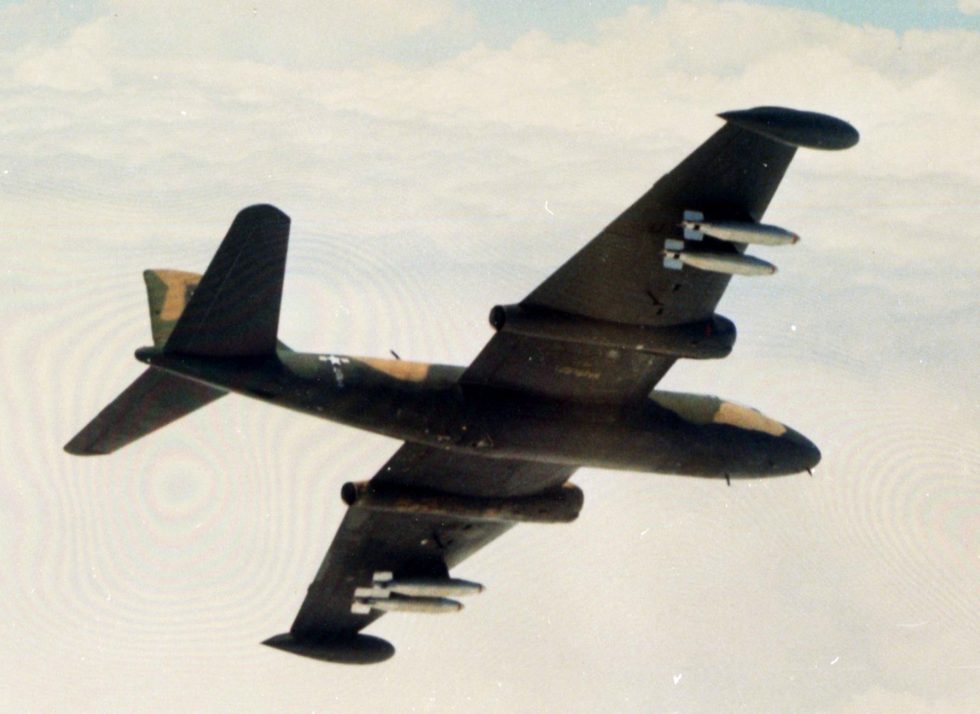
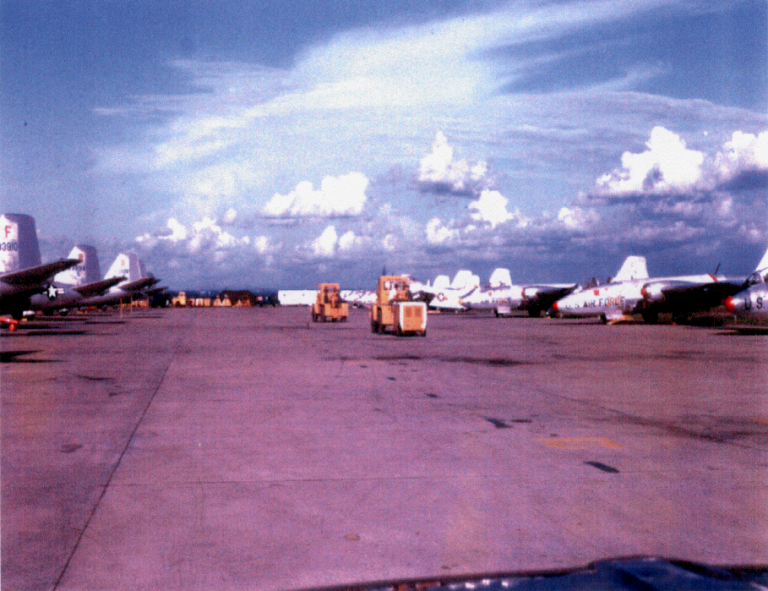
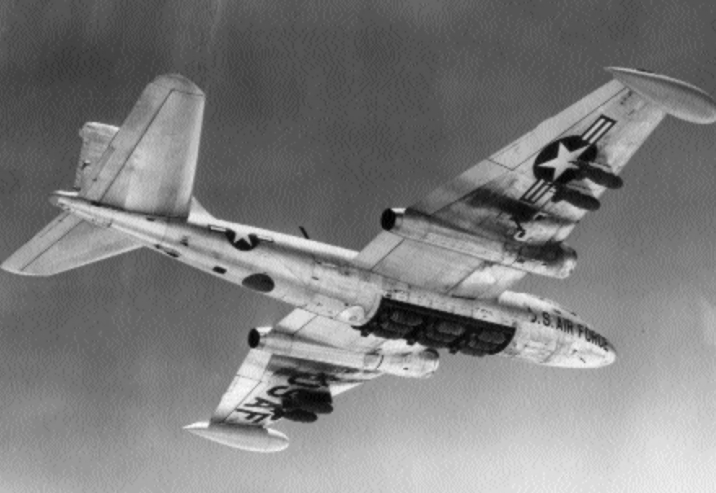
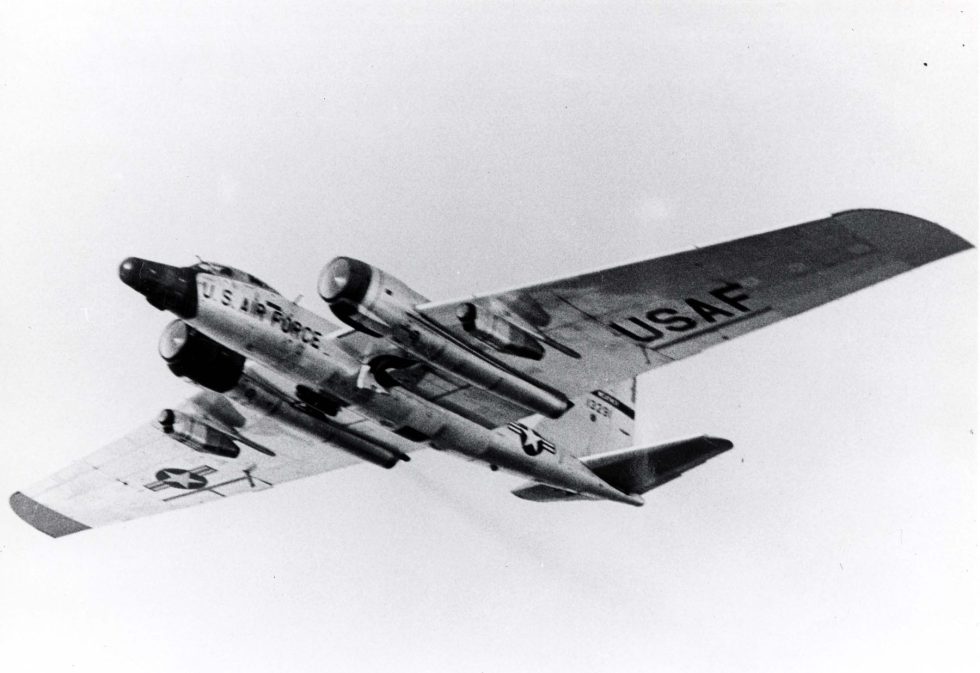
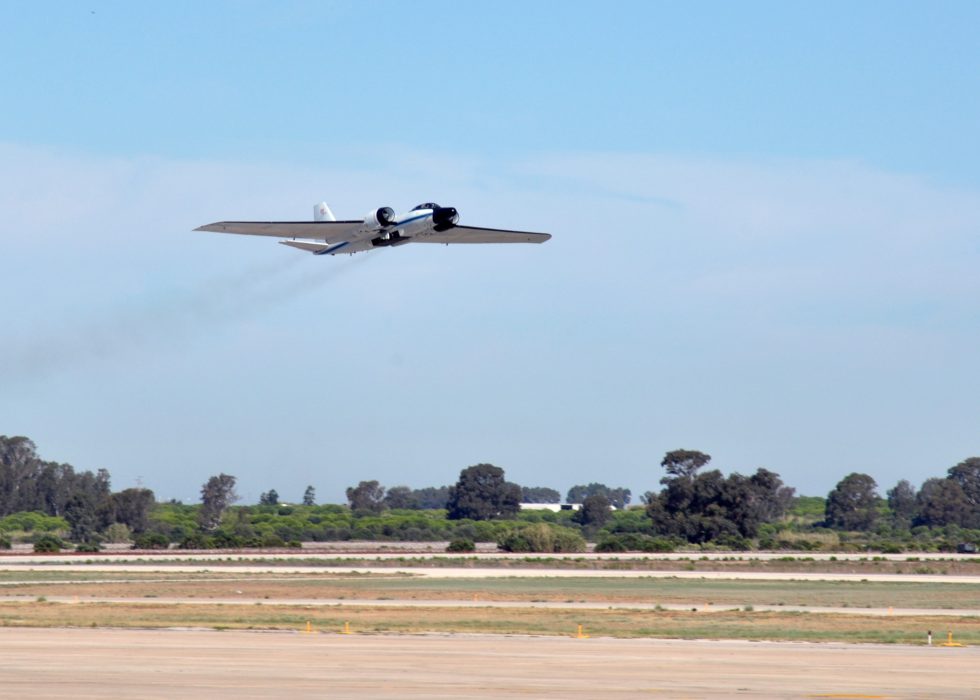
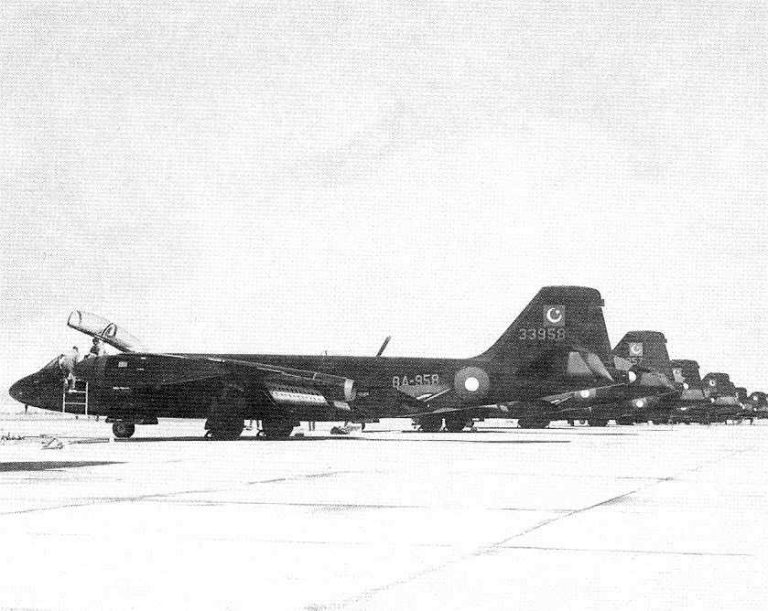
The B-57 Canberra in motion
Great Planes: Martin B-57 Canberra — the classic aviation-documentary-series profile of the type, covering the Martin redesign, its Vietnam service and the high-altitude RB-57 reconnaissance variants.
Where the B-57 Canberra flew
The B-57 Canberra’s war record
The Martin B-57 was a bomber and a spyplane, not a dogfighter, and its record is written in strike sorties and reconnaissance rather than air-to-air kills. It flew early USAF raids of the Vietnam War, pioneered night truck-hunting with the sensor-laden B-57G, served as Pakistan’s main night bomber against India, and — as the RB-57 — helped mark a grim milestone: the first aircraft ever downed by a surface-to-air missile.
Compare the combat record of every military aircraft. Figures as of 2026.
Everything people ask about the B-57 Canberra
Can I fly in a Martin B-57 Canberra?
Is the Martin B-57 the same as the English Electric Canberra?
What was the B-57 used for in Vietnam?
How high could the RB-57 reconnaissance versions fly?
Are any B-57 Canberras still flying?
Did a B-57 ever get shot down by a missile?
How many B-57 Canberras were built?
You can’t fly the B-57 Canberra.
These, you can.
Some legends only live in museums — others are fuelled and waiting. MiGFlug has put civilians in real military jet cockpits since 2004.
 Fly the L-39 AlbatrosThe world’s most-flown jet trainer — aerobatics included
 Fly the F-104 Starfighter“The missile with a man in it”
 Fly the MiG-21The Cold War’s most-produced jet
 Fly the T-33 Shooting StarAmerica’s first jet trainer
 Fly the DH VampireA piece of early jet history
 Fly the S.211Agile Italian jet trainer
 Fly the MB-326The classic Aermacchi jet
 Fly the MiG-15The Soviet legend of the Korean War
Continue the tour
Every fact, checked
- National Museum of the U.S. Air Force — Martin B-57B CanberraOfficial history, first flight, ~403 built, B-57B specifications and Vietnam service.
- NMUSAF — “Patricia Lynn: Taking Away the Night”The secret RB-57E infrared night-reconnaissance program in Vietnam.
- NASA Johnson Space Center — WB-57 ProgramThe three flying WB-57s, Ellington Field basing and high-altitude research missions.
- Smithsonian National Air and Space MuseumReference for the B-57’s design, licence origins and variants.
- Federation of American Scientists — RB-57RB-57D/F wingspans, the China shoot-downs and the Black Sea RB-57F loss.
- GlobalSecurity.org — RB-57RB-57D first flight, the honeycomb wing and its structural strengthening.
- HistoryNet — Aviation HistoryThe Bien Hoa attack of 1 November 1964 and B-57 losses in Vietnam.
- Air & Space Forces MagazineCuban Missile Crisis clarification — the 1962 overflights were U-2s, not RB-57s.