
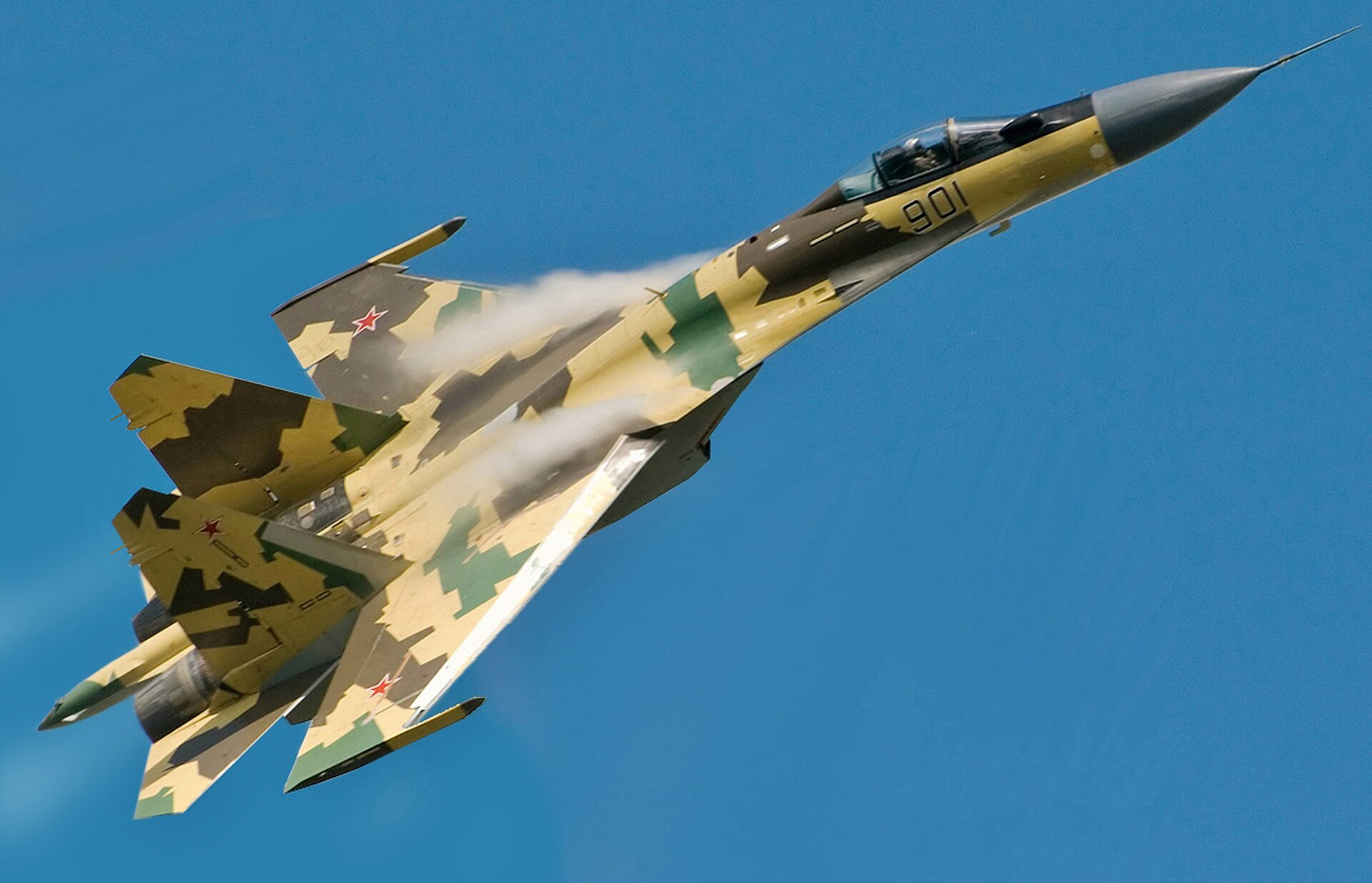
Sukhoi Su-35
“Flanker-E”
The ultimate expression of the Flanker bloodline — a thrust-vectoring “4++ generation” super-manoeuvrable heavyweight that is Russia’s frontline air-superiority fighter, built on brute performance and a huge radar rather than stealth.
The ultimate Flanker
The Su-35S is a heavily reworked, 4++ generation derivative of the Soviet-era Su-27 “Flanker.” The name “Su-35” first appeared on 1980s–90s demonstrators — the canard-equipped Su-27M/Su-35 and the thrust-vectoring Su-37 — but the modern jet is a near clean-sheet modernisation internally called the Su-35BM (bolshaya modernizatsiya, “big modernisation”), unveiled at MAKS in August 2007. Crucially, the production Su-35S has no canards: its agility comes from a reinforced airframe, relaxed stability and thrust vectoring instead.
Its signature is raw manoeuvrability. Paired AL-41F1S turbofans with 3D thrust-vectoring nozzles let it point its nose almost anywhere in the sky, sustaining post-stall airshow routines — Pugachev’s Cobra, the flat “pancake” spin, the Kulbit somersault — that look like gravity has been switched off. Beyond the theatrics it pairs that agility with a huge internal fuel load, long combat range and a heavy 12-hardpoint payload, plus the powerful long-range N035 Irbis-E radar.
Russia positions the Su-35 as its workhorse air-superiority fighter — a “4++ gen” answer to Western fifth-generation jets built on brute performance rather than low observability. It has flown combat over Syria (from 2016) Ve Ukraine (from 2022), where it remains Russia’s premier air-superiority Flanker despite documented combat losses. The first Su-35BM prototype flew on 18 February 2008; the serial Su-35S reached operational service in 2014.
01The Su-35’s lineage: how a 1970s Flanker became Russia’s most capable operational fighter
The Su-35S distils roughly 40 years of Flanker evolution into one airframe: bigger, thrust-vectoring engines, a strengthened frame, a powerful radar and a glass cockpit. Where the earlier Su-30MKI/Su-35/Su-37 line experimented with canards, the production Su-35S dropped them, achieving its aerodynamic and (modest) signature refinements through the airframe and flight-control system instead.
Roughly 150+ airframes have been built across Russian service and export. It is not a stealth aircraft — it is the heavyweight Russia relies on to hold air-superiority when a true fifth-generation fleet is not available in numbers, and it was marketed aggressively for export, with China the first foreign buyer and further deals with Iran and Egypt reported and contested.
What makes the Su-35 special
Twin thrust-vectoring engines
Two Saturn AL-41F1S turbofans (izdeliye 117S), each about 86 kN dry and ~142 kN in afterburner, carry independently steerable 3D vectoring nozzles. That gives the Su-35 extreme post-stall controllability and super-agility — controlled flight at very high angles of attack and its trademark Cobra and Kulbit manoeuvres.
The N035 Irbis-E radar
A large X-band passive electronically scanned array with a ~900 mm antenna and high peak power, reported to track around 30 targets at once. Manufacturer figures cite detection of a large target at up to ~400 km — a best-case number; real-world detection of smaller or stealthy targets is far shorter. It is Russia’s brute-force workaround for lacking stealth of its own.
Range and heavy payload
A large internal fuel load gives roughly 3,600 km range on internal tanks (~4,200 km with external tanks), and 12 hardpoints carry up to ~8,000 kg of ordnance. That combination of persistence, reach and weapons load is rare for a fighter of its class, from the R-77 and R-73 up to the very-long-range R-37M.
02The Su-35’s Irbis-E: why the headline radar ranges are best-case
The Irbis-E is deliberately enormous and power-hungry, trading the efficiency of a modern AESA for sheer peak output. The manufacturer’s often-quoted ~400 km figure applies to a very large, non-stealthy target under ideal conditions; against fighter-sized or low-observable targets the practical detection range collapses to a fraction of that. Treat the big numbers as marketing ceilings, not operational reach — the design intent was to partly offset the Su-35’s own lack of stealth, not to match a fifth-generation sensor suite.
03The Su-35’s engines: AL-41F1S, not the old AL-31F
The production engine is the Saturn AL-41F1S (izdeliye 117S), a substantially upgraded development of the Su-27’s AL-31F with more thrust and the thrust-vectoring nozzle. Some older references label it “AL-31F-117S,” and different power and range figures circulate across sources; the values here are representative rather than definitive. What is not in doubt is the effect: independently vectoring nozzles give control authority long after the wings stop flying.
Full Su-35S specifications
Airframe & Performance
- Mürettebat
- 1
- Uzunluk
- ~21.9 m
- Kanat açıklığı
- ~15.3 m
- Yükseklik
- ~5.9 m
- Max takeoff weight
- ~34,500 kg
- Max speed
- Mach ~2.25 · ~2,390 km/h at altitude
- Servis tavanı
- ~18,000 m
- Menzil
- ~3,600 km internal / ~4,200 km with tanks
- Sert noktalar
- 12 (payload ~8,000 kg)
Propulsion & Systems
- Engines
- 2 × Saturn AL-41F1S (izdeliye 117S), 3D TVC
- Thrust
- ~86 kN dry / ~142 kN afterburner each
- Radar
- N035 Irbis-E PESA
- Gun
- 1 × 30 mm GSh-30-1 (150 rounds)
- Missiles
- R-77, R-73, R-37M AAMs; air-to-ground & anti-ship
- First flight
- 18 February 2008 (Su-35BM)
- Built
- ~150+ (Russian + export)
- Unit cost
- ~$40–65 million (estimate)
04The Su-35’s price tag: why the cost figures vary so widely
No single authoritative unit price exists for the Su-35. Export and estimate figures circulate across a wide band — commonly cited in the region of $40–65 million — but they vary enormously by customer, contract year, weapons and support package, and whether the number reflects flyaway or programme cost. Treat any single dollar figure as an unverified estimate. The same caution applies to headline performance numbers: sources disagree on exact speed, range and engine-power values, so the specifications above are representative rather than definitive.
From demonstrator to frontline Flanker
The first “Su-35”
Canard-equipped Su-27M/Su-35 and thrust-vectoring Su-37 demonstrators are developed from the Su-27.
Su-35BM finalised
The modernised, canard-less Su-35BM design is completed and unveiled publicly at MAKS 2007.
First flight
The first Su-35BM prototype takes to the air.
Serial production begins
Flight testing runs in parallel as serial Su-35S production spins up at Komsomolsk-on-Amur.
Enters VKS service
The Su-35S reaches operational service with the Russian Aerospace Forces.
Combat debut over Syria
First foreign deployment — air-superiority patrols and escort in crowded, contested airspace.
China buys 24
China becomes the first foreign customer, receiving 24 Su-35s; no follow-on order follows.
The Ukraine war
Extensive air-superiority and stand-off missions over Ukraine — and multiple documented combat losses.
The Iran deal
A reported deal for up to 48 jets and shelters at Hamadan; deliveries remain contested and slip toward 2026–27.
From the flight line: twelve Su-35 stories
The ultimate Flanker
How a 1970s Soviet design became Russia’s most capable operational fighter.
Read the full story
Cobra, Kulbit & the pancake
The manoeuvres that should not be possible.
Read the full story
Steering with the exhaust
Thrust vectoring means control long after the wings stop flying.
Read the full story
The Irbis-E eye
A radar built to see through the stealth era — on paper.
Read the full story
Syrian debut
First blood abroad, 2016.
Read the full story
The Ukraine reckoning
Confirmed losses, contested tallies.
Read the full story
Friendly fire over Tokmak
Shot down by its own side?
Read the full story
China, the first buyer
24 jets, then the door closed.
Read the full story
The Iran deal
A multi-billion-dollar question mark.
Read the full story
Egypt’s sanctioned Flankers
Reportedly built, then stranded.
Read the full story
No stealth, but deadly agile
Does manoeuvrability still matter?
Read the full story
Flanker vs the West
Where it sits against the F-15 and F-22.
Read the full story
The Su-35 in pictures
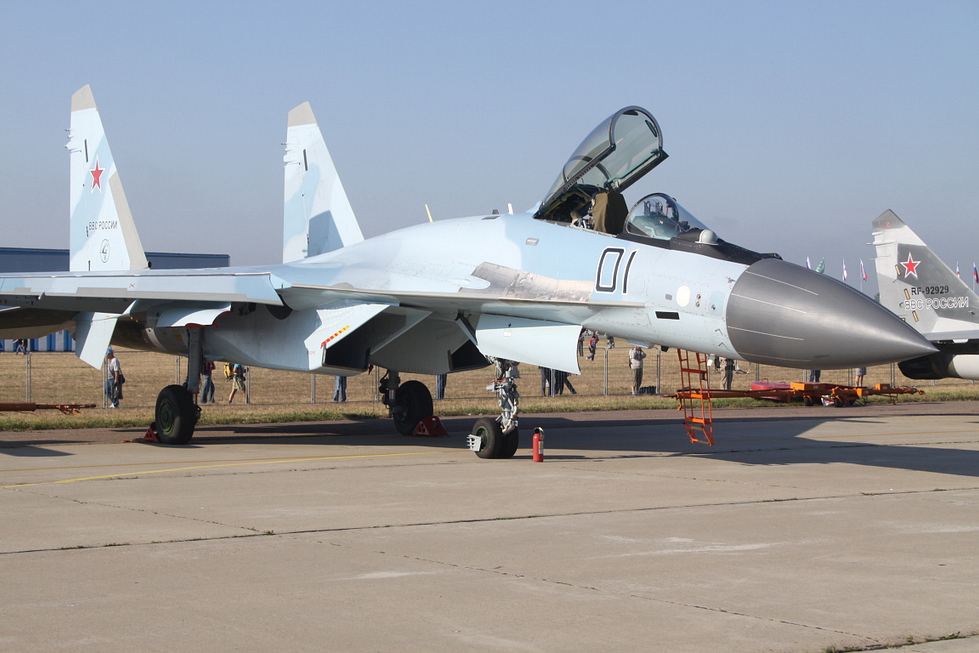
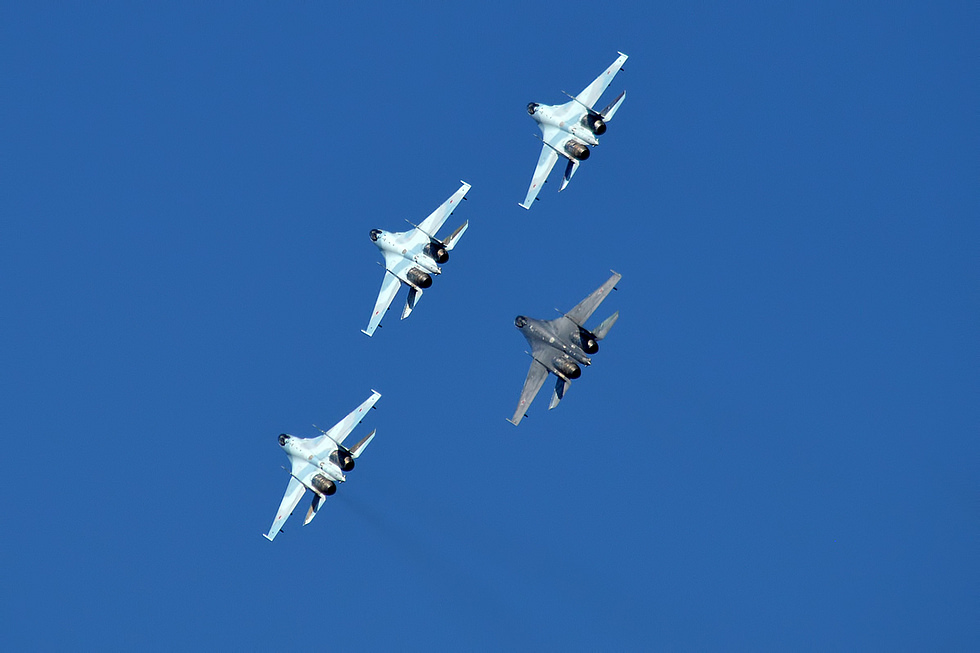
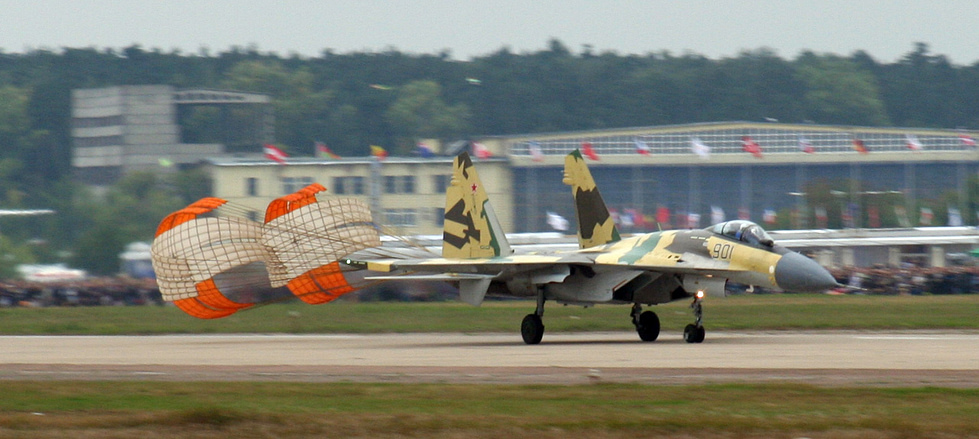
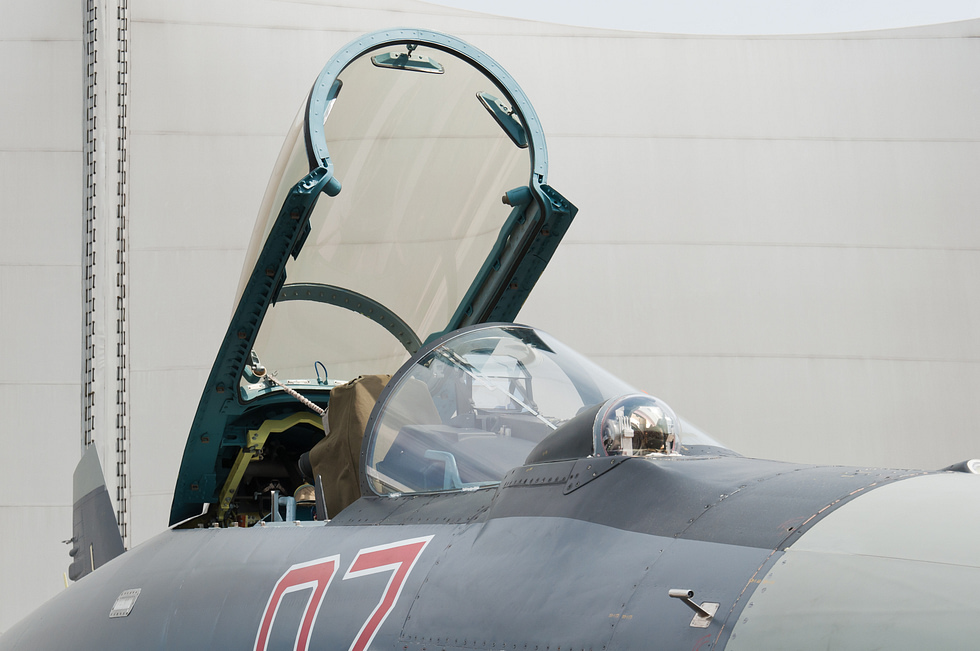
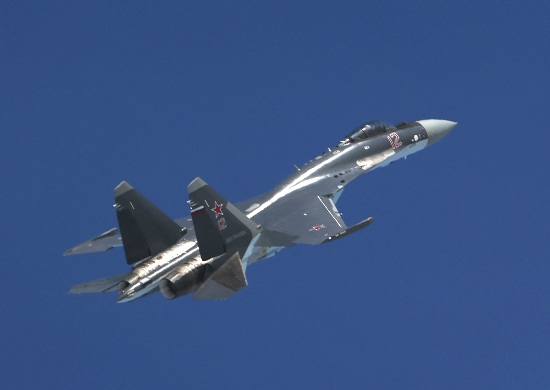
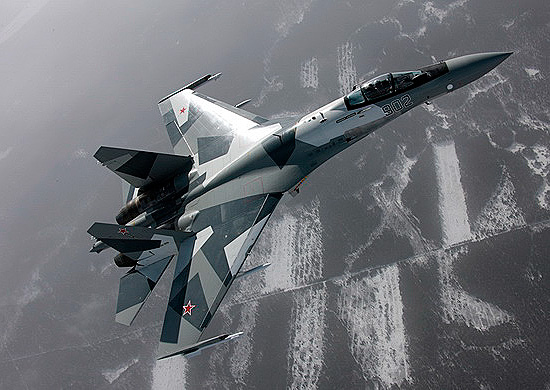
The Su-35 in motion
A Su-35 airshow display — the Cobra, Kulbit and flat-spin manoeuvres that thrust vectoring makes possible.
The Su-35 in motion
maxispeed0 — one of the most-watched Su-35 films on YouTube.
Where the Su-35 flies
Syria, Ukraine and contested tallies
The Su-35 has flown combat over Syria since 2016 and extensively over Ukraine since 2022. Its loss accounting is heavily contested — always read the numbers as claims, not settled scores. Notably, not a single Su-35 loss has been independently confirmed as an air-to-air kill; all verified losses are attributed to ground-based air defences.
Independent assessments (e.g. RUSI) estimate Russia lost only around 20 Su-35S/Su-30SM2 combined beyond repair since February 2022, with the Komsomolsk-on-Amur plant continuing to deliver — though production and attrition figures are themselves estimates. Compare the combat record of every military aircraft. Figures as of July 2026.
Everything people ask about the Su-35
Can I fly in a Su-35?
How fast is the Su-35?
What makes it so manoeuvrable?
How does it compare to the F-15 and F-22?
Is the Su-35 stealthy?
Is it still in service?
How many were built?
What’s the difference between the Su-35 and the Su-27?
You can’t fly the Su-35.
These, you can.
Some legends only live in museums — others are fuelled and waiting. MiGFlug has put civilians in real military jet cockpits since 2004.
 Fly the L-39 AlbatrosThe world’s most-flown jet trainer — aerobatics included
 Fly the F-104 Starfighter“The missile with a man in it”
 Fly the MiG-21The Cold War’s most-produced jet
 T-33 Shooting Star'ı uçurunAmerica’s first jet trainer
 Fly the DH VampireA piece of early jet history
 Fly the S.211Agile Italian jet trainer
 Fly the MB-326The classic Aermacchi jet
 Fly the MiG-15The Soviet legend of the Korean War
Continue the tour
Every fact, checked
- Airforce Technology — Su-35 Flanker-EDevelopment, design and specification overview.
- Key.Aero — All you need to know about the Su-35Background, variants and capability summary.
- 19FortyFiveRussia’s Su-35 losses over Ukraine and continued production.
- The War Zone (TWZ)The contested friendly-fire shoot-down near Tokmak (Sept 2023).
- Defense ExpressLeaked contract data on reported Su-35 orders (Iran, Algeria, Ethiopia).
- Defence Security AsiaSatellite imagery of Iran’s Su-35 preparations at Hamadan.
- The Washington InstituteThe Egyptian military’s perspective on the collapsed Su-35 deal.
- Military Watch MagazineThe Su-35 as an export product and its 2025 sales turnaround.