
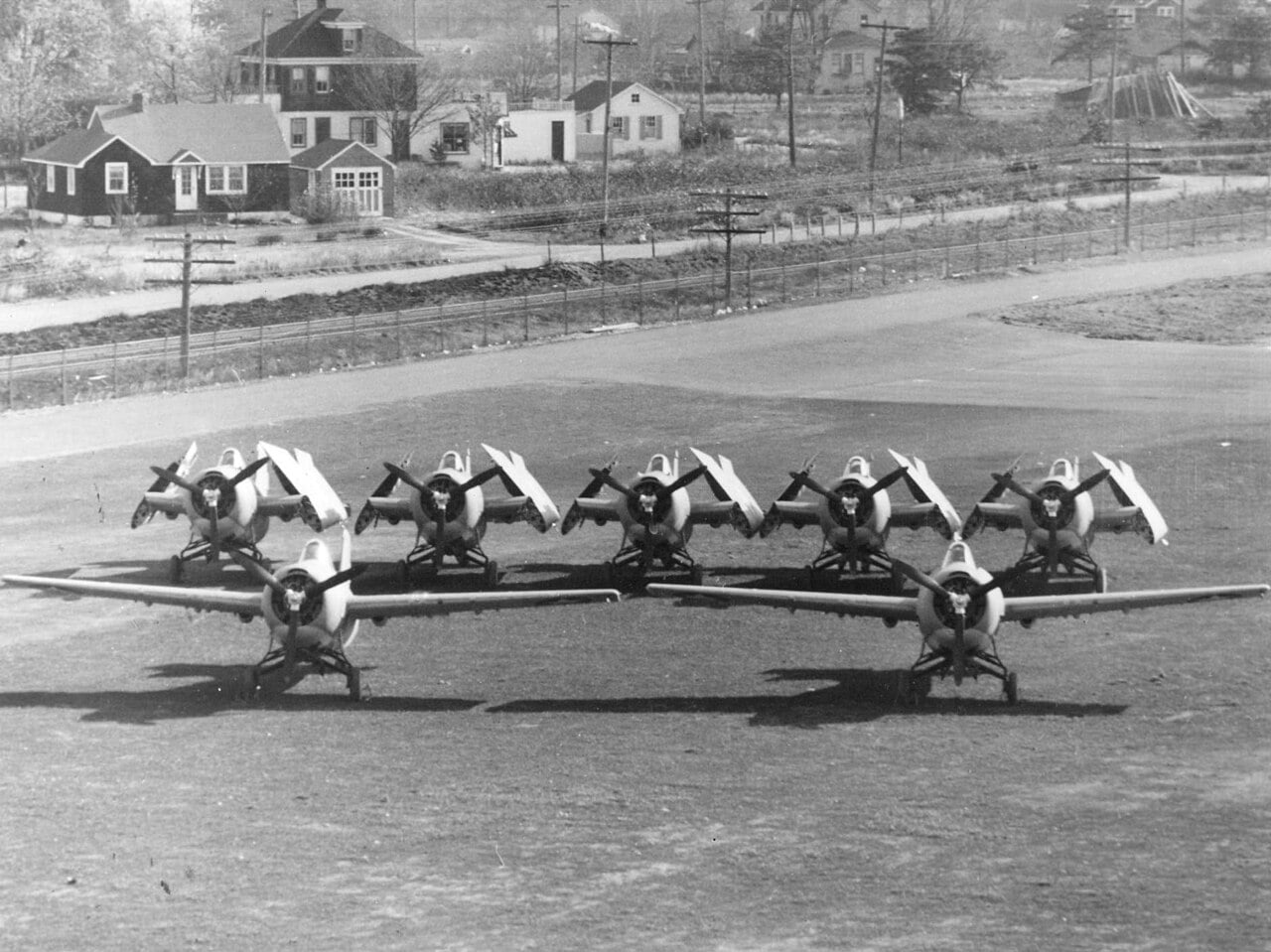
A US Navy photograph from 1942 shows seven F4F Wildcats parked on grass. Two have their wings spread. Five have them folded back along the fuselage, and those five occupy roughly the same frontage as the two.
That photograph is the entire argument for folding wings on carrier aircraft, and it is why Grumman’s patent on the mechanism was worth having. A carrier is a fixed amount of steel. Wingspan is the thing that decides how much of an air wing you can put on it.
Quick Facts
| Why wings fold | To cut the space an aircraft occupies on the flight deck, in the hangar and on the lifts, so more can be carried |
| First patents | Short Brothers, from 1913, for ship-borne biplanes — the Short Folders |
| Earlier still | The Breguet Type III of 1910, folded so it could be towed by road or carried by rail |
| The famous one | Grumman’s Sto-Wing, developed by Leroy Grumman in early 1941 and first flown on the XF4F-4 |
| What it achieved | Grumman’s system more than doubled the number of fighters that could be parked in a given area |
| Recognition | The Wildcat wing-folding mechanism is an ASME Historic Mechanical Engineering Landmark |
| The cost | Extra weight and more complex fuel, electrical and structural joints across the fold line |
| Carrier types that do not fold | The Dassault Rafale M, the F-35B and the AV-8B Harrier II, all compact enough to manage without |
| Other solutions | Oversweeping the wings, as on the F-14 Tomcat, or taking the aircraft apart, as in the biplane era |
Space Is the Only Currency
Everything about carrier aviation is a fight for area. Aircraft have to fit on the flight deck without fouling the landing area, ride the lifts down to the hangar, and pack into that hangar tightly enough to be worth the trip. Every metre of span you remove from a parked aeroplane is another aeroplane you can bring.
The idea is older than carriers. In 1910 Breguet built its Type III with folding wings so the machine could be towed behind a car or carried on a railway flatcar without being taken apart. Three years later Short Brothers patented folding mechanisms specifically for ship-borne aircraft, and the Short Folders — one of which, the Short 184, was built 936 times — set the pattern for the next twenty years: hinges near the fuselage, latches released, wings swung straight back alongside the fuselage with their surfaces still horizontal.
During the First World War the same mechanism went onto very large land-based bombers — Britain’s Handley Page Type O and the American Martin MB series — for an unglamorous reason. The hangars that existed had been built for smaller aeroplanes.
Grumman’s Awkward, Brilliant Twist
When monoplanes arrived, the obvious answer was to hinge the wing about a third of the way out and fold the outer panels straight up. The Douglas TBD Devastator of 1935 appears to have been first, the Vought SB2U Vindicator followed in 1936, and carrier aircraft have used that arrangement ever since. It is simple, and it trades width for height.
Grumman went further. The Sto-Wing, developed by Leroy Grumman in early 1941 and first fitted to the XF4F-4, rotates the wing about a skewed hinge so that as each panel swings back it also twists: the leading edge turns downward and the panel ends up lying flat against the side of the fuselage, upper surface outward. The aircraft goes from a fighter to something the width of its own fuselage. Grumman’s system is credited with more than doubling the number of fighters that could be parked in a given area, and the American Society of Mechanical Engineers has designated it a Historic Mechanical Engineering Landmark.
Grumman then used it for decades: the TBF Avenger, the F6F Hellcat, the AF Guardian, the E-1 Tracer, and the E-2 Hawkeye and C-2 Greyhound. The early aircraft folded by hand. Grumman’s first prototype had powered folding and the feature was deleted from production to save weight; by the time of the E-2 the wings were simply too big for deck crew to move, and power came back.
The American Heritage Museum on how a Sto-Wing actually moves.
What Folding Wings Cost You
Folding wings are heavier than fixed ones, and more complicated: fuel lines, electrical runs, control linkages and primary structure all have to cross the fold line and still be trustworthy after a few hundred catapult shots and arrested landings.
The bill came due publicly in 1942. The F4F-4 Wildcat added the Sto-Wing and two extra machine guns without any additional engine power, and the result was an aircraft noticeably more sluggish than the F4F-3 it replaced. Navy pilots had been reasonably happy with the -3. They flew the -4 against the A6M Zero at Midway and were considerably less happy. The answer turned out to be tactics rather than airframe: mutual support flown as a unit, rather than trying to out-turn the aeroplane in front.
Which is why some carrier aircraft never bothered. The Douglas SBD Dauntless, the A-4 Skyhawk, the Brewster F2A Buffalo and the Sea Harrier all went to sea with fixed wings because they were small enough to get away with it. The same is true today: the Dassault Rafale M, the F-35B and the AV-8B Harrier II all operate from ships without folding anything.
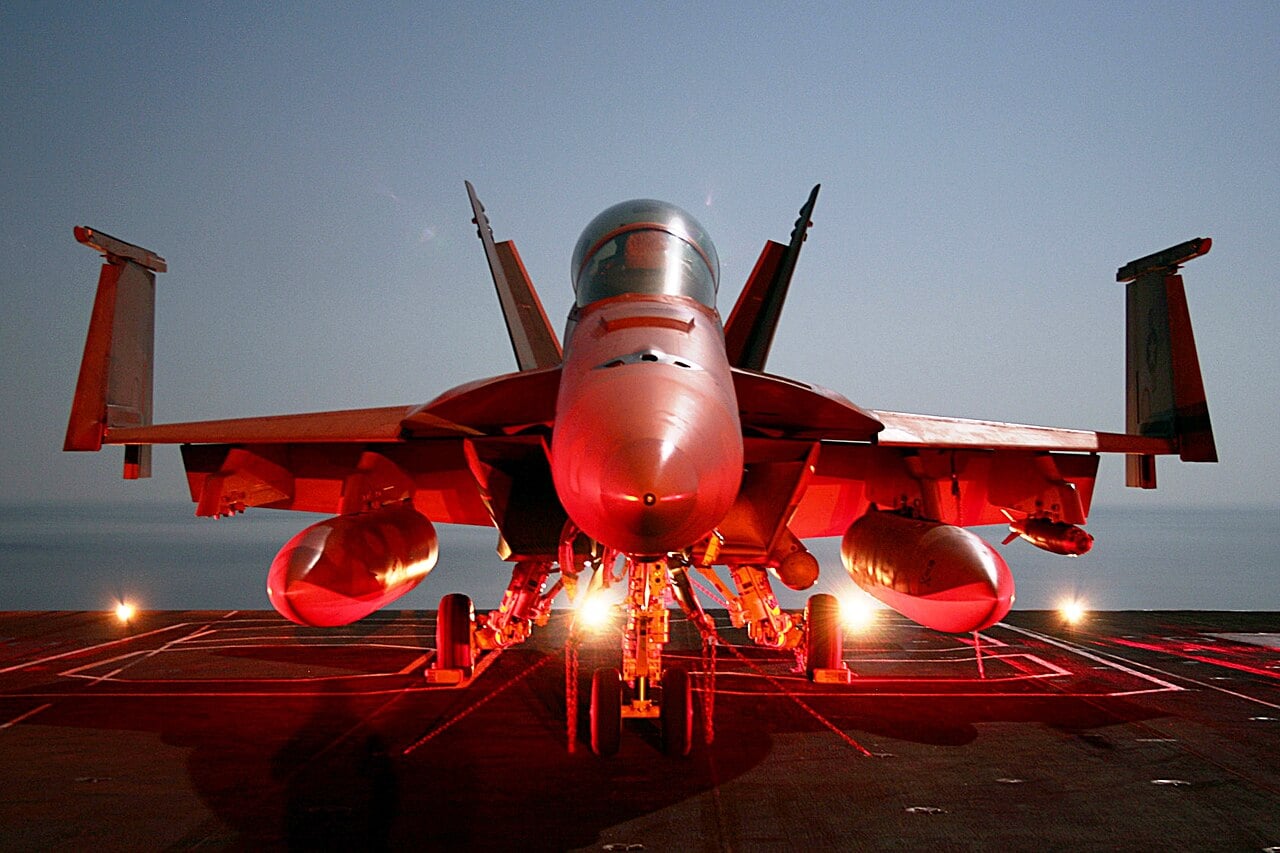
And when the wing is nearly short enough, designers fold only the last bit of it. The F/A-18 Hornet and the Soviet Yak-38 fold just the outer wingtips upward; the F-35C, the carrier variant, folds sections of its wings and carries extra ailerons out there to make it work.
The Aircraft That Cheated
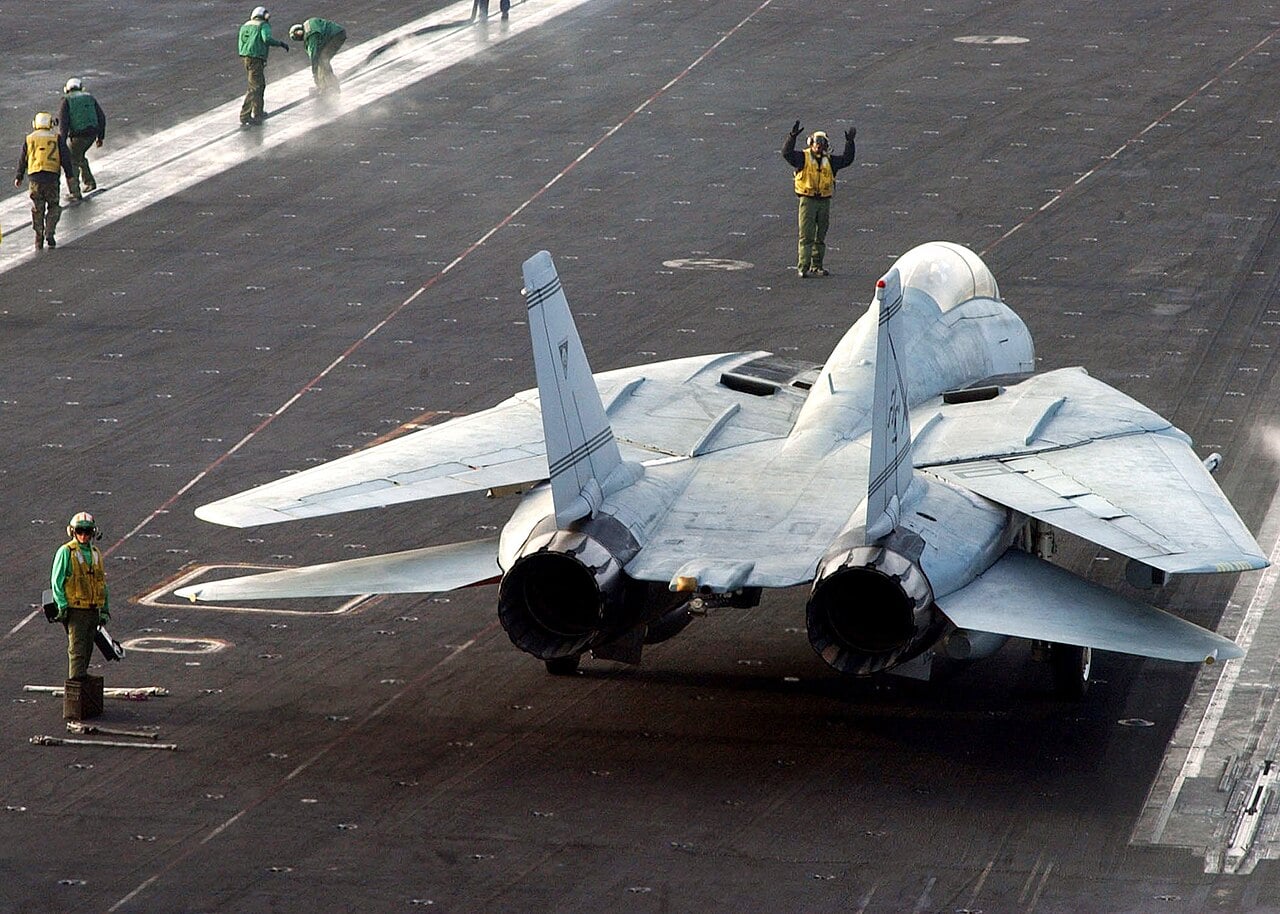
The F-14 Tomcat already had wings that moved, so it did not need a fold at all. On deck the crew simply pushed the variable geometry wings past their normal aft limit into a position called oversweep, tucking the tips back over the tailplanes and shrinking the parked footprint without a single extra hinge. It is the neatest solution on this list, and it only worked because Grumman had already accepted the weight of a swing wing for aerodynamic reasons.
In the biplane era the crude answer was common: take the aeroplane apart. The shipboard Sopwith Camel 2F.1 had a removable rear fuselage so that the two halves could be lifted separately through a small hatch. HMS Vindex in 1915 stowed two dismantled landplanes in a cramped forward hangar and could have them flight-ready in ten minutes.
Wings folding and unfolding, which is as satisfying to watch as it sounds.
Folding has quietly spread beyond the sea. Aircraft too tall or too wide for available hangars have folded tails and fins — the Boeing B-50, the Boeing 377 Stratocruiser, the Saab 37 Viggen, the S-3 Viking. Boeing offered the original 777 with folding wingtips for cramped airports and never sold one. The 777X carries them anyway, in a shorter and simpler form: seven extra metres of span in the air, and the same airport gates on the ground.
Which is exactly the bargain Leroy Grumman struck in 1941, moved from a hangar deck to an airport apron.
Sources: Wikipedia entries for folding wings, the Grumman F4F Wildcat and the Lockheed Martin F-35, the latter on the F-35C wing fold; the American Society of Mechanical Engineers designation of the Wildcat wing-folding mechanism as a Historic Mechanical Engineering Landmark; John B. Lundstrom, The First Team, as cited on the F4F-4 performance penalty.
0 Comments