
Grumman TBF / TBM
“Avenger”
The big, rugged carrier torpedo bomber that survived a catastrophic combat debut at Midway to become the standard US Navy strike aircraft of the Pacific war — and helped sink the two largest battleships ever built.
The Grumman TBF Avenger: from Midway disaster to the Pacific’s standard torpedo bomber
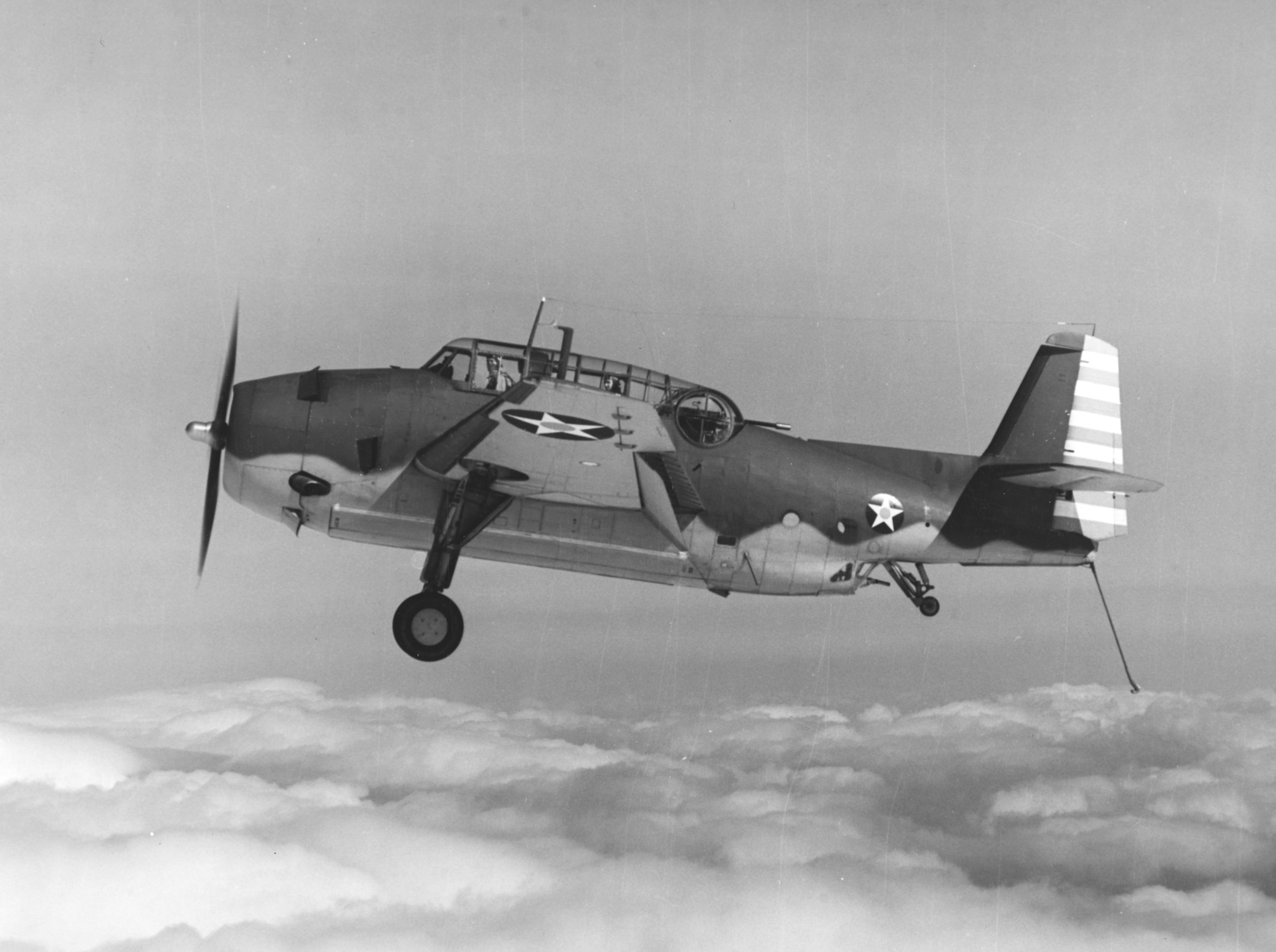
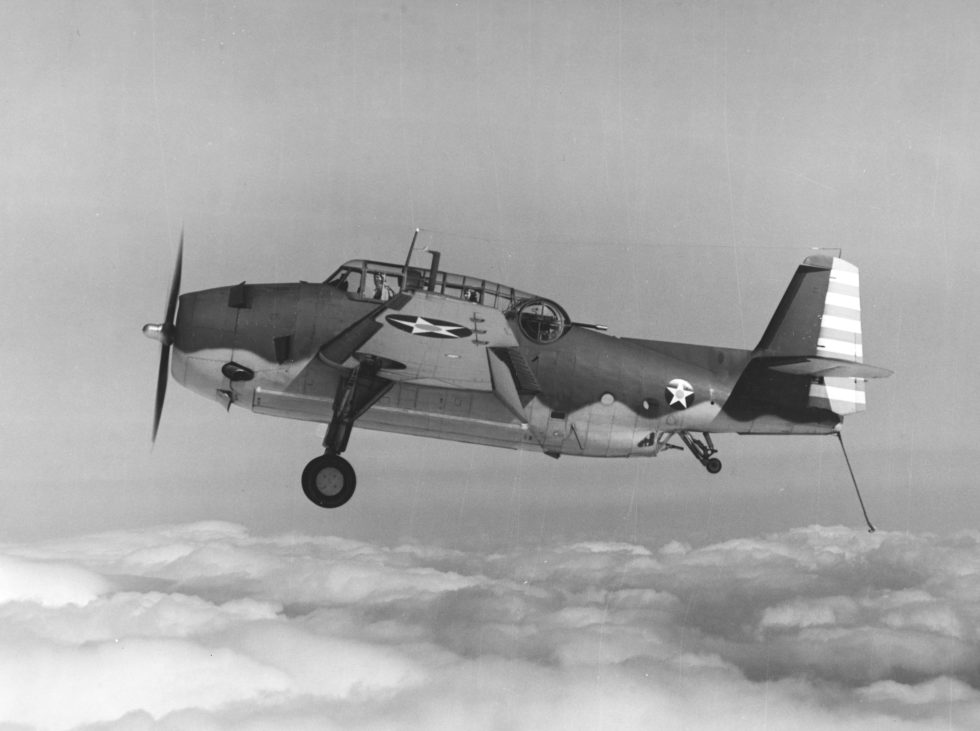
The Grumman TBF Avenger was designed in 1940 to replace the hopelessly obsolete Douglas TBD Devastator as the US Navy’s carrier torpedo bomber. It was a big, single-engined machine — the heaviest single-engined aircraft of the war to fly from carriers — with a deep fuselage built around an internal weapons bay, a crew of three, and a power-operated ball turret behind the cockpit. The prototype first flew on 7 August 1941, and the type was named “Avenger” in the aftermath of Pearl Harbor.
Its combat debut was a massacre. Six Avengers of Torpedo Squadron 8 flew from Midway on the morning of 4 June 1942, ahead of the carriers; five were shot down and only one badly shot-up aircraft, flown by Ensign Albert “Bert” Earnest, limped back. Yet the Avenger recovered from that opening catastrophe to become one of the most important American aircraft of the Pacific. Built in enormous numbers — General Motors’ Eastern Aircraft Division turned out the majority as the TBM — it equipped almost every US Navy and Marine torpedo squadron for the rest of the war.
The Avenger was rugged, stable and versatile. It carried a Mark 13 torpedo or up to about 900 kg of bombs, dropped them level or in a glide, hunted submarines from tiny escort carriers, fired rockets at shipping and shore targets, and later carried early airborne radar. Avengers helped sink the Japanese super-battleships Musashi (1944) and Yamato (1945), sank U-boats in the Atlantic, and served with the navies of Britain, New Zealand, Canada, France, the Netherlands and postwar Japan. A young naval aviator named George H. W. Bush flew one and was shot down near Chichijima in 1944. Long after the war, surplus Avengers found a second life as aerial water- and borate-bombers fighting forest fires.
01The TBF Avenger’s name: how a torpedo bomber came to be called “Avenger”
Grumman rolled the prototype out just before the United States entered the war. The company had a house style of naming its fighters “Cats” — Wildcat, Hellcat, Bearcat — but the new torpedo bomber was publicly unveiled at a ceremony held, by coincidence, only days after the Japanese attack on Pearl Harbor in December 1941. The name “Avenger” was chosen to reflect the national mood: an aircraft that would carry America’s answer back to the enemy. It proved apt — within three years Avengers were sinking the largest warships Japan possessed.
What makes the Avenger special
A rugged carrier bomber with an internal bay
The Avenger was built around a deep, roomy fuselage with an internal weapons bay that could swallow a full-length Mark 13 torpedo or up to about 900 kg (2,000 lb) of bombs — unusual for a carrier aircraft of its day, and far cleaner aerodynamically than slinging ordnance under the wings. Folding wings, a stout undercarriage and Grumman’s famous structural toughness let it absorb heavy battle damage and still come home.
The powered ball turret — defensive firepower
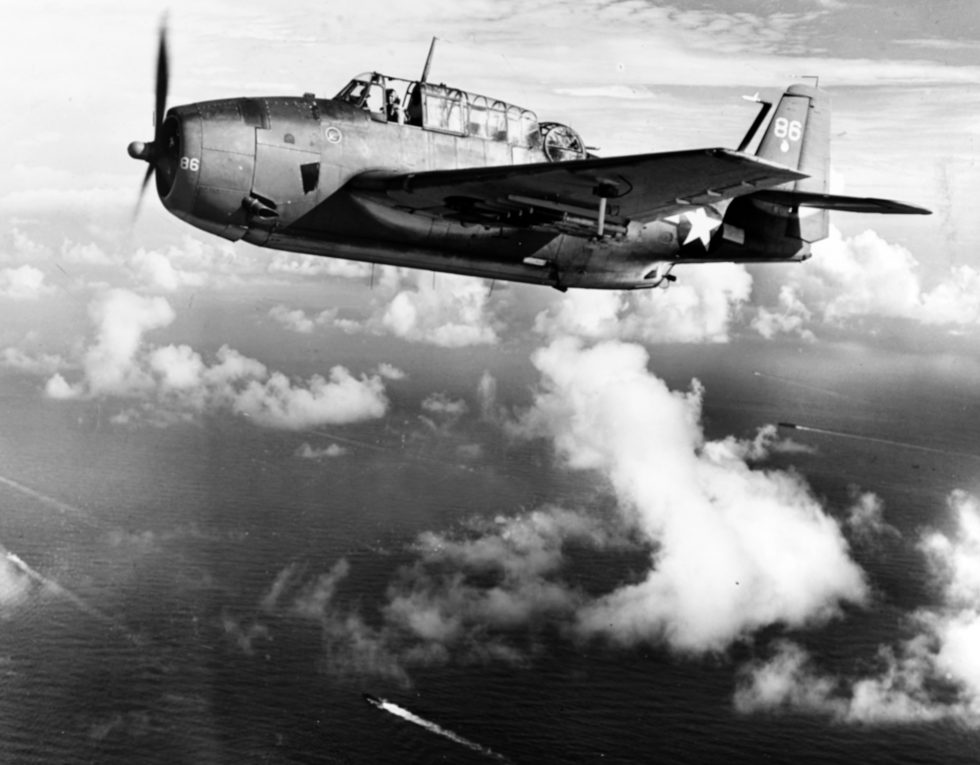
The Avenger was among the first US Navy aircraft to carry a power-operated gun turret: an electro-hydraulic ball turret behind the cockpit mounting a single .50-calibre machine gun, with a second .50 in the wings and a .30 in a ventral tunnel position. Three crew — pilot, turret gunner and radio operator/bombardier — gave it all-round defence that a single-seat dive bomber could never match.
Versatility: torpedo, bomber, sub-hunter, radar picket
Few aircraft did so many jobs so well. The Avenger dropped torpedoes and bombs, fired rockets, laid mines, spotted for gunfire, and became a superb anti-submarine platform flying from small escort carriers. Radar-equipped versions hunted U-boats at night, and the postwar TBM-3W carried a large search radar as one of the first airborne early-warning aircraft.
02The Avenger’s toughness: why Grumman airframes came home shot to pieces
Grumman’s Bethpage factory earned the nickname “the Grumman Iron Works” for the sheer structural strength of its aircraft. The Avenger inherited it. Bert Earnest’s TBF at Midway had its hydraulics shot out, its elevator cables severed and one wheel hanging, its turret gunner dead — and it still flew him and his wounded radioman back to a crash-landing at Midway. That ability to soak up damage and keep flying, over hundreds of kilometres of open ocean, was worth as much to aircrews as any performance figure.
03The Avenger and the Devastator: replacing a torpedo bomber that had become a death trap
The aircraft the Avenger replaced, the Douglas TBD Devastator, was slow, lightly built and by 1942 desperately obsolete. At Midway the Devastator squadrons were annihilated attacking the Japanese carriers. The Avenger was the answer already in the pipeline: faster, far tougher, better armed and better protected. Ironically its own first mission, flown by the Midway-based Avenger detachment of the same Torpedo 8, was nearly as costly — but the aircraft itself was sound, and mass production quickly made it the backbone of Navy torpedo aviation.
Full specifications: the Grumman TBM-3 Avenger
Baseline note: the figures below describe the TBM-3E, the late-war standard built by the Eastern Aircraft Division of General Motors — the mark that flew the close-support strikes off Okinawa, filled the escort-carrier anti-submarine squadrons and then spent thirty years dropping water and insecticide on Canadian forests. Deltas for the Grumman-built TBF-1 and TBF-1C, the TBM-1C, the radar-picket TBM-3W and the Royal Navy marks are given in grey. Published tables for this type are unusually inconsistent: the most-copied online specification block is headed TBM-3 but lists the 1,700 hp R-2600-8 and the 15,536 lb gross weight of the TBF-1, so engine, weight and speed figures migrate freely between marks in secondary sources. Where a number belongs to one mark, it is named here.
Dimensions & weights
- Crew
- 3 — pilot; a turret gunner sitting inside the dorsal power turret; and a radioman-bombardier in the belly compartment who worked the radio, the radar, the bomb sight and the ventral tunnel gun (ASW and target-towing conversions often flew with two, and the postwar fire bombers with one)
- Length
- 12.19 m (40 ft 0 in). The Avenger was the largest single-engined aircraft to serve from carrier decks in the war — longer than a Beaufighter’s fuselage and heavier loaded than a Bristol Blenheim
- Wingspan
- 16.51 m (54 ft 2 in)
- Width, wings folded
- 5.79 m (19 ft 0 in) — the Grumman Sto-Wing pivoted each panel backwards to lie flat along the fuselage, cutting the parked footprint by nearly two-thirds and letting an Essex-class hangar hold roughly twice as many torpedo bombers as it could Devastators
- Height
- 5.00 m (16 ft 5 in), tail down — a tall aeroplane, because the bomb bay sat under the wing spar and the undercarriage had to clear a torpedo
- Wing area
- 45.52 m² (490 sq ft)
- Aspect ratio
- 5.99
- Aerofoil
- NACA 23015 at the root, NACA 23009 at the tip — a thick, forgiving, entirely conventional section chosen for low-speed handling and internal volume rather than speed
- Internal weapons bay
- one enclosed bay with hydraulic doors, rated at 907 kg (2,000 lb) and long enough for a 4.09 m (13 ft 5 in) Mark 13 torpedo — the single feature that separated the Avenger from every torpedo aircraft that preceded it, all of which slung the weapon in the airstream
- Empty weight
- 4,783 kg (10,545 lb); the TBF-1 was some 200 kg lighter
- Gross weight
- 8,117 kg (17,895 lb) — against 4,624 kg (10,194 lb) for the TBD Devastator it replaced. The Avenger weighed nearly twice as much and carried the same single torpedo; what it bought with the weight was armour, self-sealing tanks, a power turret and 100 mph
- Maximum take-off weight
- 8,278 kg (18,250 lb)
- Wing loading
- 178 kg/m² (36.5 lb/sq ft) at gross — high for 1942, and the reason loaded Avengers were routinely catapulted rather than deck-run from the short escort carriers
Performance
- Maximum speed
- 430 km/h (267 mph) at 4,880 m (16,000 ft), clean. The lighter TBF-1 on the 1,700 hp R-2600-8 was credited with 436 km/h (271 mph); with a torpedo hung inside and the bay doors shut, squadron aircraft saw perhaps 40 km/h less
- Cruise speed
- 237 km/h (147 mph) for maximum range. Tables quoting 346 km/h (215 mph) are giving a high-speed cruise, not the setting a search leg was actually flown at
- Stall speed
- 122 km/h (76 mph) at gross with flaps and gear down — docile, which mattered more to a deck-landing crew than any other number on this list
- Rate of climb
- 5.5 m/s (1,075 ft/min) at gross weight. Figures for the TBM-3 range from this up to about 10.5 m/s (2,060 ft/min) in different compilations; the spread is mostly the difference between an aeroplane carrying a torpedo and one that is not
- Service ceiling
- 7,130 m (23,400 ft) — academic for a type that spent its working life between 50 and 12,000 ft
- Range, with torpedo
- 1,610 km (1,000 miles) on internal fuel — the operationally meaningful number, and roughly double what the Devastator managed
- Ferry range
- 2,335 km (1,450 miles) with the 1,040 litre (275 US gallon) bomb-bay tank fitted in place of weapons
- Combat radius
- about 400 km (250 miles) for a strike with a torpedo and a reserve for a deck landing; escort-carrier anti-submarine sorties traded weapons for fuel and ranged further
- Patrol endurance
- 5 to 6 hours on an Atlantic anti-submarine sortie with depth bombs and a partial bay tank; night patrols from the hunter-killer groups routinely ran past four hours
- Take-off run
- about 370 m (1,200 ft) at gross in still air. In practice a loaded Avenger left an escort carrier on the hydraulic catapult; a fleet carrier with 25 knots of wind over the deck could free-run it
- Approach speed
- 150 km/h (80 knots) over the ramp — the type had excellent low-speed manners and a wide, strong undercarriage, and it was popular with pilots for exactly that reason
- Power loading
- 4.27 kg/kW (9.4 lb/hp) at gross on the R-2600-20
Propulsion & systems
- Engine
- one Wright R-2600-20 Twin Cyclone, a 14-cylinder two-row air-cooled radial of 42.7 litres (2,603 cu in), rated at 1,900 hp (1,417 kW) for take-off
- Earlier engines
- Wright R-2600-8 of 1,700 hp (1,268 kW) on the XTBF-1, TBF-1, TBF-1C, TBM-1 and TBM-1C. The 200 hp step to the -20 in mid-1944 is the single largest difference between the early and late Avenger, and it arrived just as the type’s work shifted from torpedoes to bombs and rockets
- Supercharger
- single-stage, two-speed geared supercharger — no turbocharger, which is why the Avenger’s performance fell away above 5,000 m and why nobody cared
- Propeller
- Hamilton Standard three-blade constant-speed, 3.96 m (13 ft 0 in) diameter
- Fuel
- 1,250 litres (330 US gallons) internal, self-sealing, in the wing centre section; the TBF-1C and later added two 219 litre (58 US gallon) droppable wing tanks and could take a 1,040 litre (275 US gallon) tank in the bomb bay
- Dorsal turret
- Grumman-designed electro-hydraulic power turret with a single 12.7 mm gun, the gunner sitting inside it — compact enough to fit a single-engined fuselage, which no previous American power turret had managed. It was the type’s most novel piece of engineering after the bomb bay
- Wing folding
- Grumman Sto-Wing, hydraulically operated, the panels rotating about a skewed hinge to lie flat against the fuselage sides with leading edges down
- Radar and search gear
- ASB radar on Yagi masts under each wing on early marks; from 1944 the AN/APS-4 or AN/APS-3 "ASH" set in a pod on the starboard wing. Anti-submarine aircraft added sonobuoy racks and, on some, magnetic anomaly detection — and the TBM-3W carried the enormous AN/APS-20 in a ventral radome, the first airborne early-warning radar ever flown operationally
- Protection
- armour for the pilot and turret gunner, self-sealing tanks and a fire-suppression system — standard on a 1942 American naval aircraft and conspicuously absent from the Japanese torpedo bombers the Avenger met
- Deck equipment
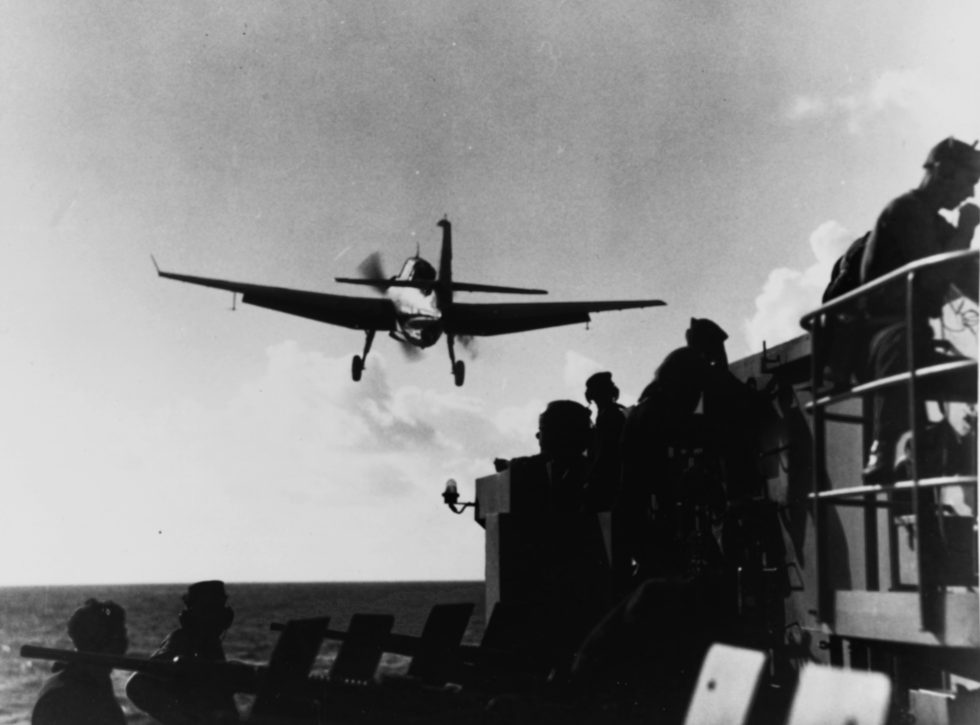
- arrester hook, catapult hooks, hydraulically folding wings, and an inflatable dinghy stowed in the rear fuselage; the belly was flat and strong enough that ditchings were survivable more often than not
- Electrical system
- 24-volt, driving the turret, the bay doors, the wing fold and the radar — an unusually electrified aeroplane for its date and a maintenance burden on small carriers
04The Avenger’s operating costs: why no clean dollar figure exists
The Avenger was a wartime government product built by the thousand under military contract, so no clean, comparable flyaway unit price or cost-per-flight-hour survives in the public record the way it does for modern jets. What is well documented is scale: nearly 9,839 were built in barely three years, most of them by General Motors’ Eastern Aircraft Division. Today the relevant cost is the price of keeping a warbird airworthy — a restored, flying Avenger is a multi-million-dollar aircraft, and each display flight burns a large radial engine’s worth of fuel and maintenance. Any precise period dollar figure you see should be treated as an estimate.
Armament & payload
The Avenger put its torpedo inside the aeroplane, and everything else about the design follows from that
Every torpedo aircraft before the Avenger hung its weapon in the airstream, paid for it in drag, and flew slowly enough to be shot down by anything. Grumman’s answer was a bomb bay long enough to swallow a 4.09 m Mark 13 torpedo behind hydraulic doors, which forced a deep fuselage, a high wing and an aeroplane so large that it became the heaviest single-engined type ever to operate from carrier decks. The bay also made the Avenger flexible in a way no torpedo bomber had been: the same aircraft that carried a torpedo could carry a 2,000 lb bomb, four 500-pounders, a stick of depth bombs, a ferry tank, a searchlight, a camera or a homing torpedo it was not supposed to talk about.
Defensive armament was equally deliberate. A single 12.7 mm gun in a compact electro-hydraulic dorsal turret, a second hand-held 7.62 mm gun firing aft and down through a ventral tunnel, and from the TBF-1C two 12.7 mm guns in the wings — enough that Avenger crews shot down Japanese aircraft in numbers, and enough that a Fleet Air Arm Avenger destroyed a V-1 flying bomb on 9 July 1944 and another shot a Nakajima Ki-44 "Tojo" out of the air at low level over Sumatra in January 1945. What the armament could not do was save the aircraft at Midway, where six machines went in without fighter escort against a fully alerted carrier force. Fits varied sharply by mark and operator: the TBF-1 had a cowl-mounted rifle-calibre gun and no wing guns at all, the TBM-3 added wing rocket rails and hardpoints, Royal Navy Avengers carried British radio and radar, and the postwar anti-submarine conversions gave up guns entirely.
Gun
- One 7.62 mm Browning M1919 in the upper cowl, fired by the pilot through the propeller arc — fitted to the TBF-1 and TBM-1, and universally regarded as useless
- Two 12.7 mm Browning AN/M2 in the wings outboard of the propeller arc, roughly 600 rounds per gun, standard from the TBF-1C and TBM-1C of 1943 onward and the change that made the Avenger a credible strafer
- One 12.7 mm Browning M2 in the Grumman electro-hydraulic dorsal turret, about 400 rounds — a single heavy gun rather than a pair of rifle-calibre weapons, which was the right choice and unusual for its date
- One 7.62 mm Browning M1919 on a flexible mount in the ventral tunnel, fired by the radioman lying prone in the belly — awkward, cramped and the only defence against an attack from below and behind
- Postwar anti-submarine and airborne-early-warning conversions deleted the turret and every gun with it; a TBM-3W had no armament whatsoever
Air-to-air
- No air-to-air missile existed in United States service in this period; the Avenger’s air-to-air weapon was the turret gun, and it earned its keep
- Avenger gunners were credited with a substantial number of Japanese aircraft over the Solomons and the Marianas, though squadron claims for defensive gunnery are inflated across every air force of the war and should be read with that in mind
- An 846 Naval Air Squadron Avenger destroyed a V-1 flying bomb over the North Sea on 9 July 1944 — almost certainly the only torpedo bomber ever to shoot down a cruise missile
- During Operation Meridian in January 1945, a Fleet Air Arm Avenger shot down a Nakajima Ki-44 "Tojo" in low-level combat over Sumatra while returning from the Palembang refinery strikes
- A loaded Avenger had no business manoeuvring with a fighter, and the tactical answer from mid-1942 onward was simple: never send them anywhere without Wildcats or Hellcats overhead, a lesson bought with five aircraft at Midway
Air-to-surface guided
- Mark 24 mine — not a mine at all, but a passive acoustic homing torpedo deliberately misnamed for security, and known to its crews as FIDO. 308 kg (680 lb), a 42 kg (92 lb) HBX warhead, four piezoelectric hydrophones, 12 knots for ten minutes
- It had to be dropped below 90 m (300 ft) and below 120 knots, at a swirl left by a submarine that had just submerged — a delivery profile the slow, stable Avenger suited better than almost anything else flying
- In service from March 1943; roughly 204 were released in the war, sinking 37 Axis submarines and damaging 18. The escort-carrier hunter-killer groups in the Atlantic were among its heaviest users
- An Avenger from USS Bogue sank the Japanese cargo submarine I-52 in the mid-Atlantic on 24 June 1944 with a FIDO placed on a sonobuoy contact — an attack that combined two brand-new technologies and is a fair claim to the first modern anti-submarine kill
- The Navy’s other wartime guided anti-ship weapon, the ASM-N-2 Bat glide bomb, went to the PB4Y-2 Privateer rather than to carrier aircraft; no Avenger carried it operationally
Bombs
- One Mark 13 aerial torpedo in the bay: 4.09 m long, 1,005 kg (2,216 lb), a 272 kg (600 lb) Torpex warhead, 33.5 knots to 5,800 m (6,300 yards)
- The Mark 13 was appalling until it was fixed. Mid-1943 trials found 36 per cent ran cold and 20 per cent sank outright; the plywood nose drag ring and the Caltech shroud-ring tail transformed it, raising the permitted release from 50–100 ft at 150 knots to 800 ft at 300 knots and turning the Avenger’s attack from suicide into a survivable manoeuvre
- Alternatively one 907 kg (2,000 lb) bomb, two 454 kg (1,000 lb), or four 227 kg (500 lb) bombs in the bay, with wing hardpoints on the TBM-3 for a further pair
- Anti-submarine loads: typically four 159 kg (350 lb) Mark 44 depth bombs, or a mixed load of depth bombs and one FIDO, plus sonobuoys and marine markers released through the bay
- Aerial mines — Avengers laid substantial minefields in the Palau lagoon and Japanese home waters, unglamorous work that closed harbours as effectively as any bombing
Rockets
- Eight 5-inch HVAR "Holy Moses" rockets on wing rails, standard from the TBM-3 of 1944 and the addition that kept the Avenger relevant after Japanese shipping ran out of targets
- Earlier 3.5-inch and 5-inch forward-firing aircraft rockets on rails or tube launchers appeared from 1943 on TBF-1C and TBM-1C airframes as stocks allowed
- Rockets were also an anti-submarine weapon: Royal Navy and United States Navy Avengers fired them at surfaced boats, where a solid-headed rocket punching through pressure-hull plating below the waterline was more lethal than a near-miss depth charge
- By Iwo Jima and Okinawa the standard Avenger load for a close-support sortie was rockets and bombs, not a torpedo; Marine squadrons flew it as a heavy attack aircraft over the beachhead
- The 11.75-inch Tiny Tim was cleared on the TBM-3 and carried in small numbers late in the war; it was a Corsair weapon in practice
Pods & other stores
- Two 219 litre (58 US gallon) droppable wing tanks, or a 1,040 litre (275 US gallon) tank in the bomb bay for ferrying and long searches
- AN/APS-4 or AN/APS-3 "ASH" radar in a wing-mounted pod from 1944, and the vast AN/APS-20 in a ventral radome on the TBM-3W
- Sonobuoy dispensers, smoke floats and marine markers; some anti-submarine conversions carried magnetic anomaly detection gear in a tail boom
- A retractable searchlight in the bomb bay on the TBF-1L, for illuminating surfaced submarines at night, and a vertical camera installation on the TBF-1CP and TBM-3P for photographic reconnaissance
- Postwar civil fits: a 2,700 litre (600 Imperial gallon) retardant tank with drop doors on the fire bombers, and a dry hopper and spreader for aerial topdressing and insecticide spraying — the bomb bay outlived the torpedo by six decades
Three typical loadouts
- Anti-shipping torpedo strike, Pacific 1944
- One Mark 13 torpedo with drag ring and shroud ring in the bay, full internal fuel, two 12.7 mm wing guns and turret loaded. Flown low and fast in a coordinated attack with dive bombers overhead and a Hellcat escort, ideally from two bearings at once. This is the load that put a torpedo into Hiyō from USS Belleau Wood on 20 June 1944 and helped open Musashi at Leyte Gulf and Yamato off Okinawa.
- Escort-carrier anti-submarine patrol, Atlantic 1943–44
- Four 159 kg depth bombs, or two depth bombs and one Mark 24 FIDO, ASB or ASH radar, a rack of sonobuoys, part-filled bay tank, crew of three. Five hours or more of empty ocean, flown in pairs with a Wildcat for flak suppression. Unglamorous, mathematically decisive, and responsible for a large share of the roughly thirty submarines the type helped destroy.
- Close support and island strike, Okinawa 1945
- Four 227 kg bombs in the bay and eight 5-inch HVAR on the wing rails, no torpedo, no bay tank. Marine and Navy Avengers flew this profile against cave positions, artillery and airfields, and it is the load the type ended the war carrying — a torpedo bomber that had become a heavy attack aircraft because the enemy had no ships left worth a torpedo.
Sourcing caveat: ordnance clearances changed continuously between 1942 and 1945 and squadron practice diverged from the manuals, especially over rocket fits and depth-bomb spacing. Submarine-kill totals for the type are shared credits in almost every case, split between aircraft, escorts and other squadrons, and the figure of about thirty should be read as an order of magnitude rather than a ledger.
Variants
General Motors built three of every four Avengers, which is why most survivors are properly called TBMs
Grumman designed the Avenger and built 2,293 of them, then handed the whole programme away in 1943 because Bethpage was needed for Hellcats. The recipient was the Eastern Aircraft Division of General Motors, an organisation assembled out of five idle car plants in New Jersey and New York whose engineers had never built an aeroplane. Grumman delivered a TBF-1 held together with sheet-metal screws so that Eastern could take it apart one component at a time and redesign it for automotive production. Eastern went on to build 7,546 Avengers, more than three times Grumman’s output, and did it at a quality the Navy never complained about. It is one of the more remarkable industrial stories of the war and it is why the aircraft in almost every museum wears a TBM designation.
The type’s development after 1944 ran away from torpedoes altogether. The TBM-3W hung an eight-foot AN/APS-20 radar under the belly and became the first airborne early-warning aircraft in history, flying under the codename Project Cadillac from 1945 and pairing with the weapons-carrying TBM-3S in the hunter-killer teams that defined naval anti-submarine practice for a decade. That lineage runs directly to the AF Guardian, the S-2 Tracker and eventually the E-2 Hawkeye. The Avenger’s own last military users retired it around 1960; its civil career went on until 2012.
- XTBF-1 (1941, 2 built)
- First flight 7 August 1941, six months after the mock-up was ordered. The first prototype was lost to a fire in November 1941; the second flew on, and the dorsal fin fillet added to cure directional problems became standard.
- TBF-1 and TBF-1B (Grumman, 1942–43, 1,526 built)
- The original production Avenger: R-2600-8, one cowl-mounted 7.62 mm gun, turret and tunnel gun. The TBF-1B was the Lend-Lease block for Britain. This is the mark that six aircraft of VT-8 took to Midway.
- TBF-1C (Grumman, 1943–44, 765 built)
- Two 12.7 mm guns in the wings in place of the cowl gun, plus provision for droppable wing tanks. A modest change that roughly tripled the aircraft’s usefulness against boats, barges and surfaced submarines.
- TBF-1D, -1E, -1J, -1L, -1CP (1943–44, conversions)
- Field and factory conversions for specific jobs: ASD radar on the wing, ASB with the earlier antennas, all-weather equipment, a retractable searchlight in the bay, and a vertical camera fit for photographic reconnaissance.
- TBM-1 and TBM-1C (Eastern Aircraft, 1942–44, 550 and 2,336 built)
- General Motors’ equivalents of the TBF-1 and TBF-1C, indistinguishable in service. Eastern’s output overtook Grumman’s within a year of starting.
- TBM-3 and TBM-3E (Eastern Aircraft, 1944–45, about 4,600 including 646 TBM-3E)
- The definitive Avenger: 1,900 hp R-2600-20, strengthened wing with hardpoints for drop tanks and eight 5-inch rockets, ASH radar pod. The TBM-3E added a strengthened airframe, a lengthened tailhook installation and reduced weight; it is the mark that most survivors are.
- TBM-3W (1945 onward, about 40 wartime plus later conversions)
- Project Cadillac. Turret and armament deleted, a huge AN/APS-20 radar in a ventral radome, an operator relaying a picture to the ship by radio link. The first airborne early-warning aircraft ever fielded, and the direct ancestor of every carrier AEW type since.
- TBM-3S, -3N, -3R, -3U, -3Q, -3M (late 1940s–1950s, conversions)
- Postwar rebuilds: the -3S anti-submarine "killer" that flew as the armed half of a hunter-killer pair with the -3W, the night-attack -3N, the seven-seat -3R carrier onboard delivery transport, the -3U target tug and the -3Q electronic countermeasures aircraft.
- XTBM-4 (1945, 3 built)
- Redesigned centre section and stronger wing for higher weights. Cancelled with the war; the Avenger’s replacement lineage went instead to the Grumman AF Guardian.
- Tarpon GR.I, Avenger Mk I, II and III (Fleet Air Arm, 1943–45, roughly 400, 334 and 222 delivered)
- Lend-Lease TBF-1B, TBM-1C and TBM-3. Britain first called the type Tarpon, then gave up and used the American name from January 1944. Fleet Air Arm Avengers bombed Tirpitz in the Norwegian fjord strikes of 1944 and flew the Palembang refinery raids of January 1945.
- Avenger AS.4, AS.5 and AS.6 (Fleet Air Arm, 1953–57, 100 aircraft)
- TBM-3E and TBM-3S supplied under the Mutual Defense Assistance Program and fitted with British radar and radio by Scottish Aviation. Flown by Nos. 767, 814, 815, 820 and 824 Squadrons and the RNVR Air Branch until 1957, after which most passed to the French Navy.
- Civil conversions (1950s–2012, many dozens)
- Water bombers and sprayers with tanks and hoppers in the bomb bay, and agricultural topdressers. Forest Protection Limited of New Brunswick ran the largest civil Avenger fleet in the world, 43 aircraft at its 1971 peak, and retired the last one on 26 July 2012.
Survivors: the standard register lists roughly 67 complete Avengers worldwide, of which about 15 are airworthy — an exceptionally healthy population for a wartime carrier aircraft, and the direct legacy of the fire-bombing and crop-spraying industry that kept dozens of airframes flying and maintained into the 1990s. Every one of them is an original airframe; no Avenger reproduction has ever been built. Almost all are Eastern Aircraft TBM-3 and TBM-3E machines, because the Grumman-built TBFs were largely worn out, expended or scrapped by 1946, and very few survivors have documented wartime combat service. The United States holds about 50, Canada 7, New Zealand 5, Israel 2 and the United Kingdom 2, with the Fleet Air Arm Museum at Yeovilton and the RNZAF Museum among the notable static examples. Broader compilations that include wrecks, hulks, recovered lake and jungle airframes and long-term restoration projects run past 100; the count above is of substantially complete aircraft. The TBM-3E displayed at the George Bush Presidential Library is not the aircraft he was shot down in — that one is on the seabed off Chichijima.
The Avenger: from drawing board to fire-bomber
Ordered
The US Navy selects Grumman’s design to replace the obsolete TBD Devastator torpedo bomber.
First flight
The XTBF-1 prototype flies on 7 August; the type is named “Avenger” after the attack on Pearl Harbor.
Midway debut
Six Avengers of VT-8 attack from Midway on 4 June; five are shot down, only one returns — a brutal baptism.
Mass production as the TBM
General Motors builds Avengers by the thousand as the TBM; the type equips carrier and escort-carrier squadrons across the Pacific and Atlantic.
Musashi and Chichijima
Carrier Avengers help sink the battleship Musashi (24 October). On 2 September, Lt (jg) George H. W. Bush is shot down near Chichijima and rescued by a submarine.
Yamato sunk
On 7 April, Avengers are among the aircraft that torpedo and sink the super-battleship Yamato.
Postwar: ASW, AEW and export
Avengers soldier on in anti-submarine and airborne-early-warning roles and serve with the navies of Britain, New Zealand, Canada, France, the Netherlands and Japan.
Second life as a fire-bomber
Surplus Avengers become civilian aerial fire-fighting water and borate bombers, some flying in Canada into the 21st century.
From the cockpit: twelve Avenger stories
Grumman’s answer to the Devastator
The Avenger was designed to replace a torpedo bomber that had become obsolete before the war even began.
Read the full story
A massacre on debut
Six Avengers flew from Midway on 4 June 1942. Five never came back.
Read the full story
Bert Earnest brings one home
The single Avenger that returned was flown by an ensign on his first-ever combat flight.
Read the full story
Chevrolet builds a torpedo bomber
Most Avengers were not built by Grumman at all — they were built by General Motors.
Read the full story
The powered ball turret
The Avenger was one of the first US Navy aircraft with a power-operated gun turret.
Read the full story
Helping to finish a battleship
Avengers joined the running battles off Guadalcanal in late 1942.
Read the full story
The future president is shot down
A 20-year-old Avenger pilot named George Bush was hit over Chichijima and bailed out at sea.
Read the full story
Sinking the Musashi
On 24 October 1944, US carrier aircraft overwhelmed one of the two largest battleships ever built.
Read the full story
Sinking the Yamato
On 7 April 1945, Avengers helped send the largest battleship in history to the bottom.
Read the full story
Hunting U-boats
From tiny escort carriers, Avengers became one of the U-boat’s deadliest enemies.
Read the full story
The Avenger that was first called “Tarpon”
Britain’s Fleet Air Arm flew the type in numbers — under two different names.
Read the full story
Radar pickets and fire-bombers
The Avenger’s war ended in 1945, but its flying career ran on for decades.
Read the full story
The Avenger in pictures
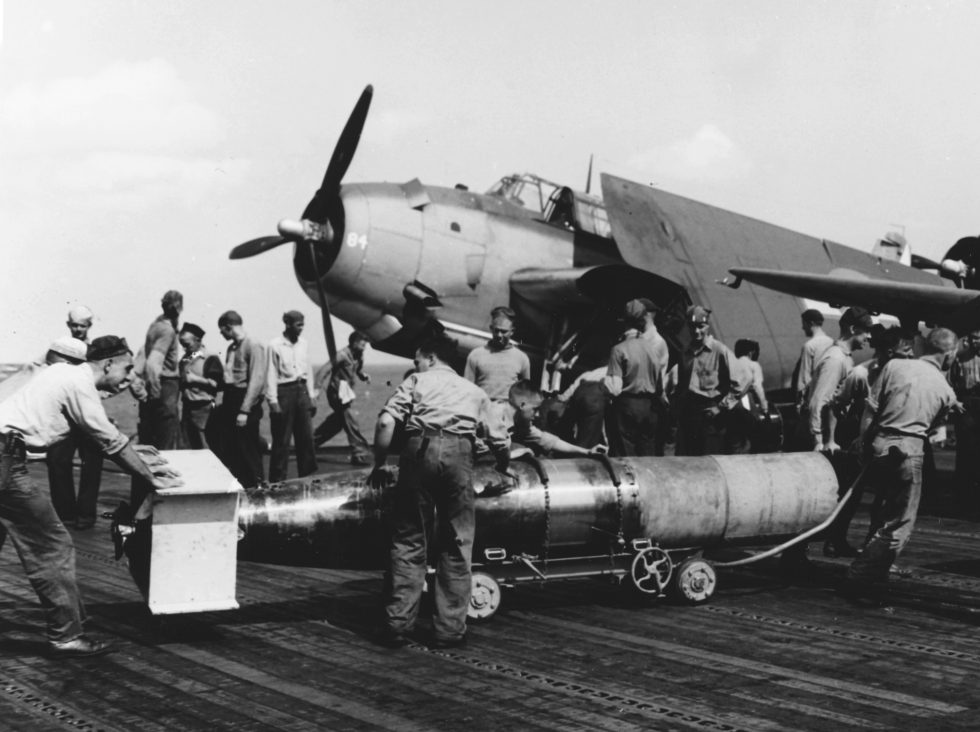
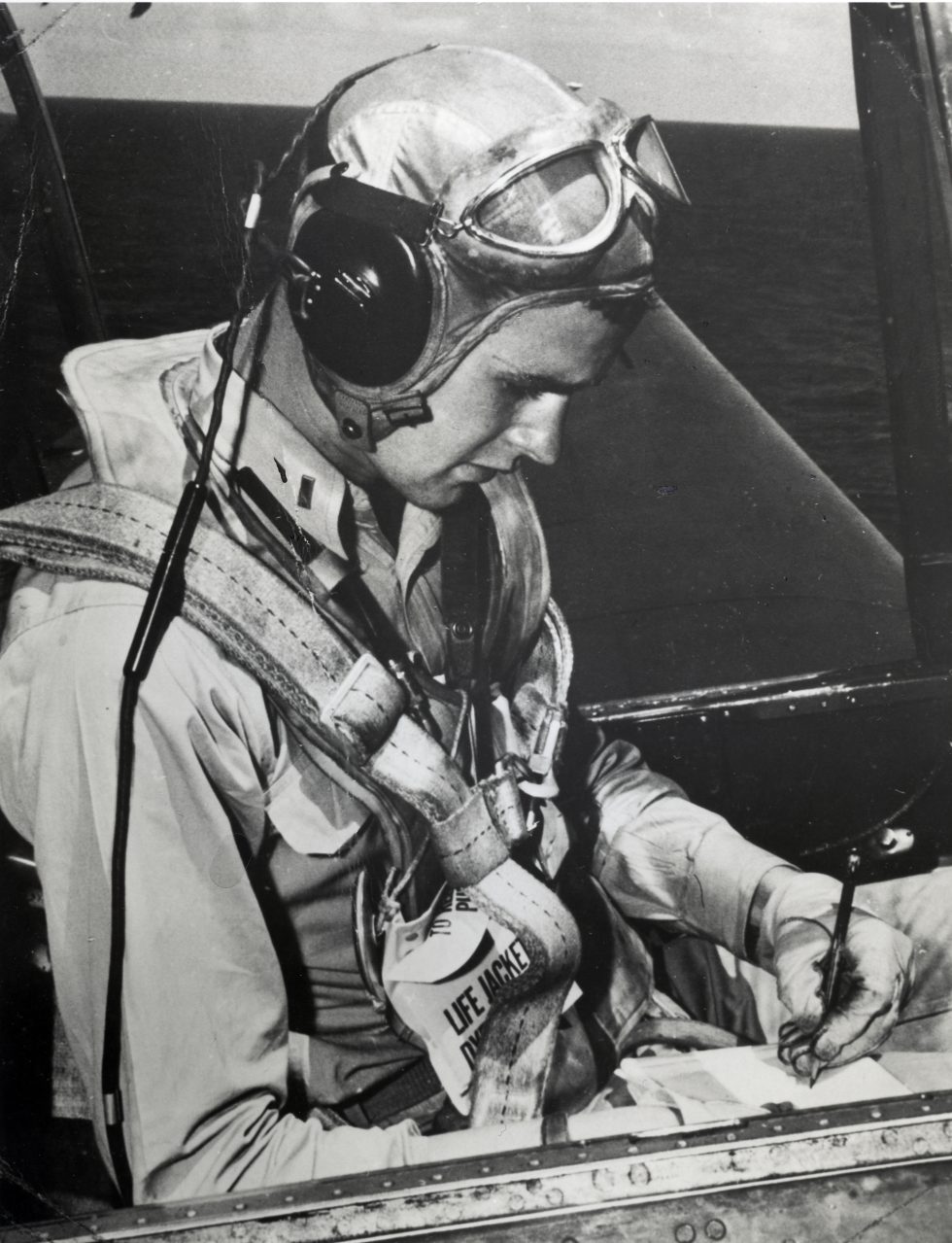
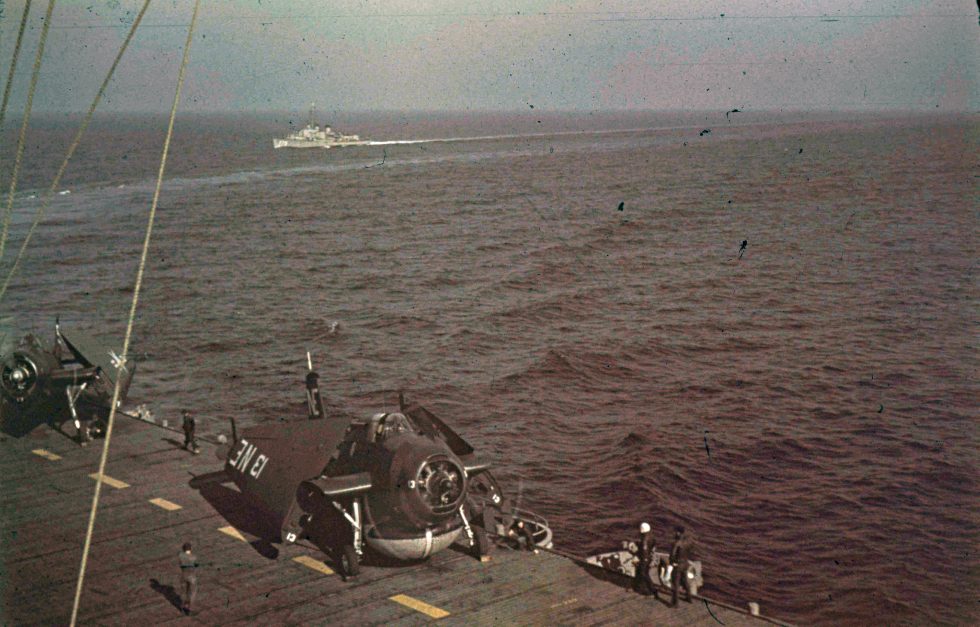
The Avenger in motion
A verified, high-authority video feature on the Grumman TBF/TBM Avenger is coming soon. In the meantime, explore the gallery above and the eyewitness stories from Midway, Leyte Gulf and the Atlantic.
Where the Avenger flew and served
The score that defines the Avenger
The Avenger’s record is not written in air-to-air kills but in ships sent to the bottom. After a catastrophic debut at Midway, it became the US Navy’s standard torpedo bomber and helped sink capital ships, submarines and merchant tonnage across two oceans — including the two largest battleships ever built.
Compare the combat record of every military aircraft. Figures as of July 2026.
Everything people ask about the Grumman Avenger
Can I fly in an Avenger?
What was the Avenger’s job?
Why was the Avenger’s debut at Midway such a disaster?
Did a US president fly the Avenger?
Did Avengers really help sink the Yamato and Musashi?
How many Avengers were built, and who built them?
Who else flew the Avenger besides the US?
Is the Avenger still flying today?
You can’t fly the Avenger.
These, you can.
Some legends only live in museums — others are fuelled and waiting. MiGFlug has put civilians in real military jet cockpits since 2004.
 Fly the L-39 AlbatrosThe world’s most-flown jet trainer — aerobatics included
 Fly the F-104 Starfighter“The missile with a man in it”
 Fly the MiG-21The Cold War’s most-produced jet
 Fly the T-33 Shooting StarAmerica’s first jet trainer
 Fly the DH VampireA piece of early jet history
 Fly the S.211Agile Italian jet trainer
 Fly the MB-326The classic Aermacchi jet
 Fly the MiG-15The Soviet legend of the Korean War
Continue the tour
Every fact, checked
- Naval History and Heritage CommandVT-8 at Midway, the Avenger’s combat debut and George H. W. Bush’s wartime service record.
- This Day in Aviation — Torpedo 8 at MidwayDetailed account of the six Midway-based Avengers and Ensign Bert Earnest’s return.
- Smithsonian National Air and Space MuseumGrumman “Tarpon” / TBF-1 Avenger history and British Fleet Air Arm service.
- NAS Fort Lauderdale MuseumAvenger design, roles and the aircraft’s wartime and postwar career.
- History of War — Grumman Avenger in American serviceVariants, production by Grumman and General Motors, and combat use.
- Military Aviation MuseumTBM-3E specifications, dimensions, powerplant and armament.
- VT-17 — Sinking of the Battleship YamatoSquadron account of the 7 April 1945 strike that helped sink Yamato.
- The National WWII MuseumContext for the Pacific carrier war, Leyte Gulf and the anti-submarine campaign.