
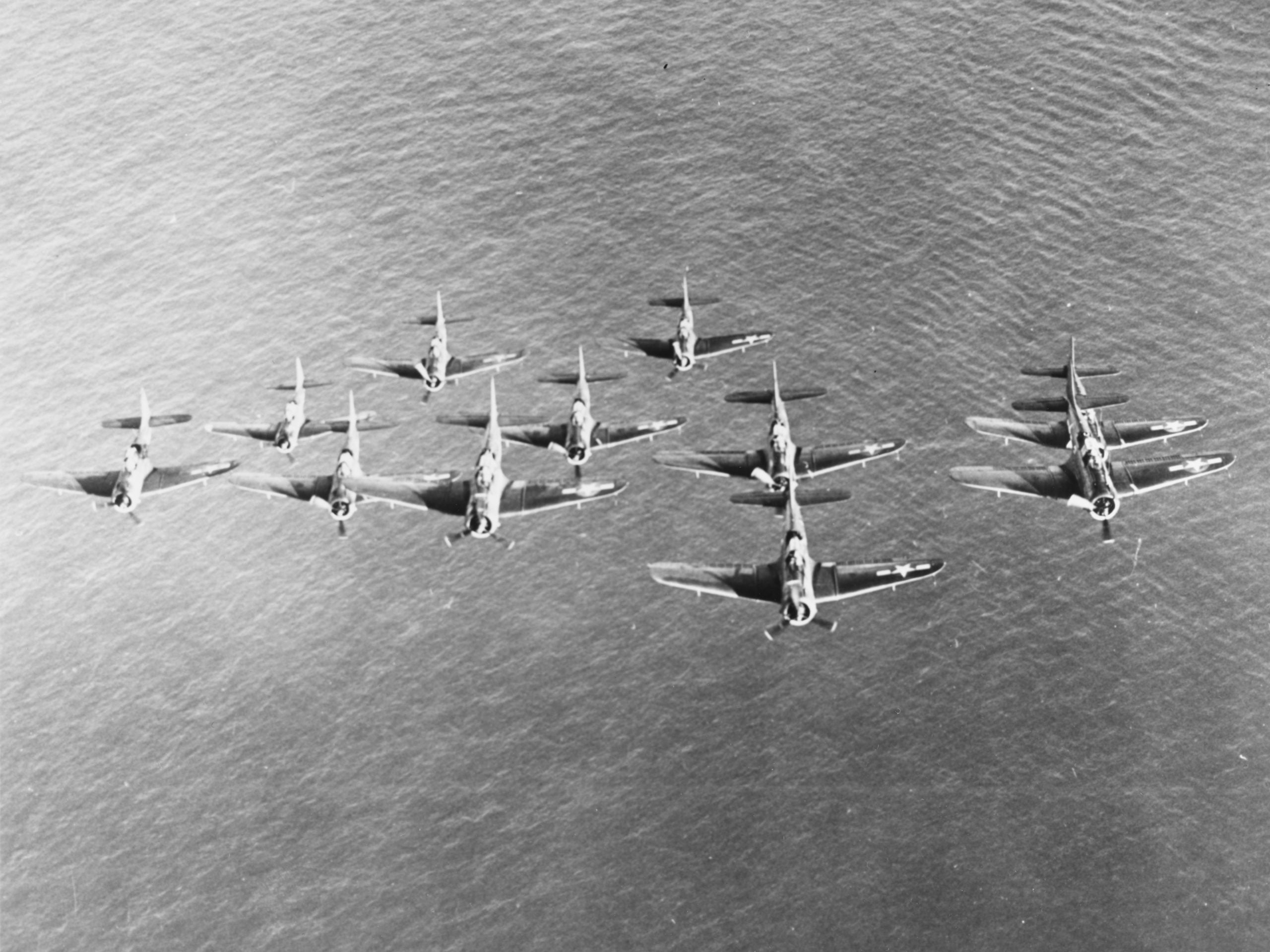
Douglas SBD Dauntless
“Slow But Deadly”
The US Navy dive bomber that broke the back of the Japanese carrier fleet — the aircraft that, in a few minutes over Midway, turned the whole Pacific war.
The dive bomber that turned the Pacific war
The Douglas SBD Dauntless did not look like a war-winner. It was slow, its wings did not fold, and by 1942 it was already considered obsolescent. Yet in a single morning over Midway it did more to decide the Second World War in the Pacific than any other aircraft — and it did it with a reputation for accuracy, toughness and a survival record no other US carrier bomber could match.
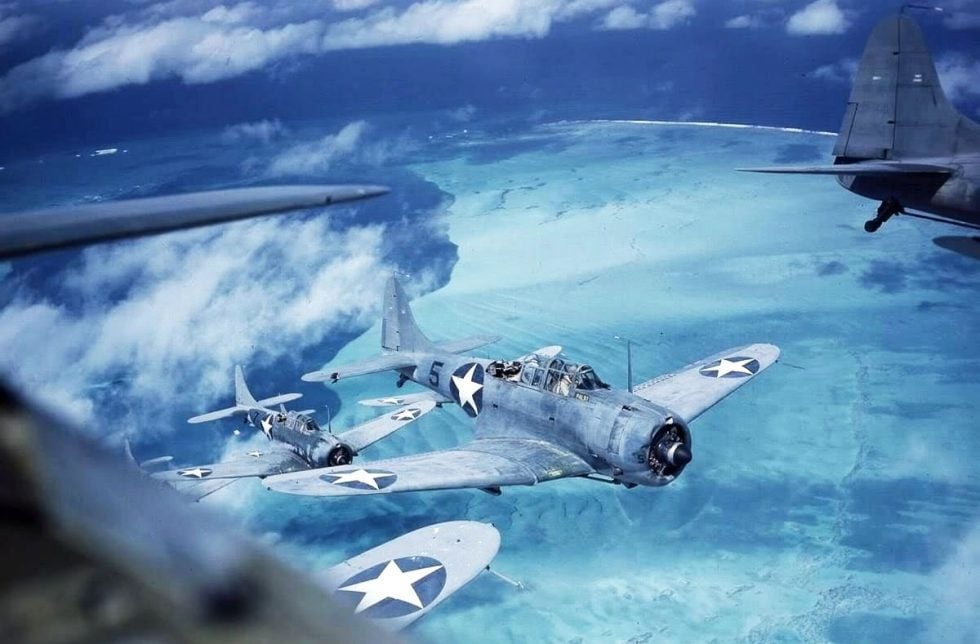
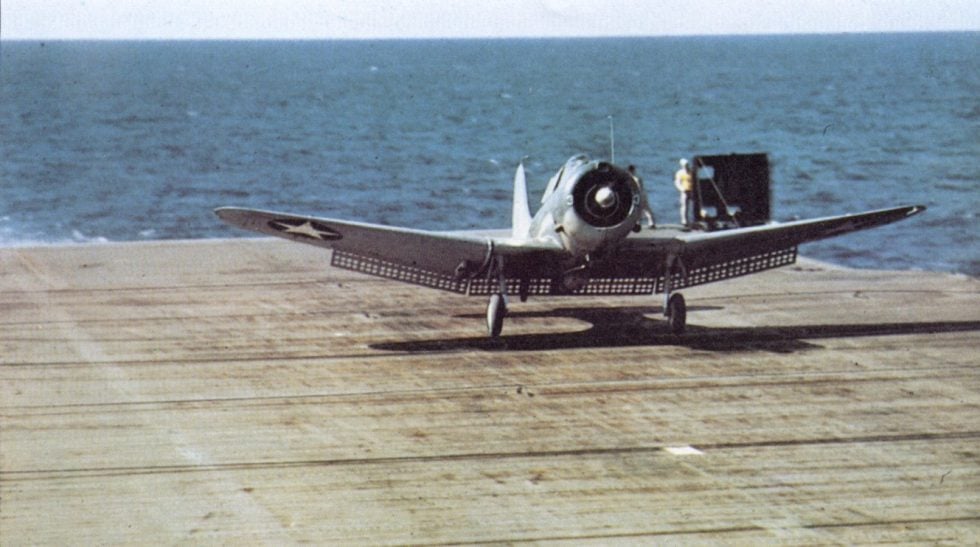
Its roots lay with Ed Heinemann and the Northrop BT-1 of the mid-1930s. When Douglas absorbed Northrop’s El Segundo division in 1937, Heinemann’s improved XBT-2 was redesignated the XSBD-1 — Scout Bomber, Douglas. It first flew in 1940 and reached the Marines and Navy in 1940–41. Its signature feature was a set of perforated “Swiss cheese” split dive flaps: drilled with holes to kill the tail buffeting that plagued early dive bombers, they let a pilot hold a steady, near-vertical dive and place a bomb with remarkable precision.
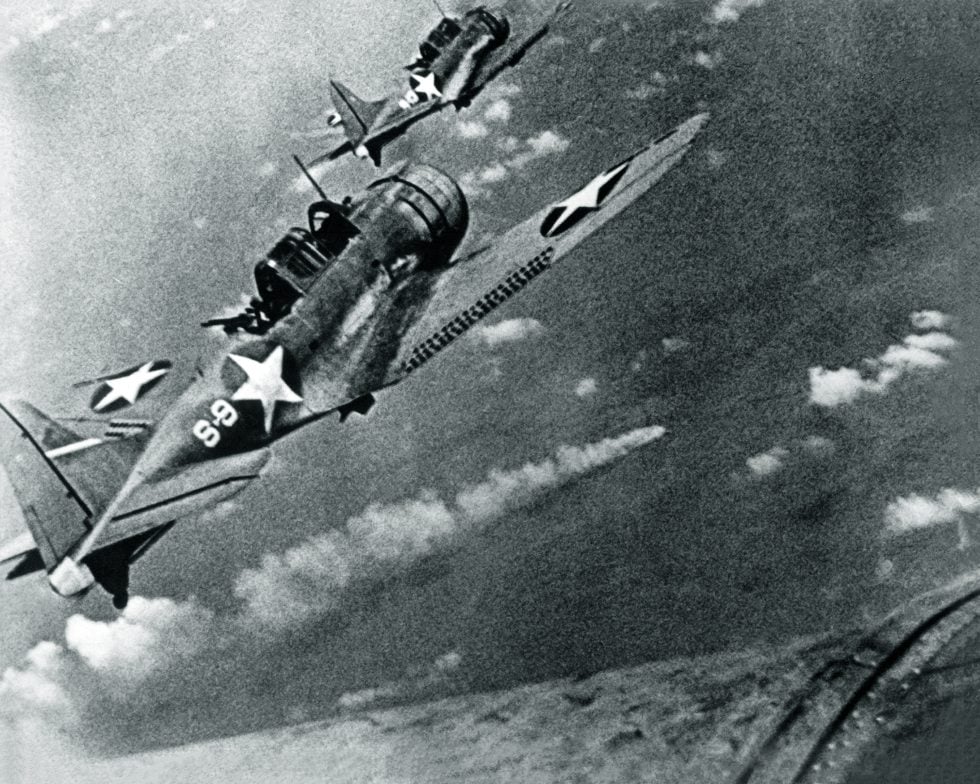
The Dauntless was blooded at Coral Sea in May 1942, helping sink the light carrier Shoho and damage Shokaku in history’s first carrier-versus-carrier battle. Then came 4 June 1942. As Japanese carriers rearmed their aircraft, SBDs from Enterprise and Yorktown — led in part by Lieutenant Commander Wade McClusky, who had gambled on following a lone destroyer to the fleet — rolled into their dives. In roughly six minutes they turned Akagi, Kaga and Soryu into blazing wrecks; that afternoon they finished Hiryu. Four fleet carriers, the heart of Japan’s striking power, were gone in a day.
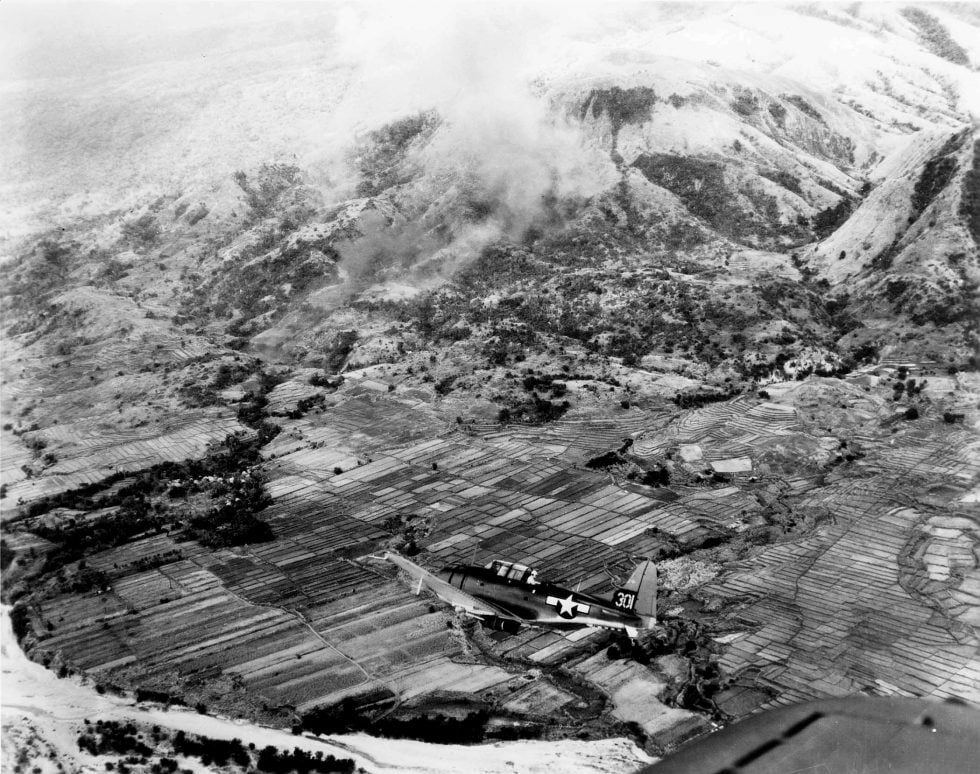
The Dauntless fought on through the grinding campaign at Guadalcanal, where the Marine and Navy SBDs of the “Cactus Air Force” hunted Japanese shipping down “the Slot,” and on to the Philippine Sea in 1944. Crews turned its designation into the affectionate backronym “Slow But Deadly.” The US Army flew a land-based version, the A-24 Banshee, and surplus aircraft later served France, Mexico, New Zealand and were evaluated by Britain. Around 5,900 were built before the faster SB2C Helldiver replaced it — though many crews thought the older, steadier Dauntless the better aircraft.
01The Douglas SBD Dauntless at Midway: how a few minutes decided the Pacific
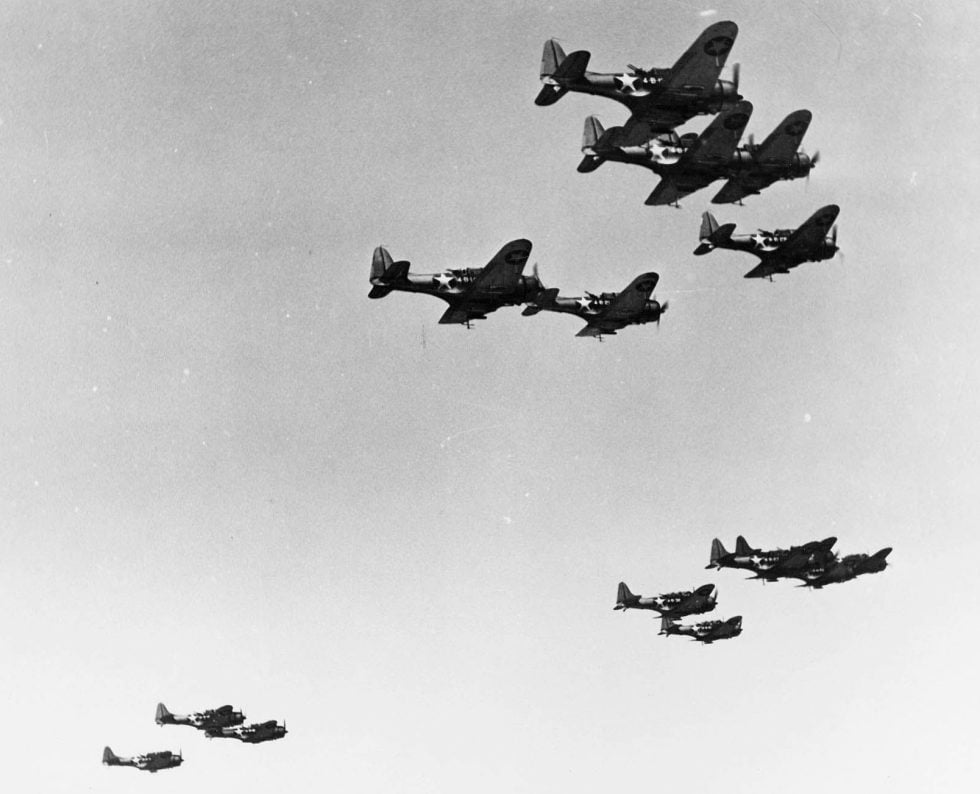
Midway is often called the most decisive naval battle of the 20th century, and the Dauntless was its instrument. Through the morning of 4 June 1942, wave after wave of American torpedo bombers attacked the Japanese carriers and were slaughtered — but in doing so they dragged the defending fighters down to sea level. When the SBD dive-bomber squadrons arrived overhead almost unopposed, they found the carriers at their most vulnerable: decks crowded with fuelled, armed aircraft being re-spotted for a strike.
The timing was part luck, part the doggedness of leaders like Wade McClusky, who pressed on past his planned search limit and followed the wake of a Japanese destroyer straight to the fleet. Within minutes Akagi, Kaga and Soryu were mortally hit; Hiryu followed hours later. Historians rightly caution against reducing so complex a battle to a single lucky interval — but it is no exaggeration that the SBD, in that window, changed the course of the war.
What makes it special
Perforated “Swiss cheese” dive flaps
The Dauntless’s trademark was its split dive flaps, upper and lower, drilled with rows of holes. Early dive bombers suffered violent tail buffeting when the flaps were deployed; the perforations broke up that turbulent wake, letting the pilot hold a stable, near-vertical dive at a controlled speed. The result was dive-bombing accuracy that made the SBD a precision ship-killer.
Rugged — and hard to kill
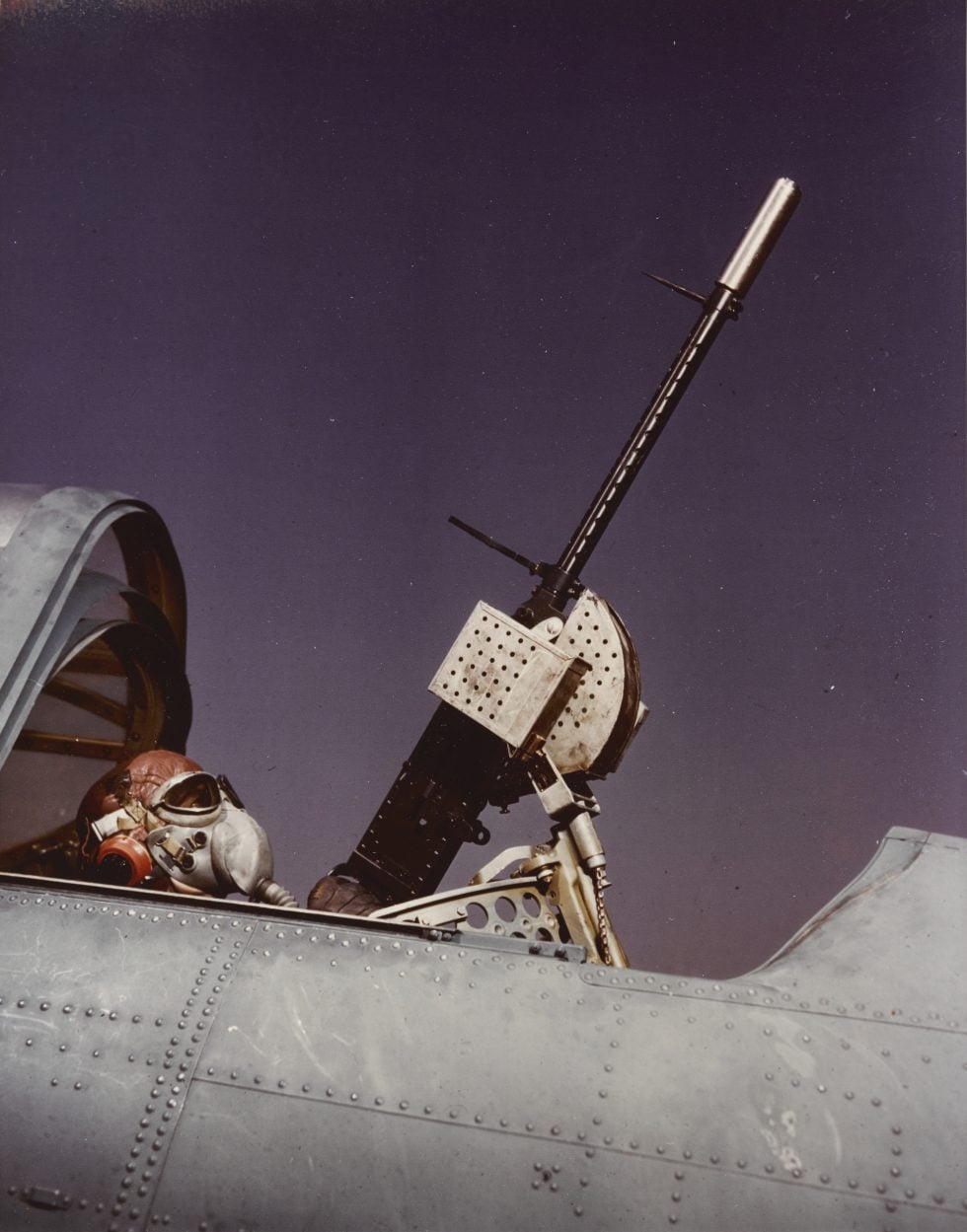
Heinemann’s team traded folding wings for a strong, simple structure. With armour, self-sealing tanks in later marks and two forward .50-cal guns plus twin flexible .30s in the rear, the Dauntless was punishing to attack. It flew with the lowest loss rate of any US carrier aircraft in the Pacific — and its gunners were even credited with shooting down enemy fighters.
Scout and bomber in one
The “S-B” in the name meant Scout Bomber. The same aircraft flew long over-water search patrols to find the enemy fleet and then delivered the strike that sank it. That dual role made the Dauntless the eyes as well as the fist of the US carrier air groups through 1942–43.
02The SBD Dauntless’s dive brakes: why the perforated flaps made it accurate
When Northrop and Douglas first tested the split-flap dive brake on the BT-1 lineage, deploying the flaps set up a violent buffet that shook the tail and spoiled the pilot’s aim. The fix was elegant: drill the flaps full of holes. The perforations let air bleed through and broke up the turbulent wake, damping the buffet while still providing the drag needed to hold the aircraft to a safe, steady dive speed. A Dauntless pilot could roll into a dive of around seventy degrees, track the target through his sight, and release low — the reason the type earned a reputation as the most accurate US dive bomber of the war.
03The SBD Dauntless’s survivability: the lowest loss rate in the US carrier fleet
For all its lack of speed, the Dauntless was remarkably hard to shoot down. Its rugged airframe absorbed damage, its crew were protected, and its rearward-firing guns gave attacking fighters a real fight. Statistically the SBD suffered the lowest attrition of any US carrier aircraft in the Pacific, and it is one of very few dive bombers ever credited with a favourable air-to-air exchange — its gunners and pilots claimed a number of Japanese aircraft. Those figures come from wartime tallies and should be read as well-supported estimates rather than exact accounts.
Full specifications
Baseline note: the figures below describe the SBD-5, the most numerous mark at 2,965 built and the aeroplane that flew the Gilberts, the Marshalls, the Philippine Sea and the Marine close-support war over Luzon. Deltas for the Northrop XBT-2 that fathered it, the SBD-1 and SBD-2, the SBD-3 of Coral Sea and Midway, the SBD-4, the SBD-6 and the land-based A-24 Banshee are given in grey. Douglas quoted performance for a clean aeroplane at a 9,359 lb gross; a squadron machine with a 1,000 lb bomb, a full gunner’s load and ASB radar aerials under the wings was slower than every number here. Most published tables reprint one performance column across marks whose engines differed by 350 hp, so where a figure belongs to a particular mark it is named.
Dimensions & weights
- Crew
- 2 — pilot, and a radioman-gunner facing aft who worked the radio, the ASB radar on later machines and the flexible guns (the photographic SBD-1P to SBD-5P sub-types kept both seats; the A-24 Banshee kept them too, and the USAAF frequently flew it with the rear seat empty, which did not help)
- Length
- 10.09 m (33 ft 1 in) — a small aeroplane by 1943 standards, and 1.1 m shorter than the SB2C Helldiver built to replace it
- Wingspan
- 12.66 m (41 ft 6 in)
- Wing folding
- none. The SBD had a fixed wing and could not be struck below in the space a folding aeroplane occupied — the single hardest count against it in a service that measured everything in deck spots, and the reason the Navy wanted a successor even while the Dauntless was winning battles
- Height
- 4.14 m (13 ft 7 in)
- Wing area
- 30.2 m² (325 sq ft)
- Aspect ratio
- 5.31, a straight-tapered wing with rounded tips and a pronounced dihedral on the outer panels — the visual signature it inherited whole from Jack Northrop’s multicellular wing structure
- Aerofoil
- NACA 2415 at the root, NACA 2407 at the tip — a thick, docile mid-1930s section chosen for lift and stall behaviour rather than speed, which is exactly the trade the aeroplane made everywhere else
- Empty weight
- 2,905 kg (6,404 lb)
- Gross weight
- 4,245 kg (9,359 lb) — against 7,537 kg (16,616 lb) for the SB2C-4 Helldiver. The Helldiver was very nearly two Dauntlesses, and every carrier pilot who flew both knew it in the first ten seconds of an approach
- Maximum take-off weight
- 4,853 kg (10,700 lb)
- Wing loading
- 141 kg/m² (28.8 lb/sq ft) at gross — against 192 kg/m² (39.4 lb/sq ft) for the SB2C-4. This one number explains why a tired pilot in a bad sea state preferred the older aeroplane
- Power loading
- 3.54 kg/hp (7.80 lb/hp) on the 1,200 hp R-1820-60; 4.25 kg/hp (9.36 lb/hp) on the 1,000 hp engines of the SBD-1 through SBD-4, which is why the early marks felt sluggish off a short deck in still air
Performance
- Maximum speed
- 410 km/h (255 mph, 222 kn) at 4,270 m (14,000 ft), clean
- Earlier and later marks
- about 402 km/h (250 mph) for the SBD-3 and SBD-4 on the 1,000 hp R-1820-52; the SBD-6 on the 1,350 hp R-1820-66 gained little, because by 1944 the airframe and not the engine was the limit
- With a 1,000 lb bomb
- roughly 370 km/h (230 mph) — and squadrons cruised the outbound leg far slower than that to conserve fuel. A Dauntless formation was a slow-moving thing and the Japanese combat air patrols found it easily; this is the honest half of the "Slow But Deadly" joke
- Cruising speed
- 298 km/h (185 mph, 161 kn)
- Dive speed behind the brakes
- held at about 400 km/h (250 mph, 217 kn) indicated in a 70° dive — the whole point of the perforated flaps. The aeroplane did not accelerate away from the pilot, the tail did not shake, and the sight picture stayed still long enough to aim
- Rate of climb
- 8.6 m/s (1,700 ft/min)
- Service ceiling
- 7,780 m (25,530 ft)
- Stalling speed
- 126 km/h (78 mph, 68 kn) with gear and flaps down — low, honest and free of vice, which made the SBD one of the easiest aeroplanes in the fleet to bring aboard
- Range
- 1,794 km (1,115 miles) with a 1,000 lb bomb
- Ferry range
- ~2,519 km (1,565 miles) clean
- Combat radius in practice
- ~320–400 km (200–250 miles) with a 1,000 lb bomb and a reserve for a deferred departure and a missed approach. At Midway on 4 June 1942 that margin was gone: the Enterprise squadrons found the Japanese carriers at the outer edge of it and lost about half their aeroplanes getting home, most to fuel exhaustion rather than to the enemy
- Attrition
- the lowest of any United States carrier aircraft of the Pacific war, and the type was credited with more aircraft shot down than it lost to enemy aircraft — extraordinary for a bomber (the attrition claim traces to Barrett Tillman and is repeated everywhere without the underlying tabulation; treat the direction as certain and the precise ratio as unverified)
Propulsion & systems
- Engine
- 1 × Wright R-1820-60 Cyclone 9, nine-cylinder single-row air-cooled radial, 1,200 hp (895 kW) for take-off — fitted to the SBD-5 and the A-24B
- Other marks
- R-1820-32 of 1,000 hp (746 kW) in the SBD-1 and SBD-2; R-1820-52 of 1,000 hp in the SBD-3 and SBD-4; R-1820-66 of 1,350 hp (1,007 kW) in the SBD-6. The XBT-2 that began it all flew behind an 800 hp R-1820-32 after its original Pratt & Whitney R-1535 was discarded
- Engine data
- 29.88 litres (1,823 cu in), bore 155.6 mm and stroke 174.6 mm (6 1/8 in × 6 7/8 in), single-stage two-speed supercharger, dry weight about 590 kg (1,300 lb). A simple, unstressed, famously durable engine — the same family that flew the DC-3 and the B-17
- Propeller
- Hamilton Standard Hydromatic three-blade constant-speed (the SBD-1 and SBD-2 used a Hamilton Standard counterweight unit; the change came with the SBD-4)
- Dive brakes
- the aeroplane’s signature. Hydraulically actuated split flaps across most of the trailing edge, the upper and lower halves opening together as an airbrake and the lower half alone serving as a landing flap. Both surfaces are drilled with rows of circular perforations — inherited from the Northrop BT-1, where solid split flaps had produced a wake that hammered the tailplane so badly the aeroplane was barely divable. Perforating them broke the coherent vortex street into fine turbulence: the drag stayed, the buffet went. It is one of the cleanest pieces of applied aerodynamics of the era, and it is why the SBD could be aimed
- Bomb displacement gear
- a swinging crutch, or trapeze, under the fuselage that carried the centreline bomb clear of the propeller arc before release — mandatory for a near-vertical dive, and a fitting the SBD shared with every serious dive bomber of its generation
- Fuel
- ~984 litres (260 US gal) internal in self-sealing tanks on the SBD-3 and later; the SBD-1 carried about 795 litres (210 US gal) and the SBD-2 raised it to 984 litres. Two 220-litre (58 US gal) drop tanks could be hung on the wing racks for ferry and long search
- Protection
- armour for both crew members, a bullet-proof windscreen and self-sealing tanks, all introduced with the SBD-3 in 1941 in the light of European reports — the SBD-1 delivered to the Marines had none of it. The airframe itself was the better protection: Northrop multicellular wing construction absorbed damage that would have folded a lighter structure, and Dauntlesses came home from Midway with holes counted in the hundreds
- Electrical system
- 12-volt from the SBD-4, up from 6-volt (a number of otherwise reliable compilations print 24-volt here; the contemporary Douglas change notes say 12)
- Radar
- ASB search radar with yagi aerials under the outer wings, fitted from the SBD-4 onward and near-universal by 1944 — the equipment that made the type’s unglamorous scouting half of the "scout bomber" designation real
- Sighting
- a 3× telescopic sight through the windscreen on the early marks, which fogged solid when a warm aeroplane dived out of cold air into humid tropical low level — a genuine and much-cursed defect. It was replaced by the Mark VIII reflector sight during SBD-5 production
- Carrier equipment
- arrester hook and catapult points; no wing fold, no bay, no folding tail. Everything about the aeroplane was conventional except the flaps, and that was the design’s strength as well as the reason it had nothing left to give by 1944
04The SBD Dauntless’s cost: what a wartime dive bomber was worth
The Dauntless was a mass-produced wartime aircraft bought in bulk by the US government, not sold on an open market, so a single authoritative flyaway price is hard to pin down. Period figures place a Dauntless in the low tens of thousands of 1940s US dollars — an order-of-magnitude figure that varied by variant, contract and year, and that should be treated as an estimate rather than a precise quote. No credible cost-per-flight-hour number exists for the type in open sources. What is certain is that, measured against the four Japanese carriers it helped sink at Midway alone, the Dauntless was among the best military investments of the war.
Armament & payload
The Dauntless carried an ordinary bomb load and put it where it was aimed
Measured as payload, the SBD was unremarkable: one bomb on a centreline crutch, two small ones on wing racks, a nominal 1,020 kg (2,250 lb) maximum that almost nobody carried and a normal combat load of a single 1,000-pounder. The Ju 87 lifted more, the SB2C lifted twice as much, and the Fairey Barracuda embarrassed it on paper. What the Dauntless had instead was the thing payload tables do not measure: behind those perforated flaps it sat steady in a 70° dive at a speed a human being could work in, and its crews hit what they aimed at.
The defensive armament was thin and stayed thin — two fixed 0.50-inch guns forward, one or two rifle-calibre 0.30-inch guns on a flexible mount aft. Against a Zero that was a gesture. And yet the type was credited with more aircraft destroyed than it lost to enemy aircraft, partly because the rear gunners were good, partly because at Coral Sea and Midway the Dauntless was pressed into service as an anti-torpedo-plane patrol over its own fleet, and mostly because a formation of SBDs flying tight and low was a genuinely awkward target. Fits varied sharply by mark and operator: the SBD-1 had a single 0.50-inch and a single 0.30-inch gun forward on some airframes, the twin flexible rear mount arrived during SBD-3 production, rocket rails were largely a late-war Marine land-based fit, and the French in Indochina flew whatever the depots could keep serviceable.
The record is worth stating arithmetically, because the legend is bigger than the numbers and the numbers are still remarkable. At Coral Sea on 7 May 1942 fifty-three Dauntlesses were part of the ninety-three-aircraft strike that put the light carrier Shōhō under in minutes — the first Japanese carrier lost in the war — and on the 8th they put three 1,000 lb bombs into Shōkaku and knocked her out of Midway. At Midway itself, on the morning of 4 June, roughly fifty SBDs from Enterprise and Yorktown arrived over Nagumo’s carriers by accident of timing and dived between 10:22 and about 10:28. Something between eight and ten bombs hit: four or five into Kaga, one decisive hit on Akagi from Richard Best’s three-aircraft section, three into Sōryū — and Max Leslie and three of his pilots dived with no bombs at all, having lost them to a faulty new electrical arming solenoid on the way out. That is a hit rate near one in five against manoeuvring warships, which by 1942 standards is astonishing and by any other standard is a reminder that most bombs missed. Twenty-six more SBDs sank Hiryū that afternoon with four hits. Three carriers in six minutes, and a fourth before dark.
Then came the unglamorous part, which mattered as much. From 20 August 1942 Marine SBDs of VMSB-232 flew off Henderson Field on Guadalcanal — twelve aeroplanes delivered by an escort carrier onto a strip of pierced steel plank — and for six months the Cactus Air Force made daylight movement down the Slot lethal for Japanese destroyers and transports. Marine Dauntlesses helped finish the battleship Hiei in November 1942 and were still flying close air support for the United States Army on Luzon in 1945, by which point the carriers had given the type up entirely. Across the war the SBD sank more Japanese shipping than any other Allied aircraft.
Gun
- Two fixed 0.50-inch Browning M2 machine guns in the upper cowling, synchronised to fire through the propeller, roughly 360 rounds a gun — standard from the SBD-3 onward
- The SBD-1 and SBD-2 are given by several standard references as carrying one 0.50-inch and one 0.30-inch cowl gun; others list two 0.50-inch from the start. The disagreement is real and probably reflects airframes that were re-armed in service
- One flexible 0.30-inch Browning M1919 in the rear cockpit on early machines, replaced during SBD-3 production by a twin 0.30-inch mount on a folding cradle that stowed under a sliding cover
- Rear ammunition was carried in flat cans the gunner changed by hand in a bouncing cockpit; running dry mid-attack was a recurring complaint and the SBD-5 increased the stowage
- The forward guns were used in earnest for strafing barges, landing craft and parked aircraft in the Solomons, where a pair of 0.50s and a shallow dive was often the whole mission
Air-to-air
- No air-to-air missile existed in the type’s war; this card belongs to the rear gunner and to a tactic nobody planned for
- At Coral Sea on 8 May 1942 twenty-three SBDs — fifteen from Lexington, eight from Yorktown — were stationed low as an anti-torpedo-plane patrol around their own carriers. They shot several Nakajima B5N Kates down and were badly cut up by the escorting Zeros in return; it was a measure of how short the fleet was of fighters
- Radioman-gunners were credited with a substantial tally of Japanese aircraft across the war, and the type finished with more aerial victories than losses to enemy aircraft — almost unheard of for a bomber, and a claim that deserves the usual scepticism applied to all wartime gunnery credits
- The SBD was never a fighter-bomber. A loaded Dauntless that tried to manoeuvre with an A6M lost, and the standing doctrine was to descend, close up into a defensive box and let the gunners work
Air-to-surface guided
- None. No guided weapon was ever carried operationally by an SBD
- The card is kept because the Dauntless is the best argument in aviation history that precision was available before guidance was: a steep stabilised dive, a steady sight picture and release at 460–600 m (1,500–2,000 ft)
- Circular error in trained hands ran to a few tens of metres against a manoeuvring ship — a figure no level bomber of the period approached, and one that no unguided weapon would beat until the war was long over
- The price of that precision was paid in the pull-out, low and slow over an alerted ship with every close-range gun aboard tracking. It is the reason dive bombing died the moment guidance made it unnecessary
Bombs
- Centreline crutch: one 454 kg (1,000 lb) general-purpose or semi-armour-piercing bomb as the normal anti-ship load; the fitting was rated to 726 kg (1,600 lb) for an armour-piercing weapon
- Two wing racks: one 45 kg (100 lb) bomb each on early marks, later cleared for 147 kg (325 lb) depth bombs, giving the quoted maximum of about 1,020 kg (2,250 lb) that squadrons essentially never flew from a deck
- The scouting load was a single 227 kg (500 lb) bomb, or none at all with drop tanks — numerically a very large share of the type’s sorties, and the half of "scout bomber" that gets forgotten
- Marine SBDs at Henderson Field flew with whatever the island held: 1,000-pounders against the Tokyo Express destroyers and transports, 100 lb fragmentation bombs against troops, and on 14–15 October 1942 anything that would leave a rack, against a convoy the airfield could not otherwise stop
- The type is credited with sinking more Japanese shipping than any other Allied aircraft, including six carriers, fourteen cruisers and shares in the battleship Hiei — achieved with the most ordinary bomb load in the fleet
Rockets
- Late marks could carry forward-firing aircraft rockets on underwing rails — 3.5-inch and 5-inch weapons as stocks reached the Pacific in 1944
- This was overwhelmingly a Marine land-based fit rather than a carrier one; by the time rockets were common, the carrier squadrons had gone over to the SB2C and the Dauntless was flying close support from island strips
- Marine SBDs supporting the Sixth Army on Luzon in 1945 used rockets and bombs interchangeably against bunkers, vehicles and gun positions, often inside 300 m of friendly troops
- The SBD was never rebuilt around rockets as the Corsair and Avenger were; its rails were an addition to a 1938 aeroplane, not a redesign
Pods & other stores
- ASB search radar with yagi aerials under the outer wing panels from the SBD-4 — the fit that let a two-man crew find a task force at night or in weather, and the reason the type flew so many search legs
- Two 220-litre (58 US gal) drop tanks on the wing racks, used for ferrying aircraft between islands and for the long outer-air-battle searches
- Camera installations in the SBD-1P, -2P, -3P, -4P and -5P photographic conversions, a small but continuous thread through the whole production run
- Smoke tanks and, in the postwar French service, ordinary bomb racks kept in service by improvisation; the Aéronavale flew SBDs in Indochina years after the depots that supported them had closed
- Target-towing and utility gear on hundreds of USAAF machines redesignated RA-24B — the fate of most Banshees, and the honest end of that part of the story
Three typical loadouts
- Carrier strike on a fleet target, Midway, 4 June 1942
- Centreline: one 1,000 lb general-purpose bomb (the Yorktown squadron carried 1,000-pounders; Enterprise’s scouting squadron flew with 500 lb bombs and a pair of 100-pounders). Wings: two 100 lb bombs where fitted. Guns: two 0.50-inch forward, twin 0.30-inch aft. Released from about 460 m (1,500 ft) at the bottom of a 70° dive.
- Cactus Air Force anti-shipping sortie, Guadalcanal, autumn 1942
- Centreline: one 1,000 lb bomb. Wings: clean, for range and climb off a coral strip in tropical heat. Fuel short, no escort guaranteed, target a destroyer or transport in the Slot at last light. This is the mission that made the Dauntless the most feared aeroplane in the Solomons.
- Long-range search, fast carrier task force, 1943–44
- Centreline: one 500 lb bomb, or nothing. Wings: two 58 US gal drop tanks. ASB radar working, gunner on the set. Eight to ten hours of empty ocean and the occasional contact report that moved a fleet — unglamorous, numerically dominant, and the job the SBD did better than the aeroplane that replaced it.
Sourcing caveat: ordnance figures come from United States Navy aircraft characteristics sheets for the SBD-3 and SBD-5 and from the standard postwar compilations. Cleared loads and carried loads diverge badly here: the 2,250 lb maximum assumed wing-rack depth bombs and a long runway, and a Dauntless launching from a carrier for a 200-mile strike carried a single 1,000-pounder and nothing else. Early-mark forward armament is genuinely disputed between references and is flagged where it appears.
Variants
Douglas built one aeroplane six times and the Army bought a seventh that failed
The Dauntless has an unusually simple variant history because the design was right early and the Navy changed only what combat forced it to change. It began as somebody else’s aeroplane: the Northrop BT-1 of 1936, a 54-aircraft dive bomber whose low-speed handling was so poor that squadrons lost machines to unexplained rolls, and which nevertheless carried the one idea that made everything after it possible — hydraulically actuated perforated split flaps. Ed Heinemann’s team at Northrop’s El Segundo plant rebuilt the last BT-1 on the line as the XBT-2, with a fully retracting undercarriage folding inward into wing wells, a new tail and eventually a Wright Cyclone in place of the Pratt & Whitney twin-row. Northrop Corporation became the El Segundo Division of Douglas in 1937, and the XBT-2 was redesignated XSBD-1 without a rivet changing. Jack Northrop’s multicellular wing and Heinemann’s flaps are the whole aeroplane; Douglas’s contribution was to build it well and leave it alone.
Everything after that is incremental: protection in 1941, more fuel, more ammunition, radar, a bigger engine. There is no SBD equivalent of the Helldiver’s eight-hundred-odd Navy-demanded changes, because there was nothing fundamental to fix. The one genuinely separate line, the USAAF’s A-24 Banshee, failed — not because of the airframe, which was identical but for the arrester hook and a pneumatic tailwheel, but because the Army sent it against defended targets without escort, without naval co-ordinated-attack doctrine and in aircraft worn out by the trip. Seven A-24s attacked Buna on 29 July 1942; one came back. The Army wrote the type off as too slow, too short-ranged and too lightly armed, which was true, and concluded that the aeroplane was the problem, which was not.
The replacement was resented, and the resentment was largely earned. The SB2C Helldiver was faster and carried twice the bombs in an enclosed bay, and it was heavier, less forgiving on an approach and, in its first year, unreliable. Carrier squadrons re-equipping in 1944 asked to keep their Dauntlesses and some got their way; the two types flew from the same task force through the year. The Navy was right to change — the SBD had no wing fold, no growth left and no defence worth the name — and the aircrew were right to complain. Both things are true, and the Dauntless is the rare aeroplane whose reputation was made not by being modern but by being trustworthy at the exact moment trust decided a war.
- Northrop BT-1 and XBT-2 / XSBD-1 (1936–38; 54 BT-1s plus one XBT-1, and one XBT-2 rebuilt from the last BT-1)
- The ancestor and the prototype. The BT-1 introduced the perforated dive flaps and a semi-retracting undercarriage and a vicious low-speed roll; the XBT-2 flew in April 1938 with fully retracting gear, a revised tail and, after trials, a Wright R-1820 in place of the Pratt & Whitney R-1535.
- SBD-1 (1940–41, 57 built)
- First production mark, delivered to Marine squadrons rather than to carriers because it had neither self-sealing tanks nor armour. About 795 litres (210 US gal) of fuel.
- SBD-2 (1940–41, 87 built)
- Fuel raised to 984 litres (260 US gal) and an autopilot fitted; still unprotected. These fought the first months of the Pacific war, and BuNo 2106 — a Pearl Harbor survivor that went on to Midway — is one of them.
- SBD-3 (1941–42, 584 built)
- The war-winner. Self-sealing tanks, armour, bullet-proof windscreen, two 0.50-inch cowl guns and, in production, the twin flexible rear mount. The mark that sank Shōhō, wrecked Shōkaku and destroyed four carriers at Midway.
- SBD-4 (1942–43, 780 built)
- 12-volt electrical system, Hamilton Standard Hydromatic propeller and provision for ASB radar — the changes that made the type a competent night and foul-weather scout as well as a bomber.
- SBD-5 and SBD-5A (1943–44; 2,965 plus 60)
- The definitive aeroplane and the baseline above: 1,200 hp R-1820-60, more ammunition, a reflector sight replacing the fogging telescope, built at Tulsa, Oklahoma. The 60 SBD-5As were airframes laid down as USAAF A-24Bs and taken over by the Navy — the reason mark-by-mark totals in most books fail to reach the accepted 5,936 unless this batch is counted once and only once.
- SBD-6 (1944, 450 built; the last delivered 21 July 1944)
- 1,350 hp R-1820-66 and non-metallic self-sealing tanks. Faster on paper and barely different in the air; production ended because the SB2C held the contracts, not because the SBD had run out of usefulness.
- SBD-1P to SBD-5P (conversions, small numbers)
- Photographic-reconnaissance conversions of each mark with a camera installation in place of some equipment. Never numerous, never separately built, and easily missed in production tables.
- A-24, A-24A and A-24B Banshee (USAAF, 1941–44; 168 + 170 + 615 = 953)
- SBD-3, -4 and -5 equivalents without the arrester hook. Crated for the Philippines in late 1941 and diverted to Australia, flown by the 91st Bombardment Squadron from Java as the "Blue Rock Clay Pigeons", mauled over New Guinea in 1942, and finally used almost unopposed by the 531st Fighter Squadron from Makin against bypassed Marshall Islands garrisons in 1943–44. Hundreds were restricted to training and target-towing as RA-24B.
- Export and post-war service (1943–53)
- Nine SBD-5s were evaluated by the Royal Navy as the Dauntless DB Mk I and politely declined; the Royal New Zealand Air Force took 68 SBD-3s, -4s and -5s and flew them operationally from Bougainville with No. 25 Squadron. The longest tail belongs to France: the Free French received a small number of SBD-3s and A-24s for ground support in 1944–45, and the Aéronavale then took SBD-5s and A-24Bs to Indochina, where Flottille 4F embarked nine of them in the escort carrier Dixmude and struck the Viet Minh stronghold at Tuyên Quang from 13 March 1947 — the first combat sorties ever flown from a French aircraft carrier. In the autumn 1947 operations the flotilla flew 200 sorties and dropped 65 tonnes of bombs by one account and 75 by another. The type left French combat status in 1949 and remained a trainer until 1953.
Survivors, precisely: roughly two dozen complete SBDs and A-24s exist worldwide, of which six are currently airworthy — SBD-4 BuNo 10518 at the Yanks Air Museum, Chino; SBD-4 BuNo 10694 at the National Museum of World War II Aviation, Colorado Springs; SBD-5 BuNo 28536 at Planes of Fame, Chino; SBD-5 BuNo 54532 with the Commemorative Air Force at Peachtree City, Georgia; A-24A 42-60817 with the Erickson Aircraft Collection, Madras, Oregon; and A-24B 42-54682 at Fagen Fighters WWII Museum, Granite Falls, Minnesota. All are original wartime airframes; there are no flying reproductions of this type. Static aircraft include SBD-6 BuNo 54605 at the National Air and Space Museum and SBD-3 BuNo 06508 at the National WWII Museum, New Orleans. A large share of the survivors came out of fresh water: USS Wolverine and USS Sable, two coal-fired Great Lakes excursion steamers converted to training carriers, qualified 17,820 pilots in some 116,000 deck landings on Lake Michigan, and an estimated 135 to 300 aircraft of all types went over the side; about 35 have been raised, the cold fresh water having preserved them far better than the sea preserves anything. The most significant is SBD-2 BuNo 2106 at the National Naval Aviation Museum, Pensacola — present at Pearl Harbor on 7 December 1941, flown from Lexington against shipping off New Guinea in March 1942, and the only surviving aeroplane of any nation that fought at the Battle of Midway, where it came home with more than two hundred bullet holes. The patches are still visible.
From Northrop drawing board to Midway and beyond
The Northrop BT-1
The design lineage begins with the Northrop BT-1 dive bomber, developed under Ed Heinemann.
Douglas takes over
Douglas absorbs Northrop’s El Segundo division; the improved XBT-2 becomes the XSBD-1.
First flight & service
The SBD enters production; SBD-1s reach the Marines and SBD-2s the Navy.
Coral Sea
SBDs help sink the light carrier Shoho and damage Shokaku in the first carrier-vs-carrier battle.
Midway
In minutes, Dauntless dive bombers fatally hit four Japanese fleet carriers — the turning point of the Pacific war.
Guadalcanal
The “Cactus Air Force” SBDs hammer Japanese shipping down “the Slot.”
A-24 Banshee
The US Army Air Forces operate their land-based version, the A-24 Banshee.
Philippine Sea
SBDs fly their last major carrier action as the SB2C Helldiver takes over front-line duties.
Production ends, service abroad
After ~5,900 built, production closes; surplus SBDs serve France, Mexico and New Zealand.
From the cockpit: twelve Dauntless stories
From the BT-1 to the Dauntless
Ed Heinemann turned a troublesome Northrop dive bomber into a war-winner.
Read the full story
Ten minutes that changed the war
As the Japanese carriers rearmed, the SBDs arrived almost unopposed.
Read the full story
Wade McClusky’s gamble
A commander who pressed past his search limit found the whole enemy fleet.
Read the full story
The Swiss-cheese flaps
Holes drilled in the dive brakes fixed a deadly buffet.
Read the full story
The first carrier duel
Before Midway, the Dauntless drew first blood at Coral Sea.
Read the full story
Down the Slot
The Cactus Air Force flew the SBD to a standstill over the Solomons.
Read the full story
“Slow But Deadly”
Crews turned the SBD designation into an affectionate boast.
Read the full story
The dive bomber that shot back
Rugged and well-armed, the SBD was dangerous to attack.
Read the full story
The Army’s Dauntless
The land-based version never matched the Navy’s success.
Read the full story
Eyes of the fleet
Before it sank ships, the SBD had to find them.
Read the full story
The Dauntless overseas
France, Mexico and New Zealand all flew the SBD.
Read the full story
Outliving its replacement
Many crews preferred the old SBD to the newer Helldiver.
Read the full story
The Dauntless in pictures
The Dauntless in motion
Video coming soon.
Where the Dauntless flew
The score that defines it
The Dauntless’s record is written in enemy ships, not aerial kills. It is credited with sinking more Japanese shipping than any other Allied aircraft in the Pacific; at Midway it fatally struck four fleet carriers in a single day; and, remarkably for a slow bomber, it flew with the lowest loss rate of any US carrier aircraft of the war. Figures are wartime tallies and are best read as well-supported estimates.
Compare the combat record of every military aircraft. Figures as of July 2026.
Everything people ask about the SBD Dauntless
Can I fly in an SBD Dauntless?
How many carriers did the Dauntless sink at Midway?
Why was it nicknamed “Slow But Deadly”?
What were the perforated dive flaps for?
What was the A-24 Banshee?
How many were built, and what replaced it?
Are any SBD Dauntlesses still flying?
You can’t fly the Dauntless.
These, you can.
Some legends only live in museums — others are fuelled and waiting. MiGFlug has put civilians in real military jet cockpits since 2004.
 Fly the L-39 AlbatrosThe world’s most-flown jet trainer — aerobatics included
 Fly the F-104 Starfighter“The missile with a man in it”
 Fly the MiG-21The Cold War’s most-produced jet
 Fly the T-33 Shooting StarAmerica’s first jet trainer
 Fly the DH VampireA piece of early jet history
 Fly the S.211Agile Italian jet trainer
 Fly the MB-326The classic Aermacchi jet
 Fly the MiG-15The Soviet legend of the Korean War
Continue the tour
Every fact, checked
- The National WWII Museum — Douglas SBD DauntlessOverview of the type, its Midway record and specifications.
- National Naval Aviation MuseumPreserved airframes and the SBD’s service history.
- USS Midway Museum — SBD DauntlessThe dive bomber’s role at the battle that gave the museum ship its name.
- Naval History Magazine (USNI) — The Ship KillersThe Dauntless as the war’s pre-eminent ship-sinking aircraft.
- History HitAnalysis of the Dauntless’s decisive part at Midway.
- The National InterestThe SBD’s development lineage and Midway strike.
- Naval EncyclopediaDetailed variants, specifications and foreign operators.
- National Museum of WWII AviationA pilot’s perspective on flying the Dauntless.