
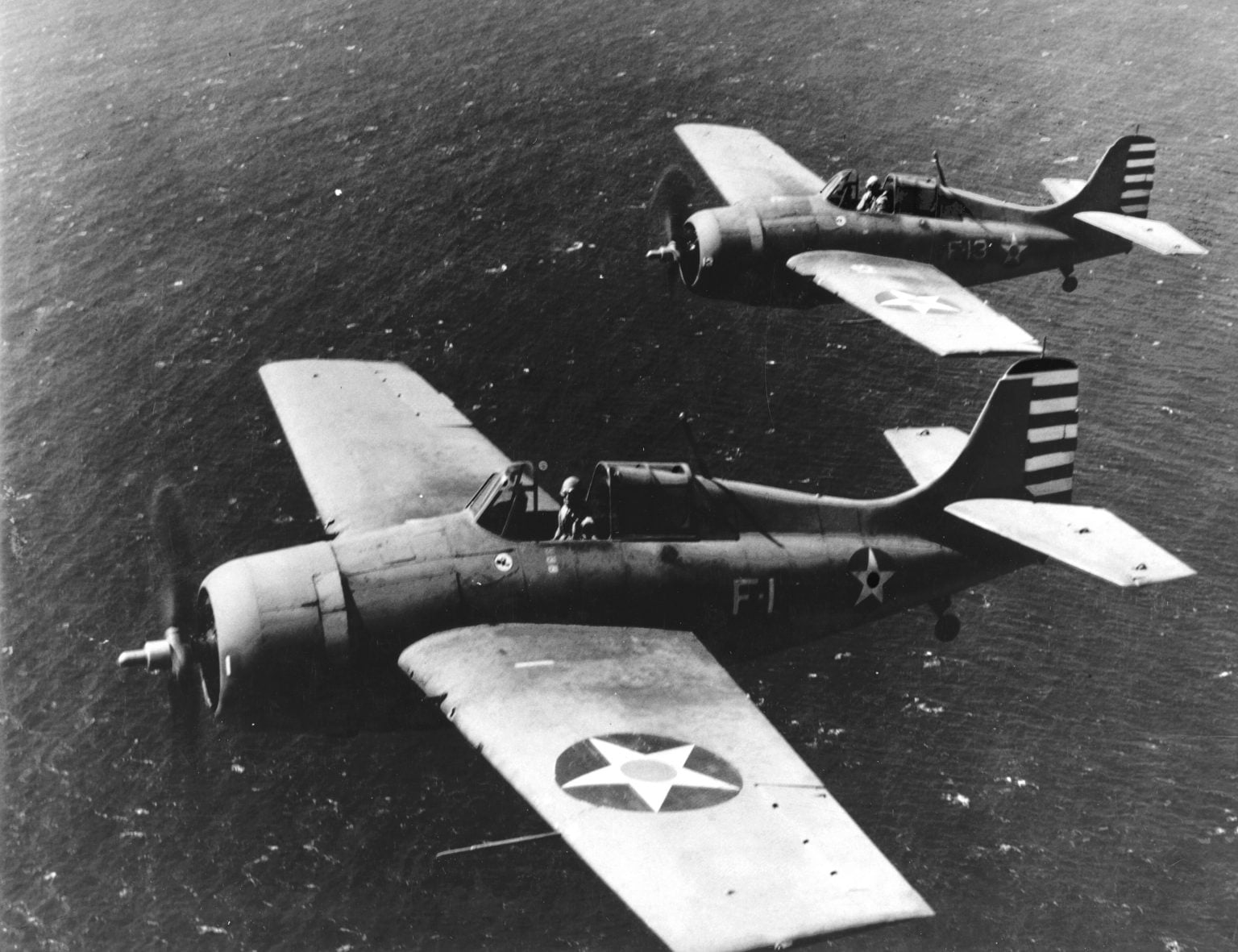
Grumman F4F
Wildcat
Stubby, rugged and hand-cranked, the US Navy’s early-war carrier fighter was outclassed on paper by the nimble A6M Zero — yet its pilots held the line through 1942 and, as the GM-built FM-2, it fought on to the last day of the war.
How the Grumman F4F Wildcat held the line
The Wildcat began life as a biplane. When Grumman’s XF4F-1 lost a 1936 US Navy fighter competition to the Brewster Buffalo, the company redesigned it into a stubby, barrel-nosed monoplane. The prototype XF4F-2 first flew on 2 September 1937, and after further development the F4F-3 entered US Navy and Marine Corps service in 1940. It was not elegant: a mid-wing tub of a fighter with a narrow, hand-cranked undercarriage that folded into the fuselage after some thirty turns of a crank. But it was tough.
When the Pacific War opened, the Wildcat was the US Navy’s front-line carrier fighter, and on paper it was outclassed. The Japanese A6M Zero climbed faster, turned tighter and out-ranged it. What the Wildcat had was armour plate, self-sealing fuel tanks, a sturdy airframe and six heavy machine guns — it could absorb punishment that tore a Zero apart, and it could hit hard. Marine pilots at Wake Island in December 1941, Navy squadrons at Coral Sea and Midway, and the ragged “Cactus Air Force” over Guadalcanal all fought the early battles on the Wildcat’s broad shoulders.
The answer to the Zero’s agility was not a better turn but better teamwork. Lieutenant Commander John “Jimmy” Thach devised a mutual-defence weave that let a pair of Wildcats cover each other’s tails, blunting the Zero’s advantage. The British flew the type too — as the Martlet in Fleet Air Arm service, it scored the first kill by an American-built fighter in British hands in December 1940. And when carrier decks grew short, General Motors built a lighter, more powerful version, the FM-2 “Wilder Wildcat,” that flew from tiny escort carriers to the end of the war. Nearly 7,885 were built, and the type is generally credited with a positive overall kill ratio — the fighter that bought the US Navy time until the Hellcat and Corsair arrived.
01The Grumman F4F Wildcat vs the A6M Zero: why toughness beat agility
On raw performance the Zero should have swept the Wildcat from the sky: it was lighter, climbed and turned better and had far greater range. But the Zero bought that agility by leaving out armour and self-sealing tanks, so a short burst from the Wildcat’s six .50-calibre Brownings could set it ablaze. The Wildcat, by contrast, was built to come home — armour behind the pilot, protected tanks and a rugged structure meant it soaked up hits that would have destroyed a lighter fighter.
US pilots learned not to dogfight the Zero on its own terms. They dived, used height and speed, fought in pairs and refused the turning duel — and above all used the Thach Weave (see below). The result, by the end of 1942, was a claimed kill ratio the US Navy put as high as roughly nine to one in some accounts; across the whole war the type is commonly credited with a positive overall ratio near 6.9 : 1. Treat the precise figures as claims — wartime tallies are always contested — but the direction is not in doubt.
What makes it special
A rugged, survivable carrier fighter
The Wildcat was built to take a beating and bring its pilot home. It carried armour plate around the cockpit, self-sealing fuel tanks and a stout airframe — luxuries the lightweight A6M Zero went without. Combined with six 0.50-calibre Browning machine guns, that durability turned it from an underdog into a fighter the Japanese found genuinely hard to shoot down. The narrow, hand-cranked landing gear was awkward, but the aircraft was famously tough.
Teamwork over agility: the Thach Weave
Unable to out-turn the Zero, US Navy pilots out-thought it. Lieutenant Commander John “Jimmy” Thach worked out a “beam-defence” manoeuvre — a scissoring weave in which two Wildcats turned toward each other so that any Zero on one’s tail flew into the other’s guns. First used in combat at Midway in June 1942, the Thach Weave let inferior aircraft fight superior ones on even terms, and the tactic outlived the Wildcat itself.
The FM-2 “Wilder Wildcat” and escort-carrier longevity
As Grumman moved to the bigger Hellcat, General Motors’ Eastern Aircraft Division kept the Wildcat in production. Its FM-2 was lighter, with a more powerful Wright R-1820 radial (~1,350 hp) and a taller tail — the “Wilder Wildcat.” Small enough to fly from tiny escort carriers, the FM-2 served to the war’s end, including the desperate defence at the Battle off Samar in October 1944.
02The Grumman F4F Wildcat’s hand-cranked landing gear: 30 turns of the crank
The Wildcat inherited a narrow-track main undercarriage that retracted into the fuselage — and in the F4F it was raised and lowered by hand. The pilot cranked a wheel roughly thirty turns after take-off, a chore that could make the aircraft porpoise as he worked, and a slip of the hand could spin the crank back painfully. The narrow track also made the Wildcat a handful on deck and prone to ground loops. It was a genuine weakness — but hydraulic gear of the day was seen as more vulnerable to battle damage, and the manual system was simple and hard to knock out.
03The Grumman F4F Wildcat’s Sto-Wing folding wings: doubling a carrier’s fighters
From the F4F-4, Leroy Grumman’s engineers gave the Wildcat the Sto-Wing — a clever skewed-axis hinge that let the wings rotate and fold flat back along the fuselage, “like a bird’s wing.” Folded Wildcats took up far less deck and hangar space, roughly doubling the number of fighters a carrier could embark. The same folding principle was carried into the later Hellcat and survives today on the Navy’s E-2 Hawkeye. The F4F-4 also added a sixth gun and armour, at some cost in agility — a trade-off many pilots grumbled about.
Full specifications
Figures below are for the F4F-4, the main carrier version of 1942; the FM-2 and F4F-3 differed in engine, weight and gun count.
Baseline note: the figures below describe the F4F-4, the folding-wing, six-gun mark that fought the 1942 carrier battles — Midway, the Eastern Solomons, Santa Cruz — and equipped the Marine squadrons on Henderson Field. Deltas for the XF4F-2 and XF4F-3 prototypes, the F4F-3 and F4F-3A, the long-range F4F-7, the Eastern Aircraft FM-1 and FM-2 and the Fleet Air Arm Martlet marks are in grey. Two things a single specification column hides are worth stating first. The FM-2 was not a footnote but the majority of the type at 4,777 built, and it is a materially different aeroplane: lighter, a single-row Wright Cyclone in place of the Twin Wasp, and half again the rate of climb. And against the usual shorthand, the Twin Wasp did not power most Wildcats — counting the FM-2, the Martlet I and the Martlet IV, roughly two-thirds of all Wildcats built left the factory behind a Wright R-1820. Published production totals themselves disagree at 7,824, 7,860 and 7,885 depending on whether prototypes, undelivered French machines and 1945 acceptances are counted, and weight and ceiling figures vary widely between compilations; where they do, the range is given rather than a false single number.
Dimensions & weights
- Crew
- 1 (the only two-seat Wildcat was a postwar civil conversion; the type was single-seat throughout its service life)
- Length
- 8.76 m (28 ft 9 in); the FM-2 is usually quoted marginally longer at 8.81 m (28 ft 11 in)
- Wingspan
- 11.58 m (38 ft 0 in) — unchanged across every mark from the XF4F-2 to the FM-2
- Wingspan, wings folded
- 4.37 m (14 ft 4 in) on the F4F-4 and later; the Martlet I, Martlet III(A) and the earliest F4F-3s had fixed wings and could not be struck below on a British carrier
- Height
- 3.61 m (11 ft 10 in). The FM-2 carried a visibly taller fin and rudder to hold the extra torque of the Cyclone, the quickest way to tell one from an F4F-4 at a distance
- Wing area
- 24.15 m² (260 sq ft) — against 22.44 m² (241.5 sq ft) on the A6M2 Zero, which weighed a third less
- Aspect ratio
- 5.56, a short, blunt, thick wing built for strength and deck handling rather than for lift-to-drag
- Aerofoil
- NACA 23015 at the root, NACA 23009 at the tip — a mid-1930s section, deep enough to bury four guns and their ammunition and to take a beating
- Undercarriage track
- narrow, because the mainwheels retracted into the sides of the fuselage rather than into the wing — a Leroy Grumman layout inherited from the FF and F3F biplanes. It made the folding wing possible and made the aeroplane a handful on a rolling deck or a coral strip; ground-loops and gear that failed to lock were routine
- Empty weight
- 2,610–2,675 kg (5,760–5,900 lb) depending on fit and on which compilation is consulted; the FM-2 came down to 2,471 kg (5,448 lb)
- Gross weight
- 3,617 kg (7,975 lb); the F4F-3 was some 250 kg lighter at 3,367 kg (7,423 lb), and the FM-2 recovered nearly all of that at 3,370 kg (7,431 lb)
- Maximum take-off weight
- 3,975 kg (8,762 lb) with two drop tanks; 3,752 kg (8,271 lb) for a fully loaded FM-2
- Wing loading
- 150 kg/m² (30.7 lb/sq ft) at gross — against 107 kg/m² (22.0 lb/sq ft) for the A6M2. This single line explains the whole of the turning fight, and no amount of pilot skill closed it
- Power loading
- 3.01 kg/hp (6.65 lb/hp) — against 2.56 kg/hp (5.65 lb/hp) for the A6M2. The FM-2, at 2.50 kg/hp (5.50 lb/hp), was the first and only Wildcat to better the Zero on this number, and it did so in 1944, when there were fewer Zeros left to meet
Performance
- Maximum speed
- 512 km/h (318 mph, 276 kn) at 5,915 m (19,400 ft)
- Maximum speed, F4F-3
- 533 km/h (331 mph, 288 kn) at 6,400 m (21,000 ft) — the folding wings and two extra guns of the F4F-4 cost roughly 20 km/h (13 mph), and pilots noticed
- Maximum speed, FM-2
- 534 km/h (332 mph, 289 kn) — the lightened airframe on the 1,350 hp Cyclone recovered everything the F4F-4 had lost, three years late
- Against the A6M2 Zero
- 533 km/h (331 mph) at 4,550 m (14,930 ft). The F4F-3 matched it; the F4F-4 that actually fought at Midway and Guadalcanal did not, and was slower at every altitude the two met
- Cruising speed
- 249 km/h (155 mph, 135 kn); the FM-2 cruised rather faster at about 264 km/h (164 mph)
- Carrier approach speed
- about 130 km/h (80 mph, 70 kn) — slow, docile and forgiving, which is precisely why the Wildcat outlived the far better Hellcat and Corsair aboard the short-decked escort carriers
- Rate of climb
- 9.9 m/s (1,950 ft/min) as Grumman claimed it; squadron pilots in combat trim reported 2.5–5.1 m/s (500–1,000 ft/min), and Thach said so bluntly in his Midway action report
- Rate of climb, F4F-3 and FM-2
- 11.7 m/s (2,300 ft/min) for the F4F-3; 18.5 m/s (3,650 ft/min) for the FM-2 — a transformation, and the reason FM-2 pilots stopped complaining
- Time to 6,100 m (20,000 ft)
- 12.5 min for a Martlet II and 14.6 min for a Martlet IV on British test — against roughly 7.5 min for an A6M2 to 6,000 m. A Wildcat scrambled at the same moment as a Zero simply arrived late
- Service ceiling
- about 10,360 m (34,000 ft). Published values scatter from 9,200 m (30,100 ft) for a British-tested Martlet IV to 12,010 m (39,400 ft) in some tables; the two-stage supercharged R-1830 gave genuinely good high-altitude performance, the single-stage F4F-3A and FM-2 markedly less
- Range, internal fuel
- 1,240 km (770 miles); 1,360 km (845 miles) for the F4F-3 and roughly 1,450 km (900 miles) for the FM-2
- Range, two drop tanks
- ~1,930 km (1,200 miles). The unarmed F4F-7 photo-reconnaissance conversion, with fixed wings and 2,650 litres (700 US gal) of fuel, reached 5,955 km (3,700 miles) — a Wildcat that could cross the Atlantic
- Dive
- the one axis the Wildcat won outright. It could be pushed over and held there; the Zero’s ailerons and elevator went heavy above roughly 480 km/h (300 mph), so a Wildcat in trouble dived away and a Zero could not follow it down and back up. Every surviving American tactic of 1942 was built on that fact
Propulsion & systems
- Engine
- one Pratt & Whitney R-1830-86 Twin Wasp, 14-cylinder two-row air-cooled radial, 1,200 hp (895 kW) for take-off
- Supercharging
- two-stage, two-speed mechanically driven supercharger — unusual on a 1940 fighter and the source of the F4F-3 and F4F-4’s creditable performance above 6,000 m
- Engine, F4F-3 and F4F-3A
- R-1830-76 (1,200 hp, two-stage) and R-1830-90 (1,200 hp, single-stage two-speed) respectively. The -3A was a stopgap forced by a shortage of two-stage superchargers; it fell away above 4,900 m (16,000 ft) and pilots disliked it
- Engine, FM-2
- one Wright R-1820-56 Cyclone 9, single-row nine-cylinder radial, 1,350 hp (1,010 kW) — 150 hp more in a lighter, simpler installation. Fewer cylinders, one bank, no two-stage blower: the FM-2 traded altitude performance for climb and take-off, which is exactly what an escort carrier needed
- Engine, Martlet I and Martlet IV
- Wright R-1820-G205A and R-1820-40B Cyclones in distinctively rounder cowlings — the French G-36A order and the 220 British F4F-4Bs. The Cyclone Wildcat was therefore in service with the Fleet Air Arm from 1940, four years before the FM-2
- Propeller
- three-blade constant-speed of about 2.97 m (9 ft 9 in); Hamilton Standard Hydromatic or Curtiss Electric depending on mark and block
- Internal fuel
- ~545 litres (144 US gal) in two self-sealing fuselage tanks under and behind the cockpit
- External fuel
- two 220-litre (58 US gal) drop tanks on the wing racks — the difference between a point-defence fighter and one that could escort a strike
- Undercarriage
- hand-cranked, retracting into the fuselage sides; roughly thirty turns of a crank by the pilot’s right hand while flying with his left — the reason new Wildcat pilots leaving the deck were recognisable by a porpoising climb-out. The Navy accepted it because the mechanism was light and simple; no other American fighter of the war asked it of its pilot
- Wing fold
- Grumman Sto-Wing from the F4F-4 — a compound-angle pivot that rotated the wing and laid it flat along the fuselage. It raised carrier fighter squadrons from 18 aeroplanes to 27 and is an ASME Historic Mechanical Engineering Landmark; the same joint later folded the wings of the Hellcat, the Avenger and the Bearcat
- Protection
- armour plate behind the pilot, armour glass and self-sealing tanks, retrofitted to F4F-3s and standard on the F4F-4 — absent from the earliest deliveries, which also lacked reflector gunsights. This is the whole of the Wildcat’s reputation for toughness, and it was bought with weight the Zero refused to carry
- Navigation
- ZB "Zed Baker" homing receiver, giving a bearing to the parent carrier at up to 48 km (30 miles). It saved many crews and failed others: ten VF-8 F4F-4s from USS Hornet went into the sea at Midway after failing to find their ship
- Deck equipment
- arrester hook and catapult spools; British machines added Blackburn-fitted RN gunsights, catapult gear and, after trials, kept the American radios as the better sets
04The Grumman F4F Wildcat’s operating costs: what a wartime fighter was worth
The Wildcat was a mass-produced wartime aircraft, not an item sold on any open market, so a precise flyaway price is elusive. Contemporary US Navy fighters of its class were procured for very roughly US$30,000–40,000 apiece in early-1940s dollars — an order-of-magnitude figure, not an audited unit cost, and one that fell as production scaled up. No meaningful modern cost-per-flight-hour figure exists for an out-of-service piston fighter; today only a handful of airworthy FM-2 and F4F warbirds fly, at collector-aircraft running costs. Treat any exact dollar figure attached to the Wildcat as an estimate.
Armament & payload
The Wildcat was a gun platform and almost nothing else, and its guns were the argument
Across the whole war United States Navy and Marine Wildcats dropped 154 tons of bombs. That is not a rounding error in the record of a fighter-bomber; it is the record of an aeroplane that was never asked to be one. What the Wildcat carried was four, and later six, Browning AN/M2 half-inch machine guns in the wings, and what it did with them decided the first year of the Pacific war. Against the A6M2 Zero’s pair of 20 mm Type 99 cannon with sixty rounds apiece — about seven seconds of fire — and two rifle-calibre guns, the Wildcat put up a battery that fired for twenty seconds or more, hit hard at any convergence, and did not run dry after one firing pass.
The arithmetic of the six-gun F4F-4 was more contested than it looks. Four guns with 450 rounds each gave the F4F-3 thirty-four seconds of fire; six guns with 240 rounds each gave the F4F-4 under twenty, for the same weight of ammunition and a heavier aeroplane. The change was made largely at British insistence, and Jimmy Thach’s verdict was "a pilot who cannot hit with four guns will miss with eight." General Motors agreed with him: the Eastern-built FM-1 and FM-2 went back to four guns with more rounds behind each. There was a second, uglier problem early on: the wing gun installations jammed under g, and on 20 February 1942, while Butch O’Hare was making the Navy’s first ace-in-a-day pass at a formation of Betty bombers off Bougainville, his wingman sat beside him with dead guns.
From 1943 the FM-1 and FM-2 grew wing racks, bombs, depth charges and rockets, and the escort-carrier Wildcat spent as much of its time strafing barges, marking targets and hunting U-boats as it did fighting aircraft. That was a genuine second career rather than a bolt-on. Fits varied sharply by mark and operator: the F4F-3 and FM series carried four guns, the F4F-4 and Martlet IV six, the Martlet I was delivered with French Darne guns in the contract and American Brownings in the event, and the F4F-7 carried no guns at all.
Gun
- Four 12.7 mm Browning AN/M2 machine guns in the wings, 450 rounds per gun — the F4F-3, F4F-3A, Martlet I, Martlet II and Martlet III; about 34 seconds of fire
- Six 12.7 mm Browning AN/M2, 240 rounds per gun — the F4F-4, Martlet IV and Wildcat V equivalents; under 20 seconds of fire for no increase in ammunition weight
- Four 12.7 mm Browning AN/M2 with roughly 430 rounds per gun on the FM-1 and FM-2, General Motors quietly reversing the Navy’s decision and giving the pilot back his firing time
- Early wing installations jammed in hard manoeuvre — a fault shared with most American wing-gun fighters of 1941–42 and cured by squadron armourers rather than by the factory
- No cannon was ever fitted to an operational Wildcat, and Fleet Air Arm pilots, contrary to Air Ministry doctrine, were entirely happy about it
Air-to-air
- No guided air-to-air weapon existed in Allied service in this aeroplane’s war; the Wildcat’s air-to-air armament is the gun card above, and its air-to-air weapon was formation discipline
- The Thach Weave — devised by Lieutenant Commander John Thach in mid-1941 from intelligence reports before he had ever seen a Zero, named by Jimmy Flatley, first flown in combat at Midway on 4 June 1942 — had two Wildcats scissor towards each other so that a fighter attacking one flew into the guns of the other
- The two-plane section, rather than the three-plane vic, was the second half of it: a leader and a wingman who never separated, so no Wildcat was ever alone with a Zero on its tail
- Navy and Marine F4Fs and FMs flew 15,553 combat sorties, 14,027 of them from carrier decks, and claimed 1,327 aircraft destroyed for 178 lost in air combat — a claimed ratio of 6.9 to 1, and roughly 5.9 to 1 in 1942 alone
- Claim totals are claims: Japanese loss records do not support them in detail, and O’Hare’s five Bettys are better read as three destroyed and two damaged. The direction of the result is not in doubt; the multiple is
Air-to-surface guided
- None, on any Wildcat, in any air force, at any point. The card is kept because its emptiness is the point: this was a pure gun fighter that acquired a strike role late and unglamorously
- The nearest thing to precision the type ever had was a pilot in a shallow dive with six half-inch guns, which at Samar on 25 October 1944 meant FM-2s from the Taffy escort carrier groups strafing the bridge of the battleship Yamato with machine guns because they had nothing else left to throw
- The United States Navy’s wartime guided anti-ship weapon, the ASM-N-2 Bat, went to the PB4Y-2 Privateer; nothing of the kind was ever cleared on a single-engined carrier fighter of this generation
- The Fleet Air Arm’s Wildcat VIs over Norway in 1945 flew as escort and flak-suppression for rocket-armed Avengers and Fireflies rather than carrying the anti-shipping weapons themselves
Bombs
- Two 45 kg (100 lb) bombs on underwing racks — the F4F-3 and F4F-4’s entire offensive load against surface targets, and almost never carried
- Two 113 kg (250 lb) bombs on the FM-1 and FM-2, the first genuinely useful bomb load the type had
- Depth charges on escort-carrier FM-1s and FM-2s hunting U-boats in the Atlantic, usually working in a hunter-killer pair with a TBM Avenger that carried the sonobuoys and the homing torpedo
- 154 tons of bombs dropped by USN and USMC Wildcats in the entire war — for comparison, a single Essex-class air group could exceed that in a fortnight of 1945 operations
- Fleet Air Arm Wildcat Vs and VIs flew armed reconnaissance and anti-shipping escort in Norwegian waters with bombs and rockets to the last weeks of the European war
Rockets
- Six 5-inch HVAR rockets on wing rails, standard on the FM-2 from 1944 and the single most useful thing ever hung on a Wildcat
- Earlier 3.5-inch and 5-inch forward-firing aircraft rockets appeared on FM-1 and early FM-2 airframes as stocks reached the escort carriers
- Rocket and strafing runs, not bombing, were the FM-2’s normal ground-attack idiom in the Philippines, at Iwo Jima and off Okinawa — quicker, flatter and safer than a dive from an aeroplane with no dive brakes
- No Grumman-built F4F ever carried rockets operationally; this is entirely an Eastern Aircraft chapter
Pods & other stores
- Two 220-litre (58 US gal) drop tanks — the only store most F4F-4s ever carried, and the one that made carrier escort work possible
- Fairchild F-56 cameras in place of the reserve fuel tanks on 18 F4F-3P tactical reconnaissance conversions of June 1942, which kept their guns and flew air defence from Espiritu Santo
- 21 F4F-7s built as unarmed strategic reconnaissance machines: fixed wings, no guns, no armour, 2,650 litres (700 US gal) of fuel and cameras in the belly
- One F4F-3S "Wildcatfish", BuNo 4038, on Edo twin floats, first flown 28 February 1943 and cut to 388 km/h (241 mph) by the drag — a straight answer to the Japanese A6M2-N, cancelled because the Seabees built airstrips faster than Grumman could build floatplanes
- Smoke tanks and message containers on escort-carrier machines supporting amphibious landings, the least celebrated and among the most useful things the type did
Three typical loadouts
- Combat air patrol, USS Yorktown, 4 June 1942
- F4F-4, clean: six 12.7 mm guns with 240 rounds each, no external stores, full internal fuel. Thach’s division flew the first Thach Weave of the war in this configuration while escorting Torpedo Three, and came home having proved the tactic against Zeros that were faster, climbed better and turned inside them at will.
- Cactus Air Force scramble, Henderson Field, October 1942
- F4F-4, six guns, no stores, taking off on a coastwatcher’s warning and climbing hard for twenty minutes to get above the incoming Betty formation from Rabaul. High-altitude ambush — dive, fire, zoom, repeat — not a turning fight, because a turning fight was a way to die.
- Escort-carrier strike, Philippines and Okinawa, 1944–45
- FM-2, four 12.7 mm guns with about 430 rounds each plus six 5-inch HVAR rockets, or two 113 kg (250 lb) bombs, from a deck 150 m shorter than a fleet carrier’s. Ground support, barge-busting, flak suppression, and combat air patrol against kamikazes when the Hellcats were elsewhere.
Sourcing caveat: sortie, claim and loss totals come from the US Navy’s own 1946 statistical study (OPNAV-P-23V No. A129) and are claims made at the time, not audited results; Japanese records rarely corroborate them at squadron level. Ammunition loads, rocket fits and bomb ratings varied between production blocks and between the American and British services, and squadron practice varied again from what the manuals allowed.
Variants
The Wildcat that mattered most was built by General Motors and carried a Wright engine
The type began as a loser twice over. The XF4F-1 of 1935 was a biplane, ordered as insurance in case the Brewster F2A monoplane failed; Grumman looked at its own drawings, concluded the aeroplane would be obsolete before it flew, and never built it. The monoplane that replaced it on the same contract, the XF4F-2, first flew on 2 September 1937 and then lost the fighter competition to the Buffalo outright — marginally faster, less manoeuvrable, and judged the inferior machine. Grumman rebuilt that single prototype as the XF4F-3 with a new wing, a new tail and a two-stage supercharged Twin Wasp, and this time the Navy bought it. The Buffalo, chosen first, was a catastrophe at Midway; the Wildcat, chosen second, carried the United States Navy through the year it could not afford to lose.
Production then went somewhere nobody planned. When Grumman’s Bethpage lines were needed for the F6F Hellcat in 1942, the whole Wildcat programme was handed to General Motors’ newly created Eastern Aircraft Division, working out of converted car plants in New Jersey. Eastern built more than three-quarters of all Wildcats, and its FM-2 — lighter, Cyclone-engined, taller-tailed, four-gunned — was both the most numerous mark and the best one. The type’s British career ran in parallel and slightly ahead: aircraft ordered by France and Greece, diverted to the Fleet Air Arm as the Martlet, in service months before the US Navy adopted the name Wildcat on 1 October 1941.
- XF4F-1 (1935–36 / none built)
- Grumman G-16, a biplane ordered as a hedge against the Brewster monoplane. Abandoned on the drawing board once Grumman accepted it would be inferior — the rare case of a manufacturer talking itself out of a contract it already had.
- XF4F-2, rebuilt as XF4F-3 (1937–39 / one airframe, plus XF4F-5 and XF4F-6 testbeds)
- G-18, the monoplane redesign, BuNo 0383, first flight 2 September 1937 on a 1,050 hp R-1830-66: marginally faster than the F2A Buffalo, less manoeuvrable, and beaten by it. The same airframe was then rebuilt as the XF4F-3 with larger square-tipped wings, a taller redesigned tail and a two-stage supercharged R-1830-76, flying again on 12 February 1939 and written off in a fatal accident on 16 December 1940. Two XF4F-5s tested the Wright Cyclone and one XF4F-6 the single-stage R-1830-90. The hand-cranked fuselage undercarriage carried over from the F3F biplane and the type never lost it.
- F4F-3 and F4F-3A (1940–42 / 285 and 95)
- First production marks: four guns, fixed wings, two-stage supercharger. The F4F-3A substituted a single-stage two-speed R-1830-90 because superchargers were short; it lost badly above 4,900 m and was unpopular. These fought Wake Island, Coral Sea and, in Marine hands, Midway.
- F4F-3P and F4F-7 (1942 / 18 conversions and 21 built)
- Reconnaissance. The F4F-3P swapped reserve fuel for Fairchild F-56 cameras and kept its guns; the F4F-7 was a purpose-built unarmed long-range machine with fixed wings and 2,650 litres of fuel, good for 5,955 km. A hundred were ordered and 79 cancelled.
- F4F-4 and F4F-4B (1941–43 / 1,068 and 220)
- The definitive Grumman mark: Sto-Wing folding wings, six guns, armour and self-sealing tanks as standard. Heavier and slower than the F4F-3 and disliked for it, but it was what flew from the fleet carriers at Midway, the Eastern Solomons and Santa Cruz. The F4F-4B was the Cyclone-engined British version.
- F4F-3S "Wildcatfish" (1943 / 1)
- BuNo 4038 on Edo twin floats, with auxiliary tail fins and later a ventral fin to restore stability. Answered the Japanese A6M2-N; overtaken by the speed with which Seabees built real runways. A production order for 100 was cancelled.
- Martlet I, II and III (1940–41 / 91, 100 and 40)
- Cyclone-engined G-36As built for France and taken over by the Fleet Air Arm after the fall of France, entering service on 8 September 1940; Twin Wasp G-36Bs ordered directly by Britain as the Martlet II, with folding wings from August 1941; ten fixed-wing G-36Bs as Martlet III(A) and 30 ex-Greek F4F-3As as Martlet III(B), the latter delivered to Gibraltar after Greece fell.
- Martlet IV (1942 / 220)
- F4F-4Bs with the Wright R-1820-40B in a rounder, more compact cowling. British testing at Boscombe Down measured 480 km/h (298 mph) at 4,450 m and 14.6 minutes to 6,100 m — slower and slower-climbing than the Twin Wasp machines, and a fair measure of what the Fleet Air Arm was actually working with.
- FM-1 / Wildcat V (1942–43 / 1,060)
- Eastern Aircraft’s F4F-4 with the gun battery cut back to four and the ammunition raised, plus racks for two 250 lb bombs or six rockets. First flight 31 August 1942; 311 to the Royal Navy, renamed Wildcat V in January 1944 when the Admiralty dropped its own names for American ones.
- XF4F-8 and FM-2 / Wildcat VI (1942–45 / 2 and 4,777)
- The "Wilder Wildcat": two prototypes, then the most-built mark of all. A 1,350 hp Wright R-1820-56 Cyclone, a lightened airframe, a taller fin and rudder to hold the torque, four guns, rockets and bombs. Climb went from under 10 m/s to 18.5 m/s. Purpose-shaped for escort carriers, and it spent 1944 and 1945 doing work the Hellcat could not do from a 150-metre deck.
Survivors, counted precisely. The standard published survivor list runs to about 44 airframes, all of them original wartime aircraft — no Wildcat reproduction is known to have been built. Roughly 18 are airworthy: two in Britain, both FM-2s at Duxford (86690, restored to flight in 2022 by the Aircraft Restoration Company and damaged in a crash at Heveningham Hall on 6 July 2023, and 86711 with The Fighter Collection), and 16 in the United States. Of those 16, exactly one is a Grumman-built F4F-3 — BuNo 12260, of Lewis Air Legends, San Antonio — and the other 15 are all FM-2s. Every flying Wildcat in the world bar one is therefore a General Motors machine. Around 24 more are on static display, including the sole surviving Martlet, Martlet I AL246 at the Fleet Air Arm Museum, Yeovilton; FM-1 15392 at the National Air and Space Museum; six F4F-3s and two F4F-3As, four of them at or on loan from the National Naval Aviation Museum at Pensacola; and an unrestored F4F-4, BuNo 12068, still standing in the open at the Vilu War Museum on Guadalcanal where the type earned its reputation. Two are under restoration: FM-1 JV482 with the Ulster Aviation Society at Lisburn and FM-2 86773 privately in Pennsylvania. At least ten of these survivors came out of Lake Michigan. Between 1942 and 1945 the paddle-steamer training carriers USS Wolverine and USS Sable qualified some 17,000 pilots off Chicago and left a scatter of aircraft on the lake bed; A and T Recovery has raised close to forty of them since the 1980s, among them F4F-3s 4039, 12290, 12297 and 12320, F4F-4 11828, FM-1 14994 and FM-2s 16278, 55052, 57039 and 74161. BuNo 12320 rolled off Wolverine in 1943, came up virtually intact, and was restored in 2001 in the markings of Butch O’Hare’s aircraft; it stands today in Terminal 2 of the Chicago airport named after him. FM-2 57039 went over the side of Sable on 28 December 1944, was towed 45 miles along the lake bed to Waukegan, lifted out on 7 December 2012, restored by the Air Zoo at Kalamazoo between 2013 and 2024, and is now at the American Heritage Museum in Stow, Massachusetts. Cold fresh water is the reason the earliest marks survive at all: no F4F-3 came home from the Pacific.
From losing biplane to war-winning workhorse
Beaten, then reborn
Grumman’s biplane XF4F-1 loses a US Navy contest to the Brewster Buffalo; the company redesigns it as a stubby monoplane.
First flight
The prototype XF4F-2 flies on 2 September, beginning the line that becomes the F4F Wildcat.
Into service
The F4F-3 enters US Navy and Marine Corps squadrons; Britain orders the type, which it names the Martlet.
First British kill
Two Martlets of 804 Naval Air Squadron down a Junkers Ju 88 over Scapa Flow — the first victory by an American-built fighter in British service.
The Wake Island stand
Marine Wildcats of VMF-211 fight a doomed defence of Wake, sinking the Japanese destroyer Kisaragi before the island falls.
O’Hare’s Medal of Honor
Lt Edward “Butch” O’Hare, flying from USS Lexington, breaks up a bomber attack and becomes the Navy’s first WWII ace and Medal of Honor airman.
Midway and the Thach Weave
At Coral Sea and Midway the Wildcat carries the fight; Jimmy Thach debuts his mutual-support weave against the Zero.
The Cactus Air Force
Marine and Navy Wildcats fly from Guadalcanal’s Henderson Field, holding the island through months of attrition.
The Wilder Wildcat
General Motors puts the lighter, more powerful FM-2 into production for the growing fleet of small escort carriers.
Battle off Samar
FM-2s from escort carriers help fend off a far larger Japanese surface fleet in one of the war’s great last stands.
End of the line
Production ends with roughly 7,885 built; the Wildcat serves to the last day of the war and passes into history.
From the flight deck: twelve Wildcat stories
The biplane that lost
Grumman’s XF4F-1 lost a 1936 contest — so it was reborn as a monoplane.
Read the full story
The last stand of VMF-211
A dozen Marine Wildcats fought a hopeless defence of Wake — and sank a destroyer.
Read the full story
Five bombers in minutes
On 20 February 1942 Butch O’Hare broke up a bomber formation almost single-handed.
Read the full story
First blood for the Martlet
British Martlets scored the first kill by an American-built fighter in UK service.
Read the full story
The Thach Weave
Jimmy Thach invented a weave that let two Wildcats guard each other from the Zero.
Read the full story
Proving the weave
At Midway, Thach used his own tactic against swarming Zeros — and it worked.
Read the full story
The Cactus Air Force
From a muddy island strip, Wildcats held Guadalcanal through months of attrition.
Read the full story
Built to come home
Armour and self-sealing tanks made the Wildcat brutally hard to kill.
Read the full story
Thirty turns of the crank
The F4F’s landing gear was raised by hand — a workout after every take-off.
Read the full story
Joe Foss, ace of aces
A Marine scored all 26 of his kills in the Wildcat — matching WWI’s top American ace.
Read the full story
The Wilder Wildcat at Samar
Lightened FM-2s from escort carriers charged a Japanese battle fleet off Samar.
Read the full story
Martlet becomes Wildcat
In 1944 the Royal Navy dropped “Martlet” and adopted the American name.
Read the full story
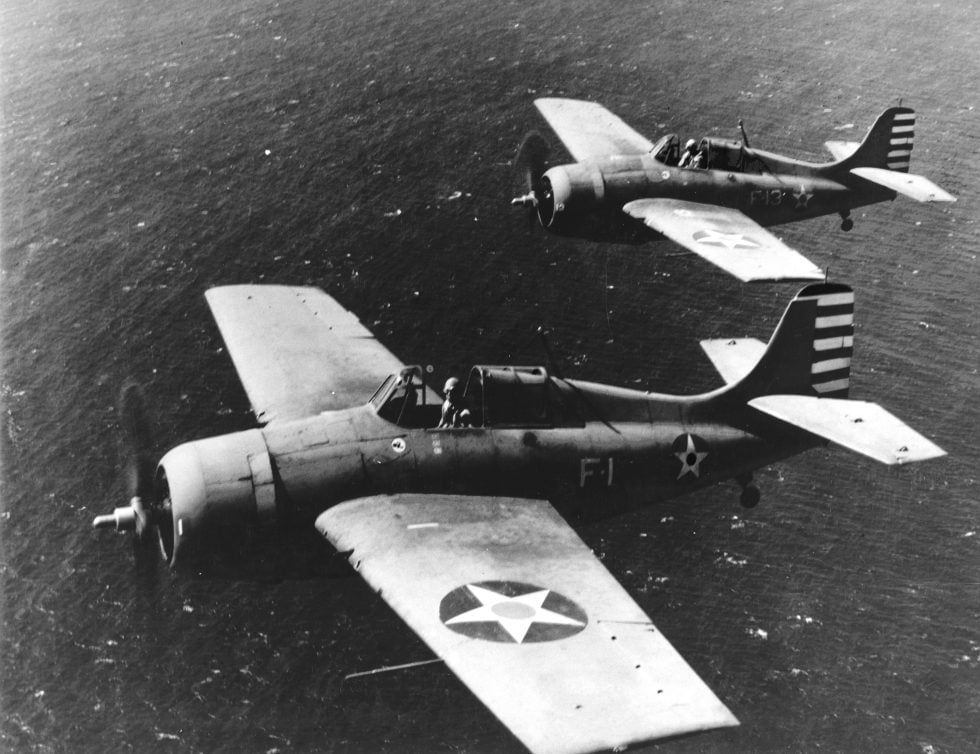
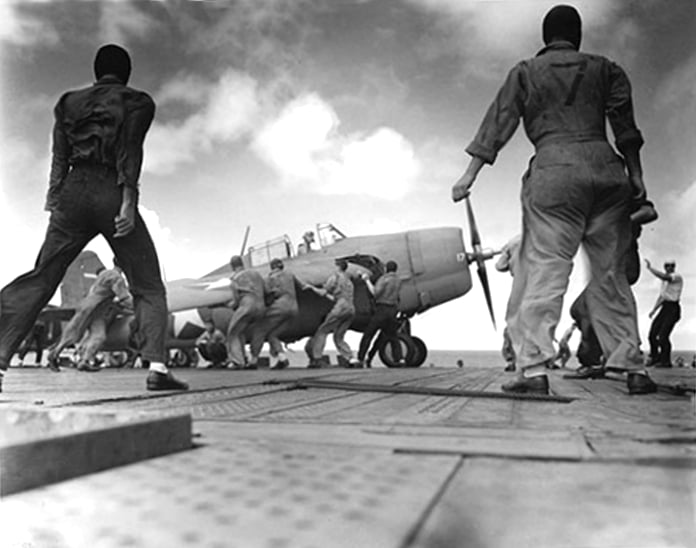
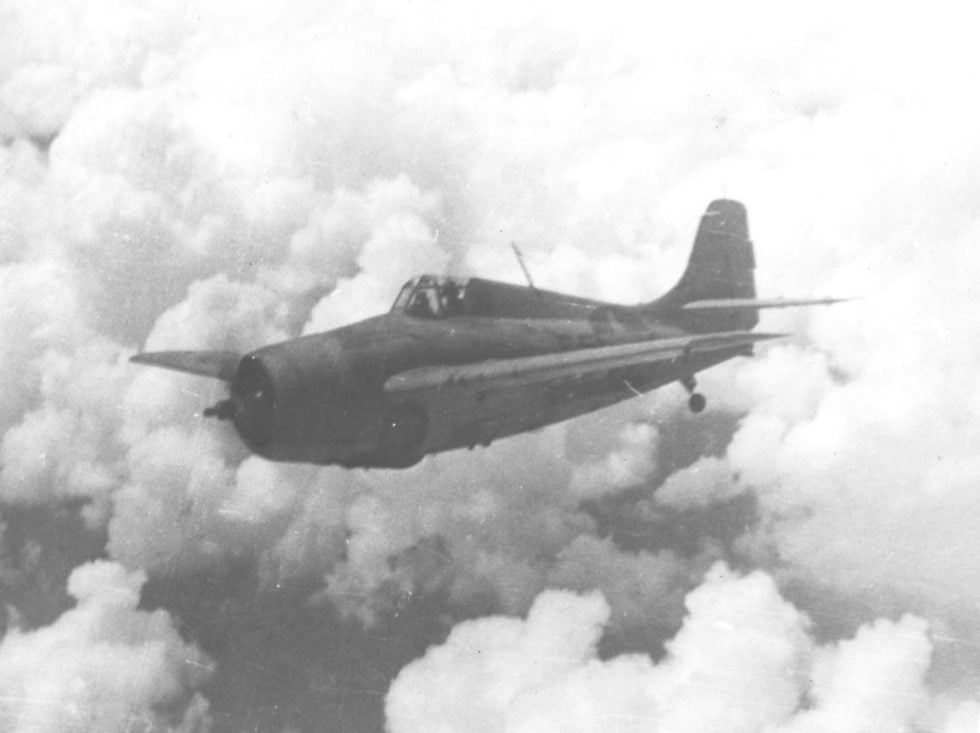
The Wildcat in pictures
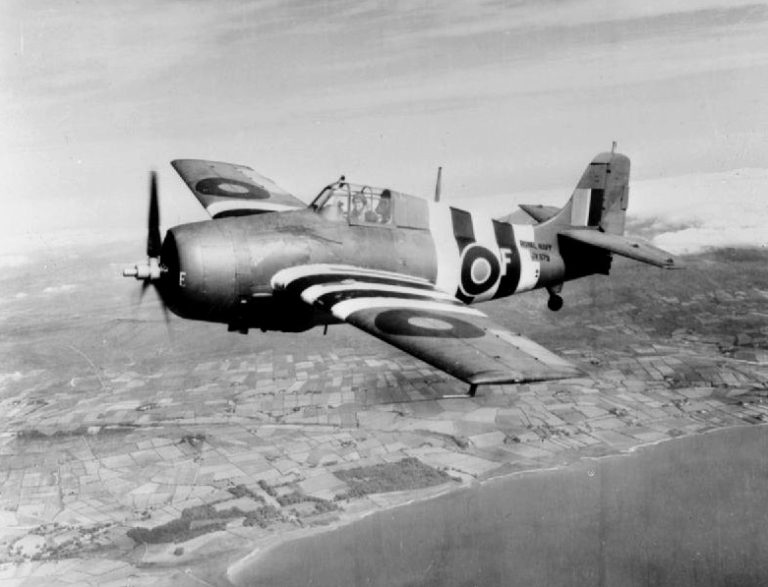
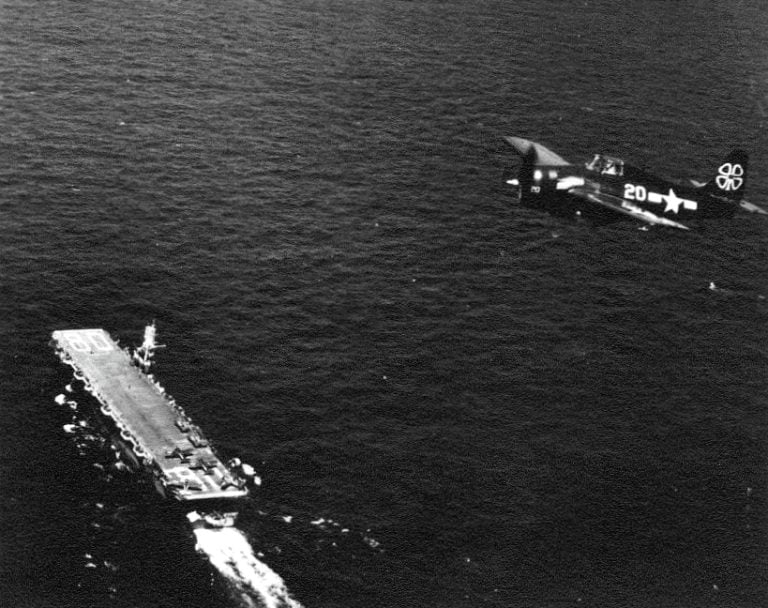
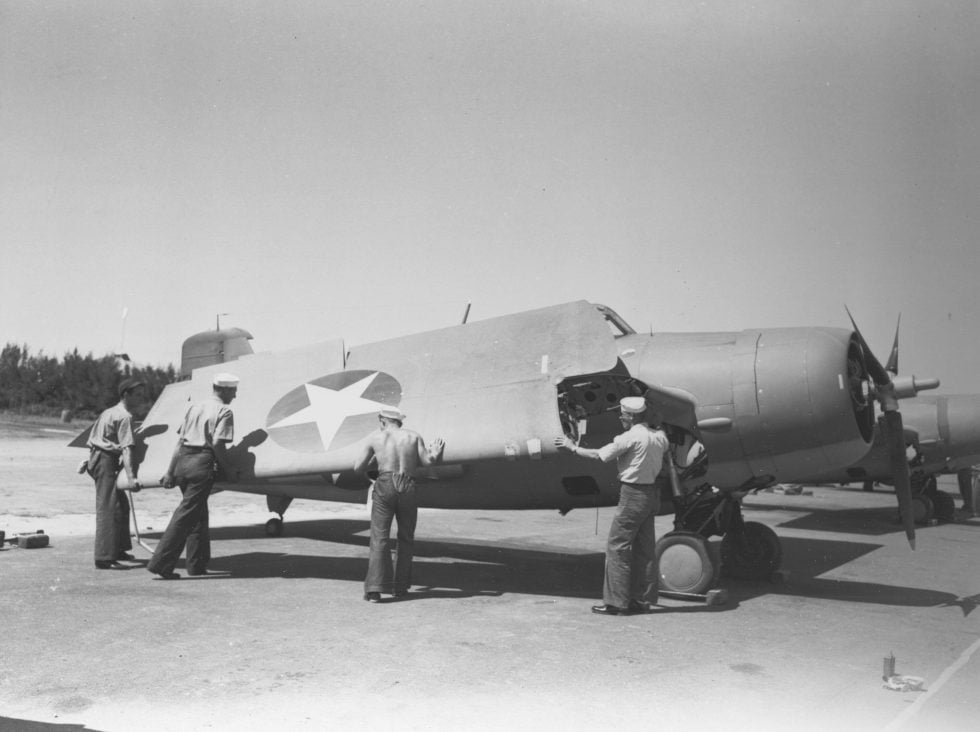
The Wildcat in motion
A featured documentary film on the Grumman F4F Wildcat is coming soon to this exhibit. In the meantime, explore the stories, gallery and operations map above and below.
Where the Wildcat flew
The score that defines it
The Wildcat entered the war as an underdog and left it credited with a positive kill ratio — a rare achievement for a fighter its rivals out-performed on paper. Its record was written in defensive battles won, carriers protected and better aircraft bought time to arrive. Wartime tallies are always contested, so the figures below are best read as widely cited claims rather than audited totals.
Compare the combat record of every military aircraft. Figures as of July 2026.
Everything people ask about the F4F Wildcat
Can I fly in an F4F Wildcat?
Why was the Wildcat successful against the faster A6M Zero?
What is the Thach Weave?
Who was Butch O’Hare?
What is the difference between the F4F, the FM-2 and the Martlet?
How many Wildcats were built?
Is the Wildcat still flying?
You can’t fly the Wildcat.
These, you can.
Some legends only live in museums — others are fuelled and waiting. MiGFlug has put civilians in real military jet cockpits since 2004.
 Fly the L-39 AlbatrosThe world’s most-flown jet trainer — aerobatics included
 Fly the F-104 Starfighter“The missile with a man in it”
 Fly the MiG-21The Cold War’s most-produced jet
 Fly the T-33 Shooting StarAmerica’s first jet trainer
 Fly the DH VampireA piece of early jet history
 Fly the S.211Agile Italian jet trainer
 Fly the MB-326The classic Aermacchi jet
 Fly the MiG-15The Soviet legend of the Korean War
Continue the tour
Every fact, checked
- Naval History and Heritage Command — F4F WildcatUS Navy reference for the type, its kill ratio and its aces.
- Smithsonian Magazine — “How the Rugged F4F Wildcat Held the Line”NASM curator on the Wildcat’s toughness, the Sto-Wing and Joe Foss.
- Congressional Medal of Honor Society — Edward “Butch” O’HarePrimary citation for O’Hare’s 20 February 1942 action.
- History of War — Grumman MartletBritish Fleet Air Arm service, the first Scapa Flow kill and the 1944 renaming.
- General Aviation News — “The Wilder Wildcat”The GM-built FM-2, its Wright engine, taller tail and escort-carrier role.
- This Day in Aviation — 2 September 1937First-flight date and detailed early-Wildcat specifications.
- Naval Encyclopedia — Grumman F4F WildcatProduction totals, the hand-cranked gear and the claimed 6.9:1 ratio.
- War History Online — O’Hare, first naval MoHContext for O’Hare as the Navy’s first ace and MoH aviator.