
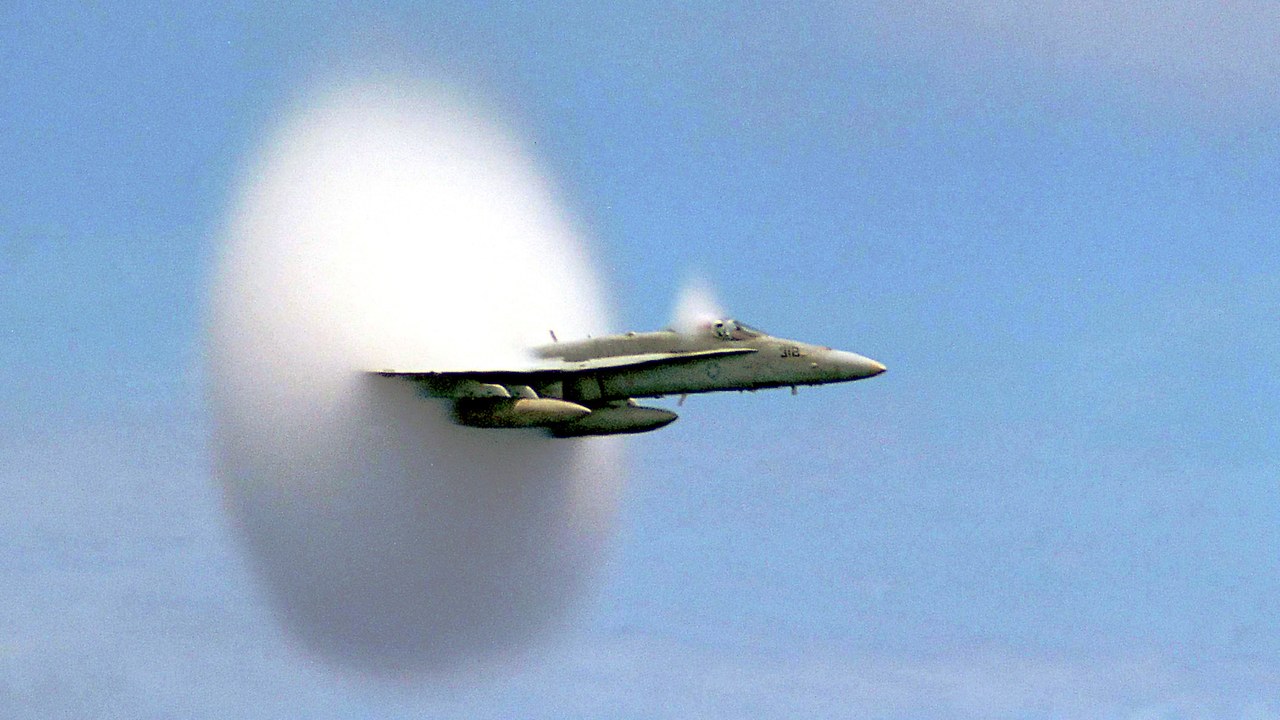
You look up, the jet is already past, and only then does the sky crack: two sharp bangs, a fraction of a second apart. The F/A-18 Hornet above you did not "break" anything at that moment. It had been flying faster than sound for some time. What you heard was a cone of compressed air that it has been dragging behind it all along, finally sweeping over the spot where you stand.
That is the part most people get wrong about the sonic boom. It is not a single event at the instant an aircraft passes Mach 1. It is a continuous sound, carried along with the aircraft for as long as it stays supersonic, and everyone on the ground underneath its path hears it in turn.
Kurzinfo
- What it is: the sound of shock waves made by an object moving faster than sound
- Shape of the pressure wave: an "N-wave", a sudden rise, a steady fall, then a sudden return
- Why two bangs: one shock from the nose, one from the tail
- Boom carpet: roughly 1 mile wide for every 1,000 ft of altitude
- Concorde: about 1.94 lb/sq ft of overpressure, cruising at 52,000 ft
- SR-71 Blackbird: about 0.9 lb/sq ft at 80,000 ft
- A small everyday sonic boom: the crack of a whip
Sound Can't Get Out of the Way
Every aircraft pushes the air in front of it. At low speed, that disturbance travels ahead at the speed of sound, and the air has time to move aside before the aircraft arrives. That is why you hear an approaching airliner long before it is overhead.
Once the aircraft flies faster than sound, the pressure waves it creates can no longer run ahead of it. They pile up and merge into shock waves, thin zones where the air pressure jumps almost instantly. Seen from the side, they form a cone that trails back from the aircraft, called the Mach cone. The faster the aircraft, the narrower the cone.

NASA has photographed these shock waves in flight. In the image above, a T-38 Talon flying supersonic shows the shocks streaming back from its nose, canopy, wings and tail. Most of them merge before they reach the ground. What arrives at your ears is usually just two: the bow shock at the front and the tail shock at the back.
Why It's a Double Bang
Plot the air pressure at the ground as the cone passes, and it looks like the letter N. The bow shock causes a sudden rise in pressure. Behind it the pressure falls steadily, until it is below normal. Then the tail shock snaps it back to normal in an instant. Those two sudden jumps are the two bangs. For a fighter, they come so close together that many people hear them as one. For a large vehicle such as the Space Shuttle, the gap is long enough to hear two distinct booms.
The strength of a boom is measured as overpressure: how much the pressure rises above normal, usually given in pounds per square foot. The numbers are smaller than you might expect. Concorde, cruising at 52,000 ft, produced about 1.94 lb/sq ft. The SR-71 Blackbird at 80,000 ft managed only about 0.9. The F-104 Starfighter at 48,000 ft produced about 0.8. It is not the size of the pressure change that makes a boom startling, but how suddenly it happens.
The Boom Carpet
Because the cone travels with the aircraft, the boom sweeps the ground along the whole supersonic part of the flight. The strip of land that hears it is called the boom carpet. As a rough rule, it is about a mile wide for every 1,000 ft of altitude, so an aircraft at 50,000 ft drags a carpet about 50 miles wide behind it.
Altitude does two things at once. It spreads the boom over a wider area, and it weakens it, because the shock waves lose strength as they travel down through the atmosphere. That is why high-flying aircraft such as the SR-71 produced relatively mild booms despite their speed.
There is also a curious catch. Sound travels faster in warm air than in cold air, and the air near the ground is usually warmer than the air at altitude. The shock waves are bent upwards as they travel down. An aircraft flying only just above Mach 1 at high altitude can therefore produce a boom that never reaches the ground at all. To be sure the boom reaches the surface, an aircraft has to be faster than the speed of sound at ground level, not just at its cruising altitude.
That Cloud Is Not the Boom
The photo at the top of this page, an F/A-18 Hornet wrapped in a white cone of cloud, is often captioned as a jet "breaking the sound barrier". It is a spectacular picture, but the cloud is not the sonic boom.
It is a vapour cone. At speeds close to Mach 1, the air flowing around parts of the aircraft drops sharply in pressure and temperature. In humid air, that is enough to condense water vapour into a brief cloud. It shows that the aircraft is in the transonic range, where the airflow over the airframe is partly supersonic. It does not mark the moment a boom is born, and it can appear on aircraft that are not yet supersonic at all.
Why Supersonic Flight Over Land Stopped
The first person to fly faster than sound in level flight was Chuck Yeager, in the rocket-powered Bell X-1, on 14 October 1947. Decades later, he still saw that flight as part of the job rather than an adventure.
Within a few years of Yeager's flight, supersonic fighters were common, and so were booms over populated areas. In 1964, the US government tested public reaction directly. Over six months, Oklahoma City was subjected to eight sonic booms a day. The result was around 15,000 complaints and a lawsuit against the government, which the residents lost on appeal in 1969. The experiment helped shape the rules that followed: in 1973, the United States banned civil aircraft from flying supersonic over land. We explain that rule, and why it still applies, in our post on why airliners still can't go supersonic over land.
Concorde lived with that ban for its entire career. It flew supersonic over the ocean and slowed down before it reached the coast.
From Boom to Thump
The modern answer is not to fly higher, but to change the shape of the aircraft. If the shock waves along the airframe can be kept from merging into a strong bow shock and tail shock, the N-wave arriving at the ground is softer and more rounded. Instead of two sharp bangs, people hear a dull thump.
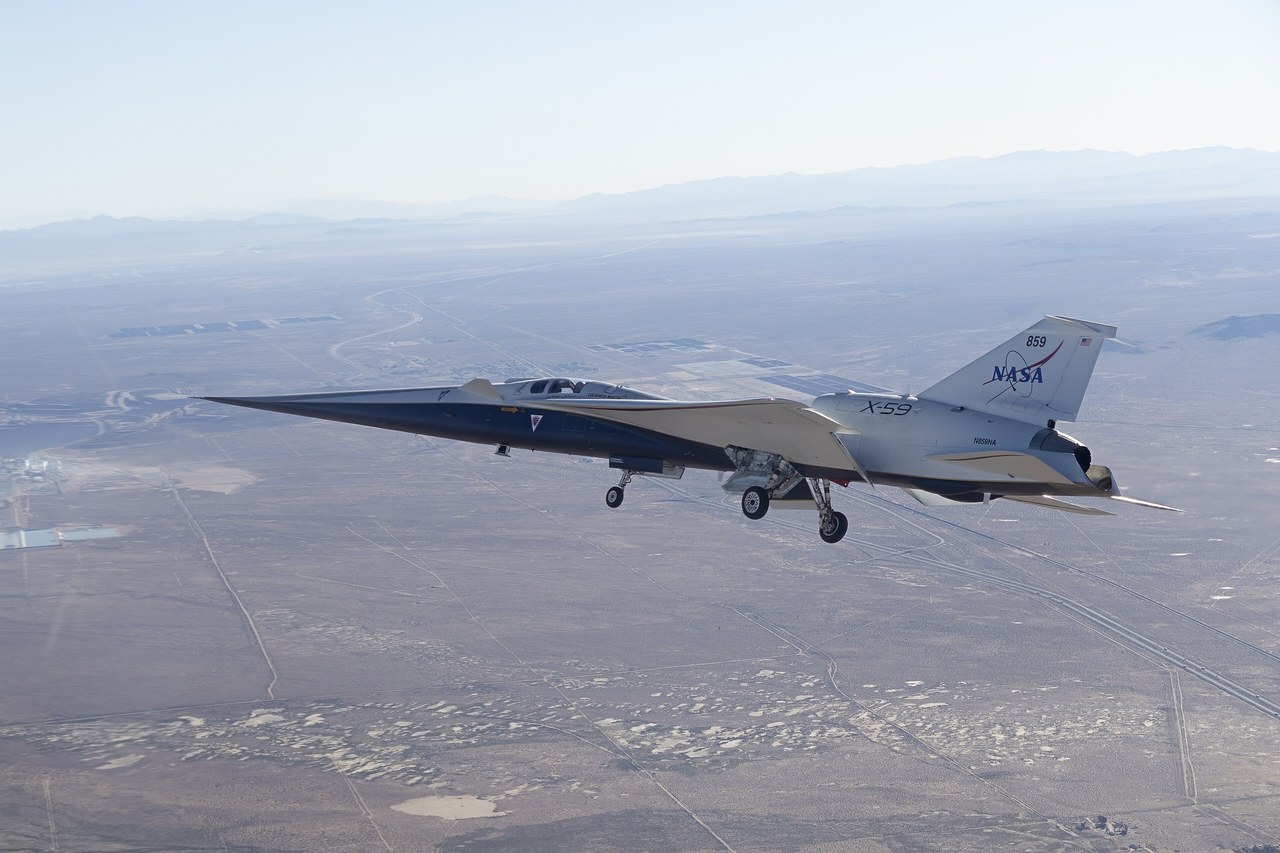
That is the idea behind NASA's X-59, built by Lockheed Martin under a $247.5 million contract signed in 2018. Its long, thin nose and carefully shaped body are designed to spread the shocks out, so that the boom sounds more like a car door closing. The X-59 first flew in October 2025 and made its first supersonic flight on 5 June 2026, reaching Mach 1.1 at 43,400 ft with NASA test pilot Jim Less at the controls. Later test flights have taken it to Mach 1.4. Cathy Bahm, NASA's X-59 project manager, summed up what the first supersonic sortie meant for the team.
The next step is to fly the X-59 over communities in the United States and ask people what they hear. If the thump proves acceptable, the data could help regulators replace a flat ban with a noise limit. The physics of the sonic boom will not change. What the X-59 is testing is whether the boom can be shaped into something people barely notice.
The TED-Ed animation below explains how the shock waves form and why the boom is so hard to get rid of.
Sources: Wikipedia (Sonic boom; Lockheed Martin X-59 Quesst; Bell X-1; Chuck Yeager); NASA Quesst mission pages; Scientific American, "NASA's X-59 plane goes supersonic for the first time" (June 2026); Men's Journal, "Life Advice from Chuck Yeager" (2009); TED-Ed, "The sonic boom problem" (Katerina Kaouri)

0 Comments