
On 24 October 1974, a C-5A Galaxy flying over the Pacific let an intercontinental ballistic missile fall out of its cargo hold. The 86,000-pound Minuteman I dropped from 20,000 feet to about 8,000 feet. Then its first-stage motor lit, and a ten-second burn carried it back up to 20,000 feet before it fell into the ocean.
Der Luftwaffe der Vereinigten Staaten never deployed the idea, but the test proved a point weapon designers keep returning to. A ballistic missile does not have to start life in a silo or on a truck. Hang it under an aircraft and the launch pad moves, at altitude and speed, to wherever it is needed.
That is the air-launched ballistic missile, or ALBM. The Cold War Americans and British tried it, Russia revived it with the Kh-47M2 Kinzhal, and it now rides under Chinese bombers and Israeli fighters. Here is how it works, and why the label “hypersonic” needs a footnote.
Kurzinfo
- What it is: A ballistic missile carried aloft and launched by an aircraft
- Flight profile: Drop, motor ignition, boost, ballistic or quasi-ballistic coast, terminal dive (sometimes manoeuvring)
- Why air-launch: Altitude and speed head start, the aircraft’s own range, an unpredictable launch point
- Cold War: GAM-87 Skybolt for the B-52H and Vulcan B.2, cancelled December 1962; C-5A Minuteman drop test, 24 October 1974
- Russland: Kh-47M2 Kinzhal on the MiG-31K, unveiled 1 March 2018
- China: CH-AS-X-13 (shown as the JL-1 in 2025) for the H-6N bomber
- Israel: Rampage on the F-16I; Air LORA unveiled in 2024
- Not an ALBM: AGM-183 ARRW, a boost-glide weapon
Why launch a ballistic missile from a jet?
A ballistic missile is powered only briefly. Its rocket burns for seconds or minutes, then the warhead coasts the rest of the way on an arc shaped mostly by gravity, like a thrown stone. Every bit of energy the missile does not have to spend at the start is energy it can spend on distance.
An aircraft hands it some of that energy for free. At jet cruising altitude the air is only about a third as dense as at sea level, so the missile skips the draggiest part of its climb and starts with the carrier’s speed instead of from a standstill.
The bigger gain is geography, and headline ranges often add the aircraft’s own combat radius to the missile’s reach. Russian media figures of 2,000 km for a Kinzhal carried by a MiG-31K, and 3,000 km for one carried by a Tu-22M3, are arrived at exactly that way.
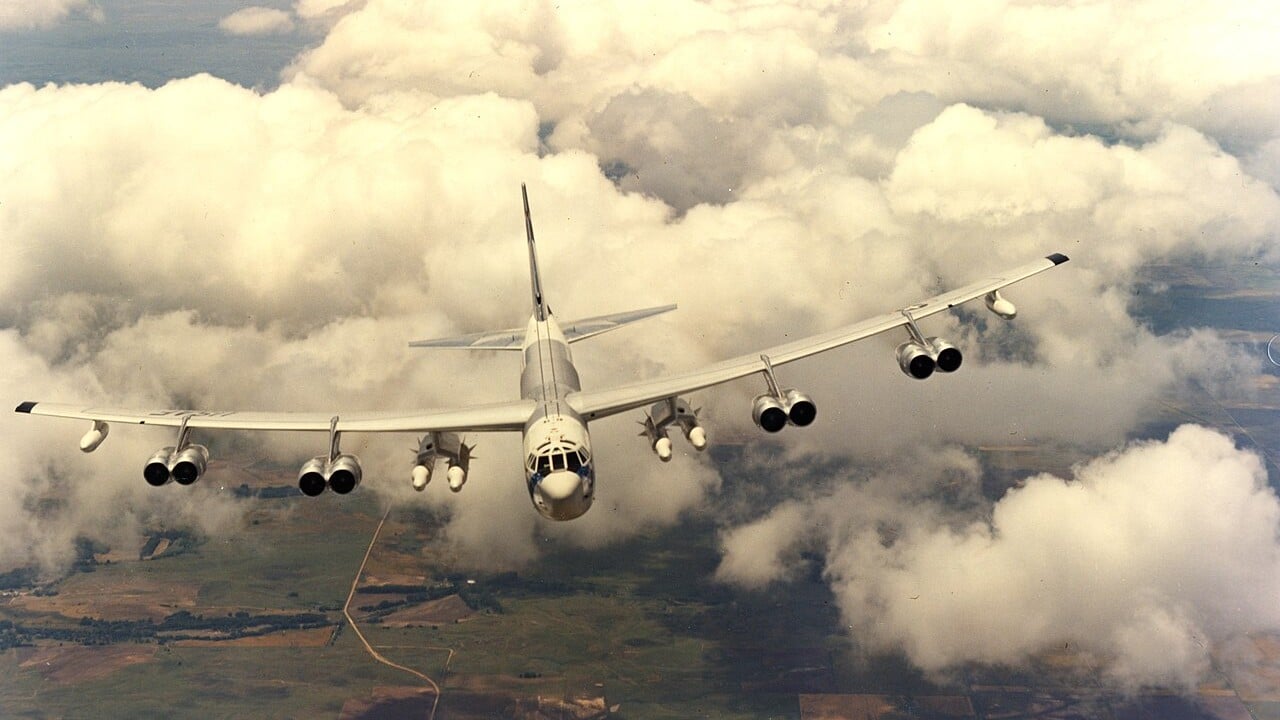
Then there is surprise. A silo has a fixed address; an aircraft can approach from any direction, which the CSIS Missile Defense Project notes could strain radars that watch only a fixed sector of sky, such as Patriot’s. In the 1950s the US Air Force also liked that a bomber could be retargeted by radio right up to launch.
The flight profile, step by step
The Douglas GAM-87 Skybolt, the most ambitious ALBM of the Cold War, shows the sequence clearly. A B-52H was to carry four of them and an Avro Vulcan B.2 two, on underwing pylons. On the pylon, each missile wore a tail cone to cut drag.
Release. The missile was dropped from the pylon, the tail cone was ejected and the first stage of its two-stage solid-fuel rocket ignited. Dropping first and lighting second keeps the rocket blast clear of the aircraft: ALBMs fall before they fly.
Boost and coast. After first-stage burnout, Skybolt coasted for a while before its second stage fired. Movable tail fins steered the first stage, a gimballed nozzle the second. A star tracker kept correcting the inertial guidance, because over a planned range of about 1,850 km (1,150 miles) even small errors at burnout grow into big misses at the target.
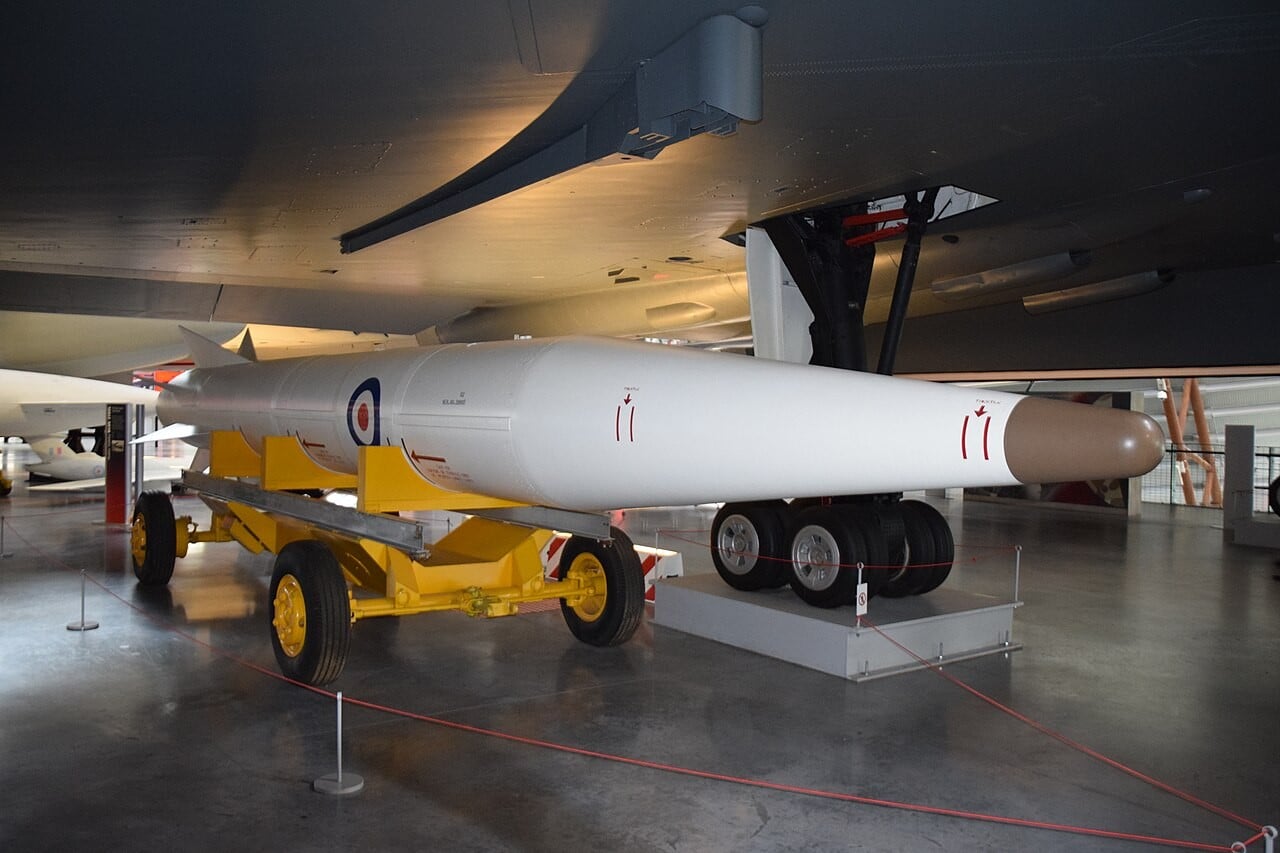
Terminal dive. Last comes the plunge back through the atmosphere. A purely ballistic warhead is predictable here, which is what missile defences exploit. Newer designs answer with manoeuvring re-entry vehicles, or with a quasi-ballistic path: a shallower, largely ballistic trajectory on which the missile stays guided and can manoeuvre in the atmosphere.
Skybolt never reached service. The first five powered tests in 1962 failed, and the first full success came on 19 December 1962, the month the programme was cancelled. Afterburner told the political fallout in Skybolt and Blue Streak: How the RAF Lost Britain’s Bomb.
British Movietone footage of the Skybolt missile on its carrier aircraft and being fired (no sound).
Cold War experiments, from bombers to cargo jets
Skybolt had ancestors. Under the WS-199 programme, Martin’s Bold Orion was fired from B-47 Stratojet bombers in 1958 and 1959. Its final test passed within about 6.4 km (4 miles) of the satellite Explorer VI, proof of how high an aircraft-launched rocket could reach.
The idea revived in the 1970s, when more accurate ICBMs raised fears for missiles in silos, and led to the C-5A Minuteman drop. It worked, but deployment was ruled out over engineering and security difficulties, and the capability became a bargaining point in the Strategic Arms Limitation Talks.
The US Air Force film of the 1974 air-mobile feasibility tests, in which a C-5A dropped a Minuteman ICBM that then ignited in mid-air. Via PeriscopeFilm.
Kinzhal: what Russia claims and what analysts assess
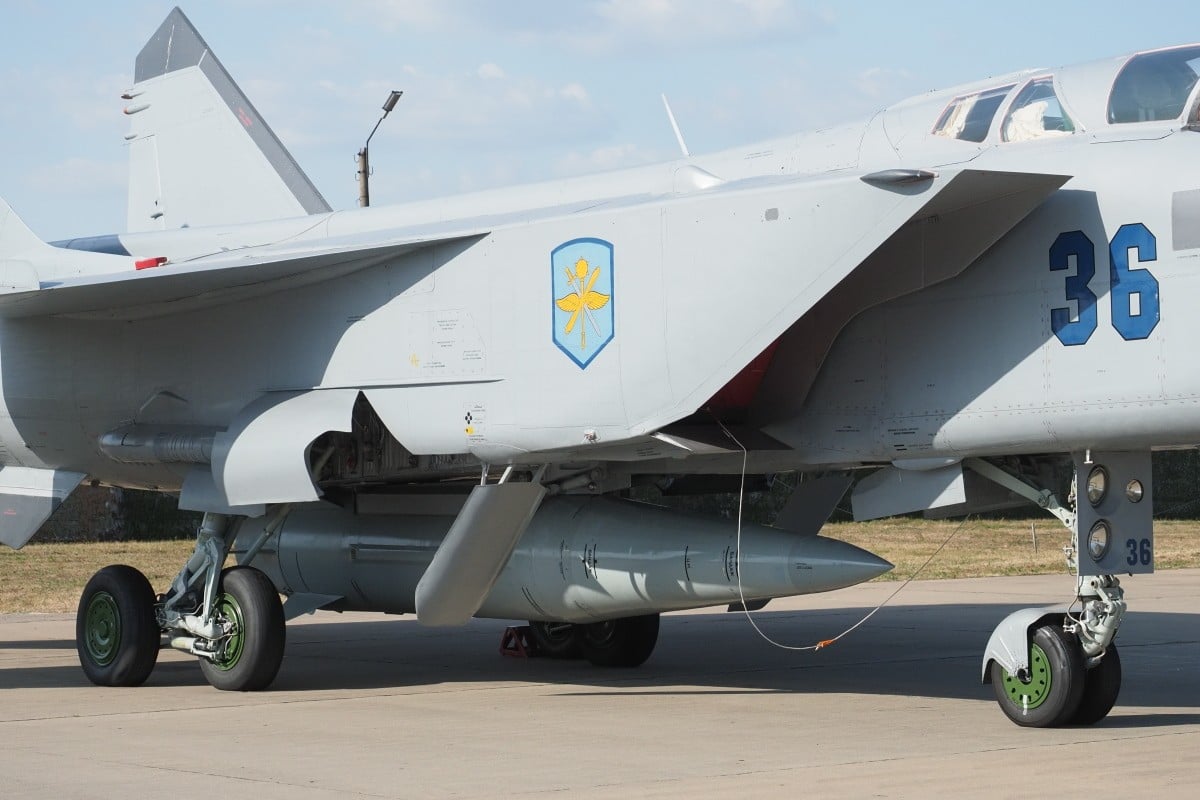
Russia brought the ALBM back in a tactical form. President Vladimir Putin unveiled the Kh-47M2 Kinzhal (“dagger”, NATO name AS-24 Killjoy) on 1 March 2018 as one of six new strategic weapons; Russia says it entered service in December 2017. Its main carrier is the MiG-31K, a version of the MiG-31 Foxhound interceptor of the Russian Aerospace Forces. Tu-22M3 bombers can also carry it, and reportedly the Su-34.
As claimed by Russia: Mach 10, up to 2,000 km from a MiG-31K, a nuclear or conventional warhead, and the ability to hit ships. After a March 2018 test launch from a MiG-31, its Ministry of Defence said the missile had hit its preset target.
Russian Ministry of Defence footage, released in March 2018, of a MiG-31 crew carrying out a Kinzhal practice launch.
As assessed by Western analysts: CSIS judges the Kinzhal is likely derived from the ground-launched 9K720 Iskander-M short-range ballistic missile, with a reported payload of 480 kg and, according to one report, a launch weight of about 4,300 kg. After launch it rapidly accelerates to about Mach 4 and may reach up to Mach 10. Because the 2,000 km figure includes the jet’s radius, the missile itself is generally placed in the same few-hundred-kilometre class as the Iskander it comes from.
The UK Parliamentary Office of Science and Technology has described Kinzhal as flying a quasi-ballistic trajectory and capable of limited manoeuvres. That is the heart of the “hypersonic” debate: Kinzhal exceeds Mach 5, but so does almost every ballistic missile. Planners usually reserve the term for boost-glide vehicles and scramjet cruise missiles that manoeuvre above Mach 5 for much of their flight, as explained in Hypersonic Weapons Explained: Boost-Glide, Scramjet and Ballistic.
Russia’s Ministry of Defence said it first used Kinzhal in combat in March 2022, against a depot at Deliatyn in western Ukraine, and US officials told CNN they had tracked the launches in real time. How it has fared against Ukraine’s air defences since is disputed by the two sides, and this explainer takes no position on those claims.
China’s bomber-borne ballistic missile
In 2018, the director of the US Defense Intelligence Agency, Lieutenant General Robert Ashley, said China was developing two new air-launched ballistic missiles, one of them able to carry a nuclear warhead. One of them, designated CH-AS-X-13 by the US Department of Defense, is believed to be derived from the DF-21 two-stage ballistic missile.
Its carrier is the H-6N, a heavily modified Xian H-6 of the People’s Liberation Army Air Force. Instead of a bomb bay it has a reshaped belly that carries one large missile semi-recessed on the centreline, plus an aerial refuelling probe above the nose to stretch its range.
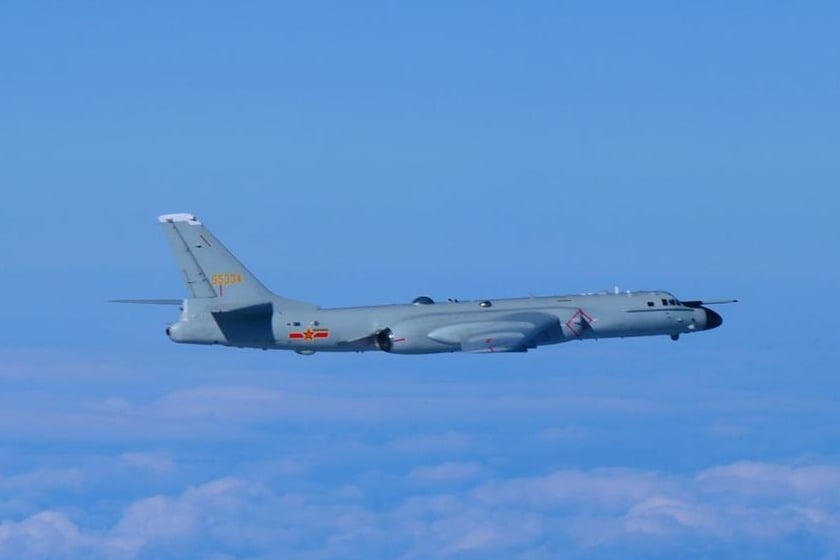
At the Victory Day parade in Beijing on 3 September 2025, China showed the JL-1 (Jinglei-1, “thunderclap”), which its commentator called an “air-based long-range missile.” The Federation of American Scientists judges it is likely the CH-AS-X-13. The War Zone noted its resemblance to the DF-21D, with a manoeuvrable re-entry vehicle on top; a range of about 8,000 km reportedly given by state media is far beyond what is assessed for the DF-21 family. In August 2026 Afterburner covered state TV footage of an H-6N carrying the missile under J-20 escort.
Israel: where artillery rockets meet ballistic missiles
Israel’s air-launched ballistic weapons are smaller and tactical. The best known, Rampage, was developed by Israel Military Industries and Israel Aerospace Industries from the EXTRA guided artillery rocket and unveiled in 2018. The Israeli Air Force carries it on the F-16I, and India has bought it for Su-30MKI, MiG-29 and Jaguar fighters.
Israel also has Rafael’s Rocks and IAI’s Air LORA, an air-launched version of the LORA tactical ballistic missile unveiled in 2024. The War Zone reported that debris found in Iraq after Israel’s April 2024 strike on Iran pointed to ALBMs fired from well outside Iranian airspace. For an air force with few tankers, that stand-off is the point.
What an ALBM is not: the ARRW
Lockheed Martin’s AGM-183 ARRW also hangs under a B-52 and is rocket-boosted past Mach 5, but it is a boost-glide weapon. After burnout, its glide vehicle uses aerodynamic lift to glide and manoeuvre towards the target instead of coasting on a ballistic arc. Afterburner covered its move toward production in ARRW Hypersonic Missile Enters Production in $694M Air Force Deal.
The difference matters: a ballistic arc can be predicted once tracked, a glide path can be bent. Cruise missiles, which fly on wings and engines all the way, are a third family again, with navigation of their own, explained in TERCOM and DSMAC.
The air-launched ballistic missile is an old trick that keeps coming back because the physics never changed. Lift a rocket high, give it a running start, and launch it from somewhere the enemy did not expect. Skybolt failed and the Minuteman drop was shelved, but today Russia, China and Israel all fly versions of the idea.
Sources: Wikipedia (Air-launched ballistic missile; GAM-87 Skybolt; Kh-47M2 Kinzhal; Xian H-6; JL-1 (air-launched ballistic missile); Rampage (missile); AGM-183 ARRW; Ballistic missile), CSIS Missile Threat, Federation of American Scientists, The War Zone, Designation-Systems.net, CNN


0 Comments