
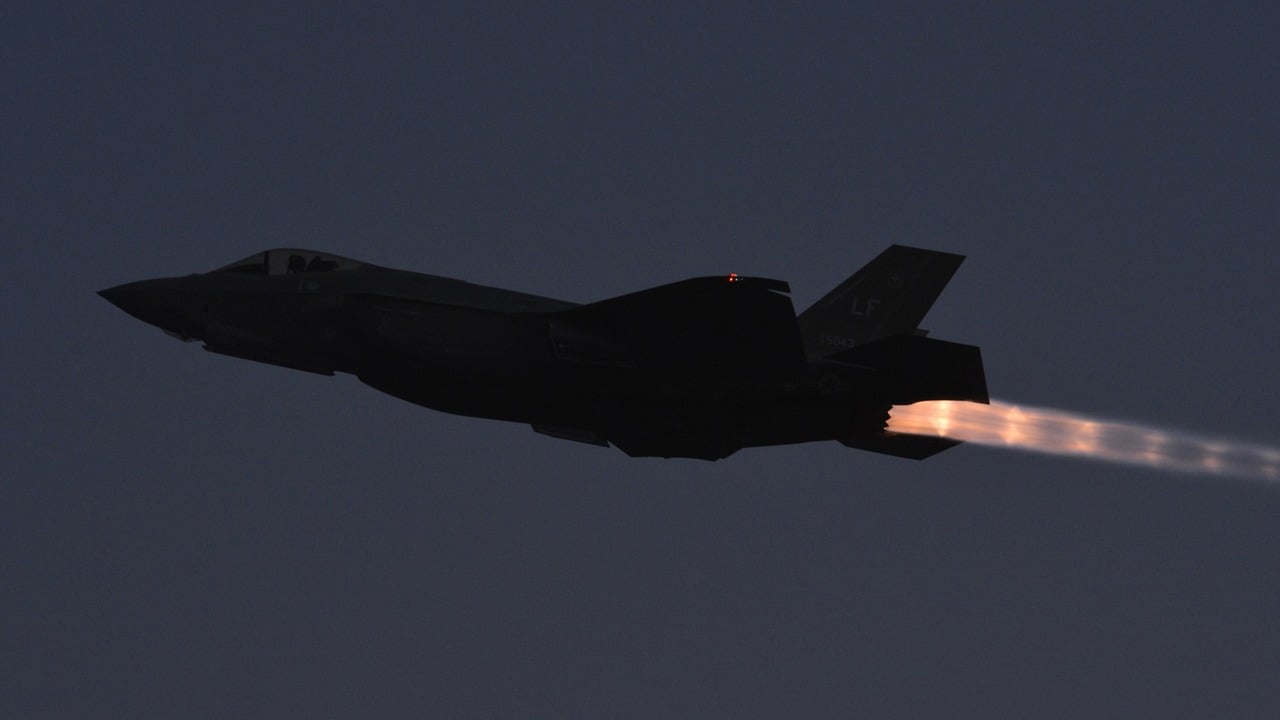
Ask how loud a fighter jet is and you will usually get a single number, delivered with great confidence: 130 decibels, 140, 150. Every one of those numbers is missing the only thing that makes it mean anything. Loud from where? A metre from the exhaust, at the end of the runway, or in a garden two miles away under the approach path?
The good news is that fighter noise is one of the most carefully measured sounds on Earth. The US Air Force, the US Navy and university acousticians have pointed hundreds of microphones at fighters running at full power, precisely because the answer matters for the hearing of the people on the flight line and the patience of the people next door. Here is what they found, and how to read it without being fooled.
Kurzinfo
- Whisper vs lawnmower: About 20 dB vs 90 dB (US Office of Naval Research)
- The logarithm: +10 dB = 10 times the sound power; +3 dB = about double
- Hearing limit: NIOSH: 85 dBA averaged over 8 hours, 3 dB exchange rate
- F-35A, military power: Above 150 dB 1-2 m from the exhaust; about 135 dB at 76 m (AFRL/BYU, flat-weighted)
- F-35, maximum afterburner: 149.0 dB median at one near-field microphone (AIAA 2015)
- Carrier flight line: Up to 150 dB from tactical jets (ONR)
- Community benchmark: FAA: DNL 65 is considered incompatible with homes
- Rules: FAA Part 36 noise certification covers civil aircraft, not fighters
First, a decibel is not a ruler
The decibel is a logarithmic unit. A change of 10 dB means ten times the sound power; a change of about 3 dB means double. That is why two machines that each produce 90 dB do not add up to 180 dB when you run them together. They make about 93 dB.
So the scale is brutally compressed. The Office of Naval Research puts a whisper at 20 decibels and a lawnmower at 90. Those 70 decibels between them hide a power ratio of ten million. When someone says one jet is “only 5 dB louder” than another, the honest translation is “about three times the sound power”.
There is a second trap: weighting. Hearing-protection rules and the FAA use A-weighted decibels (dBA), which discount the deep rumble the human ear is less sensitive to. Engineers measuring jet noise itself often report flat, unweighted levels. A fighter’s roar is rich in low frequencies, so the same moment can produce two quite different numbers depending on which one you read.
A 2023 UK Acoustics Network webinar by Zhong-Nan Wang of the University of Birmingham on how jet noise is generated and how engineers try to reduce it.
What an F-35 actually measures
In September 2013, a team led by the Air Force Research Laboratory tied down an F-35A and an F-35B at Edwards Air Force Base and surrounded them with microphones at 235 positions, from 3 metres outside the exhaust flow to 1,220 metres away. The engines were run from idle all the way to maximum afterburner, and the results were published by the AIAA in 2015.
At one microphone position close to the jet, the median overall level at maximum afterburner was 149.0 dB. An earlier AIAA paper on F-35A ground run-ups, by researchers from Brigham Young University, Blue Ridge Research and AFRL, reported levels above 150 dB just one to two metres from the edge of the exhaust of an F-35A at military power, the highest setting without afterburner, and about 135 dB at 76 metres, roughly 250 feet.
Those are flat-weighted figures, measured on the ground with the jet strapped down. They also hide a curiosity: at these levels sound stops behaving politely. The researchers found nonlinear effects, in which the pressure waves steepen into tiny shocks as they travel. That is the source of the ragged crackle you hear from an F-35 Lightning II at full power, rather than a smooth roar.
150 decibels on the flight deck
Nowhere do people stand closer to fighter exhaust than on an aircraft carrier. The Office of Naval Research says jet noise from tactical aircraft can reach 150 decibels on the flight line, where sailors and Marines prepare aircraft for launch. For comparison, it notes, factories must start a hearing-protection programme at 85 decibels.
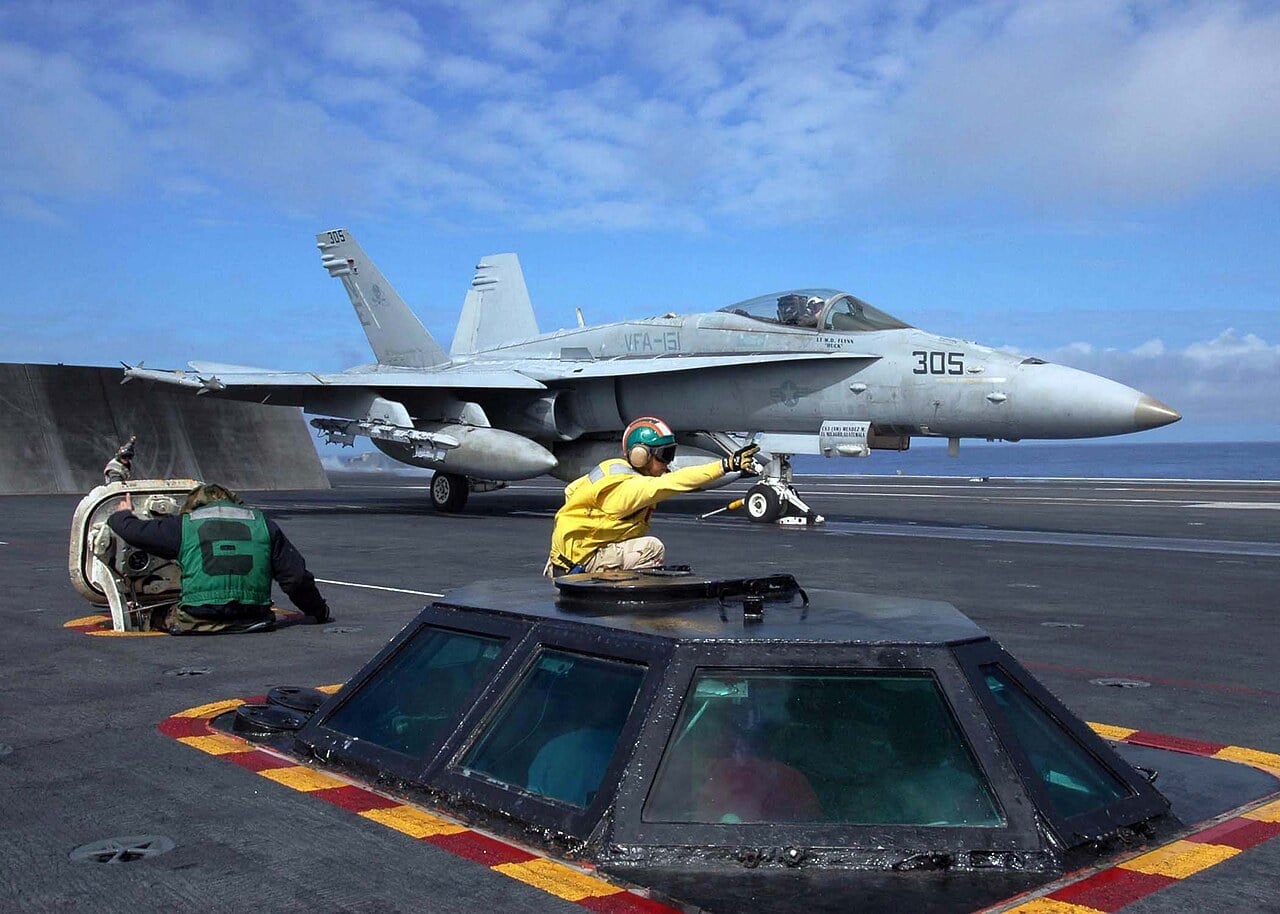
The 85 figure is not arbitrary. The NIOSH recommended exposure limit is 85 dBA averaged over an eight-hour shift, and NIOSH uses a 3 dB exchange rate. Because every 3 dB doubles the energy, every 3 dB also halves the safe time: a worker exposed to 100 decibels for 15 minutes takes on the same risk as one exposed to 85 decibels for eight hours.
Extend that arithmetic to 150 decibels and the safe unprotected exposure shrinks to a fraction of a second. That is why nobody works a flight deck without hearing protection, and why the Navy has spent years funding research into quieter jet exhaust.
Why fighters are louder than airliners
Most jet noise is made not inside the engine but behind it, in the turbulent mixing of the exhaust with the still air around it. The faster and hotter that exhaust stream, the more violent the mixing. Virginia Tech researchers working on the Navy programme built a model rig that blasts air through a small nozzle at about 1.6 times the speed of sound, because that, they explained, is where the roar comes from.
A fighter engine is built for exactly the wrong thing, acoustically. To push a small, slim aircraft to supersonic speed, it squeezes its thrust out of a narrow, very fast, very hot jet, and in afterburner it makes that jet hotter still. An airliner’s high-bypass turbofan does the opposite: it moves a huge mass of air through a big fan relatively slowly. Far gentler mixing, far less noise. Afterburner aside, that is most of the difference.
Airliners have also had decades of regulators pushing them quieter. Civil noise rules have tightened in steps, most recently to the ICAO Chapter 14 standard, which the FAA adopted as Stage 5. Inside the cabin of an Airbus A321 at cruise, measured levels have been reported at about 78 dB(A).
How the neighbours hear it: Lmax, SEL and DNL
Communities around air bases do not argue about a single moment of noise. They argue about averages, and here the logarithm bites again. The FAA describes three key metrics. Lmax is the peak level of one flyover. SEL squeezes all the acoustic energy of one event into the equivalent of a single second. DNL, the Day-Night Average Sound Level, reflects cumulative exposure over 24 hours, with night-time noise counted more heavily.
The FAA’s own worked example shows how strange the result can feel. One event a day with an SEL of 114.4 dBA produces a DNL of 65. So do ten events at 104.4 dBA, or a hundred at 94.4 dBA. A base that swaps old jets for fewer, louder ones can keep its average flat while the individual flyovers get noticeably more startling.
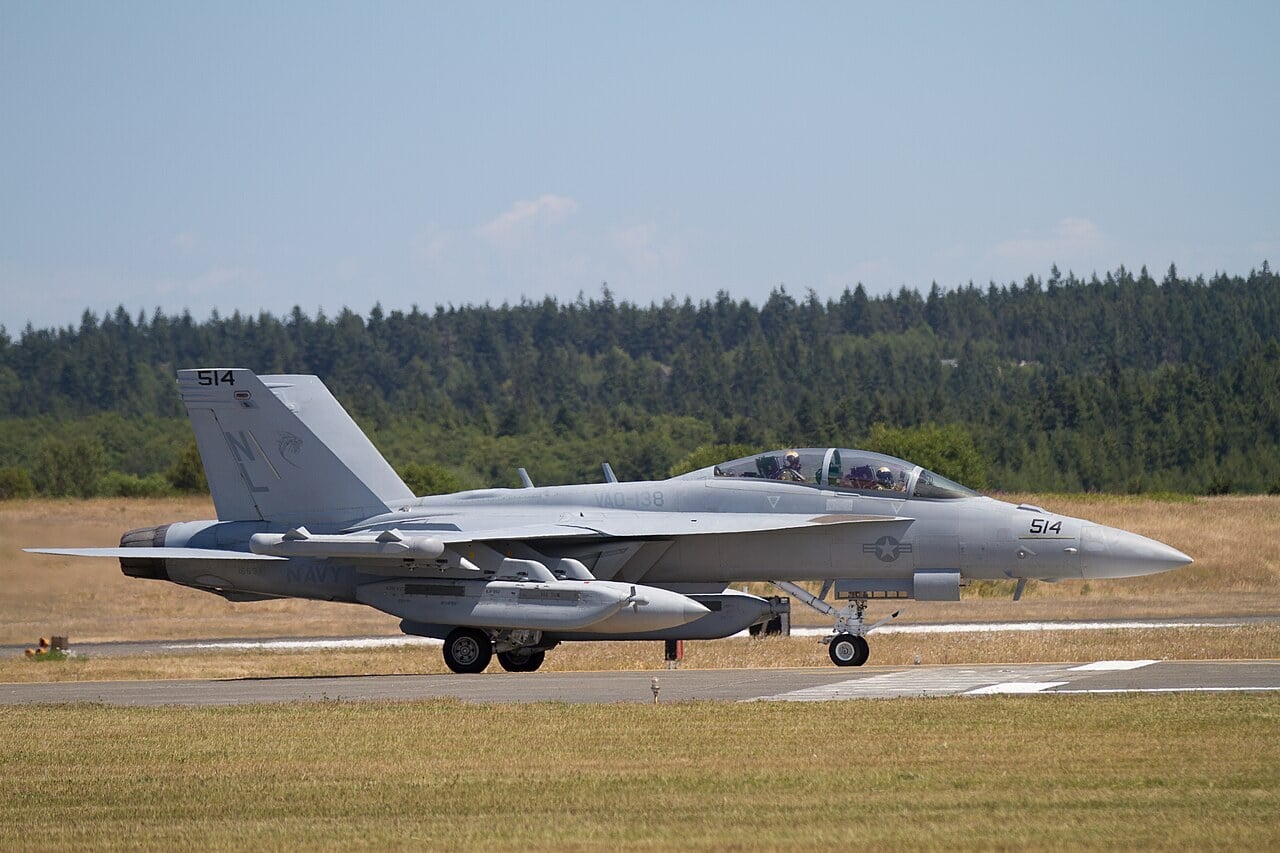
DNL 65 matters because the FAA says a day-night average of 65 dB is incompatible with residential communities. Around Naval Air Station Whidbey Island in Washington, home of the US Navy’s EA-18G Growler fleet, the Navy ran real-time noise monitoring from December 2020 to August 2021 and concluded that its computer noise models were accurate. Local critics were not persuaded.
The University of Washington on its research into EA-18G Growler noise and the people living near Naval Air Station Whidbey Island.
The rulebook fighters never signed
That brings us to the structural reason this argument never ends. Civil noise standards are attached to certification. The FAA’s Part 36 noise rules apply to the issue of type and airworthiness certificates for civil aircraft, and an airliner cannot enter service without meeting them. Military fighters are not certificated that way, so there is no equivalent decibel ceiling that a new fighter must pass before it is allowed near a town.
Instead, military noise is handled through environmental assessments, noise contour maps and negotiation, base by base. Every time a squadron re-equips, the old maps are redrawn and the argument starts again from scratch. Afterburner has followed one such case in Switzerland, where a planned F-35 noise comparison slipped: Meiringen F-35 Noise Test Slips a Year Over a Missing Net.
So, how loud is a fighter jet? On a tie-down at full afterburner, close enough to touch, around 150 decibels, about as much sound as the human body can sensibly be near. On a carrier deck, up to 150 decibels with nothing but earplugs and a helmet in between. From a garden under the approach path, much less, and how much less depends on distance, power setting and weather. Anyone who gives you one number without the distance has told you very little.
Sources: US Office of Naval Research, AIAA papers by AFRL, Blue Ridge Research and Consulting and Brigham Young University (2012, 2015), NIOSH, FAA (Fundamentals of Noise and Sound; 14 CFR Part 36), Virginia Tech, Stars and Stripes, Whidbey News-Times, Wikipedia (Decibel; Occupational noise; Aircraft noise pollution)

0 Comments