

Sit over the wing on your next flight and watch what happens the moment the wheels touch. A row of panels on top of the wing slams upright, killing lift and pinning the aircraft to the runway. Nobody in the cockpit has the muscle to do that. Something else does: an oily fluid, squeezed to thousands of pounds per square inch.
Aircraft hydraulics are the muscles of a modern jet. They raise and lower the landing gear, move the flight controls, extend the flaps, steer the nosewheel and stop the aircraft with its brakes. They are so important that big jets carry three or more completely separate systems, and they are one of the least understood bits of the machine you are sitting in.
Kurzinfo
- Principle: Pascal’s law: pressure on a confined liquid is transmitted equally in all directions
- Typical pressure: A few hundred psi on light aircraft; 3,000 psi on most airliners; 5,000 psi on the largest transports
- Main jobs: Landing gear, flight controls, flaps and slats, brakes, nosewheel steering, thrust reversers
- Redundancy: Airliners carry three or more independent systems, such as A, B and standby on the 737 NG
- Airbus names: Green, blue and yellow on the A320 family
- PTU: Transfers power, not fluid, between two systems; the A320’s “barking dog”
- Fluids: Mineral oil (MIL-H-5606, dyed red) or fire-resistant phosphate esters such as Skydrol on most airliners
A trick from the 17th century
The physics is old. Blaise Pascal worked out that pressure applied to a confined liquid is passed on undiminished to every part of it. Liquids barely compress, so if you push on the fluid at one end of a pipe, it pushes back with the same pressure at the other, however long and twisted the pipe is.
That gives engineers two superpowers. The first is force multiplication: a small piston pushing on the fluid can drive a much larger piston with far more force, because force equals pressure times area. The second is flexibility: you can generate the pressure in one place, by a pump on the engine, and use it anywhere you can run a pipe, from the tail to the nose gear.
Pump, reservoir, actuator
Every aircraft hydraulic system has the same basic cast, according to the FAA’s maintenance handbook: a pump to generate pressure, a reservoir holding spare fluid, an accumulator that stores pressure like a spring, a heat exchanger to cool the fluid, filters to keep it clean, and valves that send it where it is needed. At the far end sits an actuator, a cylinder whose piston turns fluid pressure into movement.

On a small aircraft, hydraulics may do nothing more than work the wheel brakes, at a couple of hundred psi. Large transports run their systems at 3,000 psi and, on the newest big jets, 5,000 psi. Higher pressure means the same force from smaller, lighter pipes and actuators, which matters when every kilogram costs fuel.
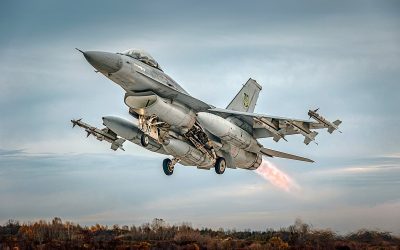
Fighters are no different. At Seymour Johnson AFB in North Carolina, an Air Force hydraulics shop rebuilds brakes, reservoirs, accumulators, actuators and struts for the F-15E Strike Eagle, F-16 Und A-10, including the servo-cylinders that swing the F-15E’s all-moving stabilators.
Epic Flight Academy’s ground-school lesson on aircraft hydraulic systems.
Why three systems, not one
The great weakness of hydraulics is that a single leak can drain a system. So airliners never rely on one. The Boeing 737 Next Generation has three 3,000 psi systems, called A, B and standby, which power the flight controls, flaps and slats, landing gear, brakes, nosewheel steering, thrust reversers and autopilots. The Boeing 777 also has three, named left, centre and right.
Airbus colour-codes them. The A320 family has green, blue and yellow systems; the green one is pressurised by a pump on the left engine and the yellow by a pump on the right engine, backed by an electric pump. Spreading the jobs across several independent systems means one failure does not take everything with it. Losing them all is the scenario designers work hardest to rule out, and it is exactly what the crew of a DHL A300 hit by a missile over Baghdad in 2003 had to land without.

The barking dog
If you have ever heard an Airbus make a loud, rhythmic “whoop-whoop” noise on the ground, you have met the power transfer unit, or PTU. It links two hydraulic systems with a motor and a pump on a shared shaft. The FAA handbook puts it neatly: the PTU transfers power, but not fluid, so a leak in one system cannot drain the other.
On the A320, the PTU sits between the green and yellow systems and starts by itself whenever the pressure difference between them grows too large. That happens most often when only one engine is running, such as during engine start or shutdown. The PTU surges in short bursts, and passengers have been comparing the sound to a barking dog for decades.
Captain Joe explains the Airbus power transfer unit and its famous barking sound.
Purple, fire-resistant and very particular
The fluid itself is a story. The oldest aircraft hydraulic fluid, MIL-H-5606, is mineral oil, dyed red. It works well but burns readily. After a run of hydraulic brake fires in the post-war years, the airline industry pushed for something safer, and the result was phosphate ester fluids such as Skydrol and Hyjet, which are now used in most commercial transport aircraft.
Those fluids are extremely fire-resistant, but not fireproof. They are also fussy. Mineral and phosphate ester fluids do not mix, and the seals for one will not tolerate the other. Service a system with the wrong fluid, the FAA warns, and it must be drained and flushed straight away.
Bigger jets, higher pressure
The A380 is the clearest example of how far hydraulics have come. Airbus chose a 5,000 psi system to save weight, according to a 2002 trade report on the programme, with eight engine-driven pumps supplied by Eaton. It paired two hydraulic flight-control circuits with two electrically powered backup circuits driving electro-hydrostatic actuators, so any one of the four can fly the aircraft.
That is where hydraulics are heading: towards higher pressures, more electric backups and smarter monitoring. But the core idea has not changed since Pascal. Push on a liquid here, and it pushes just as hard over there. Next time the spoilers snap up on landing, you will know who is doing the heavy lifting.
A compilation of the A320 family’s PTU “barking dog” recorded on board.
Sources: FAA Aviation Maintenance Technician Handbook (Airframe, Vol. 2), Power & Motion, Eaton, Iberia, DVIDS
Header photo: Ken Lund / Wikimedia Commons, CC BY-SA 2.0
0 Comments