
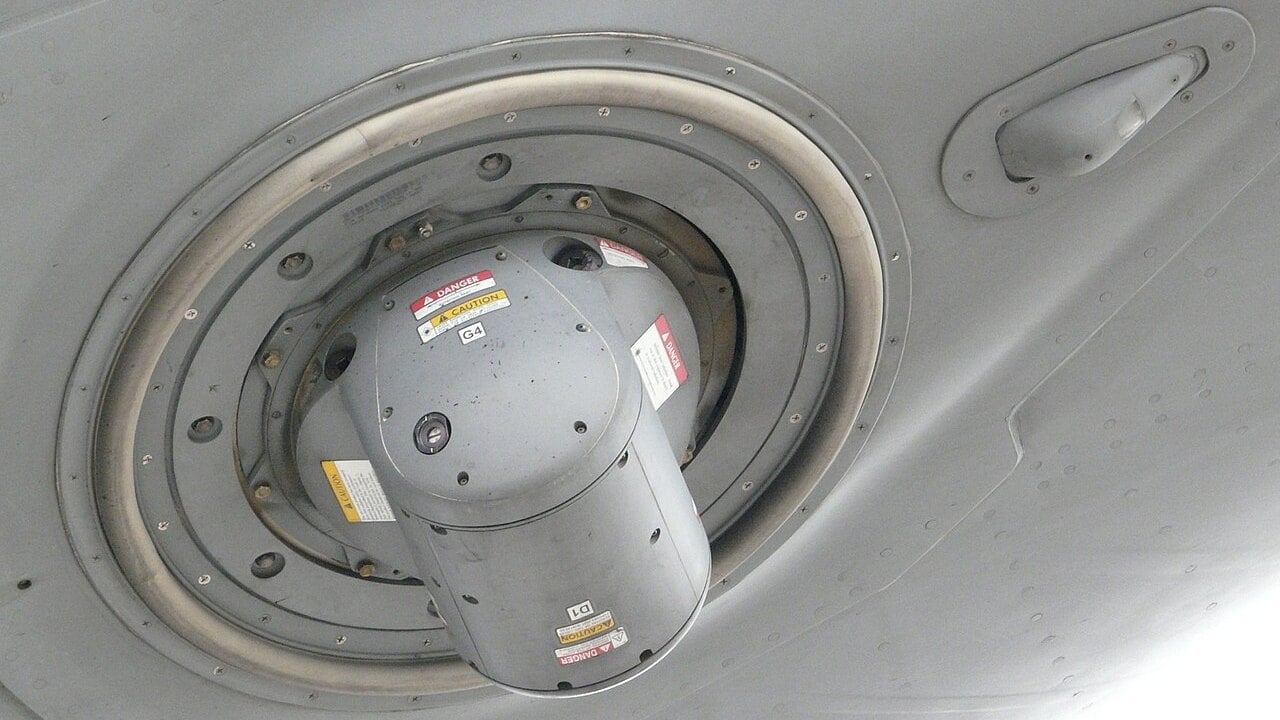
A four-engined transport climbs out of an airfield at dusk. Somewhere below, a shoulder-fired missile leaves its tube and starts hunting the hottest thing in the sky: the aircraft’s engines. A sensor on the fuselage spots the launch. Within moments a small turret under the belly swings round, locks on to the incoming missile and fires an invisible beam of infrared laser light straight into its eye.
The missile does not explode. It simply loses track of where the aircraft is, and wanders off. That is a directional infrared countermeasure, or DIRCM, and it is why large transports, tankers, helicopters and even some airliners now carry little glass-domed turrets.
Flares still have their place. But DIRCM does something no flare can: it talks directly to the seeker and lies to it.
Kurzinfo
- Was: Directional infrared countermeasure (DIRCM): a pointed laser jammer that defeats infrared-guided missiles
- Threat: Heat-seeking missiles, especially shoulder-fired MANPADS
- Wie: Missile warning sensor detects launch; turret tracks the missile; modulated laser energy corrupts the seeker’s guidance
- Advantage over flares: Energy aimed at the missile instead of spread in all directions; no limit of expendable decoys
- US systems: AN/AAQ-24(V) Nemesis for LAIRCM on large aircraft; CIRCM for helicopters
- European/Israeli systems: Elbit J-MUSIC and C-MUSIC, Leonardo Miysis
- Limit: Works only against infrared-guided missiles, not radar-guided ones
Why flares are not enough
A heat-seeking missile steers towards infrared energy. Afterburner explained how that seeker works in How a Heat-Seeking Missile Works, and Why Flares Stopped Saving You. The classic defence is the flare: a burning decoy hotter than the engines, meant to pull the seeker away. It works, but every aircraft carries a limited number, and modern seekers are increasingly good at telling a flare from an aircraft.
An older alternative was the omnidirectional jammer, which pulses infrared energy in all directions at once. BAE Systems’ AN/ALQ-144, an always-on jammer still offered for helicopters, works this way. The problem is physics. Energy sprayed in every direction thins out quickly with distance, so only a tiny share of it ever reaches the missile.
DIRCM turns that around. Instead of lighting up the whole sky, it points all of its energy at the one place that matters: the seeker window of the missile coming at you.
Step one: see the missile
A DIRCM cannot jam what it cannot see, so every system starts with a missile warning system. These sensors watch for the ultraviolet or infrared flash and plume of a rocket motor and decide, within a fraction of a second, whether it is a threat or a false alarm. Afterburner covered them in detail in Missile Approach Warning Systems: How Aircraft See Heat-Seekers Coming.
Once the warning system declares a launch, it hands the rough direction to the DIRCM turret. Now the clock is running. A shoulder-fired missile, as Afterburner’s MANPADS explainer shows, needs only seconds to reach a low, slow aircraft.
Step two: point and track
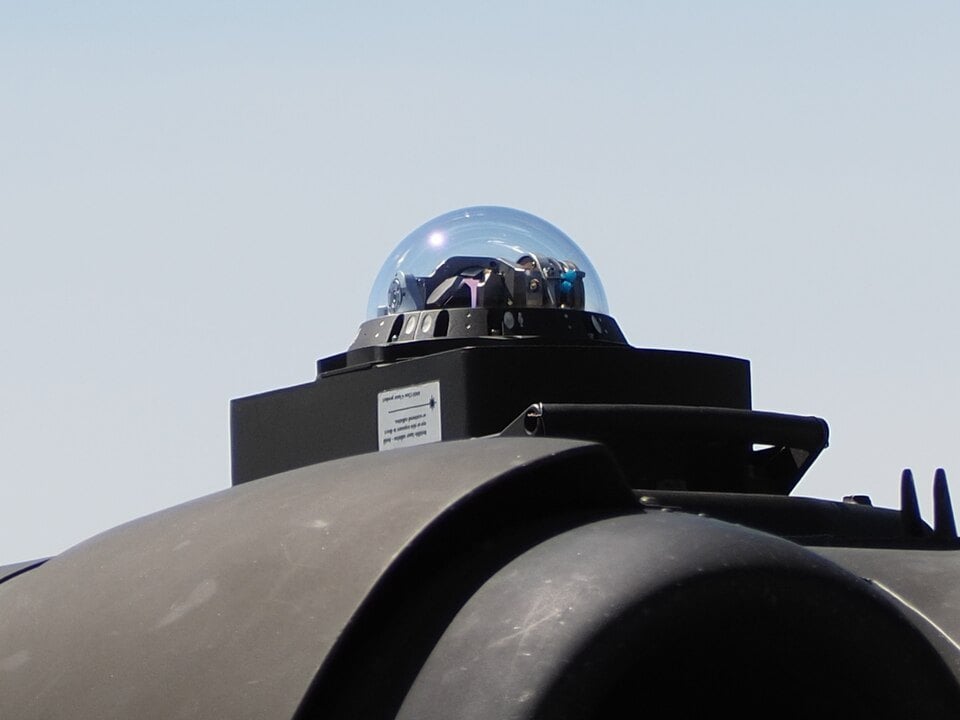
The turret is the clever part. It contains a fast-moving mirror or gimbal and its own tracking sensor, usually a thermal camera, that finds the missile in the sky and follows it precisely. Elbit Systems describes its J-MUSIC system as combining a fibre laser with a high frame-rate thermal camera and a small, high-speed sealed-mirror turret.
Precision matters because the laser beam is narrow. To jam a seeker it has to stay on that seeker’s small window while both the aircraft and the missile are moving fast. That is the job of the pointer-tracker.
Northrop Grumman’s overview of the Large Aircraft Infrared Countermeasures (LAIRCM) system.
Step three: lie to the seeker
With the beam on target, the system fires modulated infrared laser energy into the seeker. It is brighter than the aircraft’s own heat signature, and it is pulsed in a pattern designed to corrupt the signal the seeker uses to steer. The missile thinks the target is somewhere it is not, and the guidance loop falls apart.
Modern systems use lasers as their light source: fibre lasers in Elbit’s MUSIC family, and quantum cascade lasers in Northrop Grumman’s newer Common Infrared Countermeasure, or CIRCM. Lasers put far more energy into a far narrower beam, which is what allows the hardware to shrink.
Nemesis and LAIRCM: protecting the big jets
The best-known DIRCM in the West is Northrop Grumman’s AN/AAQ-24(V), often called Nemesis. Under the US Large Aircraft Infrared Countermeasures programme, or LAIRCM, it protects big transports and tankers such as the C-17 Globemaster III. Northrop Grumman says its laser-based DIRCM systems now protect more than 1,500 aircraft of 85 types, and that its engineers developed the first active onboard infrared countermeasure back in 1961.
According to Robins Air Force Base, which repairs and tests the system, LAIRCM combines a missile warning system, a laser jammer called the Guardian Laser Transmitter Assembly, a laser pointer-tracker, a central processor and an interface unit through which crews load mission software. In tests, technicians fire the lasers in a black-walled range, and the base’s LAIRCM chief warned that even a very short exposure can permanently blind a person.
Northrop Grumman footage of its CIRCM system defeating a shoulder-fired missile in testing.
CIRCM: the helicopter version
Helicopters face the same threat lower and slower, and they cannot carry a large turret. The US Defense Systems Information Analysis Center notes that the most widely used IRCM system for rotorcraft is CIRCM, developed for US helicopters and light fixed-wing aircraft and designed to be lightweight and low cost.
Northrop Grumman’s CIRCM uses a compact pointer-tracker, an off-the-shelf processor and a quantum cascade laser. The US Army fits it to helicopters such as the UH-60 Black Hawk, where its glass dome sits on a fairing on the fuselage.
Leonardo’s introduction to its compact Miysis directional infrared countermeasure.
J-MUSIC, Miysis and the airliner question
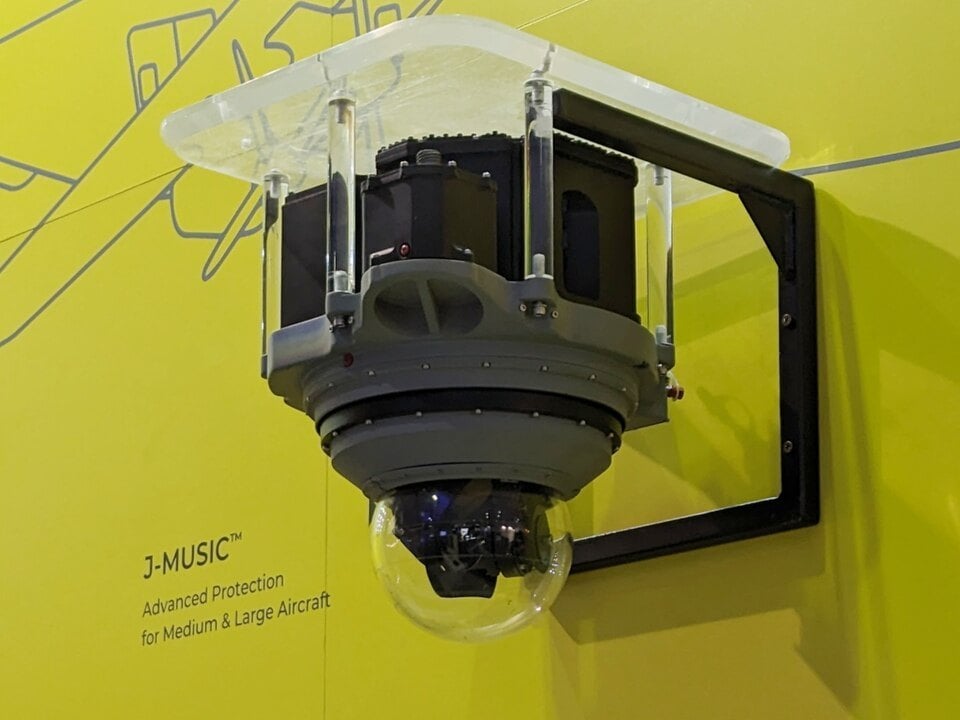
Europe and Israel build their own. Elbit Systems’ MUSIC family includes J-MUSIC for medium and large jets, and the company says its DIRCM systems protect Israeli commercial airliners, the Italian Air Force’s C-27J, C-130J and AW101, and Brazil’s KC-390. In 2014 Germany ordered J-MUSIC for its first A400M transports, in a multi-turret installation for 360-degree cover.
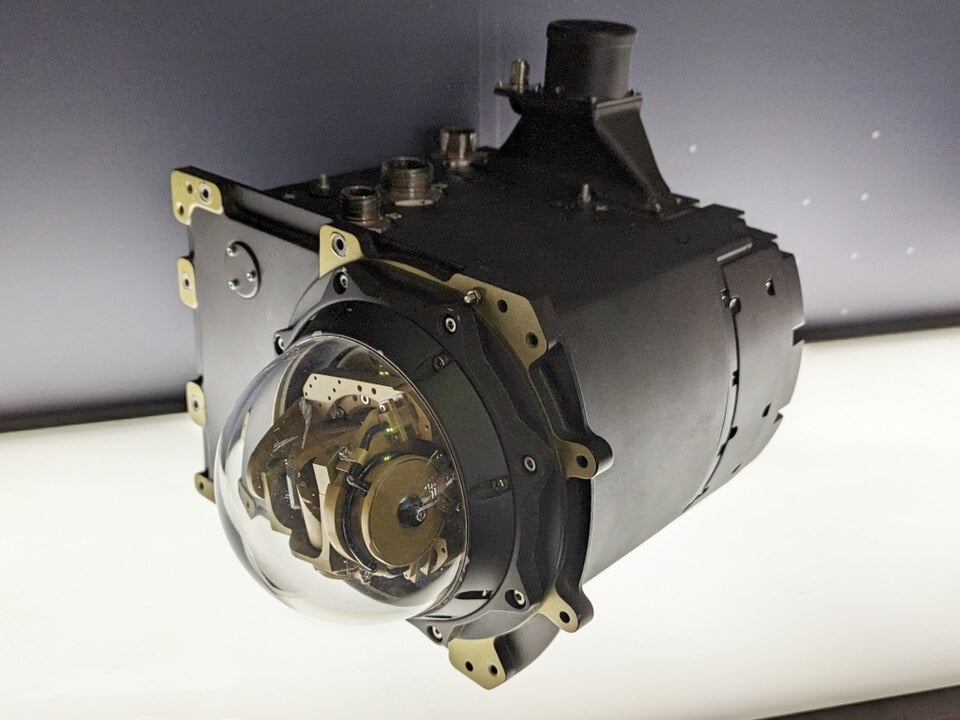
Size shows the trade-offs. According to optics.org, citing Elbit, J-MUSIC weighs 57 kg and draws 1.8 kW, while C-MUSIC, the larger version developed for Israel’s programme to protect its commercial airliners, weighs 160 kg and needs 3 kW. Leonardo’s Miysis goes the other way: under 16 kg and around 190 W, small enough for helicopters and drones.
Not a magic shield
DIRCM only works against infrared-guided missiles. It does nothing against radar-guided weapons, which is why the same aircraft still carry radar warning receivers, chaff and, often, flares. The systems are expensive and heavy compared with a flare dispenser, which is why they appeared first on high-value transports, tankers and VIP jets.
But for an aircraft that spends its life low and slow near airfields, inside the reach of a shoulder-fired missile, a turret that can see the threat, track it and blind its seeker in seconds is the closest thing to a force field aviation has. The next time you see a small glass dome under a transport’s belly, you will know what it is watching for.
Sources: Northrop Grumman, Elbit Systems, Defense Systems Information Analysis Center (DSIAC), Robins Air Force Base Public Affairs, optics.org

0 Comments