
Embraer C-390 Millennium
Brazil’s Jet Airlifter
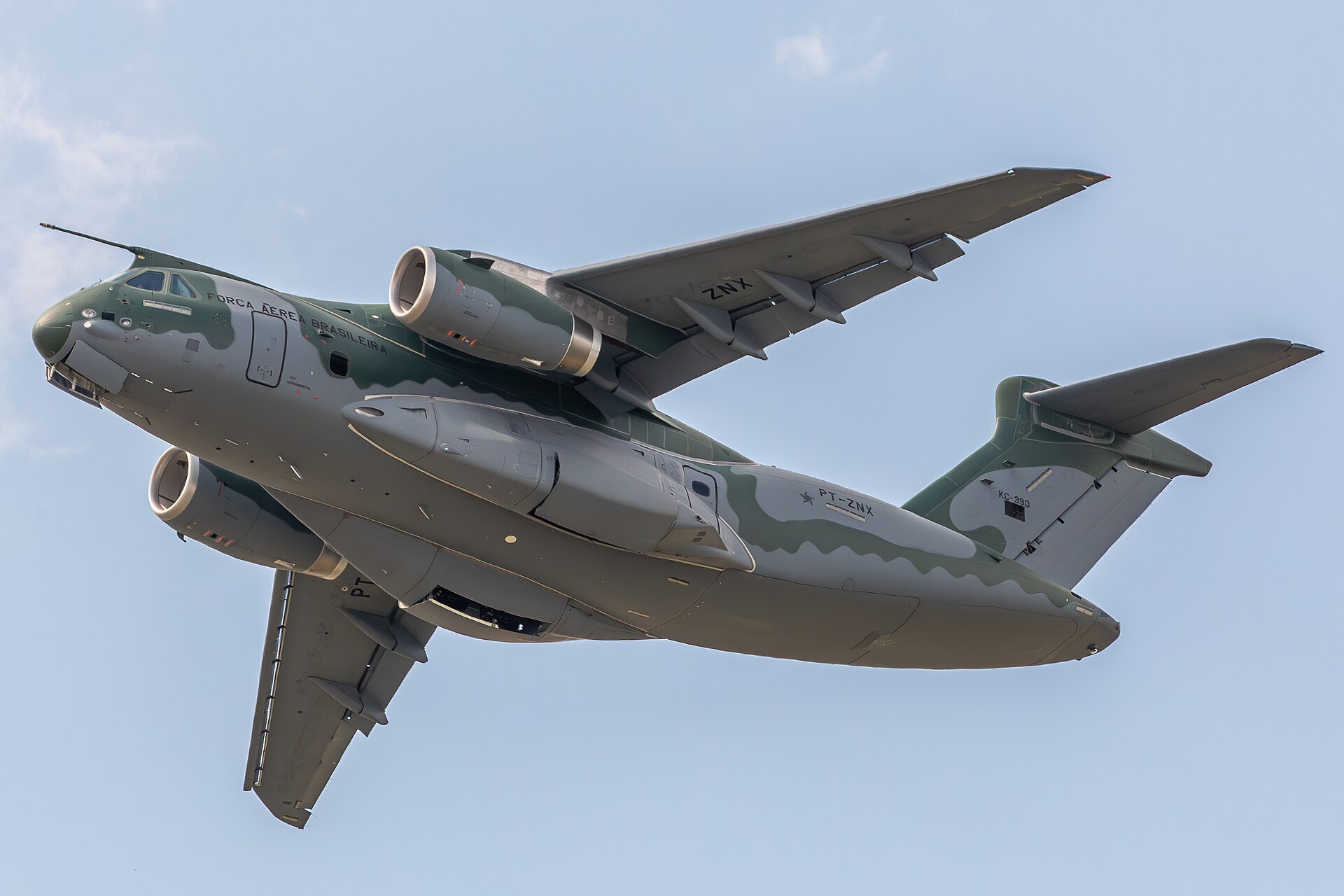
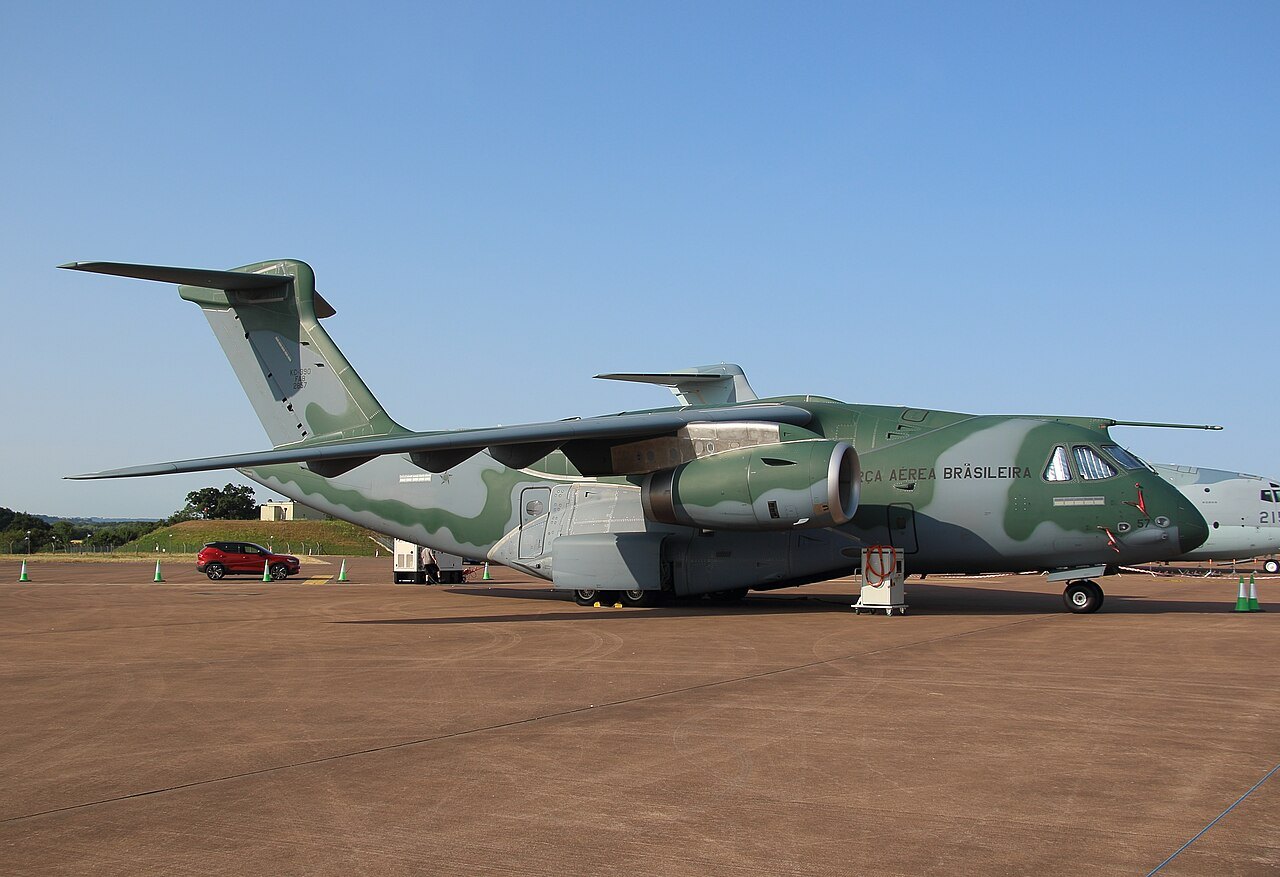
The heaviest aircraft Embraer has ever built: a jet-powered tactical airlifter and tanker from Brazil that has flown into Antarctica, Beirut and wartime Ukraine, and is now being bought by NATO air forces to replace the C-130.
The C-390 Millennium: how Brazil built a jet to replace the Hercules
For half a century the medium tactical airlifter meant one thing: four turboprops, a high wing and a rear ramp, the formula of the Lockheed C-130 Hercules. In the mid-2000s Embraer, a company known for regional jets, began asking whether a jet could do the same job faster. Early studies grafted an E190 wing and CF34 engines onto a cargo fuselage. By the time the Brazilian Air Force signed a US$1.5 billion development contract for two prototypes in April 2009, the design had become all-new: a high wing with slats, a T-tail, a fly-by-wire flight control system and two IAE V2500-E5 turbofans. Embraer argued that a jet engine set high on the wing was more tolerant of dust and gravel than propeller tips close to the ground, and that cruising at Mach 0.8 would move more cargo per day than any rival in its class.
The first prototype, PT-ZNF, rolled out at Gavião Peixoto in São Paulo state in October 2014 and flew on 3 February 2015. Brazil’s economic crisis then imposed a two-year delay, but the test campaign recovered, and the aircraft received Brazilian civil type certification in October 2018. The first production aircraft went to the Brazilian Air Force on 4 September 2019, at Anápolis, and two months later Embraer gave the export model its new name, C-390 Millennium; Brazil kept the KC-390 designation for its tanker-capable fleet. The hold, 18.5 m long, takes two M113 armoured vehicles, a Boxer, a Black Hawk helicopter, 80 troops or 74 stretchers, and loads of up to 26 tonnes. Wing pods turn it into a probe-and-drogue tanker for fighters and helicopters.
The aircraft’s first years were defined less by war than by emergencies. Brazilian KC-390s flew medicines to Beirut after the 2020 port explosion, shuttled oxygen and patients in and out of Manaus during the COVID-19 crisis of January 2021, carried rescue teams to Haiti and brought evacuees home from Ukraine in 2022. Then the export orders arrived: Portugal and Hungary first, followed by the Czech Republic, the Netherlands, Austria, Sweden, South Korea, Uzbekistan and the United Arab Emirates, with Colombia and Greece also reported as buyers. For a type that first flew in 2015, it is an unusually rapid spread, and it has made the C-390 the most serious challenge the Hercules has faced in its own market.
01The C-390’s long road to a contract: partners, cuts and a cancelled joint venture
Embraer did not go it alone. From 2010 it gathered an international industrial team: Argentina’s FAdeA builds the tail cone, cargo door and landing gear doors; Aero Vodochody in the Czech Republic produces the rear fuselage; OGMA in Portugal, an Embraer subsidiary, makes sponsons and centre fuselage parts; BAE Systems supplies the fly-by-wire primary flight control system and Rockwell Collins the Pro Line Fusion avionics. The V2500-E5 was the first military application of the IAE engine.
Boeing signed cooperation agreements in 2012 and 2013 and in November 2019 the two companies announced a joint venture, Boeing Embraer – Defense, to market the aircraft. Boeing walked away in April 2020 when it terminated its wider deal with Embraer. At home, the original Brazilian order for 28 aircraft was cut to 22 in February 2022 as an austerity measure, and later to 19. Even so, by the first quarter of 2023 the Brazilian fleet had logged more than 8,000 flight hours, and at the end of March 2023 the aircraft received its Final Type Certificate, marking full operational capability.
02The C-390 in Europe: why NATO air forces switched from propellers
Portugal, a programme partner since 2010, was the first European customer and received its first aircraft in late 2022 for 506 Squadron “Rinocerontes” at Beja. Among its first missions it flew a Black Hawk helicopter back from the United States, crossing the Atlantic directly from Providence, Rhode Island, to Ovar. Hungary ordered two in 2020, including an intensive care unit kit, for its airlift squadron at Kecskemét.
The Netherlands selected the C-390 in June 2022 to replace its C-130H Hercules and signed in July 2024. Austria chose it in September 2023 to replace its C-130Ks, and Sweden followed in 2024 and 2025 as part of a joint procurement with Austria and the Netherlands that includes options for seven more aircraft and a shared aeromedical module. The Czech Republic ordered two in October 2024, Slovakia entered talks, and Greece has been reported as planning to buy the type through an agreement with Portugal. For these air forces the argument was speed, payload and modern systems at a price competitive with the C-130J.
What makes the C-390 special
Jet speed in a tactical airframe
Two IAE V2500-E5 turbofans of about 31,330 lbf (139 kN) each, the same engine family as the Airbus A320, give the C-390 a cruise speed of Mach 0.8, around 470 kn. Embraer says no other aircraft in the medium airlift market moves payload faster. Yet the airframe is built for tactical work: slats and high-lift devices deflecting up to 40 degrees bring the stall speed, according to Aviation Week’s pilot report, to just over 100 kn, and a combination of slats, idle thrust and spoilers allows a controlled descent of 9,000 ft per minute into a threatened airfield.
Fly-by-wire and a jet cockpit
The C-390 is the first aircraft of its class with full fly-by-wire controls and active sidesticks, built around Rockwell Collins Pro Line Fusion avionics. Dual head-up displays show an enhanced vision system fed by four cameras. The flight control laws protect the aircraft up to a 3 g load factor and an autothrottle reduces crew workload in tactical approaches. Self-protection includes radar warning, chaff and flare dispensers and a directional infrared countermeasures suite, and an onboard maintenance system monitors the health of the airframe and its systems continuously.
Hold, ramp and refuelling pods
The hold measures 18.5 m by 3.45 m by 2.95 m and is reached by a large rear ramp. It can carry seven 463L pallets, 80 troops, 66 paratroopers with full kit, or 74 stretchers with life-support equipment, and loads of up to about 19 tonnes can be air-dropped. Low-pressure tyres let it operate from unpaved or damaged runways. Two wing-mounted Cobham probe-and-drogue pods turn it into a tanker that can pass up to 400 US gallons (about 1,500 litres) a minute to fighters, other transports or helicopters at speeds between 120 and 300 kn.
03The C-390’s variants and roles: from KC-390 to maritime patrol
- C-390 Millennium: the standard transport, also configured for search and rescue, medical evacuation and aerial firefighting.
- KC-390: Brazilian Air Force designation for its fleet, fitted for air-to-air refuelling with two wing pods; the aircraft can also be refuelled in flight itself.
- Aeromedical module: a roll-on, roll-off intensive care unit ordered by the Netherlands in 2025 on behalf of the Dutch, Austrian and Swedish fleets.
- C-390 IVR: an intelligence, surveillance and reconnaissance and maritime patrol version that Embraer and the Brazilian Air Force agreed to study in December 2024, a possible replacement for Brazil’s P-3 Orions.
- Agile Tanker: a boom-equipped concept that Embraer is developing for the United States market, with Northrop Grumman as a partner since 2025.
Embraer C-390 Millennium specifications
Specifications
- Crew
- 3 (two pilots, one loadmaster)
- Capacity
- 80 troops, 66 paratroopers, 74 stretchers or 7 × 463L pallets
- Length
- 35.20 m (115 ft 6 in)
- Wingspan
- 35.05 m (115 ft 0 in)
- Height
- 11.84 m (38 ft 10 in)
- Cargo hold
- 18.5 × 3.45 × 2.95 m (60 ft 8 in × 11 ft 4 in × 9 ft 8 in)
- Empty weight
- 35,000 kg (77,162 lb)
- Max take-off weight
- about 87,000 kg (191,800 lb)
- Maximum payload
- 26,000 kg (57,320 lb)
- Powerplant
- 2 × IAE V2500-E5 turbofans, 31,330 lbf (139 kN) each
- Maximum speed
- Mach 0.93 (988 km/h; 614 mph)
- Cruise speed
- Mach 0.8 (470 kn; 870 km/h)
- Range
- 2,000 km (1,080 nmi) with 26 t; 5,020 km (2,710 nmi) with 14 t
- Ferry range
- 6,240 km (3,370 nmi); 8,460 km (4,570 nmi) with auxiliary tanks
- Service ceiling
- 11,000 m (36,000 ft)
- g limits
- up to 3 g (fly-by-wire protected)
- Armament
- None; self-protection suite with RWR, chaff and flares and DIRCM
Costs & production
- Unit cost
- about €80 million per aircraft (2024 European procurement reporting); Teal Group estimated US$50–55 million in 2016
- Cost per flight hour
- Not published by Embraer. A hedged estimate of roughly US$8,000–15,000 per hour, by analogy with twin-turbofan airliners of similar engine class and tactical transports of similar size; actual figures depend on fuel prices, contract support and utilisation
- Production
- In production since 2014 at Gavião Peixoto, Brazil; Brazilian order reduced from 28 to 19
- Programme
- US$1.5 billion development contract (2009); first flight 2015; first delivery 2019; full operational capability 2023
04The C-390’s operating costs: what the jet trade-off means
Embraer’s pitch rests on productivity rather than fuel burn. A turbofan transport burns more fuel per hour than a turboprop of similar size, but it cruises roughly a third faster, so it completes more sorties per day and spends fewer hours in the air for each tonne delivered. Embraer and the Brazilian Air Force reported that in the first three and a half years of operation the fleet flew more than 8,200 hours in about 6,000 flights with technical availability of around 80 per cent and a mission completion rate of 99.5 per cent, according to European Defence Review.
The V2500 engine family is in airline service worldwide, so spares and overhaul capacity are widely available. Purchase prices reported in European procurements, around €80 million per aircraft in 2024, include varying amounts of support and training. We give a wide, clearly labelled estimate for the hourly cost because no air force or Embraer has published an official figure.
The C-390 from drawing board to NATO service
Study revealed
Embraer says publicly that it is studying a medium-size military airlifter, then called the C-390.
Development contract
The Brazilian Air Force awards Embraer US$1.5 billion to develop and build two prototypes.
First flight
Prototype PT-ZNF flies at Gavião Peixoto on 3 February.
Type certificate
Brazilian civil type certification is granted in October after about 1,900 test hours.
Into service
The first production aircraft is delivered on 4 September; in November the export model is named C-390 Millennium.
First international mission
A KC-390 carries medicines and equipment to Beirut after the port explosion; Hungary orders two.
Manaus airlift
KC-390s fly supplies into Manaus and evacuate patients during the COVID-19 emergency.
Ukraine and Antarctica
A KC-390 evacuates civilians from the Ukraine war; another drops supplies to the Comandante Ferraz station; the Netherlands selects the type.
Full capability and Portugal
Final Type Certificate in March; Austria and South Korea choose the C-390.
European momentum
The Netherlands and Czech Republic sign contracts and Sweden selects the type.
New operators
Uzbekistan is revealed as a customer, the UAE signs for up to 20, and Colombia and Greece are reported as buyers.
Stories & eyewitnesses: the C-390 in service
Gavião Peixoto, 3 February 2015
The heaviest aircraft Embraer had ever built leaves the ground.
Read the full story
A plunge from 20,000 feet
Flight testing was not without its frights.
Read the full story
Beirut, August 2020
The first overseas mission was a mercy flight.
Read the full story
Manaus: the oxygen airlift
In January 2021 an Amazon city ran out of breath.
Read the full story
Out of Ukraine
A KC-390 brought civilians home from a war zone.
Read the full story
Supplies over Antarctica
Airdrops to Brazil’s polar station.
Read the full story
Salitre: tanking F-5s in Chile
The first refuelling on an international exercise.
Read the full story
Portugal’s Rhinos cross the Atlantic
A new squadron and a long first trip.
Read the full story
The Dutch choose a successor to the Hercules
A NATO air force that had flown C-130s for decades changed its mind.
Read the full story
Haiti, August 2021
Search and rescue teams flown into an earthquake zone.
Read the full story
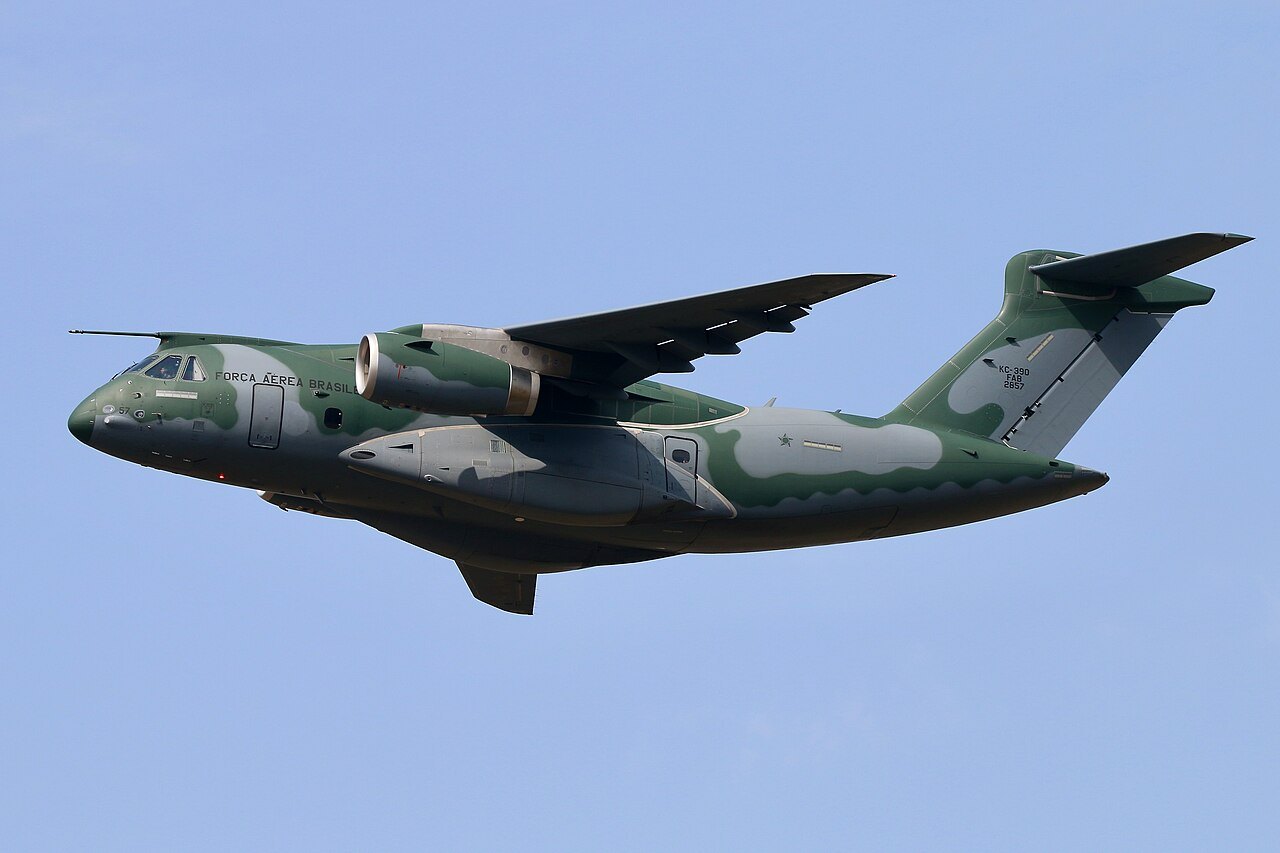
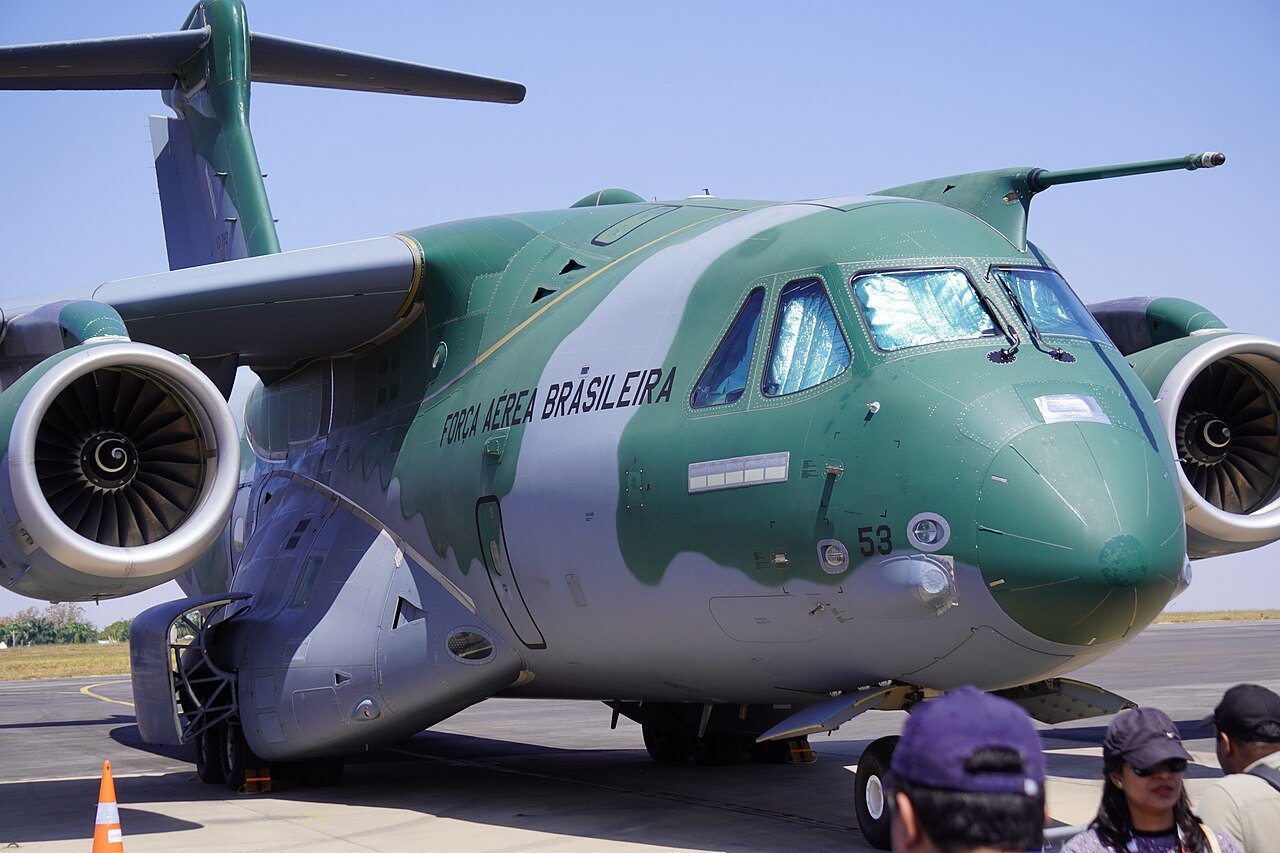
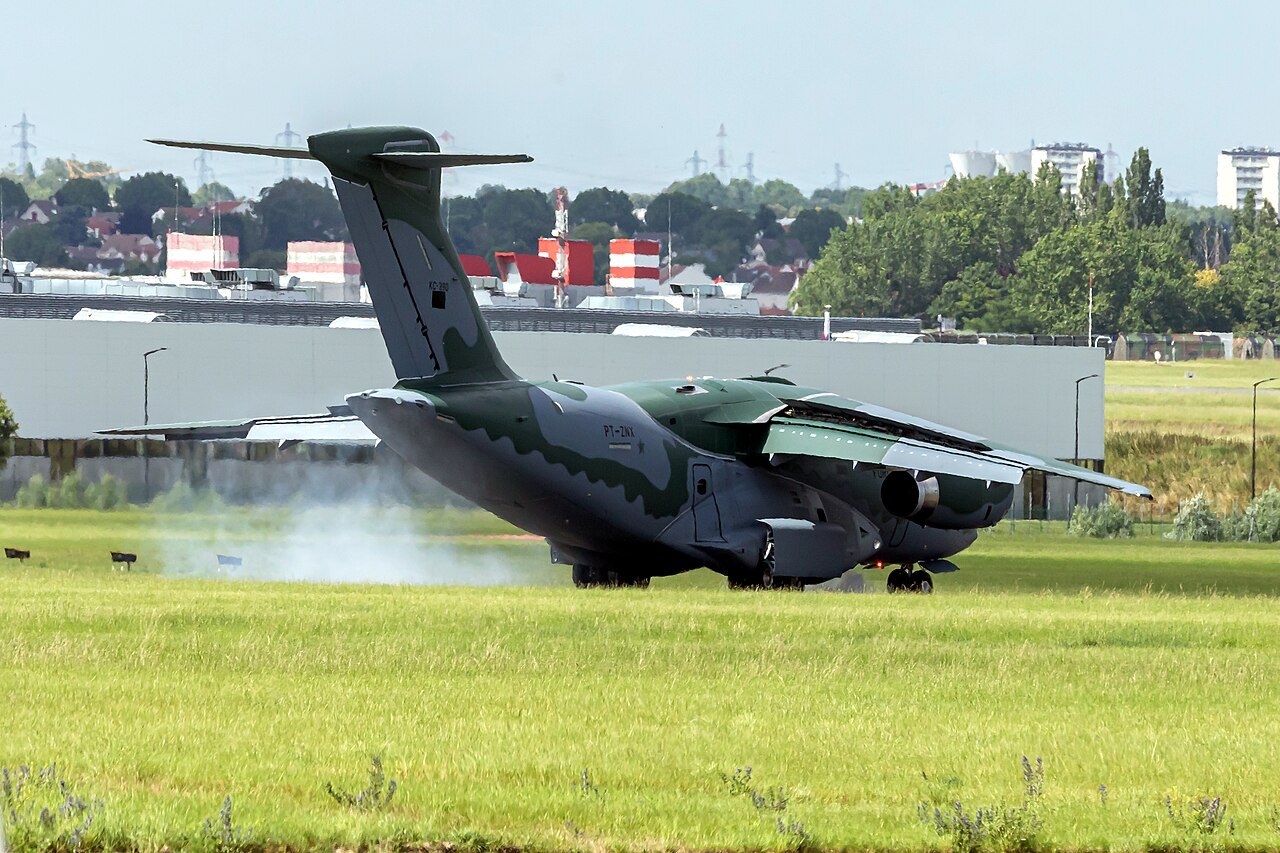
The C-390 in pictures
Where the C-390 flies and flew
The C-390’s service record
The C-390 has not flown in a war as a combatant. Its record is humanitarian and logistic: airlifts to Beirut, Manaus, Haiti and Antarctica, evacuations from Ukraine and refuelling training with fighters. Brazilian Air Force figures give a sense of how hard the early fleet worked.
See how training and combat types compare in the military aircraft statistics database. Figures are approximate.
Everything people ask about the C-390
Can I fly in an Embraer C-390 Millennium?
What is the difference between the KC-390 and the C-390?
Why does the C-390 use jet engines instead of turboprops?
How much can the C-390 carry?
Can the C-390 refuel other aircraft?
Which countries operate the C-390?
How much does a C-390 cost?
You can’t fly the C-390.
These, you can.
Most of this museum you can only look at. These genuine military jets you can fly yourself with MiGFlug — with aerobatics and time on the controls.
 Fly the L-39 AlbatrosThe world’s most-flown jet trainer — aerobatics included
 Fly the F-104 Starfighter“The missile with a man in it”
 Fly the MiG-21The Cold War’s most-produced jet
 Fly the T-33 Shooting StarAmerica’s first jet trainer
 Fly the DH VampireA piece of early jet history
 Fly the S.211Agile Italian jet trainer
 Fly the MB-326The classic Aermacchi jet
 Fly the MiG-15The Soviet legend of the Korean War
Continue the tour
Every fact, checked
- C-390 MillenniumEmbraer Defense & Security official product page
- Pilot Report: Putting Embraer’s KC-390 Through Its PacesAviation Week (Wuerfel, 2019): handling, stall speed, descent performance, hold
- Embraer, Brazilian air force agree six-unit cut to C-390 contractFlightGlobal (Hoyle, 2022) on the Brazilian order reduction
- Embraer strongly pushes its C-390 Millenium on the international marketEuropean Defence Review (2023): FAB flight hours, availability and mission completion
- KC-390 transporta mais de 8 toneladas de equipamentos para ManausDefesanet on the January 2021 Manaus airlift
- Portugal conducts first force projection with new KC-390 transport aircraftPortuguese first missions and the transatlantic Black Hawk flight, 2023
- Entscheidung ueber C-130 Hercules-Nachfolge ist gefallenAustrian Armed Forces announcement, September 2023
- Hungary Signs Contract For Acquisition of Two Multi-Mission KC-390 Millennium AirliftersEmbraer press release, November 2020