
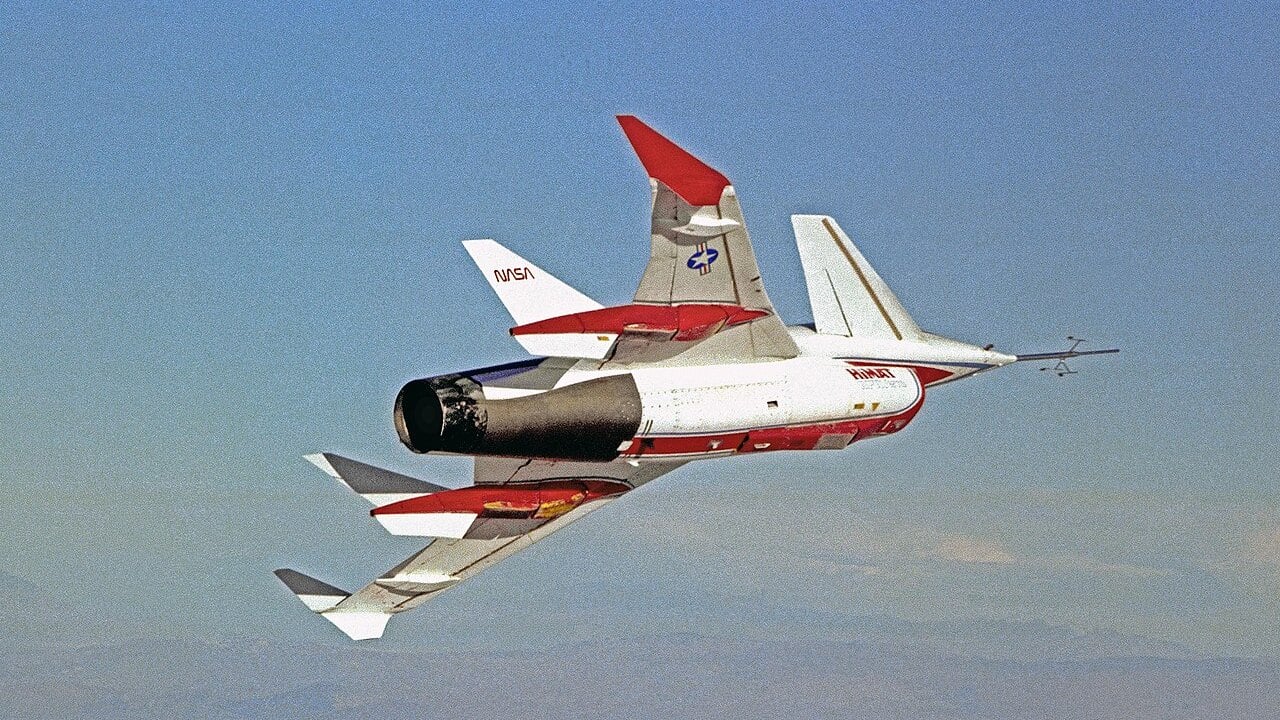
On 27 July 1979, a NASA B-52 climbed over the Mojave Desert with a strange red-and-white fighter hanging under its wing. It had swept-back wings mounted far aft, a small canard wing near the nose, upturned fins on its wingtips and, where a pilot would normally sit, a television camera. Nobody was on board.
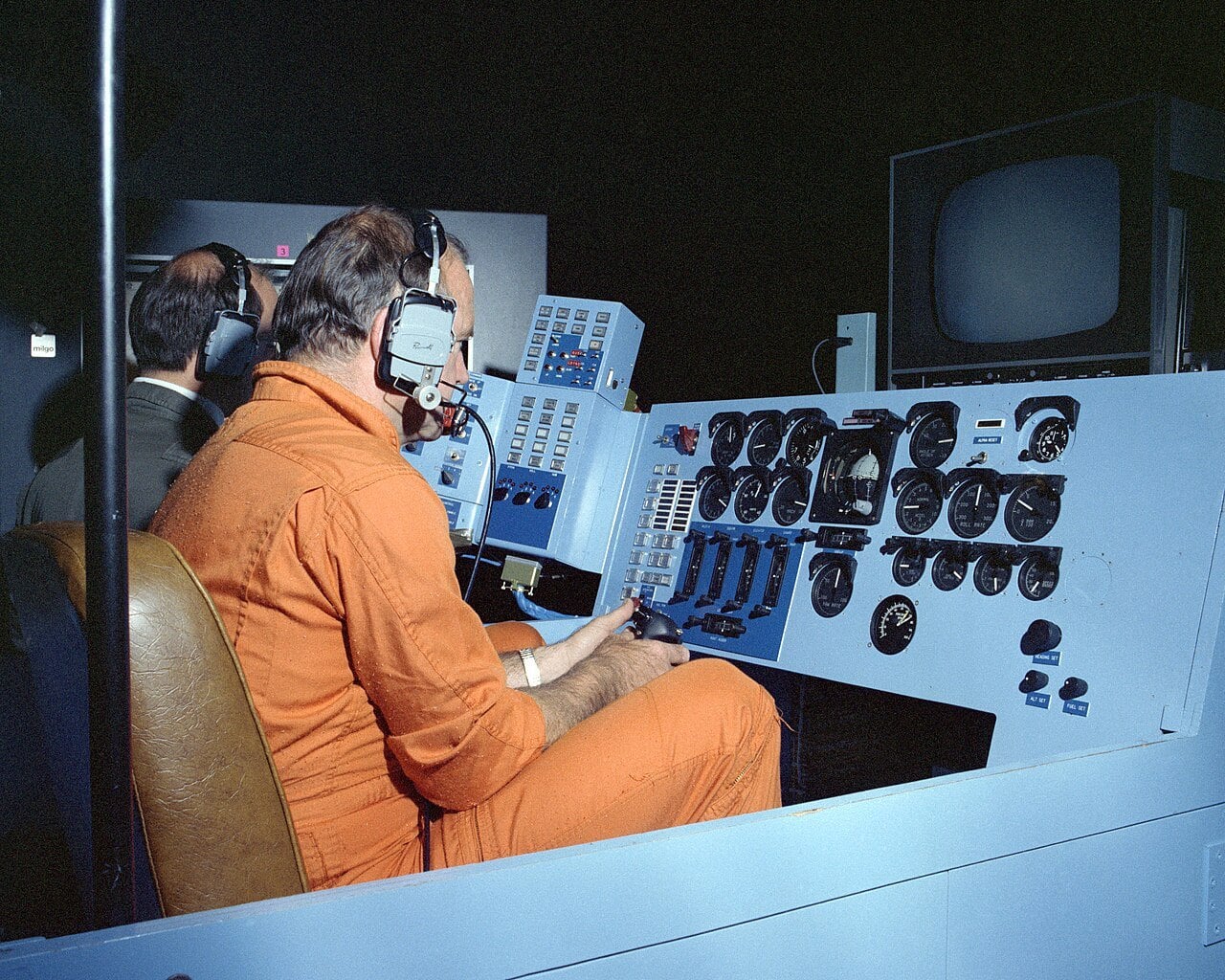
Its pilot, NASA research pilot Bill Dana, was sitting in a room at Edwards Air Force Base, watching a TV screen and holding a control stick. When the B-52 let go, Dana flew the little jet through its first test flight from the ground and brought it down on the dry lakebed. Every objective was met.
This was the Rockwell HiMAT, the Highly Maneuverable Aircraft Technology demonstrator. Over the next three and a half years it would pull turns far tighter than the frontline fighters of its day could sustain, and quietly test half a dozen technologies that later showed up on real aircraft.
Kurzinfo
- Flugzeug: Rockwell HiMAT (Highly Maneuverable Aircraft Technology), remotely piloted research vehicle
- Programm: NASA and the US Air Force Flight Dynamics Laboratory; began 1973
- Gebaut: Two (RPRV 870 and 871), Rockwell contract awarded August 1975; $17.3 million for both
- Größe: 23.5 ft (7.2 m) long, span just under 16 ft (4.9 m); roughly half an F-16
- Motor: One GE J85-21 turbojet, 5,000 lb static thrust
- Leistung: Sustained 8 g at Mach 0.9 and 25,000 ft; top speed listed by NASA as Mach 1.4; Mach 1.45 reached in May 1982
- Flüge: 26, from 27 July 1979 to 12 January 1983, launched from a B-52 at about 45,000 ft
- Überlebende: National Air and Space Museum; NASA Armstrong Flight Research Center
Why build a fighter with no pilot?
Through the Vietnam era, as NASA puts it, the crux of fighter research had been speed. By the 1970s that was changing. An energy crisis made efficiency fashionable, digital electronics were becoming small enough to fly, and the combat environment was shifting towards manoeuvre.
The HiMAT programme began in 1973 as a joint effort between NASA and the Air Force Flight Dynamics Laboratory at Wright-Patterson Air Force Base, Ohio. Its goals were bold: a 100 percent increase in aerodynamic efficiency over 1973 technology, and the ability to sustain an 8 g turn at Mach 0.9 and 25,000 feet. In August 1975, Rockwell International won the contract to build two aircraft. The two vehicles cost $17.3 million.
The key decision was to leave the pilot on the ground. A remotely piloted vehicle needs no ejection seat, no life support and no oxygen system, and if a high-risk manoeuvre goes wrong, nobody dies. It also meant the team could take risks a crewed programme could not.
Half an F-16, twice the turn
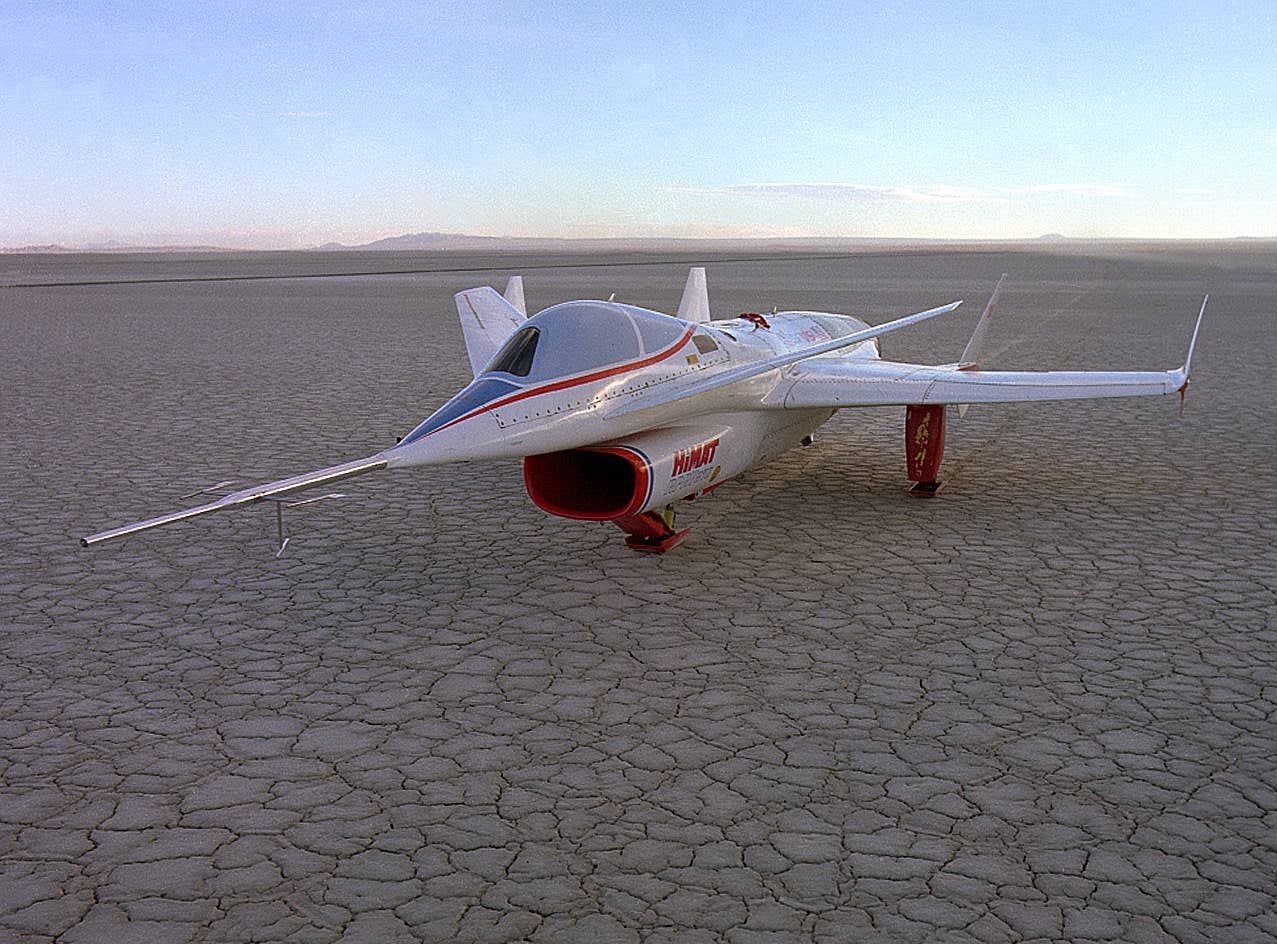
Each HiMAT was roughly half the size of an F-16: 23.5 feet (7.2 m) long with a wingspan of just under 16 feet (4.9 m). A single General Electric J85-21 turbojet produced 5,000 lb of static thrust at sea level. Launch weight was 4,030 lb, including 660 lb of fuel, and NASA lists its top speed as Mach 1.4.
The shape was the point. Swept wings mounted at the rear, a controllable canard ahead of them and a digital fly-by-wire control system gave HiMAT a turn radius twice as tight as conventional fighters. At near the speed of sound and 25,000 feet, it could sustain an 8 g turn. NASA’s own comparison: an F-16 at the same altitude could sustain about 4.5 g.
About 30 percent of the airframe was made of experimental composites, mainly fibreglass and graphite-epoxy. The wings were aeroelastically tailored, meaning the layers of composite were laid up so the wing would twist in a useful way as it bent under load. The winglets, small upturned fins at the wingtips, were there to reduce drag.
Rockwell and NASA also took a gamble on the design process itself. Instead of thousands of hours in wind tunnels, the team leaned heavily on then-unproven computational design tools developed at NASA’s Ames Research Center. It saved a great deal of tunnel time, but several early flights had to be devoted to measuring the stability and control data that a conventional programme would have had before first flight.
Boeing Classics footage of a Rockwell HiMAT test flight. Rockwell’s aerospace business later became part of Boeing.
Flying from a desk
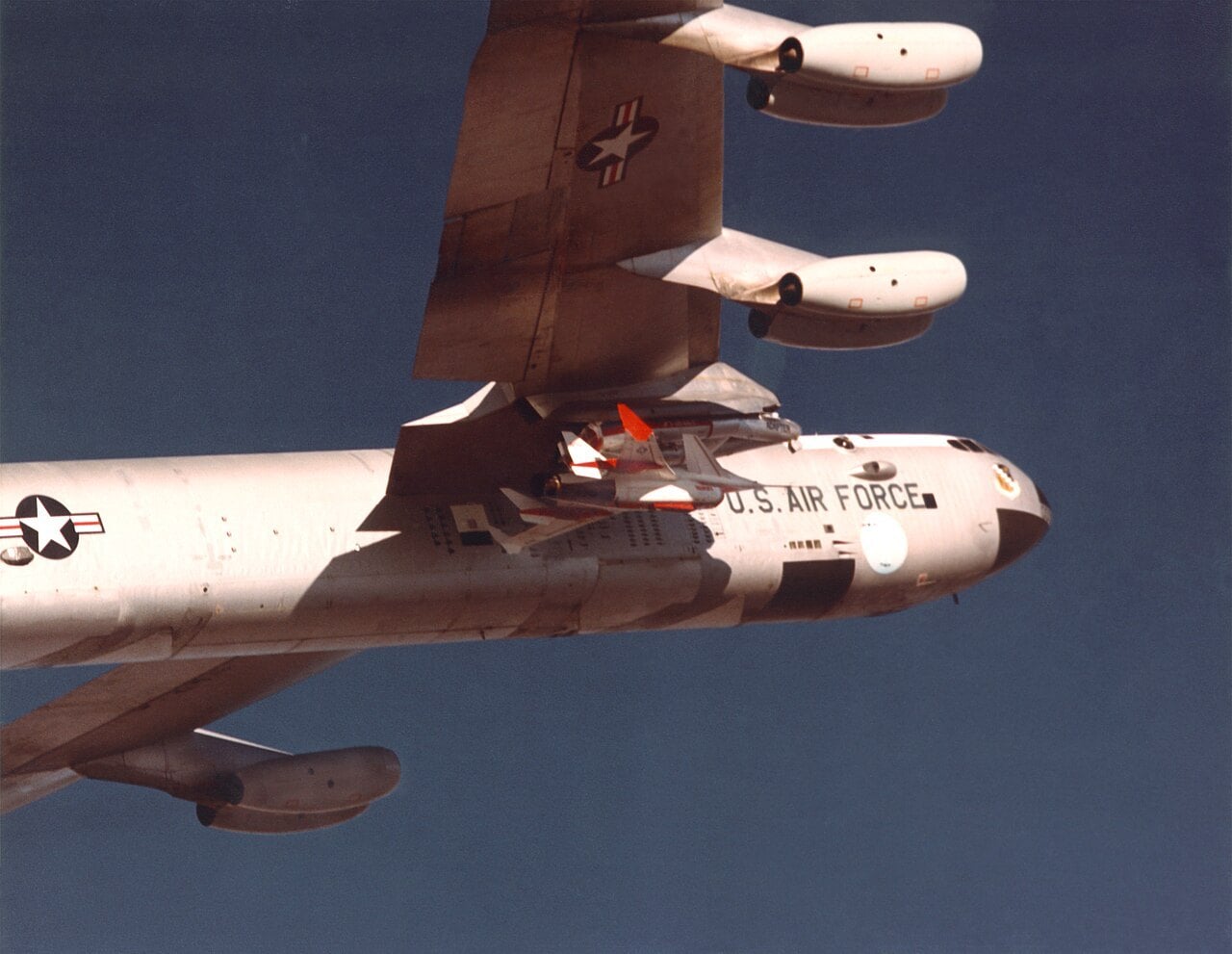
Every HiMAT mission began under the wing of NASA’s B-52 mothership, which released it at around 45,000 feet. From there, a NASA research pilot flew it from a ground cockpit, with a television camera in the HiMAT’s nose feeding him the view ahead and an onboard digital computer turning his stick inputs into control-surface movements.
A TF-104G Starfighter flew chase on every mission, and it was more than a camera ship. It carried a set of backup controls, so that if the ground station lost control, the pilot in the chase plane could take over. At the end of each flight, HiMAT landed on skids on Rogers Dry Lake.
The backup was needed. On HiMAT’s fifth flight, on 8 July 1980, a decoder failure forced the hand-off to the backup pilot, according to the Edwards Air Force Base history office. A glitch in the latest software update then stopped the landing skids from deploying, and the aircraft made an emergency gear-up landing on the lakebed. The damage was minor, and the aircraft was repaired and returned to flight.
One of the programme’s quieter successes was a flight test manoeuvre autopilot based on a design by Teledyne Ryan Aeronautical. It flew prescribed manoeuvres precisely and repeatably, so engineers could gather large amounts of clean data in a short flight. NASA later described it as a technique with potential benefit to any flight programme.
Supersonic, then retired
HiMAT went supersonic in May 1982. On 11 May, pilot Steve Ishmael took it to Mach 1.2, and three days later it reached Mach 1.45, according to the Edwards history office. The two aircraft, RPRV 870 and RPRV 871, flew 26 times in total during the three-and-a-half-year programme. Einar Enevoldson flew the last mission on 12 January 1983.
Both goals had been met: the efficiency target and the sustained 8 g turn at Mach 0.9 and 25,000 feet. More importantly, the experiments had shown how digital controls, canards, composites, aeroelastic tailoring and winglets behaved together on one airframe.
Archive footage from the NASA Video Collection of the HiMAT research vehicle at Dryden.
Where HiMAT ended up
Much of what HiMAT tested reappeared quickly. The Grumman X-29, the forward-swept-wing research jet that first flew in 1984, used a forward canard, a rear-mounted wing and lightweight composite construction, all areas HiMAT had explored. NASA credits HiMAT with far-reaching advances in digital flight control and notes that composites and winglets are now used extensively on commercial and military aircraft.
Both airframes survive. RPRV 870 is at the Smithsonian’s National Air and Space Museum in Washington, D.C. RPRV 871 returned to NASA’s Armstrong Flight Research Center at Edwards, the former Dryden, in 2009, where it was restored to its original colours and placed on display.
Today, uncrewed combat aircraft and loyal-wingman drones are some of the most talked-about projects in military aviation. HiMAT was there more than four decades earlier, turning harder than an F-16 while its pilot sat in a chair at Edwards.
Sources: NASA Dryden Flight Research Center (HiMAT fact sheet FS-2002-06-025-DFRC), Edwards Air Force Base history office (AFMC News HiMAT history article), NASA Armstrong Flight Research Center image archive
0 Comments