
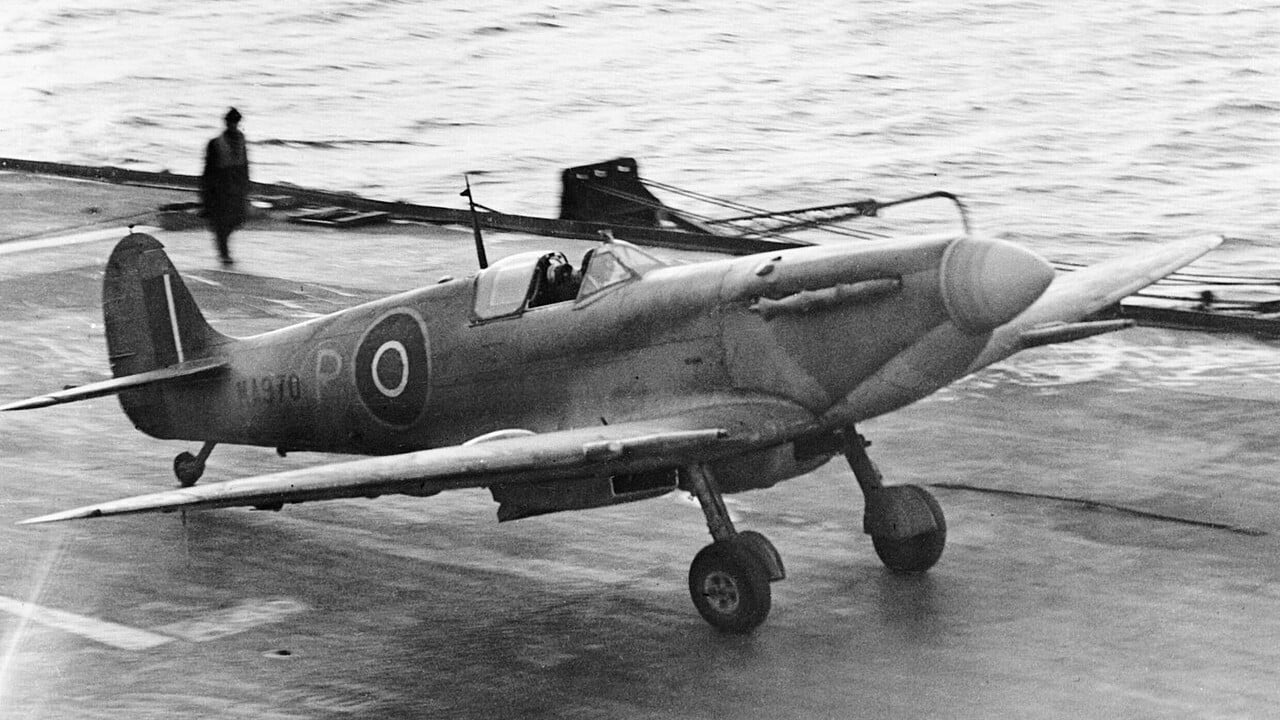
On the morning of 9 September 1943 the sea in the Gulf of Salerno was almost glass. For the pilots of 106 Seafires circling above them, it was the start of a nightmare.
Their escort carriers could barely make 17 knots, and with no natural wind there was not enough air flowing over the deck to slow a landing fighter down. Within three days, most of the Royal Navy’s fighter cover was out of action, put there not by the Luftwaffe but by its own flight decks.
That was the paradox of the Supermarine Seafire. It was a thoroughbred in the air, a genuine Spitfire with a hook. On a pitching carrier it could be a liability. This is the story of how the Royal Navy got its Spitfire, what it cost, and why the type still flew in combat over Korea in 1950.
Kurzinfo
- Flugzeug: Supermarine Seafire, naval version of the Spitfire
- Name: Contraction of “Sea Spitfire”
- Operator: Royal Navy Fleet Air Arm
- Erste Auslieferungen: June 1942, to 807 Squadron (Seafire Ib)
- First combat: Operation Torch, North Africa, November 1942
- Most numerous: Seafire III, the first with folding wings, about 1,220 built
- Salerno, 1943: 106 Seafires deployed; only 39 serviceable by day three
- Last combat: Seafire 47s of 800 Squadron, HMS Triumph, Korea, July to September 1950
- Ersetzt durch: Hawker Sea Fury and early naval jets
A Spitfire for the Navy
The name says it all: Seafire is a contraction of “Sea Spitfire.” The Fleet Air Arm wanted one long before it got one. The Admiralty first showed interest in a carrier-borne Spitfire in 1938, and in early 1940 a contract for 50 folding-wing Spitfires was agreed. Winston Churchill, then First Lord of the Admiralty, cancelled it in March 1940. Every Spitfire was needed for the coming battle over Britain.
So the Navy made do with what it had. The two-seat Fairey Fulmar soldiered on, and American Grumman F4F Wildcats, known in British service as Martlets, filled the gap. Only in late 1941 did the Air Ministry relent and release Spitfire Vbs for conversion.
The result, the Seafire Ib, was little more than a hooked Spitfire: an A-frame arrester hook, strengthened lower longerons, naval radio and instruments recalibrated to knots. Some 166 were converted, and 807 Squadron took the first deliveries in June 1942. The Seafire IIc that followed was the first built as a Seafire from the start, but neither version had folding wings, which kept them off carriers with small lifts.
Period film of Seafire deck operations in the Royal Navy, around 1943.
Built for runways, sent to sea
The problem was baked into the design. The Spitfire was a short-range, land-based interceptor, and its narrow-track undercarriage was meant for grass and concrete, not a moving steel deck. The many naval modifications moved the centre of gravity aft, and the aircraft’s long nose and gentle float on touchdown made it hard to put down accurately and catch a wire.
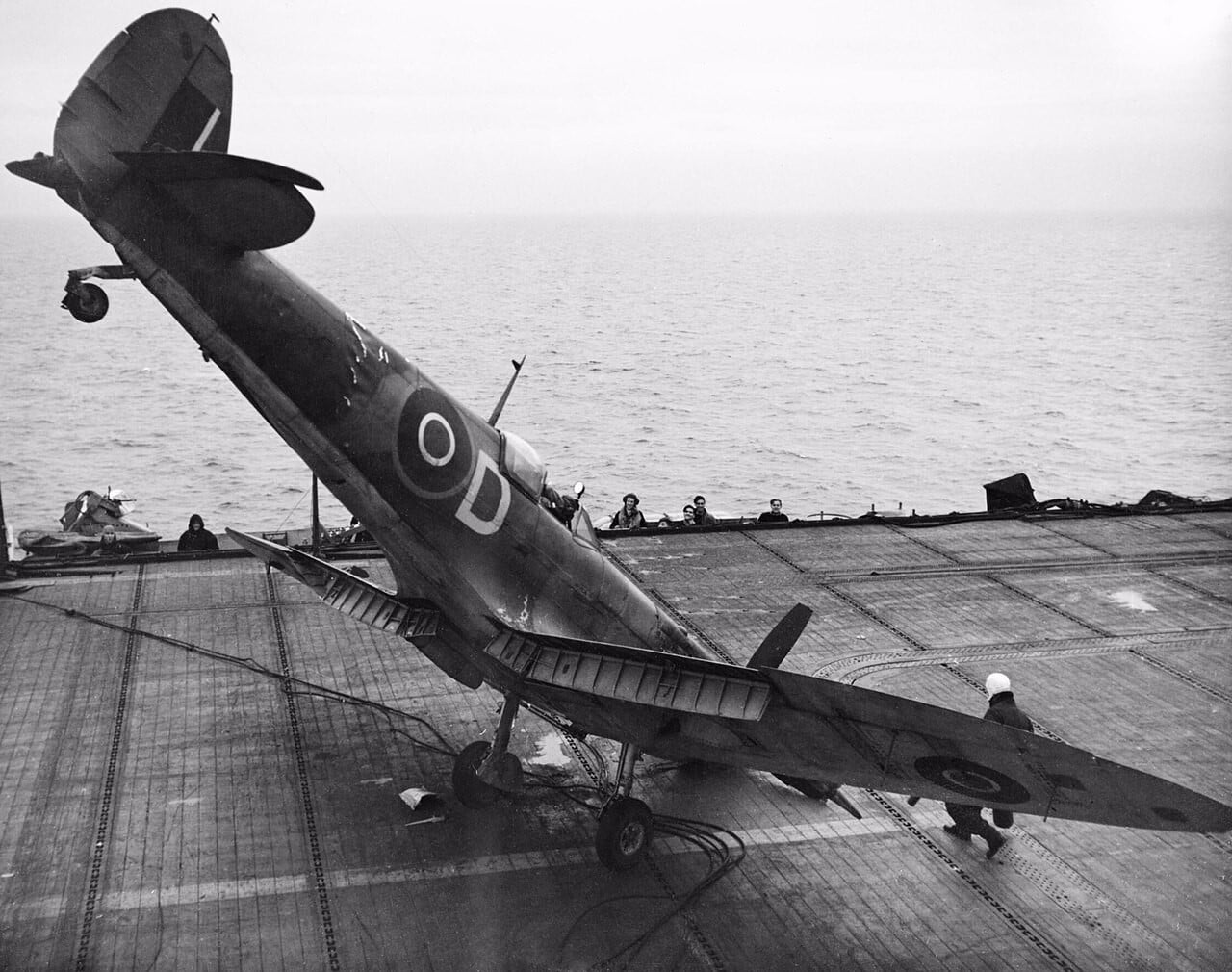
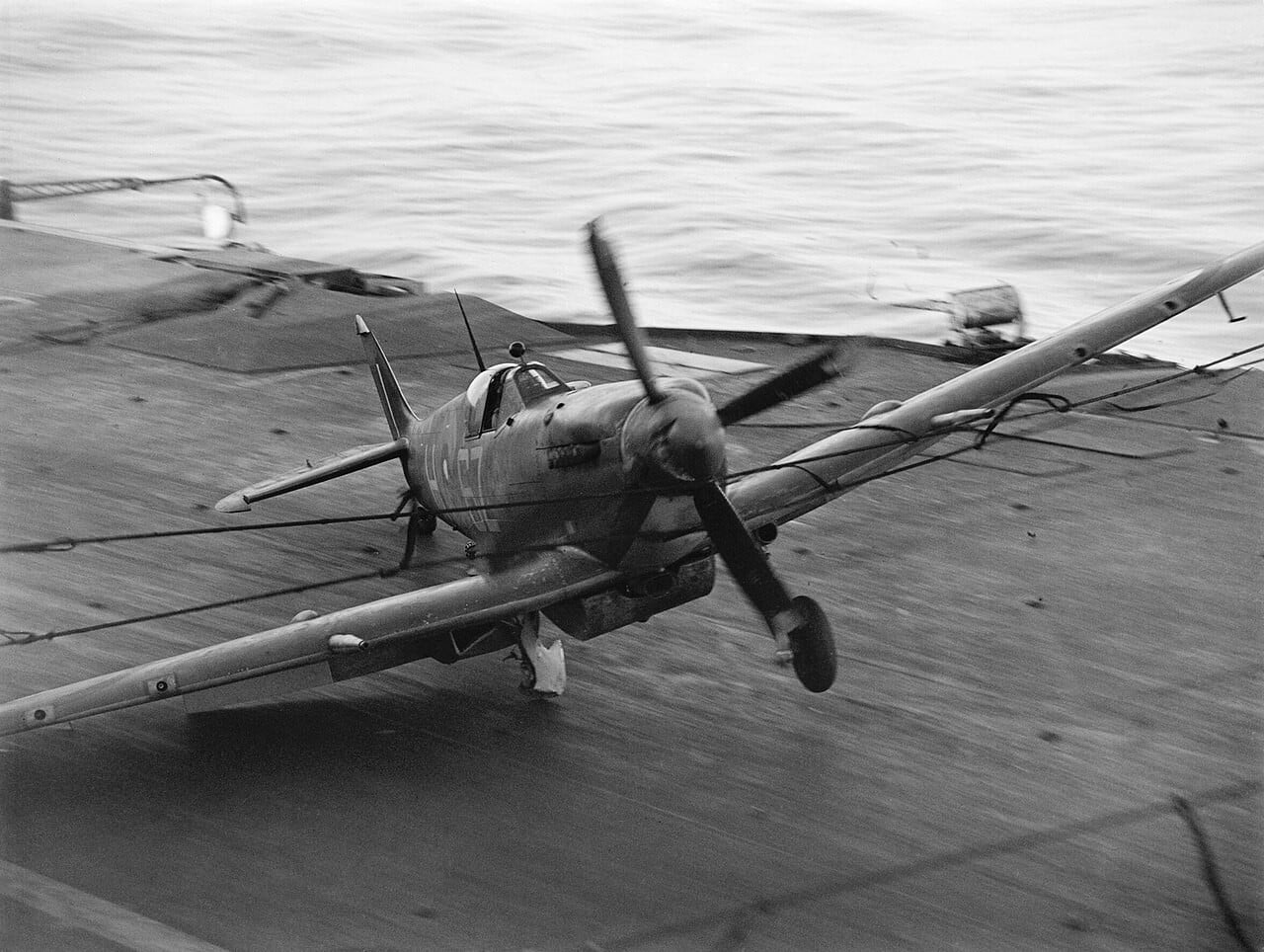
Heavy landings wrinkled rear fuselages, collapsed oleo legs and tore off hooks. On the plus side, the Seafire was a genuinely high-performance fighter, well able to hold its own against German and Italian opponents.
Its first test came in November 1942, during Operation Torch, the Allied landings in North Africa. Seafires of 801 and 807 Squadrons flew from HMS Furious and, unusually, wore American star markings for the operation. In July 1943 they covered the invasion of Sicily. Then came Salerno.
Salerno: the flat calm
Operation Avalanche, the landings at Salerno, was the largest Seafire deployment yet. The beaches were at the edge of fighter range from Sicily, so the Navy’s carriers had to provide the umbrella. Most of the Seafires flew from the aircraft maintenance ship HMS Unicorn and the escort carriers Attacker, Battler, Hunter Und Stalker, grouped as Force V under Rear-Admiral Philip Vian.
The plan was for the Seafires to cover the beachhead for a single day, until land-based fighters could fly in. Instead, the army took four days to capture the Montecorvino airfield, and the little carriers had to keep going in near-windless conditions. On the first day the Seafires flew 265 sorties, holding an umbrella over the landing craft and chasing off German fighter-bombers.
The landings were the cost. Seafires missed the wires and slammed into the crash barriers, tore off their hooks, burst their undercarriages or tipped onto their noses. By the third day, only 39 of the 106 Seafires were ready for action. According to the operational analysis summarised by Armoured Carriers and History of War, 42 Seafires were written off, 32 of them in landing accidents, and none to enemy action. Unicorn alone, with turbulent air over her deck, accounted for 21 of the landing accidents.
Fleet Air Arm pilot Hugh Popham, whose squadron was sent across to reinforce Unicorn, later described what he found.
Yet the Seafires did their job. Despite the losses, they kept fighters over the beaches, forced dozens of German fighter-bombers to jettison their bombs, and stayed on station days longer than planned. Crews even improvised a fix for propeller tips striking the deck on arrested landings, trimming the blades by two inches, according to Armoured Carriers.
Armoured Archivist’s documentary on the Seafires at Salerno and why the operation damaged the type’s reputation.
Folding wings and kamikazes
Help was already arriving. The Seafire III, which entered service in 1943, was the first true carrier adaptation of the design, with manually folding wings that let far more aircraft fit on deck and in the hangar. With some 1,220 built, it became the most numerous Seafire of all.
In 1944 Seafires flew cover for the Fleet Air Arm strikes on the battleship Tirpitz in Norway, and supported the landings in southern France. Then they went east with the British Pacific Fleet. Short range kept them from escorting strikes, so they took on the vital job of combat air patrol over the fleet, while the longer-legged Hellcats Und Corsairs went with the bombers. To stretch their endurance, crews fitted drop tanks originally made for Curtiss P-40 Warhawks.
Over Okinawa and later off the Japanese home islands, Seafires from HMS Indefatigable intercepted kamikaze attacks aimed at the British carriers. Their last combat of the war came on 15 August 1945, when a dozen Zeros clashed with a mixed force of Avengers and Seafires.
The deck problems never fully went away, especially when Seafires had to land on carriers set up for bigger American fighters. One Fleet Air Arm maintainer, on a carrier operating Corsairs, remembered Seafire visitors bluntly.
Griffon power and a last war in Korea
After the war the Navy replaced its Merlin-engined Seafires with Griffon-powered versions, and the extra power brought new trouble. The Griffon turned the opposite way to the Merlin, and on take-off its torque swung the aircraft hard to starboard, sometimes towards the carrier’s island. The Seafire XVII tamed the deck behaviour with a longer-stroke undercarriage, and the final Mk 46 and Mk 47 used contra-rotating propellers that cancelled out the swing.
The definitive Seafire 47 added hydraulically folding wings. It was the last of the line, and the only one to fight again. In 1949, Seafire 47s of 800 Squadron flew rocket strikes against communist guerrillas in Malaya from bases ashore, while their carrier, HMS Triumph, was in the Far East.
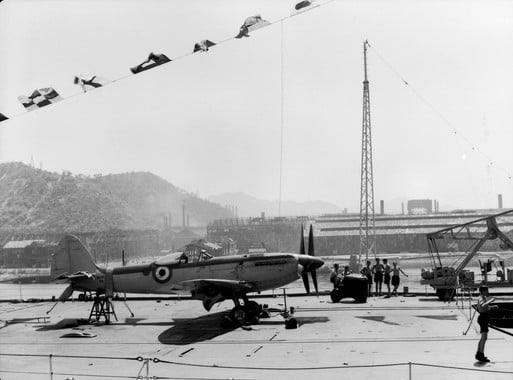
When North Korea invaded the South in June 1950, Triumph was in Far Eastern waters and was placed at the disposal of the UN forces. On 3 July her Seafires and Fireflies attacked Haeju airfield. Because the Americans thought the Seafires looked like the Yak-9s flown by North Korea, they were painted with black and white recognition stripes. Even so, on 26 July a B-29 gunner shot one down after the fighters had identified the bombers as friendly. The pilot escaped.
Spare Seafire 47s ran out quickly, and the hard deck work kept wrinkling fuselages. By 20 September 1950 Triumph had only four serviceable Seafires left. She was relieved by HMS Theseus, carrying Hawker Sea Furies, and the Seafire’s last combat deployment was over.
Das Urteil
The Seafire was a compromise, and everyone who flew it knew it. It was too fragile for heavy deck landings, too short-legged for long carrier operations, and it cost the Navy more aircraft to accidents than to the enemy. But it was also a genuinely high-performance fighter, and it arrived when the Navy had little else.
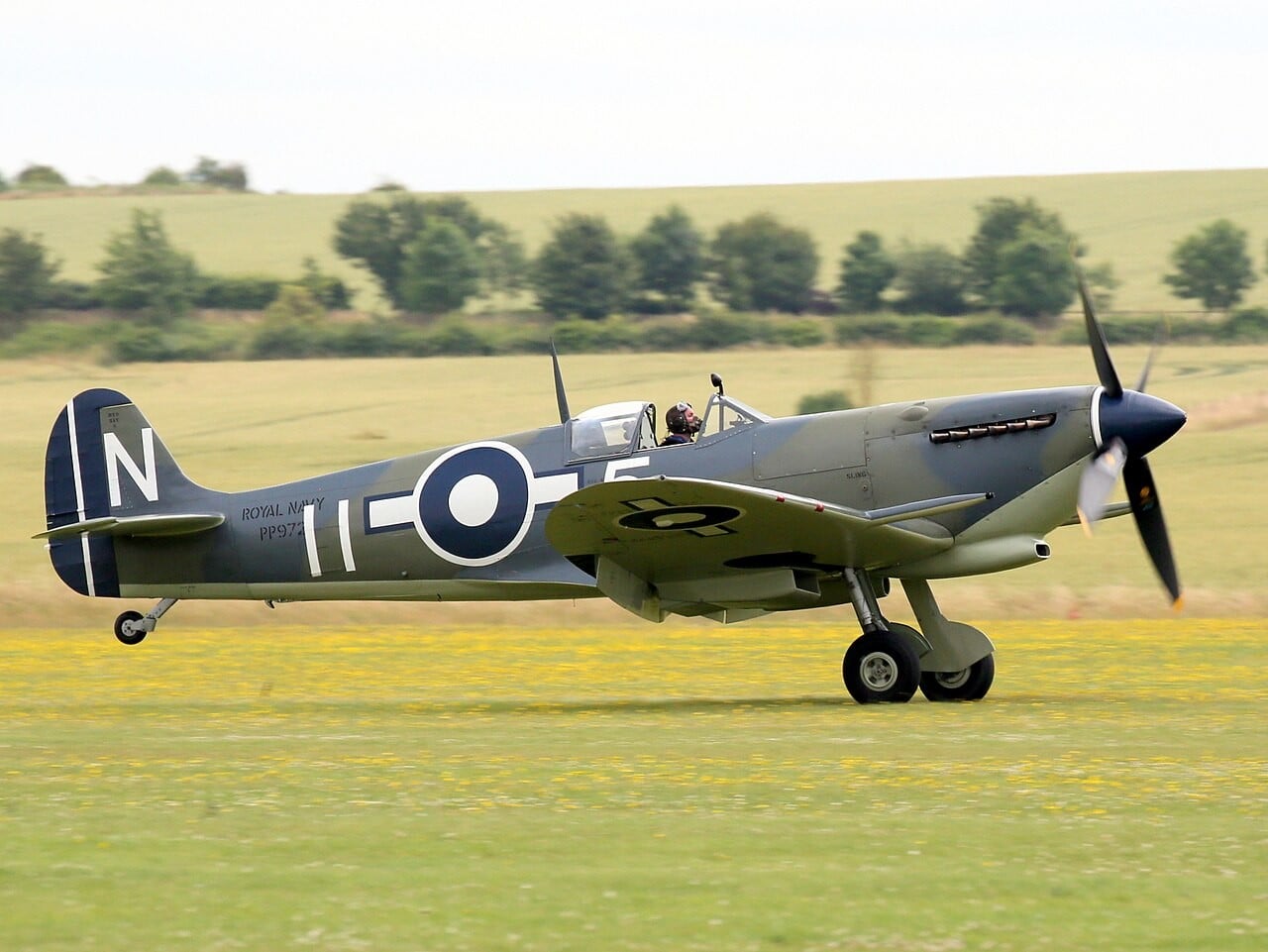
Seafire F Mk XVII SX336 flying at Old Warden in July 2015.
A few survive. Seafire LF IIIc PP972, which served with 809 Squadron, flies again in the UK as G-BUAR, and Navy Wings operates Seafire XVII SX336. Watch one land on a grass runway and it looks easy. On a carrier in a flat calm off Salerno, it was anything but.
Sources: Armoured Carriers (Seafire operational history), History of War (Supermarine Seafire), Imperial War Museums photo archive, Philip Vian Action This Day, Hugh Popham Sea Flight
Header photo: Royal Navy official photographer / Wikimedia Commons, public domain

0 Comments