
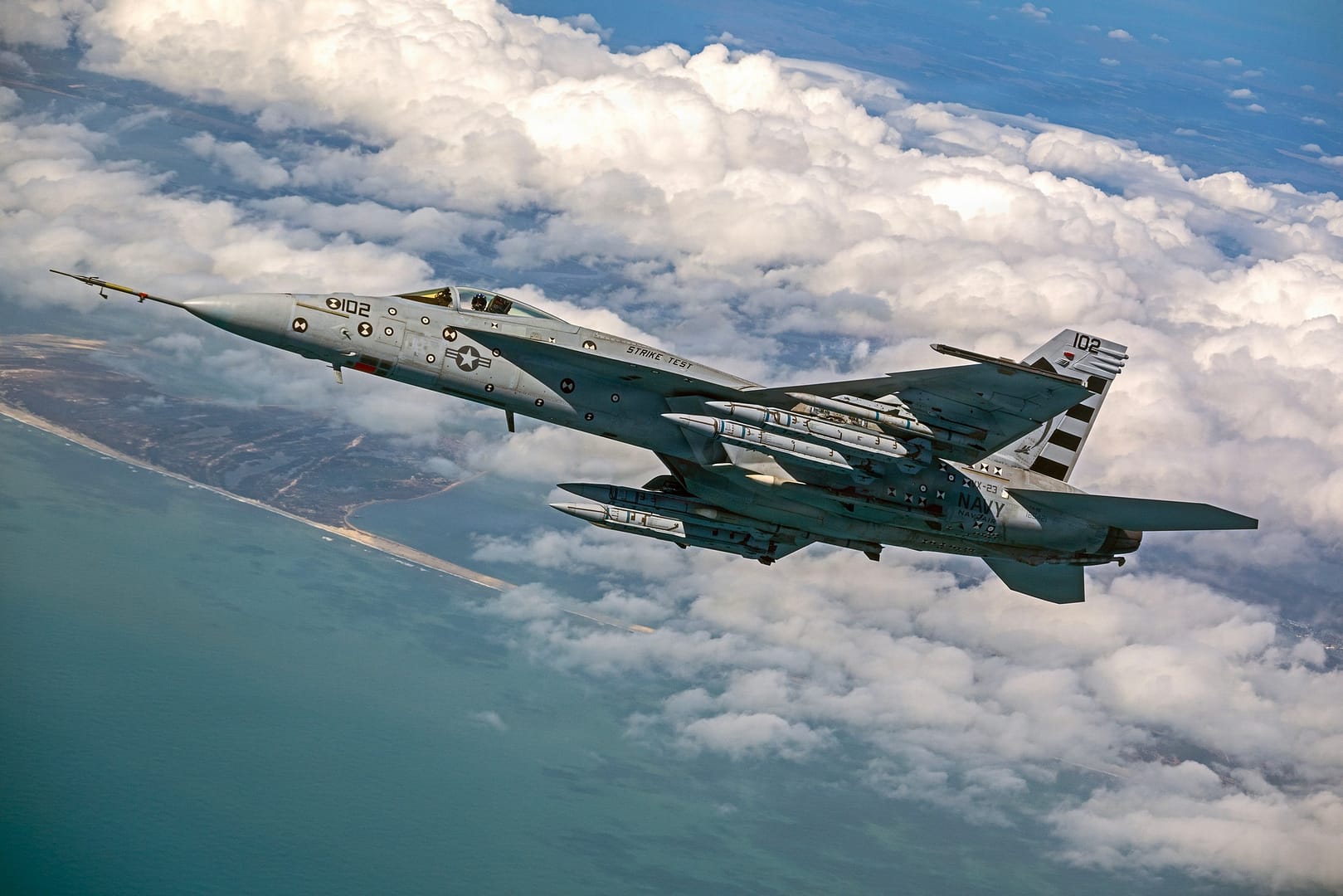
For years the U.S. Navy has had a problem it could not shoot its way out of. Its best long-range air-to-air missile, the AIM-174B Gunslinger, is a magnificent weapon that only the F/A-18E/F Super Hornet can carry, and only hanging off a wing where every radar in the sky can see it. Stealth or reach. Pick one.
On Aug. 22, 2026, at the Tailhook Symposium in Reno, Nevada, the Navy stopped making anyone pick. It revealed the AIM-424 Long Range Air-to-Air Missile, and gave it a name that tells you exactly how subtle the programme is feeling: Malice.
It flies more than 250 nautical miles. And it fits inside the weapons bay of an F-35.
Datos rápidos
| Designation | AIM-424 LRAAM, named “Malice” |
| Manufacturer | Raytheon (an RTX business), Advanced Technology division |
| Revealed | 22 August 2026, Tailhook Symposium, Reno, Nevada |
| Length | 13.5 ft (4.11 m) |
| Diameter | 13.5 in (0.34 m) |
| Envergadura | 26.2 in (0.67 m) |
| Peso | approx. 1,500 lb (680 kg) |
| Rango | in excess of 250 nautical miles (463 km) |
| Warhead | Blast-fragmentation |
| Platforms | F/A-18E/F Super Hornet, F-35C Lightning II, future F/A-XX |
| Estado | In flight testing |
The Number That Matters Is 26.2 Inches
Everyone will fixate on the range, and 250 nautical miles is worth fixating on. But the specification that actually changes the Navy’s options is the wingspan.
The AIM-174B Gunslinger spans 42.7 inches across its dorsal fins. That is simply too wide for an internal bay, which is why the Gunslinger has only ever been cleared for the Super Hornet, carried externally. A stealth fighter hauling one is no longer a stealth fighter.
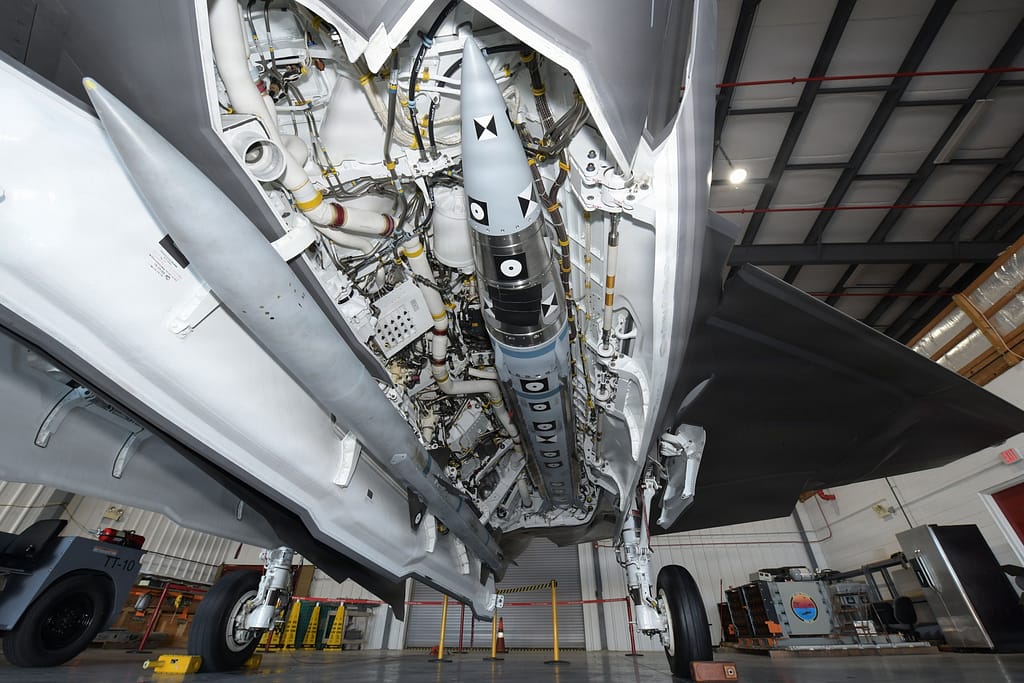
Malice spans 26.2 inches. At 13.5 feet long it is a full three feet shorter than the Gunslinger, and the Navy has already released imagery of one sitting inside the internal weapons bay of an F-35C alongside an AMRAAM on the bay door. That is the whole story in one photograph: a very long-range missile, carried by an aircraft that nobody can see.
Raytheon Is Not Being Modest About It
The Navy’s own language in its updated weapons portfolio is equally direct: the missile “sustains the Department’s first look, first shot, first kill advantage,” and is built for “4th, 5th, and 6th generation platforms.” That last phrase is doing a lot of work. It means the Super Hornet flying today, the F-35C flying today, and the F/A-XX that has not been awarded yet.
What It Is Actually For
A missile this size is not primarily a dogfighting weapon. Its natural prey is the aircraft that make an adversary’s air campaign possible: airborne early warning and control platforms, electronic warfare jammers, tankers, and the ISR aircraft that find the carrier in the first place. Kill those on night one and everything behind them gets much harder.
Naval News reports, citing a U.S. official familiar with the programme, that specialised fins and strakes let Malice keep a surprising amount of manoeuvrability for something 13.5 feet long, which may let it engage fighter-sized targets too. Aviation Week describes a two-stage weapon, and the airframe appears to carry an inlet consistent with a solid-fuel dual-mode ramjet, though the Navy has not confirmed the propulsion arrangement.
The context is a missile race the U.S. spent the last decade losing on paper. Russia’s R-37M has been fired in anger over Ukraine. China’s PL-15 became famous after the May 2025 India-Pakistan skirmish, and the PL-16 and PL-17 remain largely unknown. What none of them has yet demonstrated publicly is the ability to fly that far from inside a stealth aircraft.
The Part Nobody Will Confirm
The Navy closed its statement with a sentence that is its own kind of answer: “Further details regarding specific capabilities and deployment timelines remain classified to protect operational security.”
So we do not know when it enters service, whether it replaces the Gunslinger or flies alongside it, or whether the Air Force adopts it as it has adopted so many Navy missiles before, from the Sidewinder to the HARM. We do know one captive-carry test flight happened in April 2026 with four training rounds under a VX-23 Super Hornet, and that the F-35C fit check happened this month.
Admiral Keith Hash, then commanding the Naval Air Warfare Center Weapons Division, said something at WEST 2025 that reads rather differently now.
There were. This is one of them. And on the evidence of the last two years, it is probably not the last.
Sources: U.S. Navy Fact Files; Naval News; The Aviationist; Aviation Week; U.S. Navy Research, Development and Acquisition weapons portfolio; DVIDS imagery.



0 Comentarios