
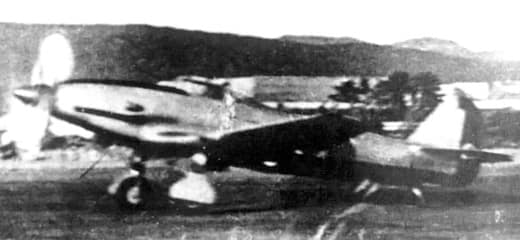
Put two engines in a fighter and you normally end up with something like a Bf 110: two nacelles, one on each wing, and an aeroplane that is bigger than the thing it is trying to shoot down.
Kawasaki tried a different answer. They put one engine in front of the pilot and the second directly behind him, ran a driveshaft from the rear engine under his seat and up through the Vee of the front one, and hung two contra-rotating propellers off a common gearbox in the nose. From outside it looked like an ordinary single-engine fighter. Inside, the pilot sat between two V12s with a spinning shaft beneath him.
Then, because that was not ambitious enough, they deleted the radiator and cooled the whole thing through the skin of the wings.
Datos rápidos
Tipo: Kawasaki Ki-64, experimental heavy fighter, Imperial Japanese Army
Allied codename: Rob, assigned after the war
Diseñador: Takeo Doi, who also designed the Ki-61 Hien
Construido: One. Three more were planned and never started
Primer vuelo: December 1943, from Gifu. No source records the exact day
Central eléctrica: One Kawasaki Ha-201: two Ha-40 inverted-V12s in tandem, 2,350 hp for take-off
Cooling: Surface evaporative condensers built into the wing and flap skin
Velocidad máxima: 690 km/h (429 mph) at 5,000 m, measured, on an unarmed airframe
Armamento: None ever fitted
Two engines, one nose
The powerplant carried a single designation, the Ha-201, even though it was two engines. Each was a Kawasaki Ha-40, itself a licence-built Daimler-Benz DB 601, the same inverted V12 that powered the Bf 109E. Japan built it under licence and used it in the Ki-61 Hien, the fighter Allied pilots codenamed Tony and frequently mistook for something Italian.
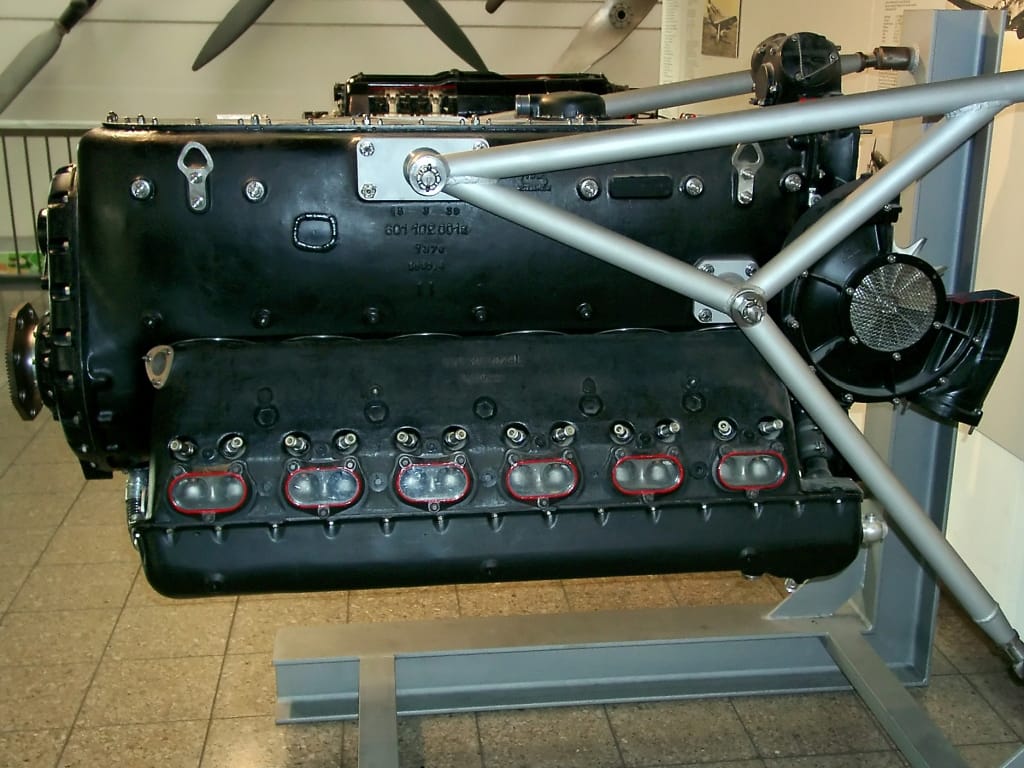
One detail is routinely got wrong. The gearbox did not combine the two engines into a single output. Each engine drove its own propeller, independently and unsynchronised. Six blades on one axis, three turning one way and three the other, driven by two entirely separate powerplants.
The layout is properly called contra-rotating, not counter-rotating. Contra means two propellers on the same shaft axis. Counter means separate propellers turning in opposite directions, which is what a P-38 has.
Cooling an aeroplane through its own skin
A radiator is drag. It sits in the airflow, slows you down, and every fighter designer of the era resented it. The Ki-64's answer was to get rid of most of it.
Coolant was pumped through a centrifugal separator where roughly two per cent of it flashed to steam. That steam was fed into condenser panels built into the skin of the wings and flaps, where it gave up its heat to the outside air, turned back into liquid, and was pumped round again. Around twenty panels in total, four upper and four lower per side, plus flap sections.
The two engines had entirely separate circuits. The front engine cooled through the left wing, the rear engine through the right.
It was not radiator-free. There was still a small retractable radiator for ground running and an oil-cooler scoop under the right wing. And the concept had been tested: a Ki-61 flew with evaporative panels from October 1942, some thirty-five flights, and the drag saving was worth something like 40 to 50 km/h.
Four good flights and one bad one
The single prototype was ordered on 23 January 1941 and finished at Gifu around the turn of 1943. It flew in December that year, unarmed, and reached 690 km/h at 5,000 metres. For comparison, that is genuinely fast for late 1943, and it was achieved with a cooling system nobody else had made work.
Then the problem showed itself, and it was the opposite of what you would expect. The system coped perfectly well in level flight. What it could not handle was ground running, take-off and the climb, exactly the phases where an engine makes the most heat and the airflow over the wing does the least work.
On the fifth flight the rear engine caught fire. The pilot got it down at Kakamigahara and broke a main gear leg doing it. The engines went to Akashi for repair and the airframe stayed at Gifu, and the two never came back together.
The programme was cancelled in mid-1944. A developed version, the Ki-64-KAI with coupled Ha-140s and a projected 800 km/h, was never built.
What was left
The airframe survived the war. American personnel found it stripped at Gifu in 1945, and what interested them was not the aeroplane but the plumbing. The cooling-system components were crated and shipped to Wright Field in Ohio for study. The rest was scrapped.
Nothing of the Ki-64 exists today. There are perhaps five wartime photographs, one of them in flight and admittedly poor, and a US technical intelligence report written in July 1946. That is the whole record of the only fighter ever built with two engines in tandem and no radiator worth the name.
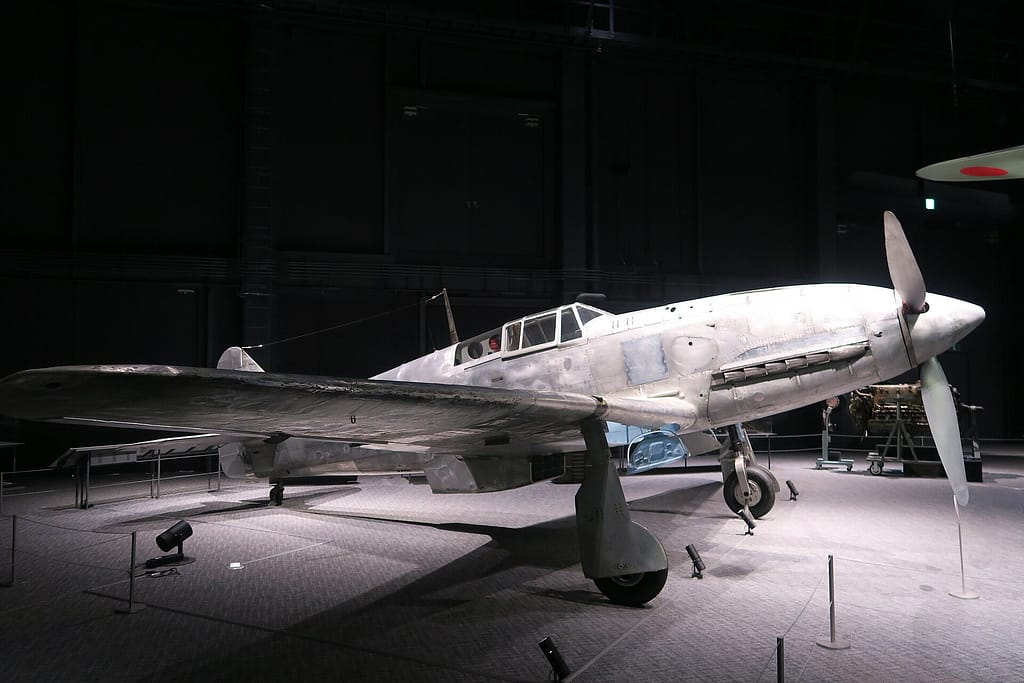
Since no example survives, the closest most people will get is a model of it.
It is easy to file the Ki-64 under wartime desperation, but that is not quite fair. The evaporative cooling idea was sound enough that the Americans thought it worth shipping home, and the tandem-engine layout reappeared in other places. What killed it was the least glamorous part of flying: getting off the ground on a hot day.
Sources: Kawasaki Ki-64 entries, English and Japanese Wikipedia; William Pearce, Old Machine Press, 20 October 2016; Dr J. Rickard, historyofwar.org, 15 October 2010; Rene Francillon, Japanese Aircraft of the Pacific War; Air Technical Intelligence Review Report No. F-IR-100-RE, Petaja and Gilmore, 31 July 1946.
Publicaciones relacionadas
0 Comentarios